How we make this list: we compare pricing pages, product documentation and public user reviews. Rankite is independent; if a vendor ever pays for a featured spot, that listing is clearly labeled Partner.
Key takeaways
- Financial planning is a three-horse race: eMoney leads on market share and depth, RightCapital on ease of use and satisfaction, and MoneyGuidePro on goals-based planning.
- Most advisor software is priced by quote or per-advisor subscription, so budget conversations happen with sales, not on pricing pages.
- Specialists still matter: Nitrogen owns risk tolerance, Holistiplan owns tax planning, and Asset-Map owns visual client conversations.
- Orion and Advyzon are the all-in-one platforms for firms that want planning, portfolio management, CRM, and trading in one stack.
- The 2026 T3/Inside Information survey remains the best independent benchmark for advisor satisfaction across 70-plus categories.
Quick comparison
| Tool | Best for | Starting price | Free plan |
|---|
 eMoney Advisor eMoney Advisor | deep cash-flow planning at scale | See website | No |
 RightCapital RightCapital | modern planning with top advisor satisfaction | See website | Free trial (14 days) |
 MoneyGuidePro MoneyGuidePro | goals-based planning and client engagement | See website | No |
 Nitrogen Nitrogen | risk tolerance and proposal generation | See website | No |
 Asset-Map Asset-Map | visual one-page financial conversations | See website | No |
 Orion Orion | all-in-one wealthtech platform | See website | No |
 Holistiplan Holistiplan | tax planning from uploaded returns | See website | No |
 Advyzon Advyzon | unified platform with top satisfaction scores | See website | No |
Is your product missing or out of date?
We review this list regularly. Vendors can request a listing, send updated pricing or ask about featured placement.
The best software for financial advisors
Financial advisors do not buy one piece of software. They assemble a stack: planning, CRM, portfolio accounting, risk analysis, tax planning, and a client portal, ideally integrated. The eight tools below cover every layer of that stack, from the big three planning platforms to the specialists that do one job better than anyone.
Starting priceSee website
Free planNo
eMoney is the planning platform most advisors measure everything else against. With the largest market share in financial planning software, 35.62% in the 2026 T3/Inside Information survey, it is the default choice for firms that need serious analytical depth: detailed cash-flow projections, Monte Carlo analysis, estate modeling, and scenario testing that holds up for complex households. The client portal and aggregation keep the plan alive between meetings instead of gathering dust.
The Decision Center deserves its mention because it changes how meetings feel. Instead of presenting a static report, you adjust variables live with the client watching, which is exactly the kind of interactivity that wins and retains business. The honest catch is the one advisors repeat most: eMoney is powerful but heavy. The Kitces research has noted that its depth becomes cumbersome, and new users commonly need three to six months to get fully up to speed. Pricing is quote-based and sits at the premium end.
What we like- Market leader with the deepest cash-flow modeling
- Strong account aggregation and client portal
- Interactive Decision Center for client meetings
Watch out for- Learning curve is real, expect months to master
- Enterprise pricing with no public numbers
Starting priceSee website
Free planFree trial (14 days)
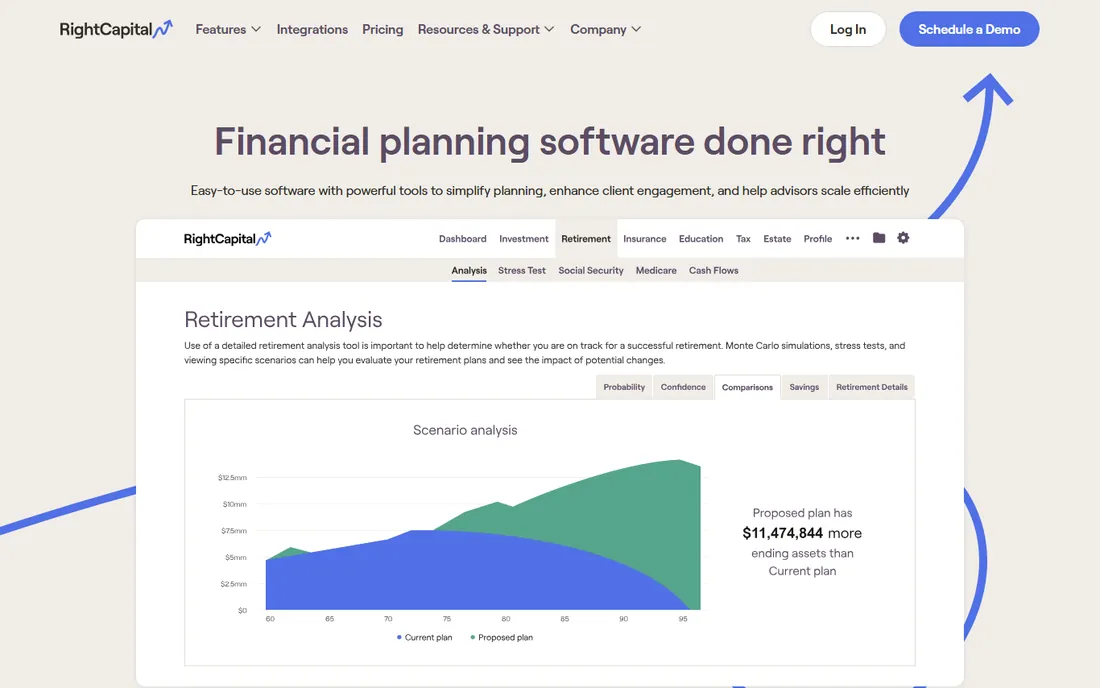
RightCapital is the insurgent that became an incumbent. It now holds over 21% market share and the highest satisfaction rating of the big three planning platforms, 8.40 out of 10 in the 2026 T3 survey, a lead it has held for five straight years. Advisors switching from eMoney consistently say the same thing: they were productive within a week instead of months.
The product hits a sweet spot between sophistication and usability. Interactive retirement planning, smart tax planning with Roth conversion analysis, insurance needs review, and the Snapshot feature for one-page client summaries all come in an interface that does not require a training course. The 14-day free trial is genuinely useful for evaluation. The tradeoff is ceiling height. For the most complex estate and cash-flow scenarios, eMoney still goes deeper, and very large enterprises sometimes find RightCapital's admin tooling less mature.
What we like- Highest advisor satisfaction of the big three, five years running
- Fast onboarding compared to eMoney
- Strong tax planning and Roth conversion modeling
Watch out for- Less modeling depth than eMoney for ultra-complex cases
- Pricing tiers still require a sales conversation for exact numbers
Starting priceSee website
Free planNo
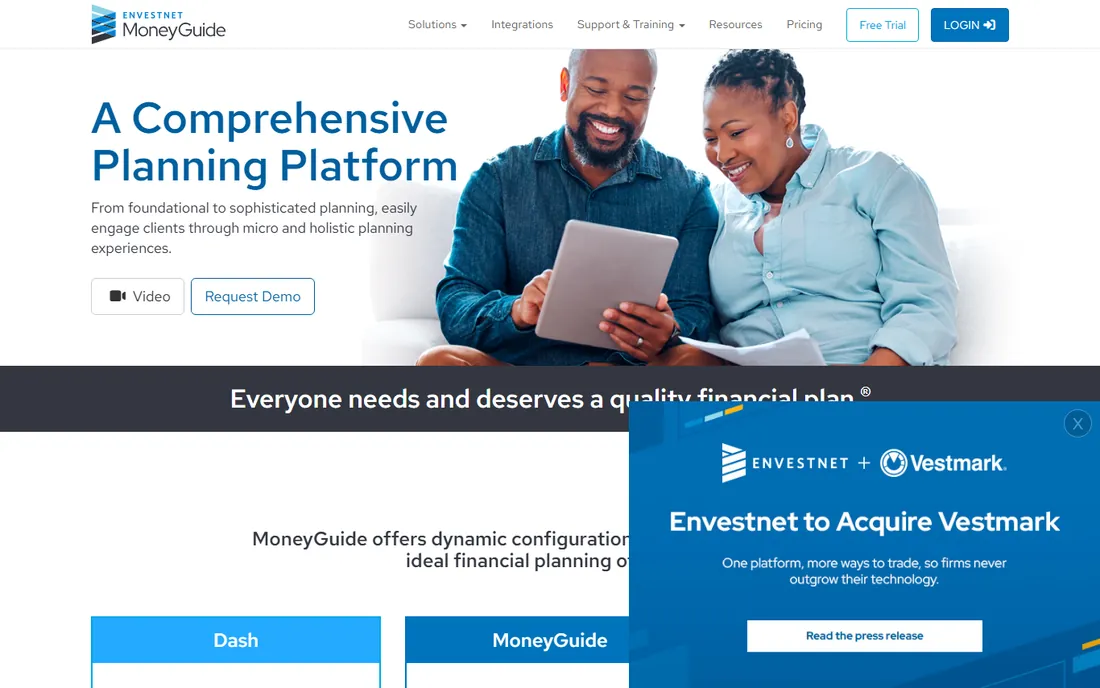
MoneyGuidePro, now part of Envestnet, built its reputation on a simple insight: clients think in goals, not in cash-flow tables. The platform organizes planning around needs, wants, and wishes, and the Play Zone lets clients drag sliders for retirement age or savings and watch the plan update in real time. In a first meeting, that interactivity is gold.
With over 100,000 advisor users, it remains one of the three dominant planning platforms, and the Wealth Studios add-on extends it into advanced estate and high-net-worth planning. The honest catch is momentum. Satisfaction ratings have drifted down to 7.62 in the 2026 T3 survey, the lowest of the big three, and advisors have waited a long time for the promised interface overhaul. It is still a strong goals-based tool, but buyers should evaluate the current product carefully rather than buying on reputation.
What we like- Pioneering goals-based approach clients intuitively understand
- Play Zone makes what-if scenarios interactive
- Strong adoption with 100,000-plus advisor users
Watch out for- Satisfaction scores have slipped behind the other two
- Interface modernization has been a long time coming
Starting priceSee website
Free planNo
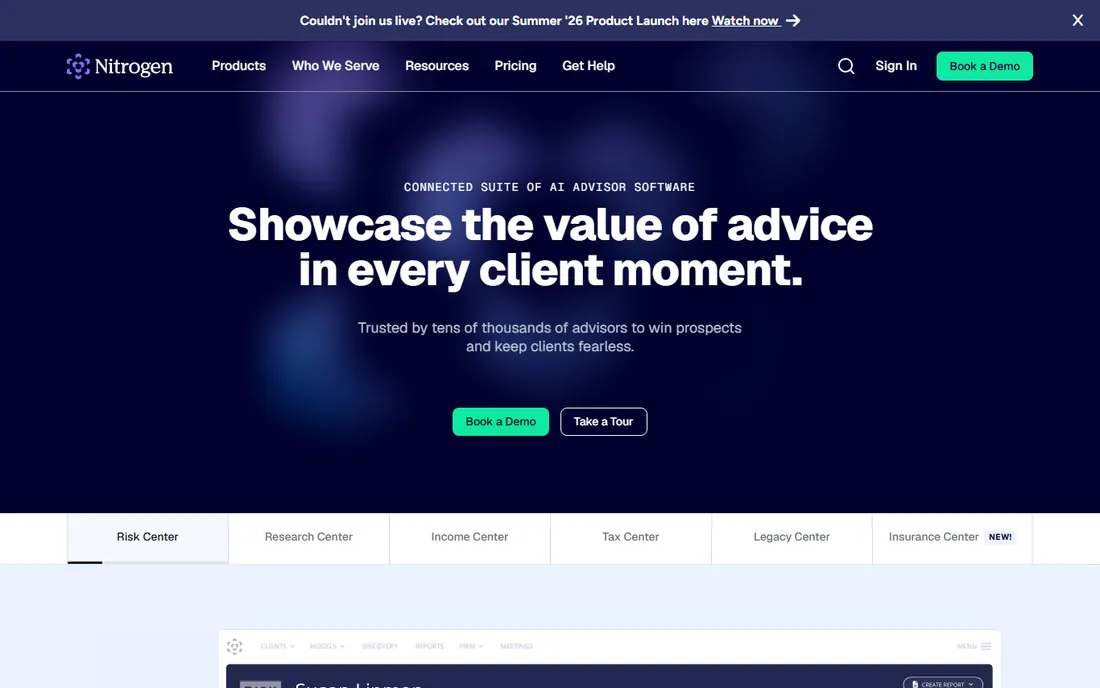
Nitrogen, formerly Riskalyze, turned one clever idea into an empire: compress a client's risk tolerance into a single number, the Risk Number, and align their portfolio to it. Clients get it immediately, which makes the risk conversation, historically one of the hardest in the business, almost easy. Advisors report generating over 1,000 proposals a day on the platform, and the company claims 85% market share in the risk center category.
What started as risk tolerance has grown into a connected suite: research, retirement income, tax, legacy, and now insurance centers, plus an AI engine that drafts meeting prep. It integrates with more than 50 other advisor tools, so it slots into most stacks. The catch is that Nitrogen is priced per advisor and the full suite is not cheap, and firms that only need risk questionnaires may find themselves paying for a platform they half-use.
What we like- The Risk Number makes risk tolerance instantly understandable to clients
- Proposal generation is a genuine prospecting machine
- Broad suite now covers tax, income, and insurance
Watch out for- Per-advisor pricing adds up across a large team
- The suite breadth can exceed what a simple practice needs
Starting priceSee website
Free planNo
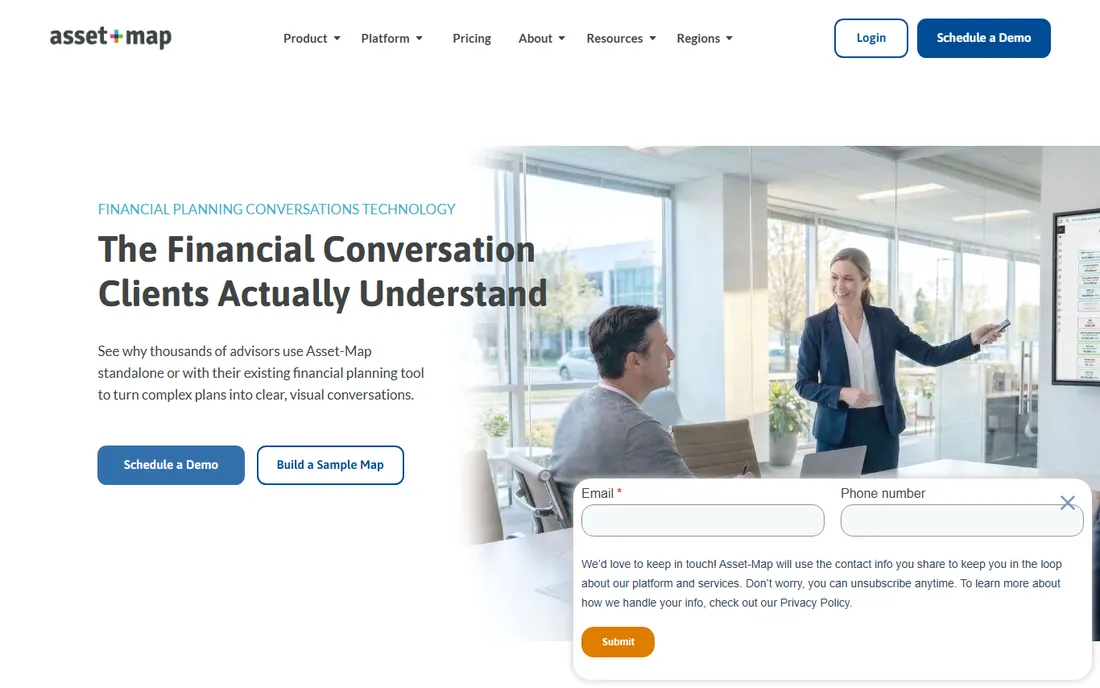
Asset-Map does one thing and does it better than anyone: it turns a household's entire financial picture into a single visual page. Instruments, people, priorities, risks, and timelines appear as an intuitive map that clients understand in seconds. Advisors use it in discovery meetings to show prospects their financial life at a glance, and the conversion effect is real enough that thousands of advisors consider it essential.
The smart positioning is that Asset-Map does not compete with eMoney or MoneyGuidePro. It sits alongside them, handling the visual conversation layer while the planning engine does the math. Signals flag gaps and risks proactively, and Target-Maps make funding timelines visible. The honest catch is scope. It is a communication and discovery tool, not a planning engine, so it is an addition to the stack rather than a replacement, and every addition has a subscription cost.
What we like- The one-page Asset-Map Report makes complex finances instantly legible
- Excellent for discovery meetings and prospect conversion
- Works standalone or alongside eMoney and MoneyGuide
Watch out for- It visualizes rather than calculates, so you still need a planning engine
- Another subscription in an already expensive stack
Starting priceSee website
Free planNo
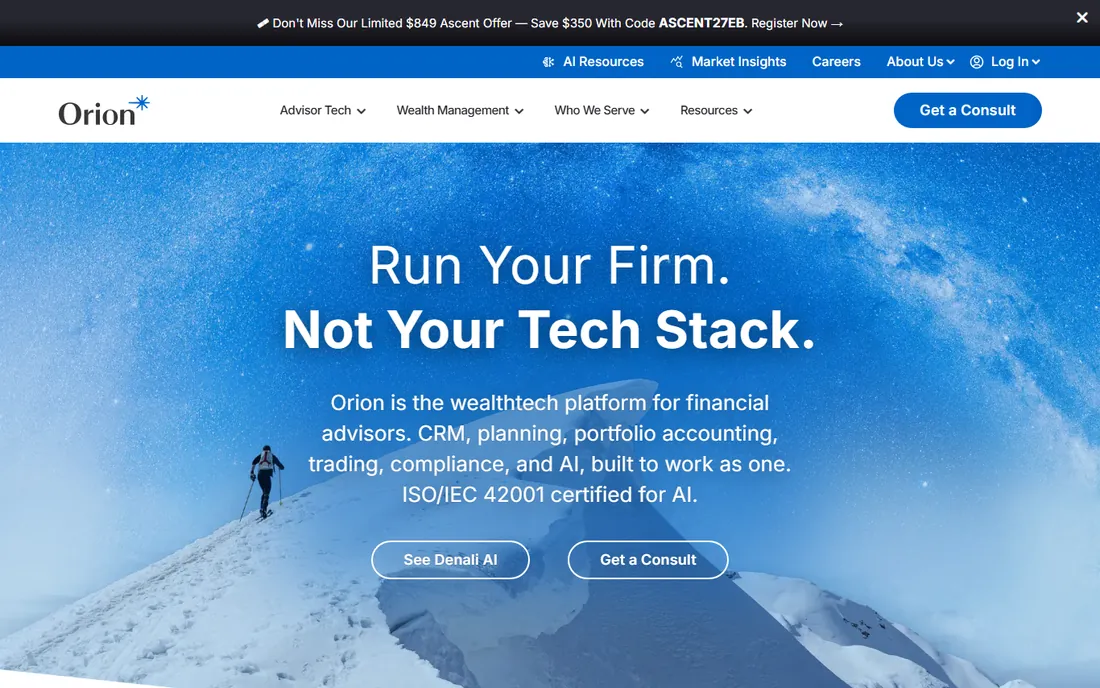
Orion is the closest thing to an operating system for a wealth management firm. Portfolio accounting, trading, planning, compliance, billing, a client portal, and Redtail CRM, which Orion acquired in 2022 and which remains the most-adopted advisor CRM, all run on one connected platform with an AI layer called Denali tying workflows together. The 2026 T3 survey gives Orion the top market share slot in CRM, portfolio accounting, and all-in-one software.
For firms tired of stitching together six vendors and six logins, that integration is the pitch. Data flows from CRM to planning to trading without re-entry, and the TAMP and OCIO services let firms outsource investment management on the same rails. The catch is scale-appropriateness. Orion is built for firms, from growing RIAs to large enterprises, and solo advisors may find the platform and its pricing more than they need. Implementation is a project, not a signup.
What we like- Number one market share in portfolio accounting, CRM, and all-in-one
- Redtail CRM included in the ecosystem
- Denali AI layer connects the whole stack
Watch out for- Breadth means implementation is a real project
- Smaller firms may pay for capability they never use
Starting priceSee website
Free planNo
Holistiplan solved the most tedious problem in advisory tax work: reading a client's tax return and figuring out what to do about it. Upload the return, and the software generates Roth conversion scenarios, tax projections, and clean visual reports that make the planning conversation easy. Over 30,000 advisors use it, and the testimonials share a theme: it pays for itself in time saved and planning opportunities found.
Tax planning has become one of the highest-value services advisors offer, and Holistiplan lets non-CPA advisors deliver it credibly. The estate and insurance modules extend its reach beyond the 1040. The honest catch is boundaries. It is a tax-first tool, not a financial planning platform, so it complements eMoney, RightCapital, or MoneyGuide rather than replacing them. And while the software does the math, the advisor still needs enough tax knowledge to stand behind the recommendations.
What we like- Turns an uploaded tax return into planning insights in minutes
- Client-ready tax reports advisors can actually explain
- Huge time savings versus manual projections
Watch out for- Focused narrowly on tax, estate, and insurance rather than full planning
- Advisors still need tax literacy to use it well
Starting priceSee website
Free planNo
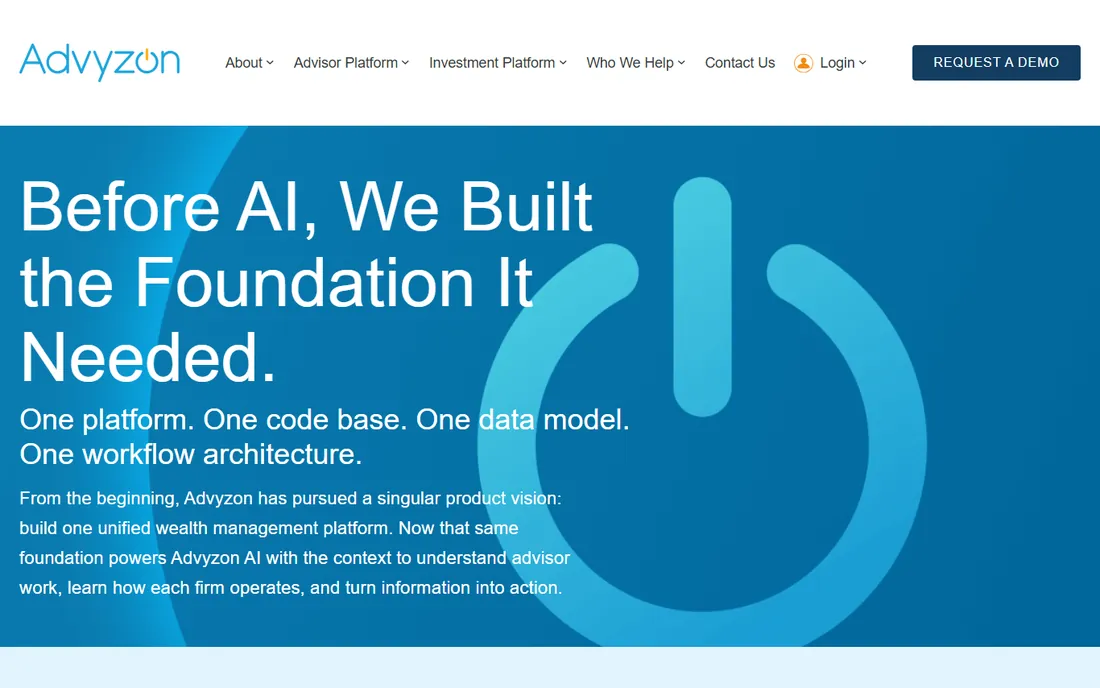
Advyzon is the all-in-one challenger that keeps winning satisfaction surveys. Nine consecutive years at number one for client satisfaction among all-in-one platforms in the T3/Inside Information survey is not a fluke, and the 2025 Kitces research ranked it first in satisfaction and value across CRM, portfolio management, performance reporting, client portals, and file sharing. Advisors praise the fact that it was built as one system rather than assembled through acquisitions.
The platform covers portfolio management, reporting, billing, CRM, rebalancing, financial planning, and a client portal, with advisor-trained AI now embedded throughout. For independent RIAs that want Orion-style breadth without enterprise complexity or cost, Advyzon is the value pick. The catch is ecosystem gravity. It does not have Orion's market share or Envestnet's distribution, so firms deeply embedded in those ecosystems face switching costs, and third-party integration breadth, while good, is not the widest.
What we like- Ranked number one in client satisfaction for all-in-one platforms nine years running
- Single architecture instead of acquired-and-integrated parts
- Strong value versus legacy stacks
Watch out for- Smaller ecosystem than Orion or Envestnet
- Brand recognition still catching up with the giants
We anchored this list in independent industry research, primarily the 2026 T3/Inside Information Software Survey and the Kitces AdvisorTech research, which rank advisor software by market share and satisfaction across dozens of categories. We cross-checked with G2 and Capterra reviews and practitioner discussion in advisor communities. Each tool's homepage was verified to confirm it exists today and serves financial advisors. We covered the full advisor stack, planning, risk, tax, visual communication, portfolio management, and all-in-one platforms, rather than listing eight planning tools. We did not claim hands-on testing. Pricing is quote-based or tiered for most of these vendors, so we say "See website" instead of repeating third-party estimates.
Building your advisor tech stack without overspending
The classic mistake is buying the biggest platform first. Start from the client experience and work backward. Every advisory firm needs three things: a way to plan, a way to communicate, and a way to stay organized. That usually means one planning platform (eMoney, RightCapital, or MoneyGuidePro), one CRM, and one client portal, with specialists added only when a real workflow demands them.
Add specialists on evidence, not enthusiasm. Nitrogen earns its seat when prospecting and risk conversations drive your growth. Holistiplan earns its seat when tax planning is a differentiator you actually sell. Asset-Map earns its seat when discovery meetings need to convert better. Each one should pay for itself in revenue or time within a quarter, or it is shelfware.
Finally, price the stack per advisor per year, not per tool per month. Advisor software stacks routinely run $5,000 to $15,000 per advisor annually once planning, CRM, risk, and tax tools are combined. All-in-one platforms like Orion and Advyzon can look expensive until you compare them against the sum of the point solutions they replace. Run that comparison before you sign anything.
Why satisfaction scores matter more than feature lists
Every vendor on this list has a long feature list, and most of them check the same boxes on paper. What separates them in practice is whether advisors enjoy using the software every day, because software that fights you does not get used, and unused software does not retain clients. That is why independent satisfaction data like the T3 survey carries more weight than any demo.
The pattern in the data is consistent: RightCapital and Advyzon win on satisfaction by being easy to learn and pleasant to use, while eMoney and Orion win on market share through depth and breadth. Neither pattern is wrong. A large enterprise with complex needs may rationally choose the deeper, harder tool. But a small firm choosing software its advisors will resent is buying a very expensive mistake. Weight the satisfaction scores heavily, and trial the shortlist with real client data before committing.
Frequently asked questions
What is the best financial planning software for advisors?
The big three are eMoney Advisor, RightCapital, and MoneyGuidePro. eMoney leads on market share and analytical depth, RightCapital leads on advisor satisfaction and ease of use, and MoneyGuidePro specializes in goals-based planning. Most firms choose between eMoney and RightCapital based on whether they prioritize depth or usability.
How much does financial advisor software cost?
Most advisor platforms price per advisor per year by quote. Planning software typically runs from around $1,500 to over $9,000 per advisor annually depending on the platform and tier. A full stack with planning, CRM, risk, and tax tools commonly totals $5,000 to $15,000 per advisor per year.
What software do most financial advisors use?
According to the 2026 T3/Inside Information survey, eMoney holds the largest financial planning market share at 35.62%, followed by Envestnet MoneyGuidePro at 24.23% and RightCapital at 21.37%. Orion leads in portfolio accounting, CRM (via Redtail), and all-in-one platforms.
Do I need a CRM as a financial advisor?
Yes, once you pass a handful of clients. An advisor CRM tracks households, not just contacts, manages review schedules and follow-ups, and keeps communications compliant. Purpose-built options integrate with planning and portfolio tools, which generic CRMs do not do well.
What is the best tax planning software for advisors?
Holistiplan is the category leader, turning uploaded tax returns into Roth conversion scenarios, projections, and client-ready reports. It is widely considered one of the highest-ROI tools in the advisor stack because tax planning is a service clients visibly value.
Can small firms afford this software?
Yes, but be selective. RightCapital offers a 14-day free trial and is known for fast onboarding, Nitrogen and Asset-Map are affordable per-advisor specialists, and Advyzon positions itself as strong value versus legacy stacks. Start with planning plus CRM, and add specialists only when a workflow justifies the cost.
Sources we checked (8)
- https://emoneyadvisor.com/
- https://rightcapital.com/
- https://www.moneyguidepro.com
- https://nitrogenwealth.com/
- https://asset-map.com/
- https://orion.com/
- https://holistiplan.com/
- https://advyzon.com/
Is your product missing or out of date?
We review this list regularly. Vendors can request a listing, send updated pricing or ask about featured placement.

Shihab Mia · Founder, Rankite
Shihab has spent more than a decade helping SaaS and e-commerce brands grow through search. He writes Rankite's software buying guides from pricing pages, documentation and public user reviews. More about Shihab.