How we make this list: we compare pricing pages, product documentation and public user reviews. Rankite is independent; if a vendor ever pays for a featured spot, that listing is clearly labeled Partner.
Key takeaways
- Mintlify and ReadMe lead for polished developer portals, but both jump to $250-$450 per month once you leave the free tier.
- Redocly, Stoplight, and SwaggerHub are the strongest picks when OpenAPI governance, linting, and spec-first workflows matter more than design polish.
- Scalar and Bump.sh appeal to docs-as-code teams: Scalar pairs a free MIT-licensed renderer with SDK generation, while Bump.sh rebuilds docs from your spec on every commit.
- Fern now sits inside Postman's agent stack after the January 2026 acquisition, and Postman itself remains the pragmatic choice for teams already testing in Postman.
Quick comparison
| Tool | Best for | Starting price | Free plan |
|---|
 Mintlify Mintlify | Developer-first companies that want beautiful docs fast | $450/month (Pro, billed annually) | Yes |
 ReadMe ReadMe | Public developer hubs with community features | $250/project/month (Pro) | Yes |
 Redocly Redocly | Teams that govern APIs with OpenAPI linting | $10/seat/month (Pro, billed annually) | Yes |
 Stoplight Stoplight | Design-first teams that document before they code | $44/month (Basic, billed annually) | Yes |
 Fern Fern | Companies that need docs and SDKs from one source | See website (Enterprise custom) | Yes |
 Bump.sh Bump.sh | Teams that want docs rebuilt from the spec automatically | $50/month (Basic) | Free trial (14 days) |
 SwaggerHub SwaggerHub | Enterprises standardized on OpenAPI | $75/user/month (Team, billed annually) | Yes |
 Scalar Scalar | Engineering-led teams that want to own the docs layer | $150/month (Pro) | Yes |
 Postman Postman | Teams that already design and test in Postman | $14/user/month (Basic, billed annually) | Yes |
Is your product missing or out of date?
We review this list regularly. Vendors can request a listing, send updated pricing or ask about featured placement.
The best software for API documentation creation
#1
Mintlify
Best for: Developer-first companies that want beautiful docs fast
Visit mintlify.com
Starting price$450/month (Pro, billed annually)
Free planYes
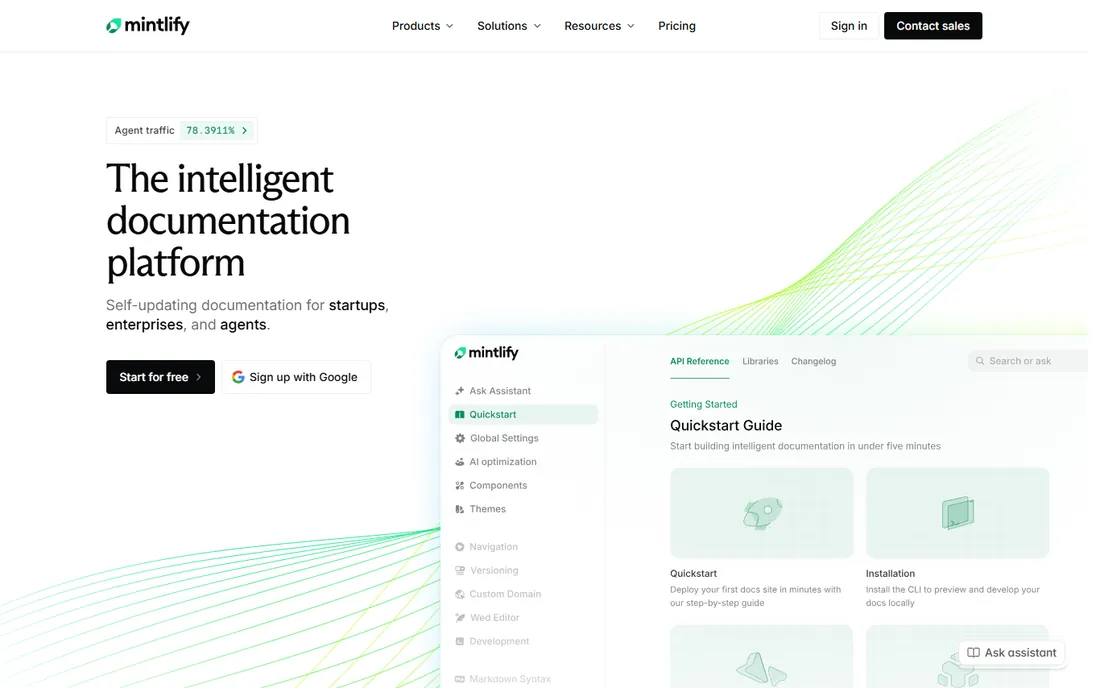
Mintlify has become the default choice for developer-tool startups, and the reason is visible in the first hour. You point it at an OpenAPI spec and get endpoint pages, parameter tables, request and response schemas, and an interactive playground, all in a design that looks custom. Docs live in your repo as MDX and deploy through Git, so engineers write documentation the way they write code.
The pricing is where teams get surprised. Starter is free and genuinely useful for solo developers, but the moment you want the AI assistant, writing agent, or automations, Pro costs $450 per month billed annually, and AI answers draw from a metered credit pool on top. For API-first products where documentation is a growth channel, the cost is easy to justify. For internal APIs or small teams, the free tier or a cheaper alternative covers the same ground.
What we like- MDX docs with bi-directional Git sync
- Auto-generates API reference from OpenAPI specs
- AI assistant, llms.txt, and MCP servers for agent traffic
Watch out for- Pro costs $450 per month, a steep jump from the free Starter tier
- AI answers consume metered credits on top of the subscription
#2
ReadMe
Best for: Public developer hubs with community features
Visit readme.com
Starting price$250/project/month (Pro)
Free planYes
ReadMe takes a different angle from the docs-as-code crowd: it is a developer hub, not just a reference renderer. Guides, API reference, changelog, and discussion forums live in one branded portal, and the analytics layer shows which endpoints get called, which pages developers read, and where they drop off. For companies whose API is a product, that feedback loop is the point.
The Starter plan is free for one project, which is enough to evaluate properly. Pro at $250 per project per month adds the AI linter, optional branches with in-product reviews, and deeper metrics, while enforced approvals and merge restrictions wait for Enterprise at around $3,000 per month. Teams that only need a clean reference can get there cheaper elsewhere. Teams that want to run a developer community around their API will find ReadMe hard to replace.
What we like- Branded developer portals with guides, changelog, and forums
- API usage analytics show which endpoints developers actually call
- Interactive try-it console
Watch out for- Pro starts at $250 per project per month
- Review workflows and enforced approvals are gated to higher tiers
Starting price$10/seat/month (Pro, billed annually)
Free planYes
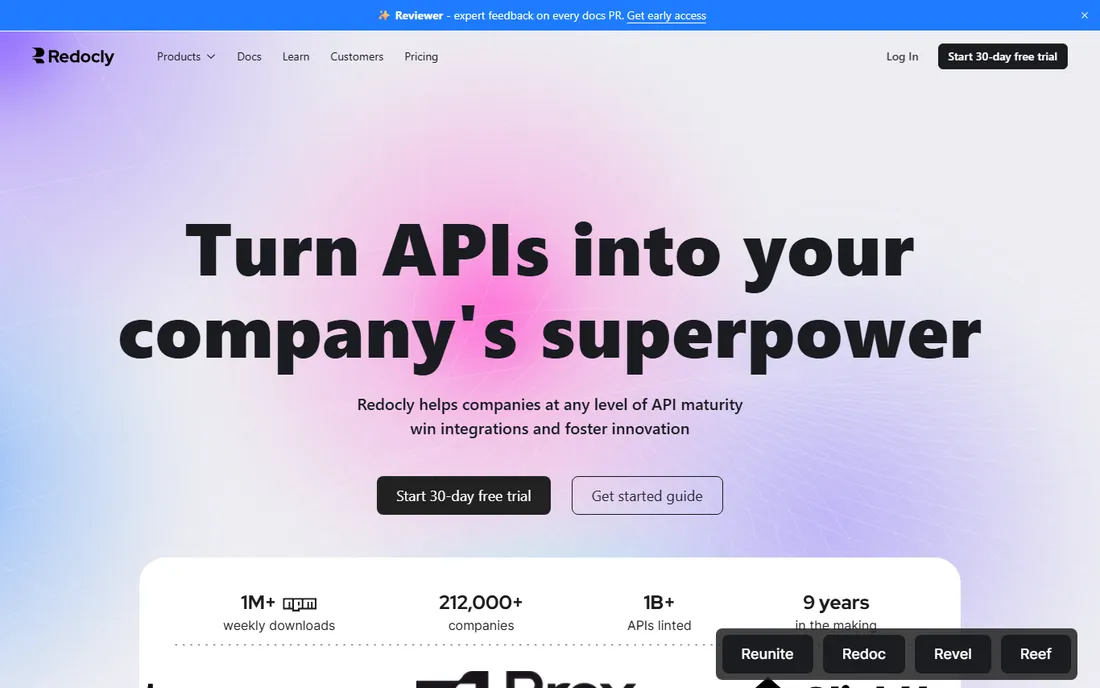
Redocly grew out of Redoc, the most popular open-source API docs renderer on GitHub, and that heritage shows in reference quality. The three-panel layout reads well on long references, code samples generate automatically, and nested schemas get deep links. Around the renderer sits a serious governance platform: lint your specs in CI, enforce style guides, and manage the whole API lifecycle from one pipeline.
Pricing is published and per seat: Pro at $10 per seat per month billed annually with a 100-page limit, Enterprise at $24 with SSO, RBAC, and MCP servers. The math favors small teams and gets expensive as headcount grows, especially with Revel and Reef sold as separate add-ons. If your priority is a beautiful portal with minimal process, Mintlify is simpler. If your priority is spec quality enforced across dozens of APIs, Redocly is the tool.
What we like- Best-in-class OpenAPI reference rendering from the Redoc lineage
- Built-in linting, style guides, and spec governance
- Docs-as-code CLI workflow
Watch out for- Per-seat pricing compounds as teams grow
- The interactive try-it console is a paid feature, not in the open-source renderer
#4
Stoplight
Best for: Design-first teams that document before they code
Visit stoplight.io
Starting price$44/month (Basic, billed annually)
Free planYes
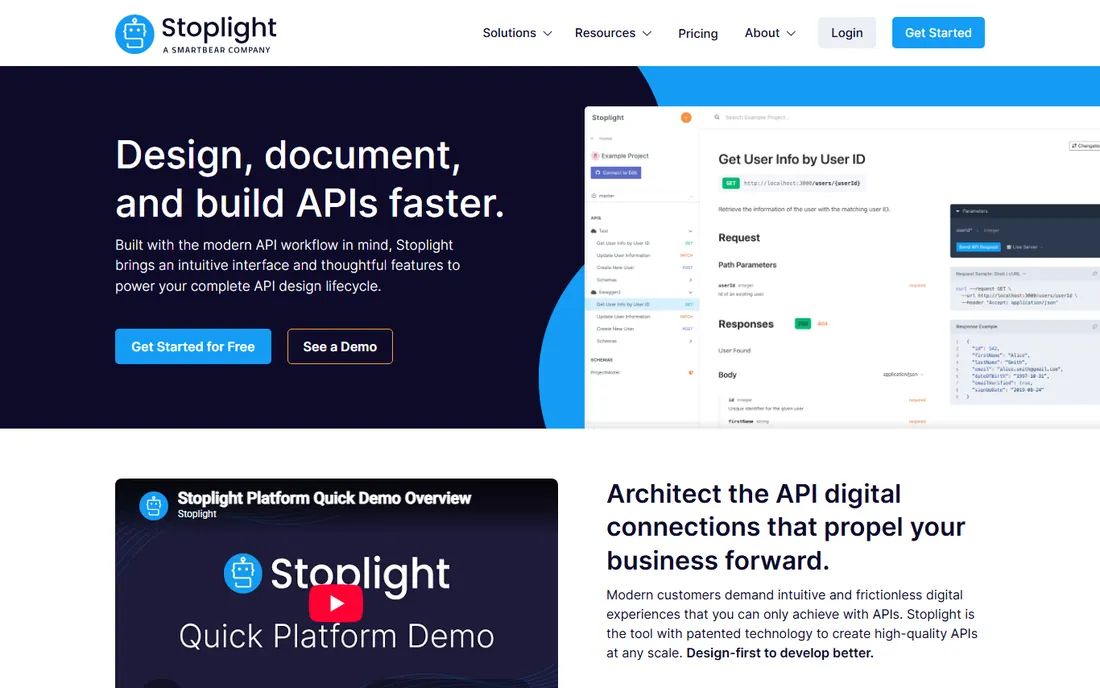
Stoplight is for teams that design the API before writing a line of implementation. The visual editor, mock servers, and style guides live alongside hosted documentation, so the contract, the mocks, and the docs never drift apart. The open-source Elements renderer and Spectral linter are Apache-2.0, which gives you an exit path most hosted tools do not.
The pricing page lists Free for one user and one project, Basic at $44 per month billed annually, Startup at $113, and Pro Team at $362. One caveat from 2026: SmartBear acquired Stoplight in 2023 and is building API Hub as its newer platform, so ask about the long-term roadmap before renewing. For design-first workflows with governance needs, it remains one of the most complete options.
What we like- Visual OpenAPI editor with mock servers
- Style guides and Spectral linting built in
- Free tier for one user and one project
Watch out for- You pay for a design platform even if you only need docs
- SmartBear is steering new investment toward API Hub, so get the roadmap in writing
Starting priceSee website (Enterprise custom)
Free planYes
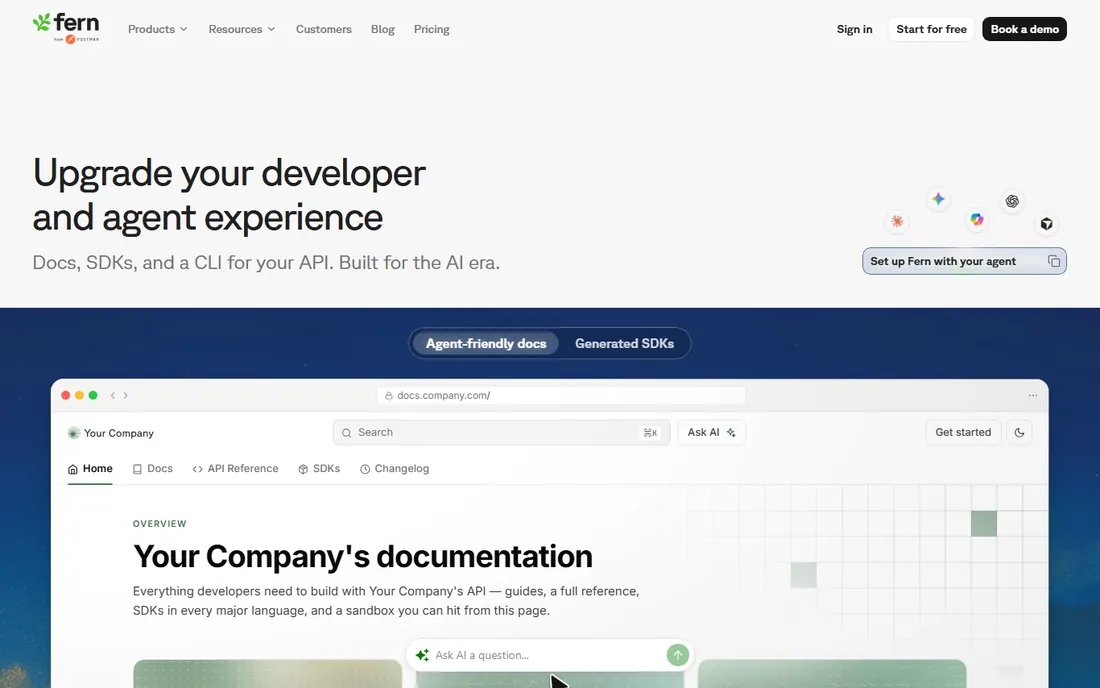
Fern's pitch is that documentation and SDKs should never disagree, because both generate from the same API definition. The SDK generators are genuinely Apache-2.0, covering TypeScript, Python, Go, Java, and more, and protocol support runs broader than most competitors with AsyncAPI, gRPC, and OpenRPC alongside OpenAPI. The free tier covers small teams and one site, which is enough to ship real docs.
In January 2026 Postman acquired Fern, and Fern now appears as the docs, SDK, and CLI layer of the Postman agent stack. The company says the product and roadmap are unchanged, but buyers should confirm pricing and direction during evaluation. If SDK generation matters as much as documentation, Fern deserves a close look before you commit to a docs-only tool.
What we like- Generates SDKs in nine languages from the same API definition
- Supports OpenAPI, AsyncAPI, gRPC, and OpenRPC
- Free tier for small teams
Watch out for- Pricing beyond the free tier is quote-based
- The docs renderer is not open source
#6
Bump.sh
Best for: Teams that want docs rebuilt from the spec automatically
Visit bump.sh
Starting price$50/month (Basic)
Free planFree trial (14 days)
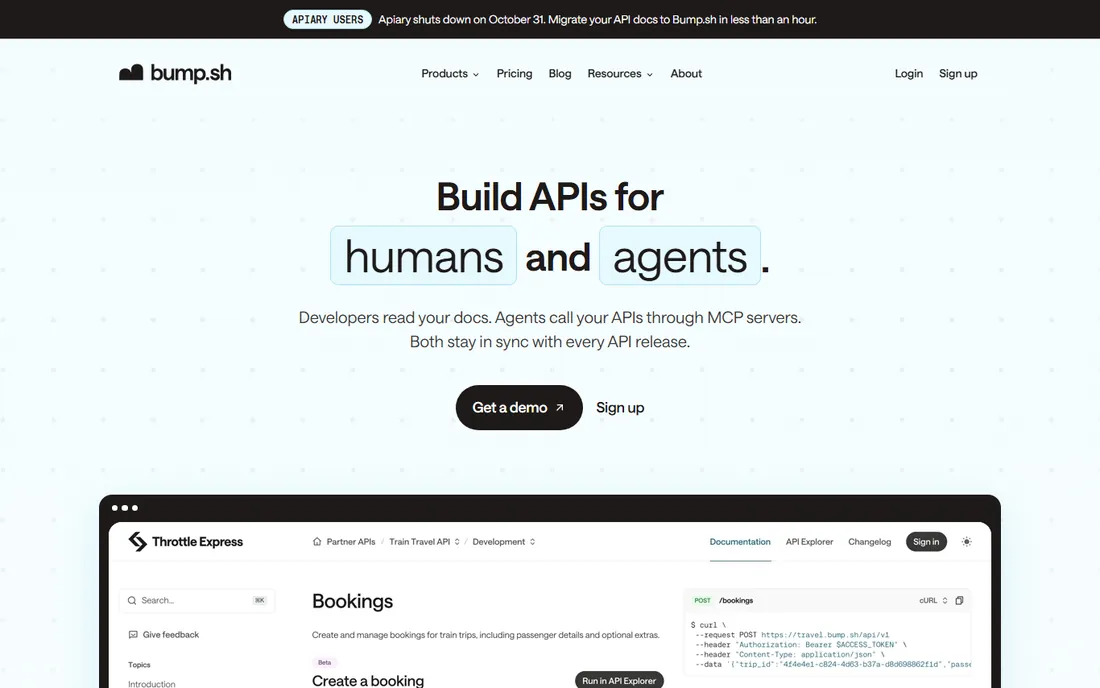
Bump.sh is the quiet workhorse of this category. You connect your repository, and every spec change triggers a deploy with a semantic diff, a written changelog, and user notifications. Breaking changes get flagged before they ship. For teams that already maintain a clean OpenAPI or AsyncAPI spec, it is the closest thing to documentation that maintains itself.
Pricing is published: Basic at $50 per month for 10 API docs, Pro at $250 for 30 docs with the API Explorer, branches, and rollback. There is no free plan, though qualifying open-source projects get Pro free on application. The honest trade-off is scope: Bump.sh does documentation and change management well, and nothing else. No SDKs, no guides editor to rival Mintlify. If the spec is your source of truth, that focus is a strength.
What we like- Every commit rebuilds docs with semantic diffs and automatic changelogs
- Supports OpenAPI, AsyncAPI, and Arazzo
- Deploy-and-forget GitHub integration
Watch out for- No free plan, only a 14-day trial on Pro
- No SDK generation
- The API Explorer requires the Pro tier
Starting price$75/user/month (Team, billed annually)
Free planYes
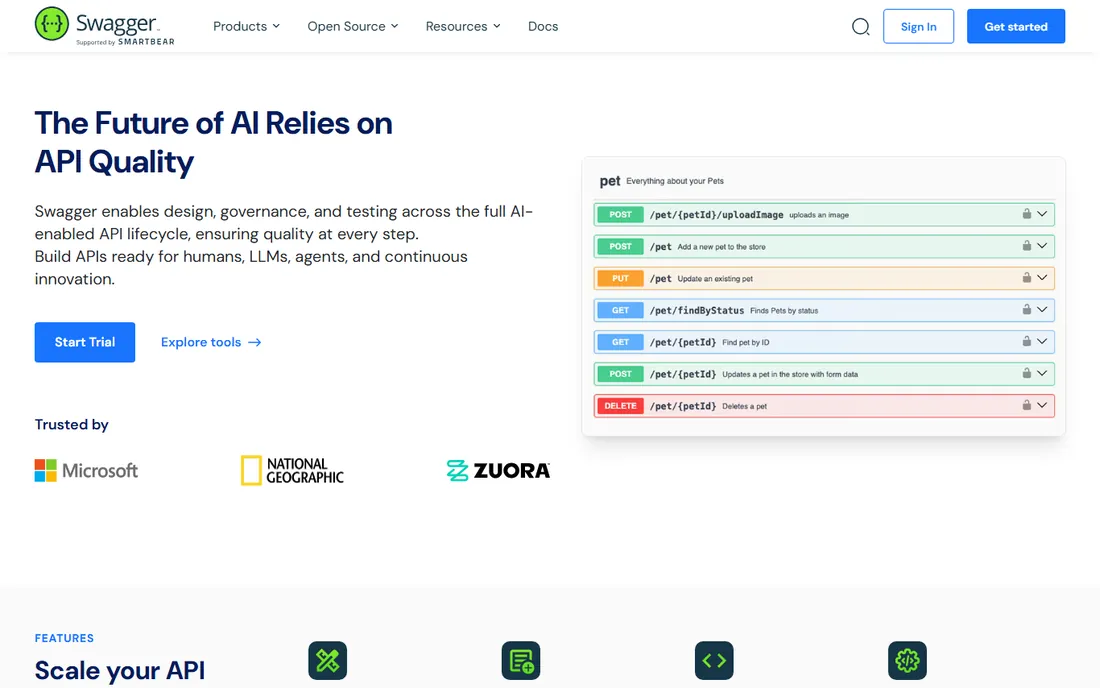
SwaggerHub is the incumbent: the hosted platform from the company behind the Swagger tooling that defined OpenAPI documentation. Teams design, document, and collaborate on specs in one place, with code generation, versioning, and integrations into gateways and CI pipelines. The free tier covers individuals with limited private APIs, which keeps it accessible for evaluation.
Paid plans start with Team at about $75 per user per month billed annually, and Enterprise is custom. Note the 2026 branding: SmartBear now groups SwaggerHub under API Hub, so expect both names during a sales process and get the roadmap in writing. For large organizations already invested in SmartBear testing tools, the integrated story is compelling. Smaller teams will find cheaper ways to publish a reference.
What we like- The original OpenAPI collaboration platform with deep editor tooling
- Free tier for individuals
- Integrates with the full SmartBear testing suite
Watch out for- Team pricing starts around $75 per user per month
- SmartBear now positions it inside API Hub, so confirm naming and roadmap
#8
Scalar
Best for: Engineering-led teams that want to own the docs layer
Visit scalar.com
Starting price$150/month (Pro)
Free planYes
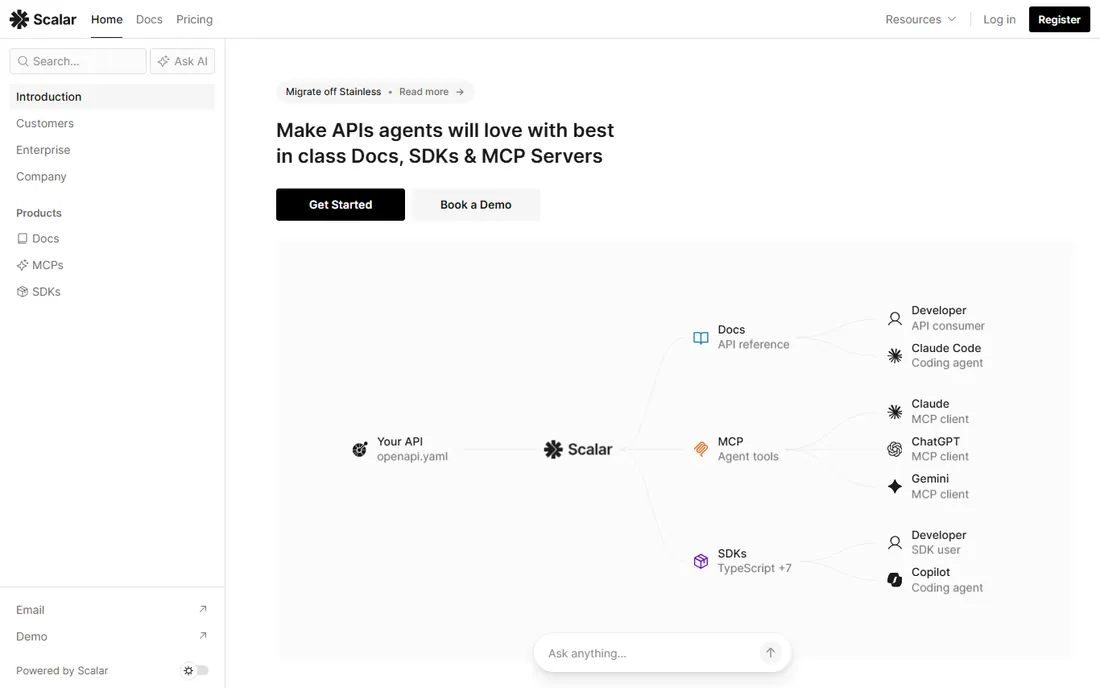
Scalar is the open-source answer to the hosted docs platform. The API reference is MIT licensed with around 15,000 GitHub stars, and it mounts inside your app via framework integrations for Express, FastAPI, Django, Laravel, Rails, and more. Every operation ships with a full API client behind it: environments, OAuth flows, and code samples in many languages. The hosted platform adds docs sites, SDK generation, a registry, and MCP servers from the same OpenAPI document.
The free tier covers hosted docs for up to three APIs with try-it included, Pro is $150 per month flat with five editor seats, and Business is $600 with SSO. The flat pricing is the differentiator: unlike per-seat tools, costs do not compound as your team grows. If you want to own your documentation layer and keep the option of a platform later, Scalar is the most flexible path.
What we like- MIT-licensed API reference renderer you can self-host anywhere
- Every operation gets a real API client with auth and environments
- SDK generation included on paid plans
Watch out for- Fewer SDK languages are generally available than Fern or Speakeasy
- Localization across many languages lags Mintlify
Starting price$14/user/month (Basic, billed annually)
Free planYes
Postman is primarily an API client and testing platform, but its documentation story is real: docs generate automatically from collections with request details and sample code, and public workspaces let anyone explore your APIs. For the 40 million developers already in Postman, publishing docs where the team already works removes an entire tool from the stack.
Watch the 2026 pricing change: since March 2026 the free plan covers one user only, so any team collaboration starts at Basic, $14 per user per month billed annually. Professional at $29 adds RBAC and partner workspaces. Postman will not win a beauty contest against Mintlify, and its docs lack the governance depth of Redocly or Stoplight. But when the team already lives in Postman, the documentation writes itself from work they are doing anyway.
What we like- Documentation generates automatically from collections
- Public workspaces double as developer onboarding
- The whole API lifecycle lives in one tool
Watch out for- The free plan is now limited to one user
- Docs are secondary to the testing workflow, not the product's focus
How we chose
We started with the tools that working API teams actually name in 2026, cross-checking vendor roundups, GitHub documentation projects, and review sites. Pricing comes from each vendor's own pricing page, checked against September and October 2026 snapshots, with per-seat math worked out for a small team so the numbers mean something. We favored tools that are actively maintained today: Fern's acquisition by Postman and SmartBear's API Hub rebrand were both verified rather than assumed. Every tool here renders an OpenAPI document faithfully, offers a hosted option or a real self-hosting path, and is used in production by real companies.
What to look for before you buy
API documentation tools look similar in screenshots and differ in workflows. These are the decisions that matter.
Docs-as-code or visual editor
If your engineers own documentation, a Git-native workflow in Markdown or MDX keeps docs next to code and reviews in pull requests. Mintlify, Redocly, Bump.sh, and Scalar all work this way. If technical writers or product managers contribute, a visual web editor matters more, which favors ReadMe and Postman. Pick the workflow your contributors will actually use, because the best renderer in the world cannot fix docs nobody updates.
Who reads the docs
Internal API consumers need accuracy and search. External developers need onboarding, guides, and a try-it console that works on the first click. Public API programs should weight the developer portal experience, analytics, and custom domains heavily. Internal platforms should weight linting, governance, and IDE integration instead.
The AI question
In 2026 every vendor ships some AI story, but they differ wildly. Mintlify auto-generates llms.txt and MCP servers and tracks agent traffic. Redocly and Scalar offer hosted MCP servers on paid tiers. Bump.sh frames the whole platform around agents calling reliable endpoints. If AI assistants will consume your API, ask for a live demo of the MCP or llms.txt output, not a roadmap slide.
Total cost at your team size
Per-seat pricing looks cheap until you multiply it. A ten-person team pays very different totals on Redocly Pro, Scalar Pro, and Mintlify Pro, and page limits, project limits, and AI credits all meter separately. Model your actual headcount, API count, and page count before comparing headline prices.
Open source or hosted
The category splits cleanly. Scalar's renderer, Redoc, Swagger UI, Stoplight Elements, and Docusaurus are open source and free to self-host, which suits teams with strong engineering and strict data requirements. Hosted platforms trade that control for speed: no infrastructure, automatic updates, and analytics out of the box. A common middle path is starting with an open-source renderer and moving to a hosted platform when the docs become a product surface. Scalar is explicitly built for that journey, and Bump.sh's Git-native flow makes the hosted side nearly invisible.
Frequently asked questions
How much does API documentation software cost?
Free tiers cover individuals and small projects on most tools. Paid plans range from $10 per seat per month on Redocly Pro to $450 per month flat on Mintlify Pro, with enterprise tiers quoted custom. Open-source renderers like Scalar, Redoc, and Swagger UI cost nothing to self-host.
Do I need an OpenAPI spec to use these tools?
Most tools in this category are built around OpenAPI, and you get the best results with a clean spec. Mintlify, Redocly, Bump.sh, and Scalar all generate references from it automatically. ReadMe and Postman are more forgiving: you can write guides first and attach the spec later.
What is the difference between Mintlify and ReadMe?
Mintlify is docs-as-code in MDX with Git sync, aimed at engineering teams that want beautiful portals fast. ReadMe is a hosted developer hub with guides, changelogs, forums, and API usage analytics, aimed at companies running a developer community. Mintlify Pro costs $450 per month; ReadMe Pro starts at $250 per project per month.
Can I self-host my API documentation?
Yes. Scalar, Redoc, Swagger UI, and Stoplight Elements are open source and run anywhere, from a CDN script tag to a Docker container. Hosted platforms like Mintlify, ReadMe, and Bump.sh keep you on their infrastructure, though Bump.sh deploys from your Git repo so the workflow still feels like yours.
Is Fern still available after the Postman acquisition?
Yes. Postman acquired Fern in January 2026 and presents it as the docs, SDK, and CLI layer of its agent stack. The company says the product and roadmap are unchanged, with the free tier still available. Confirm pricing and direction during your evaluation since post-acquisition plans can shift.
Which tool is best for SDK generation?
Fern generates SDKs in nine languages from the same API definition as your docs, and its generators are Apache-2.0. Scalar includes one SDK target on every paid plan with TypeScript, Python, and Go generally available. If SDKs are the priority, compare Fern and Scalar directly before choosing a docs-only tool.
Sources we checked (16)
- https://mintlify.com/
- https://readme.com
- https://redocly.com
- https://stoplight.io
- https://buildwithfern.com
- https://bump.sh/
- https://swagger.io/
- https://scalar.com/
- https://postman.com/
- https://bump.sh/pricing
- https://github.com/erickirt/scalar/blob/HEAD/documentation/library/best-api-documentation-tools-2026.md
- https://github.com/scalar/scalar/blob/HEAD/documentation/alternatives/swagger-ui.md
- https://www.mintlify.com/library/best-api-documentation-tools-of-2025
- http://documentation.ai/blog/mintlify-pricing
- https://ferndesk.com/blog/mintlify-pricing
- https://apidog.com/blog/postman-plan-limitations-free-solution/
Is your product missing or out of date?
We review this list regularly. Vendors can request a listing, send updated pricing or ask about featured placement.

Shihab Mia · Founder, Rankite
Shihab has spent more than a decade helping SaaS and e-commerce brands grow through search. He writes Rankite's software buying guides from pricing pages, documentation and public user reviews. More about Shihab.