How we make this list: we compare pricing pages, product documentation and public user reviews. Rankite is independent; if a vendor ever pays for a featured spot, that listing is clearly labeled Partner.
Key takeaways
- VMware vSAN and Nutanix lead the hyperconverged market, best for VMware and multi-cloud shops respectively, though both now sell through broad platform bundles.
- StarWind Virtual SAN and StorMagic SvSAN are the practical picks for small sites and edge locations that need shared storage without a SAN.
- MinIO and TrueNAS give you open-source options: MinIO for S3-compatible object storage, TrueNAS for a full file, block, and object platform with a free Community Edition.
- Red Hat Ceph Storage suits organizations already running Red Hat infrastructure that need petabyte-scale object and block storage.
- Every enterprise option here is quote-priced, so budget conversations start with a sales call, not a pricing page.
Quick comparison
| Tool | Best for | Starting price | Free plan |
|---|
 VMware vSAN VMware vSAN | VMware shops consolidating storage | See website | Free trial |
 Nutanix Nutanix | hyperconverged with multi-cloud management | See website | Free trial |
 Red Hat Ceph Storage Red Hat Ceph Storage | petabyte-scale object and block on Red Hat | See website | Free trial |
 StorMagic SvSAN StorMagic SvSAN | small sites and edge locations | See website | Free trial |
 DataCore DataCore | SAN management across mixed hardware | See website | Free trial |
 StarWind Virtual SAN StarWind Virtual SAN | two-node high availability on a budget | See website | Yes (free edition) |
 MinIO MinIO | S3-compatible object storage, open source | See website | Yes (open source) |
 TrueNAS TrueNAS | unified file, block, and object storage | See website | Yes (free Community Edition) |
Is your product missing or out of date?
We review this list regularly. Vendors can request a listing, send updated pricing or ask about featured placement.
The best software defined storage
Starting priceSee website
Free planFree trial
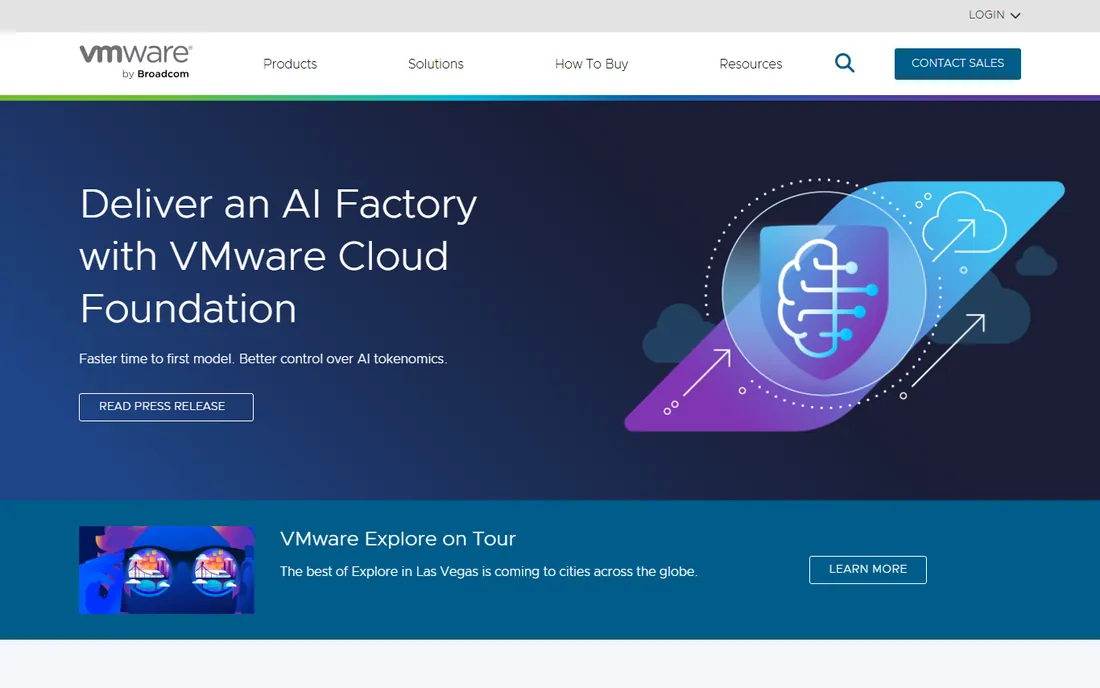
vSAN turns the local disks inside your ESXi hosts into shared storage, which removes the need for a separate SAN in many virtualized environments. If your team already runs vSphere, the learning curve is short: storage policies live next to VM settings, and failover behavior is familiar. It remains the default choice for VMware-centric data centers.
The honest caveat is commercial. Since Broadcom's acquisition of VMware, vSAN is packaged inside broader VMware Cloud Foundation bundles, and many customers report higher renewal costs. Technically it is as strong as ever. Financially, get the quote in writing and model three years before you commit.
What we like- Deeply integrated with vSphere and the VMware stack
- Mature stretched-cluster support
- Huge existing knowledge base among admins
Watch out for- Now sold through Broadcom's bundled licensing
- Pricing has become harder to predict for renewals
Starting priceSee website
Free planFree trial
Nutanix pioneered the hyperconverged pitch: compute and storage in one box, managed from one console. Its AHV hypervisor gives VMware shops an exit path, and the Prism management plane is genuinely pleasant to use. Companies standardizing on Nutanix often collapse several infrastructure silos into one platform.
Cost is the main objection. Nutanix licenses are priced at the enterprise end, and a full migration involves retraining and application validation. Organizations already planning a VMware exit, or building greenfield private cloud, are the natural fit. Everyone else should compare carefully against staying put.
What we like- Strong all-in-one hyperconverged platform
- Good multi-cloud and hybrid management
- Well-regarded support organization
Watch out for- Premium pricing
- Migration away from VMware tooling takes planning
#3
Red Hat Ceph Storage
Best for: petabyte-scale object and block on Red Hat
Visit redhat.com
Starting priceSee website
Free planFree trial
Ceph is the open-source storage system behind many of the world's largest clusters, and Red Hat's supported distribution packages it for enterprise use. It serves object, block, and file from one cluster, which replaces several separate systems. Version 8 is current, and the project keeps maturing.
Nobody should adopt Ceph casually. Cluster design, failure-domain planning, and performance tuning demand real expertise, and small deployments do not make sense given the minimum node counts. For organizations already committed to Red Hat OpenShift or OpenStack at scale, it is the natural storage layer. Others should look at simpler options first.
What we like- Proven at massive scale in production
- Unified object, block, and file in one system
- Backed by Red Hat support
Watch out for- Complex to design and operate
- Needs skilled staff or strong partner support
Starting priceSee website
Free planFree trial
StorMagic built SvSAN for the sites the big vendors ignore: retail stores, branch offices, and factory floors that need highly available shared storage across two servers. It mirrors storage between a pair of nodes with a lightweight footprint, and it does not demand a third witness site like some competitors.
The product scope is deliberately narrow, which is both the appeal and the limit. You get dependable two-node storage without SAN hardware, not a full cloud platform. For edge and ROBO deployments where simplicity beats feature count, SvSAN is one of the most practical choices available.
What we like- Runs on just two servers with no witness appliance needed
- Lightweight footprint for edge sites
- Straightforward licensing
Watch out for- Smaller ecosystem than the big HCI vendors
- Fewer advanced data services
Starting priceSee website
Free planFree trial
DataCore's SANsymphony virtualizes the storage you already own, pooling disks from different vendors behind one management layer. That makes it attractive for companies with sunk investment in storage hardware they are not ready to retire. Caching and auto-tiering features squeeze more performance from existing spindles and flash.
The company has been through product-line changes over the years, so confirm that the current offering matches your use case during evaluation. Buying is quote-based and consultative. If your goal is to extend the life of current arrays while adding software features, DataCore deserves a look.
What we like- Pools existing SAN and DAS hardware under one layer
- Strong performance optimization features
- Flexible hardware choices
Watch out for- Interface and branding have evolved through acquisitions
- Sales-led buying process
Starting priceSee website
Free planYes (free edition)
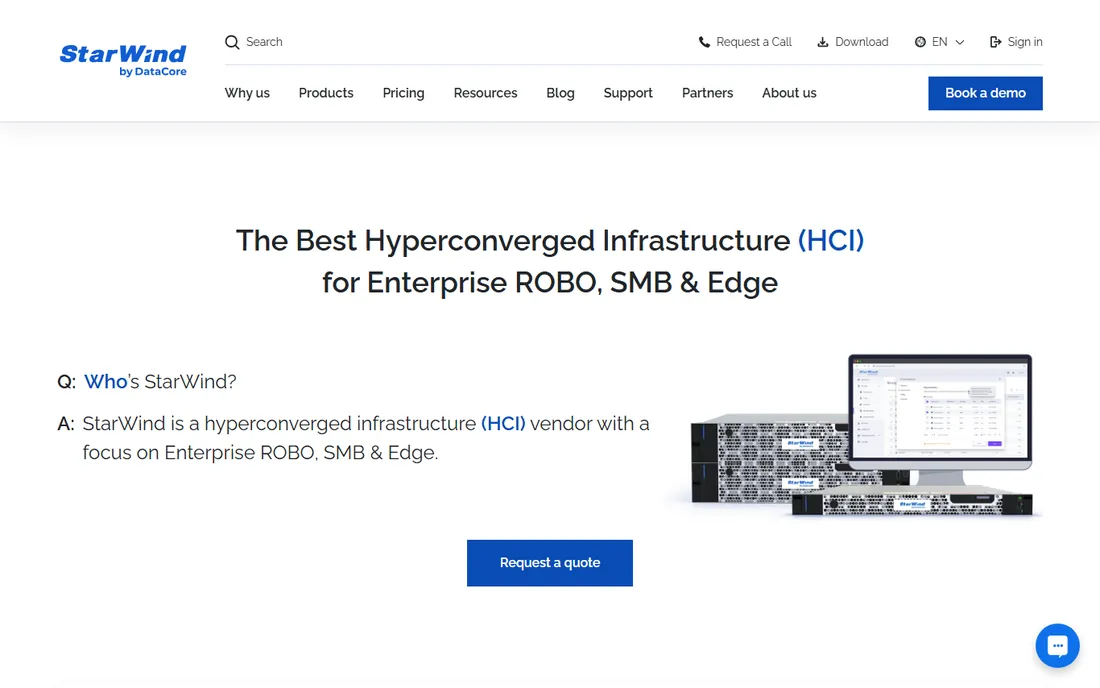
StarWind does one thing well: mirroring storage between a small number of servers to create fault-tolerant shared storage. The free edition covers basic two-node setups, which makes it easy to test in a lab before spending anything. It works with both Hyper-V and VMware, and configuration is simpler than full HCI stacks.
Larger deployments need the paid editions, and at big scale the major HCI platforms offer more automation. But for the extremely common case of two servers that must survive one failing, StarWind is the value pick. Many SMBs run their whole virtualization cluster on it.
What we like- Free edition available for basic use
- Purpose-built for two and three node clusters
- Good Hyper-V and VMware support
Watch out for- Paid features needed for larger scale-out
- Smaller company than the HCI giants
#7
MinIO
Best for: S3-compatible object storage, open source
Visit min.io
Starting priceSee website
Free planYes (open source)

MinIO is the open-source object store that became the default S3-compatible option for private cloud. It is fast, simple to deploy, and the API compatibility means applications written for Amazon S3 usually work unchanged. The company now brands its commercial offering as AIStor, aimed at AI data pipelines.
The community edition is genuinely complete for object storage, which makes MinIO the rare enterprise-grade tool you can run free forever. Just know its scope: it stores objects, not files or VM disks. Pair it with something else when you need file shares or block volumes.
What we like- Fully open source with S3-compatible API
- Extremely fast object storage
- Runs anywhere from edge to cloud
Watch out for- Enterprise features sit behind paid AIStor licensing
- Object-only, no native file or block
Starting priceSee website
Free planYes (free Community Edition)
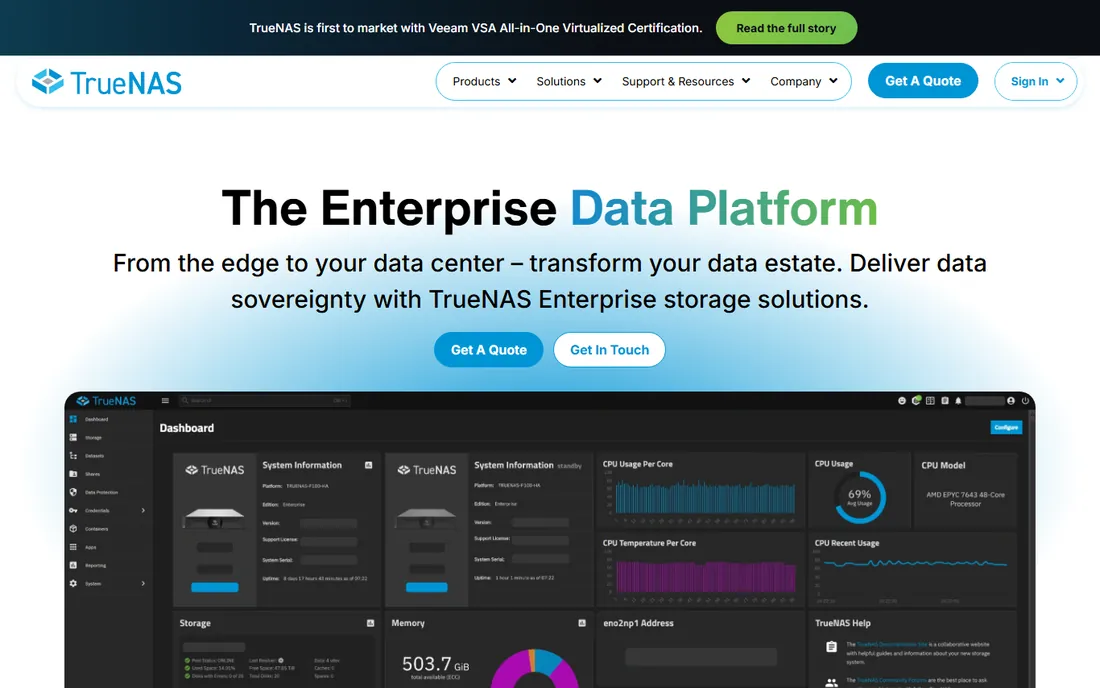
TrueNAS combines the beloved open-source storage OS with supported appliances from iXsystems. The Community Edition costs nothing and includes the OpenZFS filesystem with checksums, snapshots, and replication that protect against silent data corruption. One system can serve SMB shares, iSCSI block, and S3-compatible object storage together.
Hardware choice matters more here than with pure software plays, so check the compatibility lists before building. Support contracts are optional but recommended for production. For organizations that want enterprise storage behavior without enterprise licensing, TrueNAS is the most complete free starting point.
What we like- Free Community Edition is full-featured
- OpenZFS data integrity and snapshots
- Serves file, block, and object from one system
Watch out for- Hardware compatibility needs checking
- Enterprise support is a separate purchase
How to evaluate software-defined storage for your business
Start with the workload, not the vendor. Virtual machine storage, file shares, backup targets, and object archives have different performance and protocol needs. A hyperconverged platform like Nutanix or vSAN fits virtualized data centers. Object-heavy workloads lean toward MinIO or Ceph. Small remote sites need something light like StorMagic or StarWind.
Count the real total cost over three years. Software licenses are only part of it: add the servers, networking, power, and the staff time to run the system. Open-source options look free until you price the expertise to operate them. Quote-based enterprise products look expensive until you compare against the SAN refresh you would otherwise buy.
Test failure, not just speed. Every vendor demo shows good performance on healthy hardware. The questions that matter: what happens when a disk dies at 2 AM, when a node loses network, when you need to add capacity during business hours. Ask for failure-scenario documentation and talk to reference customers who have lived through outages.
Finally, check the exit. Proprietary formats and management lock-in can make leaving painful. Open formats, standard protocols like S3 and iSCSI, and portable data layouts keep your options open. The cheapest storage is the kind you can move.
Hyperconverged vs. scale-out: two paths to software-defined storage
Hyperconverged infrastructure, the HCI model from Nutanix and VMware vSAN, puts compute and storage in the same boxes. Each server contributes CPU, memory, and disks to a shared pool. You scale by adding identical nodes, and management is unified. This model suits virtualized environments where every host runs similar workloads.
Scale-out storage, like Ceph or TrueNAS, separates the storage layer from compute. Storage nodes form their own cluster, and any server can consume the capacity over the network. This fits mixed environments: physical databases, file shares, and backup targets all drawing from one pool. It also lets you scale storage and compute independently, which saves money when only one of them is growing.
Neither is universally better. HCI simplifies operations at the cost of forcing matched growth. Scale-out offers flexibility at the cost of more design decisions. Edge sites often want neither in full form, which is why two-node products like StarWind and StorMagic exist. Match the architecture to how your infrastructure actually grows.
Frequently asked questions
What is software-defined storage in simple terms?
Software-defined storage manages data storage through software running on standard servers instead of specialized hardware controllers. The software handles replication, snapshots, tiering, and failover, while the hardware underneath can be commodity servers from any vendor. This separation is what lets you scale by adding cheap servers and avoid lock-in to one array maker.
How is SDS different from a traditional SAN?
A traditional SAN is a purpose-built appliance where the vendor controls both hardware and software, and expansion means buying that vendor's disk shelves. SDS runs on standard x86 servers and manages whatever disks are installed, often from multiple vendors. The trade-off is responsibility: with a SAN the vendor owns the whole stack, while with SDS your team or integrator owns the hardware layer.
Do I need special hardware for software-defined storage?
No, that is the point, though "standard" still has requirements. You need reliable servers with enough CPU, memory, and fast networking, plus a compatibility check for drive controllers. Vendors publish hardware compatibility lists, and ignoring them is the most common source of SDS problems. Some vendors also sell pre-built appliances if you want one throat to choke.
Is open-source storage safe for production use?
Yes, with the right support model. Ceph, MinIO, and TrueNAS all run production workloads at large organizations. The software is proven; the risk is operational, since you need staff who understand the system or a support contract from the vendor. Red Hat, iXsystems, and MinIO all sell enterprise support for exactly this reason. Running open-source storage without either expertise or support is where trouble starts.
What does software-defined storage cost?
Expect quote-based pricing for enterprise platforms, typically licensed per terabyte, per node, or per socket. Small deployments of StarWind or StorMagic can cost a few thousand dollars, while large Nutanix or vSAN clusters run into six figures annually. Open-source options eliminate license fees but shift cost to hardware and staff. Always model three years including hardware, support, and power.
Can SDS replace my backup system?
No. SDS protects against hardware failure through replication, but it does not protect against deleted files, ransomware, or site loss on its own. You still need versioned backups stored separately, ideally off-site and immutable. Think of SDS as making your primary storage resilient, and backups as your recovery plan when resilience is not enough.
How we chose
We reviewed vendor documentation, product pages, and release notes for each platform, confirming current product names and availability as of October 2026. We compared feature sets against public reviews on G2 and Capterra and technical discussions on Reddit's storage and homelab communities, paying attention to recurring praise and complaints.
We selected platforms relevant to business buyers, from SMB edge deployments to enterprise data centers, and included both commercial and open-source options to cover different budgets. We verified that every product is actively sold and supported today. We did not perform hands-on testing; this ranking reflects documented capabilities, published materials, and aggregated user feedback.
Sources we checked (8)
- https://www.vmware.com/
- https://www.nutanix.com/
- https://www.redhat.com/
- https://stormagic.com/
- https://www.datacore.com/
- https://starwindsoftware.com/
- https://min.io/
- https://www.truenas.com/
Is your product missing or out of date?
We review this list regularly. Vendors can request a listing, send updated pricing or ask about featured placement.

Shihab Mia · Founder, Rankite
Shihab has spent more than a decade helping SaaS and e-commerce brands grow through search. He writes Rankite's software buying guides from pricing pages, documentation and public user reviews. More about Shihab.