How we make this list: we compare pricing pages, product documentation and public user reviews. Rankite is independent; if a vendor ever pays for a featured spot, that listing is clearly labeled Partner.
Key takeaways
- Ansible is the simplest starting point, with a free open-source core and no agents to install.
- Puppet and Chef are the enterprise governance standards, now under Perforce and Progress respectively.
- Terraform and Pulumi manage cloud infrastructure as code, in HCL or real programming languages.
- Salt, CFEngine, and Rudder are the scalable open-source engines, with Salt now under Broadcom.
- Octopus Deploy specializes in deployment automation with configuration built in.
Quick comparison
| Tool | Best for | Starting price | Free plan |
|---|
 Ansible Ansible | agentless automation | See website | Yes |
 Puppet Puppet | enterprise infrastructure governance | See website | Yes |
 Chef Chef | policy-as-code automation | See website | Yes |
 Salt Salt | high-speed remote execution | See website | Yes |
 Terraform Terraform | infrastructure as code | See website | Yes |
 CFEngine CFEngine | lightweight configuration management | See website | Yes |
 Rudder Rudder | security-driven configuration | See website | Yes |
 Octopus Deploy Octopus Deploy | deployment automation | See website | No |
 Pulumi Pulumi | infrastructure in real languages | See website | Yes |
Is your product missing or out of date?
We review this list regularly. Vendors can request a listing, send updated pricing or ask about featured placement.
Starting priceSee website
Free planYes
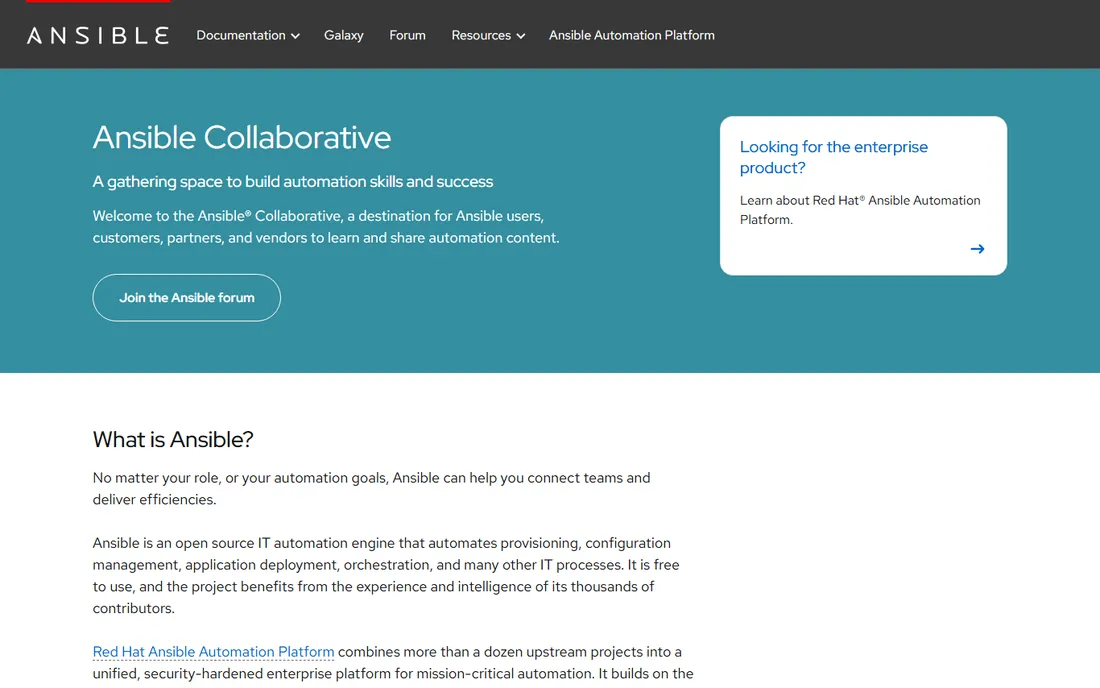
Ansible is the open-source IT automation engine that made configuration management approachable: write human-readable playbooks in YAML, push them over SSH, and configure servers, networks, and cloud resources with no agents to deploy. It automates provisioning, configuration management, application deployment, and orchestration, with Ansible Galaxy providing pre-packaged roles and collections. Red Hat Ansible Automation Platform adds enterprise hardening, event-driven automation, and AI-assisted content.
The honest trade: Ansible's push model configures on demand rather than continuously enforcing state, so pair it with something that detects drift if you need that. For teams starting automation, nothing is easier to adopt or cheaper to try.
What we like- No agents to install
- Free open-source engine
- Thousands of Galaxy collections for ready-made content
Watch out for- Push-based model does not enforce drift continuously
- The enterprise platform is a separate paid tier
- Large fleets need careful design
Starting priceSee website
Free planYes
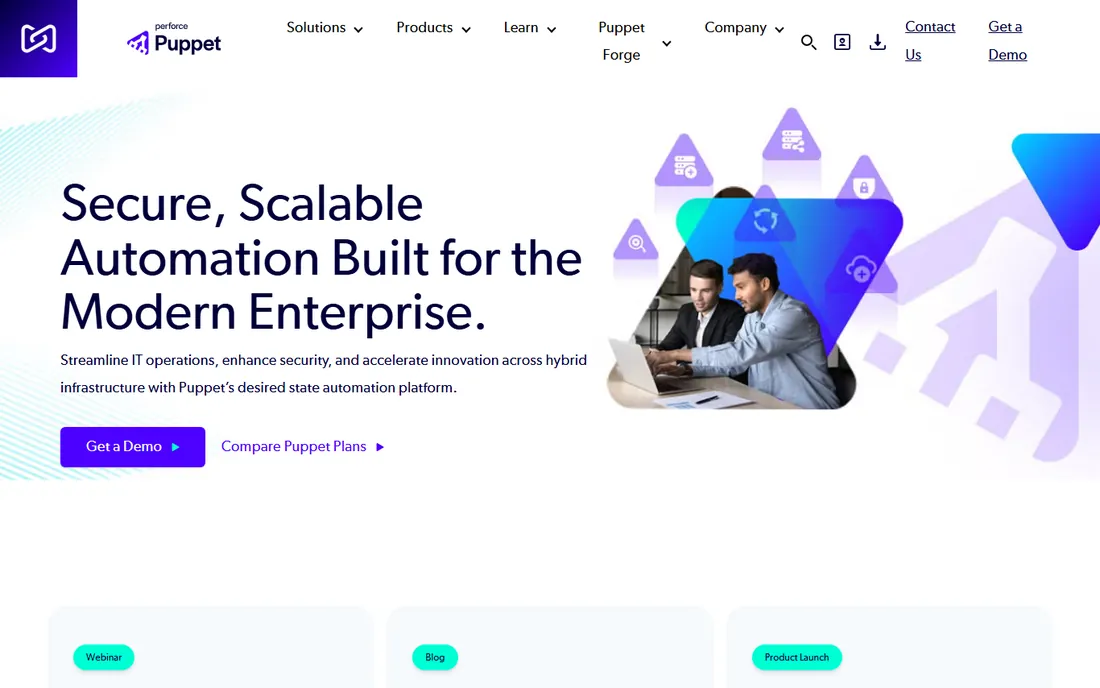
Puppet, now part of Perforce, delivers policy-driven automation that keeps servers, networks, cloud, and edge in their desired state continuously. The agent-based model enforces configuration and reports drift, with 40,000+ organizations relying on it and 97% of customers saying it improved their security and compliance posture. It is the platform for teams that answer auditors.
The honest note: Puppet's declarative language and agent architecture are more to learn and run than Ansible's. The payoff is continuous enforcement rather than periodic pushes. Regulated enterprises with large fleets get the most from it.
What we like- Policy-driven automation with continuous enforcement
- 40,000+ organizations in production
- Strong compliance and reporting
Watch out for- Its own declarative language to learn
- The agent-based architecture is heavier
- Open source edition is limited
Starting priceSee website
Free planYes
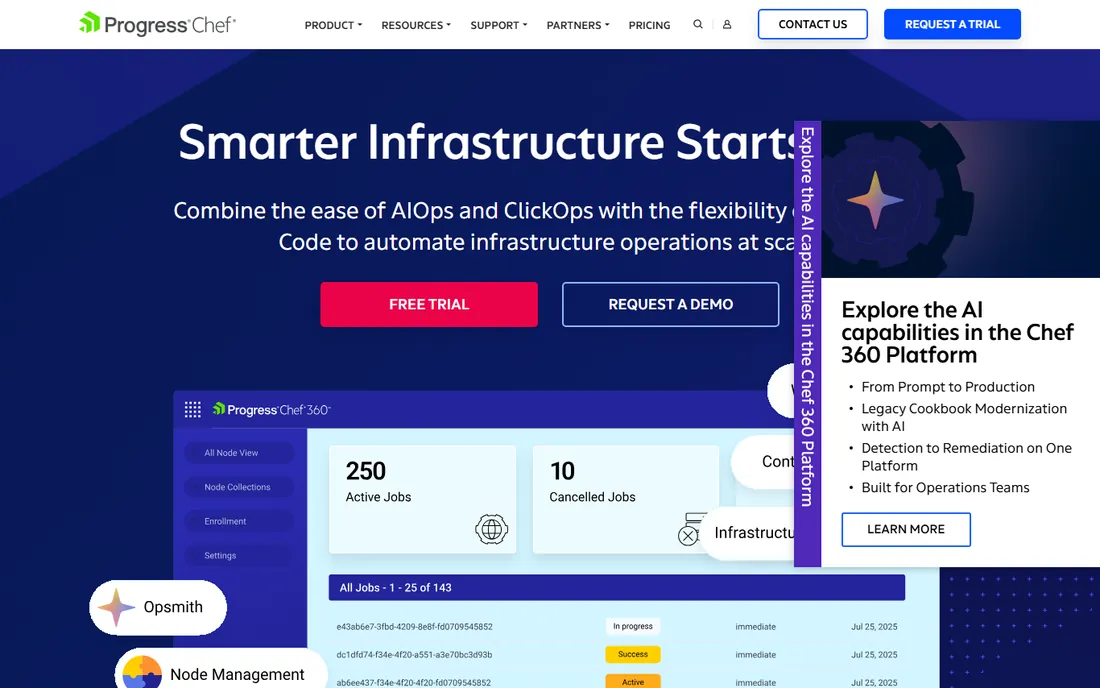
Chef, part of Progress, automates infrastructure operations at scale with policy-as-code: standardized configurations, continuous compliance audits, and workflow orchestration across cloud, on-prem, and air-gapped environments. The Chef 360 platform adds AIOps and ClickOps to bridge the gap between operators and developers, with agentless execution now an option.
The honest framing: Chef's Ruby-based recipes are powerful but ask more of your team than YAML playbooks. Shops with DevOps maturity and compliance obligations will find it excellent. Beginners should start with Ansible and graduate here if needed.
What we like- Infrastructure and compliance as code
- The Chef 360 platform with AIOps and ClickOps
- 15+ years of DevOps heritage
Watch out for- Ruby-based recipes have a learning curve
- Now available as SaaS, on-prem, or marketplace
- Progress ownership changed the licensing story
Starting priceSee website
Free planYes
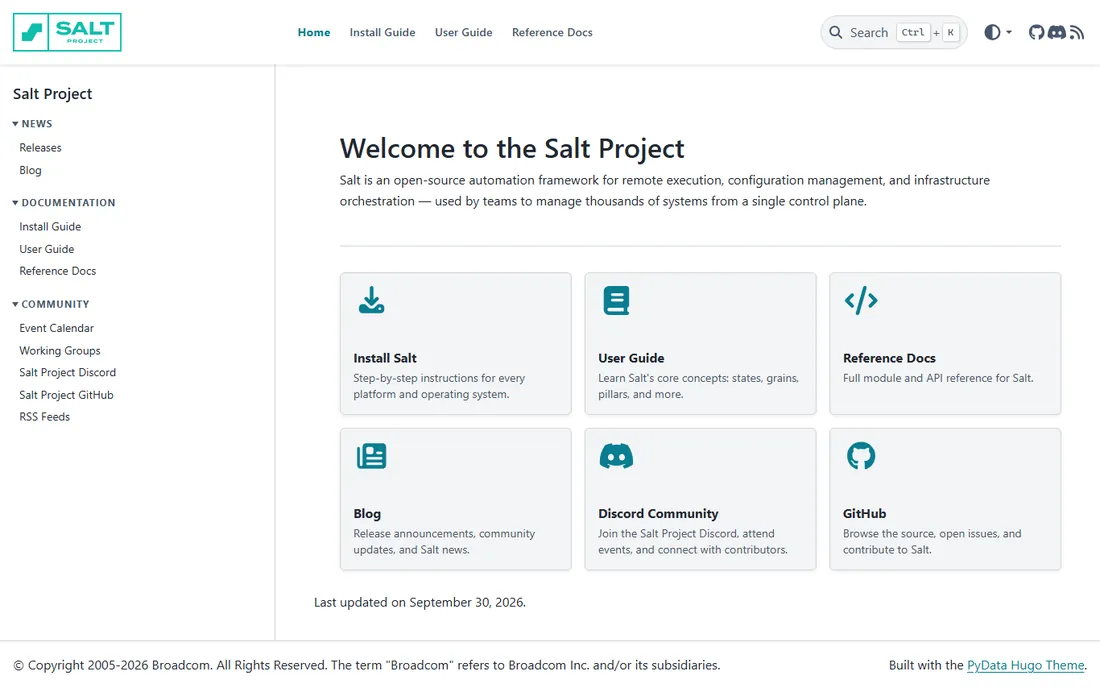
Salt is the open-source automation framework for remote execution, configuration management, and orchestration, built to manage thousands of systems from a single control plane. Its event-driven architecture makes it the fastest of the classic tools at executing commands across large fleets. The Salt Project community keeps it alive with Discord support and full reference documentation.
The honest note: Salt is powerful but demands more expertise than Ansible, and its future under Broadcom's VMware is worth watching. Teams that need raw speed across massive fleets and have the skills to wield it will find it excellent.
What we like- Extremely fast remote execution at scale
- Open-source framework with Discord community
- Manages thousands of systems from one control plane
Watch out for- Steeper learning curve than Ansible
- Now a Broadcom/VMware project, which affects its roadmap
- Documentation assumes expertise
Starting priceSee website
Free planYes
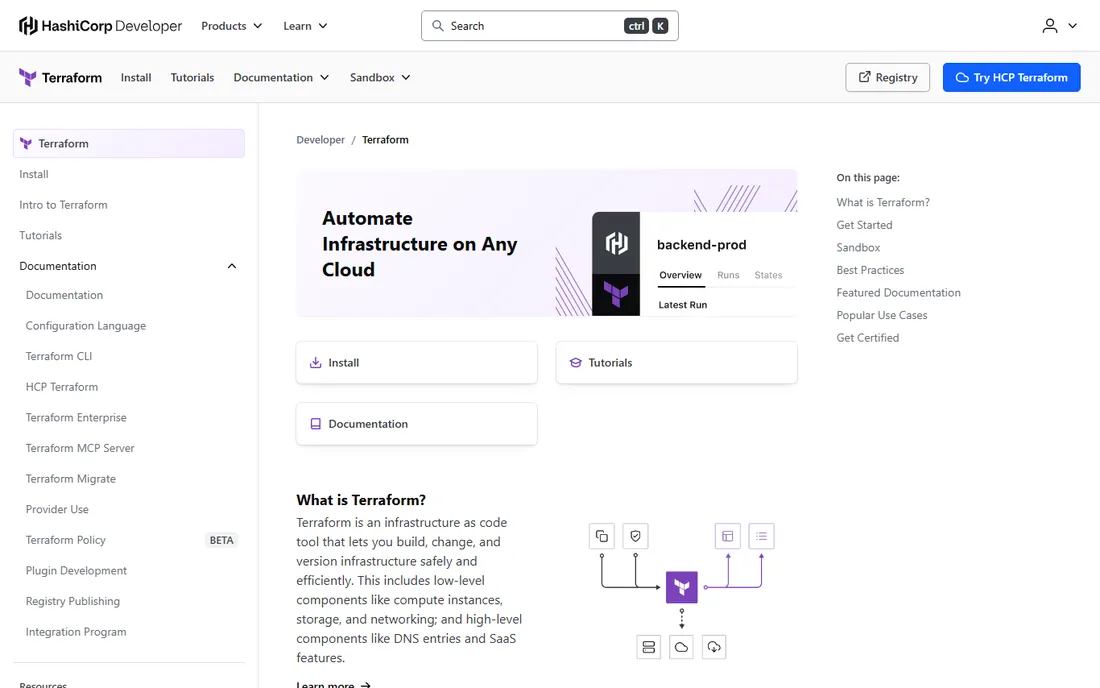
Terraform is the infrastructure-as-code standard: describe compute, storage, networking, DNS, and SaaS resources in configuration language, then build, change, and version infrastructure safely. It provisions across clouds and providers, with HCP Terraform adding collaboration, and a free tier to start. Certification programs and extensive tutorials lower the learning curve.
The honest framing: Terraform provisions infrastructure; it does not configure what runs inside servers, which is why teams pair it with Ansible, Puppet, or Chef. If your problem is cloud resources rather than server state, Terraform is the answer. HashiCorp's acquisition by IBM has not changed the open-source core.
What we like- The standard for provisioning infrastructure as code
- Provider ecosystem covers every cloud
- HCP Terraform adds collaboration
Watch out for- Provisioning-focused, not a configuration manager
- State management is the classic pain point
- Now under IBM via HashiCorp
Starting priceSee website
Free planYes
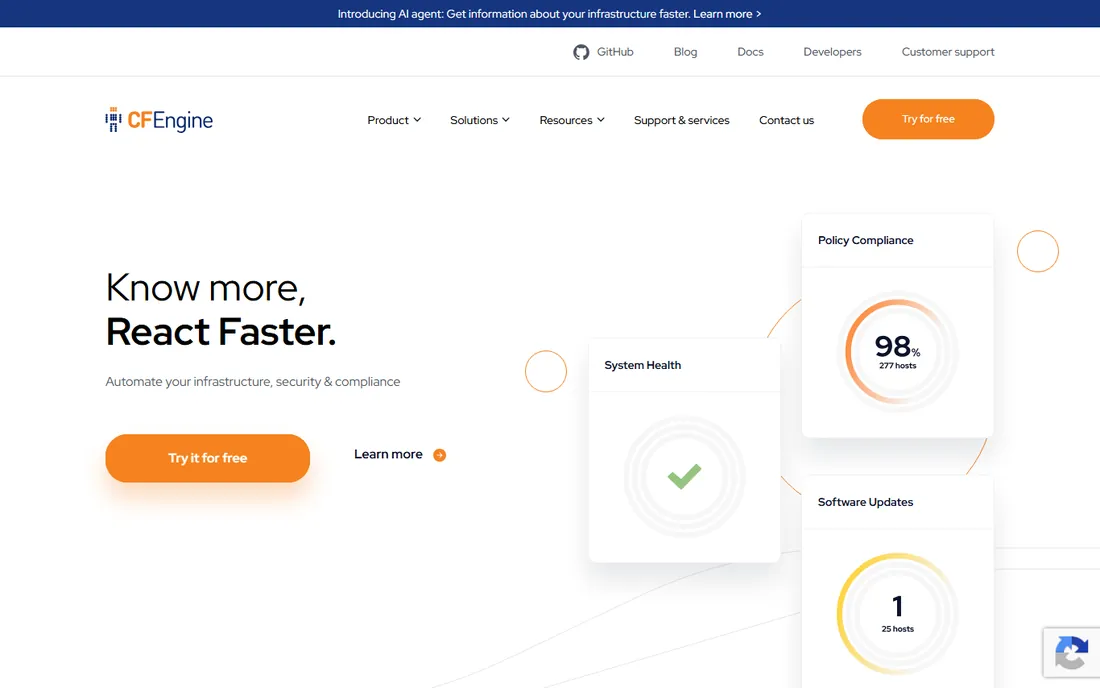
CFEngine pioneered the configuration management category and still runs some of the world's most critical infrastructures, trusted by names like Pfizer, Novartis, and the Department of Energy. It is famously lightweight, with a community edition under open-source license and an enterprise edition adding inventory, compliance reports, APIs, and dashboards. A new CFEngine AI agent answers infrastructure questions in natural language.
The honest note: CFEngine's ecosystem is smaller and older than its rivals, and the tooling feels dated. But its tiny footprint and decades of stability make it the right choice for resource-constrained environments and teams that value proven reliability over fashion.
What we like- Pioneered configuration management with tiny footprint
- Community edition is open source
- New CFEngine AI agent for infrastructure questions
Watch out for- Older community and smaller ecosystem
- The interface shows its age
- Enterprise features are paid
Starting priceSee website
Free planYes
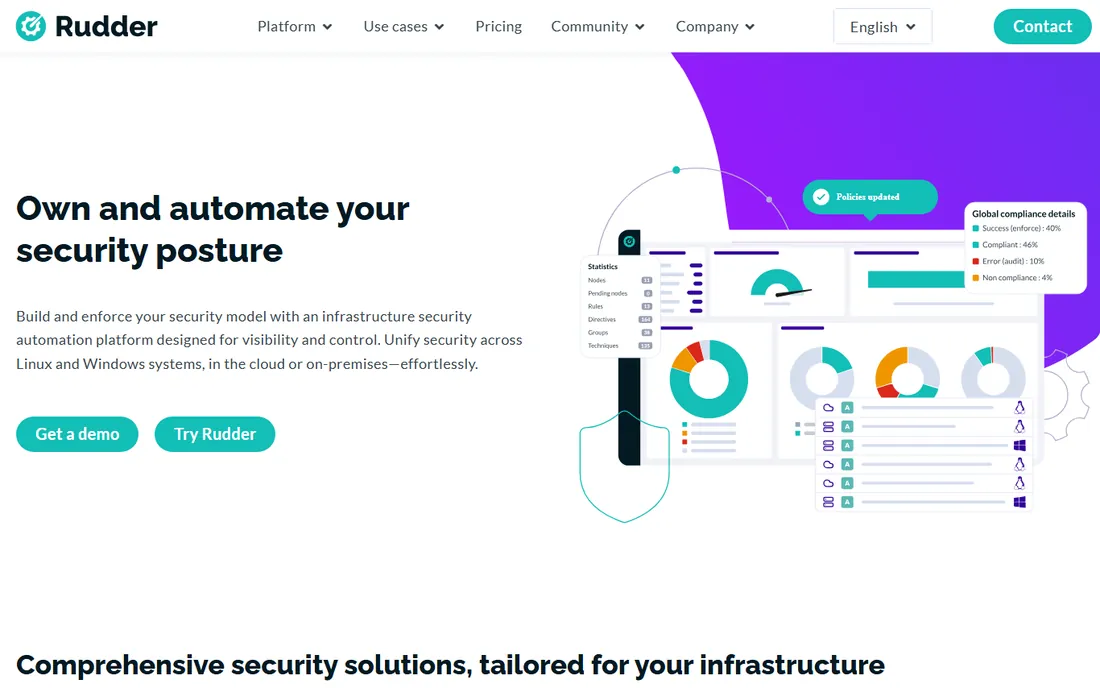
Rudder is the infrastructure security automation platform that manages configuration through a security lens: enforce security settings, automate patching, identify vulnerabilities, and audit compliance against CIS, NIST, and ISO 27001 benchmarks. The graphical interface and Rudder Score give real-time visibility across Linux and Windows systems, cloud or on-prem.
The honest framing: Rudder is really a security posture tool that does configuration management, not the other way around. Security-conscious teams that need both from one platform will love it. Pure DevOps shops wanting general automation will prefer Ansible or Terraform.
What we like- Security posture management built into configuration
- Compliance-by-design with CIS, NIST, and ISO 27001
- Graphical interface with real-time insights
Watch out for- Security-first framing may not fit pure DevOps teams
- Smaller community than Ansible
- Enterprise features are paid
Starting priceSee website
Free planNo
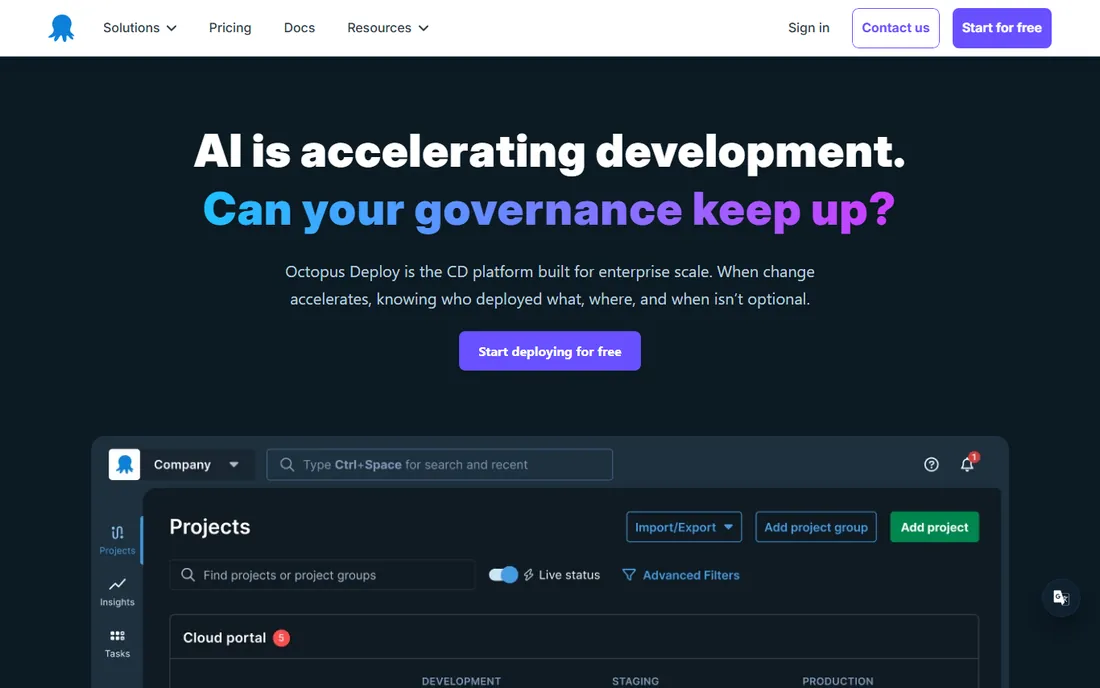
Octopus Deploy is the continuous delivery platform for DevOps teams: integrate with your existing CI tool, then let Octopus handle deployments with automated environment promotion, reusable processes, and real-time dashboards. It deploys to Kubernetes, multi-cloud, and on-prem, with enterprise-grade compliance features including RBAC, ITSM integrations, and audit logs.
The honest catch: Octopus is a deployment tool with configuration capabilities, not a configuration management engine; it assumes your CI tool builds and it ships. Teams drowning in deployment complexity get immediate relief. Teams needing server configuration enforcement should pair it with Ansible or Puppet.
What we like- Purpose-built for continuous delivery
- Deploys to Kubernetes, multi-cloud, and on-prem
- Enterprise compliance with RBAC and audit logs
Watch out for- Deployment-focused rather than configuration management
- No free tier
- Adds cost on top of CI tools
Starting priceSee website
Free planYes
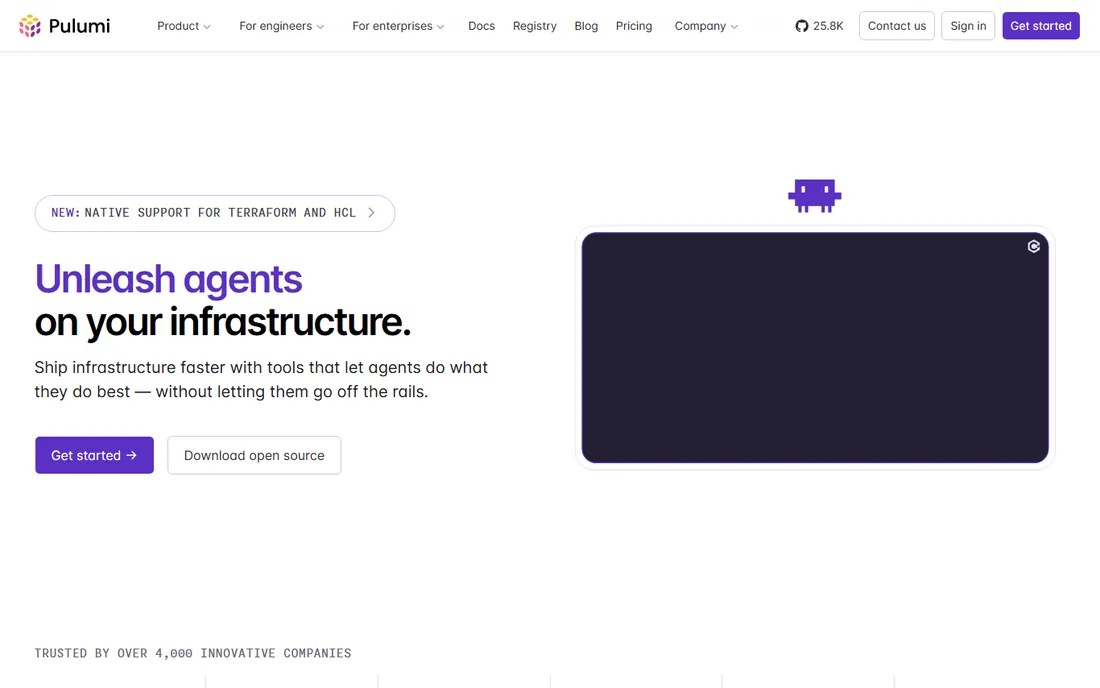
Pulumi is infrastructure as software: define, deploy, and manage cloud infrastructure using the programming languages your team already knows, including TypeScript, Python, Go, and .NET, or YAML and HCL. It brings policy as code, encrypted secrets, and full audit trails, with SOC 2 Type II certification. Open-source and trusted by 4,000+ companies, it now positions itself for the AI agent era with open-source agent skills.
The honest note: Pulumi's ecosystem is younger than Terraform's, with fewer providers and community modules. Development teams that already code will find it far more natural than HCL. Infrastructure teams invested in Terraform have little reason to switch.
What we like- Define infrastructure in TypeScript, Python, Go, or .NET
- Open source with agent-friendly tooling
- Trusted by 4,000+ companies including Snowflake
Watch out for- Programming skill required
- Younger ecosystem than Terraform
- The agent/AI positioning is new
How we chose
We verified each tool's current homepage by opening the live site and using the final resolved URL. Puppet is listed under its current Perforce ownership, Salt under the Salt Project, and Terraform under the HashiCorp developer site. No vendor publishes comparable starting prices for configuration management platforms, so all are listed as "See website". Free-plan status reflects the availability of a free open-source edition or free tier. We reviewed product pages and public documentation. We did not test any tool hands-on.
Agentless vs. agent-based
Ansible needs no agents, which makes it the fastest to start. Puppet, Chef, Salt, and Rudder install agents for continuous enforcement and richer state reporting. Choose agentless for simplicity, agents for control.
Provisioning vs. configuring
Terraform and Pulumi create cloud resources. Ansible, Puppet, Chef, Salt, CFEngine, and Rudder configure what runs on them. Most real environments use one of each: Terraform to provision, Ansible to configure.
The deployment layer
Octopus Deploy sits above both, shipping applications through environments. If your pain is releases rather than server state, start there and work down the stack.
The drift problem never goes away
Configuration management tools reduce drift; they do not eliminate it. Manual changes, emergency fixes, and cloud console clicks still happen. The teams that win combine tooling with discipline: immutable images where possible, enforced desired state where not, and monitoring that reports when reality differs from code.
Frequently asked questions
What is the best configuration management tool?
Ansible is the best starting point for most teams because it is agentless and free. Puppet and Chef lead for enterprise governance and compliance. Terraform and Pulumi lead for cloud infrastructure as code. The right tool depends on whether you need provisioning, configuration, or both.
Is Ansible really free?
Yes. Ansible's open-source engine is free to use, supported by thousands of contributors. Red Hat Ansible Automation Platform is the paid enterprise tier with support, hardening, event-driven automation, and AI features.
What is the difference between Terraform and Ansible?
Terraform provisions infrastructure: it creates servers, networks, and cloud resources. Ansible configures them: it installs software and settings inside those resources. Teams commonly use both together.
Which is better, Puppet or Chef?
Both are mature enterprise configuration management platforms. Puppet emphasizes continuous enforcement and compliance reporting; Chef emphasizes policy-as-code and DevOps workflows. Evaluate both against your team's skills and your audit requirements.
Do I need configuration management if I use Docker and Kubernetes?
You need less of it, but you still need it. Containers reduce server-level configuration, but hosts, networks, and non-containerized systems still drift. Many teams use Terraform and Kubernetes for the new world and Ansible or Puppet for what remains.
Is Salt still maintained after the Broadcom acquisition?
Yes. The Salt Project continues as an open-source project with documentation, releases, and a Discord community. Broadcom owns VMware, which stewards Salt. The roadmap reflects that ownership, so evaluate accordingly.
Sources we checked (9)
- https://ansible.com/
- https://www.puppet.com/
- https://www.chef.io/
- https://saltproject.io/
- https://www.terraform.io/
- https://cfengine.com/
- https://www.rudder.io/
- https://octopus.com/
- https://www.pulumi.com/
Is your product missing or out of date?
We review this list regularly. Vendors can request a listing, send updated pricing or ask about featured placement.

Shihab Mia · Founder, Rankite
Shihab has spent more than a decade helping SaaS and e-commerce brands grow through search. He writes Rankite's software buying guides from pricing pages, documentation and public user reviews. More about Shihab.