How we make this list: we compare pricing pages, product documentation and public user reviews. Rankite is independent; if a vendor ever pays for a featured spot, that listing is clearly labeled Partner.
Key takeaways
- Shopify is the default for most small businesses: fastest to launch, huge app ecosystem, and checkout tuned for conversion.
- WooCommerce costs nothing for the software itself and gives full ownership, but you manage hosting, updates, and security.
- BigCommerce includes more built-in features than Shopify, so high-volume stores often spend less on apps.
- Transaction fees decide the real cost: platforms charge extra unless you use their preferred payment processor.
Quick comparison
| Tool | Best for | Starting price | Free plan |
|---|
 Shopify Shopify | Fastest all-round store launch | $29/month (Basic) | Free trial |
 BigCommerce BigCommerce | High-volume and B2B catalogs | $39/month | Free trial |
 WooCommerce WooCommerce | WordPress owners wanting full control | $0 (plus hosting costs) | Yes |
 Wix Wix | Simple stores with guided setup | $29/month | No |
 Squarespace Squarespace | Design-led storefronts | $25/month | No |
 Ecwid Ecwid | Adding a store to an existing site | $5/month | Yes |
 Shift4Shop Shift4Shop | Free platform for US merchants | $0 with Shift4 payments | Yes |
 Volusion Volusion | Long-standing SMB cart with US support | $29/month | Free trial |
Is your product missing or out of date?
We review this list regularly. Vendors can request a listing, send updated pricing or ask about featured placement.
Should you rent a hosted platform or own your store outright with open-source software? That single decision shapes everything downstream: your monthly bill, who fixes things when they break, and how painful a future migration will be. The eight platforms below cover both paths, from free carts to enterprise-grade SaaS.
Starting price$29/month (Basic)
Free planFree trial

Shopify is the default recommendation for a reason. The Basic plan at $29 a month includes hosting, SSL, PCI compliance, abandoned cart recovery, and a checkout flow refined across millions of stores. The app store covers everything from subscriptions to print-on-demand, and the POS system unifies online and in-person selling.
The costs beyond the subscription deserve attention. Apps routinely add $30 to $80 a month, and using any payment processor other than Shopify Payments triggers extra transaction fees of 0.5 to 2 percent. For most product businesses, though, the speed of launch and the conversion-tuned checkout outweigh those costs.
What we like- Launch a store in a day with no code
- Best-converting checkout in the industry
- 8,000-plus apps for any feature
Watch out for- Transaction fees unless you use Shopify Payments
- Monthly app costs add up fast
- Deeper customization needs Liquid coding
Starting price$39/month
Free planFree trial

BigCommerce targets merchants who find Shopify's app bills annoying. Multi-currency selling, advanced product filtering, customer groups, and strong SEO controls come built in rather than as paid add-ons. There are no transaction fees on any plan regardless of payment processor, which matters once volume grows.
The entry plan starts at $39 a month, and each tier carries an annual online sales limit that forces an upgrade when you exceed it. Abandoned cart emails, standard on Shopify's Basic, require the Plus plan here. For scaling B2C brands and B2B sellers who need customer-specific pricing, BigCommerce is often the cheaper long-term home.
What we like- More built-in features than Shopify, fewer paid apps needed
- Strong native SEO controls
- No transaction fees on any plan
Watch out for- Theme selection smaller than Shopify's
- Abandoned cart recovery only on Plus and up
- Annual sales caps push upgrades
Starting price$0 (plus hosting costs)
Free planYes
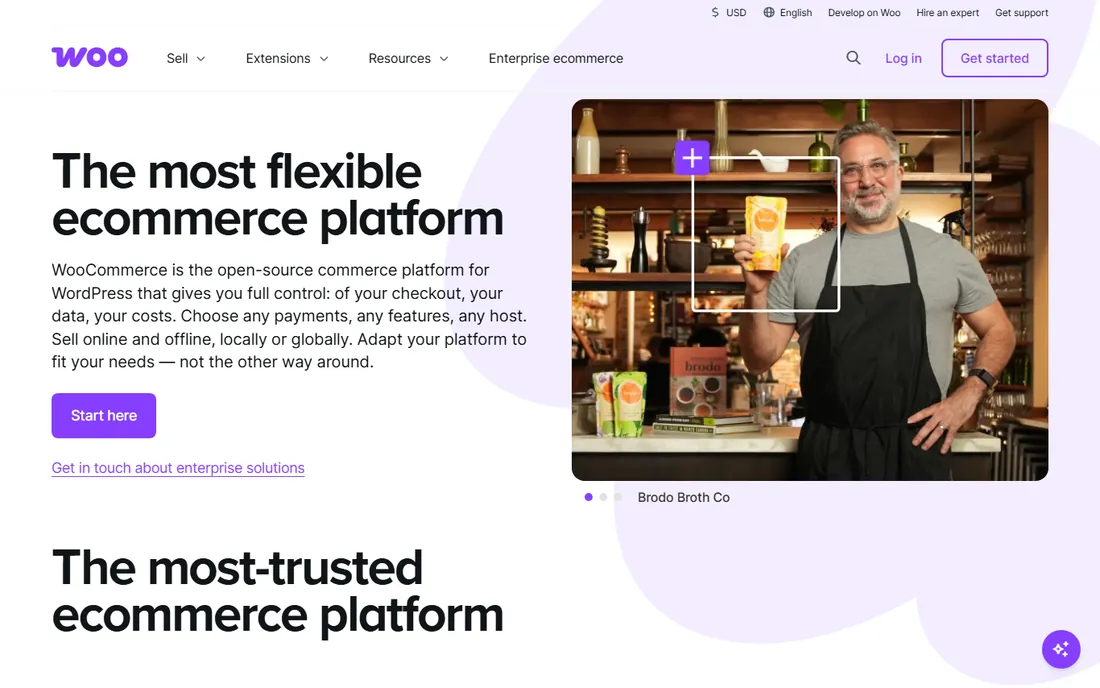
WooCommerce turns any WordPress site into a store for the price of hosting. The plugin itself is free and open source, there are no platform transaction fees, and the extension marketplace covers subscriptions, bookings, memberships, and nearly every payment gateway. You own your data outright, which matters to businesses wary of platform lock-in.
Ownership cuts both ways. Updates, security, backups, and speed optimization are your job or your developer's, and a bloated plugin stack can slow a store badly. Budget for decent hosting, not the cheapest shared plan, plus premium extensions that often run $50 to $200 a year each. For WordPress-savvy teams, it is the most flexible cart available at any price.
What we like- Free open-source software you fully own
- Unlimited customization through plugins and code
- No platform transaction fees
Watch out for- You manage hosting, updates, backups, and security
- Costs shift to hosting and premium extensions
- Performance depends on your setup
Starting price$29/month
Free planNo

Wix works for sellers whose store is one part of a broader website. The editor that builds your pages builds your product listings too, so a boutique, artist, or service business can add commerce without learning a second system. Plans with online payments start around $29 a month and include abandoned cart recovery.
Scale is where Wix shows its limits. Inventory management, variant handling, and reporting are fine for dozens of products but strain past a few hundred. Businesses that expect to grow into serious volume usually graduate to Shopify or BigCommerce within a couple of years. As a first store for a small catalog, though, it is hard to set up wrong.
What we like- True drag-and-drop store builder
- Sell on social and marketplaces from one dashboard
- Gentle learning curve
Watch out for- Ecommerce features trail dedicated platforms
- Weaker inventory tools for large catalogs
- Transaction fees on some gateways
Starting price$25/month
Free planNo

Squarespace sells the way it builds websites: through design. If your products photograph well and brand presentation drives purchases, think fashion, art, specialty food, the templates here outperform every other platform on this list visually. Commerce plans start at $25 a month with unlimited products, and built-in email campaigns reduce the need for a separate marketing tool.
The commerce engine is narrower than Shopify's. Payment options center on Stripe, PayPal, and Apple Pay, multi-currency selling is limited, and the extension library is a fraction of the size. For design-first brands with straightforward selling needs, those limits rarely bite. For complex operations, they will.
What we like- Beautiful templates that make products look premium
- Built-in email campaigns and scheduling
- Simple inventory and tax tools
Watch out for- Fewer payment gateway options
- Limited multi-currency support
- App ecosystem much smaller than Shopify's
Starting price$5/month
Free planYes
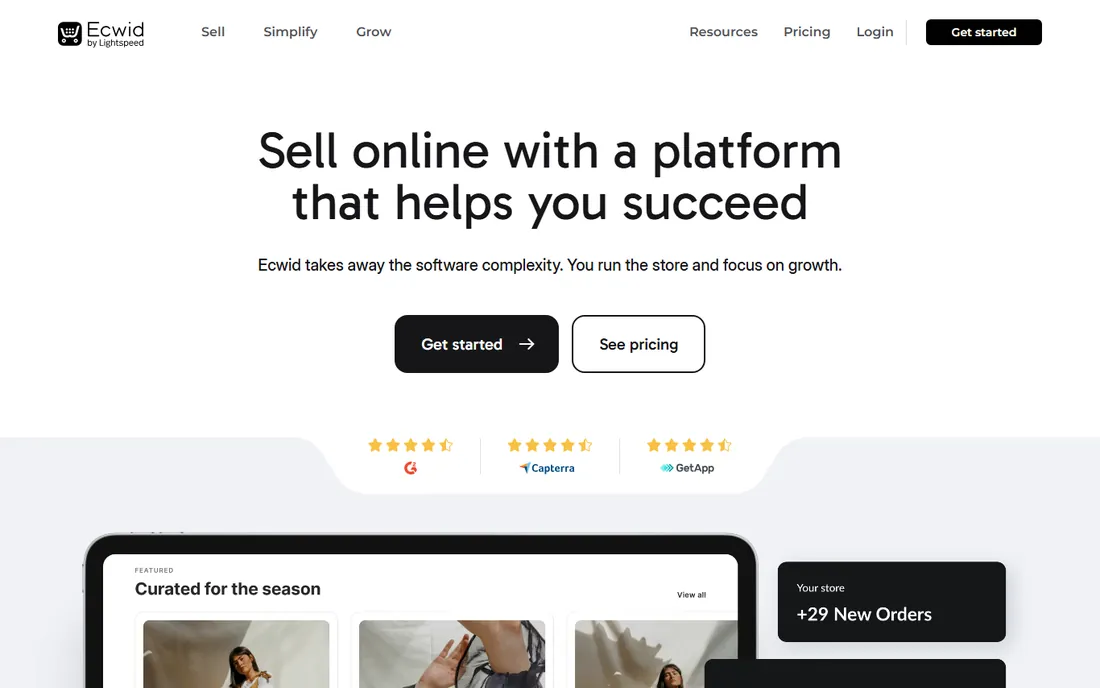
Ecwid answers a specific question: what if you already have a website and just need a cart? Instead of rebuilding on Shopify, you embed Ecwid's store into your current WordPress, Wix, Squarespace, or custom site. The free plan covers 10 products, and paid plans start at $5 a month, making it the cheapest path to selling online.
As a primary platform it is less compelling. The standalone Instant Site is functional but plain, and design control lags behind full builders. But for businesses with an established site, a blog audience, or a nonprofit that needs a small gift shop, Ecwid adds commerce without a migration. It also syncs one catalog across your site, Instagram, Facebook, and in-person POS.
What we like- Embeds into any existing website
- Free plan for up to 10 products
- Sells on social, marketplaces, and POS from one catalog
Watch out for- Standalone storefront is basic
- Advanced features need higher tiers
- Design customization is limited
Starting price$0 with Shift4 payments
Free planYes

Shift4Shop, formerly 3dcart, makes an aggressive offer: the complete platform is free for US merchants who process at least $500 a month through Shift4 payments. That includes the website builder, product management, SEO tools, email marketing, and abandoned cart recovery, features that cost extra elsewhere.
The catch is the lock-in. Leave Shift4 processing and the platform starts at $29 a month, and the whole value proposition assumes you are happy with their payment rates. The admin interface also shows its age next to Shopify's polish. For US merchants comfortable consolidating payments and platform with one vendor, though, the savings are real and immediate.
What we like- Full-featured platform free when you process with Shift4
- Hundreds of built-in features
- Strong SEO and marketing tools
Watch out for- Free plan tied to Shift4 payment processing
- Interface feels dated
- Smaller app ecosystem than leaders
Starting price$29/month
Free planFree trial
Volusion has sold shopping carts since 1999, and it shows in the depth of the commerce features: inventory management, customer CRM, loyalty programs, and deal-of-the-day tools come standard rather than as apps. Support is US-based and available around the clock, a genuine comfort for owners who want a human on the phone.
The platform has not kept pace visually. Templates look dated next to Squarespace or Shopify, and the integration ecosystem is modest. At $29 a month to start, it competes directly with Shopify's Basic while offering less modern tooling. Volusion fits established small retailers who value proven commerce depth and phone support over modern design.
What we like- Decades of ecommerce focus
- US-based support with strong reputation
- Solid built-in inventory and CRM tools
Watch out for- Design templates lag modern competitors
- Pricing less competitive than newer rivals
- Smaller third-party integration library
Hosted or open-source: picking your path
Hosted platforms like Shopify, BigCommerce, Wix, Squarespace, Ecwid, Shift4Shop, and Volusion bundle hosting, security, updates, and PCI compliance into the subscription. You trade some control for the guarantee that the store works while you sleep. For most small businesses without technical staff, this is the right trade.
WooCommerce is the open-source alternative. You pay for hosting instead of a platform subscription, you own everything, and no vendor can raise your rates or change your terms. The price is responsibility: updates, security patches, backups, and performance tuning sit with you. Choose it when control and ownership outweigh convenience, or when WordPress already runs your content.
What to compare beyond the monthly price
Transaction fees often exceed the subscription in importance. Shopify adds 0.5 to 2 percent unless you use Shopify Payments; BigCommerce charges none; WooCommerce charges none beyond your gateway's own rates. Model fees at your actual volume before choosing.
Checkout and conversion
Abandoned cart recovery, one-page checkout, and digital wallets directly affect revenue. Shopify's checkout converts best in independent tests, and every platform here includes cart recovery at least on mid-tier plans. If mobile traffic dominates your audience, test the checkout on a phone before committing.
Migration cost
Switching platforms later means moving products, customers, order history, and SEO equity. It is always more painful than expected. If you plan to grow from 50 to 5,000 products, start on a platform that handles 5,000, even if it costs more today.
Total app and extension spend
The sticker price is the floor. Shopify stores commonly add $30 to $80 a month in apps; WooCommerce shifts the cost to premium extensions and better hosting. Ask what your must-have features cost as add-ons, not just what the base plan includes.
How we chose
We compared current pricing pages, feature documentation, and transaction fee schedules from each vendor, then cross-checked against hands-on reviews from TechRadar, Fit Small Business, and community discussions on G2, Capterra, and Reddit. We weighted what matters to small and mid-size US sellers: total cost including fees and apps, ease of launch, checkout quality, scalability, and support. We did not claim hands-on testing of any platform; rankings reflect documented features, published pricing, and reviewer consensus.
Frequently asked questions
What is the cheapest way to start an online store?
Ecwid's free plan and WooCommerce's free plugin are the cheapest starts, with Shift4Shop free for US merchants processing through Shift4. Expect real costs from payment processing fees of around 2 to 3 percent per transaction no matter which platform you choose.
Is Shopify worth $29 a month for a small store?
For most product businesses, yes. The hosted security, best-in-class checkout, and app ecosystem save more in time and converted sales than the subscription costs. It stops being worth it only for very low-volume hobby stores, where Ecwid's free tier or WooCommerce make more sense.
Do I need a developer for WooCommerce?
Not to launch a basic store, but budget for technical help as you grow. Updates, security, backups, and performance tuning are your responsibility. Stores doing meaningful revenue usually keep a developer on call, which offsets the savings on platform fees.
Can I migrate my store to another platform later?
Yes, but it is rarely clean. Products and customers usually transfer; order history, URL structure, and SEO rankings often do not. If you expect significant growth, choose a platform that scales to your three-year target now rather than planning a migration later.
Which platform is best for selling on social media?
Shopify and Ecwid lead here, with native integrations for Instagram, Facebook, TikTok Shop, and Google Shopping. Wix and Squarespace cover the basics. If social commerce is your main channel, Shopify's Starter plan at $5 a month is the cheapest entry to its selling tools.
Sources we checked (12)
- https://www.shopify.com
- https://www.bigcommerce.com
- https://woocommerce.com
- https://www.wix.com/
- https://squarespace.com/
- https://www.ecwid.com
- https://www.shift4shop.com/
- http://www.volusion.com
- https://fitsmallbusiness.com/best-ecommerce-platform-comparison/
- https://www.omnisend.com/blog/best-ecommerce-platform/
- https://www.techradar.com/best/best-shopping-cart-software
- https://www.importify.com/blog/the-top-16-shopping-cart-software-solutions-for-your-business-for-2023/
Is your product missing or out of date?
We review this list regularly. Vendors can request a listing, send updated pricing or ask about featured placement.

Shihab Mia · Founder, Rankite
Shihab has spent more than a decade helping SaaS and e-commerce brands grow through search. He writes Rankite's software buying guides from pricing pages, documentation and public user reviews. More about Shihab.