How we make this list: we compare pricing pages, product documentation and public user reviews. Rankite is independent; if a vendor ever pays for a featured spot, that listing is clearly labeled Partner.
Key takeaways
- ZoomInfo is the enterprise standard with 500 million contacts, but pricing is quote-only and contracts run large.
- Apollo.io at $49 a user a month is the best database app for startups: contact data plus outreach sequences in one tool, with a free plan.
- Lusha at $37 a month suits individual reps and small teams that need fast, accurate lookups without enterprise process.
- Clay at $167 a month is the enrichment specialist: waterfall data from 150+ providers for teams that build their own workflows.
- Cognism is the pick for EMEA teams where GDPR compliance and verified mobile numbers matter most.
Quick comparison
| Tool | Best for | Starting price | Free plan |
|---|
 ZoomInfo ZoomInfo | enterprise teams needing deep data and intent | See website | Yes |
 Apollo.io Apollo.io | startups wanting data plus outreach in one | $49 per user/month (billed annually) | Yes |
 Lusha Lusha | SMBs needing fast accurate lookups | $37/month (billed annually) | Yes |
 Cognism Cognism | EMEA teams with strict compliance needs | See website | No |
 Clay Clay | waterfall enrichment for ops teams | $167/month (billed annually) | Yes |
 RocketReach RocketReach | broad coverage for niche roles and regions | See website | No |
 UpLead UpLead | verified small lists with accuracy guarantee | $99/month | No |
 Hunter.io Hunter.io | finding and verifying business emails | $33/month (billed annually) | Yes |
 SalesIntel SalesIntel | US teams wanting human-verified data | $69/month | Free trial |
Is your product missing or out of date?
We review this list regularly. Vendors can request a listing, send updated pricing or ask about featured placement.
The best sales database software
ZoomInfo's database holds 500 million contacts across more than 100 million companies (ZoomInfo, 2026). That scale explains both the promise and the problem of sales database software: the data exists, but its accuracy, freshness, and compliance vary enormously between vendors, and the wrong choice means bounced emails, wasted SDR hours, and legal exposure.
A sales database gives revenue teams the people to contact: names, titles, emails, phone numbers, and company firmographics, increasingly layered with buying intent signals and technographics. The category splits between enterprise platforms with intent data and workflow depth, and focused tools that do lookups or enrichment brilliantly at a fraction of the price.
The nine tools below cover both ends. Pricing models differ more here than in any other category in this batch: per-seat subscriptions, credit systems, and quote-based enterprise contracts all compete, and the credit math often matters more than the subscription price.
Starting priceSee website
Free planYes
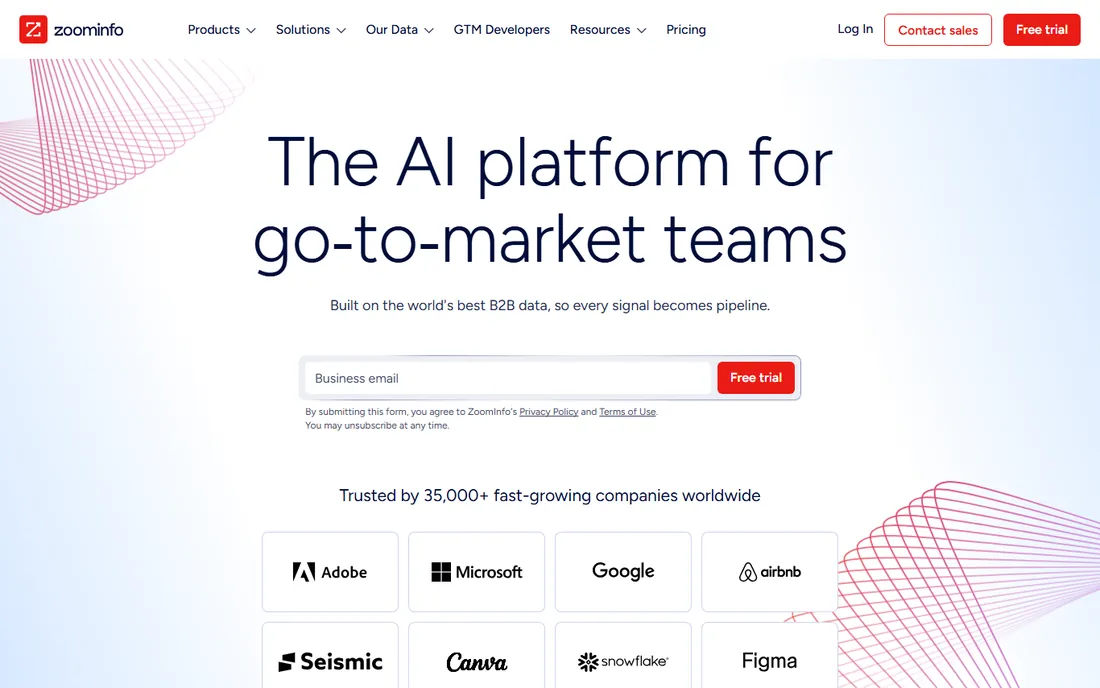
ZoomInfo is the default enterprise answer: the largest contact database, layered with intent data, org charts, technographics, and website visitor identification, all feeding a GTM Workspace where sellers research, prioritize, and act. Mid-market and enterprise teams that want one platform for data and workflow consolidation usually end up here.
The cost is the conversation. Contracts are quote-based and average in the tens of thousands annually, with multi-seat minimums. Smaller teams find the sales process itself a filter. ZoomInfo Lite offers a free starting point with limited monthly credits. For enterprises where data quality directly drives pipeline, the price is defensible. For everyone else, Apollo or Lusha deliver most of the value at a tenth of the cost.
What we like- Deepest B2B database with intent layers
- Org charts and technographics
- GTM Workspace unifies workflow
Watch out for- Quote-only pricing with large minimums
- Contract terms draw complaints
#2
Apollo.io
Best for: startups wanting data plus outreach in one
Visit apollo.io
Starting price$49 per user/month (billed annually)
Free planYes
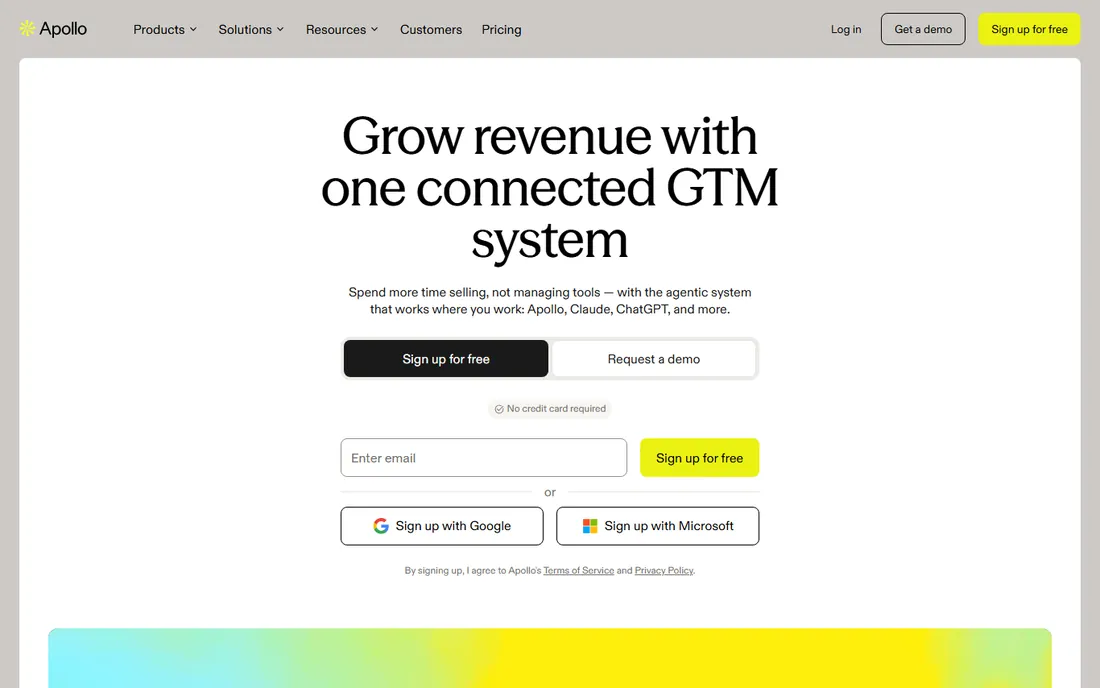
Apollo.io is the best database app for teams that want prospecting and outreach in a single login. The database covers 275 million contacts, and paid plans add email sequences, a dialer, and task workflows, so SDRs go from list to outreach without switching tools. The $49-a-user Basic plan is public and self-serve, a stark contrast to ZoomInfo's quote process.
The free plan with limited credits lets small teams start immediately. The watch-out is credit burn: enrichment, email finding, and phone numbers consume credits at different rates, and heavy users hit limits faster than the seat price suggests. For startups and SMBs running outbound, Apollo's combination of data, outreach, and transparent pricing is the category's best value.
What we like- Contact database plus sequences and dialer in one
- Transparent per-seat pricing
- Generous free plan
Watch out for- Credit consumption needs monitoring
- Data depth lags ZoomInfo at enterprise scale
Starting price$37/month (billed annually)
Free planYes
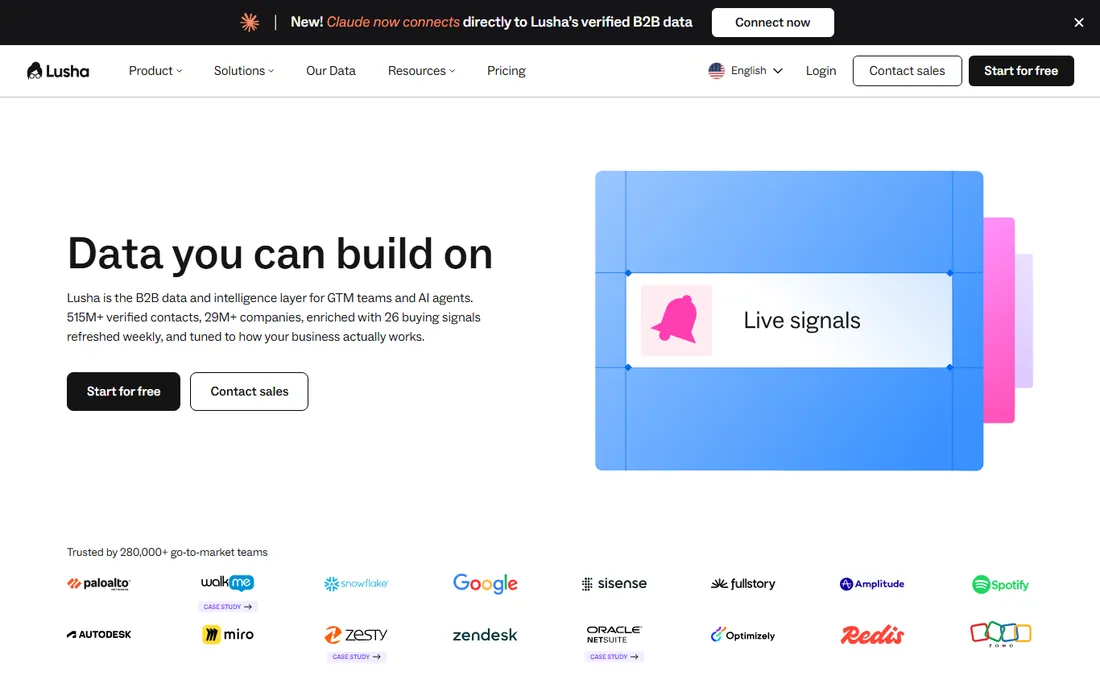
Lusha wins the individual rep use case: a browser extension and simple interface that turns a LinkedIn profile or company page into verified contact details in seconds. The $37-a-month annual plan undercuts every full database here, and the free tier's 40 monthly credits cover light users entirely.
Accuracy scores well in third-party testing, and buying signals add prospecting intelligence unusual at this price. The limitations are scale: credit ceilings frustrate heavy prospectors, and there is no enterprise workflow layer. Lusha fits founders, individual AEs, and small teams that need reliable lookups without a platform commitment. High-volume outbound teams will outgrow it.
What we like- Fast accurate individual lookups
- Low $37 entry price
- Buying signals included
Watch out for- Low credit ceilings on cheaper plans
- Not built for enterprise workflows
Starting priceSee website
Free planNo
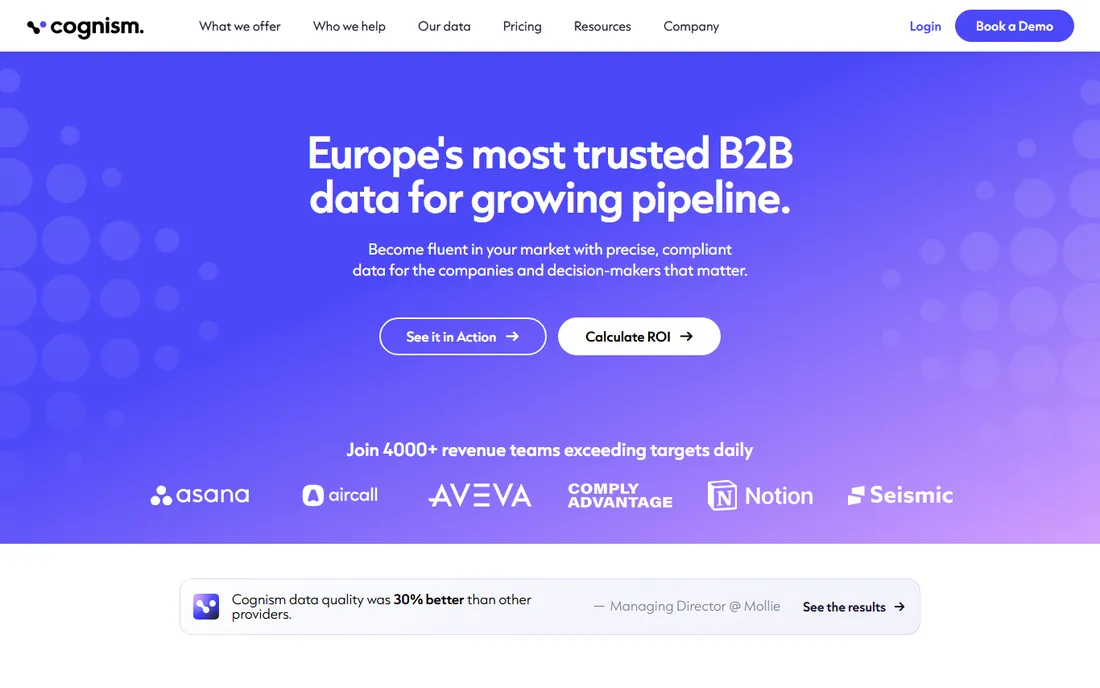
Cognism owns the European sales data market by solving its hardest problem: compliance. Its database is built GDPR-first, with phone-verified mobile numbers through the Diamond Data program that give SDRs connect rates US databases cannot match in Europe. For teams selling into the UK, DACH, and the Nordics, that combination is decisive.
Pricing is quote-only and enterprise-shaped, which rules out small teams. US coverage is thinner than ZoomInfo's, so American teams should look elsewhere. But for EMEA-focused revenue teams where a compliance mistake costs more than any subscription, Cognism is the specialist pick that generalist databases cannot replace.
What we like- GDPR-aligned data with phone-verified mobiles
- Strongest EMEA coverage
- Diamond Data quality program
Watch out for- Quote-only pricing
- Not viable for tiny teams or tight budgets
Starting price$167/month (billed annually)
Free planYes
Clay is not a database but a database of databases: it waterfalls enrichment across more than 150 data providers, trying each in sequence until it finds the email or phone number you need. That architecture delivers match rates no single provider achieves. Workflow automation then routes enriched leads into CRMs, sequences, and custom processes.
The $167-a-month annual entry price and the technical learning curve position Clay for revenue operations teams, not individual reps. Setup requires thinking in workflows rather than searches. But for teams whose current enrichment misses too many contacts, Clay's waterfall approach typically lifts match rates dramatically. It complements rather than replaces tools like Apollo: many teams prospect in Apollo and enrich in Clay.
What we like- Waterfall enrichment across 150+ providers
- Powerful workflow automation
- Free plan to start
Watch out for- Technical setup required
- $167 entry is steep for simple lookup needs
Starting priceSee website
Free planNo
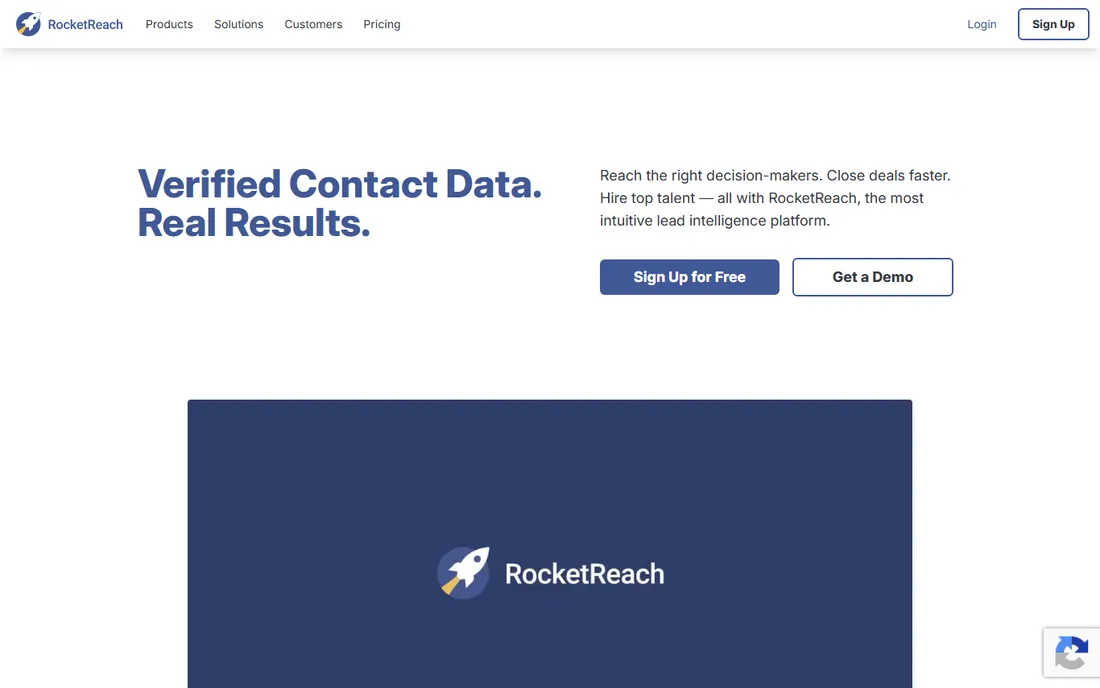
RocketReach specializes in the hard-to-find: C-suite personal emails and cell numbers with 90 to 94 percent accuracy for senior decision-makers. The 700-million-contact database emphasizes quality on executive records over breadth everywhere. Bulk lookup processes thousands of names via CSV upload, and the Chrome extension enriches profiles in real time.
It works best as a complement to a broader database: account-based teams use Apollo or ZoomInfo for list building and RocketReach for the executive contacts those tools miss. Pricing starts in the tens of dollars monthly but the exact tiers shift, so confirm current rates. For named-account strategies targeting senior buyers, it earns its place in the stack.
What we like- 700M+ contacts with executive specialization
- Bulk lookup via CSV
- Real-time browser enrichment
Watch out for- Pricing transparency weaker than Apollo or Lusha
- Firmographic depth lags ZoomInfo
#7
UpLead
Best for: verified small lists with accuracy guarantee
Visit uplead.com
Starting price$99/month
Free planNo
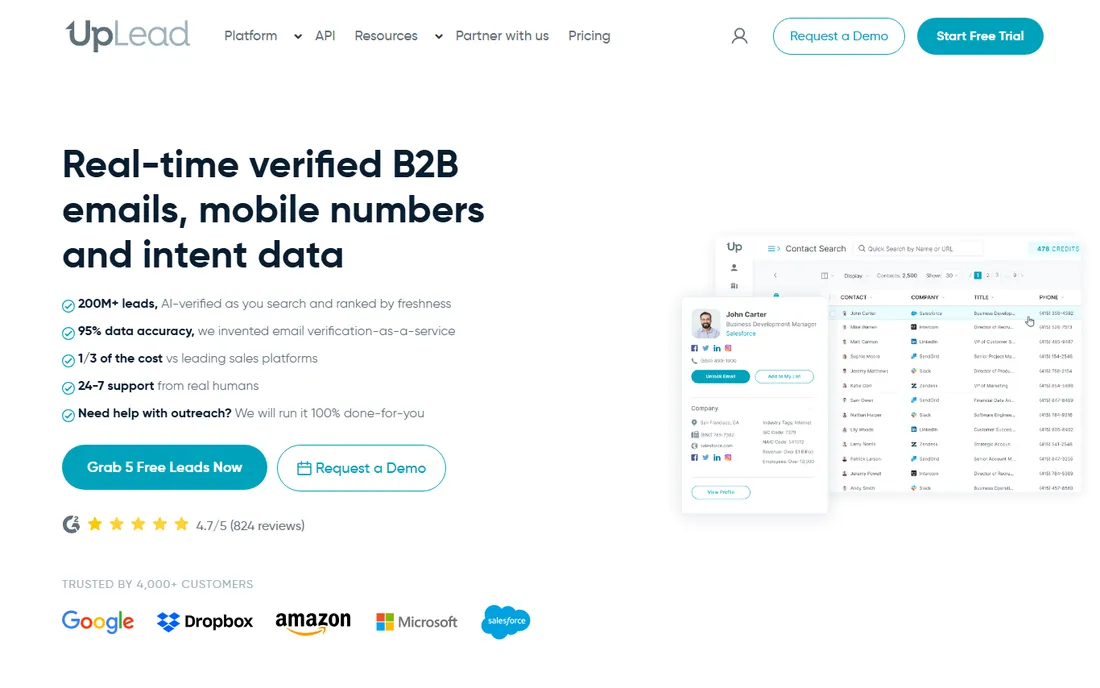
UpLead trades scale for trust: every email is verified in real time, and the 95 percent accuracy guarantee comes with credit refunds for bounces. The $99-a-month Essentials plan suits teams that would rather have 5,000 verified contacts than 50,000 uncertain ones. The interface is straightforward and the learning curve is short.
The database is smaller than ZoomInfo's or Apollo's, and there is no built-in sequencing or dialer, so outbound teams pair it with an engagement tool. Credit caps limit high-volume users. UpLead fits small businesses and agencies building clean targeted lists where deliverability matters more than volume. If your bounce rate is the problem, this is the fix.
What we like- 95% accuracy guarantee with bounce refunds
- Real-time email verification
- Simple interface
Watch out for- Smaller database than the giants
- Minimal built-in outreach features
#8
Hunter.io
Best for: finding and verifying business emails
Visit hunter.io
Starting price$33/month (billed annually)
Free planYes
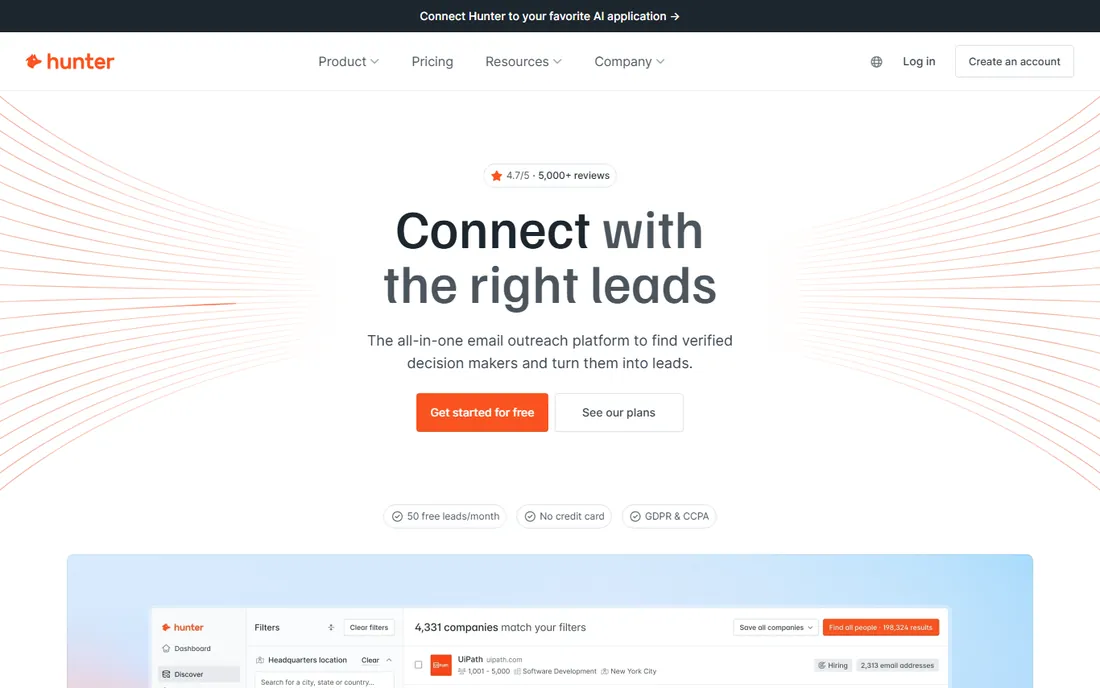
Hunter.io does one thing extremely well: find email addresses by domain and verify them. Type a company domain and get the email patterns, individual addresses, and confidence scores, with bulk verification for list cleaning. The $33-a-month annual plan and a free tier with monthly lookups make it the cheapest entry on this list.
It is email-only. There are no phone numbers, no intent data, no org charts, and minimal firmographics. That focus is the point: for link builders, recruiters, PR outreach, and anyone whose workflow is email-first, Hunter is faster and cheaper than a full database. Pair it with a phone data source when voice outreach matters.
What we like- Fastest domain-based email finding
- Excellent verification
- Free tier for light use
Watch out for- Email-only, no phone data
- Limited company intelligence
Starting price$69/month
Free planFree trial
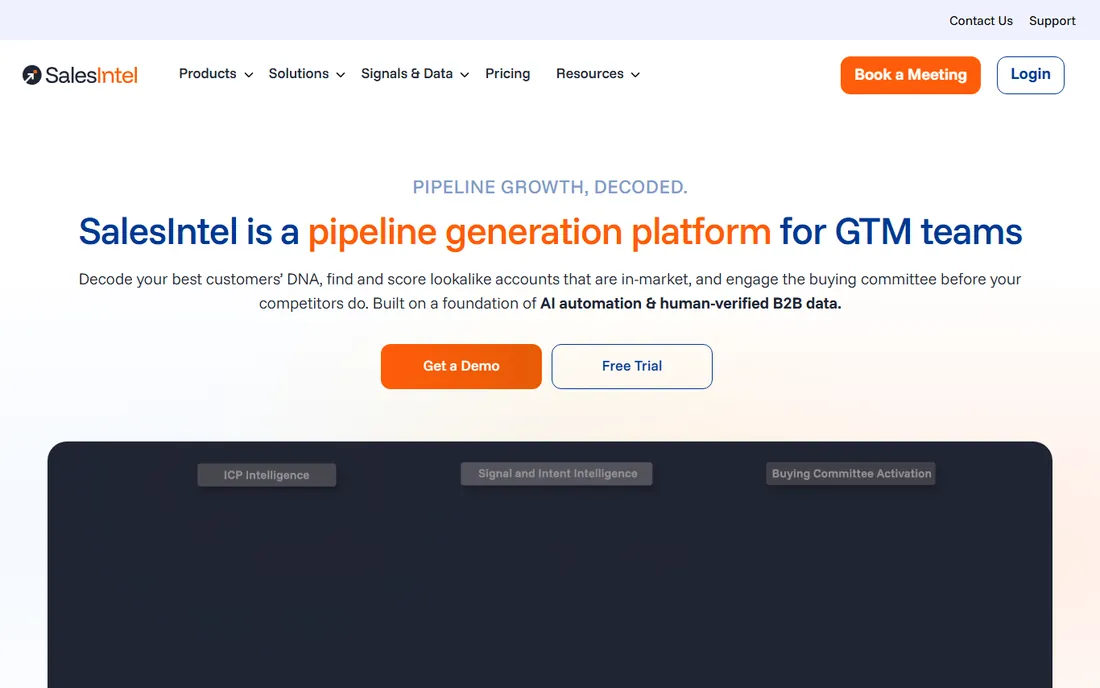
SalesIntel differentiates on verification method: human researchers verify data points rather than relying purely on algorithmic aggregation. The $69-a-month entry undercuts ZoomInfo significantly while offering intent data, technographics, and visitor identification in the same platform. US coverage is the strength; international teams should verify depth in their regions.
The 14-day trial is the only free evaluation, with no permanent free tier. Brand recognition lags ZoomInfo, which matters when buying committees compare vendor stability. For US-focused mid-market teams that want verified data and intent without enterprise contracts, SalesIntel is the value alternative worth trialing against Apollo.
What we like- Human-verified data accuracy
- Strong US coverage
- Intent data included
Watch out for- 14-day trial only, no free tier
- Smaller brand than ZoomInfo
How we built this shortlist
We compared sales database tools using vendor pricing pages, feature documentation, and review data from G2, Capterra, and sales technology publications. We weighted data accuracy and verification methods, database coverage by region, compliance posture, credit model transparency, CRM integrations, and pricing accessibility. We did not run hands-on trials, so accuracy claims reflect vendor publications and third-party testing rather than our own verification.
What to check before you buy
Test data accuracy on your actual ideal customer profile. Every vendor demos well on Fortune 500 tech companies. Upload or search 100 of your real target accounts, ideally in your actual regions and company sizes, and measure hit rates and bounce rates yourself. A database that is 95 percent accurate on US SaaS companies and 60 percent on German manufacturers is a different product depending on who you sell to.
Understand the credit model completely before signing. Credits are the real currency here: different actions burn credits at different rates, unused credits may not roll over, and overage pricing is rarely prominent. Ask each vendor for a written credit schedule and model it against your team's monthly prospecting volume. The subscription price is often the smaller half of the total cost.
Verify compliance for your jurisdictions. GDPR, CCPA, and evolving state privacy laws make data sourcing a legal question, not just a quality question. Ask where data comes from, how opt-outs are honored, and which certifications the vendor holds. Cognism leads here for Europe; US teams should still confirm CCPA handling with every vendor.
Check CRM integration depth, not just existence. "Integrates with Salesforce" ranges from one-way CSV-style syncs to bi-directional real-time enrichment with deduplication. Ask whether the integration writes to standard or custom fields, how duplicates are handled, and whether enrichment runs automatically on new records. Weak integrations create manual work that erodes the database's value.
Start with a free tier or trial and measure connect rates. Apollo, Lusha, Hunter, and Clay all offer free starting points. Run a real prospecting sprint on each finalist and compare meetings booked per hundred contacts, not just data volume. The best database app for your team is the one whose contacts answer, and only your data proves that.
Credit models: the pricing trap in sales databases
Credit-based pricing is the least transparent pricing in software, and it dominates this category. A "credit" can mean one email lookup, one phone number reveal, one enrichment, or one sequence enrollment depending on the vendor. Two tools at $49 a month can deliver wildly different amounts of actual prospecting depending on their credit schedules.
The traps are specific. Some vendors charge credits for data you already have, like re-enriching a record. Some expire unused credits monthly, punishing uneven prospecting rhythms. Some price phone numbers at multiples of email credits, which surprises teams adding cold calling mid-year. And enterprise contracts often include credit pools shared across seats, which sounds generous until three SDRs drain the quarter's allocation in month one.
The defense is modeling before buying. Take your team's actual monthly activity: new contacts added, emails found, phones revealed, records enriched. Run those numbers through each vendor's credit schedule and compare the effective cost per contacted prospect. Then ask about rollover, overage rates, and what happens when you exceed the pool mid-contract. The vendor that answers clearly usually has the fairest model.
Frequently asked questions
What is the best database app for B2B sales prospecting?
Apollo.io is the best all-around pick for most teams: contact data plus outreach sequences at a transparent $49 a user. ZoomInfo leads for enterprises, Lusha for individual reps, and Cognism for European teams.
How much does sales database software cost?
Lusha starts at $37 a month and Apollo at $49 a user, both with free tiers. UpLead runs $99 a month and Clay $167. ZoomInfo and Cognism are quote-based with contracts typically in the tens of thousands annually.
Are these databases GDPR compliant?
Compliance varies by vendor. Cognism is built GDPR-first for European data. US vendors handle GDPR and CCPA with varying rigor. Always ask about data sourcing, opt-out mechanisms, and certifications rather than accepting a compliance badge at face value.
What is waterfall enrichment?
Waterfall enrichment tries multiple data providers in sequence until it finds the contact detail you need. Clay popularized the approach with 150+ providers. It delivers higher match rates than any single database but requires more technical setup.
Can I use these tools with my CRM?
Yes, all major tools integrate with Salesforce and HubSpot, with varying depth. Confirm whether sync is bi-directional, how duplicates are handled, and whether enrichment runs automatically before committing.
Do free plans actually work for prospecting?
For light use, yes. Apollo, Lusha, Hunter, and Clay all offer free tiers with monthly credit limits that cover founders and tiny teams. High-volume outbound needs paid plans, but the free tiers are genuine evaluation tools, not demos.
Sources we checked (5)
- https://www.lusha.com/blog/best-b2b-contact-database/
- https://rankvise.com/blog/sales-intelligence-tools/
- https://pipeline.zoominfo.com/sales/lead-generation-software
- https://albato.com/blog/publications/best-data-enrichment-tools
- https://lagrowthmachine.com/lead-generation-database-2026/
Is your product missing or out of date?
We review this list regularly. Vendors can request a listing, send updated pricing or ask about featured placement.

Shihab Mia · Founder, Rankite
Shihab has spent more than a decade helping SaaS and e-commerce brands grow through search. He writes Rankite's software buying guides from pricing pages, documentation and public user reviews. More about Shihab.