How we make this list: we compare pricing pages, product documentation and public user reviews. Rankite is independent; if a vendor ever pays for a featured spot, that listing is clearly labeled Partner.
Key takeaways
- Workday HCM remains the enterprise default for the best HCM software, with its March 2026 launch of the Sana self-service agent showing where the category is heading.
- Oracle HCM Cloud and SAP SuccessFactors fit global enterprises with multi-country payroll and deep ERP integration.
- UKG Pro and Dayforce win with large hourly and shift-based workforces where scheduling and labor cost management matter most.
- ADP Workforce Now and Paylocity serve the mid-market, with Paycom offering the most unified single-database design.
- Rippling ($40/month base plus $8 per employee) and BambooHR ($10 per employee/month) are the only options here with published pricing, and they fit companies under 500 where HR and IT can live on one platform.
Quick comparison
| Tool | Best for | Starting price | Free plan |
|---|
 Workday HCM Workday HCM | Enterprises that want HR and finance on one governed platform | See website | No |
 Oracle HCM Cloud Oracle HCM Cloud | Global enterprises standardized on Oracle | See website | No |
 SAP SuccessFactors SAP SuccessFactors | SAP enterprises needing a complete HR suite | See website | No |
 UKG Pro UKG Pro | Large organizations with hourly and shift-based workforces | See website | No |
 Dayforce Dayforce | Mid-enterprise companies wanting payroll, time and talent on one database | See website | No |
 ADP Workforce Now ADP Workforce Now | Mid-market companies that prioritize compliance certainty | See website | No |
 Paylocity Paylocity | Mid-market companies that want modern UX with payroll depth | See website | No |
 Paycom Paycom | Companies that want employees to own their payroll data | See website | No |
 Rippling Rippling | Growing companies that want HR, payroll and IT on one platform | $40 per month base + $8 per employee/month | Free trial |
 BambooHR BambooHR | Small and mid-size companies that want HR simplicity first | $10 per employee/month (Core) | Free trial (7 days) |
Is your product missing or out of date?
We review this list regularly. Vendors can request a listing, send updated pricing or ask about featured placement.
The best human capital management software
What changed this year is the role AI plays inside these platforms. For years AI in HCM meant automating payroll runs and digitizing forms. In 2026 the focus moved to decision support: early attrition-risk detection, career-path recommendations, skill-adjacency modeling and manager coaching prompts. Workday illustrated the shift in March 2026 with Sana, a self-service agent carrying more than 300 skills across pay, time and absence that finds information and completes actions across connected applications.
Buyers changed with it. The question is no longer whether a platform has AI but whether that AI can show its work. The EU AI Act classifies AI systems used in employment contexts as high-risk, which pushed explainability, bias testing and audit trails to the front of enterprise buying decisions. If a platform cannot explain why it generated a promotion suggestion or a pay insight, many buyers now treat that as risk exposure rather than a feature gap. Governance moved from procurement paperwork to architecture.
That context shapes this list. The best HCM software in 2026 is judged on whether it runs the whole employee lifecycle on trustworthy data, from hire to retire, with AI that assists rather than decides. The enterprise suites below sell completeness and governance. The newer platforms sell speed and consolidation. Your headcount and workforce type decide which matters more.
#1
Workday HCM
Best for: Enterprises that want HR and finance on one governed platform
Visit workday.com
Starting priceSee website
Free planNo
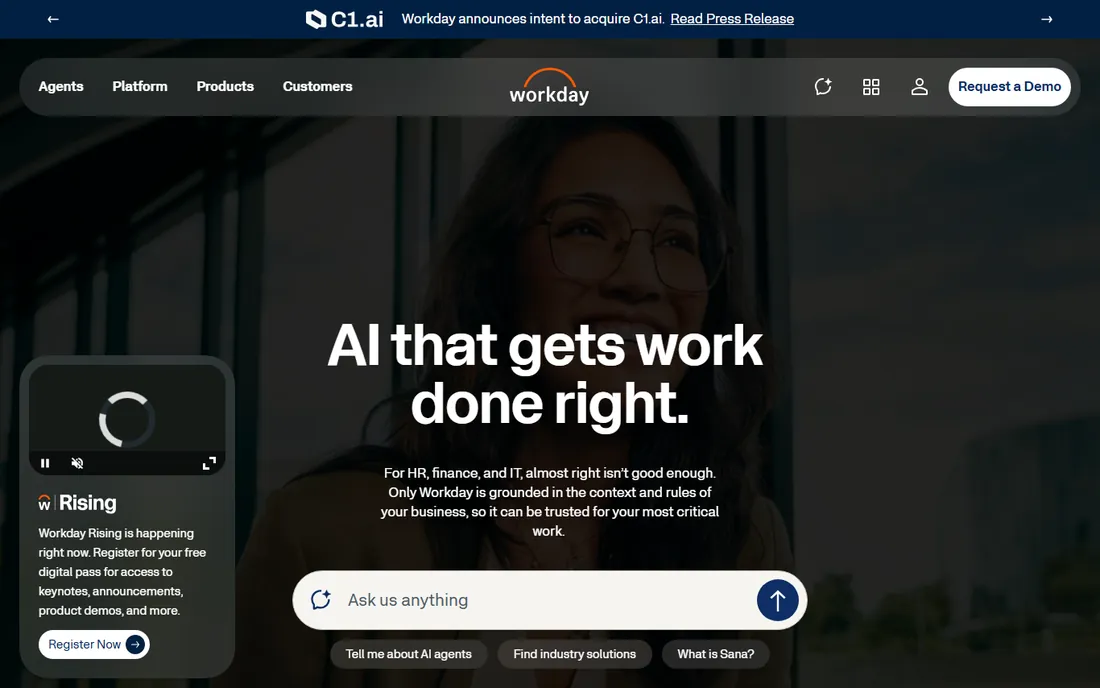
Workday is the reference point every other enterprise HCM gets measured against, and in 2026 it leaned into the two things buyers now demand: agentic AI and explainability. The March launch of Sana brought a self-service agent with hundreds of skills across pay, time and absence, designed to find information and complete actions rather than just answer questions. Workday has also positioned explainable AI inside its HCM stack to address the transparency concerns the EU AI Act made urgent.
The buying reality is unchanged: custom quotes, a sales-led process and an implementation measured in months, not weeks. Independent estimates put the software in the low-to-mid $30s per employee per month, with implementation often costing a large fraction of the first year's software spend. For organizations over a few thousand employees that need HR, payroll, talent and finance on one governed model, Workday remains the default shortlist entry. Below that scale, the cost and complexity rarely pay back.
What we like- Unified HCM and financials on one data model
- Explainable AI positioned for trust
- Strong talent and workforce planning
Watch out for- Quote-only pricing with long sales cycles
- Implementation is a major project
- Overkill for companies under 1,000 employees
#2
Oracle HCM Cloud
Best for: Global enterprises standardized on Oracle
Visit oracle.com
Starting priceSee website
Free planNo
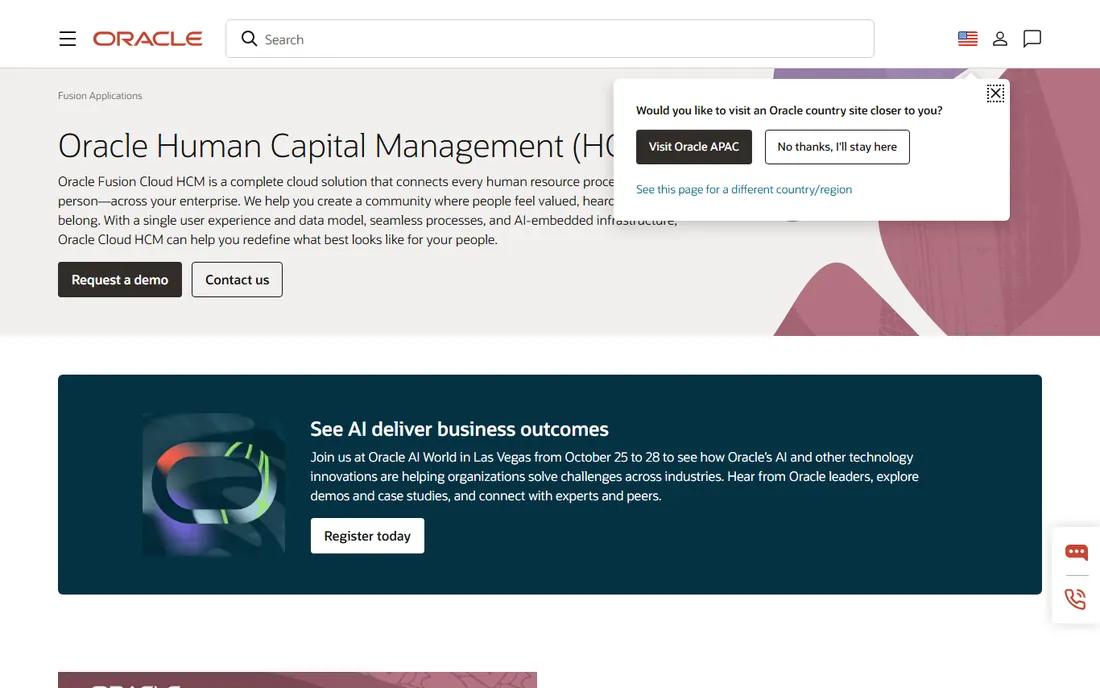
Oracle HCM Cloud is the choice when the ERP decision is already made. Running HR on the same platform as Oracle financials, procurement and supply chain gives finance and HR one data model for workforce cost, which is exactly what global enterprises pay for. Global payroll coverage and localization are deep, and the talent suite covers recruiting through succession at enterprise scale.
The tradeoffs are the familiar Oracle ones. Pricing is negotiated and opaque, implementations are large professional-services engagements, and the user experience, while improved, still feels built for administrators rather than employees. Companies on Oracle ERP should evaluate it first because the integration value is real and hard to replicate with a third party. Companies not on Oracle should compare it honestly against Workday, since switching ERP ecosystems is not a decision HR should make alone.
What we like- Deep integration with Oracle ERP and finance
- Strong global payroll and compliance coverage
- Mature talent management suite
Watch out for- Quote-only enterprise pricing
- Implementation complexity is high
- UX lags newer competitors
#3
SAP SuccessFactors
Best for: SAP enterprises needing a complete HR suite
Visit sap.com
Starting priceSee website
Free planNo
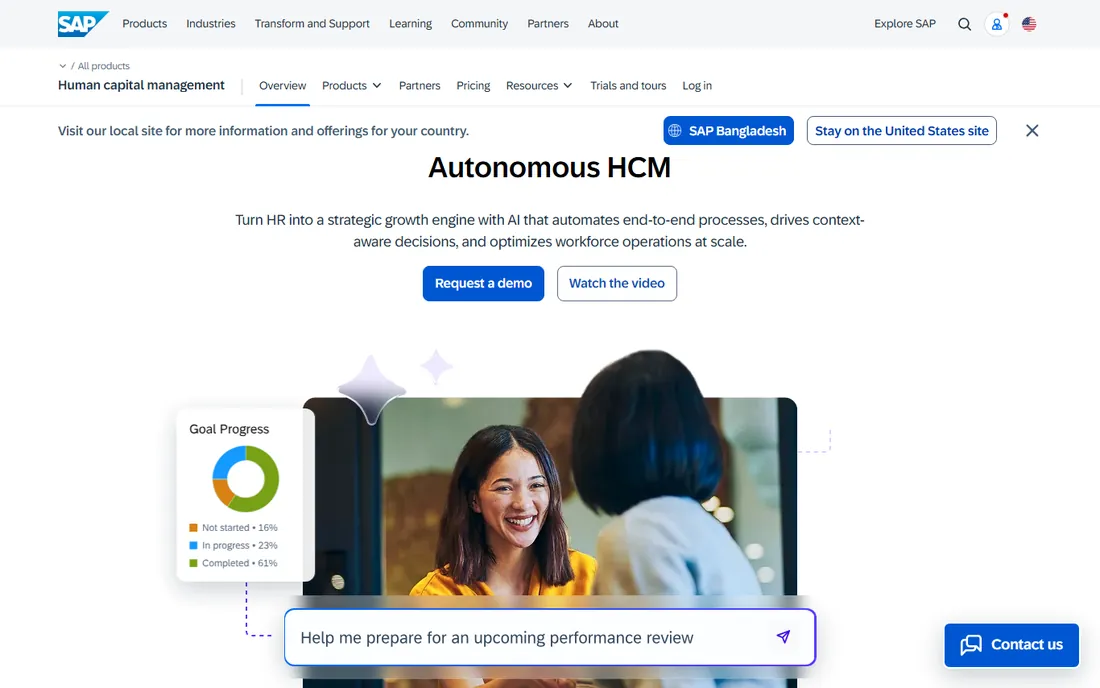
SAP SuccessFactors is the HCM arm of the SAP world, and its logic mirrors Oracle's: if the business runs on SAP, HR belongs in the same family. The suite covers core HR, payroll, talent management, learning and workforce analytics, with particular strength in European labor compliance and regulated industries where SAP already dominates. Integration with S/4HANA gives CFOs the unified people-cost view they want.
The module structure is the honest catch. SuccessFactors grew partly by acquisition, and while integration has improved, buyers still report a patchwork feel across modules and implementations that extend past plan. Pricing is entirely quote-based and scales with modules, headcount and regions. For SAP shops it is the natural pick. For everyone else, it competes with Workday and Oracle on completeness while trailing both on buying simplicity.
What we like- Tight integration with SAP ERP and S/4HANA
- Comprehensive talent modules
- Strong in regulated industries and Europe
Watch out for- Quote-only pricing
- Complex module structure
- Implementations frequently run long
#4
UKG Pro
Best for: Large organizations with hourly and shift-based workforces
Visit ukg.com
Starting priceSee website
Free planNo
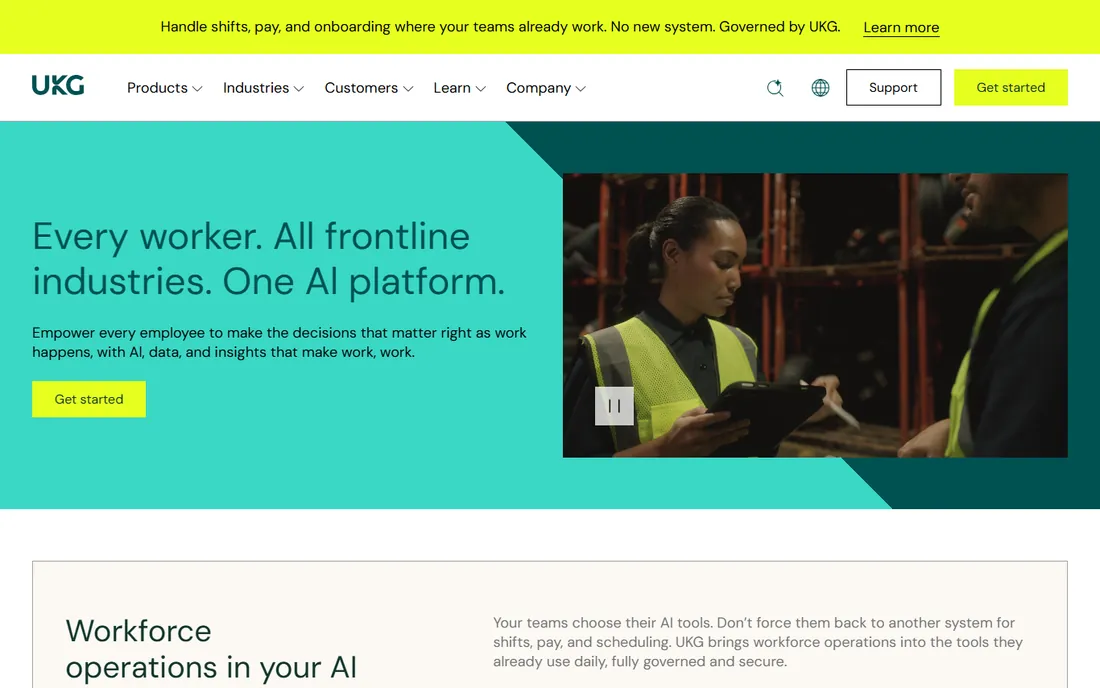
UKG Pro exists for the workforce other suites treat as an afterthought: hourly, shift-based, multi-location employees. Its workforce management, scheduling, time and attendance, and labor-cost modeling are the deepest in this list, which is why retail, healthcare, hospitality and manufacturing keep choosing it. The 2026 Gartner Magic Quadrant named UKG a Leader, and its Critical Capabilities scores were among the highest in workforce-management-heavy use cases.
The economics reflect the depth. UKG publishes no pricing; analyst estimates cluster in the high $20s to low $40s per employee per month for typical bundles, with implementation adding 40 to 70 percent of the first-year software cost. Deployments run 5 to 12 months or more. If your top HR problem is scheduling ten thousand shift workers across regions while controlling labor cost, nothing else here matches it. If your workforce is mostly salaried, the premium buys capability you will not use.
What we like- Best-in-class workforce management and scheduling
- Deep labor cost analytics
- Named a Leader in the 2026 Gartner HCM Magic Quadrant
Watch out for- No published pricing
- Implementation runs 5 to 12+ months
- Premium cost for salaried-workforce companies
#5
Dayforce
Best for: Mid-enterprise companies wanting payroll, time and talent on one database
Visit dayforce.com
Starting priceSee website
Free planNo
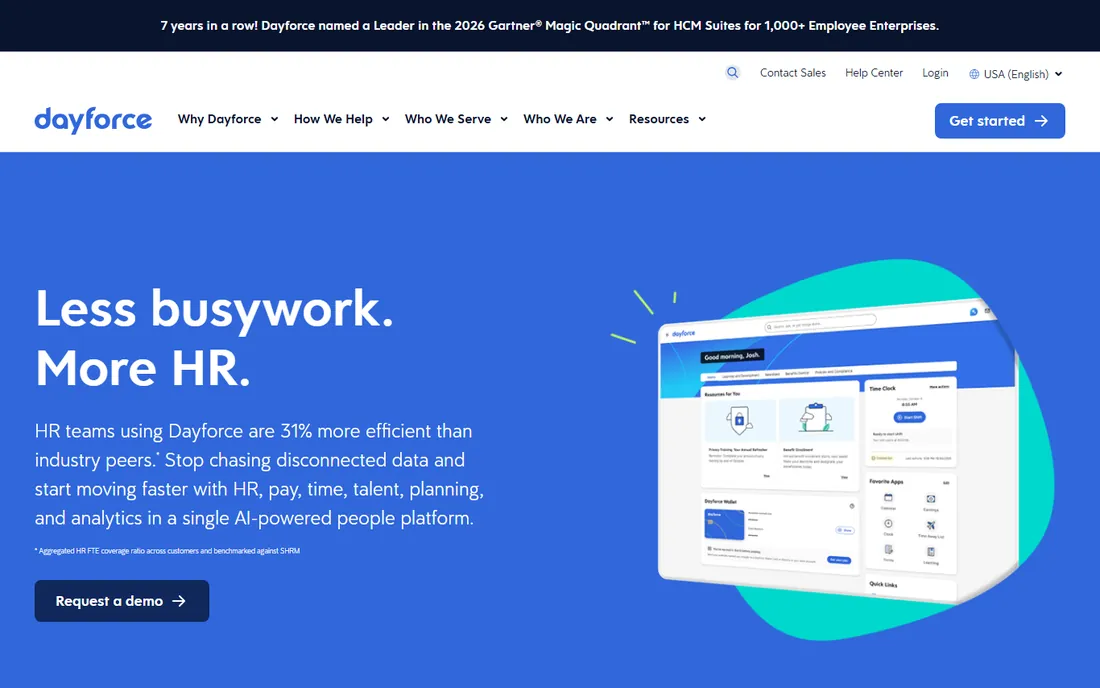
Dayforce's architecture is its argument: one database for payroll, time, benefits, talent and analytics, so a schedule change flows into pay calculations immediately instead of batching overnight. That real-time continuity is genuinely different from suites that integrate separate modules, and it shows in payroll accuracy for complex hourly workforces. Dayforce Wallet, which lets employees access earned wages on demand, doubles as a recruiting and retention tool in tight labor markets.
Estimates put typical deployments in the low-to-mid $20s per employee per month, with implementation around half of first-year software costs, but quotes vary widely by modules and countries. Custom configuration often needs Dayforce professional services, which adds to the bill. For mid-enterprise companies between roughly 350 and 5,000 employees that want to replace several systems at once, it is the strongest consolidation play on this list.
What we like- Single database means pay calculations reflect time and HR changes in real time
- Dayforce Wallet offers earned-wage access
- Strong global payroll
Watch out for- Quote-only pricing
- Professional services needed for custom configuration
- Reporting has a learning curve
#6
ADP Workforce Now
Best for: Mid-market companies that prioritize compliance certainty
Visit adp.com
Starting priceSee website
Free planNo
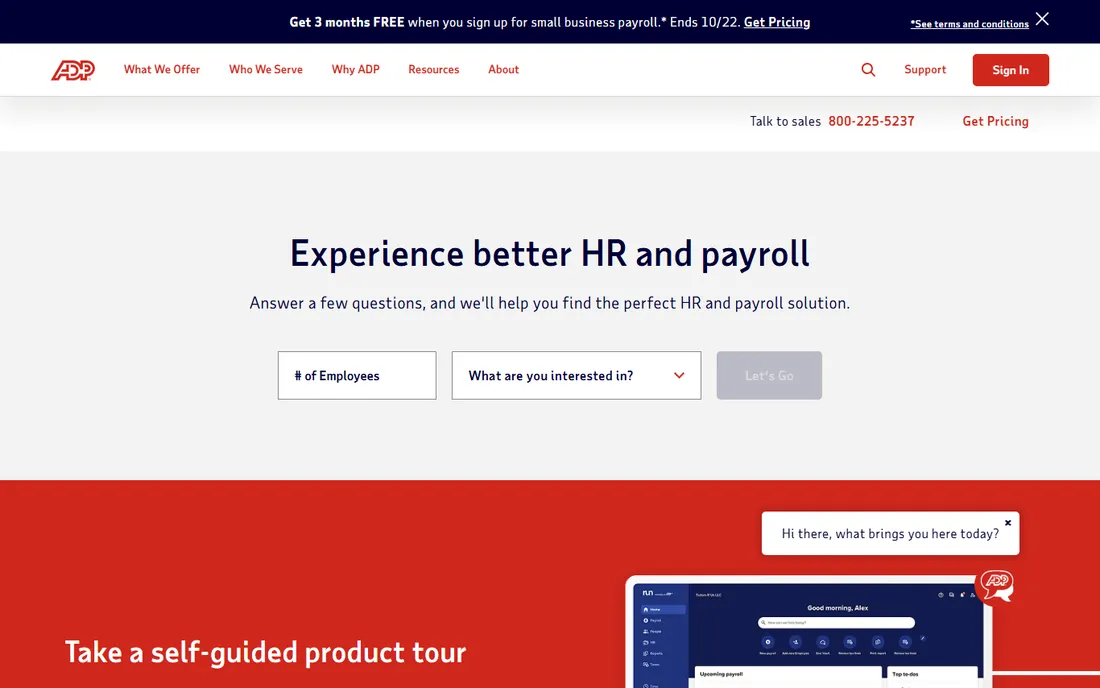
ADP Workforce Now serves companies from roughly 50 to 1,000 employees that want the ADP compliance machine without enterprise-suite complexity. Payroll tax filing, multi-state handling and benefits administration are the core strengths, backed by the largest payroll operation in the business. The module catalog is broad: time, talent, benefits, HR helpdesk and analytics can all be added as the company grows.
The buying experience is the classic ADP one. Pricing is quote-based, and buyers consistently report that the final number grows as time tracking, HR modules and year-end services enter the picture, so get the fully loaded quote in writing. The interface shows its age next to Paylocity or Rippling. Choose ADP when compliance certainty outweighs buying convenience, which for regulated industries and multi-state employers is a rational trade.
What we like- Deepest payroll-tax compliance operation in the industry
- Clear upgrade path as you grow
- Broad benefits and HR module catalog
Watch out for- Quote-based pricing with reported add-on creep
- Interface feels dated
- Support quality varies by service tier
#7
Paylocity
Best for: Mid-market companies that want modern UX with payroll depth
Visit paylocity.com
Starting priceSee website
Free planNo
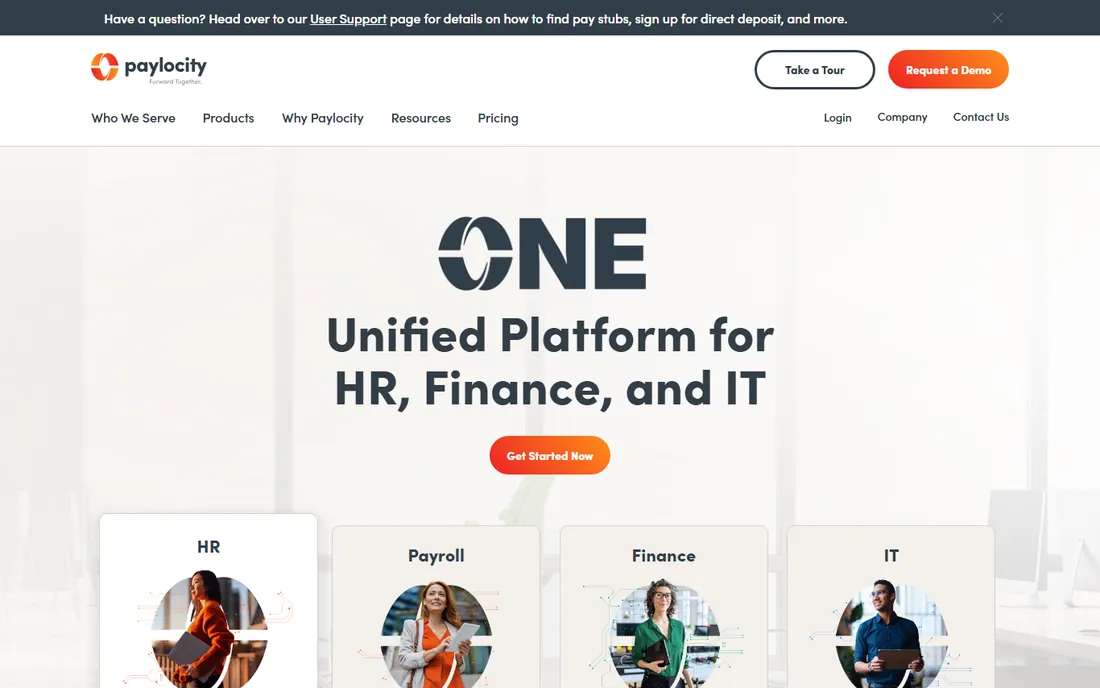
Paylocity built its reputation as the mid-market alternative that does not feel like legacy software. The interface is modern, the mobile experience is strong, and the platform layers engagement tools, recognition, surveys and community features on top of solid payroll, HR, time and talent modules. For companies where employee experience is a buying criterion rather than an afterthought, it stands out in this list.
Pricing is quote-based and scales with modules and headcount, with advanced capabilities like advanced scheduling and learning priced separately. Global coverage is thinner than ADP or Dayforce, so multinational buyers should verify country support early. For US mid-market companies between a few hundred and a few thousand employees that want one platform employees actually enjoy using, Paylocity is the most likeable pick among the established names.
What we like- Strong employee experience and engagement tools
- Modern interface
- Good payroll and HR depth for the mid-market
Watch out for- Quote-only pricing
- Advanced features cost extra
- Smaller global footprint than ADP
#8
Paycom
Best for: Companies that want employees to own their payroll data
Visit paycom.com
Starting priceSee website
Free planNo
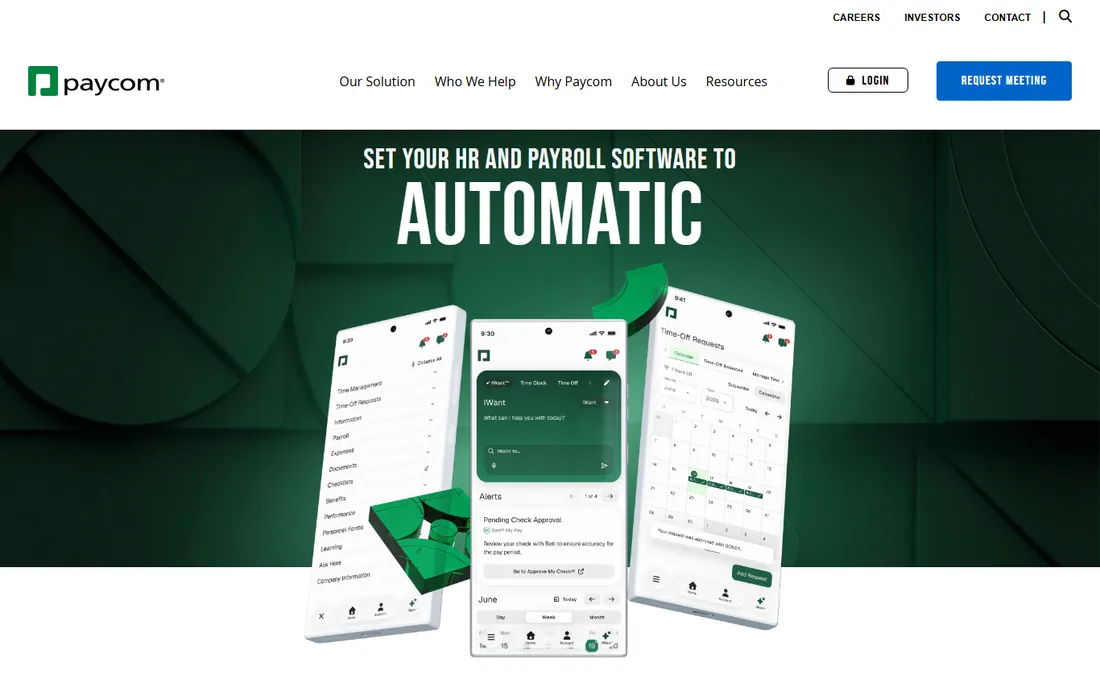
Paycom's signature idea is Beti, its employee-driven payroll: employees review and approve their own paychecks before payroll runs, which shifts accuracy responsibility to the people who know the data best. The single-database design means HR, payroll, time and talent share one record, cutting the re-entry errors that plague multi-system setups. Independent estimates put full-suite pricing around $25 to $36 per employee per month.
The model only works if employees actually use it, so adoption is a real implementation task, not an afterthought. Pricing is quote-based with implementation fees typically 15 to 35 percent of the annual subscription. Paycom fits mid-market and upper-mid-market companies that want one system and are willing to drive the cultural change that employee-driven payroll requires. Companies that want HR to stay in control of every step may find the philosophy uncomfortable.
What we like- True single-database design with employee-driven payroll
- Strong automation of HR workflows
- Unified data model reduces errors
Watch out for- Quote-only pricing
- Implementation fees run 15 to 35 percent of annual software
- Self-service model demands employee adoption
#9
Rippling
Best for: Growing companies that want HR, payroll and IT on one platform
Visit rippling.com
Starting price$40 per month base + $8 per employee/month
Free planFree trial
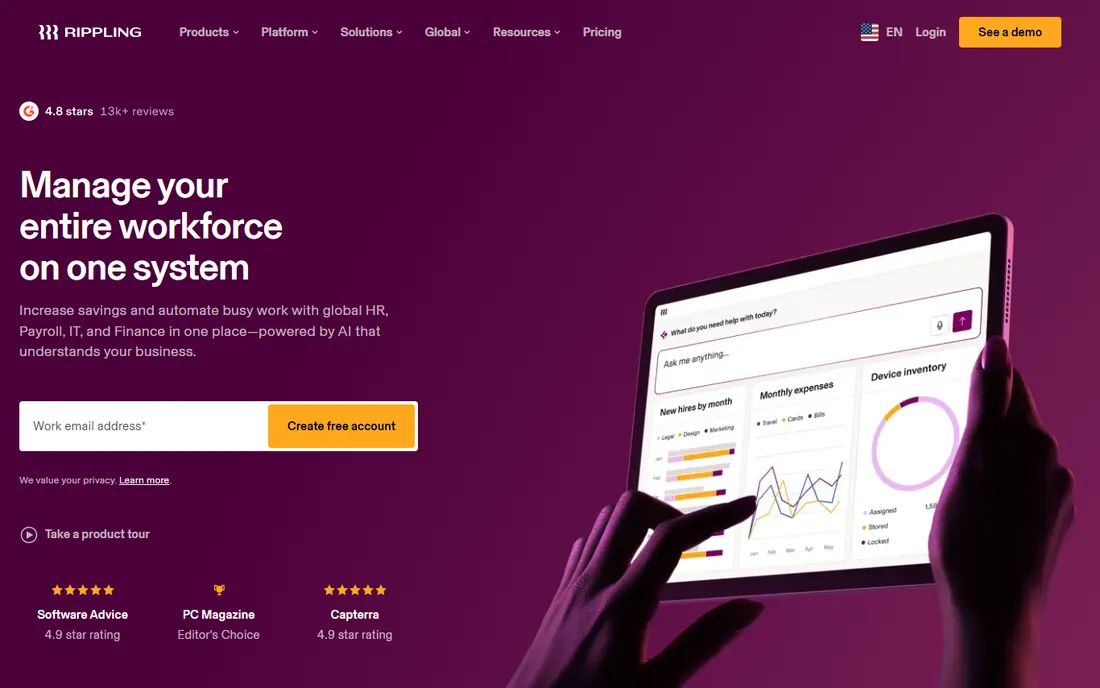
Rippling is the outlier in this list: an HCM that also provisions laptops, manages app access and handles spend. For companies under 1,000 employees, that consolidation removes entire categories of admin work, since onboarding one employee sets up payroll, benefits, devices and software from a single workflow. The published starting point is $40 a month plus $8 per employee for the platform, with payroll and other modules priced on top.
The honest math is that a realistic stack costs several times the entry figure, and the HR modules, while good, do not match the talent depth of Workday or SuccessFactors. Rippling wins when the buyer is the operations-minded founder or COO who wants one system for people, devices and money. It loses when the buyer is an enterprise HR leader who needs deep succession planning, complex compensation cycles or global payroll at scale.
What we like- Only platform here combining HR, payroll, IT device management and spend
- Published starting prices
- Powerful automation
Watch out for- Modular pricing climbs well past the entry number
- Full-stack pricing is quote-based
- HR depth is thinner than enterprise suites
#10
BambooHR
Best for: Small and mid-size companies that want HR simplicity first
Visit bamboohr.com
Starting price$10 per employee/month (Core)
Free planFree trial (7 days)
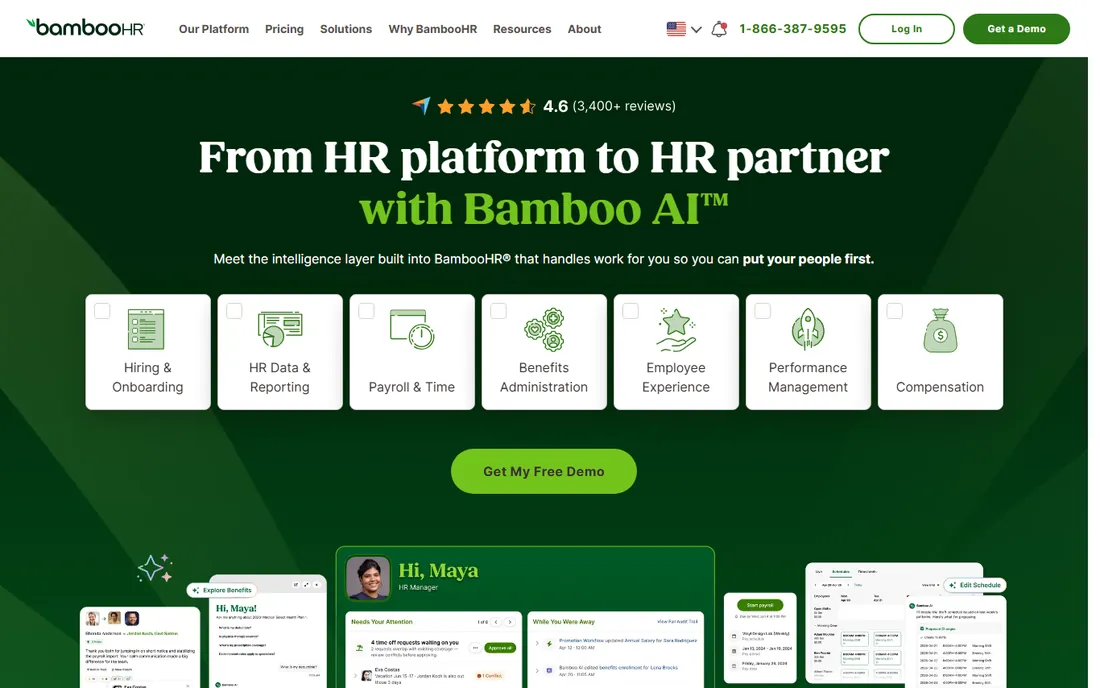
BambooHR is the smallest platform on this list and the most honest about it. The Core plan at $10 per employee per month covers employee records, onboarding, PTO, e-signatures and a small ATS, with Pro at $17 and Elite at $25 adding performance, engagement and compensation tools. It publishes its prices, offers a 7-day trial with no credit card, and consistently wins on ease of use with small HR teams.
It is not a true HCM in the enterprise sense: payroll, benefits administration and time tracking are quoted add-ons, global capability is limited, and the $250 monthly floor makes it expensive per head for very small teams. The 15 percent bundle discount on payroll plus benefits helps. Choose BambooHR when your need is an HR system of record that people will actually use, not a full talent-and-payroll suite, which describes most companies under 500 employees.
What we like- Easiest interface for nontechnical HR teams
- Publishes its pricing
- Good onboarding, PTO and reporting
Watch out for- Not a full HCM, payroll and benefits are add-ons
- $250/month floor for teams of 25 or fewer
- Limited global capability
What to evaluate before you commit
Start with headcount and workforce type, because HCM pricing and fit scale with both. Under 500 employees with mostly salaried staff, Rippling or BambooHR deliver most of the value at a fraction of the enterprise cost. Between 500 and a few thousand with hourly workers, Dayforce, UKG Pro and Paylocity are the realistic shortlist. Above that, or multinational, the conversation is Workday, Oracle and SAP, and the ERP you already run decides more than any feature list.
Then evaluate the AI the way 2026 buyers do: ask how recommendations are explained, how bias is tested and what audit trails exist. The EU AI Act made these deal questions, not nice-to-haves. Check global payroll coverage country by country if you operate across borders, because marketing maps overstate reality. And price the whole deployment, not the software line: implementation for enterprise HCM commonly runs 40 to 70 percent of the first-year software cost, and modules, support tiers and data migration all add up.
How this shortlist was assembled
This list reflects no hands-on testing, and it claims none. We compared vendor product documentation and published materials, checked pricing pages where vendors publish them, and cross-checked buyer sentiment and analyst coverage from Gartner, G2, Capterra and Reddit. Most enterprise HCM vendors do not publish pricing, so those entries say so plainly instead of repeating unverified estimates. Published prices come from each vendor's own pricing page. The shortlist covers both enterprise suites and newer platforms because mid-size companies now buy from both ends of the market. Tool counts reflect products that genuinely serve this category today.
The pricing nobody publishes
Enterprise HCM pricing is quote-based by design, and that is a feature for the vendors. Expect per-employee monthly rates in the $20s to $40s for mid-market and upper-mid-market deployments, higher for full enterprise suites, with implementation commonly adding 40 to 70 percent of the first-year software cost. Modules, regions, support tiers and data migration move every quote. The only defense is a disciplined RFP: fixed scope, fixed headcount, fixed module list, and every add-on priced in writing. The cheapest quote is rarely the cheapest deployment, and the most expensive line in year one is almost always the implementation, not the software.
Frequently asked questions
What is HCM software, and how is it different from HR software?
HCM software covers the full employee lifecycle, core HR, payroll, benefits, talent management, recruiting, learning and workforce planning, on one platform. HR software often means a narrower slice, like records and PTO. In practice the terms overlap, and vendors use them interchangeably. The useful distinction is scope: if the platform runs payroll, talent and analytics together, it is functioning as HCM regardless of the label.
How much does HCM software cost?
Mid-market deployments typically run in the $20s to $40s per employee per month for software, with implementation adding 40 to 70 percent of the first-year cost. Published prices exist only at the low end: BambooHR from $10 per employee and Rippling from $8 per employee plus a $40 base. Enterprise suites are quote-only and negotiated on modules, headcount and regions. Always budget the implementation, not just the subscription.
Which HCM is best for a company with 200 employees?
At 200 employees, the enterprise suites are usually overkill. Rippling fits if you also want IT provisioning, BambooHR fits if HR simplicity is the priority, and Paylocity or ADP Workforce Now fit if payroll depth and compliance matter most. UKG Ready, the mid-market UKG product, is worth a look for shift-based workforces. The right answer depends on how much of the employee lifecycle you want on one system.
Do I need global payroll in my HCM?
Only if you employ people across borders. Multi-country payroll is one of the most compliance-sensitive parts of HCM, and coverage varies enormously by vendor despite similar-looking marketing maps. US-only companies should not pay for global capability they will not use. Multinationals should verify each operating country individually during the RFP, because gaps force expensive local vendors later.
How long does HCM implementation take?
Mid-market platforms typically take 3 to 5 months. Enterprise suites run 6 to 12 months or more depending on scope, countries and integrations. Data migration, payroll parallel runs and change management are what consume the calendar, not the software configuration itself. Plan the go-live around a quiet business period and keep the legacy system running in parallel through at least one full payroll cycle.
What should I ask about AI in an HCM demo?
Ask how the AI explains its recommendations, how bias is tested and monitored, what audit trails exist, and whether a human approves consequential outputs like promotion or compensation suggestions. The EU AI Act classifies employment AI as high-risk, so these are compliance questions, not curiosity. A vendor that cannot answer them clearly is a risk you would be buying.
Sources we checked (18)
- https://www.workday.com/en-us/products/human-capital-management.html
- https://www.oracle.com/human-capital-management/
- https://www.sap.com/products/hcm.html
- https://www.ukg.com/products/ukg-pro
- https://www.dayforce.com
- https://www.adp.com/what-we-offer/products/adp-workforce-now.aspx
- https://www.paylocity.com/our-products/
- https://www.paycom.com/software/
- https://www.rippling.com/pricing
- https://www.bamboohr.com/pricing
- https://uctoday.com/hcm-trends-2026
- https://www.databridgemarketresearch.com/reports/global-human-capital-management-hcm-market
- https://www.ukg.com/blog/hr-leaders/what-latest-gartner-hcm-research-reveals-about-future-workforce-technology
- https://www.outsail.co/post/how-much-does-ukg-cost-in-2026
- https://boostsuite.com/blog/paycom-pricing/
- https://www.linktly.com/hr-software/ceridian-dayforce-review/
- https://leadchangegroup.com/software/rippling/pricing/
- https://employsome.com/review/bamboohr/
Is your product missing or out of date?
We review this list regularly. Vendors can request a listing, send updated pricing or ask about featured placement.

Shihab Mia · Founder, Rankite
Shihab has spent more than a decade helping SaaS and e-commerce brands grow through search. He writes Rankite's software buying guides from pricing pages, documentation and public user reviews. More about Shihab.