How we make this list: we compare pricing pages, product documentation and public user reviews. Rankite is independent; if a vendor ever pays for a featured spot, that listing is clearly labeled Partner.
Key takeaways
- Gusto is the simplest all-in-one for small US businesses, with payroll plans from $49 per month plus $6 per employee.
- BambooHR remains the best HR-first system for companies that need strong records, onboarding, and reporting, from about $10 per employee per month.
- Rippling combines HR, IT, and payroll in one platform from $8 per employee per month, but the modules stack up quickly.
- Deel is the default for hiring contractors and employees internationally; contractor plans start around $49 per contractor per month.
- ADP and Paychex still dominate mid-market compliance-heavy environments, but expect quote-based pricing and longer implementations.
Quick comparison
| Tool | Best for | Starting price | Free plan |
|---|
 BambooHR BambooHR | HR-first records and onboarding | From $10 per employee/month (Core) | Free trial |
 Gusto Gusto | Small business payroll plus HR | $49 per month + $6 per employee/month (Simple) | No |
 Rippling Rippling | Unified HR, IT, and payroll | $8 per employee/month + $35/month base (Core HR) | Free trial (IT only) |
 Deel Deel | Global hiring and compliance | From $49 per contractor/month | No |
 Justworks Justworks | PEO with bundled benefits | From $59 per user/month | No |
 ADP Workforce Now ADP Workforce Now | Mid-market compliance depth | See website | No |
 Paychex Flex Paychex Flex | Growing companies needing support | See website | No |
 HiBob HiBob | Culture-focused midsize companies | See website | No |
 Connecteam Connecteam | Deskless and shift-based teams | See website | Yes (limited) |
Is your product missing or out of date?
We review this list regularly. Vendors can request a listing, send updated pricing or ask about featured placement.
The best employee management software
Somewhere between employee ten and employee fifty, the spreadsheets break. Time-off requests live in Slack threads, onboarding is a checklist nobody follows, and payroll mistakes start costing real money. The founder who used to know everyone vacation schedule now discovers gaps the week before a launch. That is the moment companies start shopping for the best employee management software.
The confusion starts with terminology. Payroll tools, HRIS platforms, PEOs, and workforce management apps all claim to "manage employees," but they solve different problems. A five-person agency needs payroll and little else; a 200-person company with three states and hourly workers needs time tracking, compliance, and benefits administration. Buying the wrong category wastes a year and a painful migration.
This guide compares nine platforms across those categories, with current pricing where vendors publish it. The goal is to match the tool to your headcount, workforce type, and growth plans.
Starting priceFrom $10 per employee/month (Core)
Free planFree trial
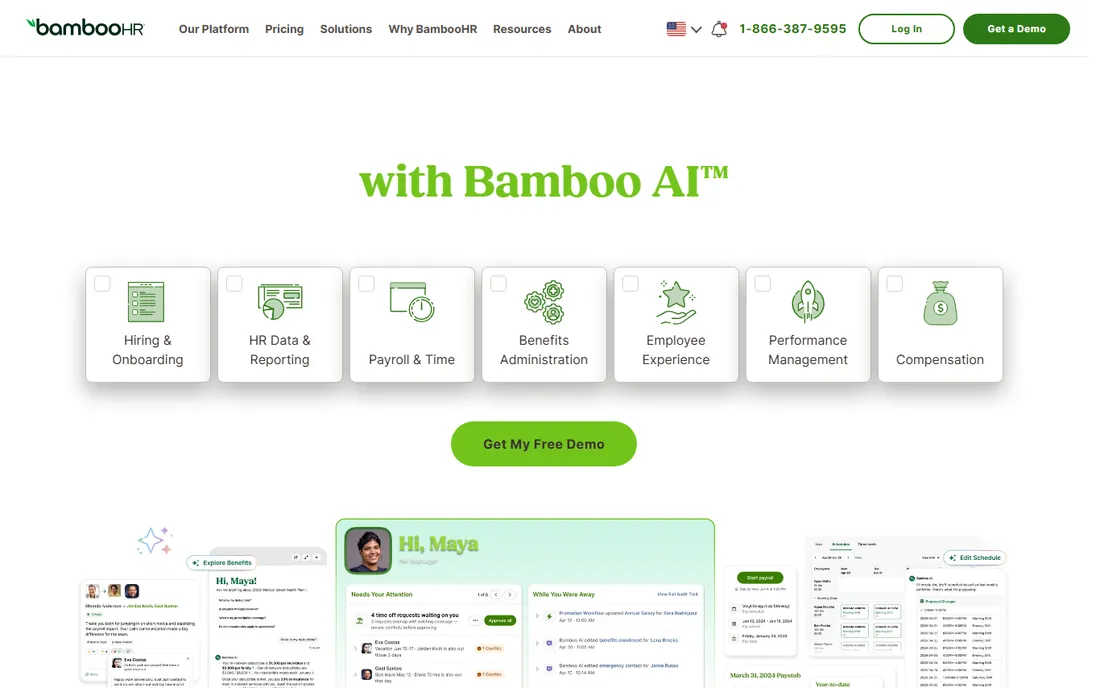
BambooHR built its reputation on being the HR system employees do not hate. The interface is clean, onboarding workflows actually get completed, and the reporting module answers the questions executives ask (headcount, turnover, time-off liability) without a data analyst. Applicant tracking is included, which removes one more tool from the stack. Implementation typically takes one to two weeks.
The pricing structure deserves attention. Core starts around $10 per employee per month, but payroll costs extra (about $6 more per employee), and the Pro and Elite tiers with performance management and engagement surveys are quote-based. Published list pricing also shows a $250 per month flat minimum for smaller teams. BambooHR fits US-based companies up to a few hundred employees that want HR done well; it is not the pick for global payroll or IT management.
What we like- Best-in-class employee experience and interface
- Strong reporting and applicant tracking
- Fast implementation for HR software
Watch out for- Payroll is a paid add-on
- Global payroll is limited
- Pricing climbs steeply past the Core tier
Starting price$49 per month + $6 per employee/month (Simple)
Free planNo
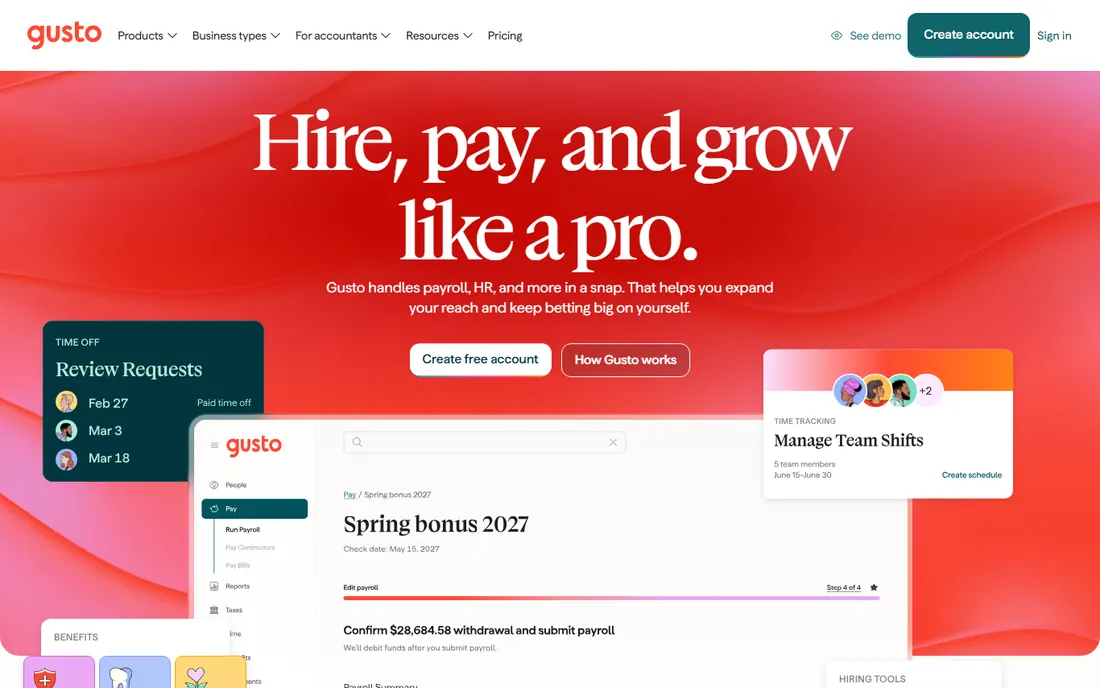
Gusto is the default recommendation for small US businesses for a reason: it makes payroll, benefits, and basic HR feel effortless. The Simple plan at $49 per month plus $6 per employee covers full-service single-state payroll, employee profiles, and benefits administration, with higher tiers (Plus at $80 plus $12, Premium at $125 plus $16) adding multi-state payroll and compliance support. Tax filings are automatic, and Gusto backs them with guarantees.
The limits are geographic and functional. There is no international payroll, and the HR toolkit (onboarding checklists, basic performance tools) does not match a dedicated HRIS. Companies that outgrow Gusto usually do so because they hire abroad or need deeper HR workflows. But for the best app for employee management at companies under 100 US-based people, Gusto remains the easiest yes in this guide.
What we like- Payroll setup in under 48 hours
- Transparent published pricing
- Automatic tax filings with error guarantees
Watch out for- US payroll only
- HR features are lighter than BambooHR
- Costs rise with multi-state teams
Starting price$8 per employee/month + $35/month base (Core HR)
Free planFree trial (IT only)
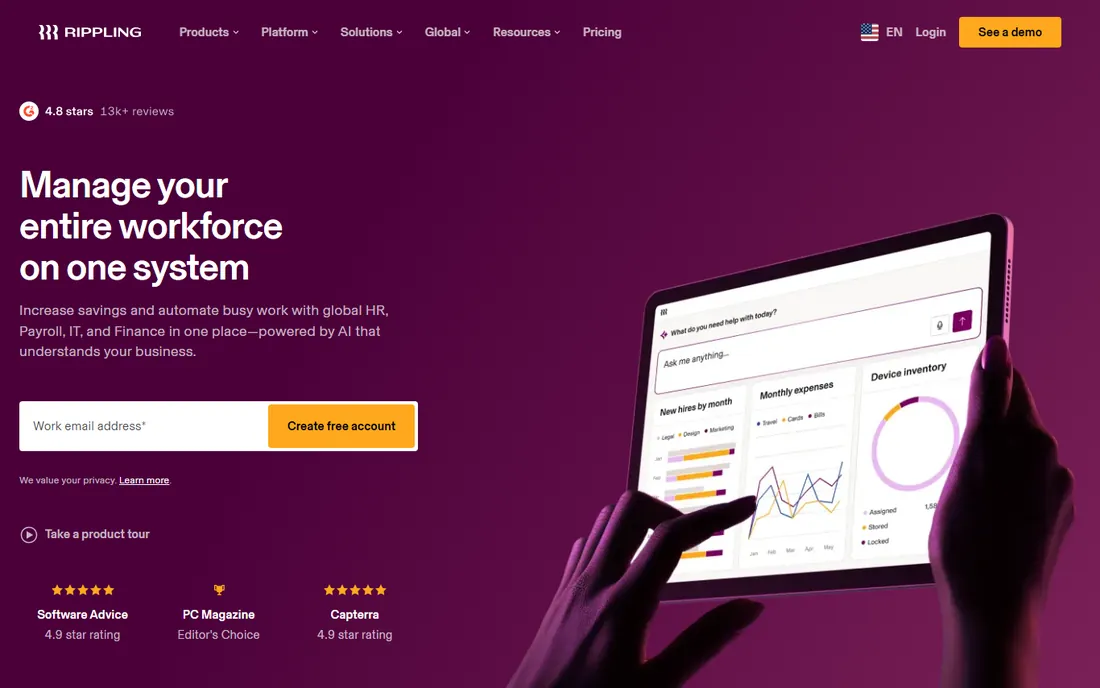
Rippling pitch is consolidation: instead of separate HR, IT, and finance tools, one platform handles onboarding (which provisions the laptop, the Slack account, and payroll in one flow) and offboarding (which revokes everything just as cleanly). Core HR starts at $8 per employee per month plus a $35 base fee, but payroll, benefits, time tracking, and IT management are separate modules that push real-world costs to $20 to $30-plus per employee for a full stack.
That modularity is both the strength and the trap: you only pay for what you use, but "what you use" grows with the company. Implementation takes two to four weeks and benefits from someone owning it internally. Rippling fits tech-forward companies from 25 to thousands of employees that want HR and IT run as one operation. If you only need payroll, Gusto will be cheaper and simpler.
What we like- One system for HR, payroll, IT provisioning, and spend
- 500+ app integrations with automatic provisioning
- Scales past 10,000 employees
Watch out for- Modular pricing stacks up fast
- Implementation takes weeks
- Employee-facing UX is functional rather than delightful
Starting priceFrom $49 per contractor/month
Free planNo
Deel solved the hardest problem in global hiring: employing someone legally in a country where you have no entity. Contractor management starts around $49 per contractor per month with localized contracts, compliant payments, and tax document handling. The employer-of-record service goes further, letting you hire full-time employees abroad while Deel handles payroll, benefits, and labor law compliance.
For distributed teams, there is no serious alternative at this maturity level; the compliance infrastructure took years to build. The costs are real, though: EOR services are quote-based and priced at a premium, and a large contractor roster at $49 a head adds up. US companies hiring only domestically should look at Gusto or Rippling instead. But the moment you hire across borders, Deel belongs at the top of the shortlist.
What we like- Hire contractors in 150+ countries with compliant contracts
- Employer-of-record service for full-time international hires
- Strong payments infrastructure
Watch out for- Contractor pricing adds up with large international teams
- EOR pricing is quote-based and premium
- US domestic HR features are thinner
Starting priceFrom $59 per user/month
Free planNo
Justworks operates as a professional employer organization (PEO): it becomes the employer of record for tax and compliance purposes while you keep day-to-day control. The payoff is access to big-company health insurance, 401(k) plans, and benefits that a 20-person startup could never negotiate alone, bundled into per-user pricing from about $59 per month. Compliance, payroll tax filings, and HR support come with it.
The PEO trade-off is control and identity: your team technically works for Justworks on paper, which some founders dislike, and you are tied to their benefits carriers. It also means one price per user whether that person needs the full stack or not. For small companies that want enterprise-grade benefits without an HR department, the PEO model is often the smartest buy; Justworks executes it with unusual simplicity.
What we like- PEO model gives small companies Fortune 500-level benefits
- Simple per-user pricing
- Handles compliance as co-employer
Watch out for- PEO means Justworks is co-employer on paper
- Less control than running your own HRIS
- Pricing is per-user regardless of usage
#6
ADP Workforce Now
Best for: Mid-market compliance depth
Visit adp.com
Starting priceSee website
Free planNo
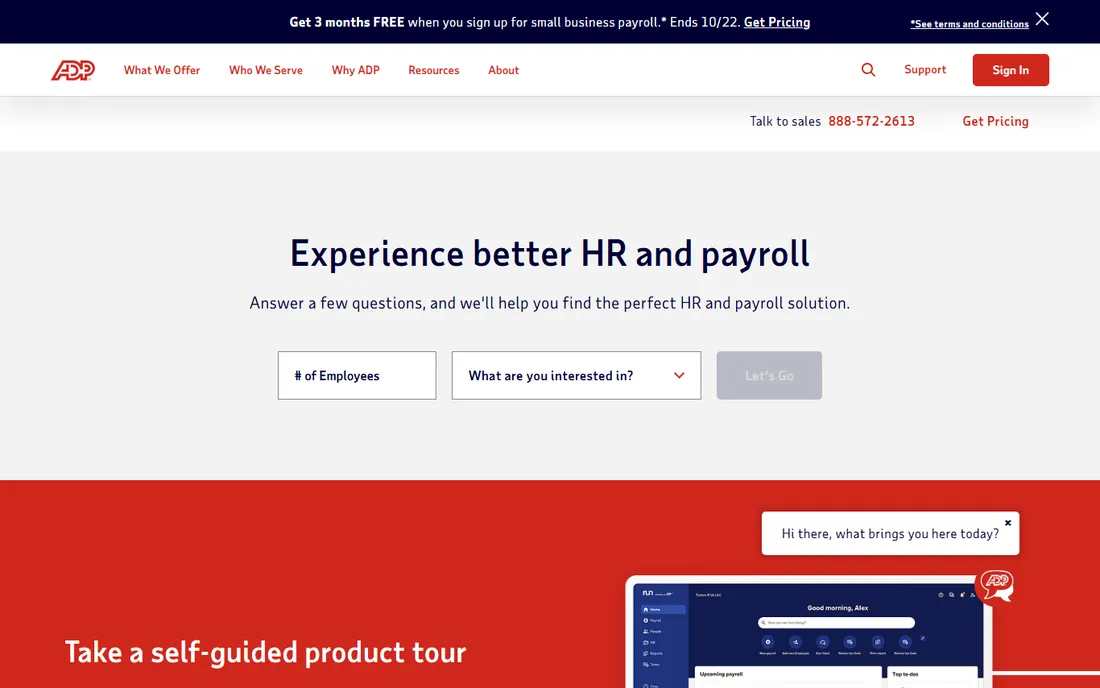
ADP is the incumbent nobody loves and everybody respects. Workforce Now serves mid-market companies with payroll, HR, benefits, talent management, and time tracking, backed by the deepest bench of compliance expertise in the business. When a new state law changes withholding rules, ADP has it handled before your team hears about it. The integration marketplace is enormous.
Everything else about ADP feels like enterprise software from an earlier era: pricing is quote-based, implementations take months, and the user experience lags BambooHR or Rippling visibly. Companies choose ADP for reliability and compliance depth, not delight. If you operate in many states, have complex union or shift rules, or simply cannot afford a payroll mistake, ADP remains the safe institutional choice.
What we like- Deepest compliance and tax expertise in the industry
- Vast integration ecosystem
- Proven at serious scale
Watch out for- Quote-based pricing
- Implementations are long
- Interface feels dated next to newer rivals
Starting priceSee website
Free planNo
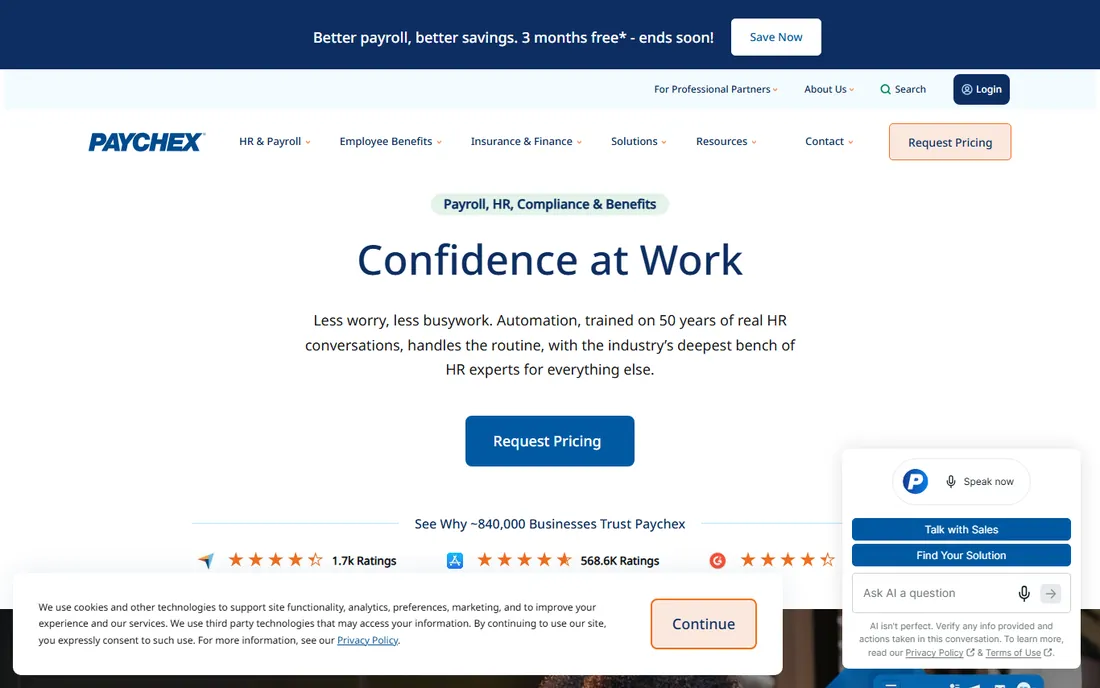
Paychex Flex takes a modular approach similar in spirit to Rippling but aimed at mainstream businesses rather than tech startups. You start with payroll and add HR, benefits, time tracking, and retirement services as you grow. The standout is human support: dedicated representatives who know your account, which matters enormously to owners who would rather call someone than troubleshoot a dashboard.
The flip side is a sales culture built on add-ons; expect regular pitches for adjacent services. Pricing is quote-based, so comparison shopping takes effort. Paychex fits established small and midsize businesses, especially outside tech hubs, that value a relationship with their provider over the slickest software. It is the comfortable incumbent choice for companies that find Rippling too Silicon Valley.
What we like- Modular platform that grows with the company
- Dedicated support representatives
- Strong payroll and HR outsourcing options
Watch out for- Quote-based pricing
- Upselling of add-on services is persistent
- Self-service UX trails the modern platforms
Starting priceSee website
Free planNo
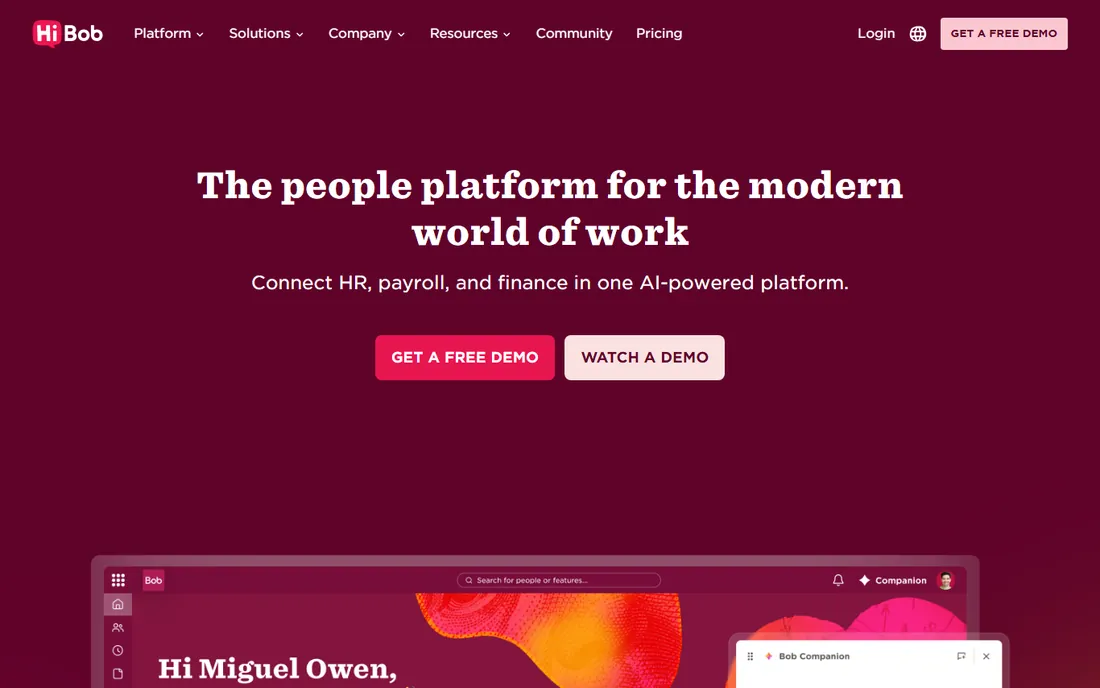
HiBob (home of the "Bob" HR platform) targets modern midsize companies that treat culture as a business function. Beyond core HR records, it bakes in engagement surveys, recognition, org charts people actually use, and people analytics that help managers spot attrition risk. The interface feels consumer-grade, which drives the adoption that makes HR data trustworthy.
The gaps are on the payroll side: HiBob partners for payroll rather than running it natively, so US companies often pair it with a payroll provider. Pricing is quote-based. It fits distributed companies of 100 to a few thousand employees that want HR software employees enjoy using and that treats engagement as data. If payroll simplicity is the priority, look at Gusto or Rippling first.
What we like- Modern UX with engagement and culture tools built in
- Strong for distributed and hybrid teams
- Good people analytics
Watch out for- Quote-based pricing
- Payroll handled through partners rather than natively
- US payroll depth lags specialists
Starting priceSee website
Free planYes (limited)
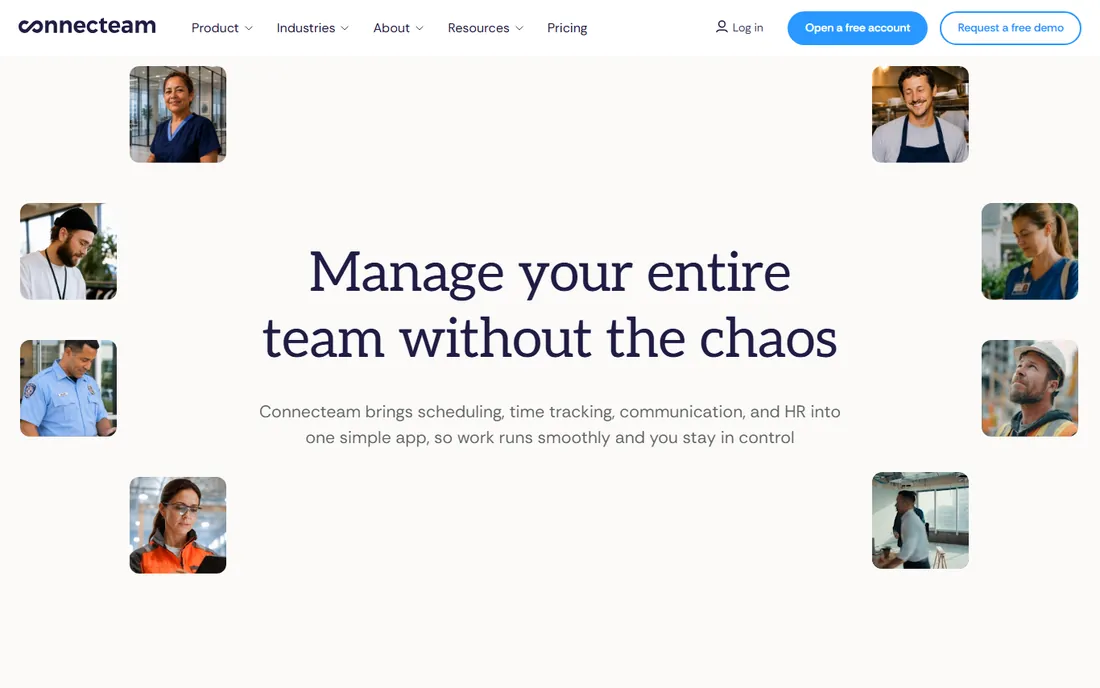
Connecteam is the only tool here designed for people who do not sit at desks: retail staff, field technicians, drivers, hospitality workers. The mobile app combines scheduling, GPS time clock, task management, team chat, and basic HR in one place, which replaces the group-text chaos most shift businesses run on. A genuinely useful free tier covers small teams.
It is not a payroll system or a full HRIS, so most companies pair it with Gusto or similar for the back office. But for managing the daily operations of a deskless workforce, the mobile-first design beats every generalist HR tool. If your employees wear uniforms instead of sitting in meetings, start your evaluation here.
What we like- Built mobile-first for non-desk workers
- Scheduling, time clock, and team chat in one app
- Free plan for small teams
Watch out for- Not a full HRIS or payroll system
- Desk-worker features are thinner
- Advanced HR needs require another tool
How this shortlist was put together
We selected platforms with significant adoption among US small and midsize businesses in 2026, covering payroll-led tools, HRIS platforms, PEOs, global hiring, and deskless workforce management. Pricing was checked against vendor pricing pages and recent independent pricing research; where vendors price by quote, that is stated rather than estimated.
We weighted published pricing transparency, implementation effort, and fit for specific company profiles over raw feature counts, since the best employee management software for a restaurant chain shares little with the right choice for a SaaS startup. Assessments were cross-checked against vendor documentation and review summaries on G2, Capterra, and Software Advice. No hands-on testing was performed.
What to check before you sign
Start by defining which category you are actually buying. If the pain is payroll accuracy and tax filings, buy a payroll tool (Gusto) and stop. If the pain is onboarding, records, and reporting, buy an HRIS (BambooHR, HiBob). If the pain is international hiring, buy Deel. The most expensive mistake in this category is buying a platform for problems you do not have.
Next, model the true per-employee cost at your headcount in 18 months, not today. Base-plus-per-employee pricing (Gusto, Rippling) scales linearly, which is fine; modular stacks and PEO per-user fees can surprise you as you grow. Ask about implementation timelines and who does the work: sub-48-hour payroll setup (Gusto) versus multi-week projects (Rippling) versus multi-month deployments (ADP) imply very different internal effort.
Finally, verify the compliance coverage for your specific situation: states you operate in, worker classifications you use, and benefits you offer. Ask for the compliance features in writing, check how multi-state tax registration is handled, and confirm data export terms. Switching HR systems is one of the most painful migrations a company does; choose as if you will live with it for five years.
The PEO question: co-employment explained
A PEO (professional employer organization) like Justworks becomes the employer of record for your team for tax, benefits, and compliance purposes, while you keep control of hiring, firing, and daily management. In exchange, your employees get access to the PEO large-group health plans and benefits, and the PEO handles payroll taxes, workers comp, and regulatory filings.
The trade-offs: per-user pricing regardless of role, less direct control over benefits carriers, and the administrative reality of co-employment. PEOs make the most sense for companies under about 100 employees that want big-company benefits without an HR team. Above that size, running your own HRIS plus a benefits broker usually costs less and gives more control. Run the numbers at your projected headcount before deciding.
Frequently asked questions
What is the difference between HR software and payroll software?
Payroll software calculates pay, withholds taxes, and files tax forms. HR software (HRIS) manages the employee lifecycle: records, onboarding, time off, performance, and reporting. Many modern tools do both, but their strengths differ: Gusto leads on payroll simplicity, BambooHR on HR depth. Buy for your actual pain point.
How much does employee management software cost?
For small businesses, expect $40 to $150 per month in base fees plus $6 to $15 per employee per month for payroll-led tools. HRIS platforms run $8 to $15 per employee per month before add-ons. PEOs charge $59-plus per user per month. Enterprise systems like ADP and Workday are quote-based and significantly more.
Can small businesses use BambooHR or Rippling?
Yes, but check the minimums. BambooHR has a flat monthly minimum that makes it pricey under 15 or so employees; Rippling modular pricing favors teams of 10-plus. Under 10 employees, Gusto or Justworks usually fit better and cost less.
Do I need HR software if I already have payroll?
Once you pass 20 to 30 employees, usually yes. Payroll handles pay; it does not handle onboarding workflows, time-off policies, performance reviews, employee records, or compliance documentation. The administrative load of doing those manually grows faster than headcount.
What is an employer of record (EOR)?
An EOR (like Deel employer-of-record service) legally employs workers in countries where your company has no entity, handling local payroll, taxes, benefits, and labor law compliance. It is the standard way to hire full-time employees internationally without incorporating abroad.
How long does implementation take?
Payroll tools like Gusto can go live in days. HRIS platforms like BambooHR typically take one to three weeks. Rippling averages two to four weeks. Enterprise systems like ADP Workforce Now take several months. The biggest variable is usually data migration from your old system, so start that early.
Sources we checked (6)
- https://hrtoolsnav.net/blog/hr-software-buyers-guide-2026-bamboohr-vs-workday-vs-gusto-vs-rippling
- https://adtools.org/buyers-guide/rippling-vs-bamboohr-vs-gusto-vs-workday-hr-software-buyer-s-guide
- https://www.itqlick.com/bamboohr/pricing
- https://www.spotsaas.com/blog/best-rippling-alternatives
- https://leadchangegroup.com/software/rippling/pricing/
- https://www.trulycritic.com/blog/rippling-vs-bamboohr-2026
Is your product missing or out of date?
We review this list regularly. Vendors can request a listing, send updated pricing or ask about featured placement.

Shihab Mia · Founder, Rankite
Shihab has spent more than a decade helping SaaS and e-commerce brands grow through search. He writes Rankite's software buying guides from pricing pages, documentation and public user reviews. More about Shihab.