How we make this list: we compare pricing pages, product documentation and public user reviews. Rankite is independent; if a vendor ever pays for a featured spot, that listing is clearly labeled Partner.
Key takeaways
- Highspot, Seismic and Showpad lead the category on breadth, but all three are quote-based enterprise contracts, so expect annual terms and a real implementation project.
- Mindtickle and Allego win when the problem is rep skill rather than content: certification, video coaching and AI role play are their core strengths.
- Enablix is the only platform here with published per-user pricing (from $25/user/month), which makes it the easiest starting point for small and mid-size teams.
- Spekit takes a different route, pushing answers and content inside Salesforce, Slack and the browser instead of asking reps to open another library.
Quick comparison
| Tool | Best for | Starting price | Free plan |
|---|
 Highspot Highspot | Large teams that live and die by content analytics | See website (custom quote) | No |
 Seismic Seismic | Regulated industries with strict content governance | See website (custom quote) | No |
 Showpad Showpad | Field and hybrid teams that sell on mobile | See website (custom quote) | No |
 Mindtickle Mindtickle | Companies running serious readiness and certification programs | See website (custom quote) | No |
 Allego Allego | Teams that coach through video and peer learning | See website (custom quote) | No |
 Bigtincan Bigtincan | Mobile and frontline teams in retail, hospitality and field services | See website (custom quote) | No |
 Enablix Enablix | Mid-market teams that want published pricing and fast setup | $25/user/month (Standard plan) | No |
 Spekit Spekit | Teams that want answers inside Salesforce and Slack, not another portal | See website (custom quote) | No |
 SalesHood SalesHood | High-growth companies wanting content, coaching and process in one place | See website (custom quote) | No |
Is your product missing or out of date?
We review this list regularly. Vendors can request a listing, send updated pricing or ask about featured placement.
The best sales enablement software
A new rep is three weeks into the job and on a call with a buyer who asks a pricing question she has never heard before. She opens the shared drive, searches three folders with slightly different names, finds a deck from last year with the old logo, and guesses her way through the answer. The buyer notices. The deal slows down. Your sales manager notices too, because the same scene repeats across the team every week.
That scene is what the best sales enablement software exists to fix. These platforms give reps one place to find current content, deliver it to buyers in tracked digital rooms, and keep their skills sharp through training and coaching. Some lean hard into content management and analytics, others into learning and readiness, and a few try to cover both. For US teams of ten reps or more, this category has settled into a clear shortlist of nine.
Prices are hard to compare because the biggest names here do not publish them. Every quote is annual, per user, and usually bundled with onboarding fees. Treat any per-user figure as the start of a negotiation, not the final bill.
#1
Highspot
Best for: Large teams that live and die by content analytics
Visit highspot.com
Starting priceSee website (custom quote)
Free planNo
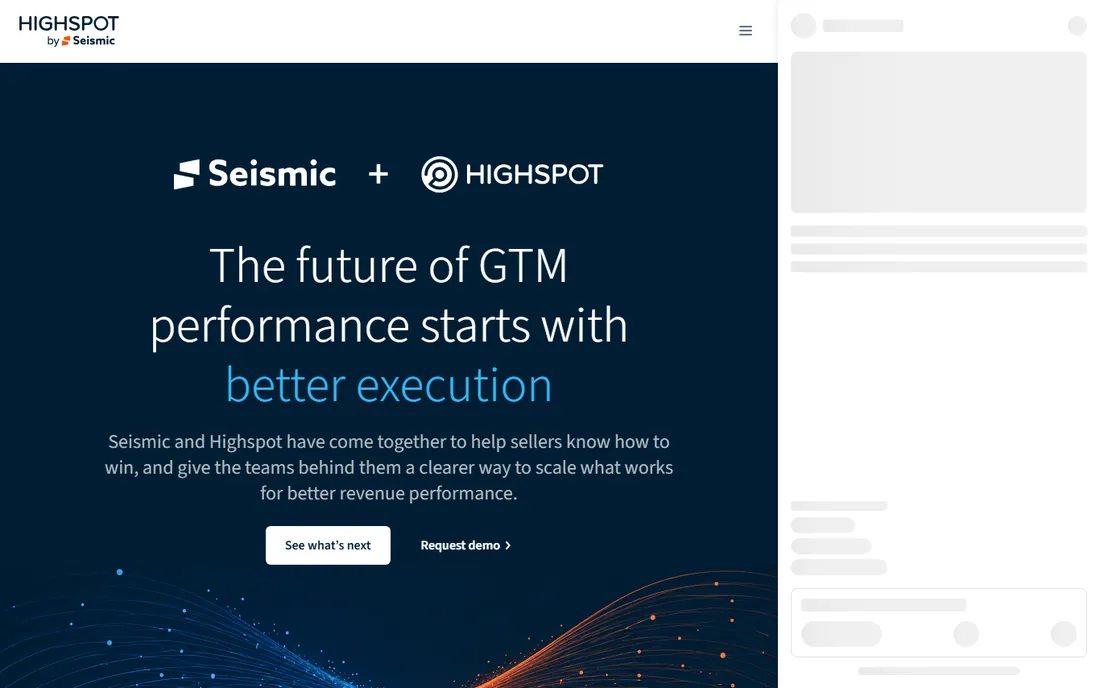
Highspot is the name that comes up first in almost every sales enablement conversation, and there is a reason. It built its reputation on findability: reps search once and get the current, approved version of a deck, one-pager or battlecard, with analytics behind it that show marketing exactly which assets moved deals. For a company with hundreds of reps and a messy content library, that search-to-close loop is the whole product.
The honest catch is that Highspot assumes a level of maturity. Small teams without a content strategy will pay enterprise money for a library nobody maintains. Contracts are annual, implementation fees are real, and you will need someone internally to own taxonomy and governance. If you have that discipline, few platforms match it. If you do not, buy the content manager before you buy Highspot.
What we like- Deep content analytics that tie asset usage to pipeline and closed deals
- Strong guidance features that steer reps toward the right content for each situation
- Broad integrations with Salesforce, Outreach and major content repositories
Watch out for- Pricing is quote-only and lands in enterprise territory
- Onboarding is a project, not a switch-on, and needs real content governance behind it
#2
Seismic
Best for: Regulated industries with strict content governance
Visit seismic.com
Starting priceSee website (custom quote)
Free planNo
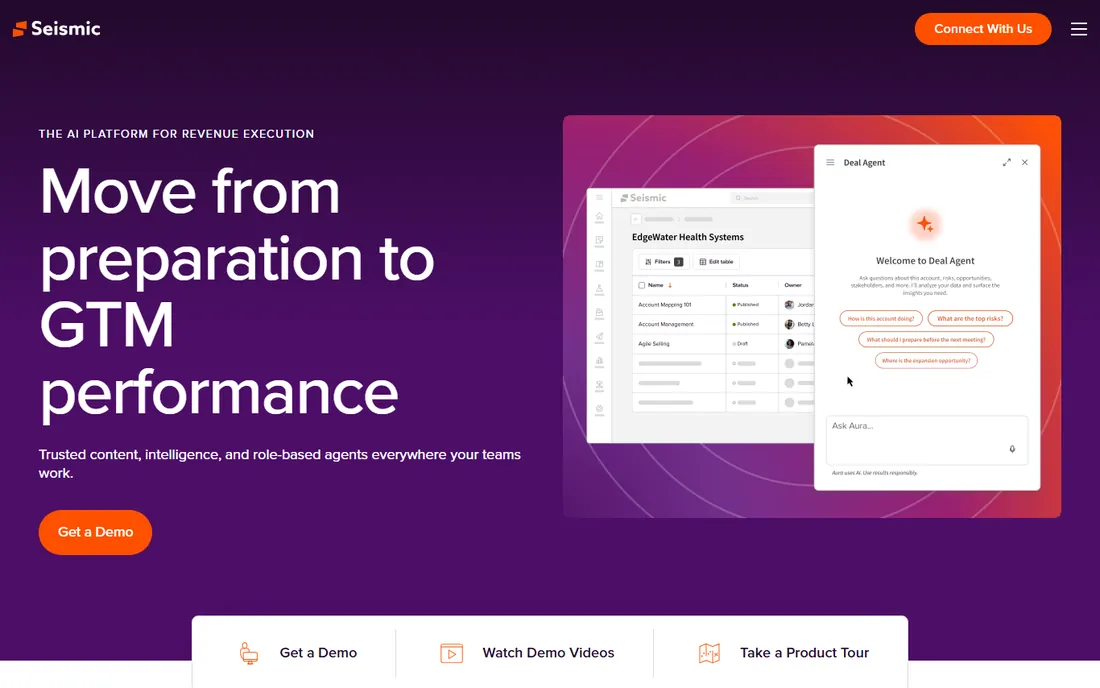
Seismic's pitch is control at scale. In financial services, insurance and healthcare, a rep cannot just edit a slide deck; every claim needs approval and every document needs an audit trail. Seismic automates that pain with template-driven document generation, so reps produce compliant, personalized materials without touching the regulated parts. For industries where marketing legal reviews everything, that capability justifies the price.
Outside regulated industries, the tradeoffs show more. Seismic is heavy, both in cost and administration, and mid-market buyers often find the governance machinery is more than they need. Implementation typically involves services work, and annual commitments are the norm. If your bottleneck is compliance, Seismic is the specialist pick. If your bottleneck is just finding the right deck, lighter options cost less.
What we like- Automated document assembly turns approved components into compliant, personalized collateral
- Governance and approval workflows satisfy financial services and healthcare compliance teams
- Content analytics and buyer engagement tracking are mature
Watch out for- Custom pricing with significant implementation costs
- Complexity suits enterprises more than mid-market teams without dedicated admins
Starting priceSee website (custom quote)
Free planNo
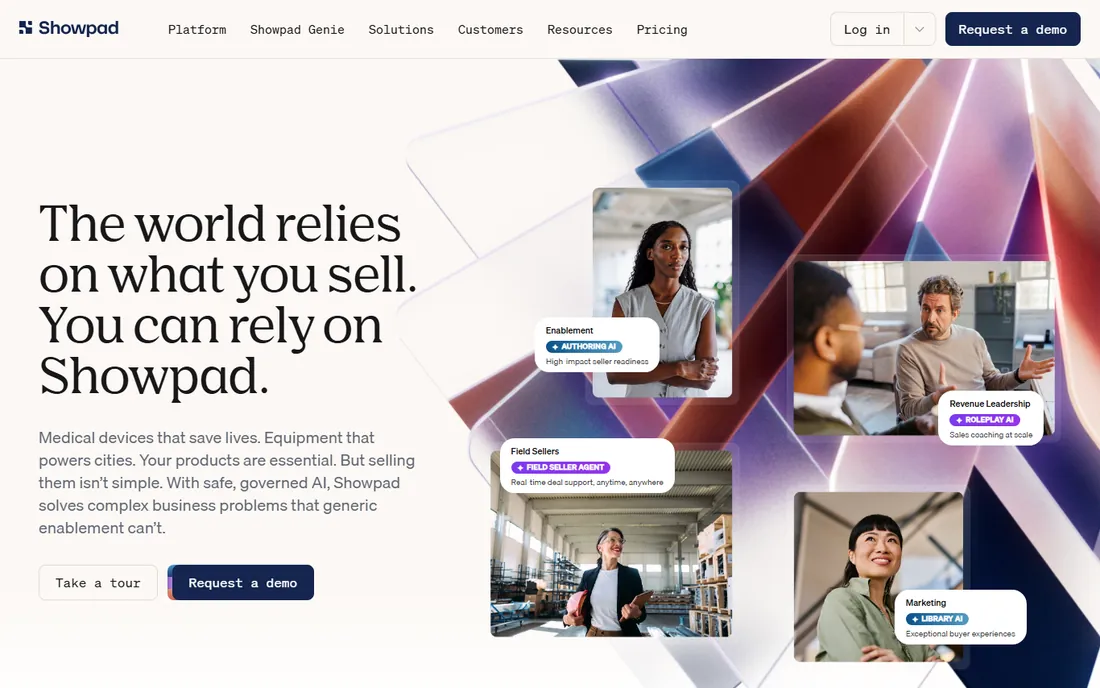
Showpad has always been the field seller's enablement platform. Where competitors assume a rep at a desk with fast wifi, Showpad assumes a rep in a hospital, on a factory floor or in a dealership, presenting from a tablet with spotty connectivity. Content syncs for offline use, presentations run smoothly on mobile, and shared spaces let buyers revisit materials after the visit. That mobile DNA still defines it.
The platform has grown well beyond mobile content. Coaching modules, readiness tracking and AI-assisted features now sit alongside the core library, making Showpad a genuine all-rounder. The pricing model, though, is pure enterprise: custom quotes, annual terms and implementation services. Mid-market teams can use it, but should budget for the services line item and a real rollout plan.
What we like- Offline-first mobile experience suits reps who present in the field
- Combines content, coaching and buyer engagement in one platform
- Digital sales rooms give buyers a single shared space per deal
Watch out for- Quote-based pricing with onboarding fees
- Broad platform means teams need time to configure it well
#4
Mindtickle
Best for: Companies running serious readiness and certification programs
Visit mindtickle.com
Starting priceSee website (custom quote)
Free planNo
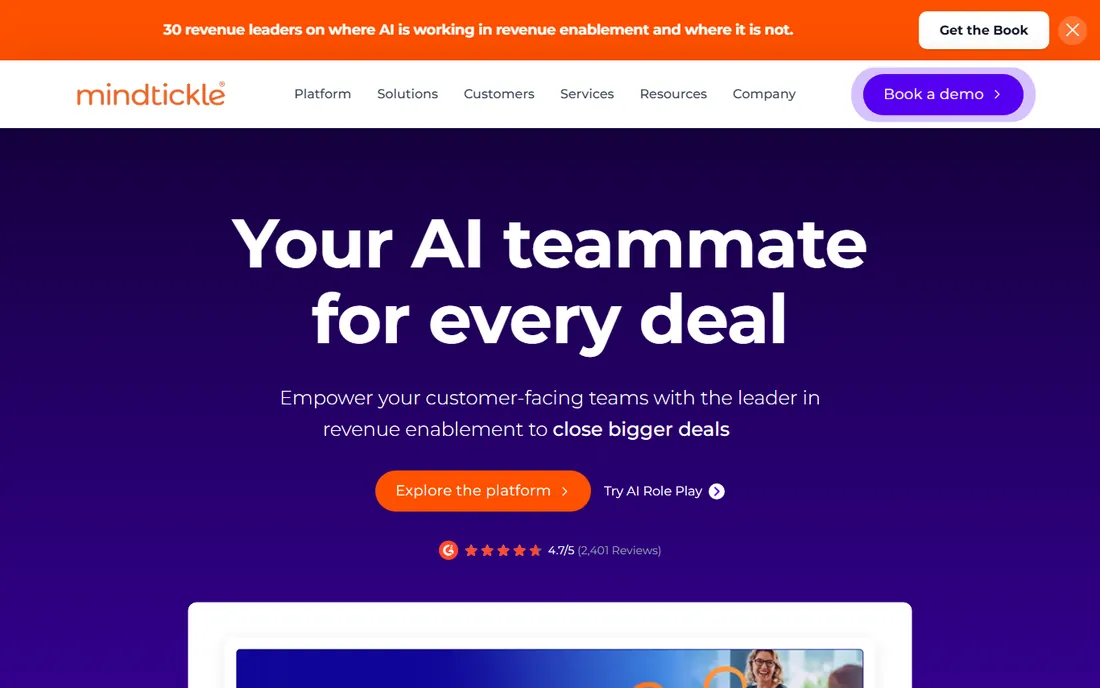
Mindtickle answers a different question than the content platforms: are your reps actually good enough to sell this? Its readiness model scores reps against an ideal profile, runs them through training, video-based practice and AI role plays, and certifies them before they touch real buyers. For companies with complex products and long ramp times, that discipline shortens time to productivity in a way content libraries cannot.
That focus is also the limit. Mindtickle is not primarily a content management platform, and teams that buy it for the library will be disappointed. It works best alongside a CMS or as the readiness layer for large sales orgs. Budget for more than the license: someone has to design the certification paths and review the coaching output, and that someone is usually you.
What we like- Readiness scoring and certification workflows measure whether reps can actually sell, not just whether they watched a video
- AI role play and coaching tools scale practice across large teams
- Strong analytics on skill gaps and coaching impact
Watch out for- Custom pricing aimed at enterprise budgets
- Implementation and program design take real effort from your enablement team
#5
Allego
Best for: Teams that coach through video and peer learning
Visit allego.com
Starting priceSee website (custom quote)
Free planNo
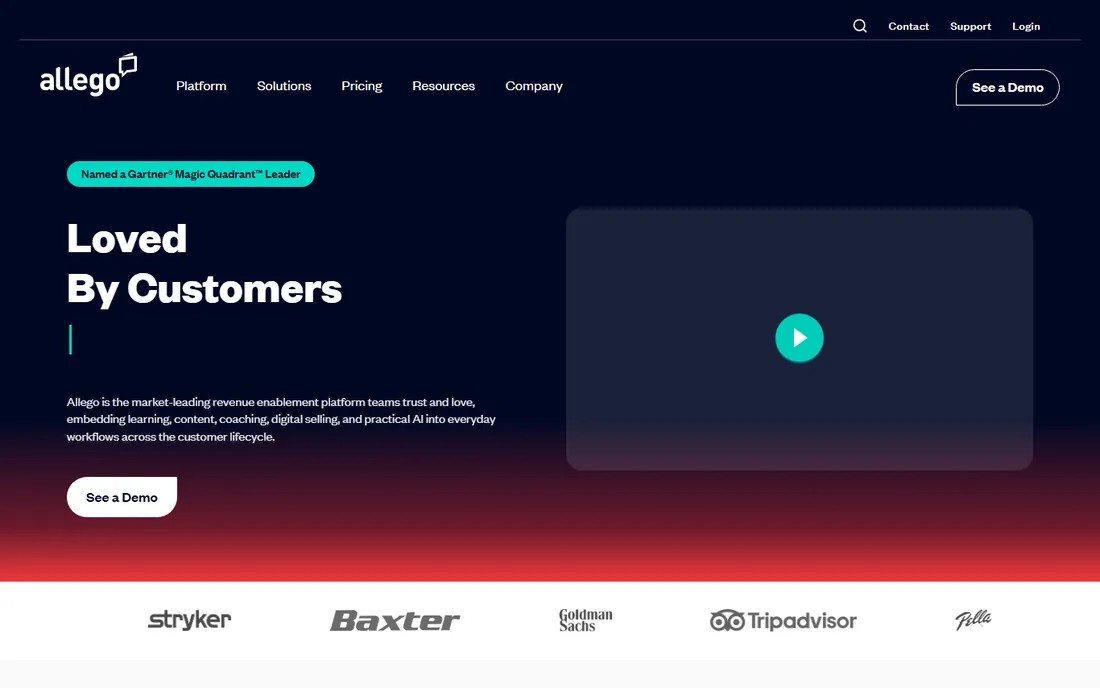
Allego built enablement around a simple insight: reps learn from watching other reps. Its platform centers on short videos, where top performers record winning pitches, new hires submit practice recordings for AI and manager scoring, and the best clips become a searchable library of real examples. For distributed and hybrid teams that rarely meet in person, that peer-learning loop replaces a lot of lost hallway knowledge.
The platform has expanded into conversation intelligence and broader enablement, but video remains its identity. That is a strength for coaching cultures and a hurdle for teams whose reps will not record themselves. Pricing is custom and annual, in line with the rest of the enterprise tier. If coaching and ramp are your binding constraint, Allego deserves a demo. If you mainly need a content library, look elsewhere.
What we like- Video-based practice and AI-scored role plays make coaching asynchronous and scalable
- Peer learning libraries let top reps share what actually works
- Conversation intelligence ties coaching to real call data
Watch out for- Quote-based pricing
- Video-first approach needs cultural buy-in from reps who dislike recording themselves
#6
Bigtincan
Best for: Mobile and frontline teams in retail, hospitality and field services
Visit bigtincan.com
Starting priceSee website (custom quote)
Free planNo
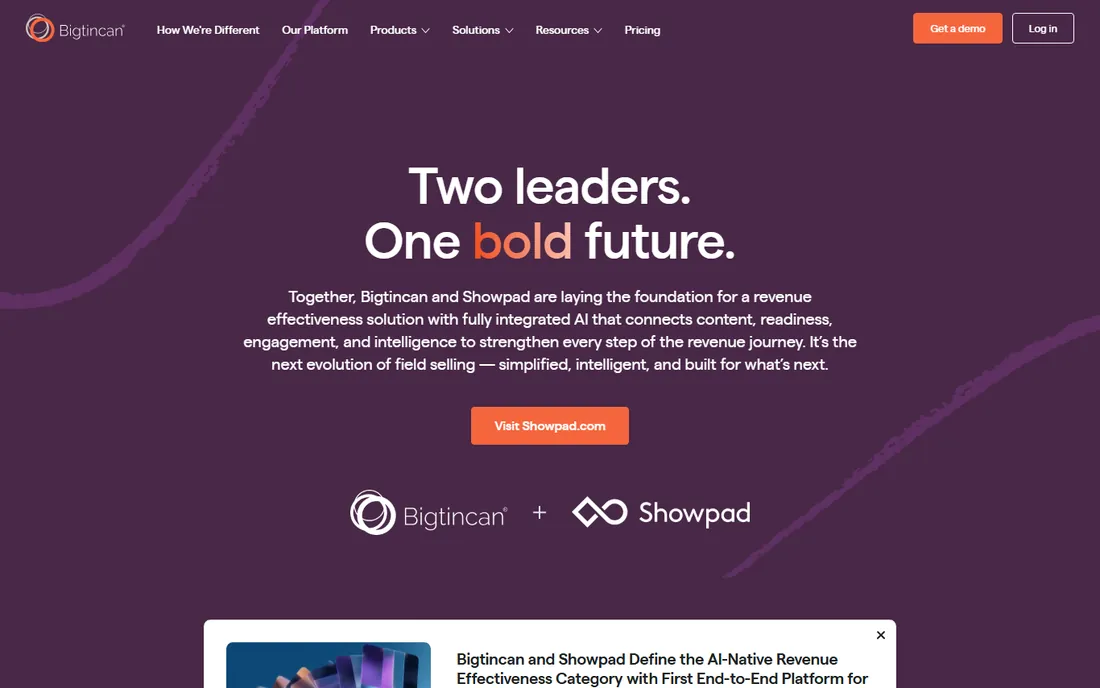
Bigtincan plays in the same field-first space as Showpad but skews toward frontline and customer-facing workers rather than B2B account executives. Think retail associates, hospitality staff, franchise teams and manufacturing reps: people who sell on their feet, turn over faster, and need training in short bursts on a phone. The platform's micro-learning and mobile delivery are tuned for exactly that audience.
For B2B sales teams, Bigtincan is a legitimate alternative to the big three, usually at a lower total cost and with faster deployment. The tradeoff is analytics depth and ecosystem breadth: Highspot and Seismic do more with content performance data. If your team works a route, a floor or a territory, Bigtincan's mobile-first approach fits the job better than a platform designed for desk work.
What we like- Mobile-first design with offline access built for frontline workers
- Micro-learning and readiness features fit high-turnover roles
- Strong in verticals like retail, hospitality and manufacturing
Watch out for- Custom quote pricing
- Less depth in content analytics than Highspot or Seismic
#7
Enablix
Best for: Mid-market teams that want published pricing and fast setup
Visit enablix.com
Starting price$25/user/month (Standard plan)
Free planNo
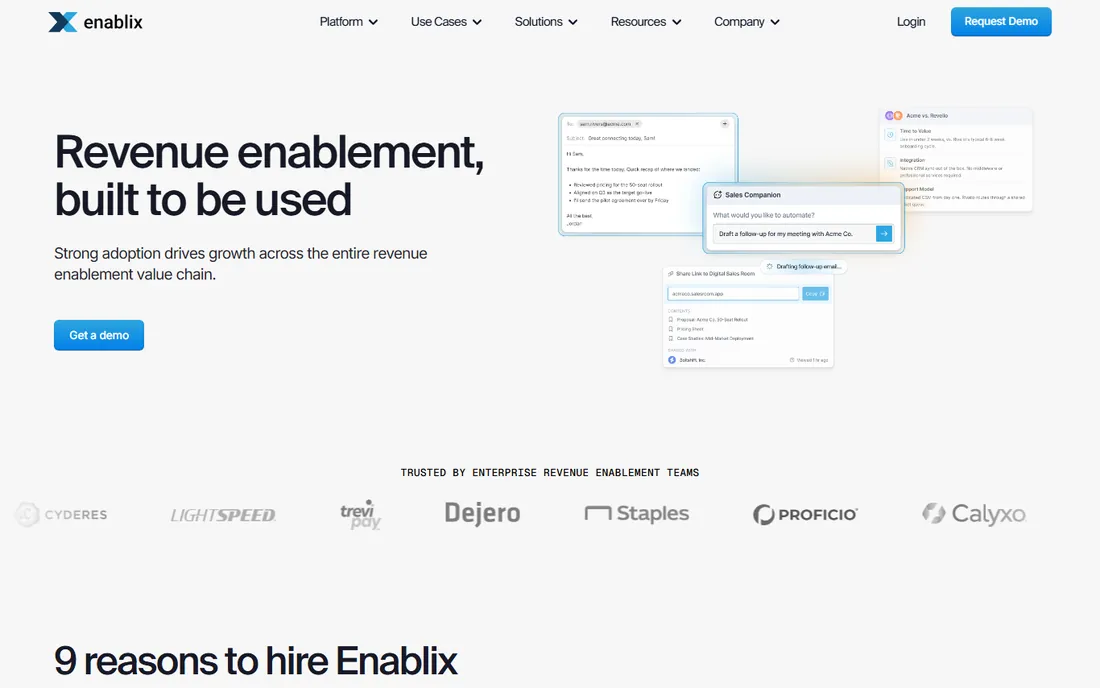
Enablix is the rare sales enablement platform that puts its prices on the website. Standard starts at $25 per user per month, Professional at $40, with Enterprise on custom terms. That transparency alone makes it worth evaluating, because it gives you a concrete number to hold the quote-based vendors against. The product covers the core jobs: organizing content, tracking buyer engagement, running training and onboarding, and reporting on what content actually gets used.
The platform targets product marketers and mid-market sales teams rather than thousand-rep enterprises, and the feature set reflects that. You will not get Seismic-grade governance or Highspot-grade analytics. What you get is a working enablement system at a price a 30-person sales team can approve without a procurement cycle. For smaller companies priced out of the enterprise tier, Enablix is the most direct path to real enablement.
What we like- Published pricing starting at $25/user/month with a $40 Professional tier
- Content management, buyer engagement and training in one package
- Lighter implementation than the enterprise platforms
Watch out for- No free plan
- Smaller ecosystem and fewer native integrations than the category leaders
#8
Spekit
Best for: Teams that want answers inside Salesforce and Slack, not another portal
Visit spekit.com
Starting priceSee website (custom quote)
Free planNo
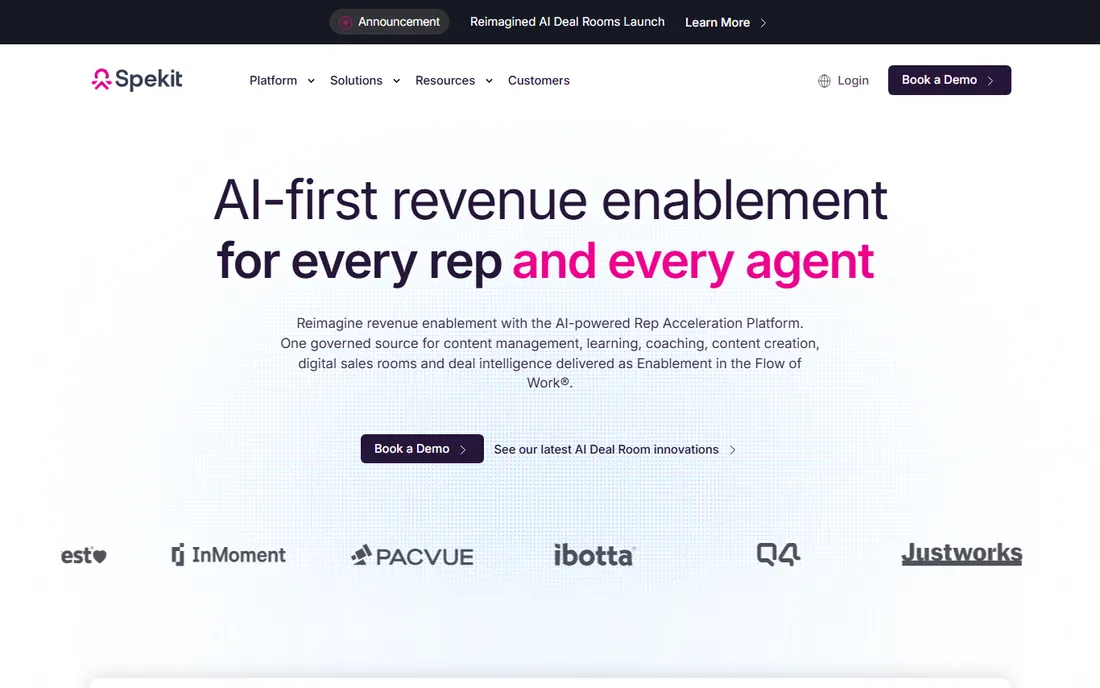
Spekit starts from the observation that reps do not open enablement portals. Instead of building a better library, it embeds answers, playbooks and content directly into the tools reps live in: Salesforce records, Outreach sequences, Slack channels, the browser. A rep prepping for a call gets the battlecard inside the CRM rather than hunting for it. The AI sidekick layer adds drafting and call prep on top of the knowledge base.
Pricing is custom with annual contracts, and third-party benchmarks put typical deals in the $12 to $20 per user per month range with five-figure annual minimums. The honest framing is that Spekit is a delivery layer for your existing knowledge. It does not fix a broken content strategy; it makes a good one instantly accessible. Teams with solid playbooks and weak adoption get the most from it.
What we like- Just-in-time answers surface inside Salesforce, Outreach, Slack and the browser where reps already work
- AI sidekick helps draft prospect emails and prep for calls
- Content management and analytics included behind the in-app layer
Watch out for- Quote-based pricing with meaningful contract minimums
- In-app model is a complement to, not a replacement for, a full content strategy
#9
SalesHood
Best for: High-growth companies wanting content, coaching and process in one place
Visit saleshood.com
Starting priceSee website (custom quote)
Free planNo
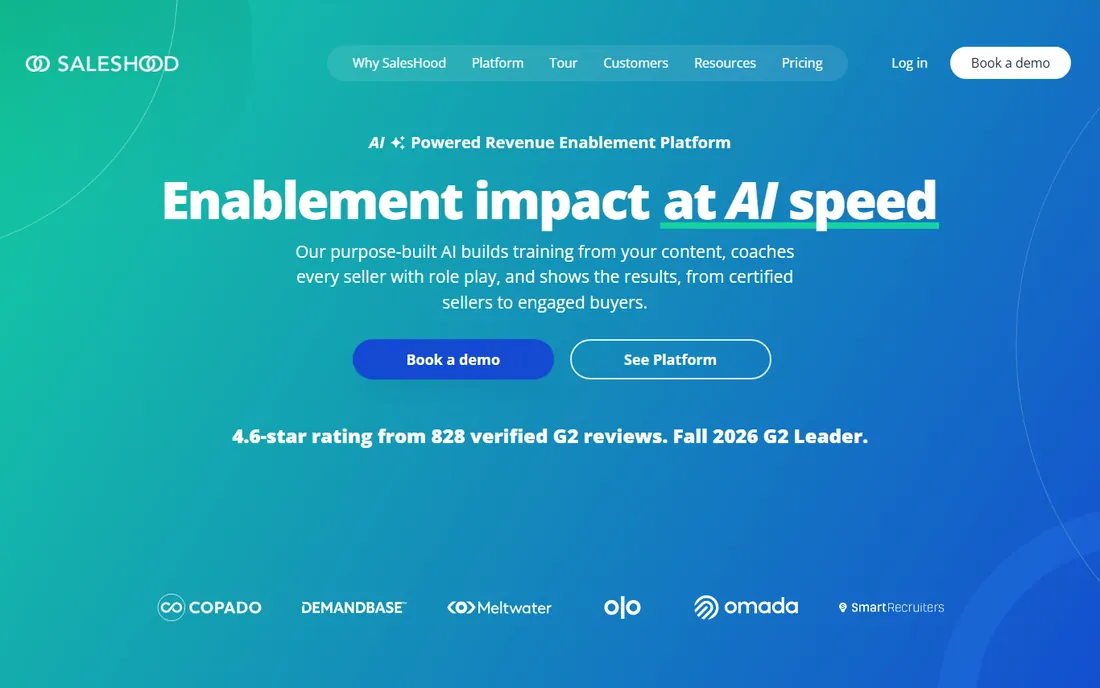
SalesHood positions itself as the all-in-one for companies that are scaling fast and cannot buy three separate tools. Content management, sales learning, video coaching, guided selling playbooks and buyer engagement live in one platform, which suits high-growth teams that need coverage across the whole enablement job. The collaboration angle is a real differentiator: marketing, sales and CS share one workspace rather than handing assets across tools.
The breadth is also the risk. Platforms that cover everything demand real ownership to keep every module alive, and SalesHood is no exception. Pricing is quote-based with annual contracts, and discounting is common on multi-year terms. For a scaling company with an enablement hire but no enterprise budget, SalesHood offers the widest coverage per dollar in the shortlist.
What we like- Broad platform covering content, learning, coaching, guided selling and buyer engagement
- Strong fit for high-growth and mid-market companies
- Collaborative features connect marketing, sales and customer success
Watch out for- Custom pricing with annual terms
- Breadth means setup and adoption need dedicated enablement ownership
What to sort out before you sign an enablement contract
Start with the actual problem, because enablement platforms solve three different ones. If reps cannot find current content, you need a content platform with strong search and analytics: Highspot, Seismic, Showpad or Enablix. If reps find content but cannot sell, you need a readiness platform: Mindtickle or Allego. If reps ignore every portal you build, you need an in-app layer like Spekit. Buying a content platform for a coaching problem, or the reverse, is the most common way this purchase fails.
Then interrogate the pricing. Every enterprise vendor here sells annual, per-user contracts, and the per-user figure you hear first is rarely the total. Ask for the implementation and onboarding fee in writing, ask what counts as a billable user, and ask how prices change at renewal. Several of these vendors negotiate 15 to 25 percent off initial quotes for multi-year or competitive deals, so run at least two vendors through a real evaluation before signing anything.
Finally, check the integrations that matter to your team. Salesforce and the sales engagement tool (Outreach, Salesloft) are table stakes, but the details decide adoption: whether content surfaces inside the CRM, whether buyer engagement data writes back to the opportunity, and whether single sign-on and user provisioning work with your identity provider. A platform your reps have to remember to open will lose to one that meets them in Salesforce every time.
How this shortlist was put together
This list was built from vendor pricing pages and documentation, public feature comparisons, and review data from G2, Capterra, TrustRadius and Reddit threads where enablement leaders discuss real deployments. Every tool here is an established product with a current sales enablement offering in 2026. Prices are included only where the vendor publishes them; everything else is marked as custom quote because that is what the vendor's own site shows.
Hands-on testing was not part of the process, and no vendor paid for placement. The ranking weights breadth of capability, fit for different company sizes, pricing transparency and the strength of coaching and buyer-engagement features. Smaller vendors with clear pricing (Enablix) are included alongside the enterprise leaders because mid-market buyers need options they can actually buy without a six-month procurement cycle.
The pricing pattern nobody tells you about
Almost nobody in this category publishes prices, and that is not an accident. Custom quotes let vendors price on your team size, your contract length and how badly they want your logo. The practical move is to get one transparent quote (Enablix publishes theirs) and use it as the anchor in every other negotiation. When a rep tells you their platform is "usually around" a number, ask for it in a written proposal with the onboarding fee, the user minimum and the renewal terms spelled out.
Watch the user definition too. Some contracts count every employee with access, others count only active sellers, and a few charge for admin and viewer seats separately. A 50-person sales org can easily be quoted for 80 seats if marketing, CS and leadership all get logins. Settle the seat definition before you compare per-user numbers, or you will compare two prices that measure different things.
Frequently asked questions
What is sales enablement software?
It is software that helps sales teams sell more effectively by organizing content, training reps and tracking buyer engagement. Typical features include a content library with search, digital sales rooms for buyers, onboarding and certification workflows, video coaching, and analytics that show which content and behaviors drive revenue.
How much does sales enablement software cost?
Enterprise platforms like Highspot, Seismic, Showpad, Mindtickle and Allego use custom annual quotes, and total first-year costs for a mid-size team commonly land in the tens of thousands of dollars including onboarding. Enablix publishes pricing from $25 per user per month, which is the clearest public anchor in the category. Always get onboarding fees, user minimums and renewal terms in writing.
What is the difference between sales enablement and sales engagement?
Sales engagement platforms (Outreach, Salesloft) run the outbound motion: sequences, calls, emails and follow-up tasks. Sales enablement platforms provide the content, training and buyer-facing experiences that make those touches effective. Many teams use both, and the two categories integrate closely.
Which sales enablement platform is best for small teams?
Enablix is the most accessible option here because it publishes per-user pricing from $25 per month and is built for mid-market teams. Spekit also suits smaller teams that want enablement inside their existing tools rather than a new portal. The enterprise platforms generally assume 50 or more reps and dedicated enablement staff.
Do these platforms replace a CRM?
No. Every platform on this list integrates with Salesforce, HubSpot or Microsoft Dynamics rather than replacing them. The CRM remains the system of record for accounts, contacts and pipeline; the enablement platform sits on top, delivering content, coaching and buyer engagement data back into the CRM.
How long does implementation take?
Expect four to twelve weeks for the enterprise platforms, depending on content migration, integrations and program design. Lighter platforms like Enablix and Spekit can go live in days to a few weeks. The real timeline driver is rarely the software: it is cleaning up the content library and defining the processes the platform will run.
Sources we checked (7)
- https://topelevens.com/sales-enablement-software
- https://www.mutinyhq.com/blog/the-best-sales-enablement-tools-in-2026-a-buyer-s-guide-for-b2b-sales-teams
- https://www.mutinyhq.com/blog/highspot-alternatives-8-platforms-b2b-teams-evaluate-in-2026
- https://www.cirrusinsight.com/blog/ai-sales-enablement
- https://www.itqlick.com/showpad/pricing
- https://www.trustradius.com/compare-products/enablix-vs-proposify
- https://www.vendr.com/marketplace/spekit
Is your product missing or out of date?
We review this list regularly. Vendors can request a listing, send updated pricing or ask about featured placement.

Shihab Mia · Founder, Rankite
Shihab has spent more than a decade helping SaaS and e-commerce brands grow through search. He writes Rankite's software buying guides from pricing pages, documentation and public user reviews. More about Shihab.