How we make this list: we compare pricing pages, product documentation and public user reviews. Rankite is independent; if a vendor ever pays for a featured spot, that listing is clearly labeled Partner.
Key takeaways
- Stripe Billing (0.7% of volume, no monthly fee) and Chargebee ($0 + 0.80% of volume) are the cheapest starts, with no fixed cost.
- Zoho Billing (from $15/month billed annually) and ChargeOver (from $229/month flat) charge no revenue percentage: the bill never grows with your MRR.
- Paddle (5% + $0.50/transaction) is the merchant-of-record pick for global tax compliance; Maxio ($599/month) is the flat-fee pick for B2B SaaS needing revenue recognition.
- Lago is free and open source for self-hosters; Orb is quote-only for complex usage-based pricing.
The revenue-tax question
Your billing platform takes a cut of every dollar you earn. The question is how big the cut is, and whether it ever stops growing. Percentage-of-revenue tools (Stripe 0.7%, Chargebee 0.80%, Paddle 5%) scale with you forever: at $100K MRR, Stripe Billing costs ~$700/month and Paddle ~$5,000. Flat tools (Zoho from $15/month, ChargeOver from $229, Maxio $599) cost the same at $10K MRR and $100K MRR.
Neither model is always right. Percentage pricing is cheap to start and aligns cost with revenue. Flat pricing wins past the crossover: ChargeOver's flat $229 beats Stripe's 0.7% once monthly billings pass ~$33K. Do the math at your current MRR and at 3x your MRR before choosing, because switching billing platforms mid-growth is nobody's idea of fun.
Quick comparison
| Tool | Best for | Starting price | Free plan |
|---|
 Stripe Billing Stripe Billing | Pre-$50K MRR SaaS and any team already processing on Stripe | 0.7% of billing volume, pay-as-you-go, no monthly fee | No standard free trial published |
 Chargebee Chargebee | $20K-$500K MRR businesses with genuinely complex billing or finance needs | $0 + 0.80% of monthly billing volume (Flow, pay-as-you-go) | Startup program (application-based; free until $1M cumulative billing) |
 Recurly Recurly | Subscription businesses ($20K-$200K+ MRR) where failed-payment recovery is the main leak | $249/month + 0.9% of billing volume (Starter; first $40K of monthly billings free) | Free trial (90 days reported on Starter) |
 Zoho Billing Zoho Billing | Bootstrapped and early SaaS under $20K MRR, especially Zoho shops | From $15/month billed annually (Standard; directories vary, confirm on vendor page) | 14-day free trial (no permanent free tier) |
 Paddle Paddle | Indie and early SaaS ($1K-$50K MRR) selling internationally | 5% + $0.50 per transaction (Starter, merchant of record, no monthly fee) | No (sandbox/demo available) |
 Maxio Maxio | Sales-led B2B SaaS ($50K-$500K+ MRR) with negotiated contracts | $599/month (Grow, up to $100K in monthly billings) | 30-day developer sandbox (free trial) |
 Lago Lago | Engineering-led SaaS and AI startups with in-house DevOps capacity | $0 (self-hosted open source, AGPL-3.0) | Yes (self-hosted open-source edition is free) |
 Orb Orb | AI, infra and API companies ($50K+ MRR) with usage-driven pricing | See website (quote-only; third-party estimates unverified) | Free developer sandbox (no free production tier) |
 ChargeOver ChargeOver | SMB and mid-market SaaS ($20K-$300K MRR) wanting billing without a revenue percentage | From $229/month flat (no revenue percentage on any tier) | Free trial available (no permanent free tier) |
Is your product missing or out of date?
We review this list regularly. Vendors can request a listing, send updated pricing or ask about featured placement.
The best SaaS billing software
Billing is the plumbing of a SaaS business: invisible when it works, catastrophic when it does not. Failed payments silently churn customers, tax nexus creeps across borders, and the finance team reconciles spreadsheets at month-end. These nine cover the real subscription billing market, from $0 open source to enterprise quotes, with the MRR math worked out for each.
#1
Stripe Billing
Best for: Pre-$50K MRR SaaS and any team already processing on Stripe
Visit stripe.com
Starting price0.7% of billing volume, pay-as-you-go, no monthly fee
Free planNo standard free trial published
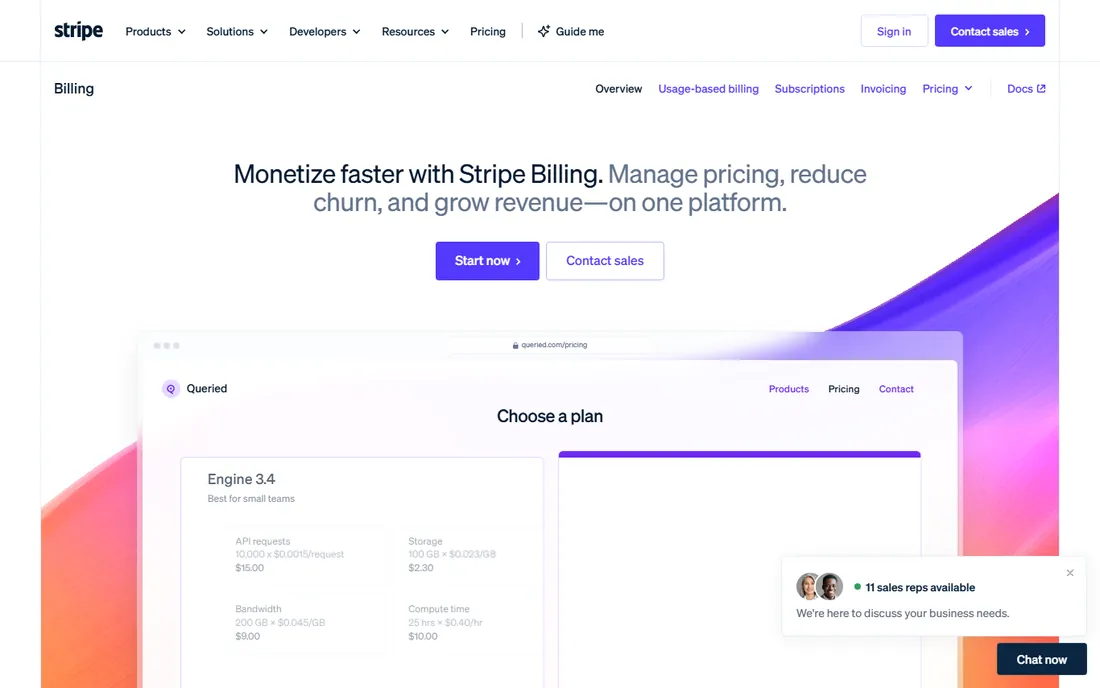
Stripe Billing is billing as a toggle: if you already process on Stripe, setup is essentially flipping a switch with no contract. At 0.7 percent of billing volume and no monthly fee, a $10K MRR business pays about $70 per month for the billing layer; at $100K MRR, about $700. ML-based Smart Retries come standard.
The honest catch is the stack. Card processing at 2.9 percent plus 30 cents sits on top, so the combined take exceeds the 0.7 percent headline, and real usage billing (tokens, API calls, compute) requires Metronome as a separate conversation. Annual options ($620/month up to $100K volume) suit steadier businesses. For the early SaaS already on Stripe, the zero-fixed-cost start is unbeatable; past $100K MRR, price the flat alternatives.
What we like- Percent-of-volume model with zero fixed fee, so it is cheap to start
- Smart Retries and automatic missed-payment reminders included at entry level
- Covers billing on and off Stripe, including off-Stripe invoicing
Watch out for- True usage-based billing routes to Metronome separately (quote-based), not folded into the 0.7%
- Card processing (2.9% + 30c) stacks on top of the billing fee
#2
Chargebee
Best for: $20K-$500K MRR businesses with genuinely complex billing or finance needs
Visit chargebee.com
Starting price$0 + 0.80% of monthly billing volume (Flow, pay-as-you-go)
Free planStartup program (application-based; free until $1M cumulative billing)
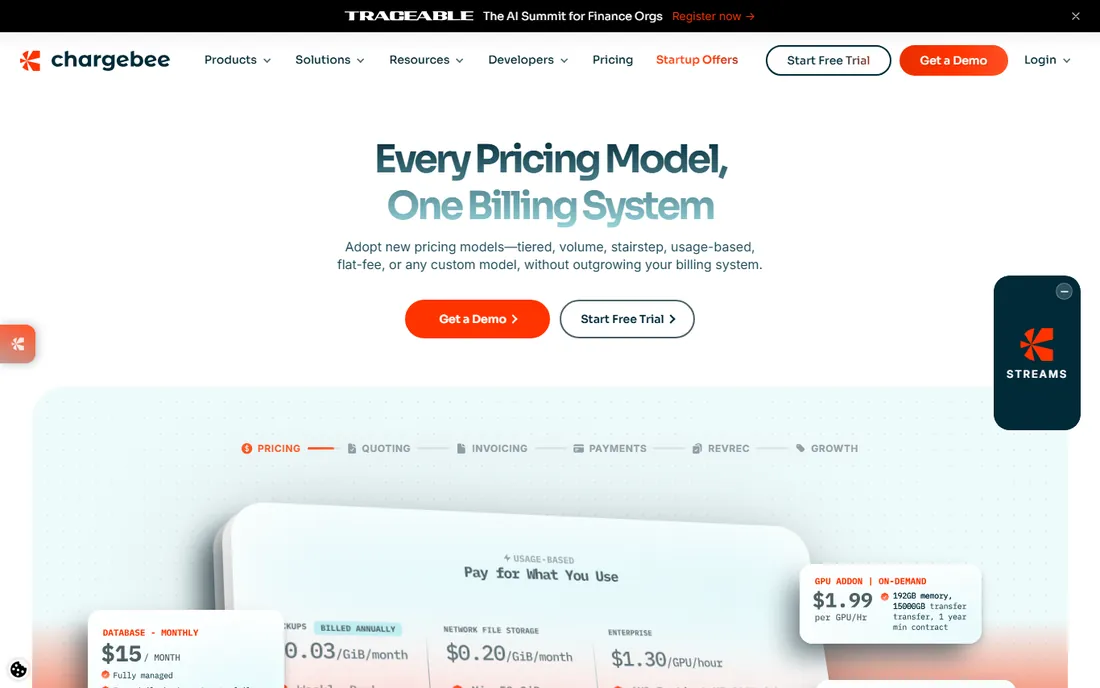
Chargebee is the complexity handler: usage tiers, proration, multi-currency and changing pricing models without custom code, plus smart dunning recovery. Flow at $0 plus 0.80 percent of monthly billing volume means $10K MRR costs about $80 per month; $100K MRR about $800 (or $99 plus 0.65 percent, $749, on the commit variant above ~$66K monthly billings).
The catch is the forever-tax: the bill scales with revenue and never stops, and gateway processing (2.9% + 30c) is separate since Chargebee does not process payments itself. Usage ingestion covers 100M events per month. For the finance-led scale-up with complex pricing, the depth justifies the percentage. For simple flat subscriptions, the flat tools cost less.
What we like- Gateway-agnostic across 40-plus payment gateways, so no processor lock-in
- First-class usage ingestion with basic and smart dunning on Flow
- Finance depth with ASC 606 revenue recognition line and 120-plus currencies
Watch out for- Percentage pricing scales with revenue forever, with no flat-rate tier
- CPQ, RevRec and Growth are separate priced product lines
#3
Recurly
Best for: Subscription businesses ($20K-$200K+ MRR) where failed-payment recovery is the main leak
Visit recurly.com
Starting price$249/month + 0.9% of billing volume (Starter; first $40K of monthly billings free)
Free planFree trial (90 days reported on Starter)

Recurly's name is made on dunning: AI retry timing built on billions of transactions recovers failed payments better than static retry schedules. Starter at $249 per month plus 0.9 percent of billings over $40K monthly means a $10K MRR business pays a flat $249; at $100K MRR, about $789. All-Access (under 1 percent of volume, $1M minimum) is quote-based.
The honest catch: the self-serve plan includes one static dunning campaign, not the AI recovery that justifies Recurly over Stripe, so serious buyers end up in quoted territory anyway. For consumer and DTC subscriptions where involuntary churn is the biggest leak, the recovery math usually pays for the premium. Price the All-Access quote before committing to Starter.
What we like- Strongest failed-payment recovery reputation (AI retry timing, multiple dunning campaigns on higher tiers)
- Gateway-agnostic across 20-plus gateways and 140-plus currencies
- Published entry pricing with no volume minimum
Watch out for- Starter withholds the AI recovery tooling it is famous for
- Engage and RevRec are separate add-ons ($1,600 and $850/month)
#4
Zoho Billing
Best for: Bootstrapped and early SaaS under $20K MRR, especially Zoho shops
Visit zoho.com
Starting priceFrom $15/month billed annually (Standard; directories vary, confirm on vendor page)
Free plan14-day free trial (no permanent free tier)
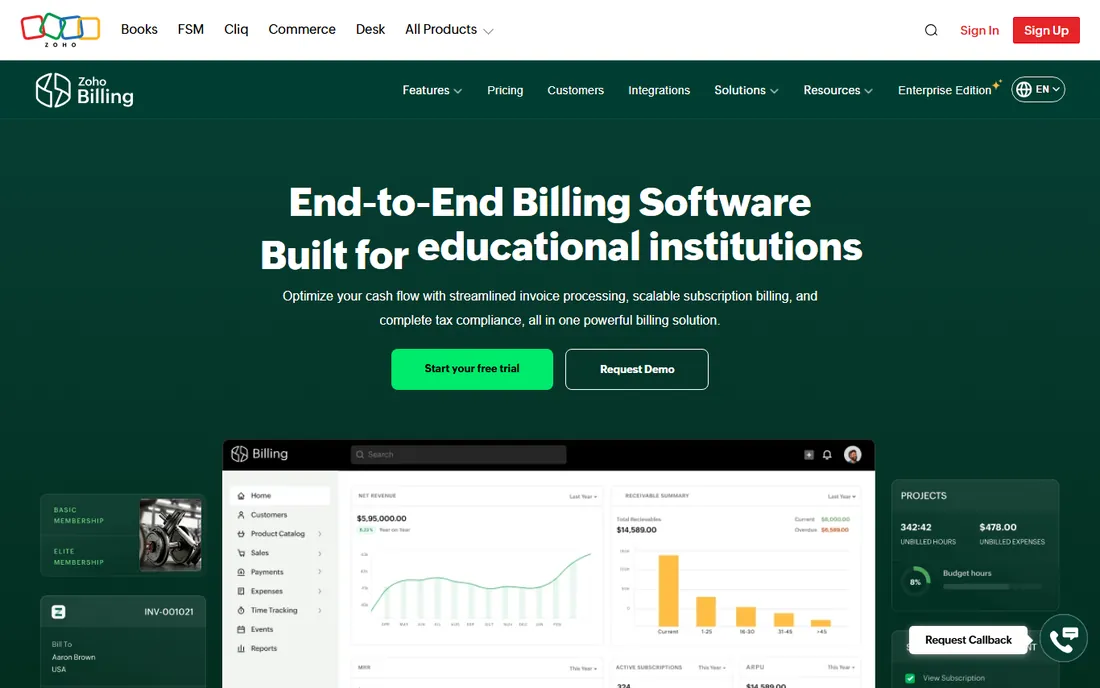
Zoho Billing is the flat-price rebel: Standard from $15 per month billed annually ($20 monthly), Professional $50 ($39 annual), Premium $100 ($79 annual), per organization, not per user, not per revenue dollar. At $100K MRR you still pay $15-$100 per month. For the bootstrapped SaaS, the predictable bill is the whole pitch.
The gating is the trade: metered billing, consolidated billing and trial management sit in Premium, and dunning is basic (automatic retries on Standard, manual campaigns on Premium) versus Recurly's AI. Figures differ across directories (G2 shows $25/$59), so confirm on Zoho's page. For the Zoho Books shop under $20K MRR, nothing touches the value.
What we like- Flat per-organization pricing, not per user and not a revenue percentage: the cheapest entry here
- Native inside the Zoho ecosystem with QuickBooks, Xero, Stripe and PayPal integrations
- Usage-based models supported on Premium
Watch out for- Real subscription features (coupons, multi-currency, hosted pages) need Professional
- Metered billing and dunning need Premium, so Standard is invoicing-centric
#5
Paddle
Best for: Indie and early SaaS ($1K-$50K MRR) selling internationally
Visit paddle.com
Starting price5% + $0.50 per transaction (Starter, merchant of record, no monthly fee)
Free planNo (sandbox/demo available)
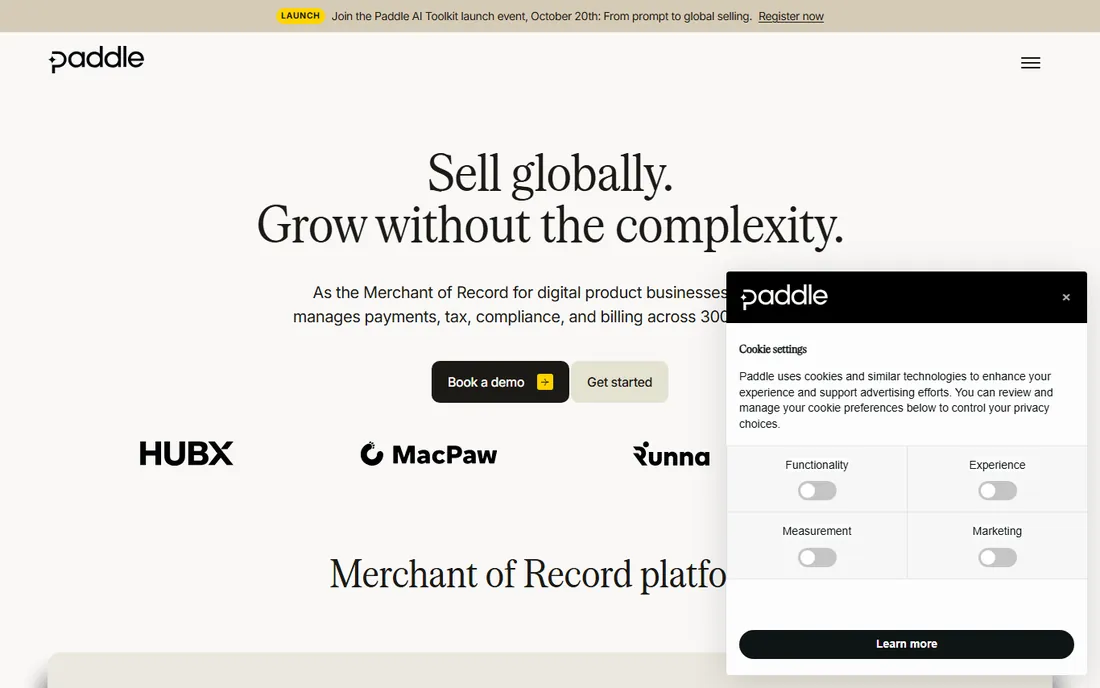
Paddle sells freedom from tax compliance: as merchant of record, it collects and remits VAT, GST and sales tax globally, handles fraud and chargebacks, and bundles billing, dunning and ProfitWell analytics in one fee. Starter at 5 percent plus $0.50 per transaction with no monthly fee is viable from the first dollar.
The math turns hard as you grow: at $10K MRR you pay about $500 per month plus per-transaction fees; at $100K MRR, about $5,000. Plan a migration or negotiate Growth pricing (roughly 3.5-4.5 percent) past ~$50K MRR. Checkout customization is thinner than Stripe's. For the indie hacker selling worldwide from day one, the tax handling alone justifies the rate; for the scaling SaaS, it is a bridge, not a home.
What we like- True merchant of record: handles VAT, GST and US sales tax in 200-plus countries, so you register for tax nowhere
- One fee covers payments, billing, dunning (Paddle Retain) and analytics
- Zero fixed cost to start
Watch out for- 5% + $0.50 is expensive at low price points (about 9.2% effective on a $12/month plan)
- The rate never stops scaling with revenue
#6
Maxio
Best for: Sales-led B2B SaaS ($50K-$500K+ MRR) with negotiated contracts
Visit maxio.com
Starting price$599/month (Grow, up to $100K in monthly billings)
Free plan30-day developer sandbox (free trial)
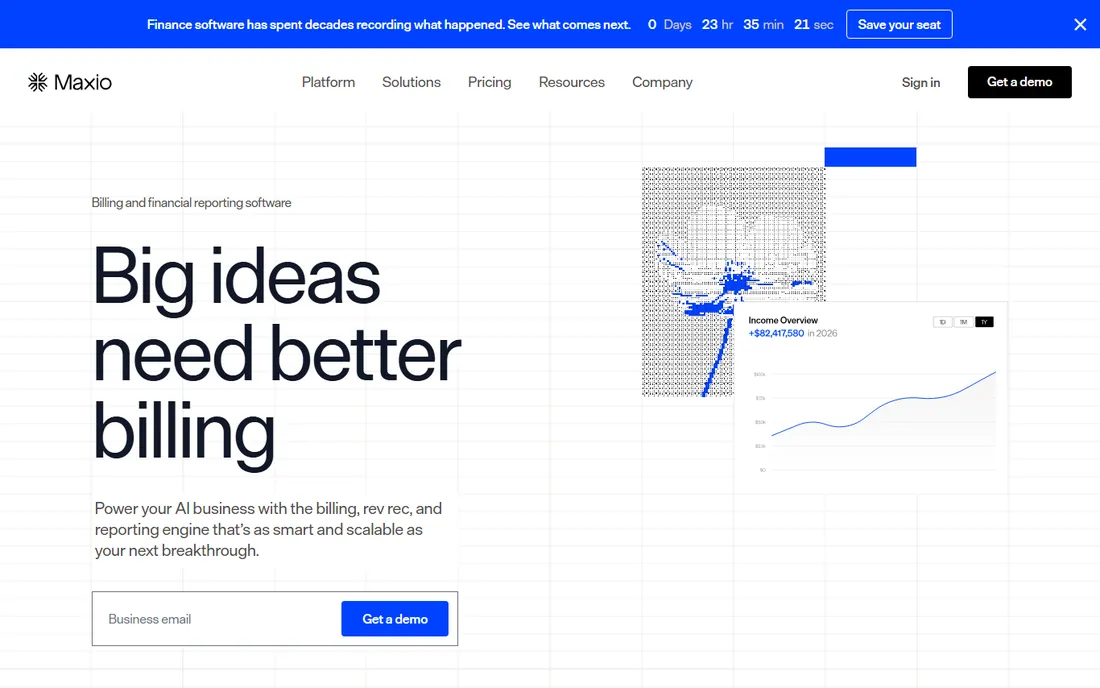
Maxio, formerly Chargify plus SaaSOptics, is billing plus rev-rec in one system of record: finance stops reconciling spreadsheets when an audit, fundraise or board demands GAAP revenue numbers. Grow at $599 per month flat covers up to $100K in monthly billings with no revenue percentage; Scale above that is quote-only.
The honest catch: Maxio publishes only the rung below what most buyers need. If audit-grade rev-rec, advanced metering or multi-entity is your reason for evaluating, you start in a sales-led quote process. At $10K MRR you pay $599; at $100K MRR you still pay $599. For the sales-led B2B SaaS approaching audit territory, the flat fee plus built-in rev-rec is the argument.
What we like- GAAP/IFRS revenue recognition (ASC 606, audit-ready) built in, not an add-on
- Purpose-built for sales-led B2B: CPQ, contract billing, expense recognition, SaaS metrics
- Flat fee with no revenue percentage on Grow
Watch out for- Advanced revenue management and multi-entity support are Scale-only (quote territory)
- $599/month is a steep floor for early startups
#7
Lago
Best for: Engineering-led SaaS and AI startups with in-house DevOps capacity
Visit getlago.com
Starting price$0 (self-hosted open source, AGPL-3.0)
Free planYes (self-hosted open-source edition is free)
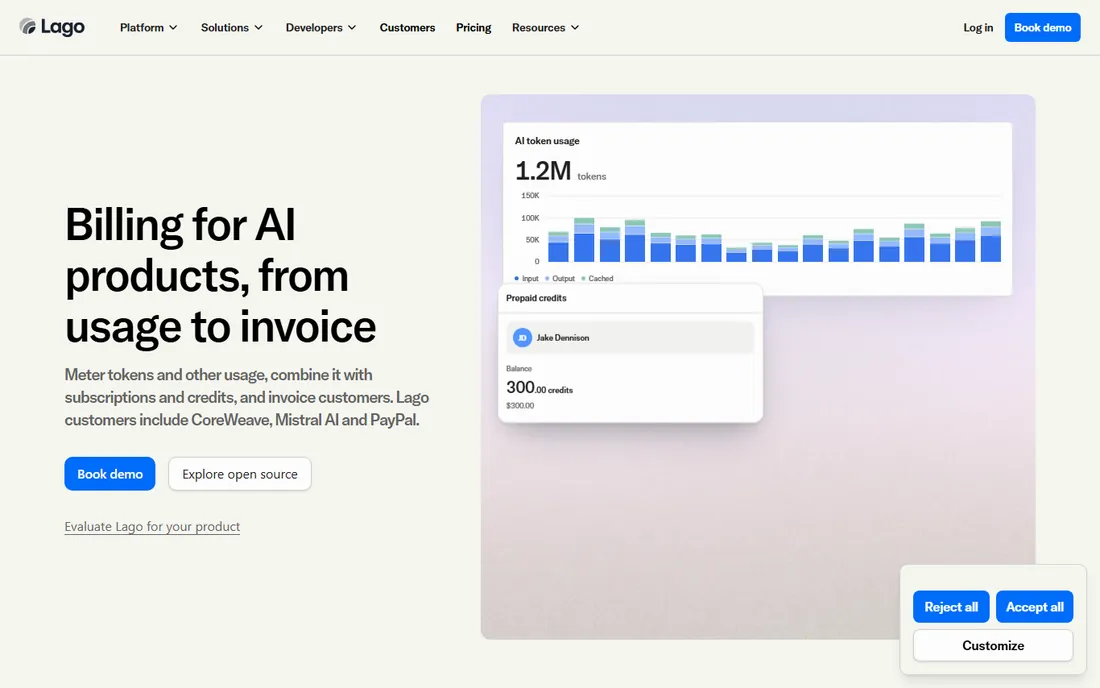
Lago is the open-source answer to the revenue tax: a real billing engine (billable metrics, coupons, invoicing) that runs on your infrastructure for $0 in license fees. At $10K or $100K MRR, the license is still $0. For fintechs with data-residency requirements or AI startups metering tokens, owning the billing stack has genuine appeal.
The real price is engineering time: upgrades, monitoring, backups and month-end on-call are yours, and the moment you need tax automation or automatic dunning, you are negotiating Lago Premium on a custom contract. Total cost often exceeds a managed platform under ~$200K monthly billings. For the team with DevOps capacity and a philosophical objection to revenue percentages, it is the principled pick.
What we like- Zero license cost with full data control: no revenue percentage, ever
- Developer-first metering and billing engine with a modern API
- Fits regulated or data-residency-sensitive companies
Watch out for- Self-hosting is not free in practice: you own upgrades, monitoring and month-end on-call
- Tax integrations and automatic dunning are commercial Premium add-ons
#8
Orb
Best for: AI, infra and API companies ($50K+ MRR) with usage-driven pricing
Visit withorb.com
Starting priceSee website (quote-only; third-party estimates unverified)
Free planFree developer sandbox (no free production tier)
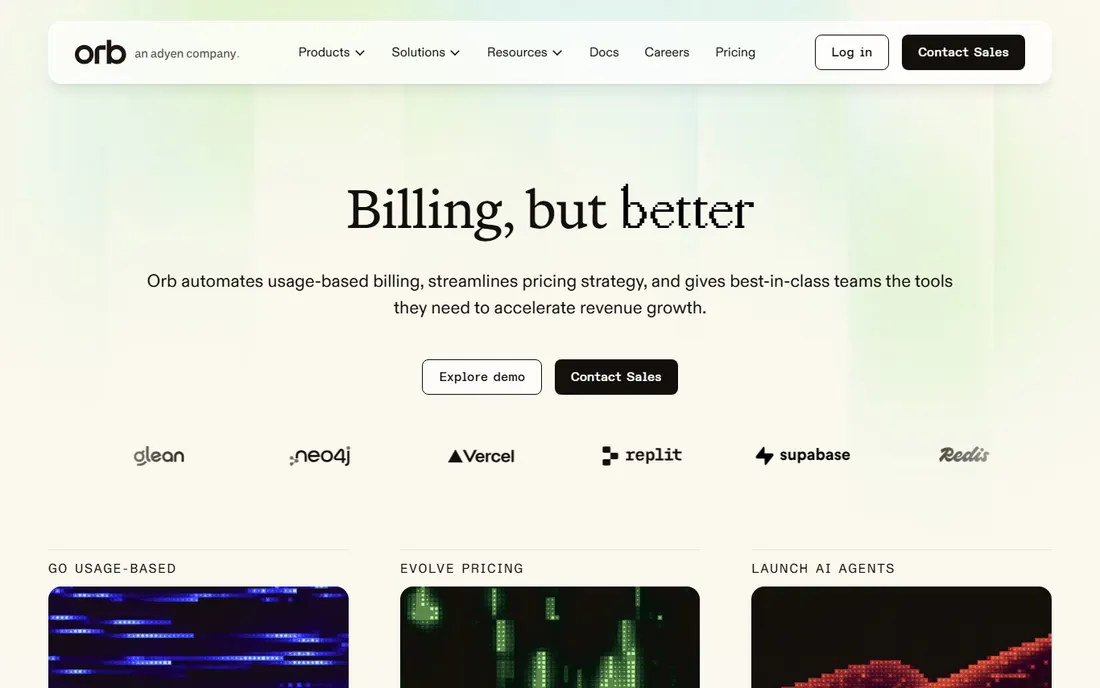
Orb exists for one hard problem: rating logic. When your pricing is tokens, API calls, compute or seats-plus-overage hybrids, general billing platforms approximate badly; Orb lets you define billable metrics in custom SQL and simulate price changes against historical usage before shipping them. Third-party estimates suggest ~$720 per month at small scale, but treat that as unverified: Orb publishes no pricing.
You still need a processor and checkout layer, so Orb is one piece of a stack, and the SQL metrics plus warehouse sync mean real implementation effort. For flat subscriptions it is overkill. For the AI company whose pricing model is the product, the rating engine is worth the procurement cycle.
What we like- Purpose-built for complex usage-based pricing: SQL-defined billable metrics, raw event ingestion via API or S3
- Handles per-unit, tiered, volume, prepaid and hybrid models
- Finance-grade reporting with native Salesforce, Snowflake and NetSuite connections
Watch out for- No built-in payment processing, checkout or customer portal: it is the rating backend, paired with Stripe for collection
- Quote-only pricing with real implementation effort
#9
ChargeOver
Best for: SMB and mid-market SaaS ($20K-$300K MRR) wanting billing without a revenue percentage
Visit chargeover.com
Starting priceFrom $229/month flat (no revenue percentage on any tier)
Free planFree trial available (no permanent free tier)
ChargeOver's pitch is a slogan: your billing platform should not get a raise every time you grow. From $229 per month flat, plans scale on active-customer volume with no revenue percentage at any tier. The vendor's own calculator puts its annual cost at $2,748 at $2M ARR against Recurly's ~$16,668 on published pricing. Dunning automation, MRR reporting and rev-rec reporting are included.
The honest catch is ecosystem: a solid 15-year-old indie vendor, not a platform, so deep usage-metering or a large integration marketplace needs verification on a trial. At $10K MRR you pay from $229; at $100K MRR, still from $229 (customer-count dependent). For the SMB SaaS that wants full subscription billing without the revenue tax, the predictable cost is the argument.
What we like- Flat pricing with no revenue percentage: the bill does not grow when you sign bigger contracts
- 50-plus payment gateways with native QuickBooks, Xero, HubSpot and Salesforce integrations
- Dunning automation and revenue-recognition reporting included
Watch out for- Smaller vendor with a smaller ecosystem than Stripe or Chargebee
- Tiers step up with customer count, so high-count, low-ACV businesses can outgrow the flat model
Frequently asked questions
How much does SaaS billing software cost?
From $0 to ~$800/month at $10K MRR, and $15 to ~$5,000/month at $100K MRR. Stripe Billing ~$70/$700, Chargebee ~$80/~$800, Recurly $249/~$789, Zoho $15-$100 flat, Paddle ~$500/~$5,000, Maxio $599 flat, Lago $0 license, ChargeOver from $229 flat. Orb is quote-only. Gateway processing (2.9% + 30c) is separate everywhere except Paddle.
Should I choose percentage or flat pricing?
Percentage pricing (Stripe, Chargebee) is cheapest to start and aligns cost with revenue: good under ~$30K MRR. Flat pricing (Zoho, ChargeOver, Maxio) wins past the crossover: ChargeOver's $229 flat beats Stripe's 0.7% once monthly billings pass ~$33K. Paddle's 5% is the most expensive at scale but buys global tax compliance. Model your MRR at 3x current before deciding.
What is a merchant of record and do I need one?
A merchant of record (Paddle) sells your software as the legal seller, handling VAT, GST and sales tax collection worldwide plus fraud and chargebacks. You need one if you sell internationally and cannot afford tax-registration overhead. If you sell only domestically, Stripe plus a tax tool (Avalara, Anrok) is cheaper at scale.
How does dunning reduce churn?
Dunning is automated failed-payment recovery: smart retries timed by AI, email sequences, and card-updater services that refresh expired cards. Recurly leads on AI retry timing; Stripe includes Smart Retries standard; Chargebee includes smart dunning on Flow; Paddle bundles Paddle Retain. Involuntary churn (failed payments) is often 20-40% of total churn, so dunning ROI is usually the easiest money in SaaS.
Can these tools handle usage-based (metered) billing?
Stripe Billing handles basic usage; true high-volume metering routes to Metronome (separate, quote-based). Chargebee, Recurly, Zoho Premium, Paddle, Maxio, Lago and ChargeOver all support metered models natively. Orb is purpose-built for complex usage pricing (tokens, API calls) with SQL-defined metrics. If usage is your core pricing, shortlist Orb, Lago and Chargebee.
When should I switch billing platforms?
The usual triggers: outgrowing flat tools (need rev-rec or multi-entity), the revenue-tax crossover (percentage fees exceeding flat alternatives), international expansion (need MoR or tax automation), or moving to usage-based pricing your current tool cannot meter. Migrate during a quiet quarter, run old and new systems in parallel for one billing cycle, and never switch mid–year-end close.
How we chose
We started with the categories buyers search: SaaS billing software and subscription billing software. For each candidate we opened the vendor's own pricing page, checked plan names and prices against public reviews on G2 and Capterra and practitioner discussion on Reddit, and compared feature lists, pricing models, dunning depth, metered billing support, tax handling and MRR-stage fit. Where a price could not be verified on the vendor's page we wrote "See website" rather than guessing, and flagged third-party estimates as unverified.
Sources we checked (11)
- https://stripe.com/billing/pricing/
- https://www.chargebee.com/pricing/
- https://recurly.com/pricing/
- https://www.zoho.com/billing/pricing/
- https://www.paddle.com/pricing/
- https://www.maxio.com/pricing/
- https://www.getlago.com/pricing/
- https://www.withorb.com/pricing/
- https://www.chargeover.com/pricing/
- https://www.g2.com/categories/subscription-management
- https://www.capterra.com/recurring-billing-software/
Is your product missing or out of date?
We review this list regularly. Vendors can request a listing, send updated pricing or ask about featured placement.

Shihab Mia · Founder, Rankite
Shihab has spent more than a decade helping SaaS and e-commerce brands grow through search. He writes Rankite's software buying guides from pricing pages, documentation and public user reviews. More about Shihab.