How we make this list: we compare pricing pages, product documentation and public user reviews. Rankite is independent; if a vendor ever pays for a featured spot, that listing is clearly labeled Partner.

Key takeaways
- Stripe Billing is the developer standard for subscription payments, with unmatched flexibility and ecosystem.
- Chargebee and Recurly specialize in subscription management with deeper billing logic than payment processors.
- Paddle (5% + $0.50) is the merchant-of-record option that handles global tax compliance for SaaS.
- Zuora serves enterprise subscription complexity; GoCardless, Braintree and ChargeOver cover bank debit, PayPal ecosystem and simplicity.
Quick comparison
| Tool | Best for | Starting price | Free plan |
|---|
 Stripe Billing Stripe Billing | developers building custom subscription products | See website | Free trial |
 Chargebee Chargebee | subscription businesses wanting billing without heavy dev | Free; paid plans (see website) | Yes |
 Recurly Recurly | scaling subscription businesses | See website (custom quote) | No |
 Paddle Paddle | SaaS companies wanting tax compliance handled | 5% + $0.50 per transaction | No |
 Zuora Zuora | enterprises with complex subscription models | See website (custom quote) | No |
 GoCardless GoCardless | recurring bank debit payments | See website | No |
 Braintree Braintree | PayPal ecosystem with subscription needs | See website | No |
 ChargeOver ChargeOver | simple recurring billing without complexity | See website | Free trial |
Is your product missing or out of date?
We review this list regularly. Vendors can request a listing, send updated pricing or ask about featured placement.
#1
Stripe Billing
Best for: developers building custom subscription products
Visit stripe.com
Starting priceSee website
Free planFree trial

Stripe Billing is the infrastructure subscription businesses are built on: flexible APIs for any pricing model (flat, per-seat, usage-based, hybrid), global payment methods, and an ecosystem of integrations that covers every adjacent need. Developers get complete control over the subscription experience.
That control requires development: billing logic, dunning and analytics need building or third-party tools. Pricing has multiple components that need modeling. For product teams with engineering resources, the flexibility is unmatched.
What we like- Unmatched API flexibility
- Huge ecosystem
- Reliable global infrastructure
Watch out for- Pricing complexity
- Billing logic needs development
#2
Chargebee
Best for: subscription businesses wanting billing without heavy dev
Visit chargebee.com
Starting priceFree; paid plans (see website)
Free planYes
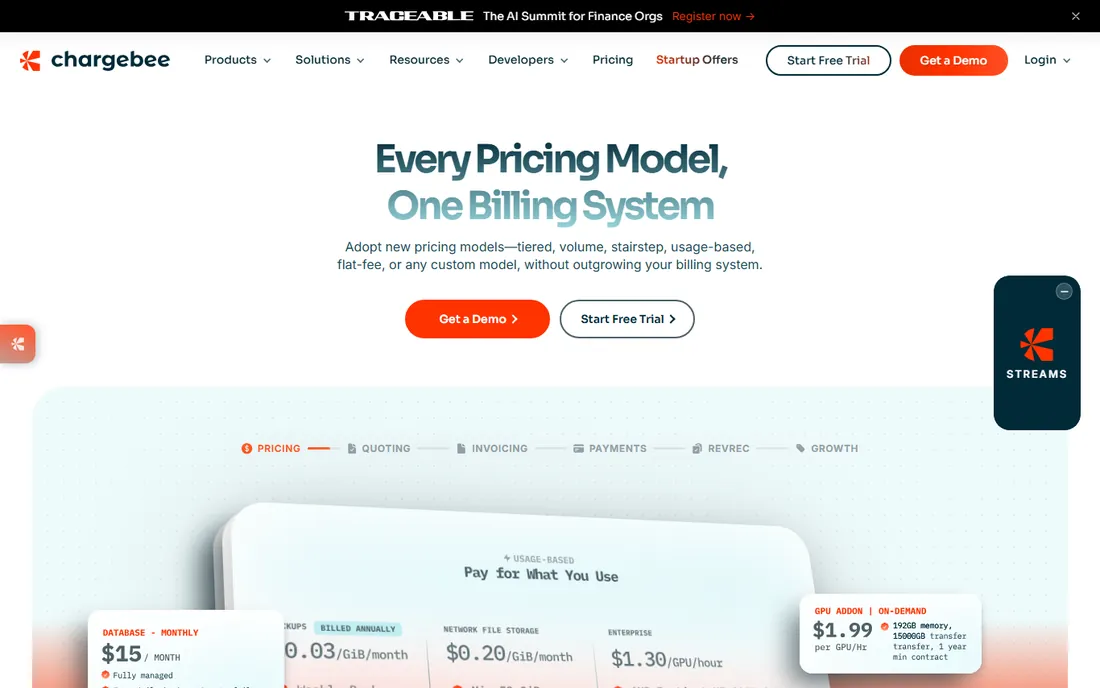
Chargebee provides the subscription management Stripe leaves to developers: complex billing scenarios, dunning management, revenue recognition and analytics, configured not coded. The free tier lets startups begin without cost. Finance teams get the subscription metrics they need.
Heavy customization hits limits that Stripe's APIs do not have. The pricing tiers take study. For subscription businesses that want sophisticated billing without a billing engineering team, it is the pragmatic choice.
What we like- Deep subscription logic out of box
- Good dunning
- Free tier for starters
Watch out for- Pricing tiers complex
- Customization limits vs Stripe
Starting priceSee website (custom quote)
Free planNo
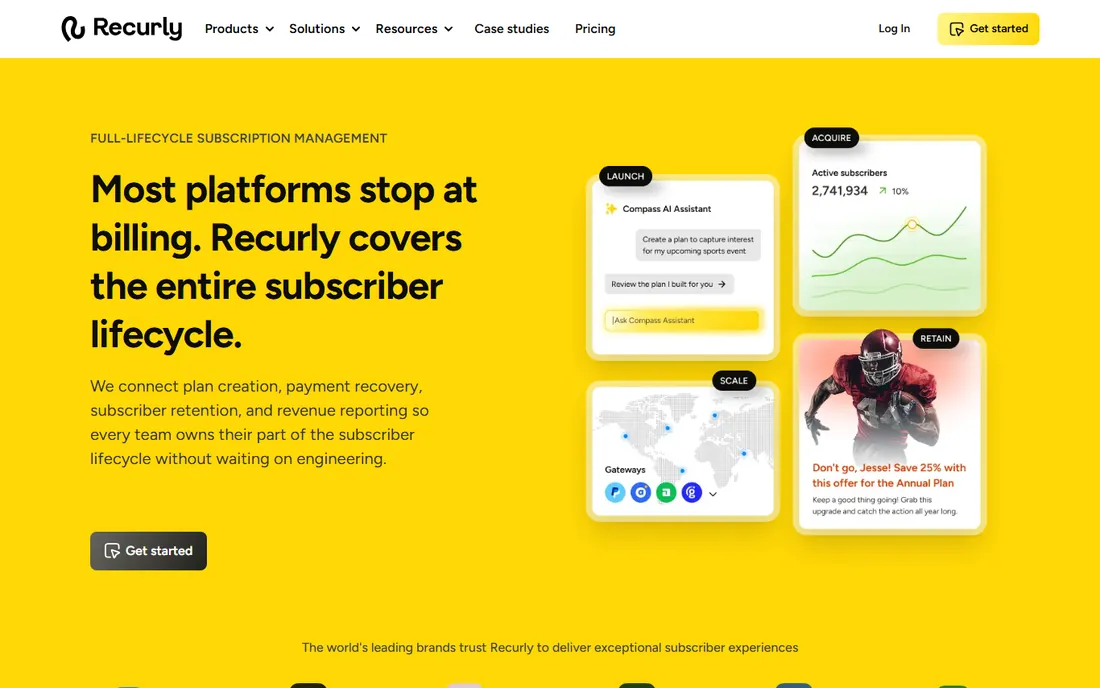
Recurly has focused on subscriptions for over a decade: the dunning, churn prevention and billing flexibility reflect deep domain experience. Scaling subscription businesses get enterprise reliability with subscription-specific intelligence. The expertise shows in edge cases.
Custom pricing and less developer community momentum than Stripe are the tradeoffs. It is the experienced specialist versus the platform giant. Subscription businesses that prioritize billing expertise over ecosystem breadth choose Recurly.
What we like- Strong subscription expertise
- Good churn tools
- Enterprise-ready
Watch out for- Custom pricing
- Less developer mindshare than Stripe
#4
Paddle
Best for: SaaS companies wanting tax compliance handled
Visit paddle.com
Starting price5% + $0.50 per transaction
Free planNo

Paddle acts as the merchant of record: they handle VAT, sales tax and compliance in every jurisdiction, which removes the most painful part of global SaaS billing. The 5% + $0.50 all-in pricing is simple to understand. Small global SaaS companies avoid tax nightmares.
At scale, 5% exceeds Stripe plus tax tooling costs, and you cede some control over the payment experience. It is a tradeoff: simplicity and compliance versus cost and control. For small teams selling globally, the compliance relief usually wins.
What we like- Merchant of record (handles VAT/sales tax)
- Simple pricing
- Good for global SaaS
Watch out for- 5% is expensive at scale
- Less control than Stripe
#5
Zuora
Best for: enterprises with complex subscription models
Visit zuora.com
Starting priceSee website (custom quote)
Free planNo
Zuora serves the most complex subscription businesses: multi-entity, usage-based, hybrid models with sophisticated revenue recognition requirements. Public companies with ASC 606 compliance needs get the controls auditors demand. The enterprise track record is deep.
Everything is enterprise: pricing, implementation, complexity. Simple subscription businesses drown. When billing complexity is the business (telecom, media, enterprise SaaS), Zuora is the standard.
What we like- Handles extreme billing complexity
- Strong revenue recognition
- Enterprise proven
Watch out for- Expensive
- Implementation is major
- Overkill for simple subscriptions
Starting priceSee website
Free planNo

GoCardless specializes in Direct Debit: recurring bank-to-bank payments that cost less than card processing and fail less often than cards expire. Memberships, invoices and B2B recurring payments suit bank debit perfectly. The international coverage handles multiple debit schemes.
Bank debits settle slower than cards and do not suit card-centric consumer subscriptions. This is a specialist tool. Businesses with invoice-like recurring payments save meaningfully on processing costs.
What we like- Bank debit cheaper than cards
- Great for invoices and memberships
- International coverage
Watch out for- Bank debit slower than cards
- Not for card-based models
Starting priceSee website
Free planNo
Braintree (a PayPal service) offers subscription billing with the advantage of PayPal and Venmo acceptance alongside cards. The APIs are solid, and businesses already in the PayPal ecosystem get unified processing. Recurring billing covers standard subscription needs.
Subscription management depth trails Chargebee and Recurly. PayPal's corporate strategy shifts affect the roadmap. For businesses where PayPal payment acceptance matters, the subscription features suffice.
What we like- PayPal/Venmo acceptance
- Solid APIs
- Trusted brand
Watch out for- Subscription features thinner than specialists
- PayPal corporate dynamics
Starting priceSee website
Free planFree trial

ChargeOver does recurring billing simply: set up customers, define billing schedules, collect payments automatically, with clean reporting. Small businesses that find Stripe complex and Chargebee excessive get the essentials without the learning curve. Support gets good reviews.
Advanced subscription scenarios (complex usage billing, multi-entity) exceed its scope. The ecosystem is smaller. For straightforward recurring billing, the simplicity is the selling point.
What we like- Straightforward and affordable
- Good support
- Quick setup
Watch out for- Less feature depth
- Smaller ecosystem
How we chose
We evaluated current recurring payment platforms on billing flexibility, dunning effectiveness, global coverage, pricing transparency and developer experience, cross-checked against SaaS practitioner feedback and 2026 comparisons. Every tool listed is actively maintained with a live homepage as of October 2026. We covered developer platforms, subscription specialists and merchant-of-record options because buyers split across all three. Prices reflect each vendor's own published tiers.
The dunning problem (and why it matters more than features)
Failed payments are the silent killer of subscription revenue: 20-40% of churn is involuntary (expired cards, insufficient funds), not customer choice. Dunning (retry logic, customer notifications, card updaters) recovers much of it. The difference between good and bad dunning is percentage points of revenue.
Evaluate dunning specifically: smart retry timing, automatic card account updaters, branded customer notifications, and analytics showing recovery rates. Stripe, Chargebee and Recurly all invest here, with varying sophistication. A platform with 5% better involuntary churn recovery outperforms a cheaper platform with worse dunning. Ask for recovery rate benchmarks during evaluation.
What to check before you sign
Start with your pricing model complexity. Simple flat subscriptions work on any platform. Usage-based, per-seat, hybrid and grandfathered pricing need the flexibility of Stripe or the depth of Chargebee/Recurly/Zuora. Map your current and planned pricing models, then verify each platform handles them natively.
Then check global requirements. Selling internationally means multi-currency, local payment methods, VAT/sales tax compliance and dunning in local languages. Paddle handles tax as merchant of record; others need tax integrations (Avalara, Anrok). The compliance burden surprises US-first companies expanding globally.
Finally, verify the revenue recognition and analytics. Subscription finance needs MRR, churn, LTV, cohort analysis and ASC 606 compliance. Check what is built-in versus what needs a separate tool (ChartMogul, Baremetrics). Finance team requirements often decide the platform more than engineering preferences.
Also plan the migration carefully if switching platforms. Subscription migrations involve transferring customer records, payment methods, billing schedules and historical data without disrupting billing. The tokenized payment data often cannot transfer directly between processors, requiring customers to re-enter payment details. Plan communication and timing meticulously: billing disruptions directly impact revenue and trust.
Frequently asked questions
What is the difference between Stripe and Chargebee?
Stripe is payment infrastructure with billing APIs you build on; Chargebee is subscription management software configured without heavy development. Developers who want control choose Stripe; businesses that want billing handled choose Chargebee. Many use both together.
How much do recurring payment platforms cost?
Stripe charges payment processing (around 2.9% + 30c) plus billing fees. Chargebee has a free tier with paid plans. Paddle charges 5% + $0.50 all-in. Enterprise platforms (Zuora, Recurly) are custom-quoted. Model total cost including processing, platform fees and tax tooling.
What is a merchant of record?
The legal seller of your product, responsible for VAT/sales tax collection and remittance globally. Paddle acts as MoR, removing your tax compliance burden. With Stripe or Chargebee, you are the MoR and handle taxes yourself (usually via integrations).
How do I reduce involuntary churn?
Optimize dunning: smart retries, card account updaters, clear customer notifications, and easy card update flows. The best platforms automate this. Also offer bank debit (GoCardless) where appropriate: it fails less than cards expire.
Should I build billing in-house?
Almost never. Billing seems simple until you handle proration, dunning, tax, revenue recognition, and the endless edge cases. The platforms amortize this complexity across thousands of businesses. Build only if billing is your core differentiator, which it is not.
How do I handle global tax compliance?
Either use a merchant of record (Paddle) that handles it, or integrate tax automation (Avalara, Anrok, Stripe Tax) with your billing platform. Do not ignore it: VAT/sales tax obligations apply from the first international sale, and penalties compound.
When should I switch from simple to complex billing?
When your pricing model outgrows your platform: adding usage-based components, enterprise contracts with custom terms, or multi-entity billing that requires manual workarounds. The switching cost grows with your subscriber base, so migrate before the pain becomes critical. Most businesses upgrade billing platforms once, from starter to scale solution.
How important are local payment methods?
Very, for international growth. Credit card penetration varies enormously: bank transfers dominate in parts of Europe, digital wallets in Asia, cash-based methods in Latin America. Supporting local methods can double conversion in some markets. Verify your platform supports the methods your target markets actually use.
The checkout experience directly impacts conversion. Every additional field, redirect or confusing step loses customers. The best platforms optimize for one-click subscriptions with saved payment methods and clear trial-to-paid transitions. Test your checkout flow on mobile: most subscription signups now happen on phones, and mobile friction kills conversion faster than any pricing objection. The platforms with the best hosted checkout pages (Stripe, Paddle) convert better than custom-built flows that cut corners. Do not underestimate the trust factor: familiar, professional checkout experiences reduce abandonment, especially for higher-priced subscriptions. Display security badges, offer money-back guarantees clearly, and make the trial terms unmistakable: transparency at checkout builds the trust that converts. The subscription businesses with the clearest trial terms have the lowest chargeback rates and the happiest customers. Clarity is a competitive advantage in an industry plagued by confusing billing practices. The businesses that treat customers fairly at billing earn loyalty that transcends price. In the subscription economy, trust is the real retention mechanism. Customers stay with billing they understand and leave billing that surprises them.
Sources we checked (8)
- https://www.stripe.com
- https://www.chargebee.com
- https://www.recurly.com
- https://www.paddle.com
- https://www.zuora.com
- https://www.gocardless.com
- https://www.braintreepayments.com
- https://www.chargeover.com
Is your product missing or out of date?
We review this list regularly. Vendors can request a listing, send updated pricing or ask about featured placement.

Shihab Mia · Founder, Rankite
Shihab has spent more than a decade helping SaaS and e-commerce brands grow through search. He writes Rankite's software buying guides from pricing pages, documentation and public user reviews. More about Shihab.