How we make this list: we compare pricing pages, product documentation and public user reviews. Rankite is independent; if a vendor ever pays for a featured spot, that listing is clearly labeled Partner.
Key takeaways
- The rate you will actually pay most often: Stripe charges 2.9% + 30 cents per online transaction, Square 3.3% + 30 cents, and PayPal 2.99% + 49 cents on standard US online card payments.
- In-person sales are cheaper everywhere: Square charges 2.6% + 15 cents at the counter and Chase 2.6% + 10 cents, so businesses that mostly swipe should price their mix first.
- Interchange-plus vendors (Helcim, Dharma) and subscription vendors (Stax, Payment Depot) publish their markups openly, while flat-rate processors keep the math simple and keep the margin.
- Every pick here publishes its US card rates on its own website in 2026. Anything quoted over the phone is a starting point, not the price.
Quick comparison
| Tool | Best for | Starting price | Free plan |
|---|
 Stripe Stripe | Online businesses and marketplaces that need developer-friendly payment tools | 2.9% + 30¢ per online transaction (US); 2.7% + 5¢ in person | No (no monthly fees; pay per transaction) |
 Square Square | Retailers, cafes and service businesses that take most payments in person | 2.6% + 15¢ in person; 3.3% + 30¢ online, invoices and payment links (US) | No (no monthly fees; the point-of-sale app is free) |
 PayPal PayPal | Businesses that want a checkout button their customers already trust | 2.99% + 49¢ standard online card (US); 3.49% + 49¢ for PayPal Checkout and Venmo; 2.29% + 9¢ card-present | No (no monthly fee to open a business account) |
 Helcim Helcim | Small businesses that want interchange-plus pricing without a monthly fee | $0/month; interchange + 0.40% + 8¢ in person, interchange + 0.50% + 25¢ online or keyed (US) | No (no monthly fee) |
 Stax Stax | Businesses processing higher monthly volume that want zero markup on interchange | From $99/month; 0% markup on interchange, 8¢ per in-person transaction (US) | No |
 Dharma Merchant Services Dharma Merchant Services | Values-driven small businesses that want transparent interchange-plus rates | $20/month + interchange + 0.15% + 8¢ per authorization (US retail) | No |
 Payment Depot Payment Depot | Established businesses that prefer a flat membership over percentage markups | Membership from $79/month (up to $199); interchange at cost with no markup (US) | No |
 Chase Payment Solutions Chase Payment Solutions | Chase business banking customers who want payments and deposits in one place | 2.6% + 10¢ for tap, dip and swipe; 2.9% + 25¢ e-commerce; 3.5% + 10¢ keyed-in (US) | No |
Is your product missing or out of date?
We review this list regularly. Vendors can request a listing, send updated pricing or ask about featured placement.
The best payment software for small business
Every payment processor advertises the same thing: a low number. You see 2.9% on a landing page, sign up, and your first statement tells a different story, with per-transaction cents, monthly fees, PCI line items and a higher rate for keyed-in cards. A coffee shop that swipes most payments and an online store that invoices customers are buying different products even when the processor's name is the same. These eight options are the payment software US small businesses actually compare, with the published 2026 rates so you can run the math on your own mix of in-person and online sales.
#1
Stripe
Best for: Online businesses and marketplaces that need developer-friendly payment tools
Visit stripe.com
Starting price2.9% + 30¢ per online transaction (US); 2.7% + 5¢ in person
Free planNo (no monthly fees; pay per transaction)
Stripe is the default choice for online-first businesses because the pricing is one line and the integration options are the deepest in the industry. The US online rate is 2.9% plus 30 cents per transaction, with 2.7% plus 5 cents for in-person payments through Terminal. There is no monthly fee, so a store doing $5,000 a month online pays about $160 in processing and nothing else. The product suite covers subscriptions, invoicing, marketplaces and fraud screening without changing vendors.
The honest catch is account stability. New sellers in high-risk categories report frozen payouts while Stripe reviews their business, sometimes for weeks, and getting a human on the phone on the standard plan is difficult. Stripe is also priced for online volume: the 30-cent fixed fee eats into small tickets, and the in-person offering is thinner than Square's or Chase's. If your revenue is mostly online and you have a developer or a platform plugin, it is hard to beat. If you are a counter business, keep reading.
What we like- Flat published rate with no monthly fees or setup cost
- Radar fraud screening and multi-currency support included
- Billing, Invoicing and Terminal share one dashboard
Watch out for- Account holds and fund freezes are a common complaint from new sellers
- Support is ticket-first, with phone help hard to reach on the standard plan
#2
Square
Best for: Retailers, cafes and service businesses that take most payments in person
Visit squareup.com
Starting price2.6% + 15¢ in person; 3.3% + 30¢ online, invoices and payment links (US)
Free planNo (no monthly fees; the point-of-sale app is free)
Walk into an independent coffee shop or boutique and there is a good chance the register is a Square stand, because Square made card acceptance nearly free to start. The US rate is 2.6% plus 15 cents for tapped, dipped or swiped payments, with no monthly fee and a free POS app that handles inventory, employees and sales reports. A shop doing $20,000 a month in person pays roughly $550 in fees, with hardware costs limited to a reader or stand.
The trade-off shows up online, where Square charges 3.3% plus 30 cents, noticeably more than Stripe's 2.9% plus 30 cents. Manually keyed-in cards cost 3.5% plus 15 cents, so phone orders get expensive. Square has also drawn complaints about sudden account holds during reviews. For a business that lives at the counter, it remains the simplest full package. For a business that lives on the web, the online rate is worth comparing line by line.
What we like- Free point-of-sale app with inventory, staff management and reporting built in
- Flat rates with no monthly fees or long-term contract
- Hardware from low-cost readers to full registers
Watch out for- The online rate of 3.3% + 30¢ is among the highest here
- Account reviews can freeze funds with little warning
#3
PayPal
Best for: Businesses that want a checkout button their customers already trust
Visit paypal.com
Starting price2.99% + 49¢ standard online card (US); 3.49% + 49¢ for PayPal Checkout and Venmo; 2.29% + 9¢ card-present
Free planNo (no monthly fee to open a business account)
No other name on this list is as familiar to shoppers as PayPal, and that familiarity is the product. The US standard rate for online card payments is 2.99% plus 49 cents, with 3.49% plus 49 cents for payments through PayPal Checkout or Venmo, and 2.29% plus 9 cents for card-present sales. There is no monthly fee, and customers can pay without creating an account in many flows, which removes friction at checkout.
The 49-cent fixed fee is the catch: on a $10 sale it adds nearly 5% before the percentage rate even applies, so low-ticket sellers pay a premium for the brand. Seller reviews also complain that dispute resolution favors buyers, and held funds during disputes can take weeks to release. PayPal fits businesses where buyer trust at checkout matters more than the lowest possible rate. If your average ticket is under $15, run the numbers against Stripe or Helcim before committing.
What we like- Buyer recognition that can lift checkout conversion
- No monthly fee to open an account
- Zettle hardware covers in-person sales
Watch out for- The 49-cent fixed fee makes small tickets expensive
- Dispute handling favors buyers in many seller reviews
#4
Helcim
Best for: Small businesses that want interchange-plus pricing without a monthly fee
Visit helcim.com
Starting price$0/month; interchange + 0.40% + 8¢ in person, interchange + 0.50% + 25¢ online or keyed (US)
Free planNo (no monthly fee)
Helcim's pitch is transparency: interchange-plus pricing, where you pay the card networks' wholesale cost plus a fixed published markup, with every tier on the website. The entry tier charges interchange plus 0.40% and 8 cents in person, or interchange plus 0.50% and 25 cents for online and keyed-in payments, with no monthly fee and automatic discounts as volume grows. For a business processing $10,000 a month in person, the markup over interchange is about $40 plus 8 cents per transaction, which usually beats flat-rate pricing.
The model has two honest limits. First, you need to understand that the published markup sits on top of interchange, so your statement is harder to read than a flat rate. Second, the online markup is meaningfully higher than the in-person one, and Helcim's hardware options are thinner than Square's. Helcim suits owners who want the cheapest honest rate and do not mind learning what interchange means. If you want one number and zero homework, pick a flat-rate processor instead.
What we like- True interchange-plus pricing with published tiers and automatic volume discounts
- No monthly fee and no contract
- ACH payments at 0.5% + 25¢
Watch out for- The online markup (0.50% + 25¢) is higher than the in-person markup
- The hardware lineup is smaller than Square's or Chase's
#5
Stax
Best for: Businesses processing higher monthly volume that want zero markup on interchange
Visit staxpayments.com
Starting priceFrom $99/month; 0% markup on interchange, 8¢ per in-person transaction (US)
Free planNo
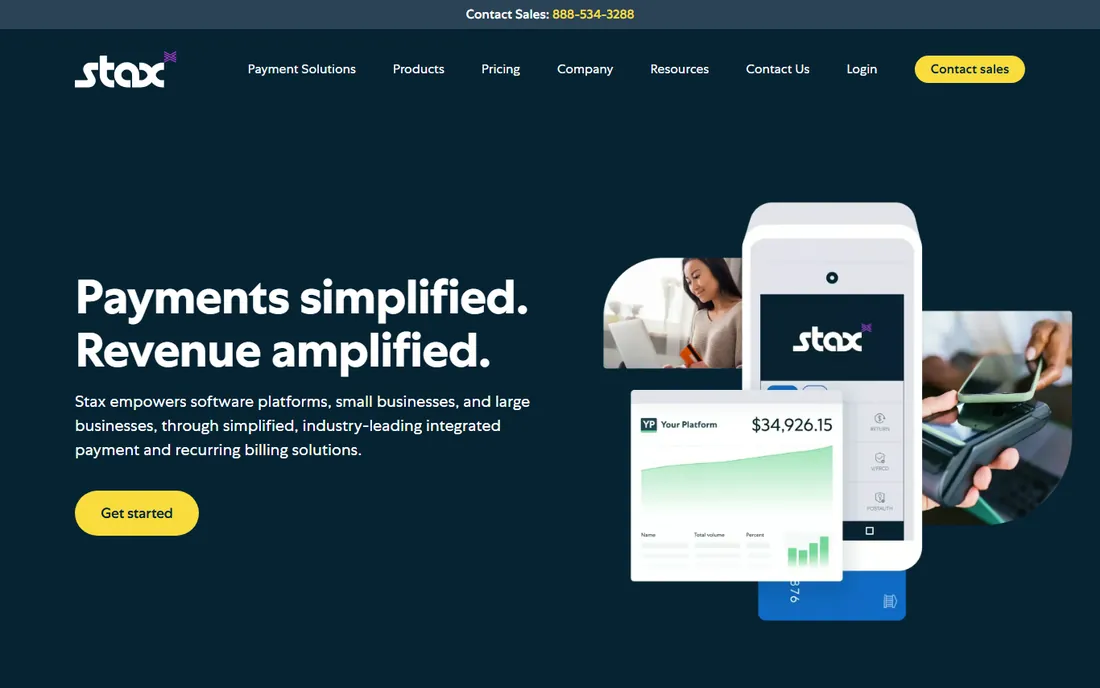
Stax sells membership instead of markup: you pay a monthly fee and get interchange at cost with zero percentage markup, plus 8 cents per in-person transaction. Plans start at $99 per month for businesses under about $50,000 a year in volume, rising to $139 and $199-plus as volume grows. At $30,000 a month in card sales, the interchange savings typically cover the membership several times over compared with a flat 2.9% rate, and ACH transfers are capped at $10 each.
The math only works above a threshold. At $5,000 a month, the $99 membership alone is nearly 2% before interchange, so smaller businesses pay more than they would with Stripe or Square. Onboarding also goes through a sales process rather than instant signup. Stax fits established businesses with steady volume that want their processor's margin to be a flat fee instead of a percentage. If you are just starting out, revisit it when volume justifies the membership.
What we like- Interchange at cost with 0% markup
- Monthly plans scale with volume ($99 to $199 and up)
- ACH capped at $10 per transaction
Watch out for- The monthly fee makes it uneconomic under roughly $5,000 to $10,000 in monthly volume
- Onboarding is sales-led rather than instant self-serve
Starting price$20/month + interchange + 0.15% + 8¢ per authorization (US retail)
Free planNo
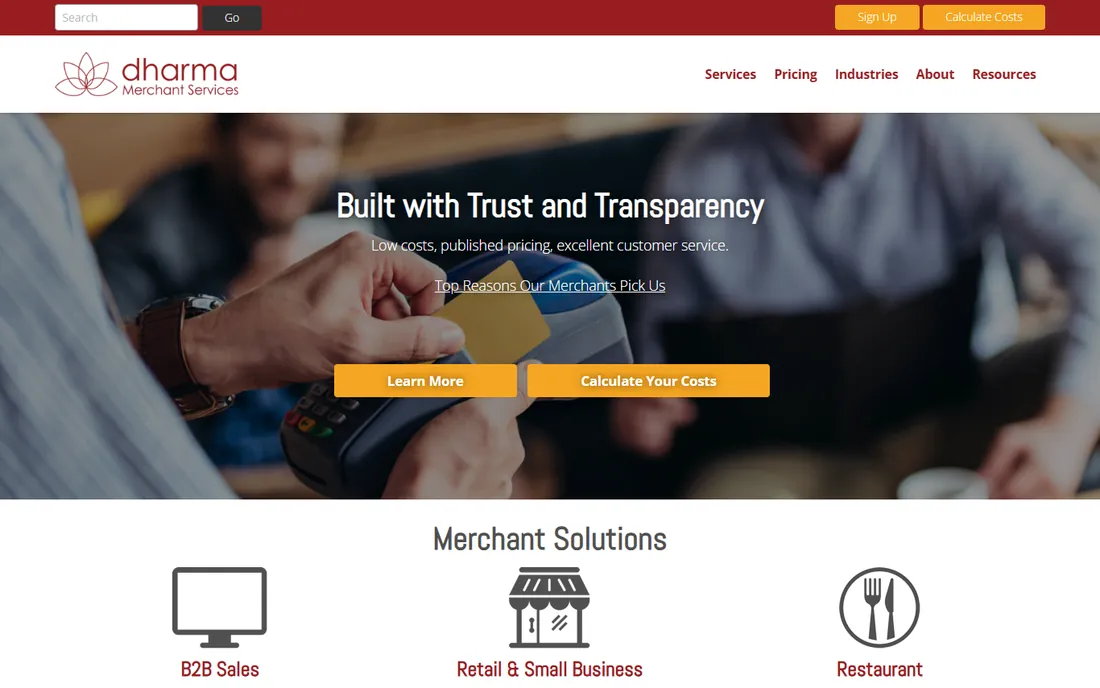
Dharma Merchant Services combines interchange-plus pricing with a values pitch: published rates, no junk fees, and a company that markets its social mission. The retail plan is $20 a month plus interchange plus 0.15% and 8 cents per authorization, with no PCI compliance fees, no AVS fees and no batch fees, and a lower 0.10% markup tier for businesses over $100,000 a month. Chargebacks cost $25 and closing the account costs $49, both stated up front.
The fixed costs are the honest trade-off: $20 a month is $240 a year before you process a dollar, so very small businesses may do better with a no-monthly-fee processor. American Express transactions also carry a higher markup of 0.25% plus 8 cents. Dharma fits owners who want to know exactly what their processor earns and who like where it stands. If you process under $3,000 a month, the monthly fee likely outweighs the low markup.
What we like- Published interchange-plus rates with no PCI, AVS or batch fees
- A high-volume tier at 0.10% + 8¢ above $100,000 a month
- Carbon-neutral shipping and a social-mission brand
Watch out for- The $20 monthly fee and $49 account closure fee add fixed costs
- Amex carries a higher markup at 0.25% + 8¢
#7
Payment Depot
Best for: Established businesses that prefer a flat membership over percentage markups
Visit paymentdepot.com
Starting priceMembership from $79/month (up to $199); interchange at cost with no markup (US)
Free planNo
Payment Depot takes the warehouse-club approach to card processing: pay a membership and get interchange at wholesale cost with no percentage markup. Memberships run from $79 a month up to $199 depending on volume, and the company bundles point-of-sale software rather than charging for it separately. For a business doing $40,000 a month in card sales, the savings versus a flat 2.9% rate can exceed $500 a month after the membership fee.
Two things to know before signing. First, like Stax, the membership only makes sense above a volume threshold; at $5,000 a month the $79 fee alone is over 1.5%. Second, Payment Depot was acquired by Stax, and the two brands now sell similar membership models side by side, so compare both quotes before choosing. Payment Depot fits established businesses that like a simple membership and want every transaction at cost. Smaller businesses should compare Helcim's no-monthly-fee interchange-plus first.
What we like- Wholesale interchange with zero markup on every plan
- No long-term contracts on published terms
- Point-of-sale software included
Watch out for- Membership pricing only pays off at higher volumes
- It is owned by Stax, so the two brands overlap in confusing ways
#8
Chase Payment Solutions
Best for: Chase business banking customers who want payments and deposits in one place
Visit chase.com
Starting price2.6% + 10¢ for tap, dip and swipe; 2.9% + 25¢ e-commerce; 3.5% + 10¢ keyed-in (US)
Free planNo
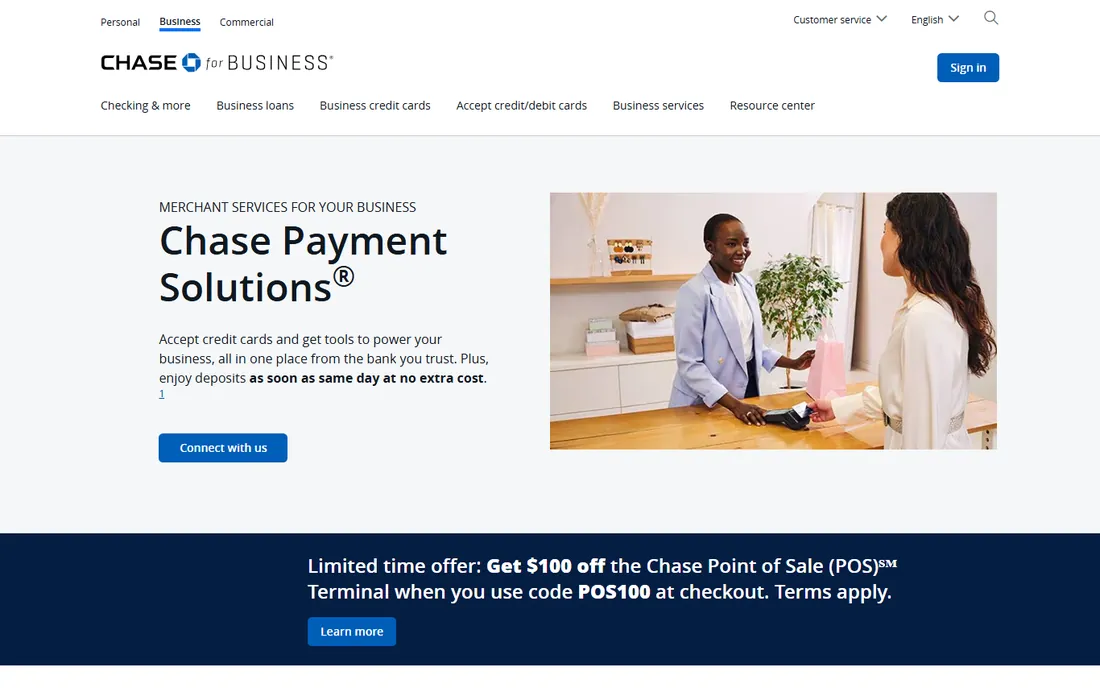
If your business bank account is already at Chase, Chase Payment Solutions is the path of least resistance: card sales fund the same account, often same-day, with one institution to call. The published US rates are 2.6% plus 10 cents for tapped, dipped or swiped payments, 2.9% plus 25 cents for e-commerce, and 3.5% plus 10 cents for keyed-in transactions, with no monthly fee on the standard schedule. The in-person rate undercuts Square by 5 cents a transaction, which adds up at volume.
The catch is the ecosystem lock-in. The funding speed and simplicity assume you bank with Chase, and the keyed-in rate is among the highest here, so businesses that take phone orders pay for the convenience. Online-only sellers will find Stripe's tooling deeper. Chase fits brick-and-mortar businesses already in the Chase ecosystem that want one statement, one login and fast funding. If you bank elsewhere, the rate alone is not a reason to switch banks.
What we like- Same-day funding to a Chase business checking account
- No monthly fee on the published schedule
- Hardware and an online gateway from one bank
Watch out for- The best value assumes a Chase banking relationship
- The keyed-in rate of 3.5% + 10¢ is steep for phone orders
How we chose
We started with the processors US small businesses actually shortlist, then kept only vendors that publish their US card rates on their own websites in 2026. That ruled out quote-only merchant accounts and resellers with teaser rates. For each finalist we read the vendor's own pricing page and terms, checked public reviews on G2 and Capterra and practitioner discussion on Reddit for recurring complaints about holds, fee surprises and support, and compared the feature set for in-person, online and invoicing use cases. We did not run live transactions or test hardware, and nothing here is sponsored placement.
What to compare before you sign
Start with your sales mix, because the cheapest processor for a coffee shop is rarely the cheapest for an online store. Write down what share of your revenue is tapped or swiped in person, what share is online, and what share is keyed in over the phone, since keyed-in rates run 0.5 to 1 point higher everywhere. Then price your actual month: take last month's volume and transaction count, apply each vendor's percentage and per-transaction cents, and add any monthly fee. The per-transaction cents matter more than most owners expect; 30 cents on a $12 sale is 2.5% before the percentage rate.
Next, read the fee schedule for the line items nobody advertises. PCI compliance fees, monthly minimums, batch fees, statement fees and early termination fees are where cheap headline rates get expensive. Every vendor on this list publishes its core rates, but ask specifically about the account closure fee (Dharma charges $49), chargeback fees (Dharma charges $25) and any monthly minimum before you sign. Finally, check funding speed and holds: same-day or next-day funding is standard now, but new accounts in some categories face rolling reserves or delayed first payouts, and the processors with the easiest signup (Stripe, Square, PayPal) are also the ones reviewers mention most for sudden holds.
The three ways processors charge, and which one wins at your volume
Flat-rate pricing (Stripe, Square, PayPal, Chase) charges one percentage plus a fixed cents amount on every transaction. It is the easiest to understand and the easiest to compare, but the processor keeps the difference between your rate and wholesale interchange, which is the margin. Interchange-plus pricing (Helcim, Dharma) passes through the wholesale interchange cost and adds a small published markup, usually the cheapest honest rate for most small businesses, at the cost of a harder-to-read statement. Subscription pricing (Stax, Payment Depot) charges a monthly membership and gives you interchange at cost with no markup, which wins once your volume covers the fee.
The crossover math is straightforward. Take $10,000 a month with 70% in person (175 transactions at $40 average) and 30% online (75 transactions at $40). On Square that is about $208 in person (2.6% + 15 cents) plus about $122 online (3.3% + 30 cents), roughly $330 total. On Chase it is about $200 in person (2.6% + 10 cents). On Stripe's online rate the $3,000 online portion costs about $110 (2.9% + 30 cents). A $99 Stax membership on the same volume typically lands under $250 all-in once interchange is at cost, which is why the membership model wins above roughly $10,000 to $15,000 a month and loses below it. Run your own numbers with your ticket size, because the fixed cents per transaction punish small tickets and reward large ones.
Frequently asked questions
What is the cheapest way for a small business to accept credit cards?
For most small businesses, interchange-plus pricing (Helcim, Dharma) produces the lowest total cost, because the markup over wholesale is published and small. Above roughly $10,000 to $15,000 in monthly volume, subscription pricing (Stax, Payment Depot) usually wins. Flat-rate processors are cheapest only at very low volume, where avoiding a monthly fee matters more than the rate.
Do I need a merchant account, or is a payment processor enough?
Modern processors like Stripe, Square and PayPal combine the merchant account and the payment gateway in one signup, so most small businesses never open a traditional merchant account. Interchange-plus providers (Helcim, Dharma) set up a merchant account behind the scenes, but you still sign one agreement. Either way, you do not need a separate bank merchant account the way businesses did a decade ago.
What is the difference between flat-rate and interchange-plus pricing?
Flat-rate pricing charges one fixed percentage plus cents on every sale, which is simple but hides the processor's margin. Interchange-plus passes through the card networks' wholesale interchange fee and adds a published markup, so you see exactly what the processor earns. Interchange-plus is usually cheaper for businesses over a few thousand dollars a month; flat-rate is simpler for businesses that value one predictable number.
Can I switch payment processors without disrupting my business?
Yes, and most small businesses can switch in days. Online stores need to update their checkout integration or plugin, and in-person businesses may need new card readers. Avoid switching mid-holiday-season if retail is your peak, and check your current contract for early termination fees before you move. Month-to-month processors (Stripe, Square, PayPal, Helcim) have nothing to unwind.
What fees should I watch for beyond the transaction rate?
Monthly fees, PCI compliance fees, monthly minimums, batch and statement fees, chargeback fees, and early termination or account closure fees. Dharma, for example, publishes a $49 closure fee and a $25 chargeback fee. Ask every vendor for the full fee schedule in writing, and treat any fee that only appears after you ask as a reason to keep shopping.
Does the processor affect how fast I get my money?
Yes. Standard funding is one to two business days, and Chase offers same-day funding to Chase business accounts. New accounts can face delayed first payouts or rolling reserves, especially with Stripe, Square and PayPal, which reviewers mention most for sudden holds. If cash flow is tight, ask about funding speed and reserve policies before your first big sales weekend.
Sources we checked (10)
- https://stripe.com/pricing
- https://squareup.com/
- https://www.paypal.com/
- https://helcim.com/pricing
- https://staxpayments.com/pricing
- https://dharmamerchantservices.com/
- https://paymentdepot.com/
- https://www.chase.com/business/payments
- https://www.g2.com/categories/payment-processing
- https://www.capterra.com/payment-processing-software/
Is your product missing or out of date?
We review this list regularly. Vendors can request a listing, send updated pricing or ask about featured placement.

Shihab Mia · Founder, Rankite
Shihab has spent more than a decade helping SaaS and e-commerce brands grow through search. He writes Rankite's software buying guides from pricing pages, documentation and public user reviews. More about Shihab.