How we make this list: we compare pricing pages, product documentation and public user reviews. Rankite is independent; if a vendor ever pays for a featured spot, that listing is clearly labeled Partner.
Key takeaways
- A SaaS billing $100,000 a month pays Stripe Billing $700 a month (0.7% of volume). Recurly's $249 plus 0.9% costs $1,149 at the same volume. The pricing model matters more than the feature list.
- Stripe Billing is the default for Stripe-native startups: no platform fee, billing plus payments plus revenue recognition in one stack.
- Chargebee's Flow plan starts at 0.80% of monthly billing value with no platform fee, making it the most flexible mid-market option for mixed subscription and usage models.
- Maxio ($599/month) and Zuora (custom) serve finance-led B2B SaaS with revenue recognition, SaaS metrics and contract complexity.
- Paddle (5% + $0.50 per transaction) is a merchant of record: it costs more per transaction but absorbs global sales tax and compliance, which the others do not.
Quick comparison
| Tool | Best for | Starting price | Free plan |
|---|
 Stripe Billing Stripe Billing | Startups already processing payments on Stripe | 0.7% of billing volume | No |
 Chargebee Chargebee | Growing SaaS with mixed subscription and usage models | From 0.80% of monthly billing value (Flow plan) | Yes (Starter free to $250K cumulative billing) |
 Recurly Recurly | Subscription businesses focused on retention and recovery | From $249/month + 0.9% of billing volume | No |
 Maxio Maxio | B2B SaaS companies where finance runs billing | From $599/month | No |
 Zuora Zuora | Large enterprises with complex global monetization | See website | No |
 Paddle Paddle | SaaS teams that want global tax and compliance handled | 5% + $0.50 per checkout transaction | No |
 Zoho Billing Zoho Billing | Small businesses that want real billing software on a budget | From $50/month | Yes |
 Orb Orb | Usage-based SaaS and AI infrastructure companies | See website | No |
 BillingPlatform BillingPlatform | Enterprises with billing models nothing off-the-shelf fits | See website | No |
Is your product missing or out of date?
We review this list regularly. Vendors can request a listing, send updated pricing or ask about featured placement.
The best recurring billing software
Recurring billing software automates subscriptions, usage metering, invoicing, dunning and revenue recognition. Nine tools below, from pay-as-you-go startup billing to enterprise order-to-revenue suites.
#1
Stripe Billing
Best for: Startups already processing payments on Stripe
Visit stripe.com
Starting price0.7% of billing volume
Free planNo
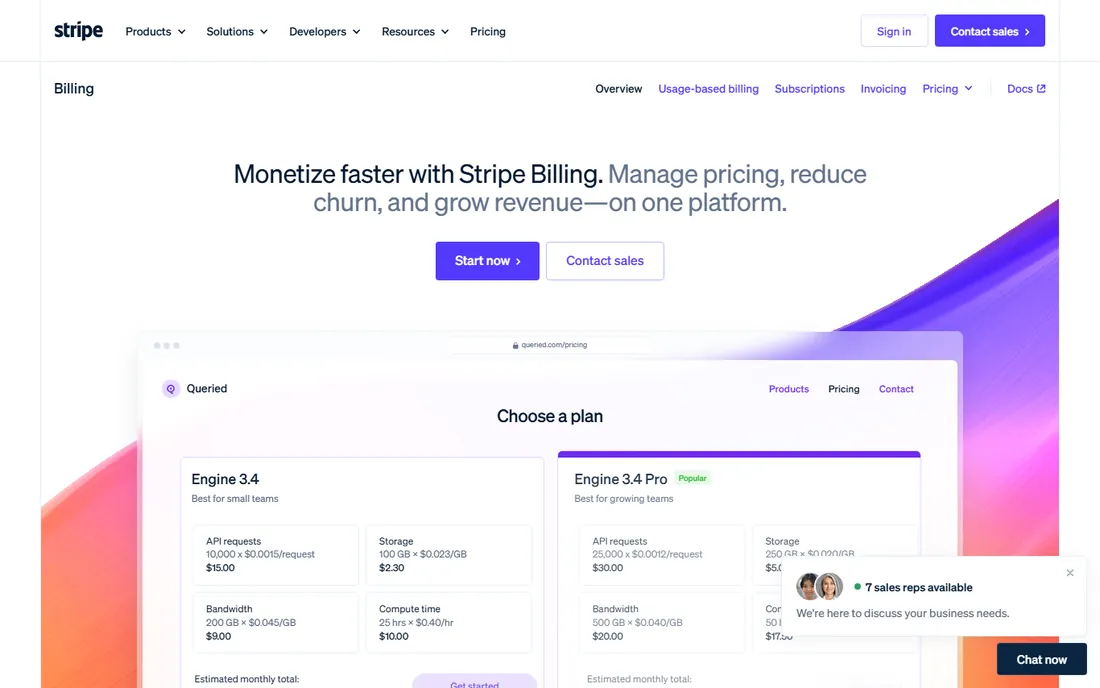
Stripe Billing is the default choice for Stripe-native companies, and the pricing is disarmingly simple: 0.7 percent of whatever it bills, no monthly fee. Subscriptions, usage-based billing, metered events, quotes, a hosted customer portal and revenue recognition all live inside the Stripe dashboard your engineers already know.
The two caveats are structural. At $1M a month in billings, 0.7 percent is $7,000 a month, which is when negotiated enterprise rates or flat-fee competitors start looking attractive. And Stripe Billing is not a merchant of record: your company handles sales tax, VAT and chargeback exposure. For startups, it is the fastest path to working recurring billing.
What we like- No platform fee and no tiers to outgrow
- Billing, payments and revenue recognition in one Stripe stack
- API-first with excellent documentation
Watch out for- Percentage pricing gets expensive at scale
- You remain the merchant of record, so tax compliance is on you
#2
Chargebee
Best for: Growing SaaS with mixed subscription and usage models
Visit chargebee.com
Starting priceFrom 0.80% of monthly billing value (Flow plan)
Free planYes (Starter free to $250K cumulative billing)
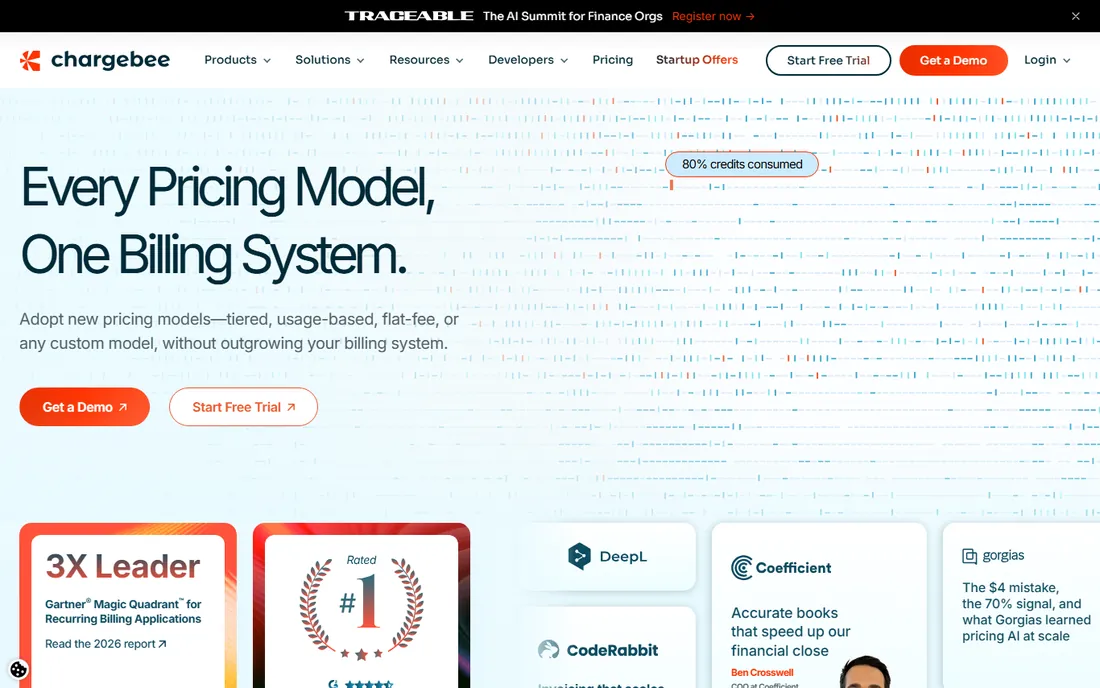
Chargebee rebuilt its pricing around usage: the Flow plan starts at 0.80 percent of monthly billing value with no platform fee, and the free Starter tier covers early startups to $250,000 in cumulative billings. It handles subscriptions, usage billing, calendar billing and dozens of payment gateways, with revenue recognition built in.
The pricing cliff is the famous complaint: outgrow Starter and Performance plans run around $599 a month plus overages. Plan the transition before you hit the ceiling. Chargebee suits companies whose pricing mixes plans, seats, usage and add-ons, the exact complexity where Stripe Billing starts feeling thin.
What we like- Free Starter plan to $250K in lifetime billings, genuinely useful
- Multi-model billing with built-in revenue recognition
- Strong dunning and retention tooling
Watch out for- The jump from free Starter to paid Performance plans is steep
- Costs rise as revenue-operations modules stack up
#3
Recurly
Best for: Subscription businesses focused on retention and recovery
Visit recurly.com
Starting priceFrom $249/month + 0.9% of billing volume
Free planNo

Recurly's pitch is retention: its dunning engine, smart retries and subscriber lifecycle tools recover revenue that other platforms write off. Starter begins at $249 a month plus 0.9 percent of billing volume, with the first $40,000 of volume included. For subscription businesses where involuntary churn is the leak, the recovery math often pays for the platform.
At small volumes the fixed fee stings: a $10,000-a-month business pays an effective 3.4 percent. Recurly fits established subscription companies doing real volume, where retention gains dwarf the platform cost. Early-stage teams should start on Stripe Billing or Chargebee Starter.
What we like- Best-in-class dunning and involuntary churn recovery
- Subscriber lifecycle management with promotions and trials
- Strong analytics on retention
Watch out for- $249/month minimum prices out early startups
- Percentage-plus-base pricing is the priciest combo here at moderate volumes
#4
Maxio
Best for: B2B SaaS companies where finance runs billing
Visit maxio.com
Starting priceFrom $599/month
Free planNo
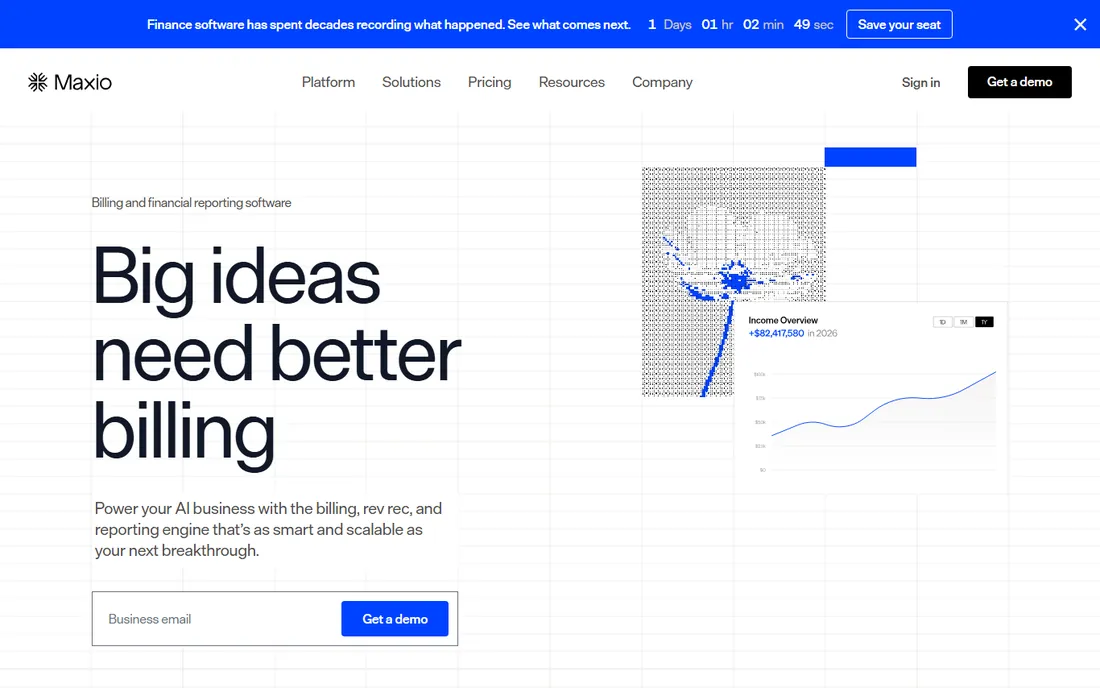
Maxio (the merged Chargify and SaaSOptics) is the finance team's billing platform. Grow starts at $599 a month for up to $100,000 in monthly billings, bundling subscription billing with ASC 606 revenue recognition, accounts receivable and the SaaS metrics boards investors ask about. It is built for contract-led B2B: negotiated terms, amendments, renewals, multi-entity billing.
That finance DNA is also the filter. Product-led startups without a controller will find it heavy, and the price floor is real. Maxio fits growth-stage B2B SaaS where the CFO, not engineering, owns the billing decision and revenue recognition accuracy is non-negotiable.
What we like- Billing, revenue recognition, A/R and SaaS metrics in one finance-grade system
- Built for contract-led B2B sales motions
- Strong audit and compliance controls
Watch out for- $599/month floor excludes startups
- Less attractive for product-led companies without a finance team
#5
Zuora
Best for: Large enterprises with complex global monetization
Visit zuora.com
Starting priceSee website
Free planNo
Zuora invented the subscription-economy category and still anchors its enterprise end. It handles the complexity the others cannot: hybrid subscription-plus-usage models across dozens of entities, intricate product catalogs, and revenue workflows that satisfy public-company auditors. Typical enterprise deals run well into six figures a year.
Everything about Zuora assumes scale: custom pricing, guided implementation, no self-serve. Companies under $10M in recurring revenue almost never need it, and buying it early is a classic expensive mistake. When monetization spans products, regions and entities, Zuora is the answer.
What we like- The deepest order-to-revenue controls in the category
- Handles hybrid models, multi-entity and global tax complexity
- 40-plus payment gateway integrations
Watch out for- Custom pricing with typical deals near six figures annually
- Implementation is a project measured in months
#6
Paddle
Best for: SaaS teams that want global tax and compliance handled
Visit paddle.com
Starting price5% + $0.50 per checkout transaction
Free planNo
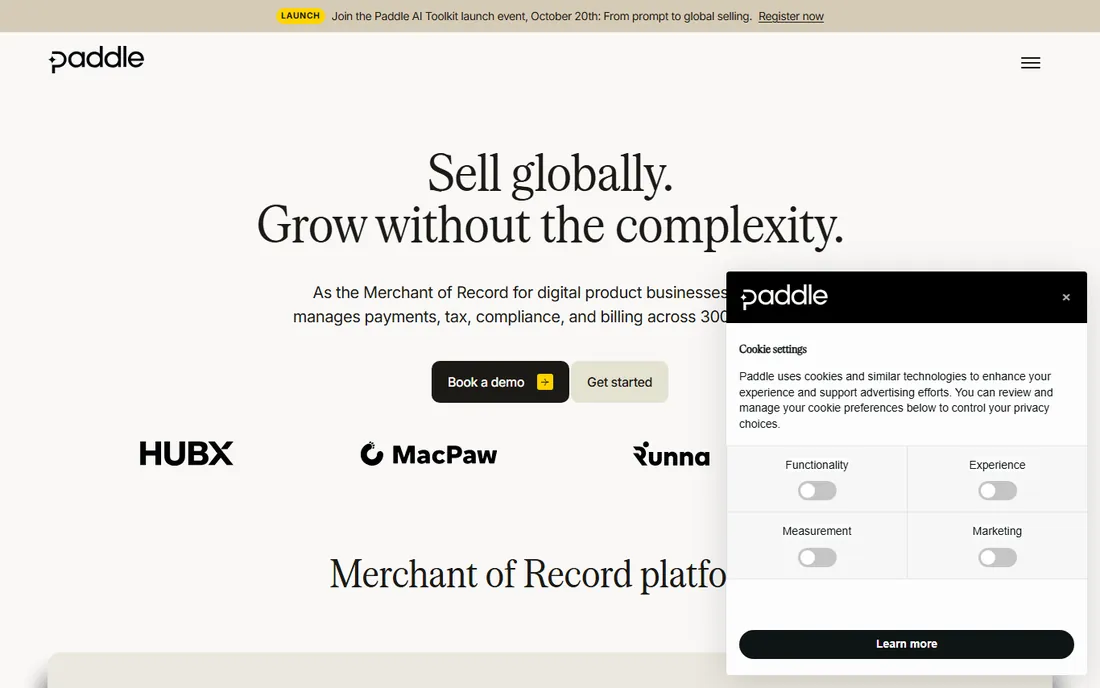
Paddle is not billing software in the usual sense; it is a merchant of record. That means Paddle is the legal seller: it collects and remits sales tax and VAT globally, handles chargebacks, and takes on compliance risk your company would otherwise manage. The price is 5 percent plus $0.50 per transaction, with no monthly fee.
For a small team selling worldwide, that trade is often worth it: the alternative is registering for VAT in multiple jurisdictions or buying tax software. For US-only SaaS with simple tax, it is expensive overhead. Choose Paddle when international compliance is the problem you want to stop thinking about.
What we like- Merchant of record: Paddle handles global sales tax, VAT and compliance
- One integration for payments, billing and tax worldwide
- No monthly fee
Watch out for- 5% plus $0.50 per transaction is the highest headline rate here
- Less billing-model flexibility than pure billing platforms
#7
Zoho Billing
Best for: Small businesses that want real billing software on a budget
Visit zoho.com
Starting priceFrom $50/month
Free planYes
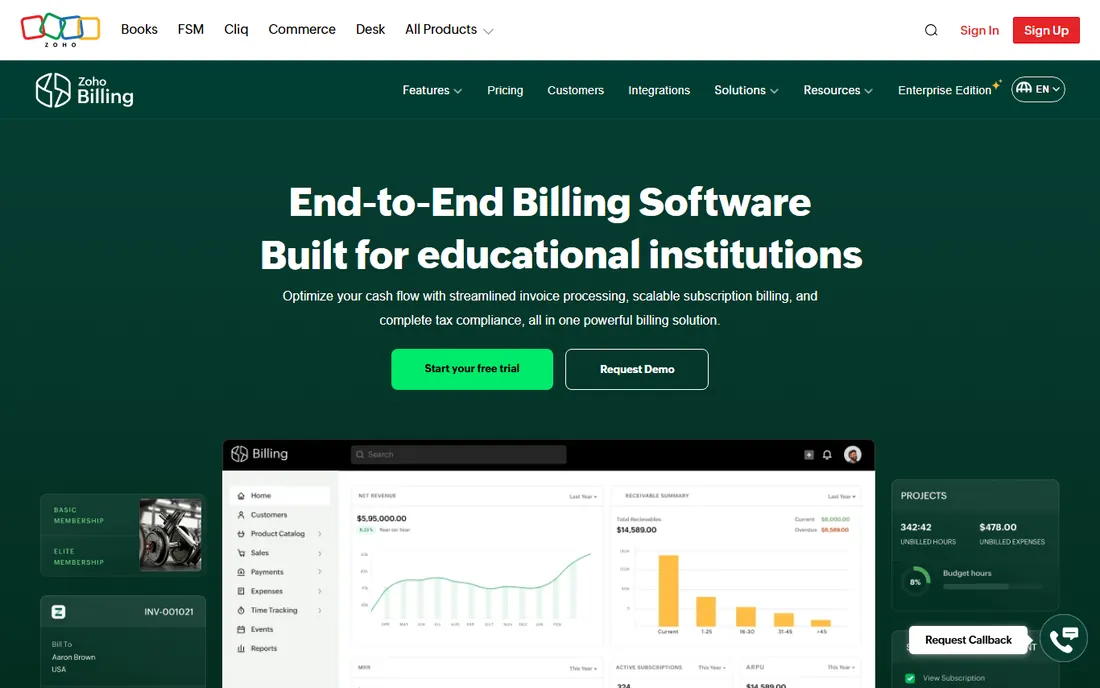
Zoho Billing is the budget pick that punches above its price. From $50 a month you get subscription management, hosted payment pages, a customer portal, dunning basics and multi-currency support, plus a free plan for the smallest operations. Paired with Zoho Books, it gives a small business a complete billing-to-accounting loop.
It will not match Recurly's recovery engine or Maxio's revenue recognition, and usage-based billing is simpler than Orb's. But for straightforward subscriptions under a few hundred customers, Zoho Billing does the job at a tenth of the enterprise price. It is the right answer when billing is a utility, not a strategy.
What we like- The cheapest serious billing platform here
- Subscriptions, quotes, customer portal and multi-currency included
- Integrates with Zoho Books and the Zoho suite
Watch out for- Less sophisticated dunning and usage-billing than specialists
- Revenue recognition is basic compared with Maxio or Zuora
Starting priceSee website
Free planNo
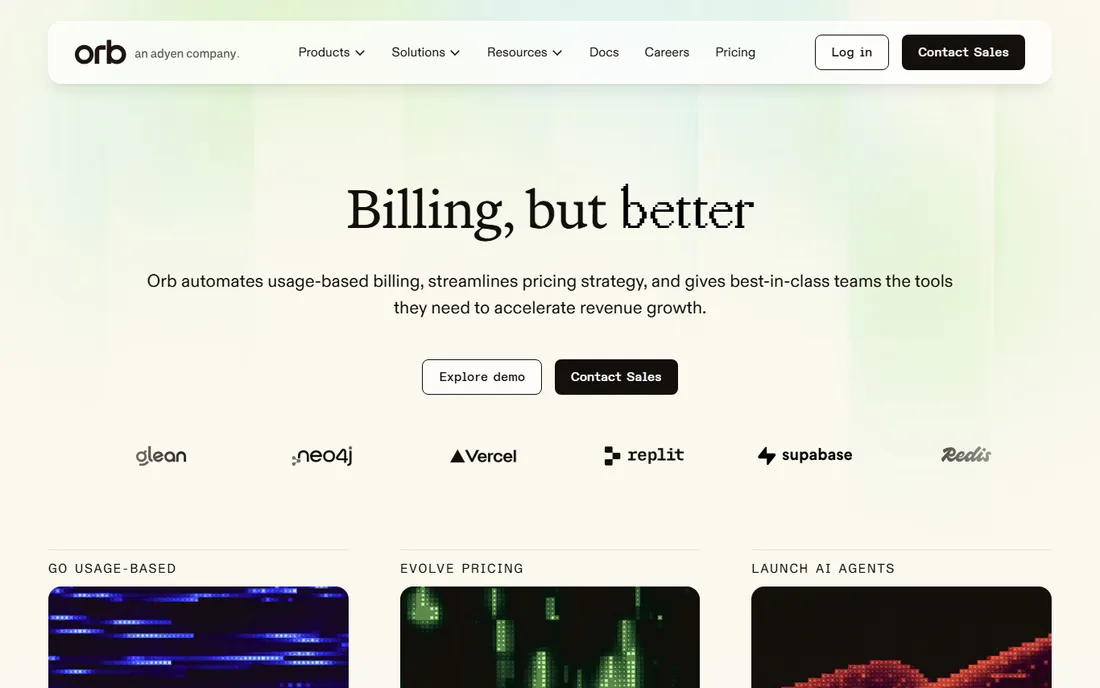
Orb is the usage-billing specialist. Where traditional platforms bolt metering onto subscription logic, Orb starts from events: ingest billions of usage events, rate them with flexible pricing rules, and invoice accurately. It is the natural fit for AI companies billing by tokens, infrastructure priced by API calls, and any product where usage is the revenue.
Stripe acquired Metronome in early 2026, and Adyen acquired Orb, which tells you how strategic usage billing has become. Custom pricing means a sales conversation. If your pricing page says "pay for what you use" and means it, Orb belongs on the shortlist.
What we like- Granular real-time event metering and flexible rating
- Built for usage-heavy models (API calls, compute, tokens)
- Now backed by Adyen
Watch out for- Custom pricing with no self-serve tier
- Overkill for simple flat subscriptions
Starting priceSee website
Free planNo
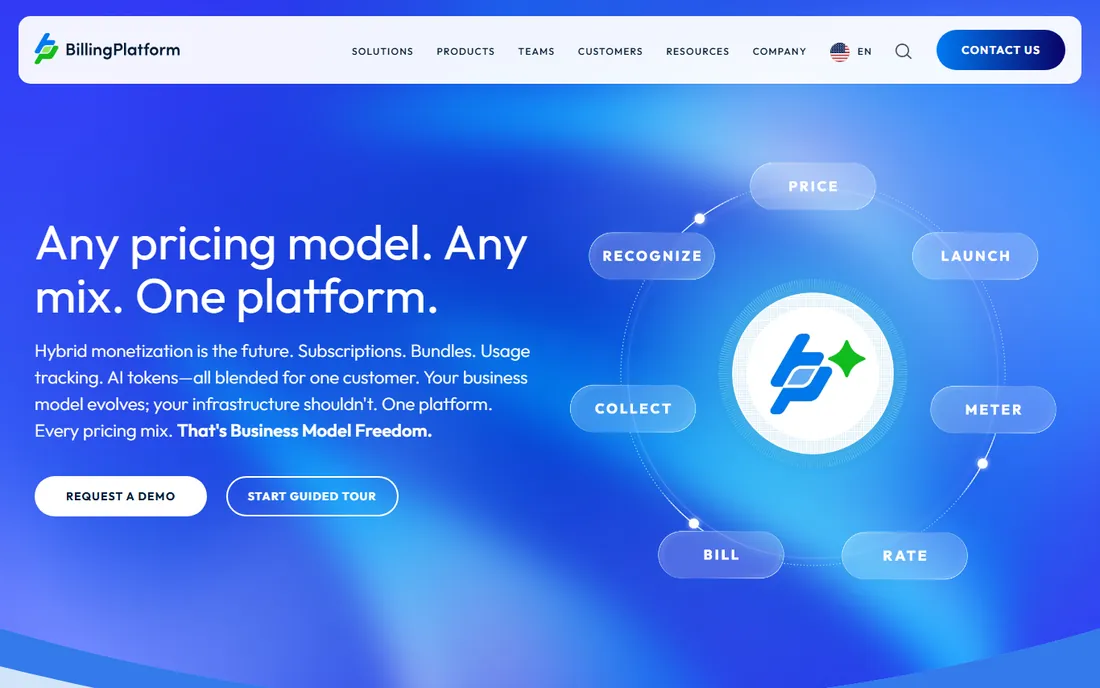
BillingPlatform is the configurability extreme: a billing engine you shape to unusual models rather than a product you adapt to. Multi-dimensional rating, complex product catalogs, custom billing workflows and full revenue lifecycle management come standard. Companies with billing logic that made other vendors flinch end up here.
That power has a price: enterprise quotes, real implementations, no trial. It competes with Zuora at the top end and wins when the billing model itself is the differentiator. For everyone else, it is more machinery than the job requires.
What we like- Extremely configurable product catalog, pricing rules and billing workflows
- Handles exotic rating and settlement scenarios
- Strong enterprise revenue lifecycle
Watch out for- Quote-only enterprise pricing
- More infrastructure than most companies need, with implementation to match
How we chose
We priced the category the way buyers should: by modeling cost at real volumes, not by comparing feature checklists. Every figure above comes from the vendor's official pricing page or from October 2026 roundups that verified pricing against those pages. We covered the three pricing philosophies (percentage of volume, flat monthly, custom enterprise) and both roles (billing software versus merchant of record), because confusing the two is the costliest mistake in this category. Reviews from G2 and finance-software buyers informed the strengths and weaknesses; we weighted dunning, revenue recognition and migration difficulty heavily, since those decide real-world outcomes.
Percentage of revenue versus flat fee: the pricing math that matters
Run your numbers before you fall in love with features. Percentage pricing (Stripe Billing 0.7%, Chargebee Flow 0.80%) is cheap at $20,000 a month in billings and expensive at $500,000. Flat-fee platforms (Recurly $249, Maxio $599, Zoho Billing $50) plus their volume percentages invert the math: the flat fee dominates at small scale and fades at large scale.
The crossover points are worth computing. Stripe Billing at 0.7% costs $700 at $100K monthly billings and $3,500 at $500K. Recurly's $249 plus 0.9% costs $1,149 at $100K and $4,749 at $500K. Chargebee Flow at 0.80% costs $800 at $100K. None of these include payment processing fees, which stack on top everywhere except Paddle. Model your next 24 months of volume, not this month's, and the cheapest option usually picks itself.
Billing software is not a merchant of record: the tax trap
Eight tools on this list are billing software: they calculate what customers owe and collect it, while your company stays the legal seller. That means your company registers for sales tax, files VAT returns, and eats chargeback risk. Only Paddle (and alternatives like Lemon Squeezy) is a merchant of record, where the platform is the seller and absorbs that burden.
This distinction decides more purchases than any feature. A two-person SaaS selling to 30 countries cannot reasonably manage global tax compliance; Paddle's 5 percent is cheaper than the alternative. A US-only B2B SaaS with a finance team gains nothing from it. Ask which problem you are buying a solution to: billing logic, or tax compliance. Then buy accordingly.
Frequently asked questions
What is the difference between Stripe Billing and Chargebee?
Stripe Billing is simplest for companies already on Stripe: 0.7% of volume, no tiers, billing plus payments in one stack. Chargebee offers more billing-model flexibility (mixed subscription and usage, calendar billing, more gateways) with a free Starter tier to $250K in billings, but its paid plans start higher. Stripe-native startups usually start with Stripe Billing; complex pricing models favor Chargebee.
How much does Stripe Billing cost?
Stripe Billing costs 0.7% of the volume it bills, with no monthly platform fee. Payment processing fees (around 2.9% + $0.30 in the US) are separate and apply on top. At $100,000 in monthly billings, Billing itself costs $700 a month.
Is there free recurring billing software?
Chargebee's Starter plan is free until you reach $250,000 in cumulative billings, and Zoho Billing has a free plan for small operations. Stripe Billing has no free tier but no monthly fee either: you pay 0.7% only on what you bill. Enterprise platforms (Zuora, Maxio, Orb) have no free options.
Paddle versus Stripe: which should I choose?
Choose Paddle if you sell internationally and want a merchant of record to handle sales tax, VAT and compliance: 5% + $0.50 per transaction with no monthly fee. Choose Stripe if you want maximum billing flexibility at lower transaction cost (0.7% for Billing plus processing) and can handle tax compliance yourself or with tax software.
When should a company move from Stripe Billing to Zuora or Maxio?
When finance owns billing decisions, revenue recognition must satisfy auditors, or contracts get complex (amendments, multi-entity, negotiated terms). The usual trigger is $5M to $10M in ARR with a controller asking for ASC 606 compliance. Moving earlier usually adds cost without benefit.
How hard is it to migrate billing platforms?
Harder than vendors admit. Active subscriptions, payment methods, trial states and dunning histories must transfer without double-charging or dropping customers. Most migrations take 6 to 12 weeks with parallel running. The major platforms all offer migration services; budget for it and migrate during a quiet period, never during a pricing change.
Sources we checked (7)
- https://www.guideflow.com/blog/recurring-revenue-finance-software
- https://upflow.io/blog/saas-finance/saas-best-billing-software
- https://dodopayments.com/blogs/chargebee-alternatives
- https://blog.alguna.com/invoicing-software-automated-recurring-billing/
- https://cartmango.com/recurring-billing-software/
- https://www.solvimon.com/blog/best-billing-software-for-fintech-and-payments-companies
- https://walletinvestor.com/news/finance-news/stripe-billing-alternatives-top-recurring-billing-engines-for-b2b-saas/
Is your product missing or out of date?
We review this list regularly. Vendors can request a listing, send updated pricing or ask about featured placement.

Shihab Mia · Founder, Rankite
Shihab has spent more than a decade helping SaaS and e-commerce brands grow through search. He writes Rankite's software buying guides from pricing pages, documentation and public user reviews. More about Shihab.