How we make this list: we compare pricing pages, product documentation and public user reviews. Rankite is independent; if a vendor ever pays for a featured spot, that listing is clearly labeled Partner.
Key takeaways
- Purchase order software exists because email approvals do not scale; the right tool makes compliant buying easier than going around the process.
- Precoro ($499/mo) and Tradogram ($99/mo) publish pricing; most competitors are quote-based, so shortlist on features first and price second.
- Ramp is genuinely free and covers PO workflows alongside corporate cards, making it the default starting point for small teams.
- Match the tool to your buying motion: intake-heavy companies need Zip, global payers need Tipalti, and enterprises need Coupa.
Quick comparison
| Tool | Best for | Starting price | Free plan |
|---|
 Procurify Procurify | mid-market PO control with budget visibility | See website | No |
 Precoro Precoro | structured procure-to-pay with fast rollout | $499/mo | No |
 Tipalti Tipalti | global payables with PO matching | See website | No |
 Tradogram Tradogram | small teams needing affordable procurement | $99/mo | No |
 Coupa Coupa | enterprise spend management | See website | No |
 Zip Zip | intake and approval orchestration | See website | No |
 Airbase Airbase | guided procurement plus AP and expenses | See website | No |
 Ramp Ramp | free PO workflows with corporate cards | Free | Yes |
 ProcureDesk ProcureDesk | controllers focused on month-end close | $830/mo (billed annually) | No |
 Fraxion Fraxion | midmarket proactive spend control | See website | No |
Is your product missing or out of date?
We review this list regularly. Vendors can request a listing, send updated pricing or ask about featured placement.
The best purchase order software
Starting priceSee website
Free planNo
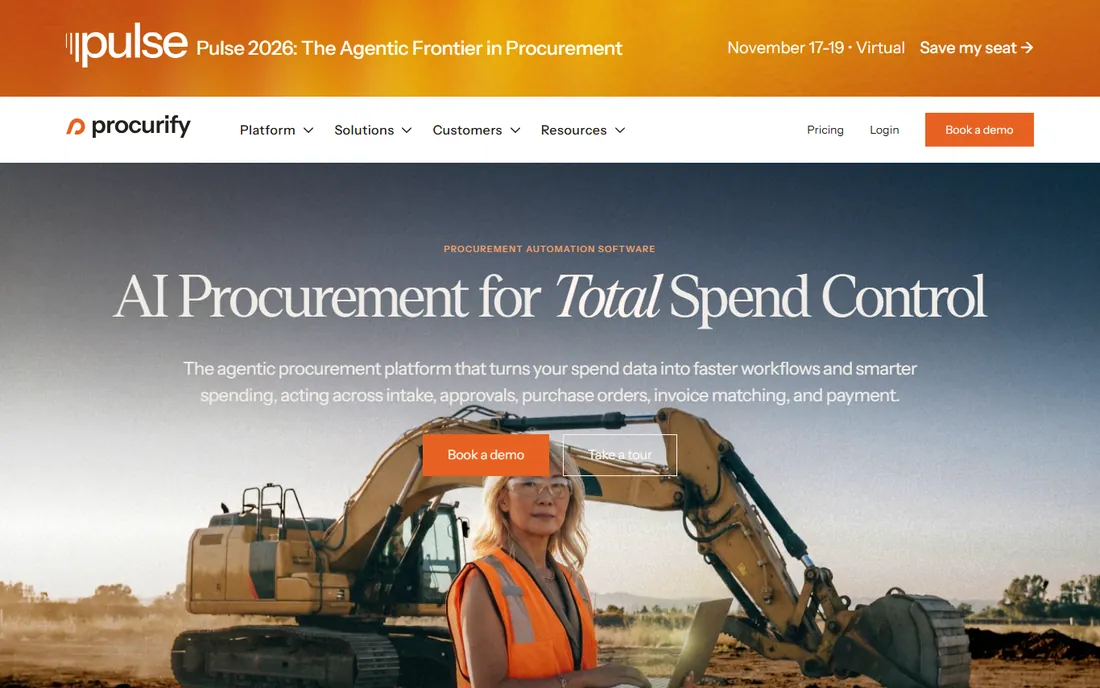
Procurify is the mid-market PO standard for a reason: it makes requesting easy enough that employees actually use it. The requisition flow is widely considered the best UX in the category, with templates, autofill for recurring orders and in-app messaging that keeps purchase decisions out of email threads.
The finance side is equally considered. Customizable approval workflows route by department, purchasing type or project, and approvers see spending against budgets directly in the platform. Audit logs capture every edit, approval and receipt. Integrations cover NetSuite, Slack and Amazon PunchOut for catalog buying.
The caveats are price and polish. Pricing is quote-based, with third-party reports putting small-business plans around $1,000 per month, and reviewers describe the interface as slow and buggy in heavier sessions. For mid-market teams that want purchasing discipline with real-time budget visibility, Procurify remains the best purchase order software to beat.
What we like- Best-in-class request-to-PO user experience
- Real-time budget visibility for approvers
- Strong punchout catalog support
Watch out for- Pricing is quote-based (reported around $1,000/mo)
- Reviewers note a sometimes slow interface
Starting price$499/mo
Free planNo
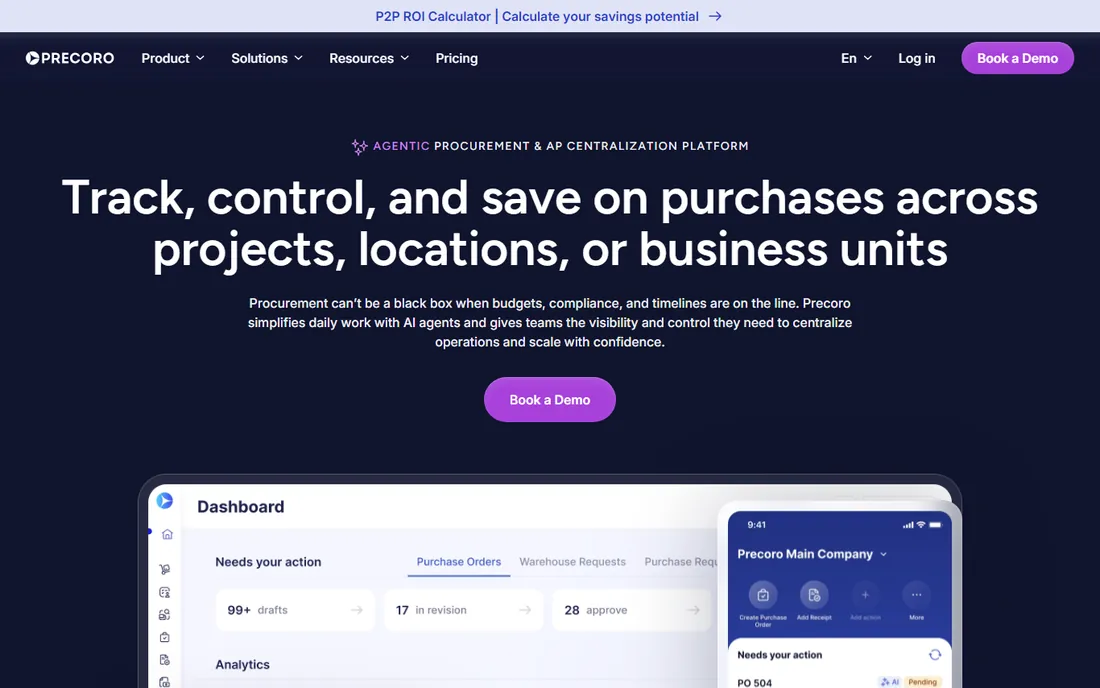
Precoro is the structured procure-to-pay option for teams that want depth without an enterprise implementation. Pricing is refreshingly public: Core starts at $499 per month and Automation at $999 per month, with Enterprise on custom quotes. The company promises go-live in 2 to 8 weeks with no IT involvement.
The feature set punches above the price. Three-way matching, inventory management, supplier portals, multi-currency support for 300 currencies, real-time budget tracking and punchout integrations with Amazon Business, Staples, Grainger and others. The Automation tier adds AI-powered document processing, matching agents and contract agents.
The pricing model scales with users, so large teams with many casual approvers pay more than on flat-rate platforms. Reviewers praise the approval workflows and support but grumble about data import and PO search. For small and mid-size businesses that want a real procurement platform with honest pricing, Precoro is the strongest value on this list.
What we like- Transparent published pricing from $499/mo
- 3-way matching and inventory built in
- AI document processing on higher tiers
Watch out for- Per-user costs scale with headcount
- Some users report clunky data import and PO search
Starting priceSee website
Free planNo
Tipalti starts where most PO tools stop: global payments. The platform covers the full procure-to-pay cycle from requisition and PO creation through invoice processing, supplier management and payment, with the differentiator being its ability to pay suppliers in more than 200 countries and territories across 120 currencies and 50-plus payment methods.
The compliance depth is serious. Machine-learning invoice capture at header and line level, managed services, a KPMG-approved tax engine that validates W-9s, W-8BENs and VAT details against thousands of rules, and OFAC/SDN screening. Multi-entity support with consolidated views suits growing international companies.
Pricing is quote-based and enterprise-oriented. Tipalti is not the tool for a domestic team buying office supplies; it is the tool for companies whose purchasing crosses borders and whose finance team dreads tax season. If that is you, nothing else on this list competes.
What we like- Pays to 200-plus countries in 120 currencies
- ML-based invoice capture with 2- and 3-way PO matching
- Tax compliance engine
Watch out for- Quote-based enterprise pricing
- Overkill for domestic-only purchasing
Starting price$99/mo
Free planNo
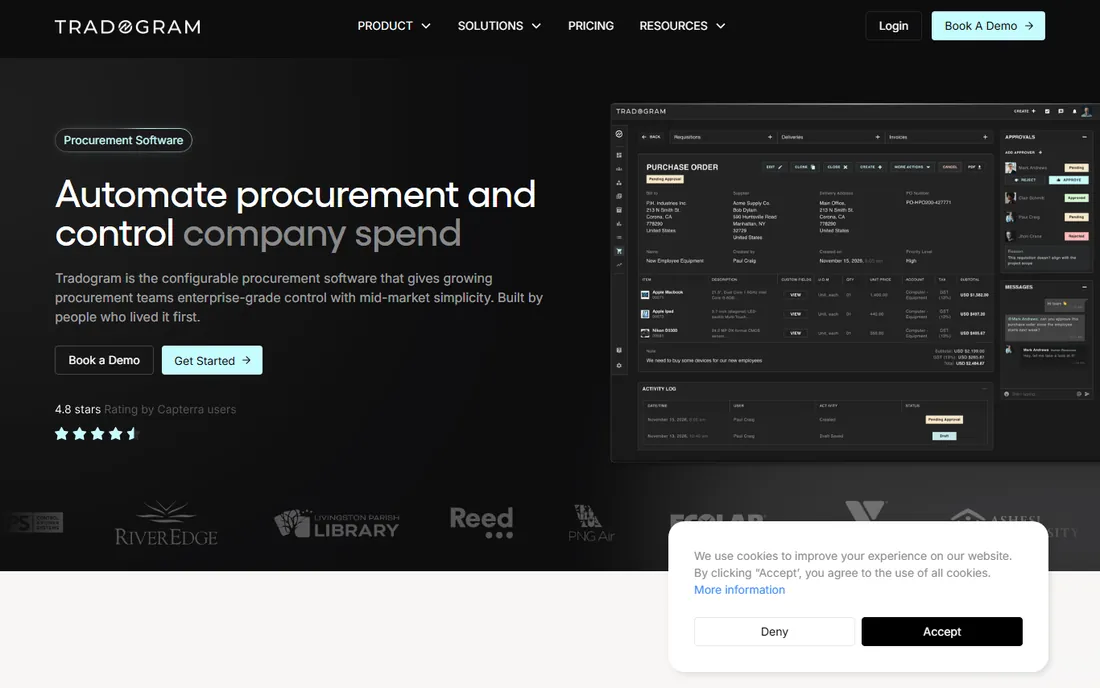
Tradogram is the accessible entry point to real procurement software. The Essentials plan starts at $99 per month (or $950.40 per year with the 20% annual discount) and covers purchase orders, supplier management, AP invoices, TradoPay payments, expense management and mobile apps, with AI OCR across all documents.
The modular design keeps the entry price low. Essentials handles core purchasing; Premium (custom quote) adds requisitions, sourcing RFx, receiving, real-time budget tracking, contract management and custom approvals for teams of 20-plus. Add-ons let Essentials users pick up advanced modules without a full tier jump.
Watch the user fees: the base covers 1-plus users with additional user fees applying. For small teams that have outgrown spreadsheets but cannot justify $500-plus per month, Tradogram is the most affordable on-ramp to proper purchase order software.
What we like- Affordable entry at $99/mo ($950.40/year annual)
- POs, suppliers, invoices and expenses in one
- AI OCR on all documents
Watch out for- Advanced modules (requisitions, RFx, budgets) are add-ons or higher tiers
- Per-user fees on top of the base
Starting priceSee website
Free planNo
Coupa is the enterprise answer to business spend management. The platform covers the full source-to-pay lifecycle: sourcing, procurement, invoicing, expenses and supplier management, with community-generated AI insights drawn from trillions of dollars in anonymized spend data.
The strength is governance at scale. Multi-entity, multi-currency, multi-language operations with configurable approvals, contract lifecycle management and supplier risk management. For large organizations that need every purchase visible, controlled and analyzable, Coupa is the default enterprise shortlist alongside SAP Ariba.
The trade-offs are the classic enterprise ones: custom pricing, annual contracts and implementations that run for quarters, not weeks. Coupa is for companies with procurement teams, not companies buying their first PO tool. If you are below that scale, everything else on this list will serve you better and faster.
What we like- The enterprise category leader
- Comprehensive source-to-pay suite
- Deep supplier network and community intelligence
Watch out for- Quote-based pricing with long contracts
- Implementations measured in quarters
Starting priceSee website
Free planNo
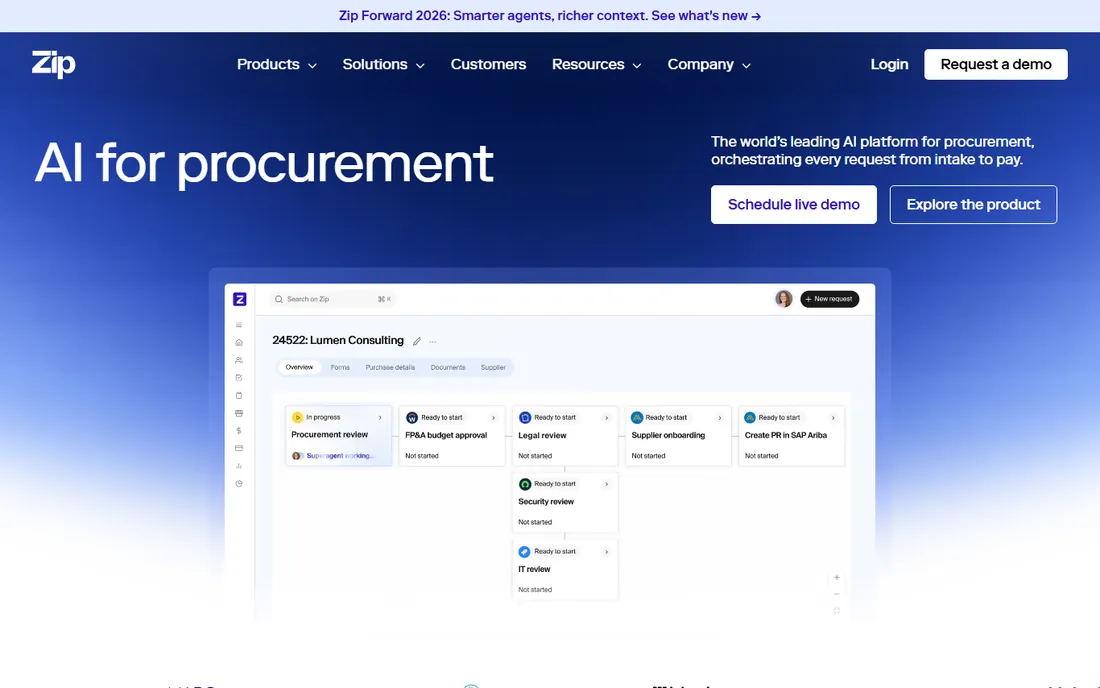
Zip attacks the problem upstream of the purchase order. Most procurement pain starts before a PO exists: an employee needs software, a contractor, a renewal, and the request bounces between Slack, email and finance. Zip's intake orchestration routes those requests across approvers and systems from a single starting point.
The employee experience is the differentiator. Instead of learning procurement software, staff describe what they need and Zip handles the routing, approvals and system updates behind the scenes. Integrations span the modern stack, and the platform has become the reference point for the intake category.
Pricing is quote-based. Zip is not trying to be the deepest procure-to-pay suite; it is trying to fix the front door of purchasing. For companies whose problem is fragmented intake rather than PO processing, it is the best purchase order software adjacent choice, and it pairs well with downstream AP tools.
What we like- Leads the intake orchestration category
- Routes requests across approvers and systems
- Modern employee-friendly UX
Watch out for- Quote-based pricing
- Focused on intake rather than full procure-to-pay depth
Starting priceSee website
Free planNo
Airbase bundles guided procurement with AP automation and expense management on a single spend platform. The pitch is consolidation: instead of separate tools for purchase requests, invoice processing and employee expenses, finance gets one system with one approval model and one view of committed spend.
Guided procurement steers employees toward preferred vendors and catalogs, while AP automation handles invoice capture, matching and payments. The combination suits mid-market finance teams that want to control spend before it happens and process what remains efficiently. Paylocity's ownership adds payroll-adjacent stability.
Pricing is quote-based. The bundled approach is a strength for teams that need all three functions and a complication for teams that only need POs. If your buying problem spans procurement, payables and expenses, Airbase deserves a demo.
What we like- Guided procurement, AP automation and expenses on one platform
- Strong approval workflows
- Now backed by Paylocity
Watch out for- Quote-based pricing
- The bundled approach may exceed what PO-only buyers need
#8
Ramp
Best for: free PO workflows with corporate cards
Visit ramp.com
Starting priceFree
Free planYes
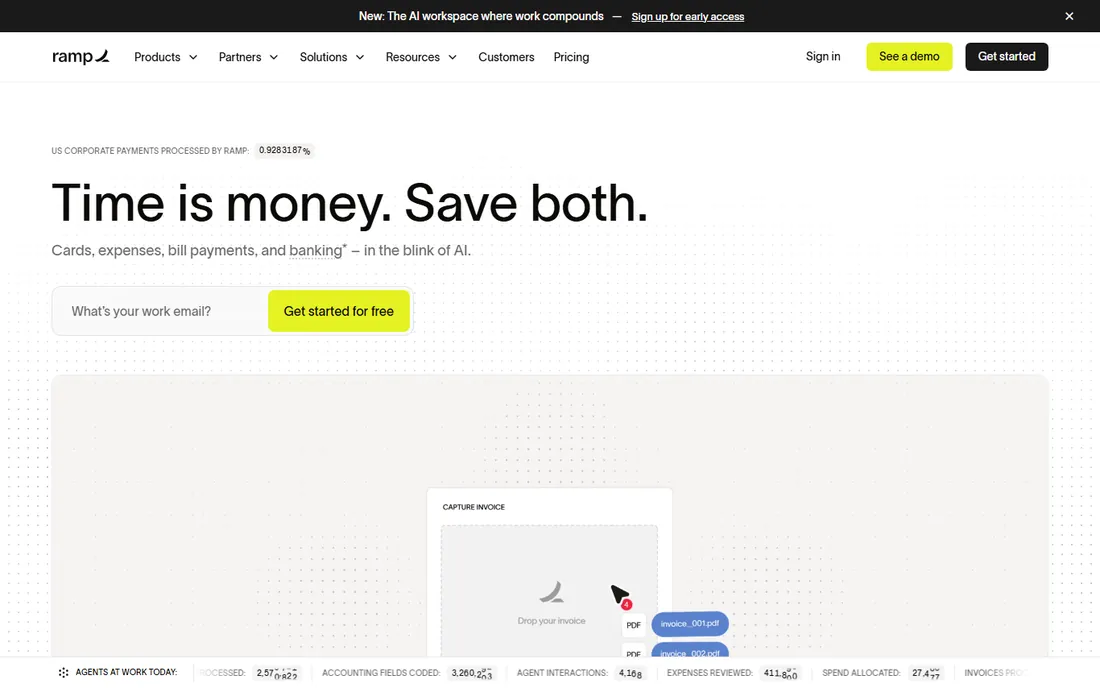
Ramp is the free disruptor in this list. Ramp Free covers corporate cards, purchase orders, item receipts, bill pay, expense management and a vendor directory at no cost, funded by card interchange rather than subscriptions. A Ramp Plus tier exists for larger teams, with a free 30-day trial.
The PO functionality is real, not a checkbox. Purchase orders with item receipts integrate with the card and bill-pay workflows, so the same platform handles the request, the purchase and the reconciliation. For startups and small teams, that consolidation at zero cost is difficult to argue with.
The honest caveat is the business model: free works because Ramp earns from card spend. Procurement depth does not match Precoro or Procurify for complex approval chains and inventory. But as a starting point, Ramp is the obvious first try for any small team, and many never need to leave.
What we like- Genuinely free, including purchase orders and item receipts
- Corporate cards with high limits
- Modern UX finance teams like
Watch out for- The free model is funded by card interchange
- Advanced procurement depth is lighter than dedicated platforms
Starting price$830/mo (billed annually)
Free planNo
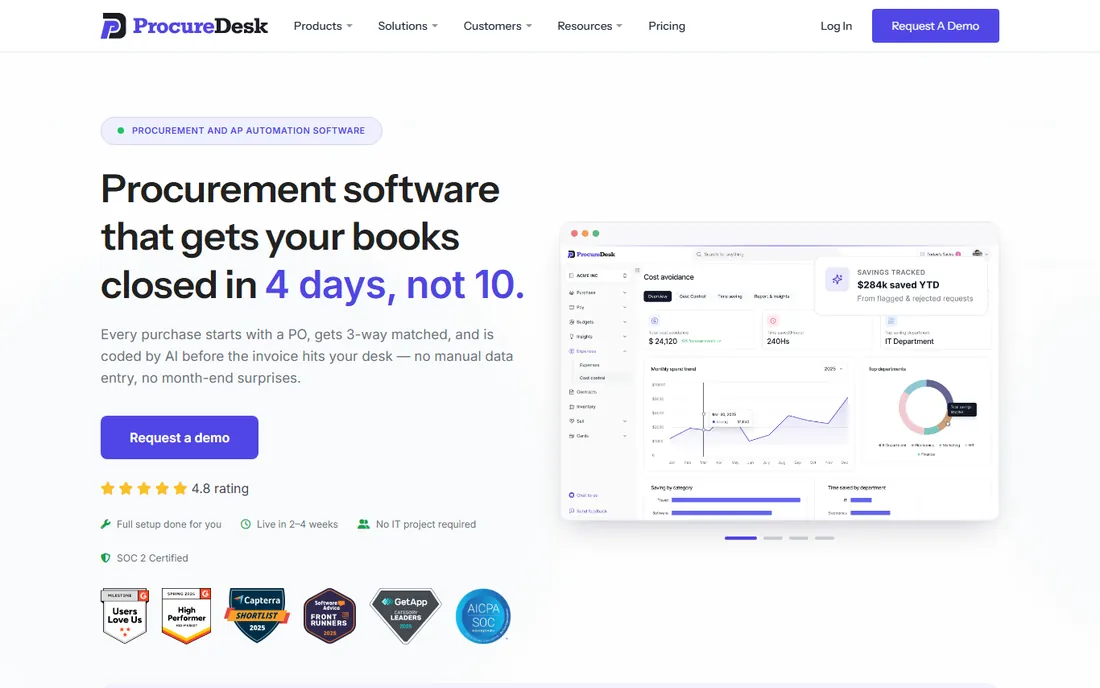
ProcureDesk is built for controllers who live in month-end close. The platform centers on the purchasing-to-close workflow: requests, POs, receiving, invoices, 3-way matching, budget tracking and spend analysis, with a 90-day outcome guarantee tied to measurably reducing close time.
Pricing is public and confident. Startup starts at $830 per month billed annually ($9,960 per year) with 10 users included, Growth at $1,250 per month with 20 users, and Enterprise on custom quotes. A 30-day money-back guarantee and done-for-you onboarding (live in 2 to 3 weeks) lower the adoption risk. Nonprofits and charter schools get a 15% discount.
The entry price puts it above Precoro and far above Tradogram, so it needs to earn the premium through the close-time savings it promises. For finance-led teams where the month-end close is the pain, ProcureDesk's focus is exactly right.
What we like- Published pricing from $830/mo
- Built for faster month-end close with 3-way matching
- 30-day money-back guarantee
Watch out for- The entry price is steep for small teams
- 10 users included, then $20/mo each additional
Starting priceSee website
Free planNo
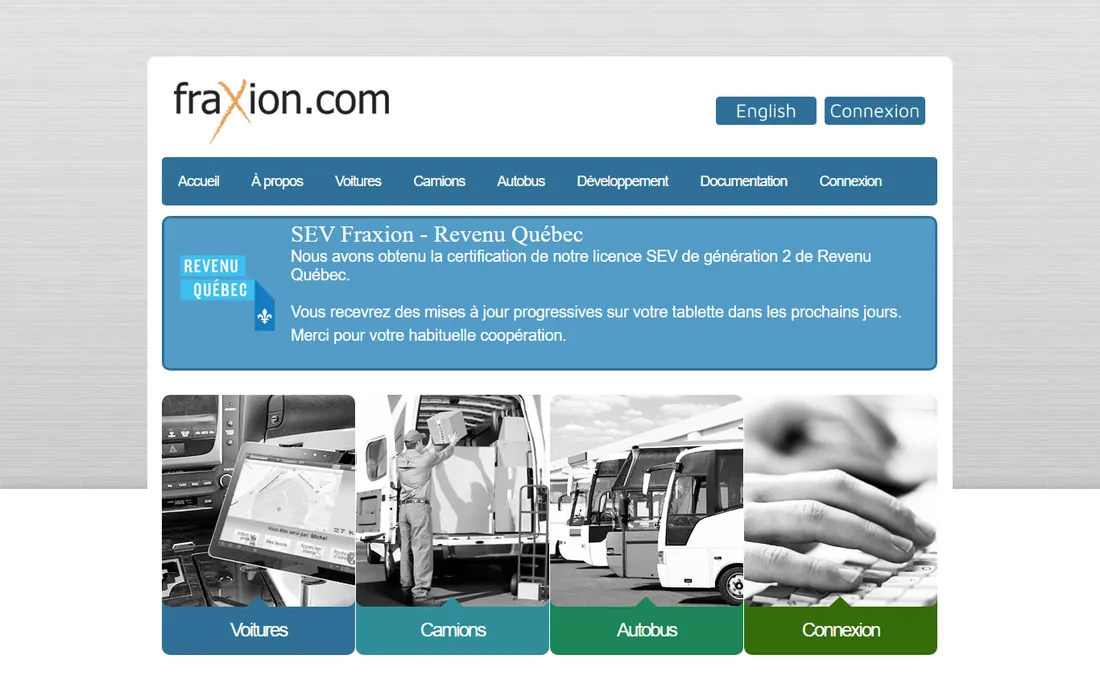
Fraxion is the midmarket specialist in proactive spend control. The platform focuses on stopping bad spend before it happens rather than reporting it afterward: approval workflows, budget enforcement, mobile approvals and the purchasing controls that keep maverick spending in check.
The mobile experience gets consistent praise, which matters because approvals die in inboxes. Managers approve from their phones, the audit trail stays clean, and finance gets the visibility it needs without chasing people.
Pricing is not published and the vendor is smaller than Procurify or Coupa, which means a thinner integration ecosystem and more diligence on vendor viability. For midmarket teams that want spend control as the primary job rather than a feature, Fraxion is worth evaluating alongside the bigger names.
What we like- Specialized procure-to-pay for proactive spend control
- Strong approval and budget features
- Good mobile app reputation
Watch out for- Pricing not published
- Smaller vendor with less ecosystem than the leaders
How we chose
We researched vendor pricing pages, product documentation and procurement software comparisons in October 2026. Every price above comes from the vendor's own site; where vendors do not publish pricing we say so rather than repeating third-party estimates. We covered dedicated PO and procure-to-pay platforms across the price spectrum, from free (Ramp) to enterprise (Coupa, Tipalti), because a ten-person startup and a multinational have different buying problems. We weighted real approval workflow quality and implementation speed over feature-list length, since adoption determines whether PO software works at all.
Matching the software to your buying volume
The right tool depends on how much you buy and how. Under roughly $50,000 a month in managed spend, Ramp's free tier or Tradogram at $99 per month will handle everything without ceremony. The buying motion is simple, the approvers are few, and the goal is basic control, not governance.
Between that and true enterprise scale, Precoro at $499 per month and ProcureDesk at $830 per month are the structured choices. This is where approval chains get real: departments, locations, budgets, three-way matching. Pick Precoro for per-user pricing and faster rollout; pick ProcureDesk if the month-end close is the organizing pain.
Above that, or across borders, the enterprise tier takes over. Tipalti for global payments, Coupa for full source-to-pay governance, Zip for intake orchestration at scale. These are quote-based, implementation-heavy platforms that pay off when purchasing is a company-wide function. Buying them earlier is the most common overspend in this category.
Where PO implementations actually fail
The first failure is treating it as a finance project. The most successful implementations treat PO software as a user experience project: if requesting is easier than sending an informal email, compliance becomes automatic. If it is harder, employees route around it and finance gets the worst of both worlds, a system nobody uses and spend nobody sees.
The second failure is approval bloat. It is tempting to encode every policy into the workflow, with five approvers for a $200 order. Start with the minimum viable approval chain and add steps only where losses justify the friction. Every approver you add is a delay your employees will resent and a reason to bypass the system.
The third failure is ignoring the tail. Catalogs and punchouts cover the top vendors, but the long tail of one-off purchases is where maverick spend lives. Make sure the tool handles ad-hoc requests gracefully, with sensible defaults and fast approvals, or the tail will stay in email forever.
Frequently asked questions
What is purchase order software?
Purchase order software digitizes the buying process: employees submit purchase requests, managers approve them against budgets, the system generates formal purchase orders, and receiving and invoicing are matched against the PO. It replaces email approvals and spreadsheets with an auditable workflow, giving finance visibility into committed spend before invoices arrive.
How much does purchase order software cost?
It ranges from free to several thousand dollars per month. Ramp is free. Tradogram starts at $99 per month, Precoro at $499 per month, and ProcureDesk at $830 per month billed annually. Procurify, Tipalti, Coupa, Zip, Airbase and Fraxion are quote-based, with third-party reports placing mid-market plans from roughly $1,000 per month upward. Enterprise platforms add implementation and services fees on top.
What is the difference between PO software and procure-to-pay software?
Purchase order software focuses on the request-approve-order-receive cycle. Procure-to-pay (P2P) software extends that to invoicing, payments, supplier management and spend analytics. Most modern tools blur the line: Precoro, Tipalti, Coupa and Airbase are full P2P platforms, while simpler tools focus on the PO workflow. If your pain is mostly approvals, PO software suffices; if it is invoices and payments too, go P2P.
How long does purchase order software take to implement?
It depends on the tier. Ramp and Tradogram can be live in days. Precoro quotes 2 to 8 weeks, ProcureDesk 2 to 3 weeks. Mid-market platforms with punchouts and ERP integrations typically take 1 to 3 months. Enterprise platforms like Coupa and Tipalti run for quarters including process design, integration and change management. The approval workflow design, not the software installation, usually sets the timeline.
Do I need purchase order software if I already have an ERP?
Maybe not, but often yes. ERPs handle POs as transactions, usually with poor requester UX and rigid approvals. Dedicated PO software earns its keep through adoption: employees actually submit requests, approvers actually approve on mobile, and finance gets clean data. If your ERP's purchasing module is unused and buying happens in email, a dedicated tool will outperform the ERP module you already pay for.
Sources we checked (14)
- https://www.procurify.com/
- https://precoro.com/
- https://precoro.com/pricing
- https://www.tipalti.com/
- https://www.tradogram.com/
- https://www.tradogram.com/pricing
- https://www.coupa.com/
- https://zip.com/
- https://www.airbase.com/
- https://ramp.com/
- https://ramp.com/pricing
- https://www.procuredesk.com/
- https://www.procuredesk.com/pricing
- https://www.fraxion.com/
Is your product missing or out of date?
We review this list regularly. Vendors can request a listing, send updated pricing or ask about featured placement.

Shihab Mia · Founder, Rankite
Shihab has spent more than a decade helping SaaS and e-commerce brands grow through search. He writes Rankite's software buying guides from pricing pages, documentation and public user reviews. More about Shihab.