How we make this list: we compare pricing pages, product documentation and public user reviews. Rankite is independent; if a vendor ever pays for a featured spot, that listing is clearly labeled Partner.
Key takeaways
- Power dialers call numbers from a list automatically, so reps spend time talking instead of dialing; parallel dialers call up to 10 lines at once for maximum volume.
- Entry pricing runs from about $25 to $35 per user per month (CloudTalk, JustCall, Kixie), while premium and parallel dialers run $140 to $300 per user per month (PhoneBurner, Orum, Nooks).
- The headline price rarely tells the whole story: per-minute charges, add-ons, and seat minimums can double the real cost, so read the fine print.
- Pick your dialing mode first (single-line power vs. multi-line parallel vs. predictive), then match the tool to your CRM and your team's daily call volume.
The math that matters with a power dialer is not the monthly fee. It is the cost per live conversation. A rep who hand-dials might reach 20 people a day; the same rep on a good power dialer reaches 60 or more, and on a parallel dialer several hundred dials can turn into a packed calendar of conversations. That is why the price range here is so wide, from roughly $25 per seat to roughly $300 per seat. The cheap seats still make one call at a time. The expensive seats multiply every rep. This guide compares ten tools across that spectrum so you can match the dialer to the job instead of overbuying or, worse, buying a single-line dialer when your team needs parallel.
Quick comparison
| Tool | Best for | Starting price | Free plan |
|---|
 Kixie Kixie | CRM-native multi-line dialing for SMB teams | From ~$35/user/month | Free trial |
 PhoneBurner PhoneBurner | Controlled calling and caller reputation | From $140/user/month (Standard, billed annually) | Free trial (60 minutes of calling) |
 CloudTalk CloudTalk | International teams needing broad number coverage | From ~$25/user/month | Free trial |
 Aircall Aircall | Hybrid sales and support teams on one phone system | From $30/license/month (annual) | Free trial |
 JustCall JustCall | Budget-conscious multi-country teams | From ~$29/user/month (annual) | Free trial |
 Dialpad Dialpad | Teams that want AI coaching built into calling | See website | Free trial |
 Orum Orum | High-volume SDR floors running parallel dials | See website | No (demo only) |
 Nooks Nooks | Parallel dialing with AI coaching in one platform | See website | No (demo only) |
 Aloware Aloware | CRM-integrated teams prioritizing conversations over raw volume | From ~$30/user/month | Free trial |
 Mojo Dialer Mojo Dialer | Real estate prospecting on a budget | From $99/month (single line, includes agent access) | No |
Is your product missing or out of date?
We review this list regularly. Vendors can request a listing, send updated pricing or ask about featured placement.
The best power dialer software in 2026
#1
Kixie
Best for: CRM-native multi-line dialing for SMB teams
Visit kixie.com
Starting priceFrom ~$35/user/month
Free planFree trial
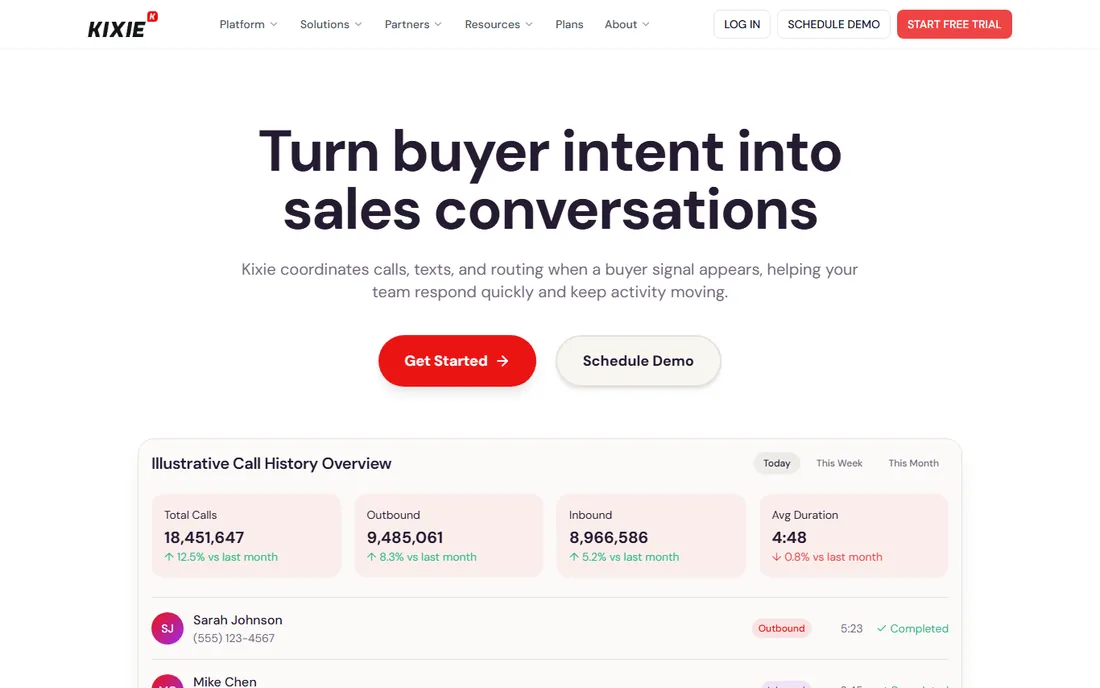
Kixie is the dialer most often recommended to teams that live inside HubSpot or Salesforce. The multi-line PowerDialer rings up to 10 lines at once and uses AI to detect whether a human answered, so reps stop wasting time on voicemail and dead air. Local presence dialing shows a local area code, and the spam-risk prevention tooling protects your numbers from getting flagged. With a G2 rating around 4.8 out of 5, it is the best-reviewed general power dialer on this list.
Watch the pricing arithmetic. The $35 starting figure is real, but reviewers and pricing analyses report that teams end up paying $109 to $220 per user per month once ConnectionBoost and other add-ons are included. Also note the primary interface is a Chrome extension, which is fine if your team is standardized on Chrome and awkward if it is not. For SMB revenue teams of 5 to 50 reps who want CRM-native dialing with strong support, Kixie still earns its spot.
What we like- Multi-line PowerDialer with AI human-voice detection
- Deep HubSpot, Salesforce, Zoho, and Pipedrive integrations
- Local presence dialing and spam-risk prevention
Watch out for- Real-world cost climbs to $109-$220/user/month with ConnectionBoost and add-ons
- Chrome-extension-based interface limits browser choice
Starting priceFrom $140/user/month (Standard, billed annually)
Free planFree trial (60 minutes of calling)
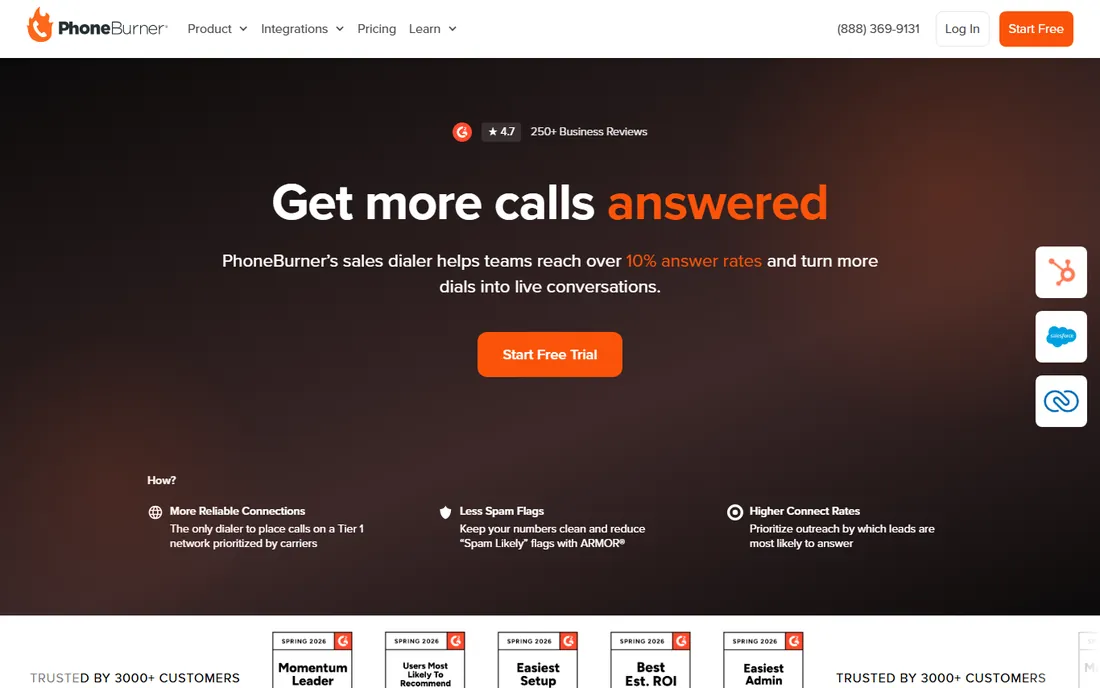
If your team's constraint is answer rates rather than raw dial count, PhoneBurner is the specialist. Instead of blasting lines in parallel, it runs fast one-to-one power dialing and invests the difference in keeping your numbers clean: ARMOR spam protection, local caller ID, and smart filtering of low-pickup numbers. Plans include unlimited dialing minutes, which makes costs predictable, and the built-in CRM features mean small teams can run without a separate CRM.
The price is the headline trade-off, at $140 to $183 per user per month depending on plan and billing term. It is also strictly a US and Canada tool, so international teams should look elsewhere. And the free trial is 60 minutes of calling, not a time period, so push for an extended demo before signing up a whole team. For high-volume US outbound where every answered call counts, the premium is defensible.
What we like- Unlimited dialing minutes with no per-minute charges
- ARMOR spam protection and local caller ID
- One-click voicemail drop and post-call workflow automation
Watch out for- Premium price point
- US and Canada only, no international calling
- No meaningful inbound support
#3
CloudTalk
Best for: International teams needing broad number coverage
Visit cloudtalk.io
Starting priceFrom ~$25/user/month
Free planFree trial
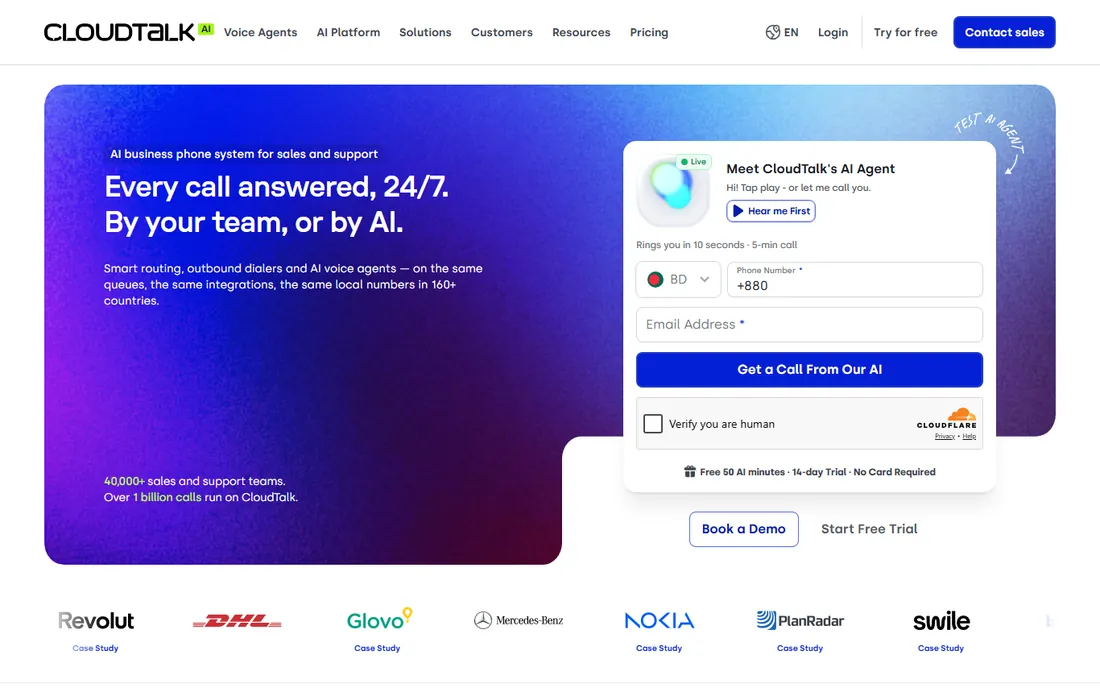
CloudTalk is the balanced pick for teams that sell across borders. The dialer stack covers preview, sequential power, parallel (up to 10 lines), and smart dialing, backed by international number coverage that few competitors match. It combines outbound dialing with inbound routing, call queues, and analytics, so it works as a full contact center rather than a dialer-only tool.
The catch is tier gating: at around $25 per user per month you get the base platform, and the stronger dialing modes live on the more expensive plans. If your outbound is entirely domestic, you may be paying for global infrastructure you never use. For growing SMB and mid-market teams with international prospects, though, it is one of the best value propositions here.
What we like- Power, parallel, and smart dialing modes in one
- Local and toll-free numbers in 160+ countries
- 100+ integrations including certified CRM connectors
Watch out for- Power dialer features sit on higher tiers
- Some advanced features need add-ons
#4
Aircall
Best for: Hybrid sales and support teams on one phone system
Visit aircall.io
Starting priceFrom $30/license/month (annual)
Free planFree trial
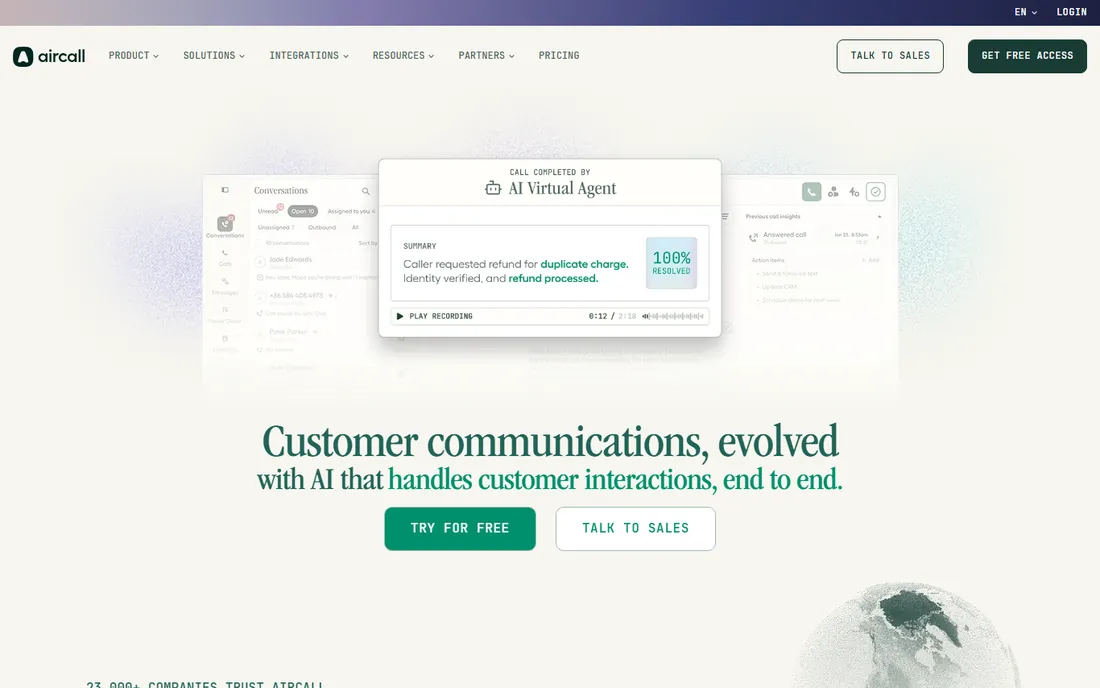
Aircall is first a cloud phone system and second a dialer, which is exactly right for teams where the same people handle inbound support and outbound sales. Deployment is fast, the integration library is one of the broadest in the category, and the Power Dialer add-on brings automated list dialing into the same interface reps already use for inbound calls.
Do not buy Aircall if you want the most aggressive dialing engine on the market; dialer-first tools like Kixie and Orum dial harder. What you get instead is simplicity: one phone system, one bill, one place to manage numbers and analytics. For inside sales teams of 10 to 50 doing mixed inbound and outbound, that consolidation is worth more than raw dials per hour.
What we like- Huge integration library across CRM and helpdesk
- Fast deployment for teams
- Shared phone system for sales and support
Watch out for- Dialer features are layered on a phone system, not a dialer-first product
- Minimum seat requirements reported on entry plans
Starting priceFrom ~$29/user/month (annual)
Free planFree trial
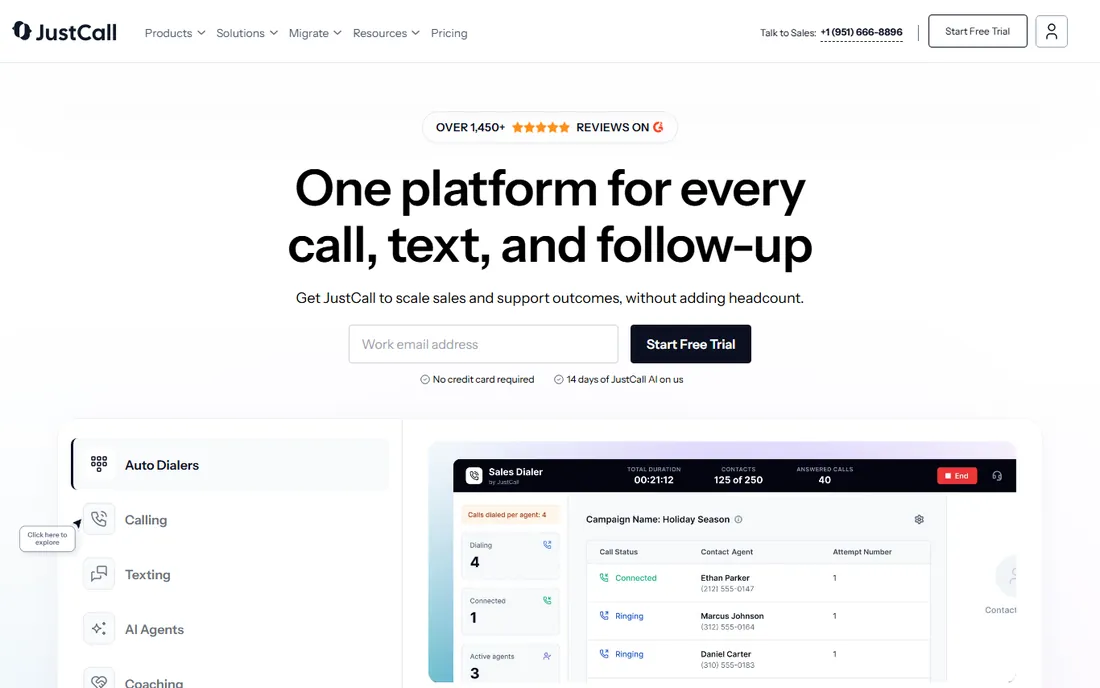
JustCall pairs a cloud phone system with serious dialer modes, power, predictive, and dynamic, plus native AI coaching and sentiment analysis that many competitors sell as add-ons. Local numbers across more than 70 countries make it a natural fit for distributed teams, and the 100+ integrations cover the major CRMs.
The pricing deserves a second look. The $29 entry figure applies to base plans billed annually; teams that need the dialer-focused tiers report $49 to $89 per user per month, and you still need a CRM underneath. Even so, for international SMB teams that want multi-line dialing without enterprise pricing, JustCall undercuts most rivals with comparable coverage.
What we like- Local numbers in 70+ countries
- Power, predictive, and dynamic dialing modes
- AI coaching and sentiment analysis included
Watch out for- Dialer-focused plans can reach $49-$89/user/month before you add a CRM
- Some features require higher tiers
Starting priceSee website
Free planFree trial

Dialpad's pitch is that every call should make the next call better. The AI transcribes calls live, generates summaries automatically, tracks sentiment in real time, and gives managers coaching material without anyone listening to hours of recordings. Power dialing, click-to-call, and call campaigns sit inside the same platform as team messaging and meetings.
Pricing for the sales-focused tiers is quote-based, which makes comparison shopping annoying, and third-party estimates vary widely. If you already run your company on Dialpad's unified communications, adding the sales dialer is the obvious move. If you only need a dialer, a dialer-first tool will be simpler and probably cheaper.
What we like- Real-time AI transcription, summaries, and live sentiment tracking
- Power dialing inside a unified communications platform
- Strong Salesforce and HubSpot integrations
Watch out for- Quote-based pricing for sales tiers
- Dialing is part of a bigger platform, so dialer-only buyers pay for more than they need
#7
Orum
Best for: High-volume SDR floors running parallel dials
Visit orum.com
Starting priceSee website
Free planNo (demo only)
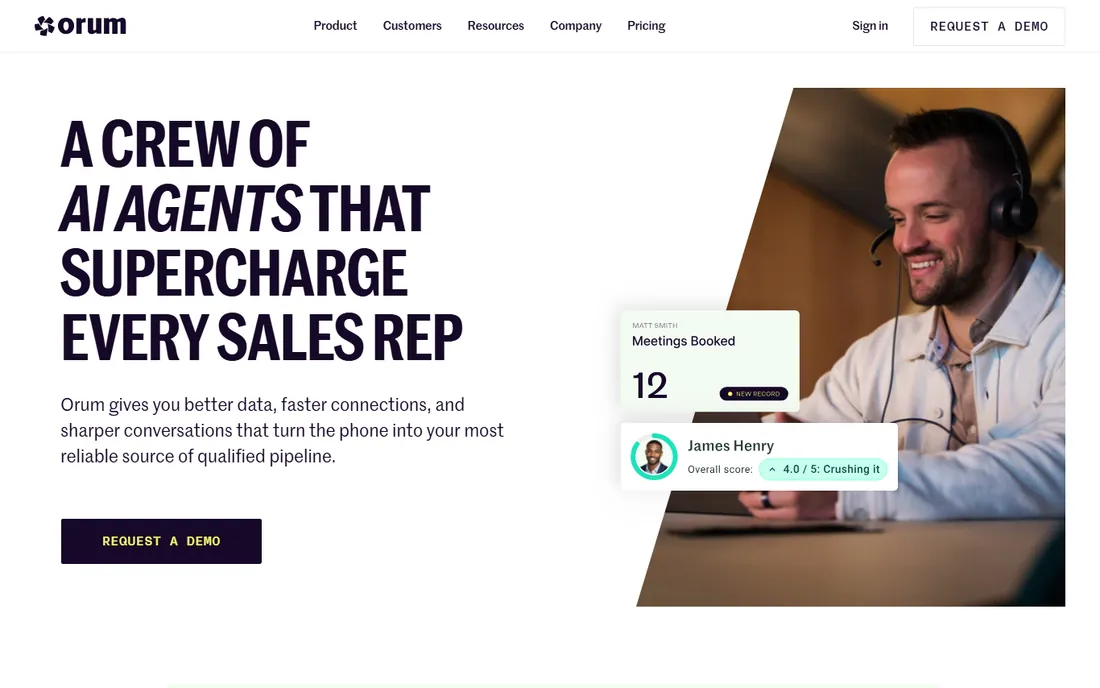
Orum is the volume king. Parallel dialing puts up to 10 lines on the screen at once, AI filters out voicemails and bad numbers, and reps talk to 500 to 800 dials' worth of prospects per day. The virtual salesfloor lets managers listen in, coach live, and run call blitzes with remote teams, which is why established SaaS SDR orgs keep choosing it.
Everything about the pricing says enterprise: custom quotes, estimates around $250 per user per month, and a nine-seat minimum. Small teams should not even demo it. But if you have a real SDR floor and your bottleneck is conversations per rep per day, nothing in the power-dialer tier touches Orum's throughput.
What we like- Parallel dialing up to 10 lines with AI live-answer detection
- Virtual salesfloor for live coaching during blitzes
- Built for Salesforce and Outreach workflows
Watch out for- Custom pricing around $250/user/month with a nine-seat minimum
- Overkill for teams under ~10 reps
#8
Nooks
Best for: Parallel dialing with AI coaching in one platform
Visit nooks.ai
Starting priceSee website
Free planNo (demo only)

Nooks takes the parallel dialer and wraps it in an AI-native outbound platform. The dialer itself handles AI live-answer detection, spam-protected number rotation, and voicemail drop, while AI agents do account research before calls and update the CRM after them. Reps start each conversation with context and finish with their records already logged. The virtual salesfloor gives remote teams the energy of a shared calling floor.
Like Orum, it is priced for serious outbound teams, with third-party estimates of $200 to $300 per user per month and custom quotes. It is also a younger company than the legacy dialers, so ask hard questions about reliability during your evaluation. For teams consolidating dialing, sequencing, and coaching into one system, it is the most modern option here.
What we like- AI parallel dialer with spam protection and number health monitoring
- AI agents handle call prep and CRM logging
- Virtual salesfloor for remote teams
Watch out for- Custom pricing estimated at $200-$300/user/month
- Newer platform with less track record than legacy rivals
#9
Aloware
Best for: CRM-integrated teams prioritizing conversations over raw volume
Visit aloware.com
Starting priceFrom ~$30/user/month
Free planFree trial
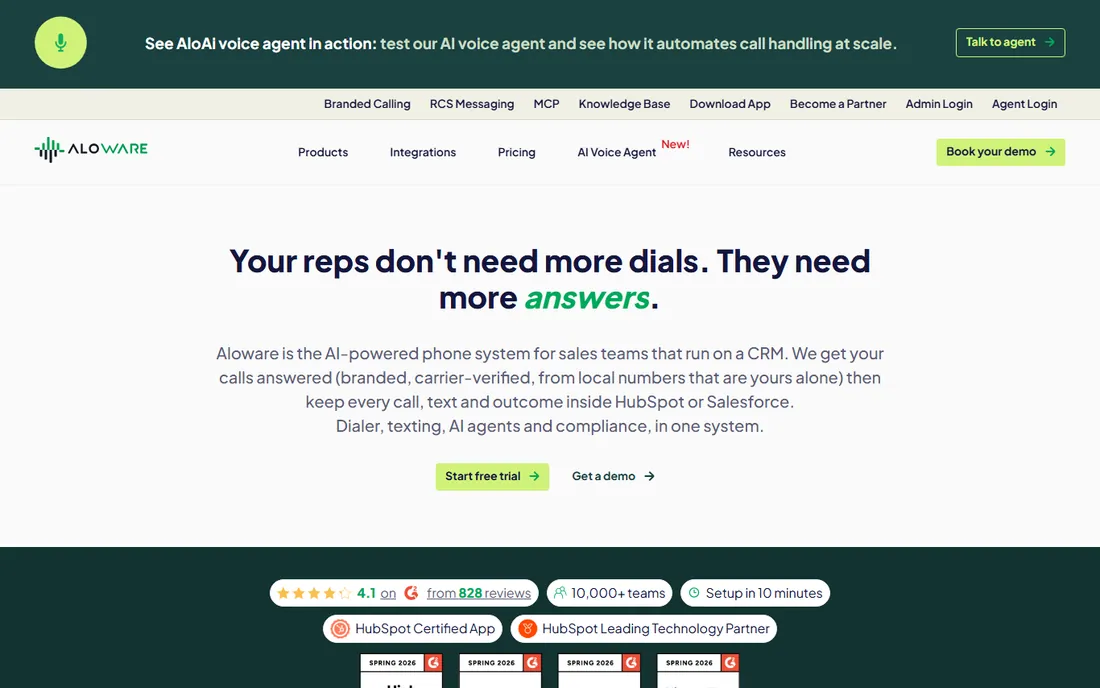
Aloware makes an argument most dialer vendors avoid: that conversations per hour matter more than dials per hour. Its 1:1 power dialer is tightly integrated with HubSpot and Salesforce, pairs voice with SMS outreach, and emphasizes pickup-rate tooling and pipeline attribution over raw throughput. Typical teams report 150 to 300 dials per rep per day, which sounds modest next to Orum until you look at the connect rates.
If your motion is high-volume SDR blitzing, this is the wrong tool. If your reps need real conversations that land in the CRM and convert, the quality-first approach often wins on pipeline per dollar. The $30 starting price is friendly, though third-party sources suggest configured costs can run higher.
What we like- 1:1 power dialer built around HubSpot and Salesforce
- Strong SMS alongside voice
- Conversation-quality focus with pipeline attribution
Watch out for- Not a parallel dialer, so peak dial volume is lower
- Some features estimated higher at ~$70/user/month in third-party comparisons
Starting priceFrom $99/month (single line, includes agent access)
Free planNo
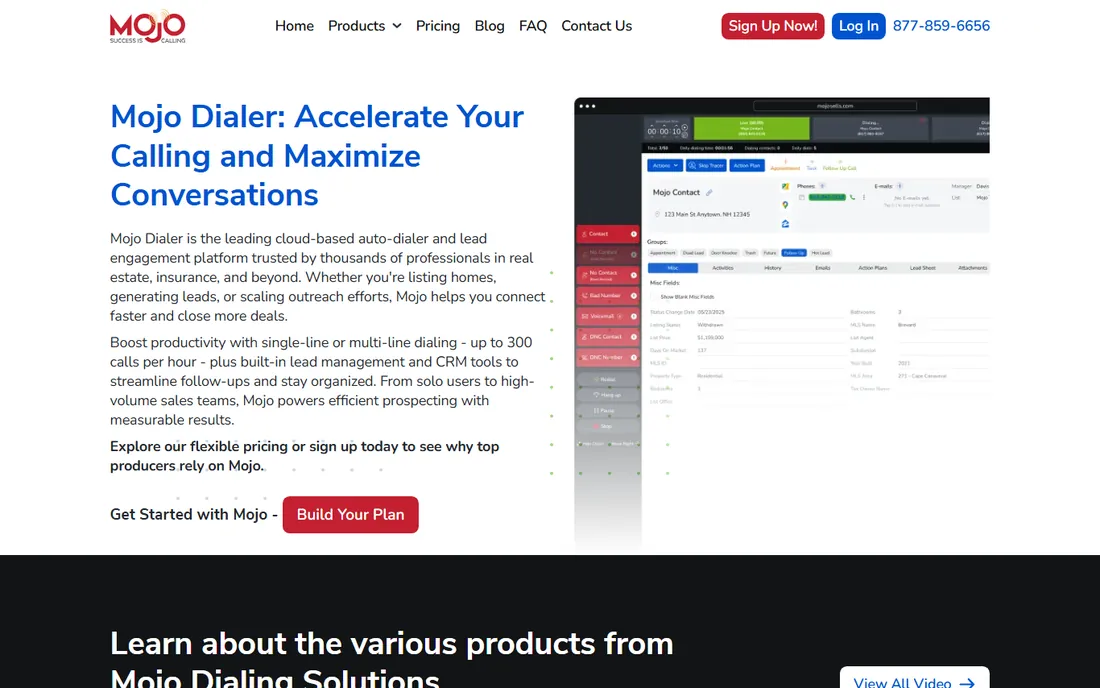
Mojo is the real estate industry's dialer. The single-line plan starts at $99 per month including agent access, and the triple-line license at $149 supports up to 300 calls per hour with live-answer detection. It runs on copper-based infrastructure rather than VoIP, which agents say delivers better call quality, and the optional data subscriptions (expired listings, FSBOs, skip tracing) let you buy leads and dial them in the same workflow.
Read the menu carefully: that $99 figure is just the single-line license. A usable setup with voice, recording, and caller ID runs about $164 per month per agent, and triple-line lands around $214. There is no free trial, and the cancellation policy is restrictive. For solo agents and small teams hammering expireds and FSBOs, it remains the fastest affordable path to triple-line volume.
What we like- Triple-line dialing up to 300 calls per hour
- Copper-based infrastructure for call quality
- Real estate data add-ons (expired, FSBO, skip tracing) in one place
Watch out for- A la carte pricing means the real cost runs $164-$214/month per agent
- No free trial
- US and Canada only
Power vs. parallel vs. predictive: which dialing mode do you need?
The terms get thrown around interchangeably, so here is the plain version. A power dialer calls one number after another automatically and only connects the rep when someone picks up. It is predictable, compliant-friendly, and right for most teams. A parallel dialer calls several numbers at once (up to 10 lines) and routes the first human answer to the rep, multiplying dials per hour dramatically. It is built for SDR floors where volume is the game. A predictive dialer goes further and uses algorithms to pace calls against agent availability, which is powerful but brings compliance baggage under telemarketing rules.
Match the mode to the team. Solo reps and small teams doing 100 to 300 dials a day should buy power. SDR floors of 10+ reps measured on conversations per day should look at parallel. Predictive belongs in enterprise contact centers with compliance counsel, not in a five-person sales team. Buying parallel when you need power wastes money; buying power when you need parallel caps your output.
How we chose
We researched each tool through vendor pricing pages and, where pricing is custom or quote-based, through multiple third-party sources including G2, Capterra, GetApp, Slashdot, TrustRadius, and dedicated pricing analyses published in 2026. We compared dialing modes (single-line power, multi-line parallel, predictive), CRM integration depth, call-quality and spam-protection features, and real-world cost including add-ons and minimums, not just headline prices. We read public user reviews to surface recurring complaints about pricing surprises, reliability, and support. The list mixes dialer-first specialists (Kixie, PhoneBurner, Orum, Nooks, Mojo) with full phone platforms that include power dialing (CloudTalk, Aircall, JustCall, Dialpad) and a quality-first option (Aloware), so teams of different sizes and volumes can find their fit. No vendor paid for placement, and we did not invent any prices, ratings, or customer claims.
Frequently asked questions
What is a power dialer?
A power dialer automatically calls the next number on a rep's list as soon as the previous call ends, skipping manual dialing. The rep only talks when a real person answers; voicemails, busy signals, and disconnected numbers are handled automatically. It typically doubles or triples daily talk time versus hand dialing.
How much does power dialer software cost?
Entry-level power dialing runs about $25 to $35 per user per month (CloudTalk, JustCall, Kixie). Premium one-to-one dialers like PhoneBurner run $140 to $183 per user per month, and parallel dialers like Orum and Nooks run an estimated $200 to $300 per user per month with seat minimums. Add-ons, per-minute charges, and onboarding can add significantly to the headline price.
What is the difference between a power dialer and a parallel dialer?
A power dialer calls one number at a time in sequence. A parallel dialer calls multiple lines simultaneously (often up to 10) and connects the rep to whichever line a human answers first. Parallel delivers far more dials per hour but costs more and suits larger SDR teams; power is the right default for most small and mid-sized teams.
Do power dialers integrate with HubSpot and Salesforce?
Most of them do. Kixie, Aloware, and Dialpad are built around deep HubSpot and Salesforce integrations with automatic call logging. Orum and Nooks target Salesforce and Outreach workflows. Always verify the specific integration you need (two-way sync, dispositions, custom fields) during a trial, because "integrates with" can mean very different things.
Are power dialers legal?
The software itself is legal, but how you use it is regulated. In the US, the TCPA restricts autodialed calls to cell phones without consent, and state laws add their own rules. Single-line power dialing is generally lower-risk than predictive dialing. If you do outbound at scale, get compliance advice rather than relying on a vendor's marketing claims.
Which power dialer is best for a small team on a budget?
CloudTalk (from ~$25/user/month) and JustCall (from ~$29/user/month) give small teams real dialing modes at entry prices. Kixie (from ~$35/user/month) is the strongest pick if your team lives in HubSpot or Salesforce, though its add-ons raise the real cost. For real estate solo agents, Mojo Dialer's $99 single-line plan is the budget path to high call volume.
Sources we checked (17)
- https://www.technology.org/2026/06/13/best-cold-calling-software-in-2026-tested-compare/
- https://coruzant.com/software/best-outbound-dialers-compared/
- https://hardwaresecrets.com/power-dialer-software-for-b2b-sales/
- https://frejun.com/power-dialer-software/
- https://aloware.com/blog/power-dialer-call-hundreds-of-leads
- https://ecommerceparadise.com/kixie-alternatives/
- https://inkris.ai/blog/best-crm-with-power-dialer
- https://getapp.com/customer-service-support-software/a/phoneburner/
- https://www.cloudtalk.io/blog/phoneburner-pricing/
- https://coldiq.com/tools/phoneburner
- https://www.toolsforhumans.ai/ai-tools/phoneburner
- https://prospeo.io/s/mojo-dialer-pricing-reviews-pros-and-cons
- https://www.ringover.com/blog/mojo-dialer-pricing
- https://www.trustradius.com/products/mojo-dialer/details
- https://www.goodfirms.co/software/mojo-dialer
- https://www.nooks.ai/blog-posts/best-ai-dialer-for-sales-outreach
- https://www.itechguides.com/best/telemarketing-software/
Is your product missing or out of date?
We review this list regularly. Vendors can request a listing, send updated pricing or ask about featured placement.

Shihab Mia · Founder, Rankite
Shihab has spent more than a decade helping SaaS and e-commerce brands grow through search. He writes Rankite's software buying guides from pricing pages, documentation and public user reviews. More about Shihab.