How we make this list: we compare pricing pages, product documentation and public user reviews. Ratings come from G2, Capterra or Trustpilot, with the date we checked them.
Key takeaways
- Coursera and edX lead for certificates that employers recognize, while Udemy leads for single practical skills bought on sale.
- Skillshare and MasterClass suit creative and inspiration-led learning, while DataCamp and LinkedIn Learning suit work skills with clear paths.
- Khan Academy is the best free start for school and foundation skills, and it pairs well with a paid platform for job skills.
- Check certificate value, course length, and renewal terms before paying, because a completion certificate is not the same as a degree or license.
Quick comparison
| Tool | Best for | Starting price | Free plan |
|---|
 Coursera | University and company certificates | $59 per month for Coursera Plus | Free trial |
 Udemy | Single practical skills on sale | See website | Yes |
 Skillshare | Creative project-based classes | See website | Free trial |
 MasterClass | Inspiration from famous practitioners | $10 per month billed annually | Free trial |
 edX | Academic courses and MicroMasters | Free to audit | Yes |
 LinkedIn Learning | Work skills with LinkedIn integration | $39.99 per month | Free trial |
 DataCamp | Data and AI skills with practice | See website | Yes |
 Khan Academy | Free foundation and school skills | $0 | Yes |
Is your product missing or out of date?
We review this list regularly. Vendors can request a listing, send updated pricing or ask about featured placement.
#1Coursera
Best for: University and company certificates4.5/5 on
G2 (489 reviews, checked Oct 2026)
Visit coursera.org
Starting price$59 per month for Coursera Plus
Free planFree trial
Coursera partners with universities and companies such as Google, IBM, and Meta to offer courses, Specializations, Professional Certificates, and degrees. A learner can audit many courses for free, pay for a certificate, or subscribe to Coursera Plus at $59 per month or $399 per year for broader access. Paths in data, cybersecurity, and project management run for three to six months at a steady pace.
The subscription model punishes slow study. Paying monthly while not studying wastes money, and some older courses teach dated tools, so checking the last update date matters. Mobile coding assignments can also frustrate learners. For a career change with a recognized certificate, Coursera remains the strongest general platform, especially when a learner can finish a certificate in a few months.
What we like- University and company partners
- Professional Certificates
- Structured paths
Watch out for- Monthly cost adds up if study is slow
- Some courses are dated
- Mobile coding is limited
#2Udemy
Best for: Single practical skills on sale4.5/5 on
G2 (757 reviews, checked Oct 2026)
Visit udemy.com
Starting priceSee website
Free planYes
Udemy sells individual courses, often at deep sale prices, with lifetime access to the bought course and a certificate of completion. That model suits a learner who needs one skill, such as Excel, Python basics, or photo editing, without a monthly subscription. Reviews, preview videos, and course length help judge quality before buying.
Quality varies because any instructor can publish, and certificates are completion records rather than employer-recognized credentials. There is no built-in path that orders courses into a career track, so learners must plan their own sequence. Udemy also offers a Personal Plan subscription in some regions, but per-course buying remains its main strength. Buy during sales, check recent reviews, and avoid buying ten courses at once.
What we like- Huge catalog
- Lifetime access to bought courses
- Frequent sales
Watch out for- Quality varies by instructor
- Certificates carry little hiring weight
- No structured path by default
#3Skillshare
Best for: Creative project-based classes3.3/5 on
G2 (42 reviews, checked Oct 2026)
Visit skillshare.com
Starting priceSee website
Free planFree trial
Skillshare focuses on creative skills, with short project-based classes in illustration, design, photography, writing, and crafts. Classes usually end with a project, which helps learners produce work rather than only watch videos. The community aspect, with shared projects and feedback, suits hobbyists and freelancers building a portfolio.
Skillshare certificates are completion records, not formal credentials, and class quality varies by teacher. Pricing has changed over time and by plan, so check the current Skillshare page, and set a renewal reminder before an annual plan renews. For creative exploration and portfolio projects, Skillshare is a lively, affordable option when used regularly.
What we like- Project-based creative classes
- Strong design and illustration set
- Community projects
Watch out for- No formal certificates
- Quality varies
- Subscription renews annually in many plans
#4MasterClass
Best for: Inspiration from famous practitioners4.3/5 on
G2 (15 reviews, checked Oct 2026)
Visit masterclass.com
Starting price$10 per month billed annually
Free planFree trial
MasterClass offers cinematic classes from well-known practitioners in cooking, writing, music, business, sports, and more, starting from $10 per month billed annually. Production quality is high, and the classes work well for motivation, ideas, and understanding how experts think. A learner can sample many fields without committing to a full course in each one.
Depth is the limit. MasterClass teaches concepts and stories more than step-by-step practice with feedback, and there is no formal certificate for hiring. Learners who need a job skill should pair MasterClass with a practice platform such as Coursera, Udemy, or DataCamp. For inspiration and broad learning, it is enjoyable and well made.
What we like- High production quality
- Famous instructors
- Wide topics from cooking to writing
Watch out for- Inspiration over depth
- No formal certificate
- Limited practice and feedback
#5edX
Best for: Academic courses and MicroMasters4.5/5 on
G2 (121 reviews, checked Oct 2026)
Visit edx.org
Starting priceFree to audit
Free planYes
edX, founded by Harvard and MIT and now part of 2U, offers university courses that learners can audit for free, with verified certificates available for a fee. MicroMasters programs, often $600 to $1,500, give deeper academic paths in business, data, and computer science that can count toward a degree at partner schools. The academic tone suits learners who want rigor and reading.
Pacing can feel slow compared with Skillshare or Udemy, and creative and hobby coverage is thinner. Certificate costs vary by course, so budgeting for a full path needs care. For learners who want university-level content and a credential with academic weight, edX is a strong, free-to-start choice.
What we like- University courses
- Free audit on many courses
- MicroMasters paths
Watch out for- Verified certificates cost $50 to $300 or more
- Pacing can be slow
- Fewer creative classes
#6LinkedIn Learning
Best for: Work skills with LinkedIn integration4.4/5 on
G2 (722 reviews, checked Oct 2026)
Visit linkedin.com
Starting price$39.99 per month
Free planFree trial
LinkedIn Learning, formerly Lynda.com, offers consistent, professionally produced courses in business, technology, and creative skills, with a monthly plan at $39.99 or an annual plan at $239.88, which equals $19.99 per month. Completed courses can appear on a LinkedIn profile, which helps recruiters see recent learning, and a one-month trial lets new users test the library.
Depth varies. Some topics have full learning paths, while others have only short introductory courses, and the platform suits general work skills more than deep specialist training. Many employers already pay for LinkedIn Learning, so checking workplace access before paying personally can save money. For steady professional development, it is a reliable library.
What we like- Consistent course quality
- Business and tech focus
- Certificates show on LinkedIn profile
Watch out for- Monthly price is high
- Annual plan is $239.88
- Depth varies by topic
#7DataCamp
Best for: Data and AI skills with practice4.7/5 on
G2 (721 reviews, checked Oct 2026)
Visit datacamp.com
Starting priceSee website
Free planYes
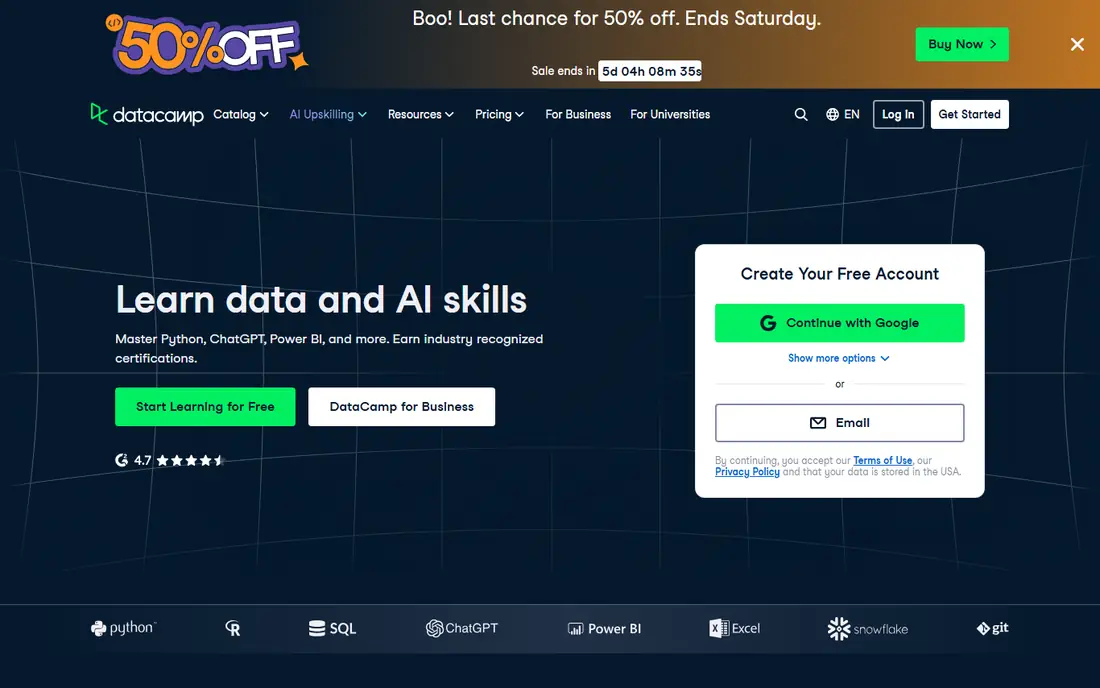
DataCamp teaches data and AI skills through interactive coding in the browser, with career tracks, skill tracks, and projects in Python, R, SQL, and machine learning. Learners practice in short exercises rather than only watching videos, which helps retention for coding skills. A free Basic plan covers introductory content, while Premium gives full access to tracks.
The focus is narrow by design. DataCamp does not cover general business, creative, or language skills, and advanced specialist topics may need a second platform. Pricing varies by plan and region, so check the current DataCamp page before subscribing. For a first data or AI skill with hands-on practice, DataCamp is a focused, effective pick.
What we like- Interactive coding practice
- Career tracks in data and AI
- Beginner-friendly paths
Watch out for- Focus is narrow to data
- Advanced topics are thinner
- Premium needed for full tracks
#8Khan Academy
Best for: Free foundation and school skills4.5/5 on
G2 (177 reviews, checked Oct 2026)
Visit khanacademy.org
Starting price$0
Free planYes
Khan Academy offers free structured courses in math, science, computing, history, economics, and test preparation, with videos, practice, and progress tracking. It is the best free foundation platform for school learners, adult learners returning to basics, and anyone who needs to fill gaps before a job course. The nonprofit model keeps all core content free.
Job certificates are not the focus. Khan Academy does not offer university credit or employer certificates in the same way as Coursera or edX, and advanced professional tracks are limited. Used as a foundation, then paired with a paid platform for a certificate, Khan Academy saves money and builds confidence. For free learning, it remains unmatched.
What we like- Completely free
- Structured courses
- Strong math, science, and history coverage
Watch out for- Limited job-skill certificates
- No university credit
- Fewer advanced professional courses
How we chose
We compared pricing pages, product documentation, and public reviews on G2, Capterra, and Reddit, and we checked catalog breadth, certificate value, practice formats, and pricing models. We favored platforms still maintained in 2026, with a clear free, trial, or per-course path. We did not claim hands-on testing, and we left out dead platforms, creator-only tools, and platforms with unclear pricing.
Define the goal in one sentence before paying. If the goal is a job certificate, choose Coursera or edX and check employer recognition for that exact certificate. If the goal is one practical skill, buy a single Udemy course on sale and finish it before buying another. If the goal is creative growth, trial Skillshare or MasterClass for a month and judge by projects finished, not videos watched.
Set a time budget as well as a money budget. A platform that needs ten hours a week will fail if you have only three, no matter how good the catalog is. Use a free audit or trial to test one full course, check the update date and reviews, and set a renewal reminder. A certificate earned slowly is still a certificate, but a subscription paid while idle is just a cost.
Frequently asked questions
Which platform is best for learning a new skill for work?
Coursera is best for recognized certificates, LinkedIn Learning is best for general work skills, and DataCamp is best for data and AI skills. Udemy is best for a single practical skill bought on sale. Match the platform to the exact skill and to whether you need a certificate for hiring.
Are free platforms enough to learn a skill?
Yes, for foundations and for many practical skills. Khan Academy covers school and foundation topics free, edX allows free auditing on many courses, and YouTube and official software tutorials cover narrow skills. Paid platforms help when you need structure, practice, feedback, or a certificate.
Do online certificates help with jobs?
Some do, and some do not. University and company certificates on Coursera and edX carry more weight than completion certificates on Udemy, Skillshare, or MasterClass. Check job postings for your target role, and look for certificates named by employers, rather than assuming any certificate counts equally.
How long does it take to learn a skill online?
It depends on the skill and on weekly time. A single Udemy course may take a weekend, a Professional Certificate may take three to six months at ten hours a week, and a MicroMasters may take longer. Set a weekly schedule first, then choose a platform whose course length fits that schedule.
Can I learn skills on more than one platform at once?
Yes, but keep it to two at most. A common pairing is a free foundation platform plus a paid certificate platform, or a creative platform plus a practice platform. Finish one course before starting three, because unfinished courses are the most common waste in online learning.
Sources we checked (8)
- https://www.coursera.org
- https://www.udemy.com
- https://www.skillshare.com
- https://www.masterclass.com
- https://www.edx.org
- https://www.linkedin.com
- https://www.datacamp.com
- https://www.khanacademy.org
Is your product missing or out of date?
We review this list regularly. Vendors can request a listing, send updated pricing or ask about featured placement.

Shihab Mia · Founder, Rankite
Shihab has 5+ years in B2B and SaaS SEO. He writes Rankite's software buying guides from pricing pages, documentation and public user reviews. More about Shihab.