How we make this list: we compare pricing pages, product documentation and public user reviews. Rankite is independent; if a vendor ever pays for a featured spot, that listing is clearly labeled Partner.
Key takeaways
- Turnitin is the academic gold standard but you cannot buy it as an individual; students get closest through Scribbr, which licenses the same detection technology per document.
- For web content and freelance writing, Copyscape's pay-per-search model and Originality.ai's credit system beat subscriptions, since you pay only for what you check.
- Grammarly Pro is the best value if you also want a writing assistant, with unlimited plagiarism checks bundled into the $12-per-month annual plan.
- Free checkers like Duplichecker and Quetext's free tier work for quick spot checks but miss paraphrased copying that paid tools catch.
- Check the document storage policy before you submit: Turnitin adds papers to its institutional database, while Scribbr deletes yours after 7 days.
Quick comparison
| Tool | Best for | Starting price | Free plan |
|---|
 Turnitin Turnitin | Universities and schools buying institution-wide | See website (custom institutional licensing) | No |
 Grammarly Grammarly | Writers who want plagiarism checks inside their editor | $12 per user/month (billed annually; $30 per user/month billed monthly) | Yes |
 Copyscape Copyscape | Bloggers and site owners checking web content | $0.03 per search (up to 200 words, plus $0.01 per extra 100 words) | Yes |
 Quetext Quetext | Students who want plagiarism checks plus citation help | $8.99 per user/month (Essential plan) | Yes |
 Copyleaks Copyleaks | Organizations needing multilingual detection at scale | $16.99 per user/month (billed monthly; $13.99 per user/month billed annually) | Yes |
 Originality.ai Originality.ai | Publishers and agencies checking freelance content | $14.95 per user/month (Pro plan; pay-as-you-go $30 for 3,000 credits) | Yes |
 PlagiarismCheck.org PlagiarismCheck.org | Academics who prefer paying per page over subscribing | $5.99 (Basic, 20 plagiarism pages) | No |
 Scribbr Scribbr | Students who want Turnitin-level checking without an institution | $19.95 per check | No |
 Duplichecker Duplichecker | Bloggers and SEOs who want free quick checks | $19.99 per user/month (billed monthly; $15.99 per user/month billed annually) | Yes |
Is your product missing or out of date?
We review this list regularly. Vendors can request a listing, send updated pricing or ask about featured placement.
Plagiarism checkers that actually catch copying
Here is the uncomfortable truth about this category: most plagiarism checkers are good at catching lazy copying and bad at catching clever copying. Paste a Wikipedia paragraph and everything flags it. Paraphrase it sentence by sentence and half the tools wave it through. The difference between a $0.03 search and an institutional license is usually the size of the database behind the check and whether the tool understands meaning or just matches strings. The nine tools below are the ones worth your time, organized by who actually buys them: schools, students, and people who publish on the web.
Starting priceSee website (custom institutional licensing)
Free planNo
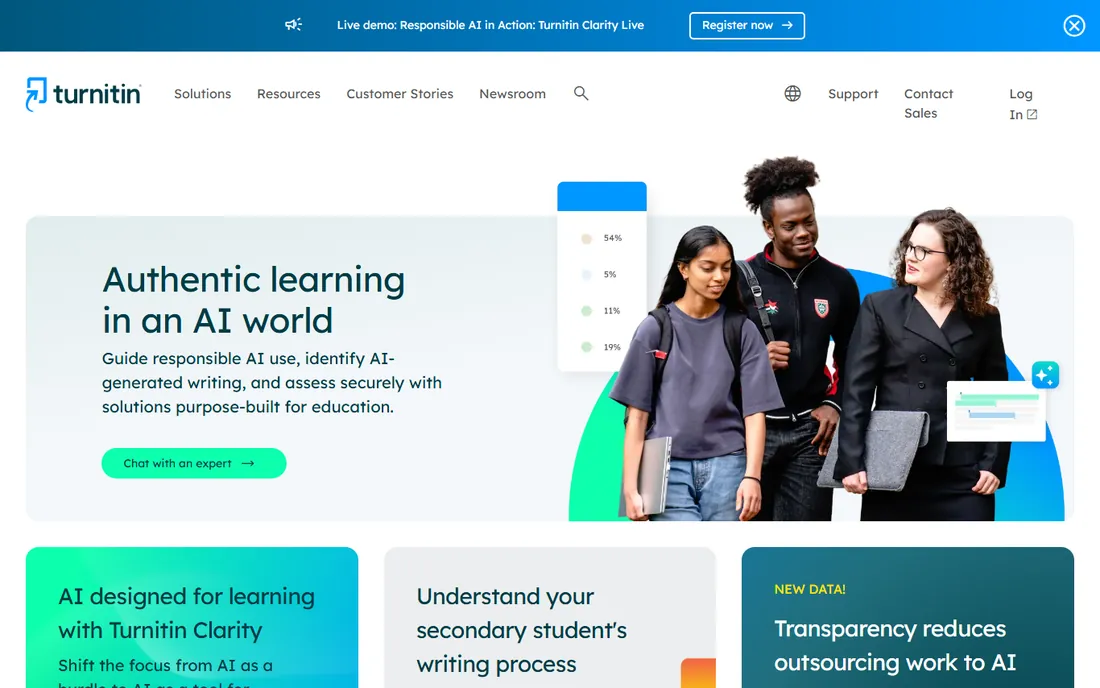
Turnitin is the name every academic integrity conversation starts with. Its database includes billions of web pages, published journals, and millions of previously submitted student papers, which is why it catches contract cheating and recycled coursework that web-only checkers miss. For institutions it bundles similarity reports with grading tools and AI writing detection, all inside the LMS workflows teachers already use.
Individuals cannot buy it, full stop. There is no student plan, no pay-per-check option, and no free tier. Pricing is negotiated per institution, typically a few dollars per student per year, which puts mid-size universities in the tens of thousands annually. Another wrinkle: submitted papers are stored in Turnitin's repository and checked against future submissions, which some students object to. If your school licenses it, use it. If not, Scribbr below is the closest you can legally buy.
What we like- Largest academic database including student submissions
- Deeply integrated with learning management systems
- Industry standard instructors trust
Watch out for- Not available to individuals at any price
- Submissions stored in its database
- Pricing opaque and negotiated per institution
#2
Grammarly
Best for: Writers who want plagiarism checks inside their editor
Visit grammarly.com
Starting price$12 per user/month (billed annually; $30 per user/month billed monthly)
Free planYes
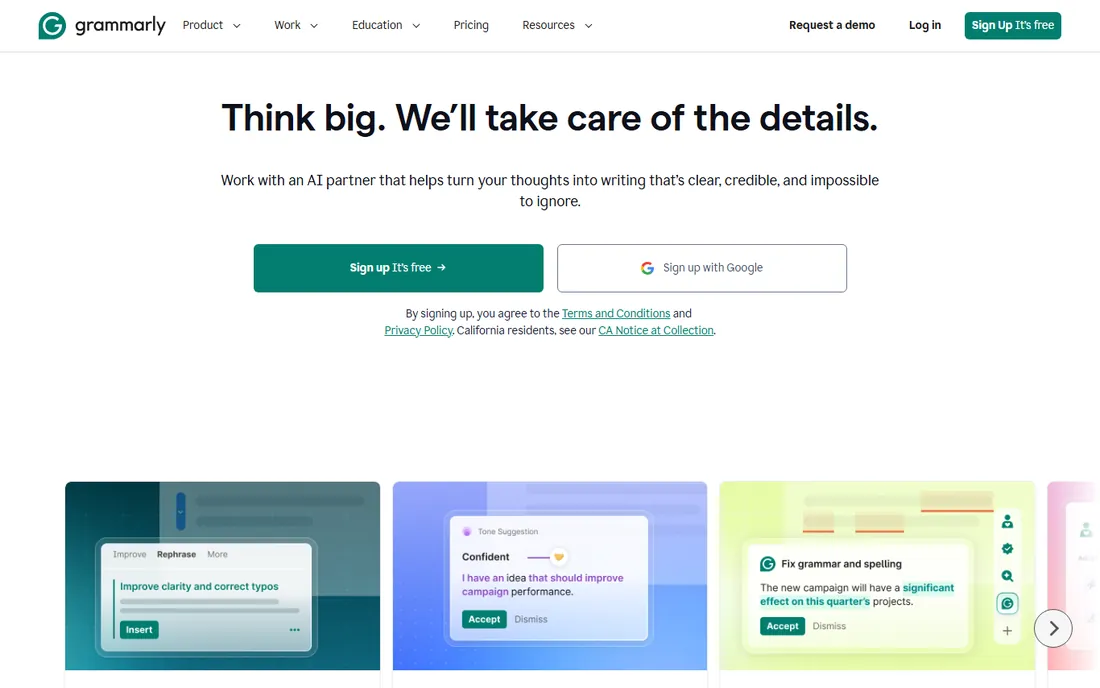
Grammarly's plagiarism checker is a side benefit of a writing subscription, and for many people that makes it the rational choice. Pro includes unlimited checks against a large web database, runs everywhere you type, and flags issues alongside grammar and clarity suggestions. If you already pay for Grammarly to improve your writing, the plagiarism detection costs you nothing extra.
As a dedicated checker it has limits. It is built for general web writing, blog posts, business documents, marketing copy, not for the journal databases and paper mills academic tools cover. Researchers and students submitting theses should pair it with something stronger. At $12 per month on annual billing ($30 month-to-month), it is also expensive if plagiarism checking is all you want; Quetext or pay-per-search options cost less for that single job. But for working writers, the bundle is genuinely good value.
What we like- Unlimited plagiarism checks in Pro
- Works inside Google Docs, Word, and browsers
- Doubles as a full writing assistant
Watch out for- Weaker than academic tools for scholarly sources
- English-focused
- Pricey if you only need plagiarism checks
Starting price$0.03 per search (up to 200 words, plus $0.01 per extra 100 words)
Free planYes
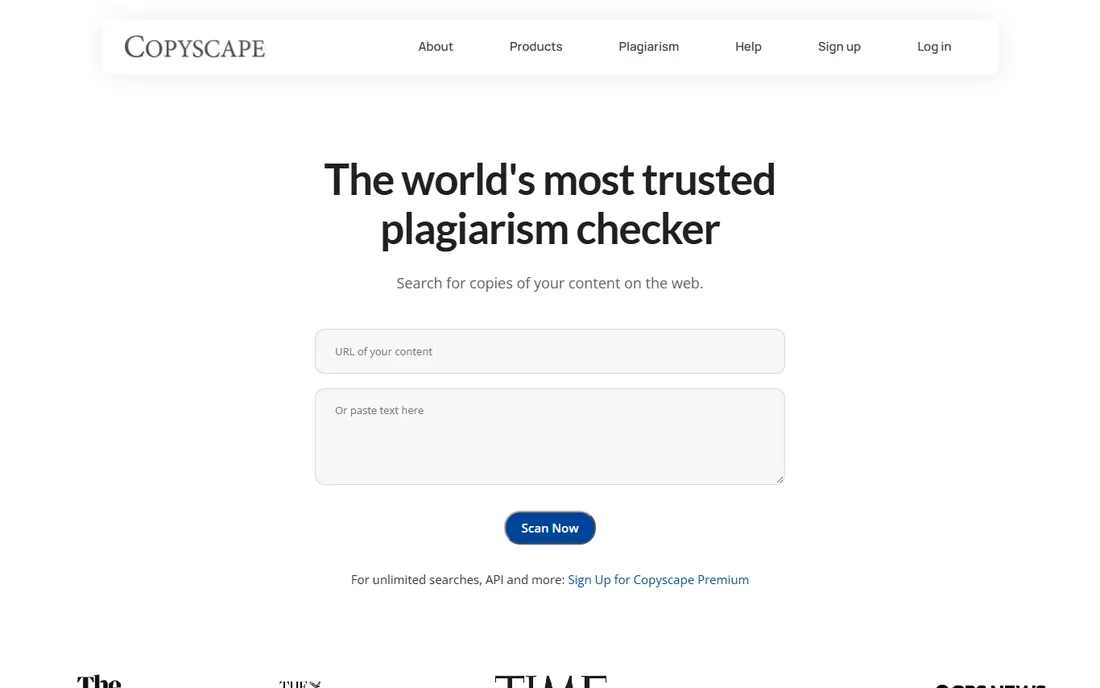
Copyscape is the old guard of web plagiarism checking, and its pricing model is still its best feature. There is no subscription: you buy credits and each Premium search costs 3 cents for the first 200 words plus a cent per extra 100 words. Checking a 1,500-word article costs under 20 cents. For freelance writers verifying their own work or editors spot-checking contributors, that is cheaper than any monthly plan.
The free version handles basic URL checks with limited results, which is enough to see if someone copied your page. Copysentry, from $4.95 a month, watches the web and alerts you when copies of your content appear. The downsides are age: the interface feels frozen in time, there is no academic database, and it checks against the public web only. It answers one question well, "is this text copied from somewhere online," and does not try to answer anything else.
What we like- Pay-per-search means no subscription
- Copysentry monitors the web for copies of your pages
- Simple and fast
Watch out for- Dated interface
- No academic or journal database
- Heavy users find per-search costs add up
#4
Quetext
Best for: Students who want plagiarism checks plus citation help
Visit quetext.com
Starting price$8.99 per user/month (Essential plan)
Free planYes
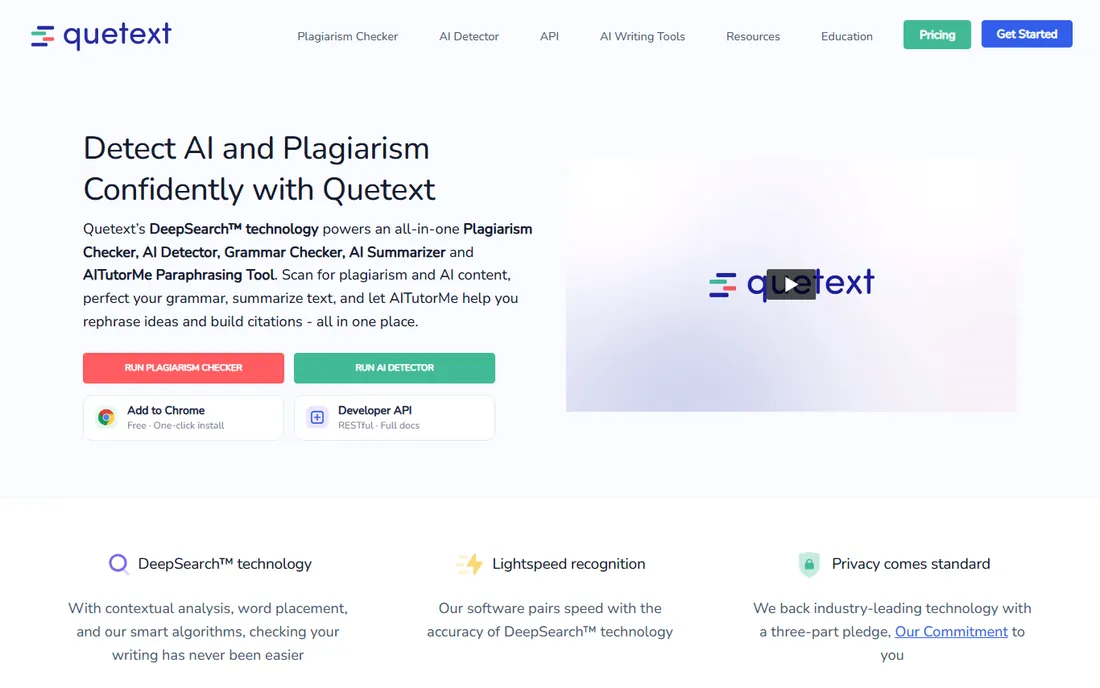
Quetext pitches itself as the student-friendly checker, and the product backs that up. DeepSearch compares your text against billions of web sources and presents matches in a color-coded report that is easier to read than most competitors'. The citation assistant is the thoughtful extra: when it flags a passage, it helps you cite the source properly in MLA, APA, or Chicago format, which turns a scary similarity score into a fixable to-do list.
The free plan covers 1,000 words, enough to check a short essay section but not a full paper. Paid plans start at $8.99 a month for 100,000 words on Essential, with Professional at $16.98 adding bulk uploads and API access, and annual billing cuts roughly 45 percent. The word-credit model means you should subscribe during heavy writing periods rather than year-round. Quetext lacks the deep integrations of Grammarly, but for students it is one of the best balances of price and capability.
What we like- DeepSearch technology with clear color-coded reports
- Built-in citation assistant
- Free tier for quick checks
Watch out for- Monthly word credits cap heavy users
- No native Google Docs or Word integration
- Free plan limited to 1,000 words
#5
Copyleaks
Best for: Organizations needing multilingual detection at scale
Visit copyleaks.com
Starting price$16.99 per user/month (billed monthly; $13.99 per user/month billed annually)
Free planYes
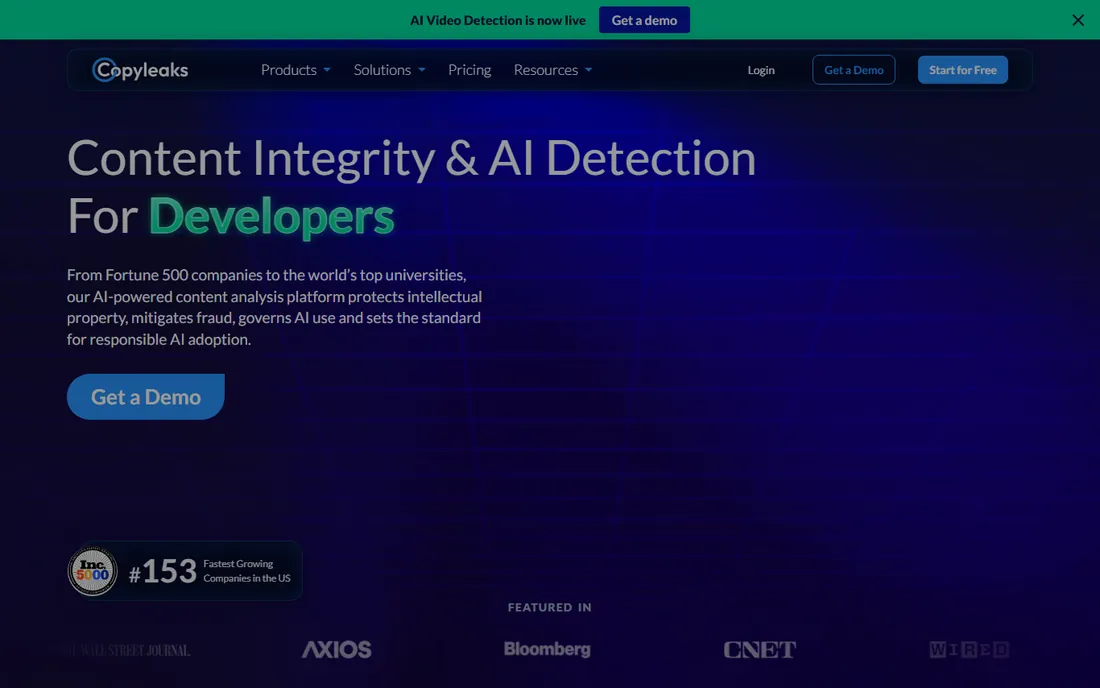
Copyleaks is the enterprise answer to plagiarism detection. It scans across more than 30 languages, detects paraphrased and translated copying that string-matchers miss, and even checks source code, which matters to technical publishers and universities with programming courses. The API and LMS integrations let organizations wire detection directly into submission pipelines instead of checking documents one by one.
The Personal plan starts at $16.99 a month ($13.99 on annual billing) with 100 credits covering roughly 25,000 words, and there are limited free credits to try it. For an individual checking a few documents a month, that is expensive next to Quetext or Copyscape. The reporting also assumes a workflow rather than a person: it is built for automated systems, not for a student trying to understand a similarity score. Choose Copyleaks when you need scale, languages, and integrations; choose simpler tools when you are one person with one document.
What we like- Covers 30-plus languages including source code
- API and LMS integrations for automated workflows
- Enterprise no-storage options
Watch out for- Pricier than rivals for low-volume users
- Reporting built for systems more than humans
- Overkill for individual writers
Starting price$14.95 per user/month (Pro plan; pay-as-you-go $30 for 3,000 credits)
Free planYes
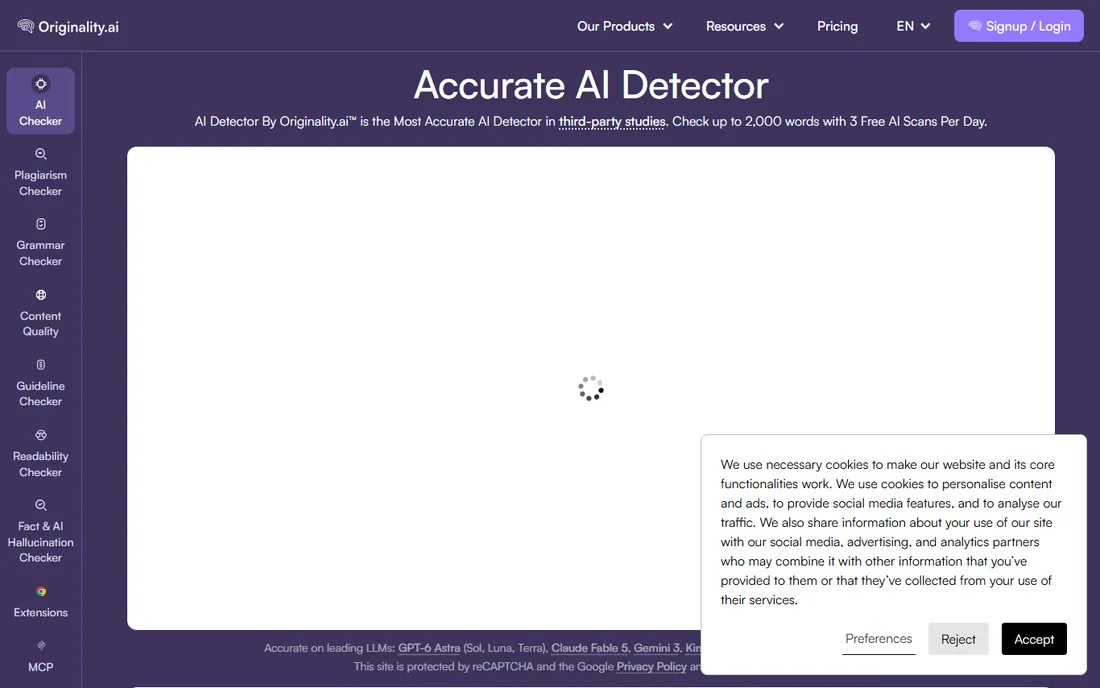
Originality.ai was built for the modern content problem: freelance articles that might be copied, spun, or AI-generated. One scan checks for all three, with sentence-level highlighting and a readability score thrown in. The reports generate shareable links, which fits agency workflows where an editor checks a writer's submission and sends the result back.
Pricing is credit-based rather than subscription-first. The Pro plan is $14.95 a month for 2,000 credits, and a $30 pay-as-you-go pack buys 3,000 credits that last two years, which suits anyone who checks content in bursts rather than daily. That flexibility is the appeal and the trap: heavy users burn credits fast and a subscription would be cheaper. There is a limited free tier for trying it. If your question is "did my freelancer write this or generate it," Originality.ai is purpose-built for exactly that.
What we like- Combines plagiarism and AI-content detection in one scan
- Credit model suits irregular use
- Shareable reports for client workflows
Watch out for- Credit system penalizes heavy daily users
- Limited free tier
- Built for content teams more than students
Starting price$5.99 (Basic, 20 plagiarism pages)
Free planNo
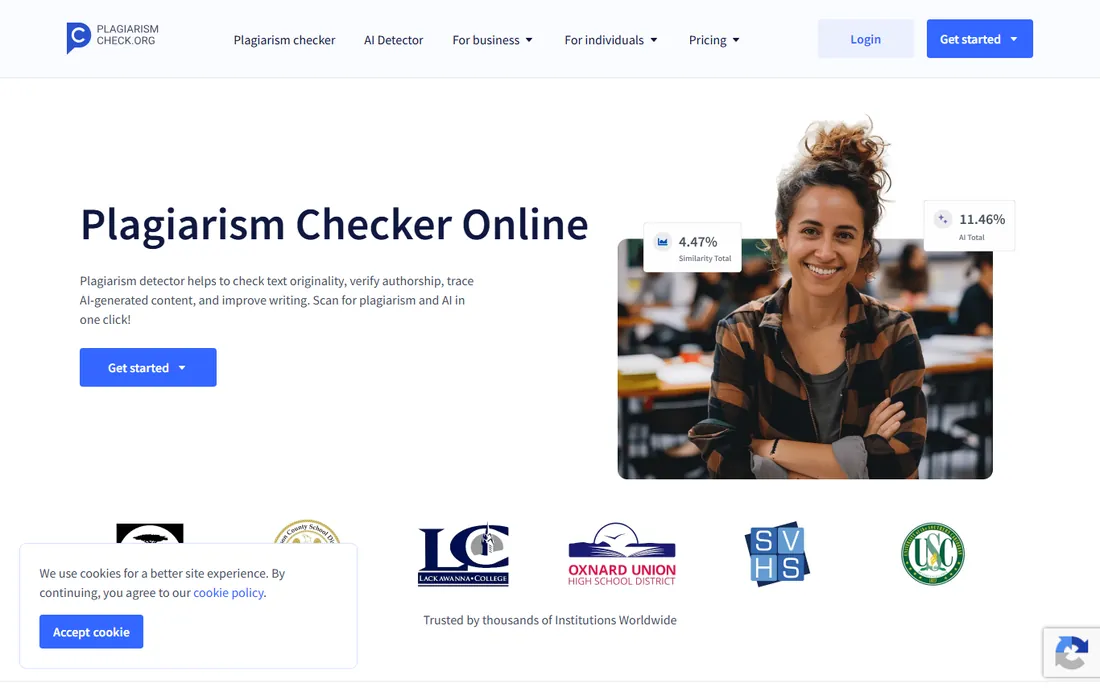
PlagiarismCheck.org takes a deliberately simple commercial approach: buy pages, check documents, no subscription. The Basic tier at $5.99 covers 20 pages, Light at $9.99 covers 50, and it scales up to team plans for institutions. For a researcher checking a manuscript before journal submission or a teacher spot-checking a suspicious essay, paying a few dollars once beats another monthly subscription.
The tool checks against web sources and academic databases, supports 15-plus languages, and plugs into Google Classroom and Moodle, which explains its following among educators outside the Turnitin ecosystem. The page-based pricing takes a minute to understand, a "page" is roughly 275 words, and there is no free tier, so your first check costs money. It is less polished than Grammarly or Quetext, but for occasional academic checking the economics are hard to beat.
What we like- Per-page pricing with no subscription required
- Academic database access
- Google Classroom and Moodle integrations
Watch out for- No free plan
- Page-based model confuses first-time buyers
- Interface less polished than consumer tools
#8
Scribbr
Best for: Students who want Turnitin-level checking without an institution
Visit scribbr.com
Starting price$19.95 per check
Free planNo
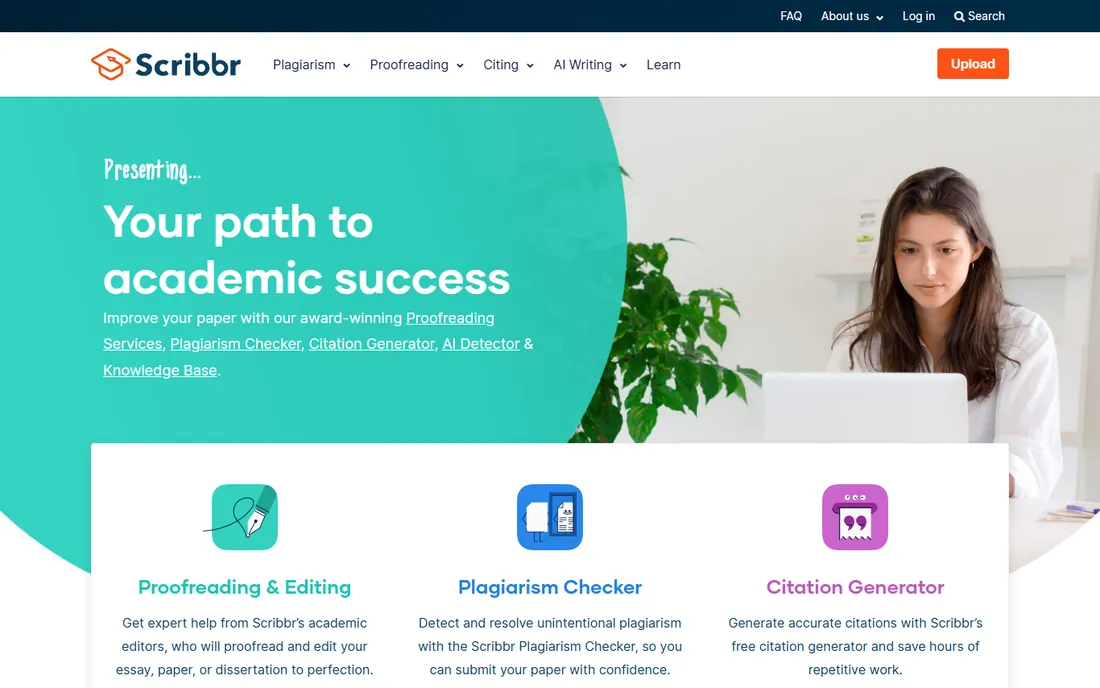
Scribbr is the workaround for the most common complaint in this category: students who want a Turnitin check but whose school does not provide one. Through a partnership, Scribbr licenses Turnitin's detection technology, so your document is checked against the same web and publication databases universities use. Each check costs $19.95 with no subscription, and your document is deleted after 7 days rather than stored.
That privacy point matters. Submitting directly to Turnitin adds your paper to its institutional repository; Scribbr's version does not, and it also cannot check against the repository of previously submitted student papers, which is the one database advantage the institutional product keeps. For a thesis or dissertation you will submit once, $19.95 is reasonable insurance. For checking every weekly assignment, the per-document cost gets painful fast, and a Quetext subscription makes more sense.
What we like- Licensed Turnitin detection technology
- Per-document pricing, no subscription
- Documents deleted after 7 days
Watch out for- Per-check cost adds up across many papers
- No subscription for heavy users
- Does not check against Turnitin's student paper repository
Starting price$19.99 per user/month (billed monthly; $15.99 per user/month billed annually)
Free planYes
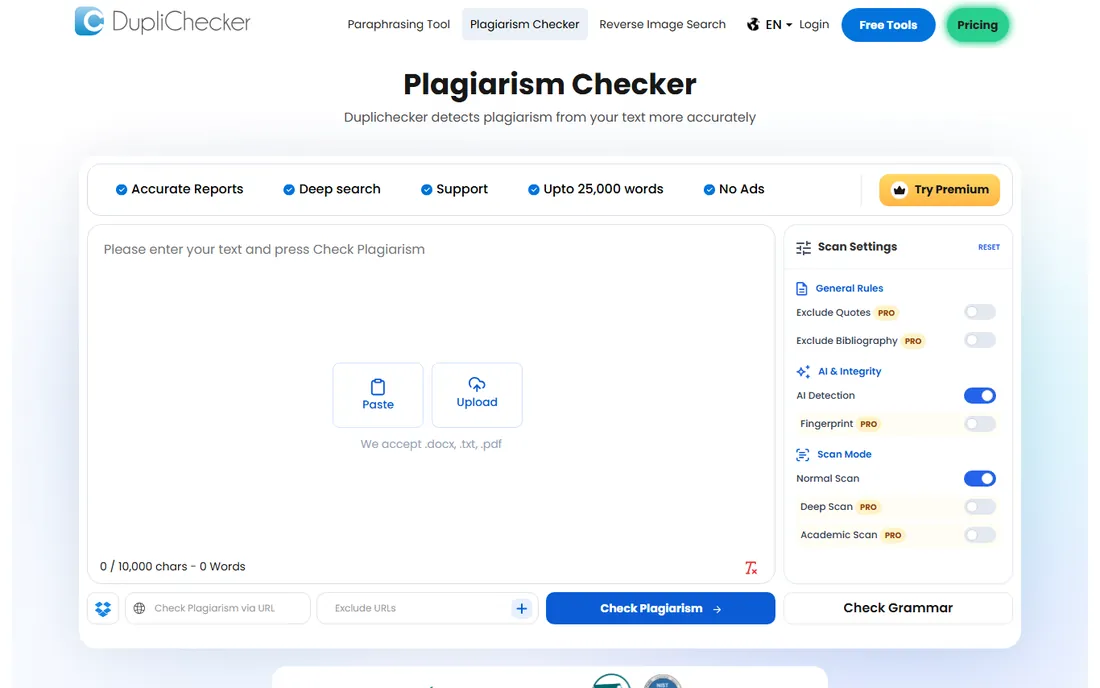
Duplichecker is the free checker most content creators actually use. Paste up to 1,000 words with no account and get a similarity report in seconds, alongside a whole toolbox of free SEO utilities: grammar checker, paraphrasing tool, keyword density, and more. For a blogger doing a quick originality sanity check before hitting publish, it is genuinely useful and genuinely free.
The business model shows. The free tier is ad-heavy, paid plans run $19.99 a month for Basic ($15.99 on annual billing) with credits that expire at each billing cycle, a policy users complain about loudly. Detection quality is fine for verbatim web copying but a step below Quetext, Originality.ai, and the academic tools on paraphrased text. Treat Duplichecker as a quick filter, not a final verdict: if it flags something, investigate; if it clears something, a second check on important documents is still wise.
What we like- Free checks up to 1,000 words with no signup
- Whole suite of free SEO tools on the same site
- Multilingual support
Watch out for- Heavy ads on the free tier
- Paid-plan credits expire monthly with no rollover
- Detection weaker than premium academic tools
Why document storage settings matter more than you think
Every checker has to do something with the file you upload, and the policies differ in ways that matter. Turnitin's institutional product stores submissions and checks future papers against them, which is powerful for catching recycled coursework and uncomfortable if it is your thesis. Scribbr deletes documents after 7 days. Copyleaks offers enterprise plans that store nothing at all. Before submitting a dissertation, a manuscript under review, or client work under NDA, read the retention policy, not just the feature list. The cheapest check can become the most expensive if your unpublished work ends up in someone else's database.
Matching the checker to the job
Students writing essays should start with Quetext or Scribbr: Quetext for ongoing coursework with its citation help, Scribbr for the one big thesis check where Turnitin-level detection justifies $19.95. Teachers and schools need institutional tools, which means Turnitin or Copyleaks depending on budget and language needs, with PlagiarismCheck.org as the per-page alternative for lighter use.
Web publishers, bloggers, and agencies live in a different world where the question is web originality, not academic integrity. Copyscape's per-search pricing is cheapest for occasional checks, Originality.ai adds AI detection that matters when you buy freelance content, and Duplichecker covers free quick checks. Grammarly Pro is the wildcard: if you want one subscription that improves writing and checks originality everywhere you type, its unlimited checks are hard to argue with.
How we chose
We mapped the real buyers in this category: institutions, students, educators, and web publishers, then picked the tools each group actually uses. Pricing comes from vendor pricing pages and provider-supplied listings, cross-checked against recent reviews. We verified Turnitin's individual-access policy (institutional only) and Scribbr's Turnitin licensing partnership from multiple sources. We excluded generic AI detectors with no plagiarism function and free-only toys with no real database. No hands-on testing is claimed; assessments rest on documented features, database coverage, and reported accuracy.
Frequently asked questions
Can I buy Turnitin as an individual student?
No. Turnitin sells only institutional licenses negotiated with schools and universities, typically a few dollars per student per year. There is no student plan or pay-per-check option. Students who want similar detection can use Scribbr, which licenses Turnitin's technology per document at $19.95, though it cannot check against Turnitin's repository of previously submitted student papers.
Are free plagiarism checkers reliable?
For catching verbatim copying from the web, yes. Duplichecker's free tier and Quetext's free 1,000 words will find pasted Wikipedia paragraphs reliably. They are weaker at paraphrased copying, translated plagiarism, and academic sources, where paid tools with larger databases and meaning-based matching do better. Use free checkers as a first filter and pay for a proper check on anything high-stakes.
Do plagiarism checkers also detect AI-generated text?
Some do. Originality.ai, Quetext, Copyleaks, and Turnitin all bundle AI-content detection with plagiarism checking. Grammarly Pro includes AI detection as well. Copyscape and PlagiarismCheck.org focus on similarity matching. Note that AI detectors have documented false-positive problems, especially on non-native English writing, so treat any AI verdict as a signal to review, not proof.
Will the checker store my document?
It depends on the tool. Turnitin's institutional product stores submissions in its database for future comparisons. Scribbr deletes your document after 7 days. Copyleaks offers no-storage options on enterprise plans. Grammarly, Quetext, and others retain documents under their privacy policies to provide the service. Always check the retention policy before uploading unpublished work like theses or manuscripts under review.
Which is better for academic papers versus web content?
Academic papers need journal and publication databases: Turnitin for institutions, Scribbr or PlagiarismCheck.org for individuals. Web content needs broad web crawling and cost-effective repeat checks: Copyscape, Originality.ai, or Duplichecker. Grammarly sits in the middle, strong for general writing but not a substitute for academic databases on scholarly work.
How much should I budget for plagiarism checking?
Occasional users can spend almost nothing: Copyscape charges cents per search and PlagiarismCheck.org starts at $5.99 for 20 pages. Regular individual users land between $9 and $20 a month on Quetext, Originality.ai, or Duplichecker. Grammarly Pro at $12 a month annually bundles unlimited checks with a writing assistant. Institutions pay custom quotes, typically thousands to tens of thousands per year.
Sources we checked (23)
- https://www.turnitin.com/
- https://eathealthy365.com/a-breakdown-of-the-turnitin-software-cost/
- https://askai.glarity.app/search/How-much-do-universities-pay-for-Turnitin-usage-per-year
- https://www.grammarly.com/
- https://dev.to/stimlau/grammarly-vs-prowritingaid-in-2026-which-editor-earns-the-subscription-3734
- https://www.demandsage.com/grammarly-vs-quillbot/
- https://www.copyscape.com/
- https://www.getapp.com.au/software/116379/copyscape
- https://kissinvestments.com/copyscape-review/
- https://www.quetext.com/
- https://www.quetext.com/plagiarism-checker/originality-ai-alternative
- https://walterwrites.ai/quetext-plagiarism-checker-review/
- https://copyleaks.com/
- https://originality.ai/
- http://originality.ai/blog/copyscape-plagiarism-checker-review
- https://plagiarismcheck.org/
- https://plagiarismcheck.org/pricing/
- https://www.toolify.ai/tool/plagiarismcheck-org/
- https://www.scribbr.com/
- https://www.checkplagiarism.ai/blog/scribbr-vs-turnitin-vs-red-paper-plagiarism-checker-comparison
- https://www.duplichecker.com/
- https://www.duplichecker.com/pricing?leadFromFreePc=1
- https://seriosity.com/duplichecker-review/
Is your product missing or out of date?
We review this list regularly. Vendors can request a listing, send updated pricing or ask about featured placement.

Shihab Mia · Founder, Rankite
Shihab has spent more than a decade helping SaaS and e-commerce brands grow through search. He writes Rankite's software buying guides from pricing pages, documentation and public user reviews. More about Shihab.