How we make this list: we compare pricing pages, product documentation and public user reviews. Rankite is independent; if a vendor ever pays for a featured spot, that listing is clearly labeled Partner.
Key takeaways
- Turnitin is the institutional standard, but individuals cannot buy it directly; iThenticate sells single-manuscript credits from $125.
- Quetext, DupliChecker, and Noplag give students and freelancers solid free tiers without an institutional contract.
- Copyscape remains the go-to for publishers and site owners checking web content, with pay-per-search pricing.
- No single checker catches everything: pair a similarity score with your own judgment, especially on paraphrased text.
Quick comparison
| Tool | Best for | Starting price | Free plan |
|---|
 Turnitin Turnitin | schools and universities | See website | No |
 iThenticate iThenticate | researchers and publishers | $125 (single manuscript) | No |
 Copyscape Copyscape | web publishers and site owners | See website | Yes |
 Quetext Quetext | students and educators | See website | Yes |
 Scribbr Scribbr | student final checks | See website | Yes |
 DupliChecker DupliChecker | budget users | $19.99/month ($15.99/month billed annually) | Yes |
 PlagiarismCheck.org PlagiarismCheck.org | teachers and small institutions | $5.99/month | Free trial |
 Copyleaks Copyleaks | enterprises and AI detection | See website | Yes |
 Compilatio Compilatio | European institutions | See website | Free trial |
 Noplag Noplag | auditable open-source checking | $9.99/month | Yes |
Is your product missing or out of date?
We review this list regularly. Vendors can request a listing, send updated pricing or ask about featured placement.
Why plagiarism checking is bigger than it used to be
Turnitin says more than 16,000 institutions worldwide use its products (turnitin.com, accessed October 2026). That number tells you how central originality checking has become to education, and it explains why the market now spans everything from free browser tools to enterprise platforms. The rise of generative AI added a second job to these tools: many now flag AI-generated text alongside copied text. Students, teachers, and publishers all shop in this market now, and the right checker depends on what you check, how often, and who reads the report.
Ten plagiarism checkers, from institutional to individual
Starting priceSee website
Free planNo
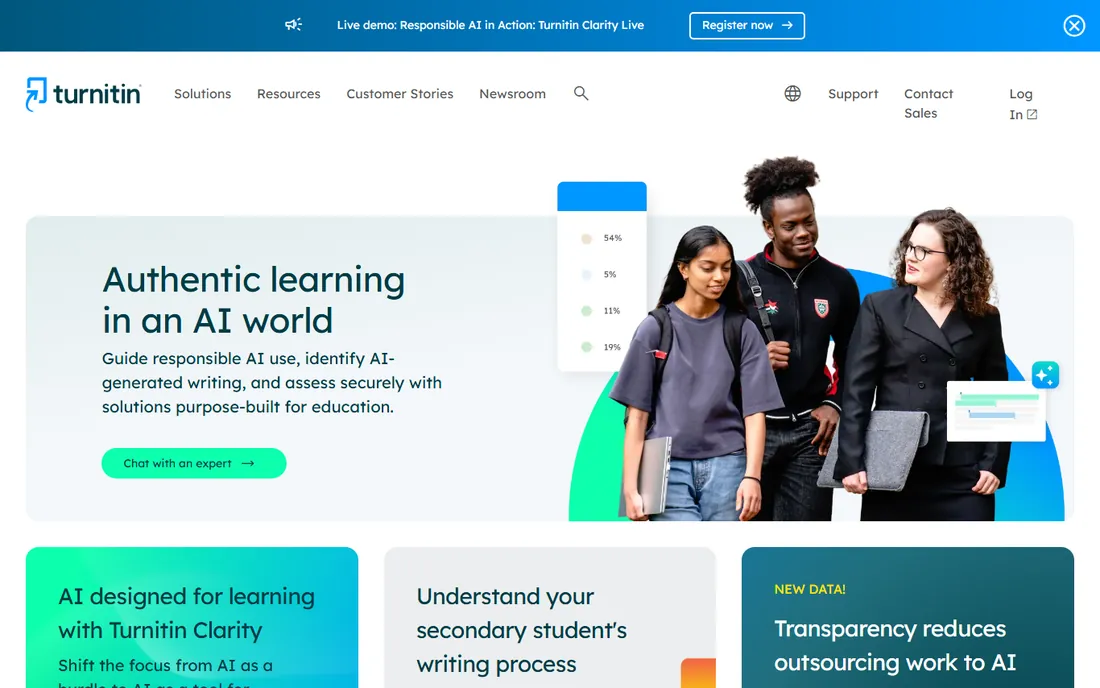
Turnitin is the reference point everything else gets compared to. Its database includes billions of web pages, published works, and, crucially, previously submitted student papers, which is how it catches copying that web-only checkers miss. For schools, the LMS integration means teachers check submissions without leaving Canvas or Moodle, and Feedback Studio adds grading tools on top of detection.
The limitation is access. Individuals cannot buy Turnitin directly; you use it through your institution or not at all. Pricing is custom and institutional, so there is no price to quote here. If your school provides it, use it. If you are buying for yourself, the tools below are your actual options.
What we like- The largest comparison database in education, including student papers
- Deep LMS integration
- AI writing detection built into the workflow
Watch out for- Sold to institutions, not individuals
- Pricing is entirely custom
Starting price$125 (single manuscript)
Free planNo
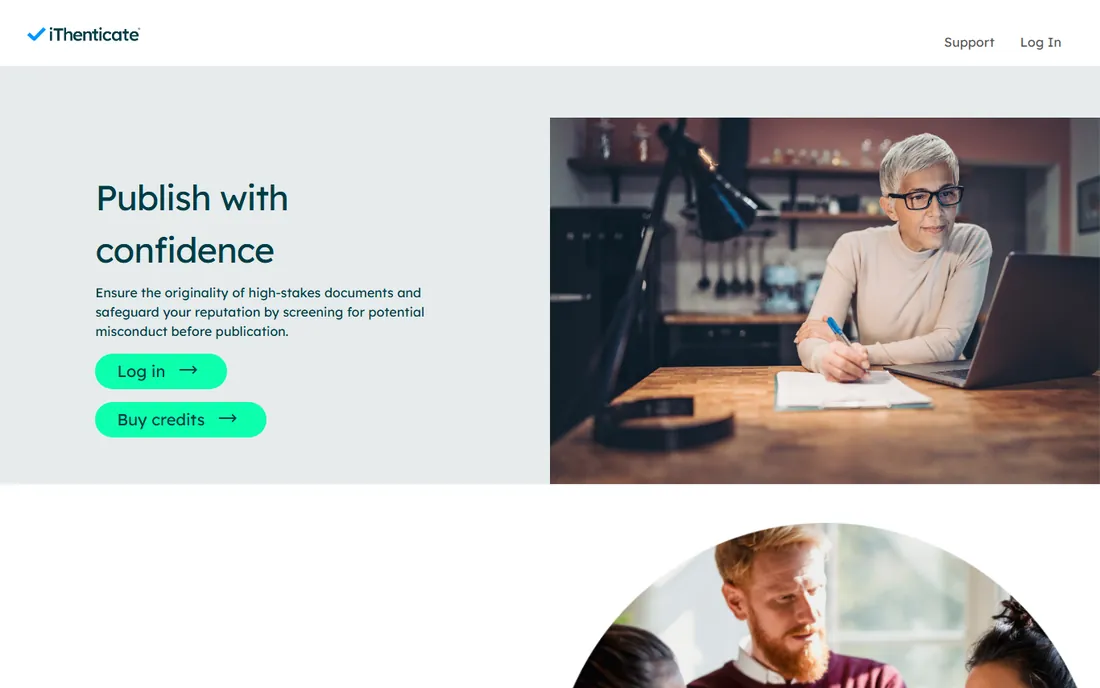
iThenticate is Turnitin's sibling for research: journals and publishers use it to screen manuscripts before publication. Unlike Turnitin, individuals can buy credits directly. A Single pack costs $125 for one manuscript up to 25,000 words, valid 12 months with five free revisions; a Multiple pack at $300 covers three manuscripts or one up to 75,000 words.
Two honest caveats. First, $125 per check is steep if you revise often, though the five included revisions soften that. Second, the individual plans explicitly exclude AI writing detection, which lives on the institutional side. For a researcher about to submit to a journal, it is still the closest thing to checking against the same database the publisher will use.
What we like- The standard for pre-publication screening
- Individual credit packs available
- Compares against premium scholarly databases
Watch out for- Expensive per document
- Individual plans exclude AI detection
Starting priceSee website
Free planYes
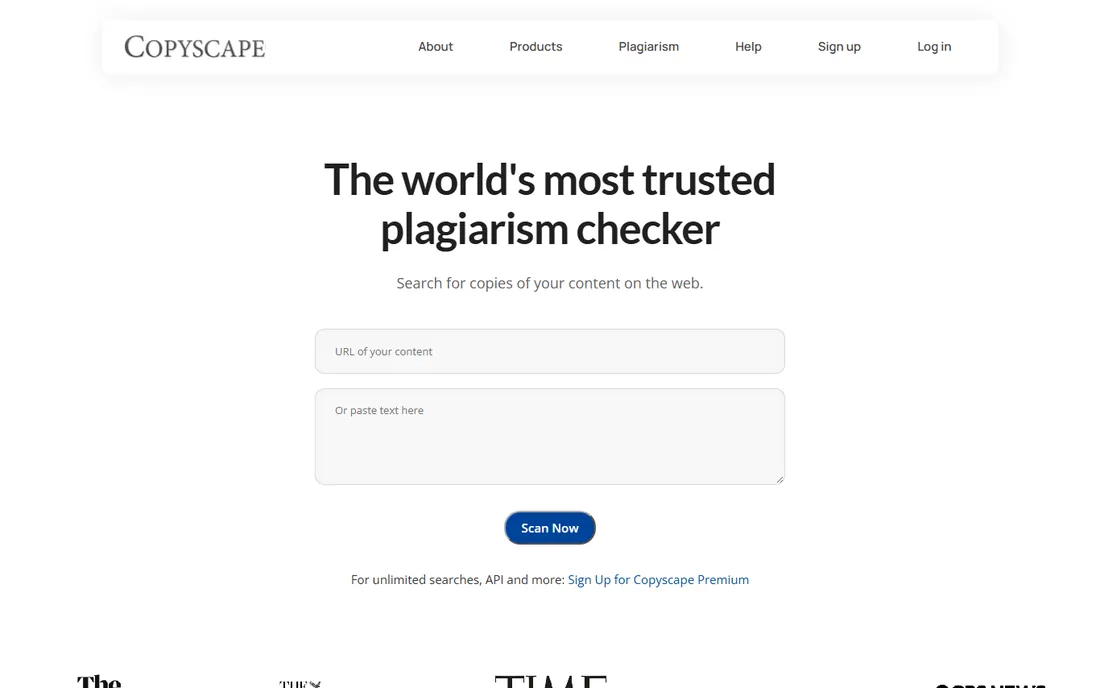
Copyscape has spent two decades becoming the default answer to "is this content original" on the web. Paste text or enter a URL and it finds matching pages, with pay-per-search pricing (historically 3 cents per search up to 200 words, plus a cent per additional 100 words) that suits occasional checks. Copysentry, its monitoring service, watches the web for copies of your pages and emails alerts.
It is less suited to academic work, where databases of papers matter more than web pages. The interface is also plain compared with newer tools. But for bloggers, SEOs, and publishers verifying originality before hitting publish, it remains the practical standard, and the free version handles quick URL checks.
What we like- The industry standard for web duplicate content
- Pay-per-search pricing with no subscription
- Copysentry monitors for content theft automatically
Watch out for- Focused on web content, not academic databases
- The interface is utilitarian
Starting priceSee website
Free planYes
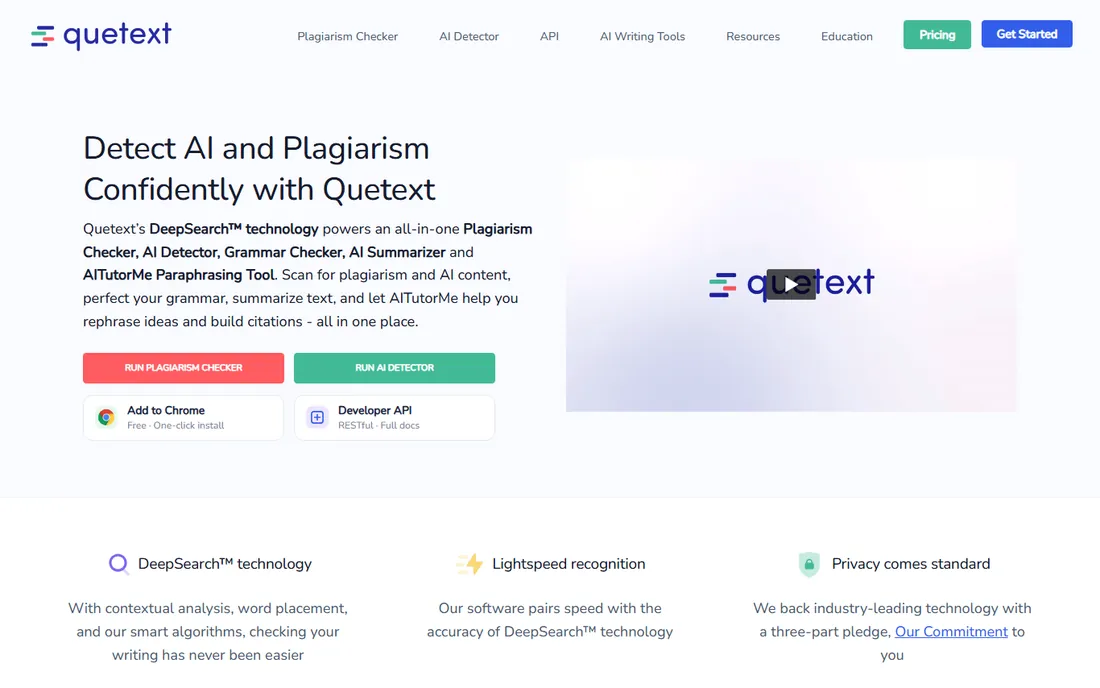
Quetext built a loyal following among students with a simple proposition: paste your text, get a clear report, fix what it flags. The free version covers occasional use, while paid plans add DeepSearch extended analysis, a citation assistant, bulk uploads, and an AI detector. The ColorGrade feedback, which color-codes exact versus fuzzy matches, makes reports easier to read than most competitors'.
The free tier is genuinely limited, a few hundred words per check and a handful of reports per month, so regular users will need to pay. There are also no native apps; it is browser-only. For students checking assignments and teachers spot-checking work, it hits the right balance of price and clarity.
What we like- Free tier for quick checks
- DeepSearch technology with contextual analysis
- Citation assistant helps fix flagged passages
Watch out for- Free plan limits are tight
- No desktop or mobile apps
Starting priceSee website
Free planYes
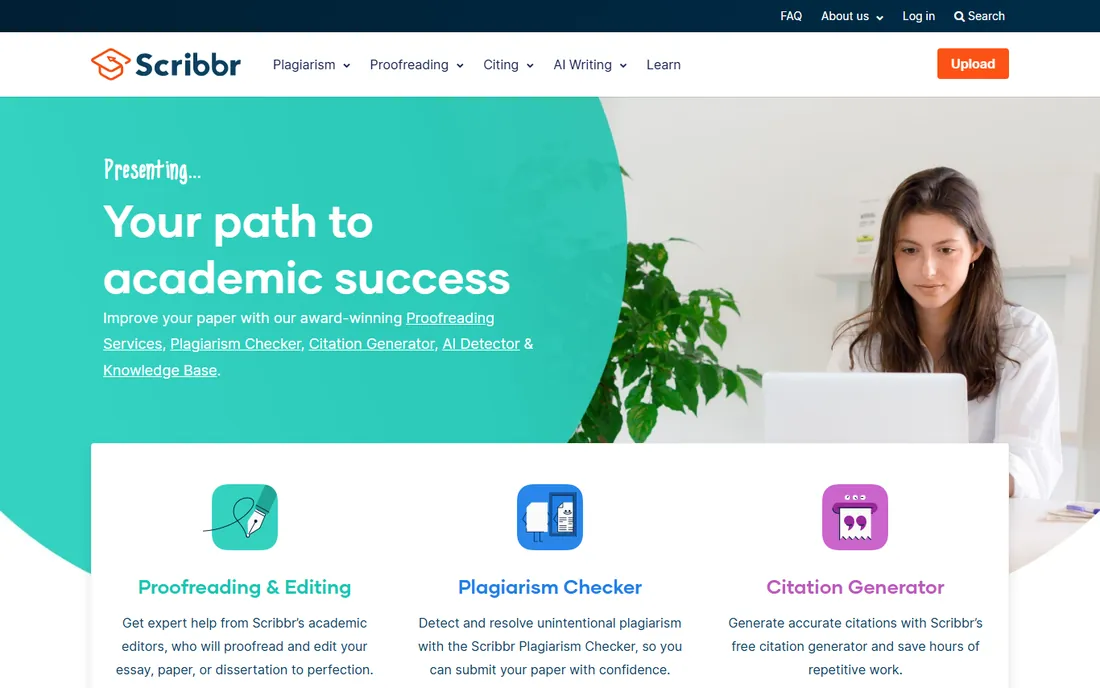
Scribbr sells certainty by the document: pay once per check (reported tiers run about $20 for small documents up to $40 for large ones), with no subscription to manage. The privacy guarantee matters to students: your paper is never added to a database other checkers can see, and documents are deleted after processing. It is purpose-built for theses, dissertations, and final submissions.
The pricing model punishes iteration. Checking four drafts of the same thesis costs four times, which gets expensive across a semester. There is also no free full check to evaluate accuracy before paying. Use Scribbr for the final verification before submission, and a free tool for draft-stage checks.
What we like- Pay-per-document with no subscription
- Strong privacy (documents never added to a database)
- Built for academic writing
Watch out for- Per-document cost adds up for multiple drafts
- No free full checks
Starting price$19.99/month ($15.99/month billed annually)
Free planYes
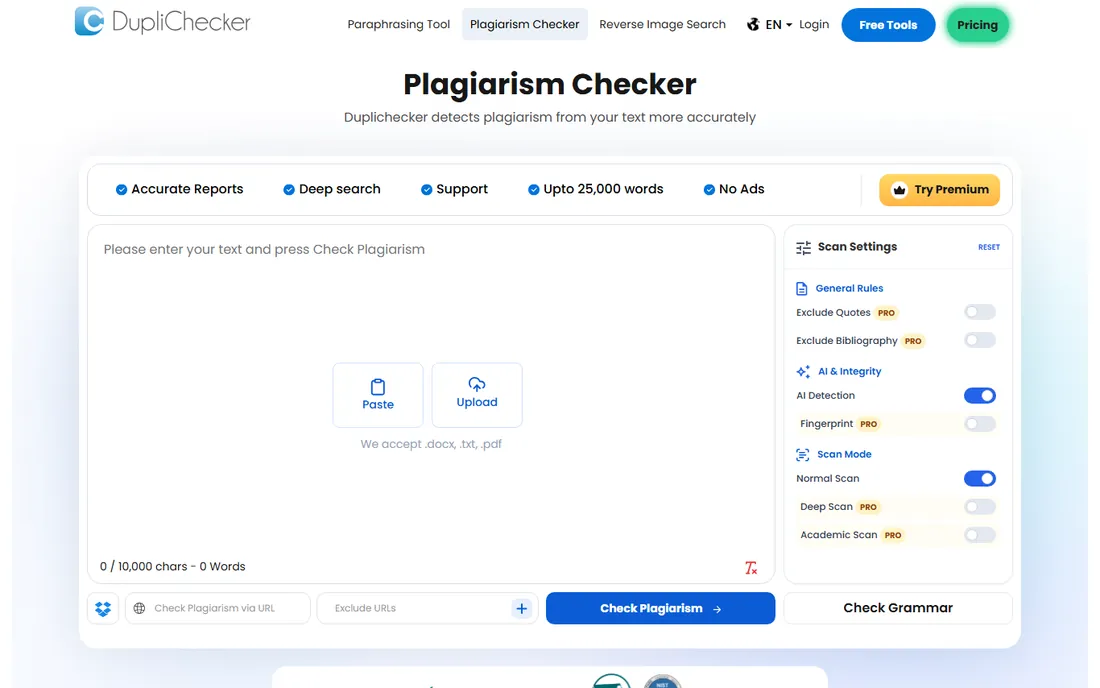
DupliChecker is the Swiss-army option for users who want one free site that does several jobs. The plagiarism checker runs without signup, with about 1,000 words per free check, and the same site offers grammar checking, paraphrasing, and AI detection. Paid plans start at $19.99 per month, or $15.99 per month billed annually, raising limits substantially.
The free experience includes ads and the accuracy is less consistent than specialist tools, particularly on heavily paraphrased text. It is a convenience tool, not a forensic one. For students and bloggers who need quick free checks and do not want five different subscriptions, it is practical. For high-stakes verification, pair it with something stronger.
What we like- Free checks with no account needed
- Bundles grammar, paraphrasing, and AI detection tools
- Paid plans start affordably
Watch out for- Free version has word limits and ads
- Accuracy reports vary by content type
Starting price$5.99/month
Free planFree trial
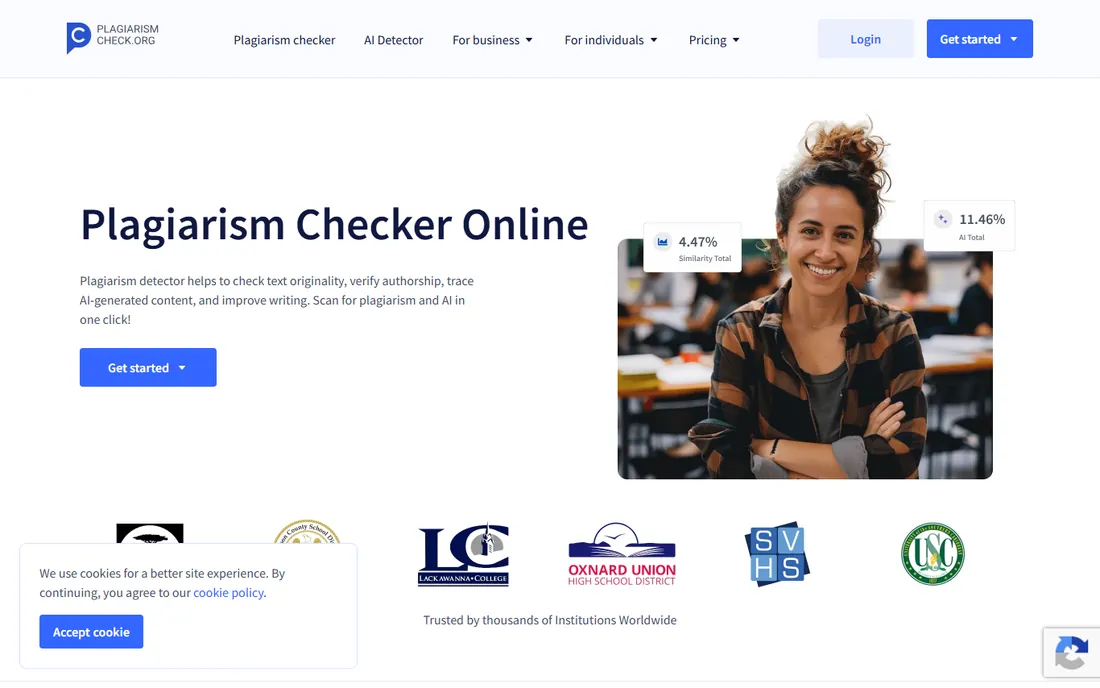
PlagiarismCheck.org targets the gap between free consumer tools and Turnitin: teachers and small institutions that need real features without enterprise contracts. Individual plans start at $5.99 per month, and the platform includes AI detection, a grammar checker, and a distinctive authorship verification feature that compares a submission against a student's earlier writing to flag possible ghostwriting. You can check two pages free before paying.
There is no ongoing free tier, so casual users should look elsewhere. The interface is workmanlike rather than beautiful. But for a teacher checking a class set of essays, or a small school that cannot afford Turnitin, the price-to-feature ratio is one of the best here.
What we like- Individual plans from $5.99
- Authorship verification catches ghostwriting
- LMS integrations for schools
Watch out for- No permanent free plan
- The interface prioritizes function over polish
Starting priceSee website
Free planYes
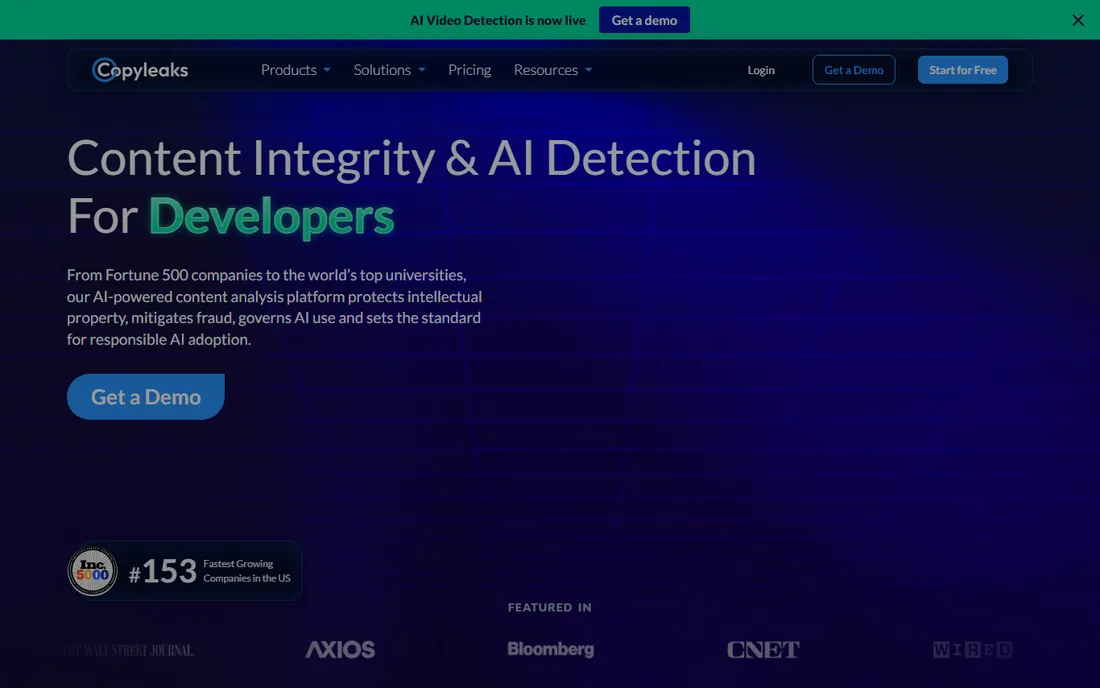
Copyleaks grew from plagiarism detection into a broader content-integrity platform, and its AI detector is now one of its main selling points. It covers 30+ languages, detects paraphrased and translated plagiarism, and offers APIs plus LMS integrations for embedding checks into existing workflows. Free AI-powered tools for individuals exist, which makes it easy to test.
The company clearly chases enterprise and education contracts, so individual pricing is not laid out simply. Small buyers may find the sales process heavier than the product warrants. If you need AI detection plus plagiarism checking at organizational scale, with API access, Copyleaks is a top contender. Solo users can try the free tools first.
What we like- Strong AI content detection alongside plagiarism
- 30+ language coverage
- API-first for enterprise integration
Watch out for- Pricing is not transparent for individuals
- Enterprise focus shows in the buying process
Starting priceSee website
Free planFree trial
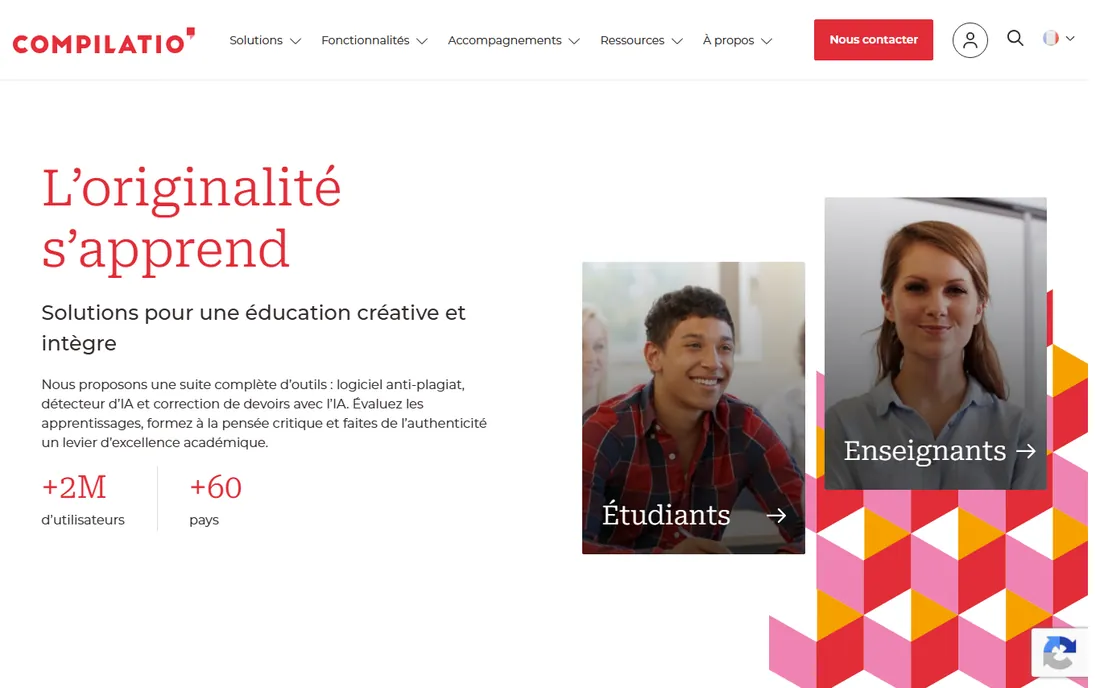
Compilatio is the European answer to Turnitin, used by 2,000+ institutions across 60 countries. It splits the product line sensibly: Magister for teachers and institutions, Studium for students, with the latter sold in credit packs (20 credits covering 5,000 words from €4.99) that suit occasional use. Detection covers 40+ languages with cross-language similarity detection.
Outside Europe it has less brand recognition, which matters if your audience expects a Turnitin report specifically. Institutional pricing is quote-based, as usual in this segment. For European universities and students wanting an alternative to the American incumbents, especially with strong French and multilingual support, it deserves a look.
What we like- Strong in European education with 40+ language support
- Separate products for students (Studium) and institutions (Magister)
- Student credit packs from a few euros
Watch out for- Institutional pricing is quote-based
- Less known outside Europe
Starting price$9.99/month
Free planYes
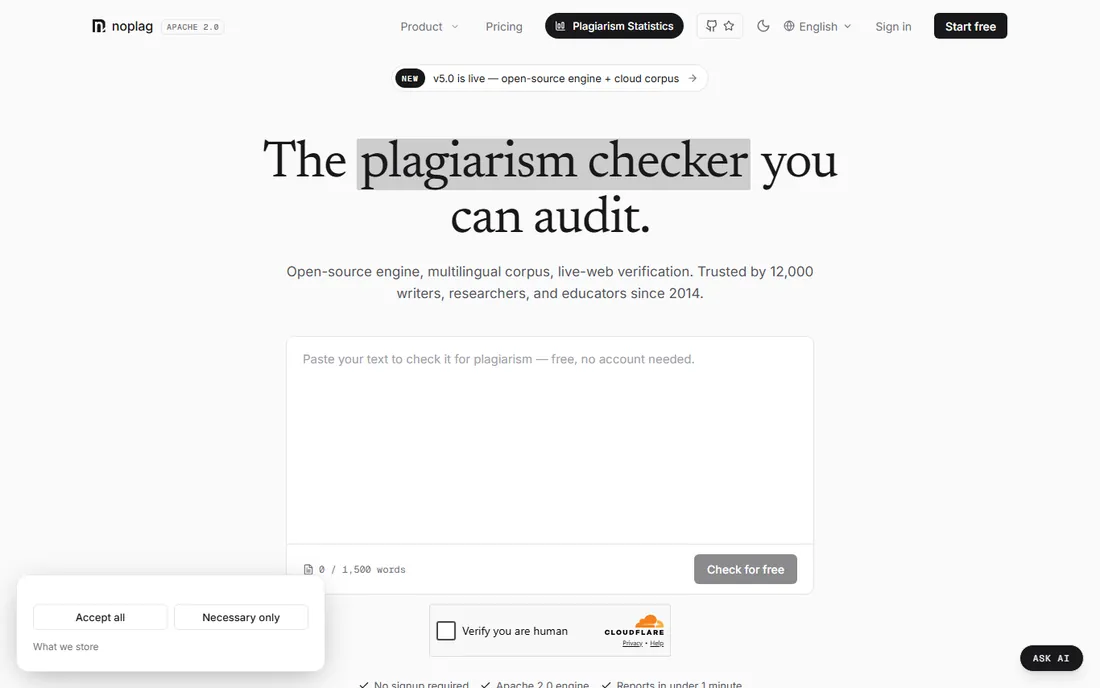
Noplag takes the unusual step of open-sourcing its detection engine under Apache 2.0, so anyone can inspect, fork, or self-host it. The hosted service offers a free tier (3 checks per month, up to 2,500 words each, no signup) and flat-rate paid plans: Pro at $9.99/month and Premium at $19.99/month. Every match links to its source, and the company publishes its evaluation methods.
The corpus is smaller than Turnitin's or Copyleaks', and standalone AI text detection is still on the roadmap rather than shipping. For privacy-conscious users and developers who want to verify how the scoring works, though, nothing else here offers this transparency. It is the most interesting new entrant on this list.
What we like- Open-source detection engine you can audit or self-host
- Free tier with no signup
- Flat-rate Pro at $9.99/month
Watch out for- Smaller corpus than the giants
- AI detection still on the roadmap
What a similarity score actually means
A 12% similarity score is not a 12% plagiarism verdict. Scores count matched text, and matched text includes quotations, references, and common phrases. What matters is which passages matched and why. Every tool above shows you the sources; read them before acting on the number.
Also know the blind spots. No checker reliably catches heavy paraphrasing or translated plagiarism, though some try. AI-generated text that is original wording will not flag as plagiarism at all, which is why AI detectors became a separate feature. Treat every report as a starting point for judgment, not a verdict.
How we chose
We confirmed each product is live today, including the two that are not: Unicheck ended its service on January 1, 2025, and PlagScan merged into Ouriginal (now part of Turnitin), so we replaced them with Copyleaks and Compilatio. Pricing figures come only from vendor sites; where vendors do not publish prices, we say so. We weighed database size, audience fit, free tier generosity, and public reviews on G2, Capterra, and educator forums. We did not run hands-on tests.
Buying advice for each audience
Students should start free: Quetext, DupliChecker, and Noplag all offer free checks, and Scribbr is worth the one-time fee for a final thesis verification. Do not pay for a subscription you will use three times a semester.
Teachers and small schools should compare PlagiarismCheck.org and Compilatio against whatever their institution already licenses. The authorship verification and LMS integrations matter more than raw database size at classroom scale.
Publishers, bloggers, and businesses should look at Copyscape for web content and Copyleaks for API-driven checks at volume. Researchers submitting to journals should use iThenticate, since it checks against the databases publishers themselves use.
Frequently asked questions
Can students buy Turnitin individually?
No. Turnitin sells to institutions; students use it through their school. Individuals who need a similar database can buy iThenticate credits directly, starting at $125 for a single manuscript, though those plans exclude AI detection.
What is the best free plagiarism checker?
Noplag offers 3 free checks per month up to 2,500 words with no signup. DupliChecker allows free checks around 1,000 words without an account. Quetext and Copyscape have free tiers with tighter limits. For serious academic work, free tools supplement but do not replace database-backed checkers.
Do plagiarism checkers detect AI-generated text?
Many now include AI detection as a separate feature, including Turnitin, Copyleaks, Quetext, and PlagiarismCheck.org. Accuracy varies, and false positives happen, particularly with non-native English writing. Treat AI scores as one signal among several, never as proof.
What happened to Unicheck and PlagScan?
Unicheck ended its service on January 1, 2025; Turnitin directs former users to Turnitin Similarity. PlagScan merged with Urkund in 2020 to form Ouriginal, which Turnitin later acquired. We replaced both with Copyleaks and Compilatio in this list.
How accurate are plagiarism checkers?
They are very good at verbatim copying and decent at light paraphrasing, but heavy paraphrasing, translated text, and idea theft remain hard to detect automatically. Always review the matched sources yourself rather than trusting the percentage alone.
Will my document be stored or shared?
It depends on the vendor. Turnitin adds institutional submissions to its database by design. Scribbr and Noplag promise not to use your text for training, with configurable retention. If privacy matters, read the data policy before uploading, especially for unpublished research.
Sources we checked (11)
- https://www.turnitin.com/
- https://ithenticate.com/
- https://www.copyscape.com/
- https://www.quetext.com/
- https://www.scribbr.com/
- https://www.duplichecker.com/
- https://www.duplichecker.com/pricing
- https://plagiarismcheck.org/
- https://copyleaks.com/
- https://www.compilatio.net/
- https://noplag.com/
Is your product missing or out of date?
We review this list regularly. Vendors can request a listing, send updated pricing or ask about featured placement.

Shihab Mia · Founder, Rankite
Shihab has spent more than a decade helping SaaS and e-commerce brands grow through search. He writes Rankite's software buying guides from pricing pages, documentation and public user reviews. More about Shihab.