How we make this list: we compare pricing pages, product documentation and public user reviews. Ratings come from G2, Capterra or Trustpilot, with the date we checked them.
Key takeaways
- Grafana k6, Apache JMeter, Gatling, and Locust cover most load testing needs for free, if your team can run its own load generators.
- BlazeMeter suits teams that want to scale JMeter, Gatling, or k6 scripts in the cloud without managing generator machines.
- Tricentis NeoLoad, LoadRunner, and WebLOAD fit enterprise estates with SAP, Citrix, or legacy protocols, but pricing is usually by quote.
- Choose by protocol, scripting language, and CI/CD fit first, because a fast tool that cannot test your protocol will not help.
Quick comparison
| Tool | Best for | Starting price | Free plan |
|---|
 Grafana k6 | Developer-led load testing in CI/CD | Free | Yes |
 Apache JMeter | Broad protocol coverage for free | Free | Yes |
 Gatling | High-throughput JVM load testing | Free | Yes |
 Locust | Python-based load testing | Free | Yes |
 BlazeMeter | Cloud scaling for open-source scripts | See website | Yes |
 Tricentis NeoLoad | Enterprise DevOps load testing | See website | Free trial |
 OpenText LoadRunner | Large enterprise protocol coverage | See website | Free trial |
 WebLOAD | JavaScript enterprise load testing | See website | Free trial |
Is your product missing or out of date?
We review this list regularly. Vendors can request a listing, send updated pricing or ask about featured placement.
Starting priceFree
Free planYes
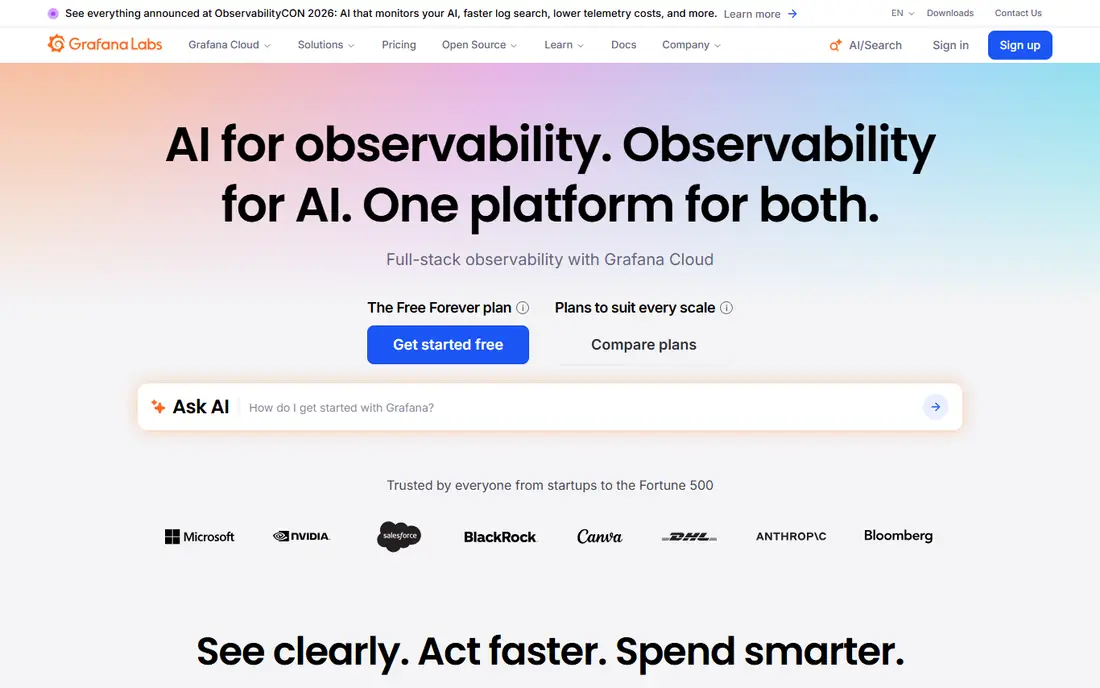
Grafana k6 leads for teams that treat load tests as code. You write a test in JavaScript or TypeScript, set thresholds for response time or error rate, and let the test fail a build when those thresholds break. That workflow fits CI/CD pipelines, because the test lives beside application code and runs on every relevant change.
The open-source engine is free to run on your own machines, and Grafana Cloud k6 adds hosted execution and dashboards for teams that do not want to manage generators. Protocol support centers on HTTP, WebSocket, and gRPC, so teams that need JDBC, JMS, or LDAP will find JMeter broader. For API-heavy services owned by developers, k6 is the most direct choice.
What we like- Tests written in JavaScript or TypeScript
- Thresholds that fail a build
- Grafana dashboards and cloud scaling
Watch out for- Protocol coverage is narrower than JMeter
- Browser testing costs more per virtual user
Starting priceFree
Free planYes
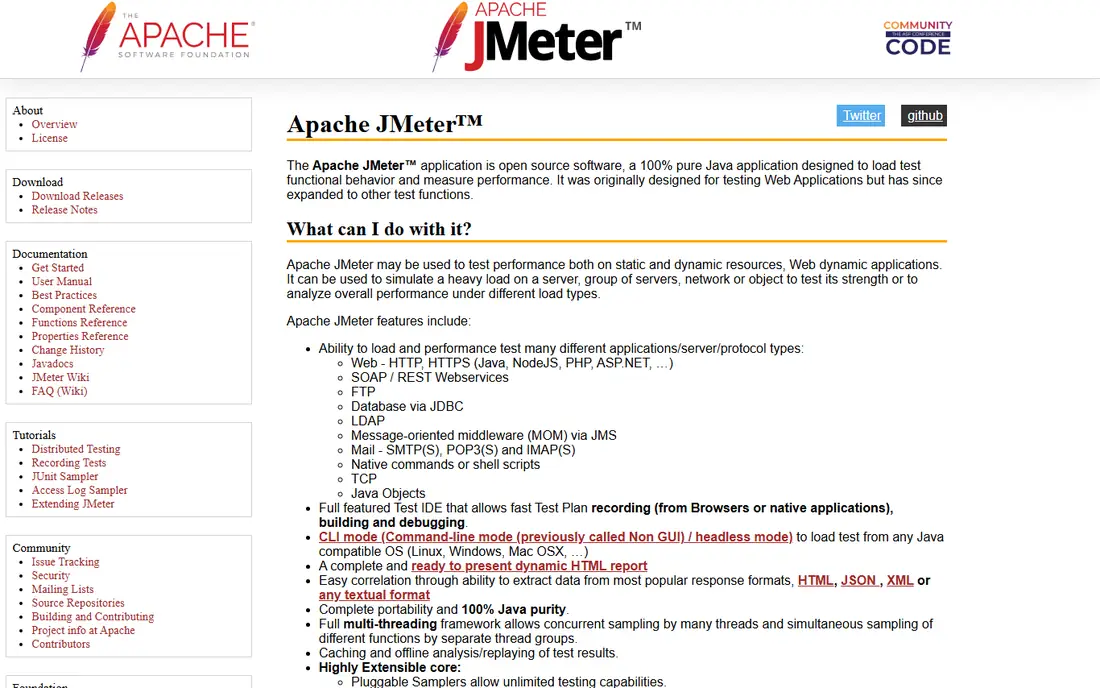
Apache JMeter remains the broadest free option, especially for teams that need more than HTTP. Samplers cover HTTP, JDBC, FTP, JMS, LDAP, and SOAP, which makes JMeter useful for backend systems, databases, and messaging queues as well as web APIs. A large plugin community extends reporting, scripting, and distributed execution.
The GUI is both a strength and a weakness. New users can build a test without code, but GUI plans stored as XML are harder to review and version than code-based tests. JMeter also uses more memory per virtual user than k6 or Gatling, so large tests need more generator machines. For protocol breadth at zero license cost, JMeter is still hard to beat.
What we like- Free and open source
- Wide protocol support, including HTTP, JDBC, FTP, and JMS
- Large plugin community
Watch out for- GUI test plans can be hard to version
- Memory use per thread is high
- No real browser execution
Starting priceFree
Free planYes
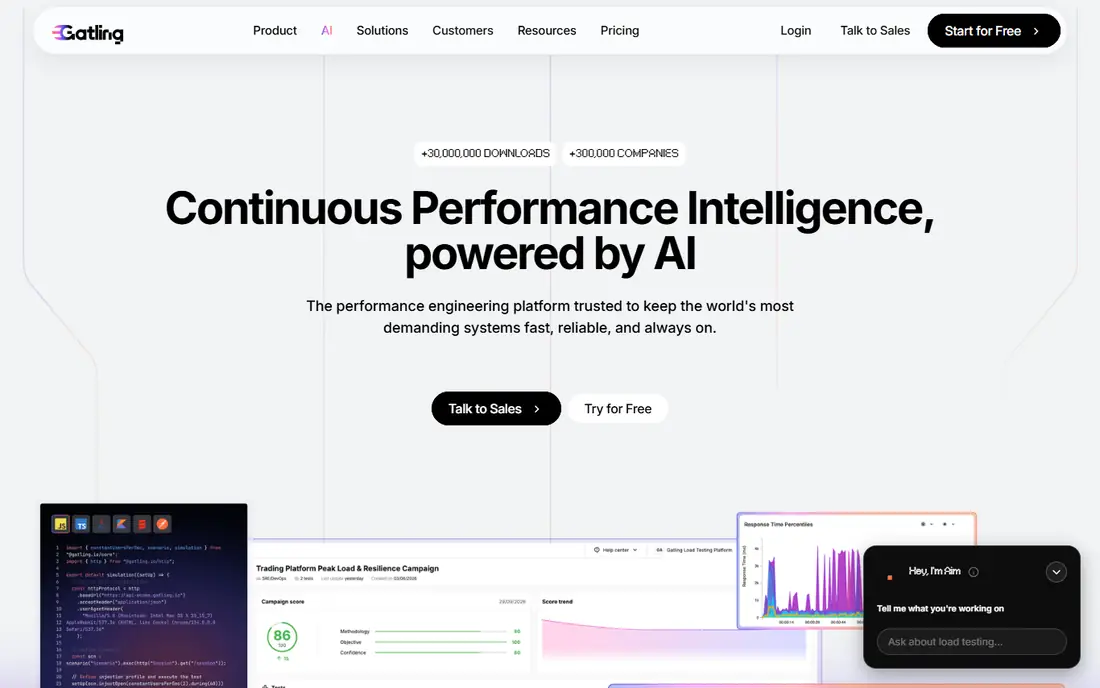
Gatling suits JVM teams that need high throughput from fewer machines. Its engine handles thousands of virtual users per agent efficiently, and tests are written as code in Java, Scala, Kotlin, or JavaScript, which makes them easy to review in pull requests. Reports are detailed, with response time distributions that help engineers find slow endpoints quickly.
The open-source engine covers the core load testing job, while Gatling Enterprise adds hosted execution, team collaboration, and integrations. Non-developers may find the code-first approach harder than a GUI recorder, so Gatling fits engineering-led teams best. If your stack is JVM based and your tests must scale efficiently, Gatling deserves a trial.
What we like- Very efficient virtual user handling
- Code-based tests in Java, Scala, Kotlin, or JavaScript
- Detailed reports
Watch out for- Enterprise features require a paid plan
- Learning curve is steeper for non-developers
Starting priceFree
Free planYes
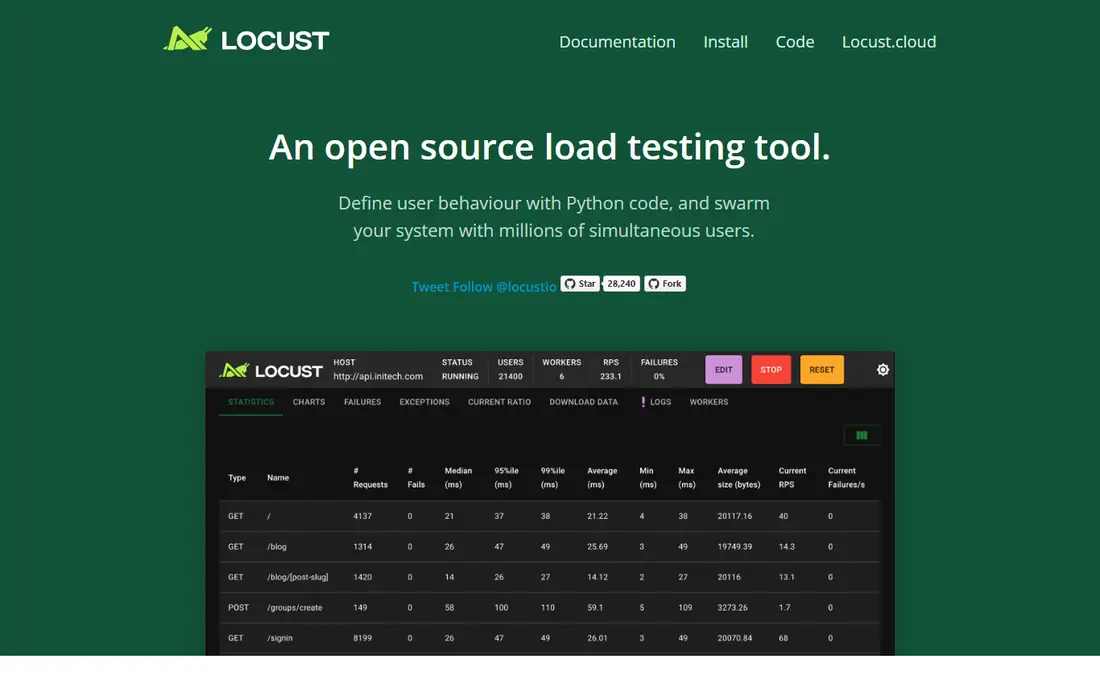
Locust is the natural pick for Python teams. Tests are plain Python classes, so a developer can model complex user behavior, such as browsing, adding to a cart, and checking out, without learning a new scripting language. A web interface shows live statistics while a test runs, which helps during an exploratory load session.
The HTTP focus is the main limit. Other protocols require extensions or custom code, so Locust is less suited to a mixed protocol estate than JMeter. Distributed execution is also self-managed, which means you provision and coordinate worker machines for large tests. For Python shops testing web APIs, Locust offers the lowest learning curve on this list.
What we like- Plain Python test code
- Easy custom user behavior
- Free and open source with a web interface
Watch out for- HTTP focus, with other protocols needing extensions
- You manage distributed execution yourself
Starting priceSee website
Free planYes
BlazeMeter bridges open-source scripts and cloud execution. If your team already writes JMeter tests, you can run them in BlazeMeter at scale without provisioning generator machines or managing a distributed cluster. Geographic distribution lets you test from several regions, which matters for global applications.
A free tier covers small tests, while larger tests move to paid plans priced by virtual users and duration. That metered model requires care, because a long test with many users can cost more than expected. BlazeMeter suits teams that like open-source script formats but want cloud scaling, reporting, and team sharing without building that infrastructure.
What we like- Runs JMeter, Gatling, and k6 scripts at cloud scale
- Geographic distribution
- API and functional testing beside load
Watch out for- Paid plans are needed for larger tests
- Cost depends on virtual users and test duration
Starting priceSee website
Free planFree trial

Tricentis NeoLoad targets enterprise teams that need both ease of use and depth. Designers can build tests without code, while engineers can use as-code options and version tests in CI/CD. Real browser emulation helps when a test must measure what a user actually experiences in a browser, not only API response times.
Pricing is by quote, which puts NeoLoad in the enterprise tier. Setup and licensing take longer than downloading JMeter or k6, and smaller teams may find the cost hard to justify. For large organizations testing SAP, Citrix, or complex enterprise applications alongside web services, NeoLoad's breadth and DevOps integration are strong reasons to request a quote.
What we like- Scriptless design plus as-code options
- Real browser emulation
- Strong DevOps integrations
Watch out for- Enterprise pricing by quote
- Heavier setup than open-source tools
Starting priceSee website
Free planFree trial
OpenText LoadRunner, formerly from Micro Focus, remains the reference for large enterprise estates. Its protocol library covers web, SAP, Citrix, mainframe, and many legacy systems that open-source tools cannot test directly. LoadRunner Cloud and on-premises options support very large tests, which matters for banks, telecoms, and government systems.
Complexity and cost are the trade-offs. VuGen scripting, protocol selection, and license management require trained performance engineers, and pricing is quote only. A small API team will find k6 or Gatling faster and cheaper. An enterprise with a mixed estate, where one tool must cover legacy protocols and modern APIs, will find LoadRunner's coverage difficult to replace.
What we like- Coverage for more than 50 protocols
- Proven at very large scale
- Strong for legacy and packaged applications
Watch out for- Quote-only enterprise pricing
- Scripting and setup are complex for small teams
Starting priceSee website
Free planFree trial
WebLOAD, from RadView, offers enterprise load testing with JavaScript scripting, which lowers the learning curve for web developers compared with C-based tools. Protocol support covers HTTP, WebSocket, JMS, MQTT, JDBC, and several enterprise clients, so it suits mixed web and backend estates. A published Starter plan has existed for smaller enterprise tests, while larger tiers are priced by quote.
The community is smaller than JMeter or k6, so answers to edge-case questions may take longer to find. WebLOAD also sits in the enterprise tier, which means procurement takes longer than downloading an open-source engine. For teams that want JavaScript scripting with enterprise protocol coverage and support, WebLOAD is a credible alternative to LoadRunner and NeoLoad.
What we like- JavaScript-based scripting
- Broad enterprise protocol support
- Published entry pricing on some plans
Watch out for- Enterprise tiers are quote based
- Smaller community than JMeter or k6
How we chose
We compared tools that perform load, stress, or performance testing today, using vendor documentation, pricing pages, and public reviews on G2, Capterra, and Reddit. We favored tools with a clear scripting model, CI/CD support, and a realistic path from a small test to a large one. Where a vendor prices by quote, we wrote "See website" rather than repeating an unverified estimate, because enterprise totals depend on virtual users, protocols, and support terms.
Start with the system you must test, not the tool with the most features. List the protocols, the peak user count, the test duration, and how often tests must run. A tool that cannot test your protocol, or that cannot run in your pipeline, will fail even if its reports look polished.
Protocols, scripting, and team skills
Protocol coverage decides the shortlist. JMeter wins for JDBC, JMS, LDAP, and FTP. k6 and Gatling win for HTTP, WebSocket, and gRPC APIs owned by developers. Locust wins for Python teams testing web flows. LoadRunner, NeoLoad, and WebLOAD win for SAP, Citrix, and legacy protocols. Scripting language matters just as much, because a test that only one engineer can edit will stop being maintained.
Cloud execution, CI/CD, and reporting
Decide who owns the load generators. Self-hosting JMeter, k6, Gatling, or Locust is free in license cost but costs engineering time. Cloud options such as BlazeMeter, Grafana Cloud k6, and Gatling Enterprise remove that burden for a fee. Check CI/CD integration, threshold support, and reporting depth, since a test that cannot fail a build or show percentile response times will not catch regressions early.
Cost per test hour, not just license cost
A free engine can still cost money in cloud machines, engineering time, and maintenance. A metered cloud plan can cost more than expected for long, large tests. Model a typical test, with peak users, duration, and frequency, and compare the monthly total across two or three tools before you commit. That model reveals whether a free engine, a cloud plan, or an enterprise license is actually cheapest for your workload.
Frequently asked questions
What is the best performance testing tool for beginners?
Grafana k6 is a strong starting point for developers, because tests are JavaScript and thresholds are easy to set. Apache JMeter suits beginners who prefer a GUI and need broad protocol coverage. Both are free, so you can try each with a small API test before deciding.
Is JMeter still a good choice in 2026?
Yes, for protocol-level API and backend tests when you have Java or Groovy skills and no license budget. JMeter lacks real browser execution and uses more memory per virtual user than k6 or Gatling, but its protocol breadth and plugin community remain unmatched among free tools.
What is the difference between load testing and performance testing?
Performance testing is the broader category, covering load, stress, endurance, and scalability checks. Load testing is one type, where you apply an expected user load and measure response time, throughput, and error rate. Most tools on this list support several of these test types.
Do I need a paid tool for large load tests?
Not always. Open-source engines can run large tests if you provision enough generator machines and manage distributed execution. Paid cloud and enterprise tools help when you need geographic distribution, managed generators, team reporting, or enterprise protocols without building that infrastructure yourself.
Which tool is best for API load testing in CI/CD?
Grafana k6 and Gatling lead for API load testing in CI/CD, because tests are code, thresholds can fail a build, and integrations with pipelines are native. Locust also works well for Python teams, while JMeter fits teams that need broader protocol coverage in the same pipeline.
How many virtual users do I need for a realistic test?
Base the number on real peak traffic, not a round number. Check analytics for peak concurrent users, add headroom for growth, and test at and above that peak. A test with too few users will miss bottlenecks, while a test with far too many users can measure generator limits instead of application limits.
Sources we checked (8)
- https://grafana.com
- https://jmeter.apache.org
- https://gatling.io
- https://locust.io
- https://www.blazemeter.com
- https://www.tricentis.com
- https://www.opentext.com
- https://www.radview.com
Is your product missing or out of date?
We review this list regularly. Vendors can request a listing, send updated pricing or ask about featured placement.

Shihab Mia · Founder, Rankite
Shihab has 5+ years in B2B and SaaS SEO. He writes Rankite's software buying guides from pricing pages, documentation and public user reviews. More about Shihab.