How we make this list: we compare pricing pages, product documentation and public user reviews. Rankite is independent; if a vendor ever pays for a featured spot, that listing is clearly labeled Partner.
Key takeaways
- Testim, mabl and Katalon are the established low-code AI testing platforms; all three use self-healing locators to cut test maintenance.
- Functionize is the only one here with published pricing on its homepage (Free, $20/month Growth, $100/month Scale), which makes budgeting dramatically easier.
- Applitools owns visual testing: if your bugs are layout and rendering issues, its Visual AI is the specialist pick.
- LambdaTest rebranded to TestMu AI in January 2026; existing accounts and integrations carry over unchanged.
Quick comparison
| Tool | Best for | Starting price | Free plan |
|---|
 Testim (Tricentis) Testim (Tricentis) | Teams testing web, mobile and Salesforce apps with AI-stabilized tests | See website | Free trial |
 mabl mabl | Teams wanting agentic testing with pass/fail confidence on every release | See website | Free trial |
 Functionize Functionize | Teams that want agentic QA with pricing they can read before a sales call | Free ($0); Growth $20/month; Scale $100/month; Enterprise custom | Yes |
 Applitools Applitools | Catching visual and layout bugs that functional tests miss | See website | Free trial |
 Katalon Katalon | Teams wanting authoring, management and execution in one platform | See website | Free starter tier |
 Testsigma Testsigma | Plain-English test automation with a release-confidence score | See website | Free trial |
 TestMu AI (formerly LambdaTest) TestMu AI (formerly LambdaTest) | Cloud-based cross-browser and real-device testing with AI agents | See website | Free trial |
 BrowserStack BrowserStack | Reliable cross-browser and real-device testing without infrastructure | See website | Free trial |
Is your product missing or out of date?
We review this list regularly. Vendors can request a listing, send updated pricing or ask about featured placement.
Your developers ship faster every quarter, and your QA process has not kept up. Tests break on every UI change, the regression suite takes days, and hiring more manual testers just moves the bottleneck. AI automation testing tools promise to break this cycle: tests that write themselves from plain English, heal when the UI changes, and tell you whether a release is actually safe. These eight platforms are the serious contenders, with the marketing claims checked against what each product really does.
#1
Testim (Tricentis)
Best for: Teams testing web, mobile and Salesforce apps with AI-stabilized tests
Visit testim.io
Starting priceSee website
Free planFree trial
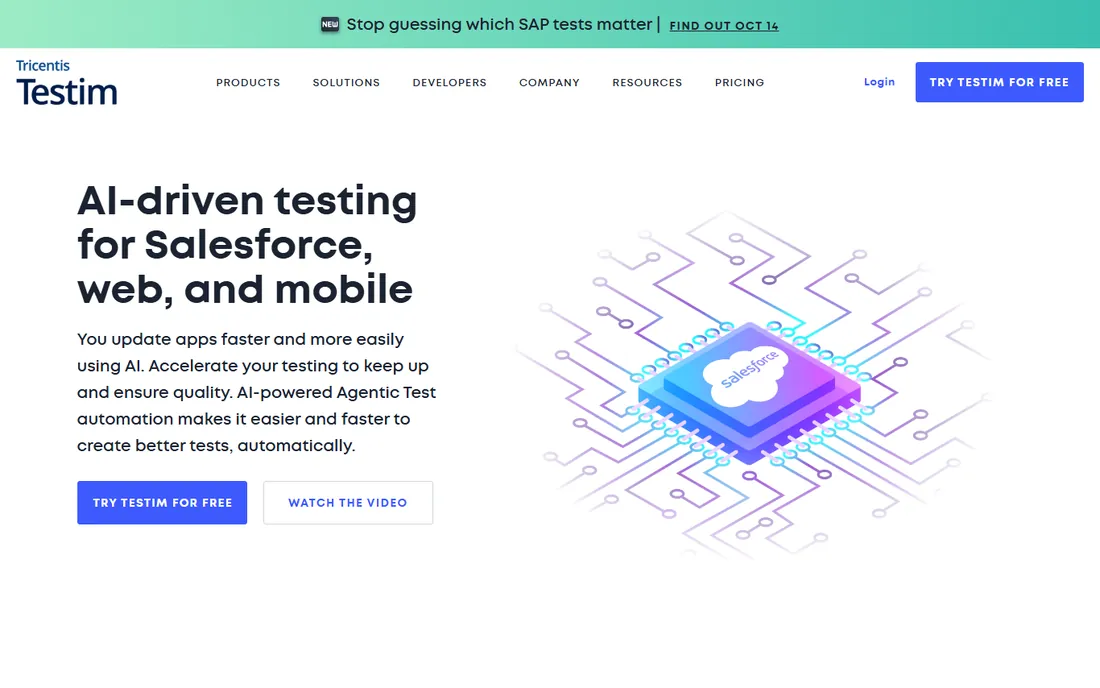
Testim, now part of Tricentis, built its reputation on one painful problem: brittle tests. Its smart locators understand page elements contextually, so when a developer renames a button or restructures a page, the test adapts instead of failing. Testers author by clicking through the application, and the platform records stable, maintainable tests, with the option to drop into code for complex logic.
The Salesforce angle is worth noting for the right buyer. Testim's agentic test automation can build Salesforce test suites from natural language, a niche where generic tools struggle with dynamic, metadata-driven UIs. For standard web testing it competes directly with mabl and Katalon on stability and authoring speed. Pricing is quote-based, so budget-conscious teams should get numbers early.
What we like- Smart locators self-heal when the UI changes, cutting maintenance sharply
- Records tests as you click, with code-level control when needed
- Salesforce testing is a genuine specialty, not an afterthought
Watch out for- Enterprise pricing with no published numbers
- The Salesforce focus matters less if you test standard web apps
- Advanced customization still needs technical testers
#2
mabl
Best for: Teams wanting agentic testing with pass/fail confidence on every release
Visit mabl.com
Starting priceSee website
Free planFree trial
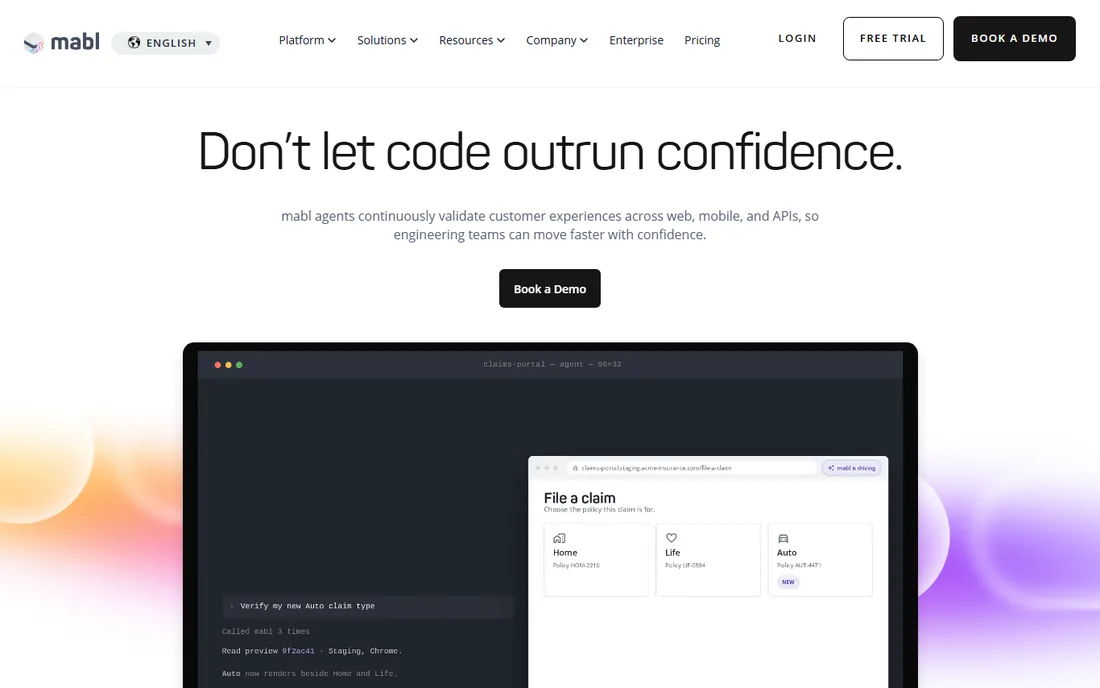
mabl's pitch is confidence in the verdict: everything needed to declare pass or fail on a release, across every surface of the application. The platform's agents learn from your application over time, and it was named a Challenger in Gartner's 2026 Magic Quadrant for Agentic Software Quality Assurance Platforms. Integration coverage is wide, from GitHub Actions and Jenkins to Jira, Slack and AI coding assistants.
What to verify in a trial is how much of the "agentic" behavior translates to your stack. The core value, auto-generated tests with self-healing and plain-language failure explanations, is real and well reviewed. But mabl sells through demos with unpublished pricing, which favors larger teams with procurement processes. Small teams should weigh the evaluation effort against simpler options.
What we like- Agentic intelligence that strengthens with every release
- Verifies across web, mobile, API and accessibility surfaces
- Broad integration list covering CI/CD, issue tracking and AI coding tools
Watch out for- No published pricing
- Positioned and priced for teams, not solo testers
- The "agents" framing takes evaluation to separate substance from marketing
#3
Functionize
Best for: Teams that want agentic QA with pricing they can read before a sales call
Visit functionize.com
Starting priceFree ($0); Growth $20/month; Scale $100/month; Enterprise custom
Free planYes
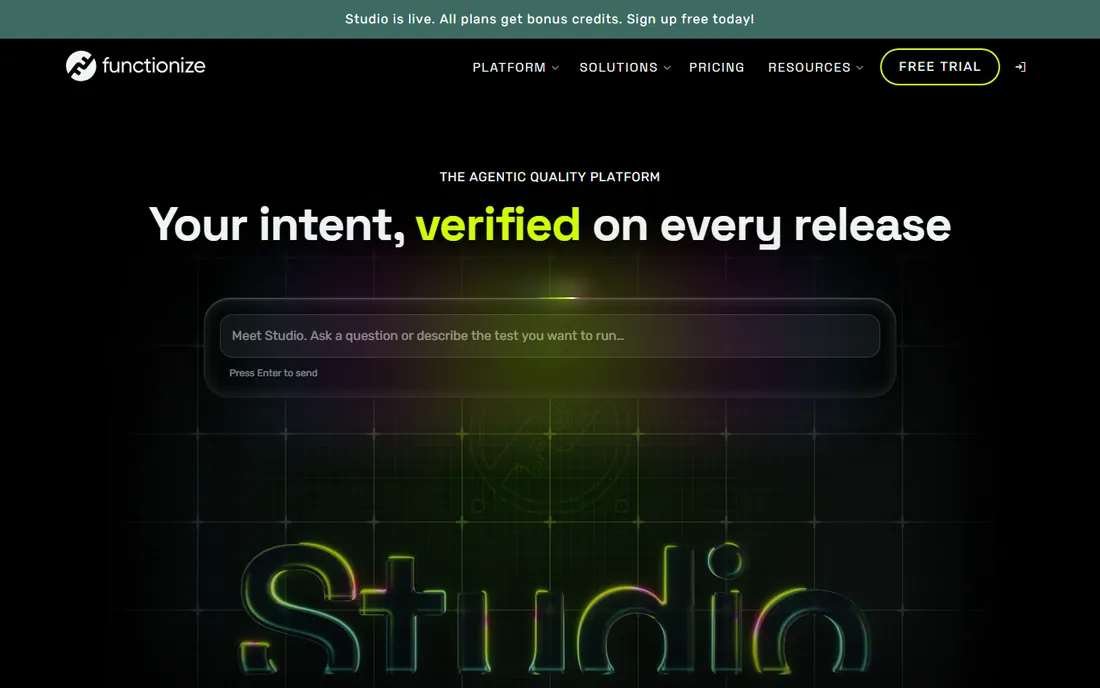
Functionize deserves attention for one reason before any feature comparison: it publishes prices. The homepage lists Free ($0, always free, for seeing what the product does on your app), Growth at $20/month, Scale at $100/month, and custom Enterprise. In a category where every competitor hides pricing behind a demo form, that transparency lets a team budget in minutes instead of weeks.
The product itself is an agentic testing platform: AI agents create tests from natural language, execute them, and maintain them as the app changes, with the vendor emphasizing models built specifically for testing. Enterprise features cover Salesforce, ServiceNow, Workday and SAP testing. For teams tired of quote-based buying, Functionize is the easiest evaluation on this list to start.
What we like- Published pricing on the homepage, rare in this category
- Free tier lets you evaluate on your real app
- Purpose-built models for testing rather than wrapped general models
Watch out for- Growth tier at $20/month is entry-level
- Serious parallel execution needs Scale or Enterprise
- Smaller brand than Tricentis or mabl, so peer references are thinner
#4
Applitools
Best for: Catching visual and layout bugs that functional tests miss
Visit applitools.com
Starting priceSee website
Free planFree trial
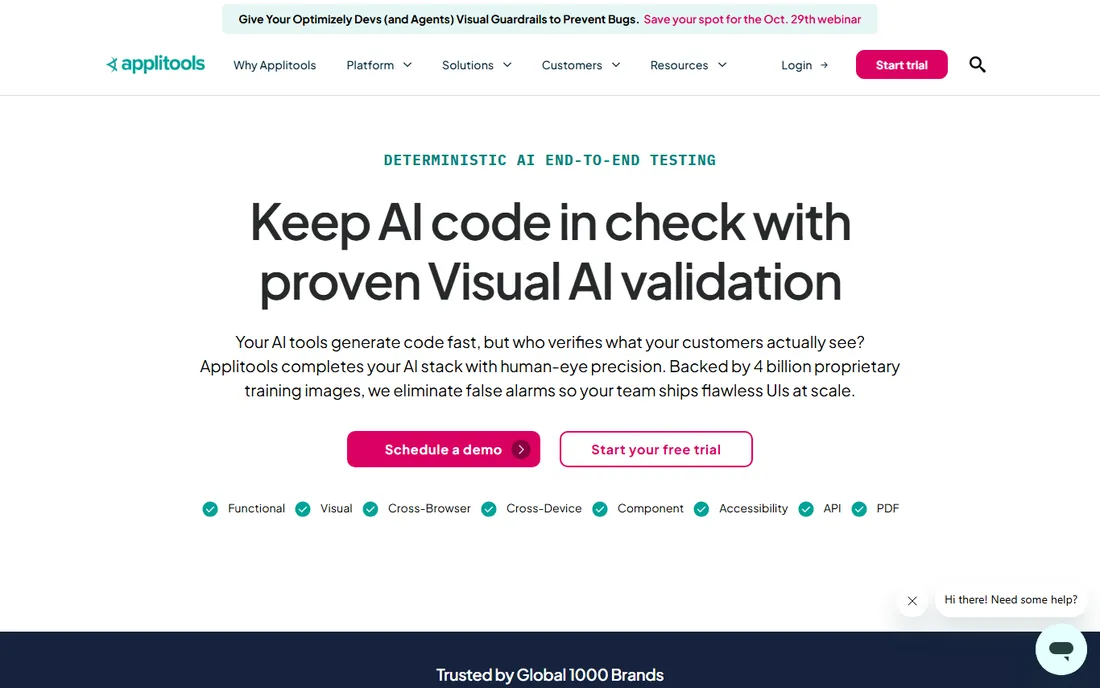
Applitools solves the problem every QA team knows: the test passed, but the page looks broken. Its Visual AI compares screenshots the way a human eye would, ignoring irrelevant rendering differences while catching real layout bugs, broken responsive behavior and accessibility issues. With deterministic models rather than probabilistic LLM agents, results are reproducible run after run.
The homepage confirms a free trial account is available for evaluation. Position Applitools correctly: it complements a functional testing tool rather than replacing one. Teams shipping design-heavy applications, marketing sites or customer-facing apps with strict brand standards get the most value. Pair it with Testim, mabl or Katalon for functional coverage and you cover both what the app does and what it looks like.
What we like- Visual AI trained on billions of images catches layout regressions with few false positives
- Deterministic approach avoids LLM flakiness
- Flexible deployment: SaaS, private cloud or on-premises
Watch out for- It is a visual testing specialist, not a full test-authoring platform
- Pricing is quote-based
- Teams need functional testing alongside it
#5
Katalon
Best for: Teams wanting authoring, management and execution in one platform
Visit katalon.com
Starting priceSee website
Free planFree starter tier
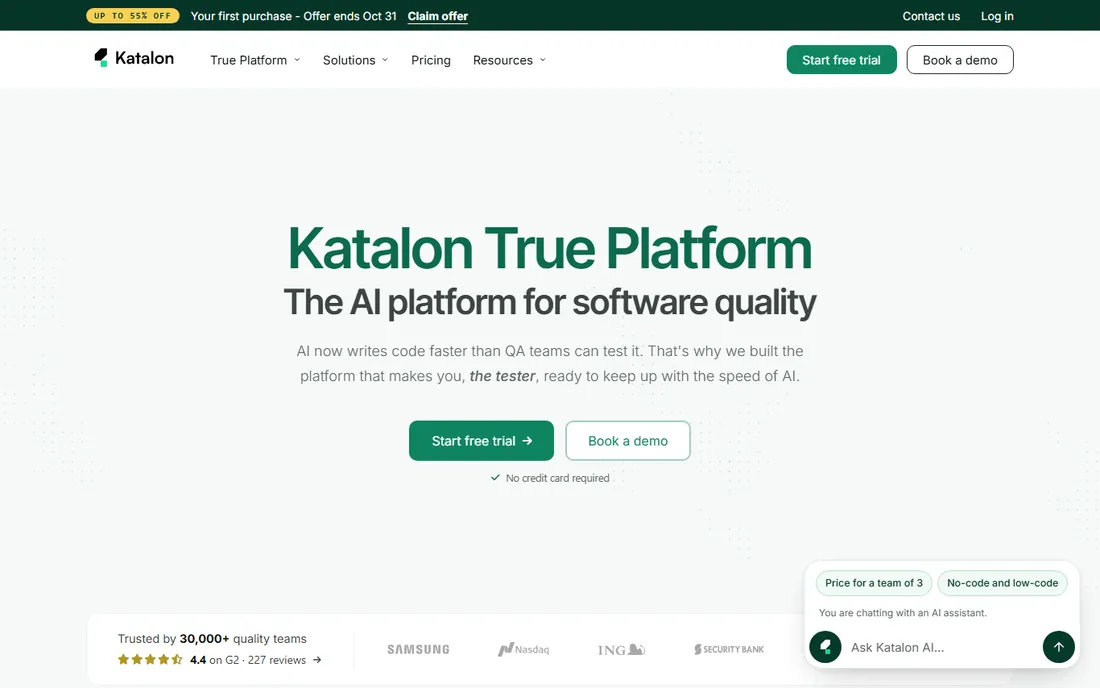
Katalon takes the platform approach: instead of one testing tool, you get an integrated set covering the whole QA lifecycle. Studio authors tests across web, mobile, API and desktop with no-code, low-code, full-code and AI-assisted options. TestOps manages cases and evidence. TestCloud runs tests in parallel on real browsers and devices. TrueTest watches production usage and generates tests for coverage gaps.
The practical advantages are migration and cost of entry. Because Studio builds on Selenium and Appium, existing scripts keep working, and TestOps ingests Playwright results too. The homepage states you can start free with no credit card. Pricing depends on products and execution volume, so model your expected runs before committing. For teams consolidating scattered tools, Katalon's breadth is the argument.
What we like- True platform play: Studio (authoring), TestOps (management), TestCloud (execution), TrueTest (production insights)
- Free to start with no credit card
- Built on Selenium/Appium so existing scripts carry over
Watch out for- Pricing varies by product and execution volume, so total cost takes work to model
- Breadth means more to learn than single-purpose tools
- TestCloud execution allotments need watching at scale
#6
Testsigma
Best for: Plain-English test automation with a release-confidence score
Visit testsigma.com
Starting priceSee website
Free planFree trial
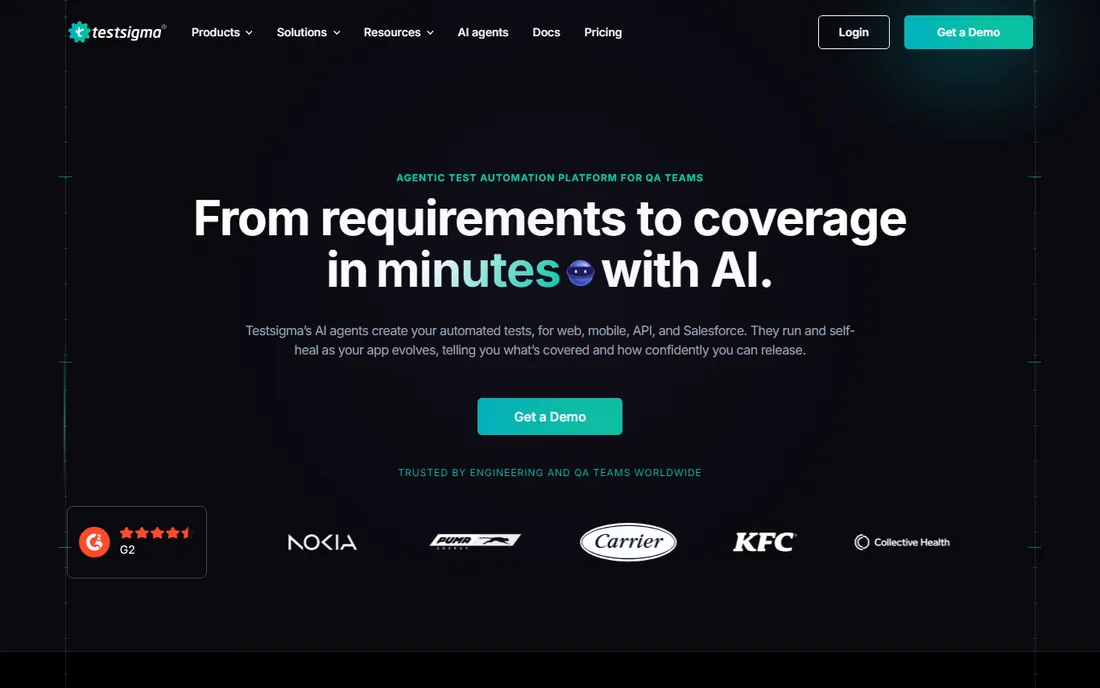
Testsigma's distinctive idea is the release gate: instead of just running tests, it scores how confident you can be in shipping, combining pass rates, coverage and critical-path analysis into one number. Its AI agents generate tests from Jira tickets, Figma designs or plain-English prompts, run them across 3,000+ real browsers and devices, and self-heal when the UI changes.
The homepage confirms a free trial to start, with paid plans scaling by parallel runs and seats, and directs buyers to testsigma.com/pricing for current plans. For QA teams without deep scripting skills, the plain-English authoring is the draw: manual testers can automate without learning a framework. Technical teams should evaluate whether the agent layer adds value beyond the solid test-execution core.
What we like- Tests authored in plain English, usable by manual testers
- Release confidence scoring tells you whether it is safe to ship
- AI agents handle planning, generation, execution and healing
Watch out for- Pricing details live on the pricing page rather than published tiers
- The agentic "Atto" layer is new and evolving
- Salesforce and SAP depth trails specialists for those stacks
#7
TestMu AI (formerly LambdaTest)
Best for: Cloud-based cross-browser and real-device testing with AI agents
Visit testmuai.com
Starting priceSee website
Free planFree trial
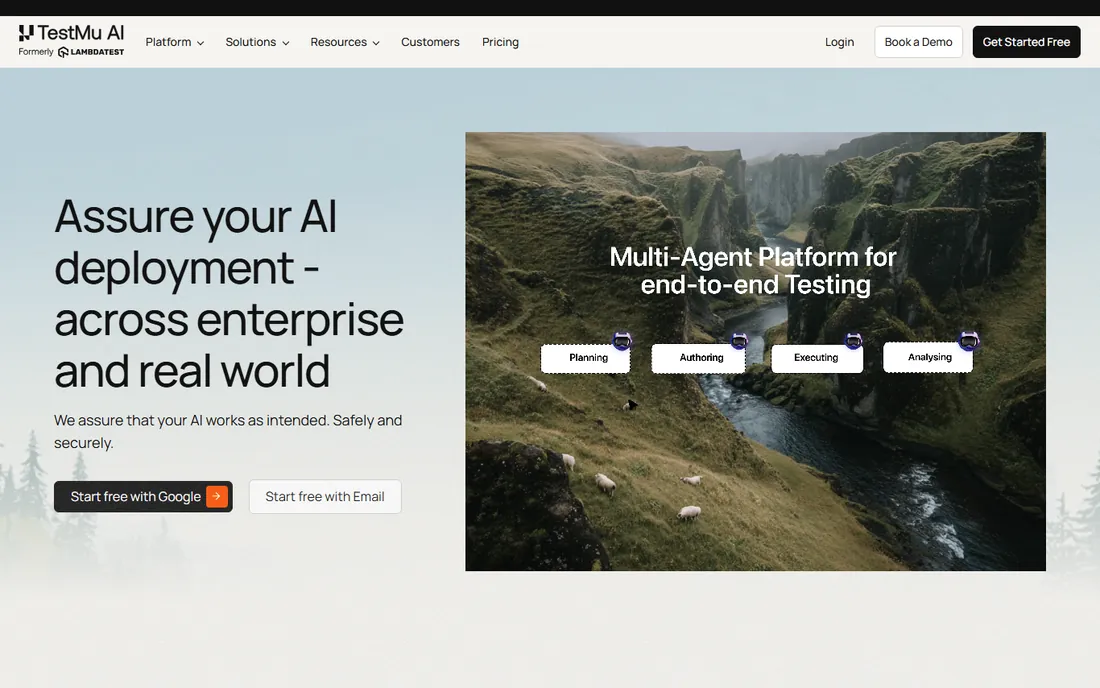
An important naming note: LambdaTest rebranded to TestMu AI on January 12, 2026. The company, platform, team and infrastructure are unchanged; only the name and visual identity changed, and existing credentials, API keys and integrations work without modification. The new home is testmuai.com.
Under either name, this is the execution-scale pick: a cloud for running tests across thousands of real browsers and devices in parallel, now extended with AI agents (KaneAI) for test creation, visual testing and autonomous orchestration. Teams with large Selenium, Cypress or Playwright suites that need parallel execution at scale should evaluate it against BrowserStack. Teams wanting test authoring rather than execution should look at the platforms above first.
What we like- Massive execution cloud: 10,000+ real devices and 3,000+ browser combinations
- KaneAI agent creates tests from natural language
- Existing LambdaTest accounts, APIs and integrations carry over unchanged
Watch out for- The January 2026 rebrand means documentation and URLs are in transition
- Pricing is quote-based for serious volume
- Breadth can overwhelm teams that need a simple tool
#8
BrowserStack
Best for: Reliable cross-browser and real-device testing without infrastructure
Visit browserstack.com
Starting priceSee website
Free planFree trial
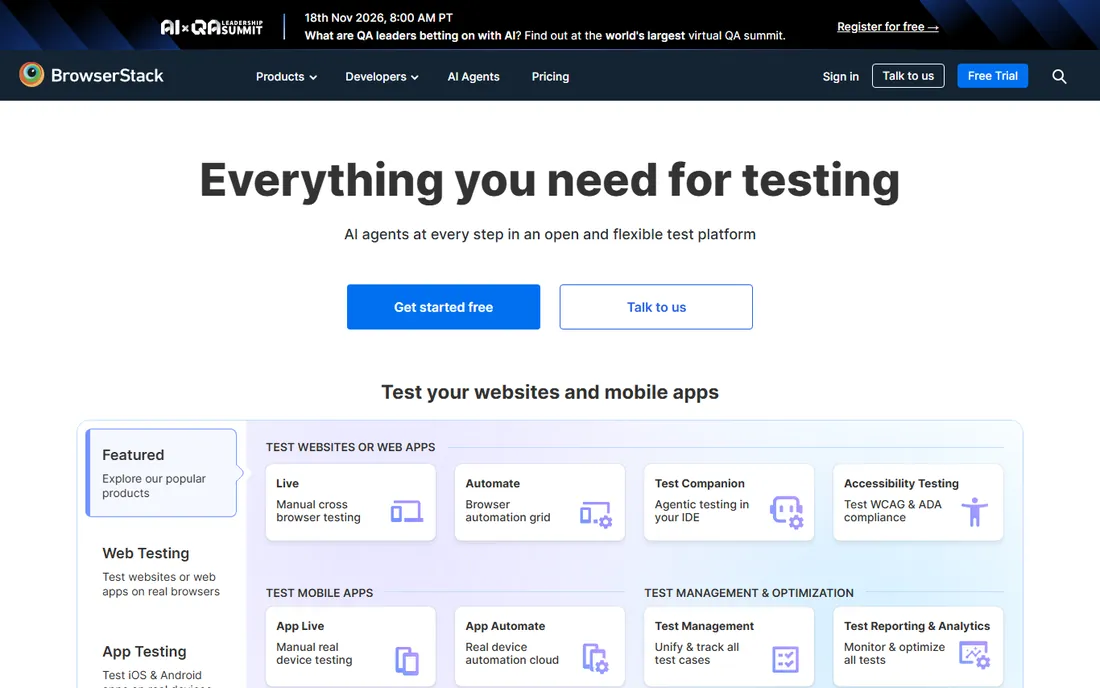
BrowserStack is the incumbent execution cloud: instead of maintaining your own device lab, you run tests on their real browsers and mobile devices. It is the safe, well-understood choice, with products spanning live manual testing, automated execution and visual review. For teams with existing test scripts that simply need somewhere to run them at scale, it remains the default evaluation.
The honest framing is that BrowserStack is infrastructure, while most tools above are intelligence. It does not write your tests or decide release readiness; it runs what you give it, reliably. Newer AI features exist but the agent-native platforms lead there. Choose BrowserStack when your problem is "where do we run 10,000 tests" rather than "who writes our tests."
What we like- The established standard for browser/device clouds with strong reliability
- App Automate and Percy cover functional and visual testing
- No infrastructure to maintain
Watch out for- Primarily an execution cloud, not an AI test-authoring platform
- Costs scale with parallel sessions and can surprise
- AI features trail the agent-native platforms
Every vendor demo looks magical, so structure your trial around your own application. Bring three real user flows: one stable, one that changes often, and one with dynamic content like dates, prices or personalized text. Watch what happens over two weeks of real code changes: which tests heal themselves, which break, and how clear the failure explanations are. That two-week maintenance record predicts your total cost of ownership better than any feature checklist.
Then check the unglamorous integration points. Does it plug into your CI pipeline (Jenkins, GitHub Actions, Azure DevOps) without custom scripting? Do failures route into Jira or Linear with enough context to act on? Can you run tests against staging environments behind your firewall? A tool that aces the demo but fights your pipeline will cost more in engineering time than its license.
Finally, get pricing in writing early, except where it is published (Functionize). Quote-based pricing in this category varies widely with execution volume, parallel sessions and support tiers. A tool that looks affordable per seat can triple in cost when you add the parallel runs your suite actually needs.
Where AI testing still needs humans
AI testing tools are excellent at the mechanical layer: generating tests, healing locators, running thousands of checks in parallel, and flagging visual regressions. They are not good at deciding what should be tested. Risk judgment, which flows matter most, what "correct" looks like for a new feature, and whether a passing test actually proves anything, all remain human work.
Exploratory testing is the other gap. Scripted tests, AI-generated or not, verify what you told them to check. A human tester poking at a new feature finds the weird states, the confusing copy, and the broken edge cases nobody specified. The teams getting the most from these tools use AI to automate the regression burden and redirect human testers toward exploration and risk analysis. Anyone selling you "zero QA headcount" is selling the demo, not the outcome.
How we chose
We started with the searches QA leaders actually run: AI testing tools, AI test automation, best automation testing tools. For each candidate we opened the vendor's own homepage, confirmed the product is current and genuinely AI-driven (not just a Selenium grid with a chatbot), and recorded the pricing model and free-tier terms. Where pricing was not published we wrote "See website" instead of guessing. We included the LambdaTest-to-TestMu AI rename per the vendor's own announcement, and we favored platforms with real agentic or self-healing capabilities over conventional tools with AI branding.
Frequently asked questions
Will AI testing tools replace QA engineers?
No, and the vendors worth trusting do not claim they will. These tools automate test creation, execution and maintenance, which removes the most tedious QA work. They do not replace risk analysis, exploratory testing, or the judgment of what "correct" means for a new feature. Expect QA roles to shift toward strategy and exploration, not disappear.
What is self-healing in test automation?
When your application's UI changes (a renamed button, a moved element), traditional tests break because they locate elements by brittle selectors. Self-healing tools use AI to identify the element by multiple attributes and context, so the test adapts to the change instead of failing. It dramatically cuts the maintenance burden, though truly ambiguous changes still need human review.
Can manual testers use these tools without coding?
Mostly yes, and that is the point of several tools here. Testsigma, Testim and Functionize all offer plain-English or record-and-playback authoring aimed at manual testers. Complex scenarios, custom assertions and CI integration still benefit from technical skills, but the barrier is far lower than writing Selenium scripts by hand.
How do AI testing tools handle dynamic content?
This is a key trial question. Good tools let you mask or parameterize dynamic regions: dates, prices, user names, ad slots. Applitools' Visual AI is specifically built to ignore irrelevant rendering differences. In your evaluation, include a page with dynamic content and see whether the tool handles it gracefully or drowns you in false positives.
Which AI testing tool is best for a small team?
Start with the ones you can evaluate without a sales process. Functionize publishes pricing and offers a genuinely free tier. Katalon lets you start free with no credit card. Testsigma offers a free trial with plain-English authoring. Run the same three test scenarios on two or three platforms and compare the two-week maintenance record before talking to sales.
Sources we checked (8)
- https://www.testim.io
- https://mabl.com/
- https://functionize.com/
- https://applitools.com/
- https://katalon.com/
- https://testsigma.com/
- https://www.testmuai.com
- https://www.browserstack.com
Is your product missing or out of date?
We review this list regularly. Vendors can request a listing, send updated pricing or ask about featured placement.

Shihab Mia · Founder, Rankite
Shihab has spent more than a decade helping SaaS and e-commerce brands grow through search. He writes Rankite's software buying guides from pricing pages, documentation and public user reviews. More about Shihab.