How we make this list: we compare pricing pages, product documentation and public user reviews. Rankite is independent; if a vendor ever pays for a featured spot, that listing is clearly labeled Partner.
Key takeaways
- Almost nobody publishes real pricing. V-Count is the exception: BoostBI analytics start at $9 per sensor per month with hardware at $299 to $799 one-time, and Density lists $229 sensors with software from $2.50 per sensor per month.
- Accuracy claims cluster at 95 to 99 percent, but they depend on mounting height, entrance width, lighting and traffic. Plan a manual count validation during your pilot.
- Privacy is now a selling point: most vendors process data on the device and transmit only anonymous counts, which matters for GDPR and employee trust.
- Retail chains should shortlist RetailNext, ShopperTrak and V-Count for conversion analytics. Offices and campuses should look at Density and Beonic instead.
- Budget for the full three-year cost: hardware, software subscription, installation and support. The sensor price is rarely the biggest number.
Quick comparison
| Tool | Best for | Starting price | Free plan |
|---|
 RetailNext RetailNext | retail chains needing traffic plus POS conversion analytics | See website | No |
 ShopperTrak (Sensormatic Solutions) ShopperTrak (Sensormatic Solutions) | large retailers already in the Sensormatic ecosystem | See website | No |
 Xovis Xovis | airports, malls and venues needing high-precision 3D sensors | See website | No |
 FootfallCam FootfallCam | retailers wanting one vendor for hardware and software | See website | No |
 V-Count V-Count | stores that want published pricing and fast self-install | From $9 per sensor/month (BoostBI); hardware $299 to $799 one-time | No |
 Density Density | offices and campuses measuring room and desk occupancy | From $2.50 per sensor/month (Desks); $229 hardware | No |
 Traf-Sys Traf-Sys | libraries, museums and US public facilities | See website | No |
 SenSource SenSource | libraries and facilities wanting a full-service install | See website | No |
 Beonic Beonic | airports, stadiums and large venues with complex data needs | See website | No |
Is your product missing or out of date?
We review this list regularly. Vendors can request a listing, send updated pricing or ask about featured placement.
The best people counting software
#1
RetailNext
Best for: retail chains needing traffic plus POS conversion analytics
Visit retailnext.net
Starting priceSee website
Free planNo
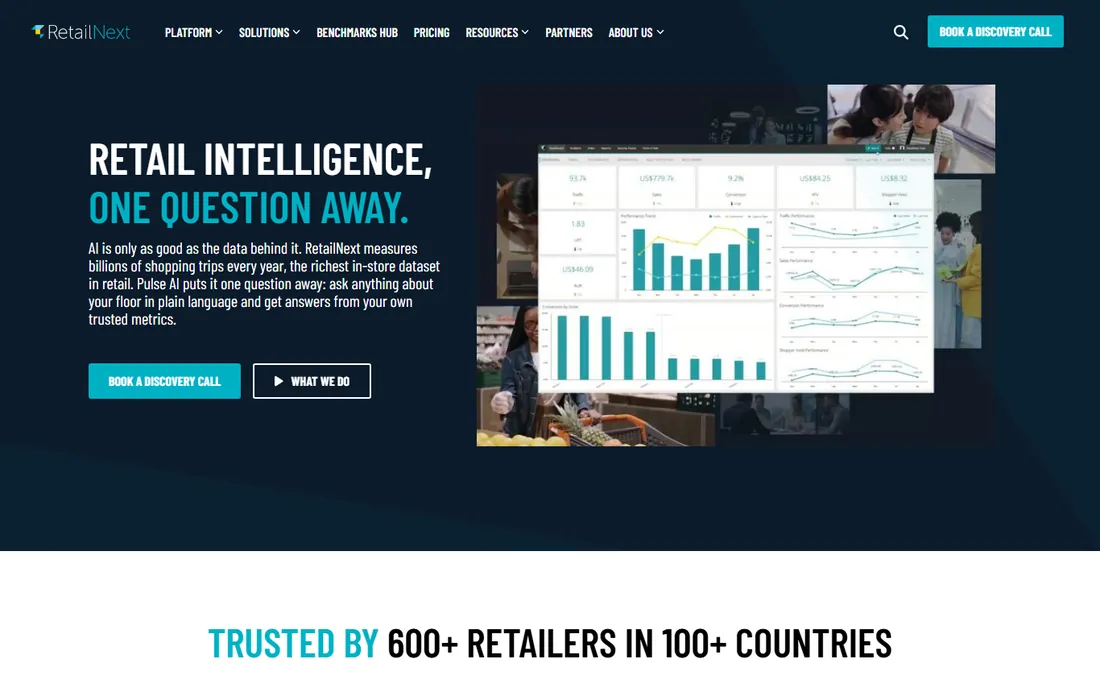
RetailNext is the analytics-heavyweight option for retail chains. Its Aurora sensor detects people up to ten times per second, and the platform connects those counts to your point-of-sale data, which turns a raw visitor number into conversion rate, the metric that actually runs a store. AI forecasting predicts traffic by store, day and daypart, then recommends staffing to match, so labor planning stops being guesswork.
The platform also covers loss prevention, merchandising and store design analytics, which makes it a genuine retail intelligence suite rather than a counter with a dashboard. The honest catch: everything is quote-based, deployments are designed for multi-store fleets, and a single independent shop will pay for capability it never uses. Shortlist it when you run ten stores or more and want one vendor for traffic, conversion and staffing.
What we like- AI-powered Aurora sensor with 95 to 99 percent claimed accuracy
- Traffic tied to POS data for true conversion rates
- AI traffic forecasting for staffing
Watch out for- Quote-based pricing with no public numbers
- Built for chains, overkill for a single store
#2
ShopperTrak (Sensormatic Solutions)
Best for: large retailers already in the Sensormatic ecosystem
Visit shoppertrak.com
Starting priceSee website
Free planNo
ShopperTrak is the oldest name in retail traffic counting, and today it operates as the traffic analytics brand inside Sensormatic Solutions, the retail portfolio of Johnson Controls. That lineage is the pitch: alongside counting, you can add loss prevention, RFID inventory intelligence and shrink analytics from the same vendor, with one contract and one support relationship.
For a large retailer already using Sensormatic for loss prevention, adding ShopperTrak traffic analytics is the natural move, and the benchmarking data from thousands of stores is genuinely useful for comparing locations. The tradeoff is that you are buying into an enterprise ecosystem with enterprise sales cycles and quote-based pricing. Independent retailers will find the process heavy for what they need.
What we like- Decades of retail traffic data and benchmarking
- Sits alongside Sensormatic loss prevention and inventory intelligence
- Global rollout capacity
Watch out for- The ShopperTrak brand now lives inside Sensormatic, so expect an enterprise sales process
- No public pricing
#3
Xovis
Best for: airports, malls and venues needing high-precision 3D sensors
Visit xovis.com
Starting priceSee website
Free planNo
Xovis builds some of the most respected counting hardware in the industry. The Swiss company's 3D sensors are installed in airports, train stations, shopping malls and stadiums worldwide, places where a miscounted crowd has operational consequences. Counting happens on the sensor with anonymous 3D data, which keeps privacy officers comfortable.
Xovis is primarily a sensor company, so the analytics layer often comes from a software partner or integrator rather than Xovis itself. That is fine for airports and transit agencies running formal tenders, but a retail chain wanting one throat to choke may prefer an integrated vendor. Pricing is quoted per project. Choose Xovis when sensor accuracy in difficult environments is the top requirement.
What we like- Swiss-engineered 3D sensors with a strong accuracy reputation
- Proven in airports, transit and stadiums
- GDPR-friendly anonymous counting
Watch out for- Hardware-first company that often pairs with third-party software
- Pricing is quote-based and project-scoped
#5
V-Count
Best for: stores that want published pricing and fast self-install
Visit v-count.com
Starting priceFrom $9 per sensor/month (BoostBI); hardware $299 to $799 one-time
Free planNo
V-Count wins the transparency prize. Its site states the numbers outright: sensors cost $299 to $799 one-time depending on model, and the BoostBI cloud analytics platform runs $9 to $49 per sensor per month depending on features. That makes three-year cost comparisons easy, which is rare in this market.
The Nano AI sensor uses 3D active stereo vision, claims up to 99 percent accuracy, counts in complete darkness, processes data on the device and connects over Wi-Fi with USB-C power, so a store manager can realistically install it without an electrician. One sensor handles counting, staff exclusion and demographic detection together. The honest caveats: check whether demographic analytics fits your region's privacy rules, and the entry BoostBI tier covers the basics only. For retail chains that want predictable costs, it is a strong pick.
What we like- Publishes its pricing openly
- Nano AI sensor counts, detects demographics and excludes staff in one device
- Self-install with Wi-Fi in about a day
Watch out for- The low-end BoostBI tier is basic
- Gender and age analytics may raise privacy questions in some regions
#6
Density
Best for: offices and campuses measuring room and desk occupancy
Visit density.io
Starting priceFrom $2.50 per sensor/month (Desks); $229 hardware
Free planNo
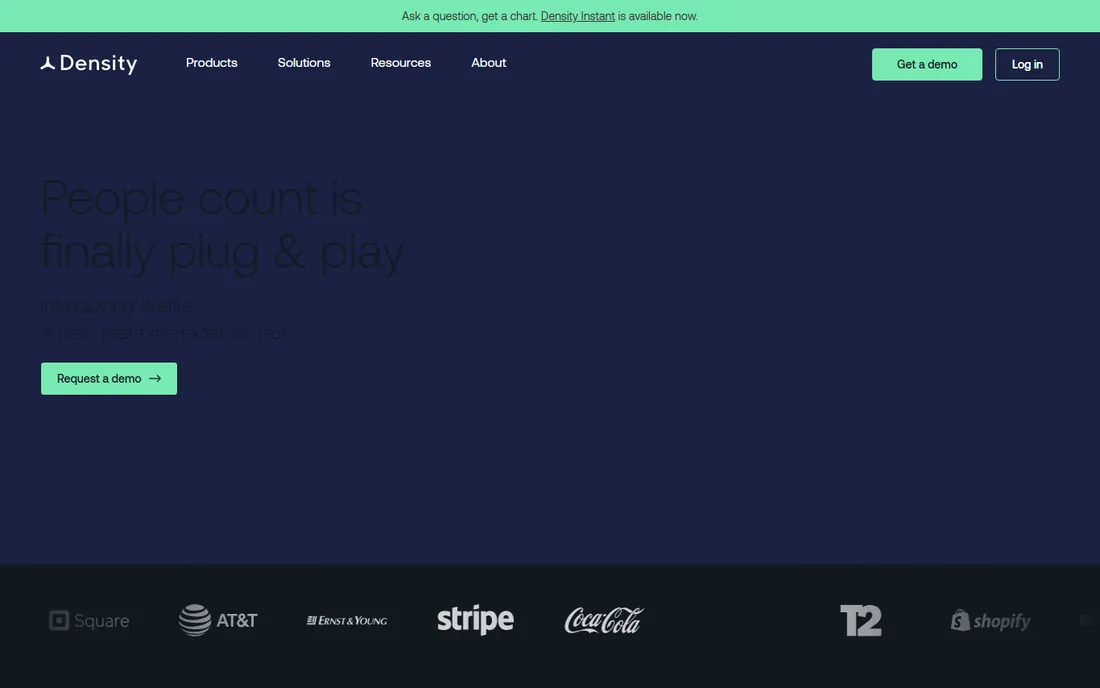
Density comes from the workplace world rather than retail. Its sensors measure how meeting rooms, phone booths, desks and open spaces are actually used, using depth-only sensing with no cameras and no personally identifiable data. That anonymous-by-design approach matters when employees are the ones being counted.
The newer Waffle sensor is the interesting part: $229 per unit, self-installable, with software at $8 per unit per month for rooms and phone booths or $2.50 for desks on annual billing. That is a fraction of traditional enterprise sensor pricing and opens the category to mid-sized companies. The limitation is scope: Density does not do retail conversion analytics or POS integration, so stores should look elsewhere. For hybrid-workplace planning and real estate decisions, it is purpose-built.
What we like- Anonymous-by-design sensors with no cameras
- Self-installable Waffle sensor at $229
- Clear per-space software pricing
Watch out for- Focused on workplaces, not retail conversion analytics
- The full Entry sensor system is quote-based enterprise
Starting priceSee website
Free planNo
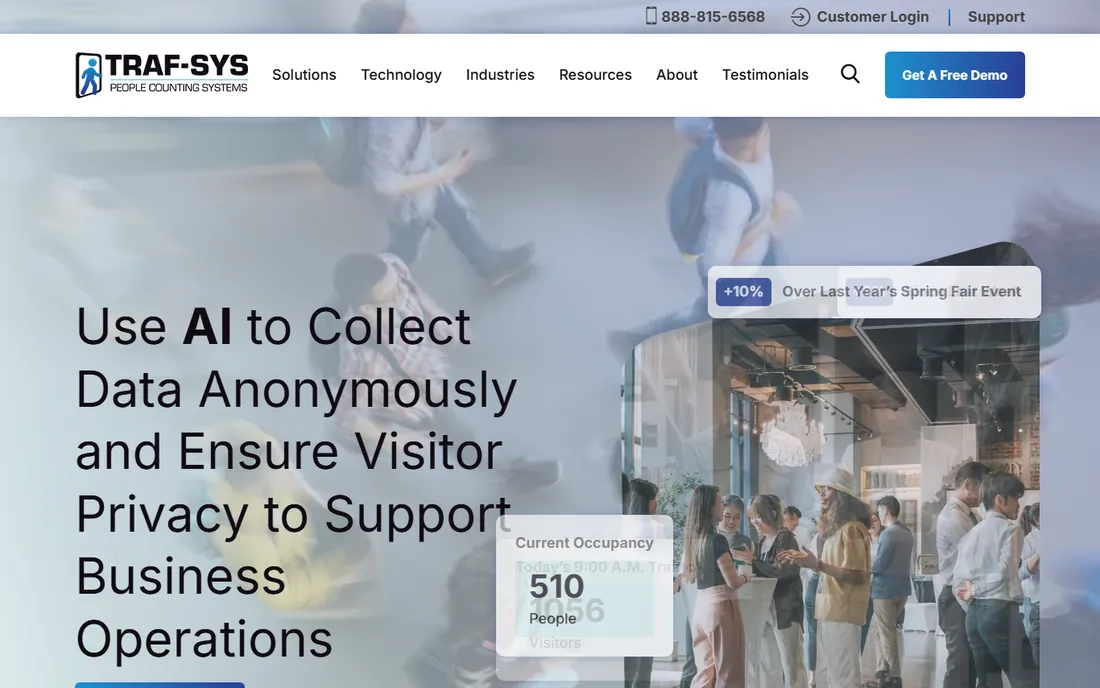
Traf-Sys has been counting people since 1996 from its Pittsburgh headquarters, and it shows in the installed base: libraries, museums, universities, casinos and shopping centers across the US. The range runs from affordable wireless beam counters for a single doorway up to 3D sensors paired with VisiCount software for multi-facility analytics, plus a cloud occupancy product for capacity monitoring.
That breadth is both the strength and the weakness. A library system can start with simple counters and grow into the same vendor's analytics platform, but first-time buyers face a catalog that needs a sales engineer to navigate. Pricing is quoted per project. If you run a public facility, university or museum network, Traf-Sys speaks your language; retail chains wanting conversion analytics should compare the specialists first.
What we like- Broad sensor range from simple beam counters to 3D vision
- VisiCount software with deep traffic reporting
- Strong in libraries, museums and universities
Watch out for- The product lineup is wide and can confuse first-time buyers
- Pricing is quote-based
Starting priceSee website
Free planNo
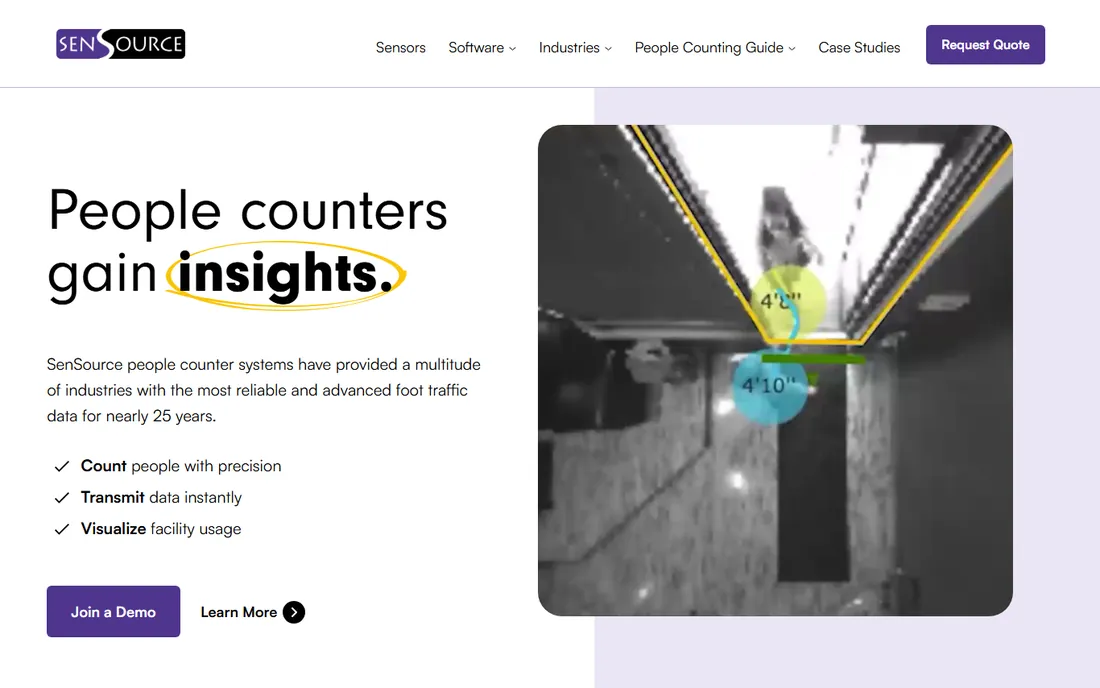
SenSource sells outcomes, not boxes. The Ohio company starts most projects with a site survey, handles installation and software configuration itself, and includes ongoing maintenance with its SaaS subscription. Its Vea analytics platform covers threshold counting, interior analytics, occupancy monitoring, forecasting and wait-time measurement, and the company guarantees 98 percent accuracy backed by proactive monitoring of your sensor fleet.
That service-heavy model fits libraries, government buildings and facility managers who want counting to simply work without becoming an IT project. SenSource counts over 1,200 library clients and a billion-plus count records, which is a meaningful track record. The tradeoff is flexibility: pricing is annual and quoted, and buyers who want to self-install cheap hardware will find the model heavier than they need.
What we like- Full-service model with site survey, installation and ongoing optimization
- 98 percent accuracy guarantee with fleet monitoring
- Vea analytics platform with forecasting
Watch out for- Pricing is annual SaaS quoted per project
- The white-glove model suits organizations, less so DIY buyers
#9
Beonic
Best for: airports, stadiums and large venues with complex data needs
Visit beonic.com
Starting priceSee website
Free planNo

Beonic, formerly known for retail analytics, now positions itself as an AI platform for physical places: airports, stadiums, shopping centers, universities and smart buildings. People counting is one input among many, fused with other data sources through 200-plus integrations to drive operational decisions. Customer names include Heathrow, Wembley Stadium and large airport operators.
That breadth is the differentiator and the risk. If you need to combine counting with queue management, dwell analysis and third-party data feeds across a complex venue, Beonic's platform approach fits. If you just need to count visitors at a museum door, it is more platform than you need. Pricing is quote-based. Shortlist it for large, complex sites where counting is one piece of a bigger data strategy.
What we like- AI platform unifying people counting with 200-plus integrations
- Strong in airports, stadiums and universities
- ISO 27001 certified data platform
Watch out for- Positioned as a broad place-intelligence platform, which can be more than a simple counting project needs
- Quote-based pricing
How we chose
We did not install sensors or run accuracy tests for this guide. We evaluated vendors the way a buyer should: opening each vendor's own site to verify current products and pricing, checking whether pricing is published or quote-based, comparing accuracy claims and how they are qualified, reviewing privacy design (on-device processing, anonymous data, GDPR posture), and reading public reviews and peer comparisons. We included both retail specialists and workplace platforms because "people counting software" covers both, and we dropped one well-known vendor whose products were discontinued during research.
Sensor types, explained simply
Not all counters count the same way, and the technology determines accuracy, cost and privacy.
3D stereo vision
Two lenses see the scene in depth, like human eyes. This is the current standard for entrance counting, with vendors claiming 95 to 99 percent accuracy. It handles crowds, works in varied lighting and processes data anonymously on the device.
Thermal and time-of-flight
Thermal sensors detect body heat; time-of-flight measures distance with light pulses. Both work in complete darkness and are inherently privacy-friendly since they never capture recognizable images. They suit environments where cameras are politically impossible.
Infrared beam and Wi-Fi counting
Simple beam counters are cheap and fine for low-traffic doorways but struggle with groups walking together. Wi-Fi counting detects phone signals to estimate visits and dwell, but phone randomization features have made it less reliable than it once was. Treat it as a supplement, not the primary count.
What to check before you buy a people counter
Accuracy numbers are measured under ideal conditions. These checks keep the project honest.
Validate accuracy on your own doors
Every vendor quotes 95 percent or better, but real accuracy depends on your mounting height, entrance width, lighting and traffic patterns. During the pilot, run a manual count at busy and quiet times and compare. RetailNext audits installations at go-live; hold every vendor to the same standard.
Get the privacy answer in writing
Counting employees or shoppers creates obligations. Ask whether data is processed on the device, whether any images are stored or transmitted, and how the vendor supports GDPR or local privacy law. Most vendors here process anonymously on-device, which is the answer you want. Get it in the contract, not just the brochure.
Price three years, not the sensor
A $299 sensor with $49 per month software costs more over three years than a $799 sensor with $9 per month software. Add installation, any required controllers or cabling, and support. V-Count and Density publish enough numbers to model this; for quote-based vendors, insist on a three-year total in the proposal.
Frequently asked questions
What is people counting software?
It is the analytics layer that turns raw sensor counts into decisions: visitor numbers by hour and day, conversion rates when tied to sales data, occupancy levels, dwell times and forecasts. The sensor counts; the software explains. Most vendors sell them together, and the software subscription is usually the larger long-term cost.
How accurate are people counters?
Modern 3D sensors claim 95 to 99 percent accuracy for entrance counting under good conditions. Real-world accuracy depends on mounting height, entrance width, lighting, traffic density and calibration. Always validate with manual counts during your pilot, and recheck after any store layout change.
Is people counting legal under GDPR and privacy laws?
Generally yes, when done right. Most current systems process data on the sensor and transmit only anonymous counts, storing no images or personally identifiable information. That design keeps them on the safe side of GDPR. Demographic features like age and gender detection deserve a closer legal look in some regions, so check with counsel before enabling them.
Do I need to buy hardware, or is there a software-only option?
You need a counting source. Most vendors sell their own sensors, some work with third-party cameras, and a few can process feeds from existing security cameras. Software-only setups using existing cameras cut hardware costs but depend heavily on camera placement and video quality. For reliable counts, a purpose-built sensor above each entrance remains the standard.
What does people counting software cost?
It varies widely. V-Count publishes $9 to $49 per sensor per month for its BoostBI platform plus $299 to $799 one-time hardware. Density lists software from $2.50 per sensor per month for desks with $229 sensors. Most other vendors quote per project based on sensor count, locations and features, so expect to request proposals and compare three-year totals.
Sources we checked (12)
- https://density.io/
- https://retailnext.net/
- https://www.shoppertrak.com/
- https://www.xovis.com/
- https://footfallcam.com/
- https://trafsys.com/
- https://v-count.com/
- https://sensourceinc.com/
- https://beonic.com/
- https://peoplecountings.com/fr/blog/leading-people-counting-system-platform-providers-an-expanded-list-top-30-providers/
- https://slashdot.org/software/comparison/RetailNext-vs-V-Count/
- https://slashdot.org/software/comparison/Density-vs-SenSource/
Is your product missing or out of date?
We review this list regularly. Vendors can request a listing, send updated pricing or ask about featured placement.

Shihab Mia · Founder, Rankite
Shihab has spent more than a decade helping SaaS and e-commerce brands grow through search. He writes Rankite's software buying guides from pricing pages, documentation and public user reviews. More about Shihab.