How we make this list: we compare pricing pages, product documentation and public user reviews. Rankite is independent; if a vendor ever pays for a featured spot, that listing is clearly labeled Partner.
Key takeaways
- None of the enterprise vendors publish pricing; the only vendor-published number in this list is Roughneck's $4,290 one-time license.
- WolfePak is now PakEnergy; SherWare is now part of Pivoten; P2 Energy is now IFS; OGsys is now Quorum. Old brand names still appear in reviews.
- Micro-operators (under 30 wells) should look at Roughneck or Pivoten, not enterprise suites built for hundreds of wells.
- Joint interest billing (JIB) and revenue distribution are the two modules that separate real O&G accounting from generic accounting.
The shortlist
| Tool |
Best for |
Starting price |
Free plan |
| PakEnergy |
Established operators needing full ERP depth |
See website |
Free trial |
| Pivoten (SherWare) |
Independents wanting field plus back office in one |
See website |
No |
| Quorum (OGsys) |
Mid-size to large upstream operators |
See website |
No |
| Enertia |
Integrated single-vendor upstream ERP |
See website |
No |
| W Energy Software |
Cloud-forward mid-to-large operators |
See website |
No |
| IFS (P2) |
Large enterprises on IFS or P2 suites |
See website |
No |
| Roughneck |
Micro-operators and small independents |
$4,290 (The Derek, single version, one-time) |
Free demo |
| iLandMan |
Land management paired with accounting |
See website |
No |
The best oil and gas accounting software

#1
PakEnergy
Best for: established operators that need deep, proven O&G accounting
Visit pakenergy.com
Starting priceSee website
Free planFree trial

PakEnergy, long known as WolfePak, is the name most field-experienced oil and gas CPAs reach for first. The platform covers the full operator back office: general ledger, accounts payable and receivable, revenue distribution, joint interest billing, AFE tracking, production, land, crude purchasing, escheat and gas balancing. With more than 1,800 customers and roots back to 1986, it is the safe incumbent pick.
The trade-off is dated design and opaque pricing. Third-party estimates put monthly fees between $400 and $1,200 depending on seats, wells and modules, but PakEnergy does not publish numbers, so every deal is a negotiation. Reviewers also note the learning curve for staff without oil field accounting backgrounds. For operators running 20 to 500 wells who need every module under one roof, PakEnergy remains the default.
What we like- Industry-leading JIB and revenue distribution
- Huge module catalog
- Used by 1,800+ customers
Watch out for- No published pricing
- Legacy interface
- Implementation complexity for new users

#2
Pivoten (SherWare)
Best for: independents that want accounting tied to field operations
Visit pivoten.com
Starting priceSee website
Free planNo

Pivoten acquired SherWare in October 2022 and folded SherWare Financials into Pivoten 360, a unified platform that combines back-office accounting with field operations, production management and tank automation. The accounting core is the SherWare engine independents have used for decades: revenue distribution for royalty and working interest owners, JIB, division orders, suspense handling and owner statements.
The pitch is a single system from wellhead to check stub for operators too small to run a big ERP. Pricing is not published; third-party data puts SherWare's Basic plan around $5,595 one-time for two users. For small to mid-size operators that want field and finance in one vendor instead of stitching tools together, Pivoten is the most integrated option. Enterprises should look at Quorum or IFS instead.
What we like- SherWare Financials now inside a unified operations platform
- Strong revenue distribution
- Built for independents
Watch out for- Acquisition means the product roadmap changed
- Limited appeal for large enterprises
Starting priceSee website
Free planNo
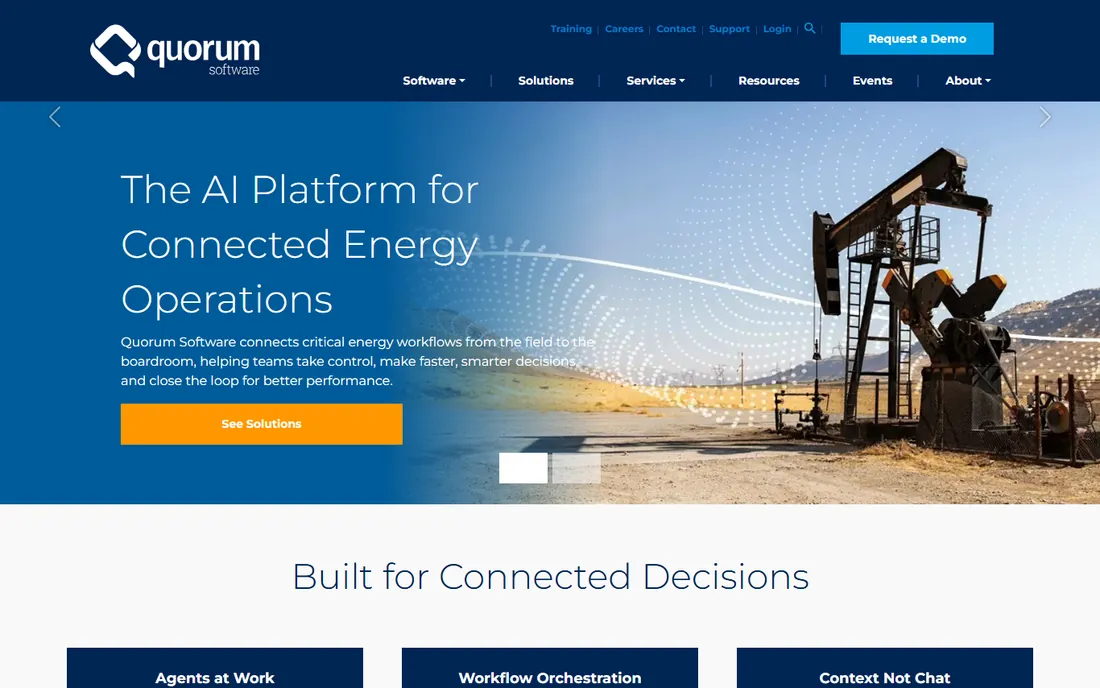
Quorum absorbed OGsys and built the broadest upstream software portfolio in the industry: OGsys On Demand and myQuorum Accounting for the back office, Aucerna tools for planning, reserves and economics, plus land, production and midstream products. For E&P companies that want one vendor from geology to general ledger, Quorum is the enterprise answer.
That breadth comes with enterprise cost and complexity. Pricing is quote-only and implementations are projects, not self-serve signups. OGsys historically served smaller operators well with its cloud foundation tier, but the combined Quorum story is aimed upmarket. For companies with hundreds to thousands of wells and institutional reporting requirements, Quorum's integrated suite is hard to beat.
What we like- OGsys On Demand plus myQuorum Accounting depth
- Strong planning and economics tools (Aucerna)
- Broad upstream portfolio
Watch out for- Enterprise pricing and implementation
- Overkill for micro-operators
Starting priceSee website
Free planNo
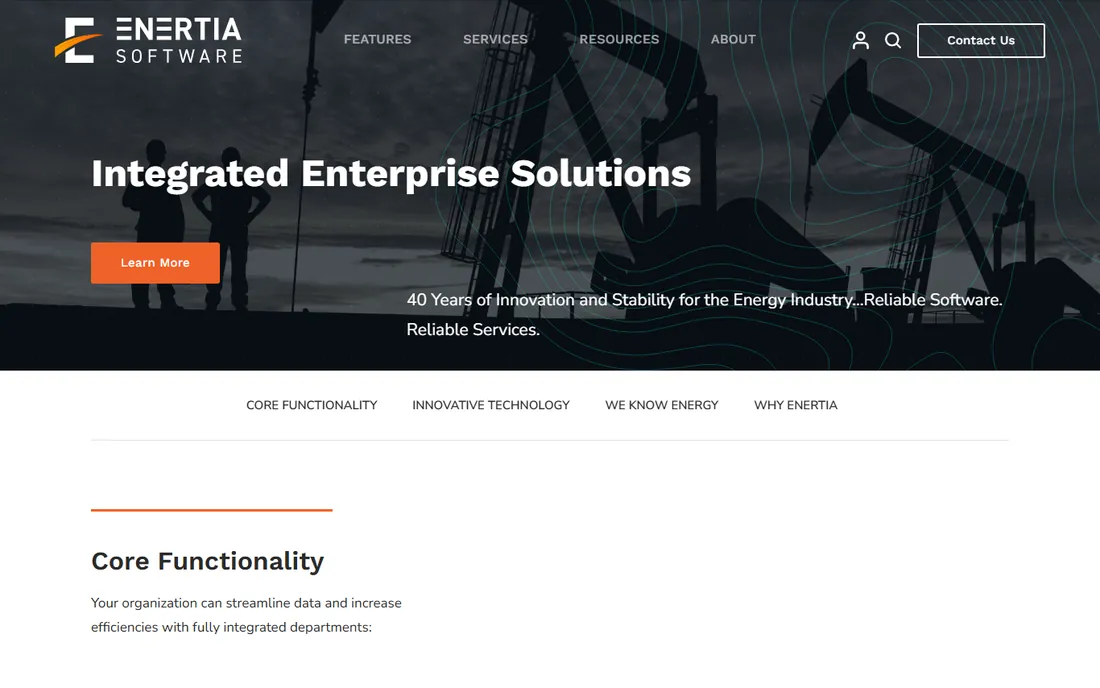
Enertia has spent four decades building one thing: a fully integrated ERP exclusively for upstream oil and gas. Accounting, land, production and operations live in one database with one vendor supporting it, which eliminates the integration tax that comes with best-of-breed stacks. The company positions itself as the only single-source vendor for the full upstream enterprise.
The single-vendor pitch cuts both ways. You get cohesion, but you are betting your back office on a ~100-person Houston company rather than a global ERP vendor. Pricing is not published and deals are enterprise-negotiated. For operators that value one throat to choke over a menu of modules from different vendors, Enertia's unified model is worth evaluating against Quorum.
What we like- Fully unified system, field to financials
- 40+ years in upstream
- Microsoft-based architecture
Watch out for- Quote-only pricing
- Smaller vendor than Quorum or IFS
- Windows/Microsoft-centric stack
Starting priceSee website
Free planNo

W Energy Software built its upstream ERP cloud-native, which shows in deployment speed and API connectivity compared with legacy client-server systems. Revenue accounting, land management and JIB come with the integration hooks mid-to-large operators need to connect SCADA, production and financial systems. Market analysts note it as the agile challenger to Quorum and PakEnergy.
As the challenger, it has fewer reference customers and less third-party review coverage than the incumbents, so due diligence means more reference calls. Pricing is quote-based. For operators modernizing off an on-premise system who want cloud architecture without losing O&G-specific accounting depth, W Energy belongs on the shortlist.
What we like- Cloud-forward architecture with strong APIs
- Agile revenue accounting and JIB
- Faster deployment than legacy ERP
Watch out for- Smaller install base than incumbents
- Enterprise pricing undisclosed

#6
IFS (P2 Energy Solutions)
Best for: large enterprises already invested in IFS or P2 products
Visit ifs.com
Starting priceSee website
Free planNo

P2 Energy Solutions, the maker of BOLO, Excalibur and Merrick, is now part of IFS, combining deep upstream accounting with a global enterprise ERP platform. IFS holds the largest share of ERP adoption among the global top 100 oil, gas and chemicals companies. For supermajors and large independents with complex multi-entity structures, this is the heavyweight option.
Everything about IFS is enterprise: quote-only pricing, long implementation cycles, consulting-led deployments. Third-party data suggests P2 BOLO implementations start in the tens of thousands. This is not a tool for a 50-well operator. For large organizations standardizing finance across upstream, midstream and corporate, IFS's scale and the P2 product depth make it the enterprise default.
What we like- P2's O&G depth (BOLO, Excalibur, Merrick) inside a global ERP vendor
- Strongest for complex multi-entity enterprises
Watch out for- Enterprise pricing and long implementations
- SMBs need not apply

#7
Roughneck
Best for: micro-operators and small independents on a budget
Visit ruff.com
Starting price$4,290 (The Derek, single version, one-time)
Free planFree demo
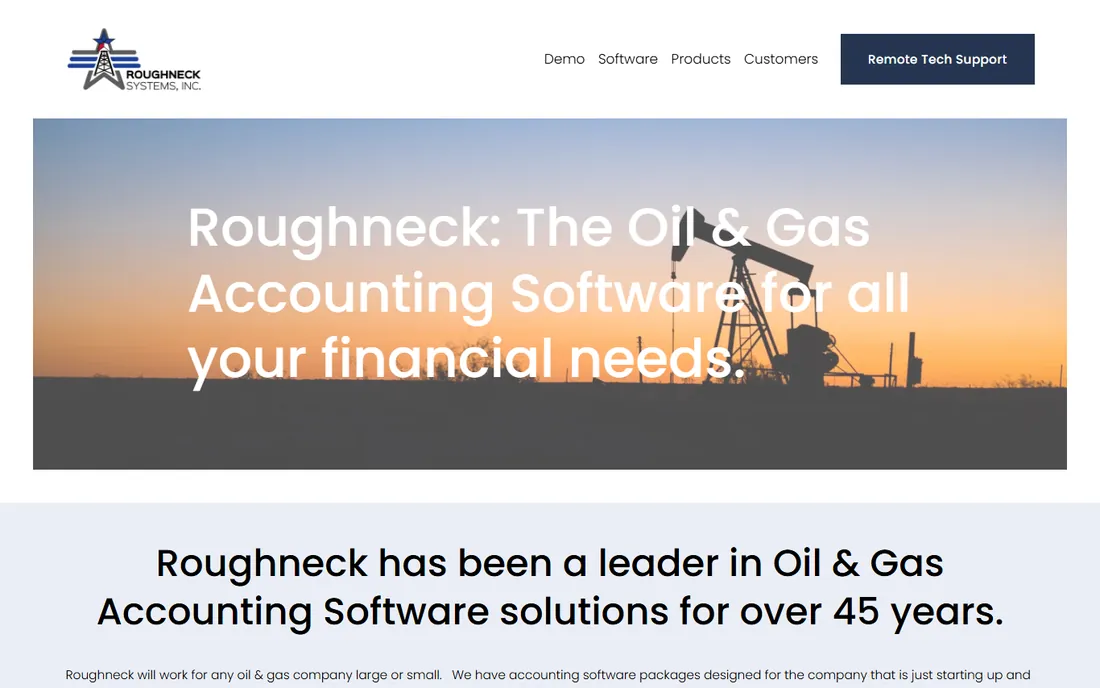
Roughneck has sold oil and gas accounting software since 1977, and its pitch has not changed: a fully loaded accounting system for operators, priced once, not per month. The Derek starts at $4,290 for the single version ($6,290 network), with add-on modules for payroll, bank reconciliation, division orders and more priced individually, plus an optional $1,295 per year service pack. A free demo is available.
The honesty of the model is its strength and its limit. You own the software and you know the price upfront, but you are running Windows desktop software with a dated interface, and reviewers agree it tops out well below the hundred-well mark. For the 1-to-30-well operator who needs JIB and revenue checks without an enterprise contract, Roughneck is the most cost-effective entry in this list by a wide margin.
What we like- Published one-time pricing
- In business since 1977
- Modular, buy only what you need
Watch out for- Dated Windows software
- Not built to scale to hundreds of wells
- Cloud story is thin

#8
iLandMan
Best for: operators where land management is as important as accounting
Visit ilandman.com
Starting priceSee website
Free planNo

iLandMan approaches the problem from the land side: leases, division orders, ownership decks and obligations, with accounting integration to keep the back office in sync. For operators whose pain is land complexity, tracking thousands of leases, owners and division orders, more than GL depth, this ordering of priorities makes sense.
It is a complement to, not a replacement for, a full accounting suite at larger operators. Pricing is quote-based. For land-heavy independents and mineral managers, iLandMan paired with a lighter accounting tool can be cheaper and better fitting than a full ERP whose land module is an afterthought.
What we like- Land-first design with accounting integration
- Strong lease and division order tracking
Watch out for- Not a full accounting replacement for complex operators
- Pricing not published
Why generic accounting software fails oil and gas
QuickBooks and Xero cannot do what this industry requires. Revenue distribution means splitting every dollar of production income across royalty owners, working interest owners and overrides according to division orders, then cutting hundreds of checks with suspense handling for unlocated owners. Joint interest billing means allocating shared well costs back to partners and invoicing them.
Add severance tax reporting by state, AFE tracking against budgets, gas balancing between partners, and escheatment of unclaimed royalties, and you have a workload no generic GL can touch. Every tool in this list exists because those workflows are the business. When evaluating, ask vendors to demo a full revenue run and a JIB cycle with your own well count, not a slide deck.
Cloud vs. on-premise in O&G accounting
This industry still runs a surprising amount of accounting on office servers. Roughneck and older PakEnergy deployments are on-premise, which appeals to operators with spotty field connectivity and a distrust of subscription pricing. The trade-off is backups, updates and remote access, all your problem.
Cloud options (Quorum On Demand, W Energy, Enertia's hosted deployments, Pivoten 360) shift that burden to the vendor and make multi-office and work-from-home accounting practical. The subscription cost is real, but so is the cost of a server failure during a revenue run. New buyers should default to cloud unless they have a specific reason, like data sovereignty or existing infrastructure, to stay on-premise.
Frequently asked questions
What is the best oil and gas accounting software?
PakEnergy is the industry standard for established operators, with the deepest JIB and revenue distribution modules and 1,800+ customers. Quorum suits larger enterprises, Pivoten suits independents wanting field plus finance in one platform, and Roughneck is the budget pick for micro-operators with published one-time pricing.
How much does oil and gas accounting software cost?
Enterprise vendors (PakEnergy, Quorum, Enertia, IFS) do not publish pricing; third-party estimates range from roughly $400 to over $1,200 per month depending on seats, wells and modules. Roughneck publishes one-time pricing starting at $4,290. SherWare's Basic plan was reported around $5,595 one-time for 2 users before the Pivoten acquisition.
What is joint interest billing (JIB)?
Joint interest billing is the process of allocating shared well expenses, drilling, operating, overhead, to each working interest owner according to their ownership share, then invoicing them. It is one of the two core workflows (along with revenue distribution) that define oil and gas accounting software.
Is WolfePak still available?
WolfePak rebranded to PakEnergy. The software, company and customer base are the same; only the name changed. If you see WolfePak in older reviews or comparisons, read it as PakEnergy.
What happened to SherWare?
Pivoten acquired SherWare in October 2022 and integrated SherWare Financials into its Pivoten 360 operations platform. The accounting product continues under Pivoten at pivoten.com.
Can QuickBooks handle oil and gas accounting?
Not properly. QuickBooks lacks revenue distribution by division order, joint interest billing, severance tax reporting, AFE tracking and gas balancing. Small operators sometimes pair QuickBooks with spreadsheets, but anything beyond a handful of wells needs purpose-built software like the tools in this list.
Sources we checked (9)
- https://rocketdigit.com/oil-and-gas-accounting-software-for-small-business/
- https://www.getapp.co.uk/software/119951/wolfepak
- https://slashdot.org/software/comparison/PakEnergy-Accounting-vs-SherWare-Oil-Gas-Accounting-Software/
- https://news.pivoten.com/blog/news-pr-pivoten-acquires-sherware?hs_amp=true
- https://pivoten.com/sherware-features-old
- https://pitchbook.com/profiles/company/242990-29
- https://www.appsruntheworld.com/oil-gas-and-chemicals-erp-adoption-among-the-global-top-100/
- http://prsync.com/pw-consulting/--pw-consulting-global-oil--gas-accounting-software-market-hits-b-in--projects--cagr-to--5201389/
- https://ces.einnews.com/pr_news/943393650/enertia-software-announces-strategic-partnership-with-choice-digital-to-modernize-royalty-owner-payments
Is your product missing or out of date?
We review this list regularly. Vendors can request a listing, send updated pricing or ask about featured placement.

Shihab Mia · Founder, Rankite
Shihab has spent more than a decade helping SaaS and e-commerce brands grow through search. He writes Rankite's software buying guides from pricing pages, documentation and public user reviews. More about Shihab.