How we make this list: we compare pricing pages, product documentation and public user reviews. Rankite is independent; if a vendor ever pays for a featured spot, that listing is clearly labeled Partner.
Key takeaways
- mabl from around $500 per month is the AI-driven choice for teams that want self-healing tests with minimal maintenance.
- Katalon and BugBug both offer genuinely free tiers, making them the best starting points for small teams.
- Testim suits enterprises that want codeless creation with the option to export tests as code.
- Leapwork's visual flowchart approach works best for business users automating across desktop, web and legacy apps.
Quick comparison
| Tool | Best for | Starting price | Free plan |
|---|
 Testim Testim | Resilient codeless end-to-end tests | See website | Free plan |
 mabl mabl | AI-driven test maintenance | From $500/month | Free trial |
 Leapwork Leapwork | Visual enterprise automation | See website | Free trial |
 Katalon Katalon | Free all-round test automation | Free | Free plan |
 Testsigma Testsigma | Unified no-code testing | See website | Free trial |
 Functionize Functionize | AI-powered enterprise testing | See website | No |
 Autify Autify | Simple web and mobile testing | See website | Free trial |
 Rainforest QA Rainforest QA | Fully codeless QA | See website | Free trial |
 BugBug BugBug | Affordable web test automation | Free | Free plan |
Is your product missing or out of date?
We review this list regularly. Vendors can request a listing, send updated pricing or ask about featured placement.
Starting priceSee website
Free planFree plan
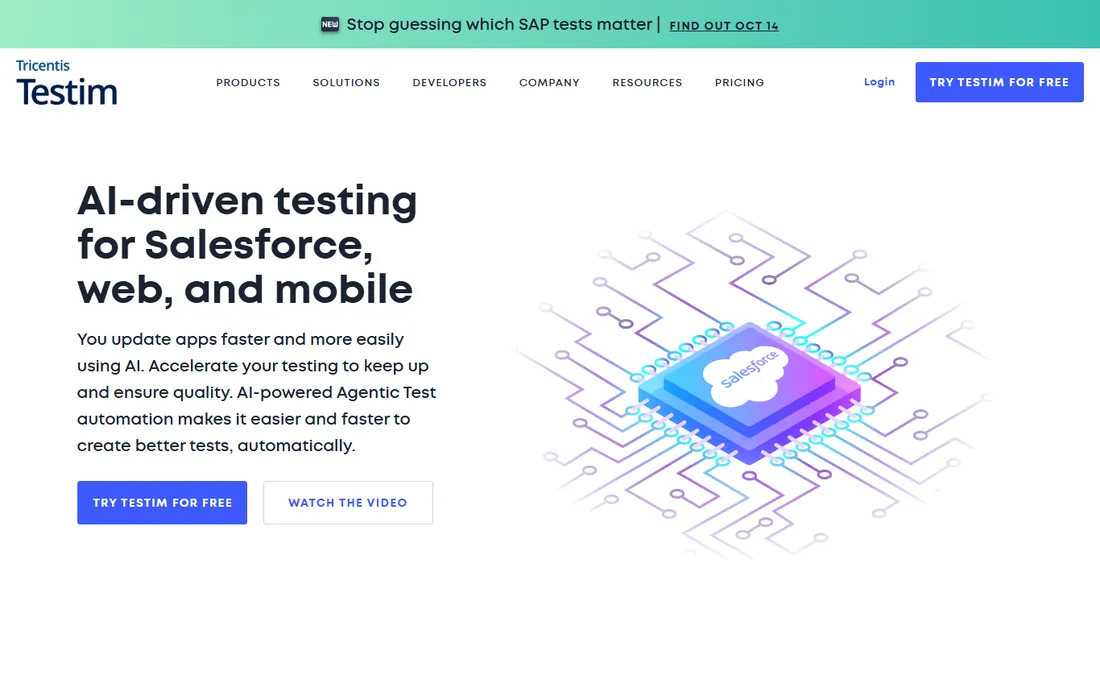
Testim (Tricentis) creates end-to-end tests codelessly with AI keeping them stable as the UI changes. The standout is flexibility: build visually, then drop into code when needed, export tests to version control, and run them on every commit. Microsoft, Salesforce and Wix run millions of Testim tests monthly.
Pricing is enterprise-grade, reported from around $20,000 per year. The free account lets small teams try the approach. For organizations standardizing test automation with room to grow into code, Testim bridges both worlds.
What we like- AI-stabilized locators
- Codeless or coded
- Parallel cross-browser runs
Watch out for- Enterprise pricing
- Free tier is limited
Starting priceFrom $500/month
Free planFree trial
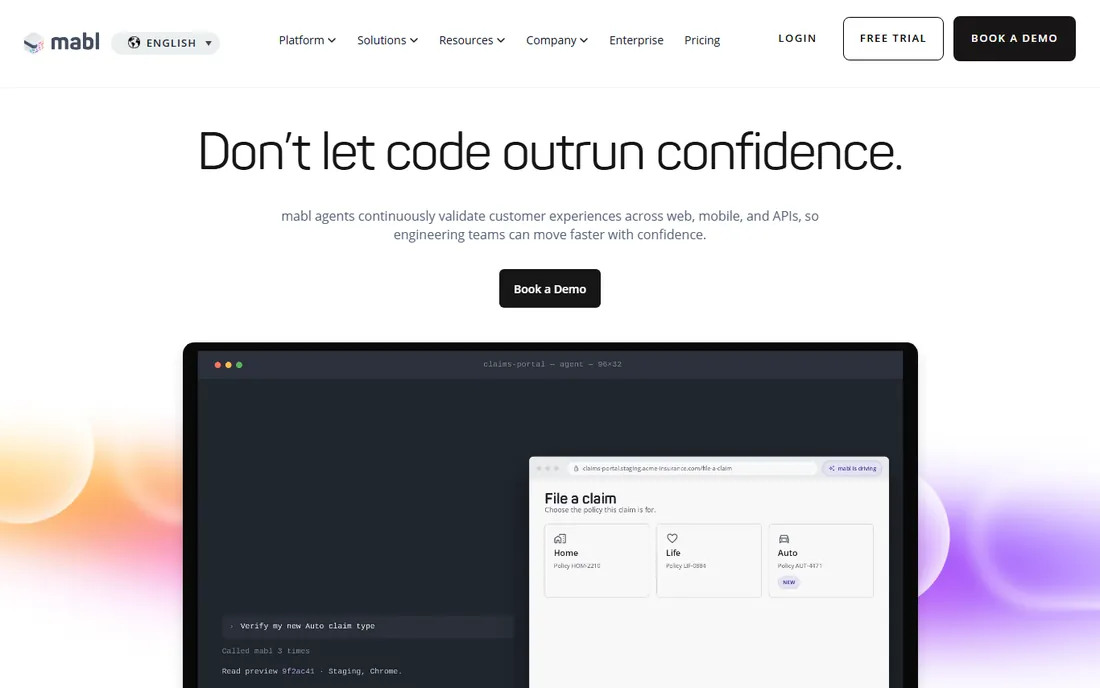
mabl is the cloud-native low-code platform built around one promise: tests that maintain themselves. Machine learning detects UI changes and auto-heals selectors, cutting the maintenance burden that kills most test automation efforts. Record tests visually, run them in parallel across browsers, and get detailed failure analysis with trend data.
Pricing starts around $500 per month, which prices out the smallest teams. For product teams practicing continuous delivery where flaky tests are the bottleneck, mabl's self-healing justifies the cost.
What we like- Self-healing tests
- Detailed reporting
- API testing alongside UI
Watch out for- Premium pricing
- Learning curve on AI features
Starting priceSee website
Free planFree trial
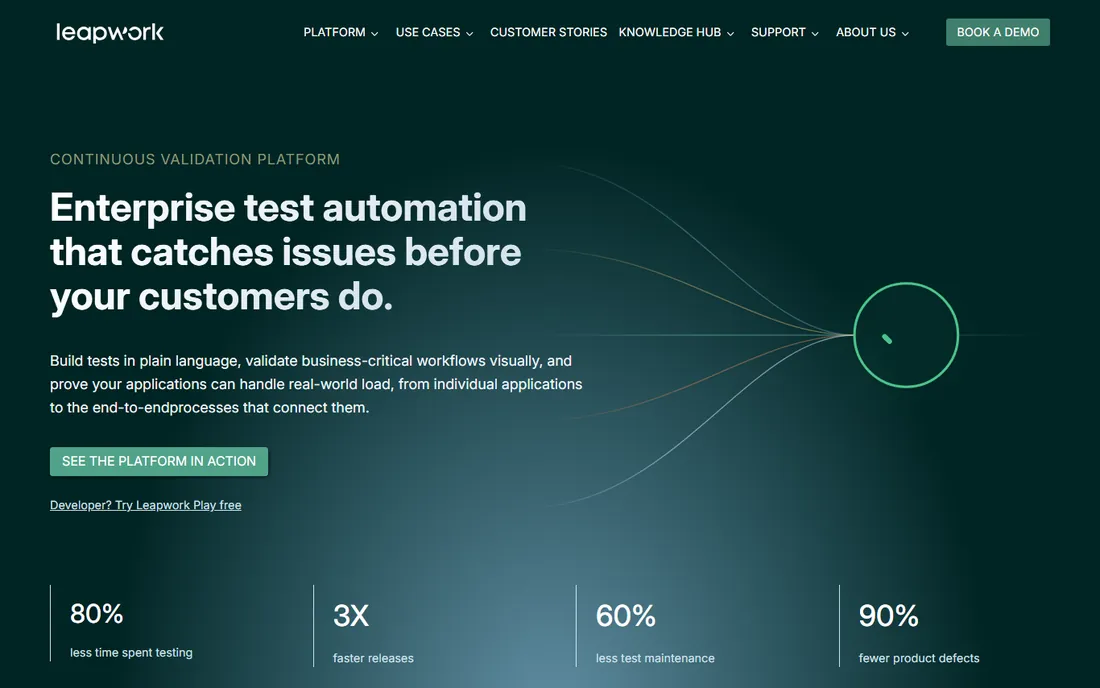
Leapwork takes a visual flowchart approach: build automation as diagrams, not scripts. Business and IT users automate across web, desktop applications and legacy systems that web-only tools cannot touch. Banks, insurers and government agencies use it at scale.
Pricing is enterprise and quote-based. For organizations where the testing surface includes desktop and legacy apps alongside web, Leapwork's breadth is unmatched. Pure web teams will find lighter options.
What we like- Flowchart-based visual automation
- Covers web, desktop and legacy
- Business-user friendly
Watch out for- Enterprise pricing
- Heavier than web-only tools
Starting priceFree
Free planFree plan
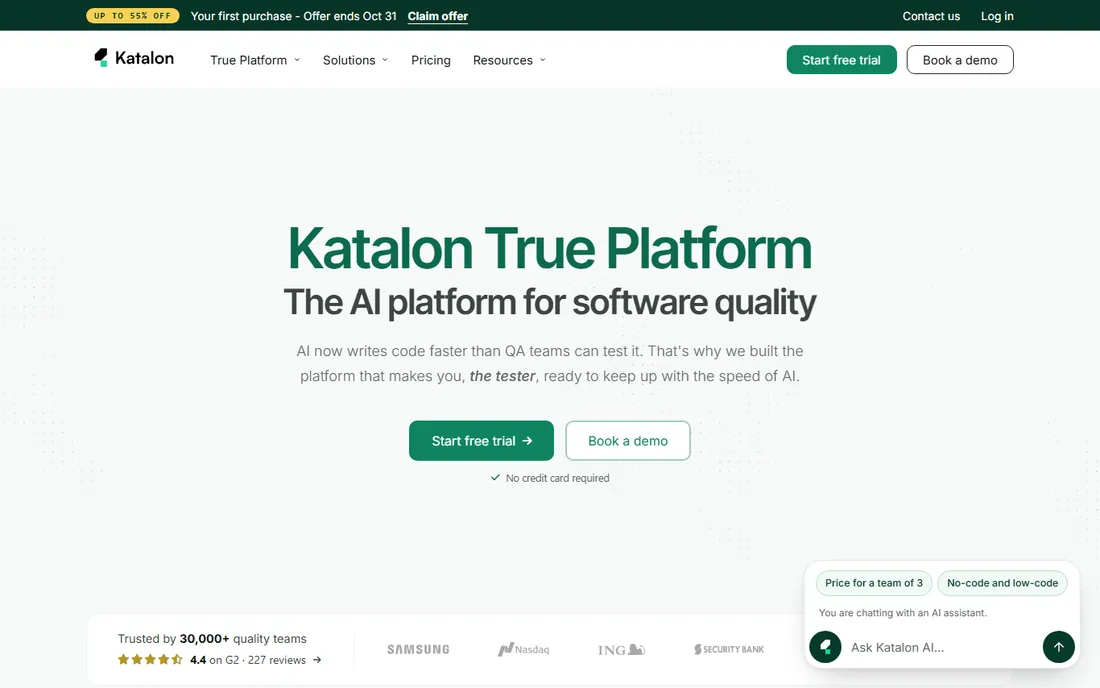
Katalon offers one of the most generous free tiers in test automation: web, API, mobile and desktop testing with a visual recorder and partial scripting when you need it. Katalon TestOps adds analytics and orchestration. CI/CD integrations cover the standard pipeline tools.
Paid plans add advanced features for larger teams. For small to mid-size teams that want serious test automation without a budget line, Katalon is the first tool to try.
What we like- Free tier is genuinely capable
- Web, API, mobile and desktop
- Strong CI/CD integrations
Watch out for- Advanced features need paid plans
- Interface can overwhelm beginners
Starting priceSee website
Free planFree trial
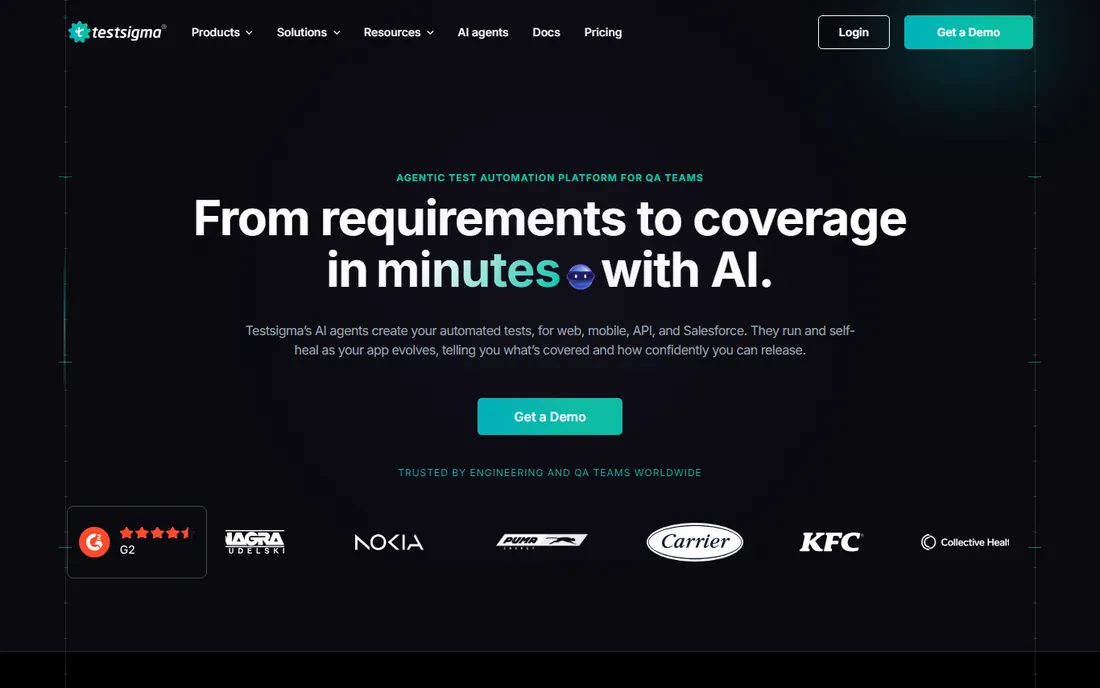
Testsigma unifies functional, visual and API testing in one no-code platform with plain-English test steps. Auto-healing handles UI changes, and the cloud execution scales parallel runs. It aims to replace several testing tools with one.
Pricing is not the cheapest for small teams; get a quote early. For mid-size teams that want one platform instead of a patchwork of recorders, Testsigma's unified approach simplifies the stack.
What we like- Unified web, mobile, API and desktop
- Natural language test steps
- Auto-healing
Watch out for- Pricing can surprise small teams
- Newer than Katalon
Starting priceSee website
Free planNo
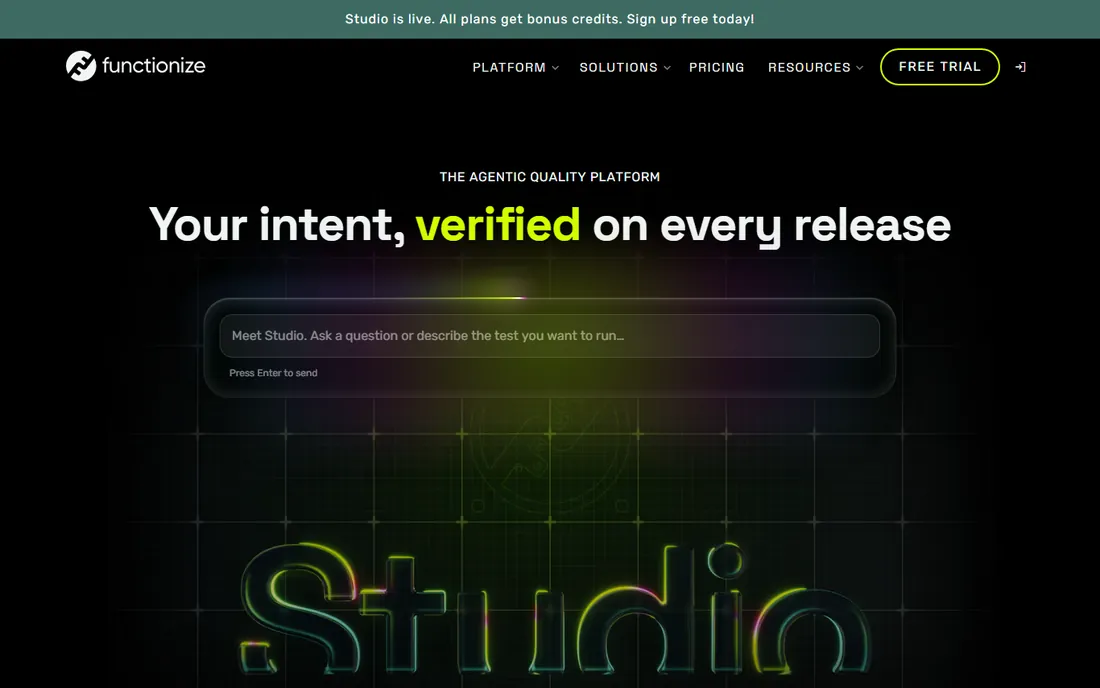
Functionize applies AI aggressively to test automation: natural language test creation, intelligent maintenance and cloud execution at enterprise scale. Large organizations with complex applications get codeless testing that keeps pace with rapid releases.
There is no free tier and buying is enterprise-style. For enterprises where test maintenance consumes QA capacity, Functionize's AI depth is the pitch. Smaller teams should start with free options.
What we like- Deep AI for test creation and maintenance
- Enterprise scalability
- Strong analytics
Watch out for- No free tier
- Enterprise sales process
Starting priceSee website
Free planFree trial
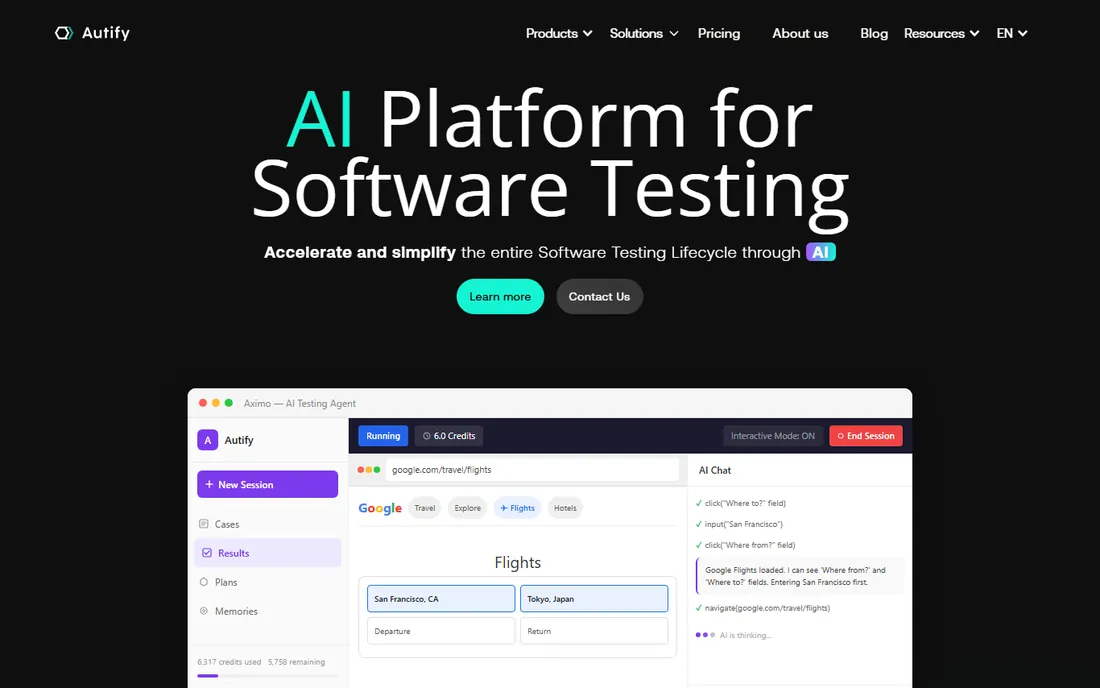
Autify focuses on simplicity: record web and mobile tests in the browser, and AI maintains them as the app changes. Teams get automated regression testing running in days rather than months. The Japanese market adopted it early, and it has expanded globally.
Enterprise depth trails Testim and mabl, and pricing requires a conversation. For teams that want test automation with minimal setup friction, Autify's ease of use stands out.
What we like- Very easy to start
- AI maintenance
- Good for web and mobile apps
Watch out for- Less depth than enterprise platforms
- Pricing not transparent
Starting priceSee website
Free planFree trial
Rainforest QA is built for teams with no automation engineers: write tests in plain language, and the platform executes them in its cloud across browsers. Non-technical QA staff can own automation end to end.
Technical teams may find it constraining compared to code-friendly tools. Pricing is not published. For organizations where QA is manual today and the goal is automation without hiring engineers, Rainforest QA fits.
What we like- Truly no-code test creation
- Built-in execution cloud
- Good for non-technical QA
Watch out for- Pricing not transparent
- Less flexibility for technical teams
Starting priceFree
Free planFree plan
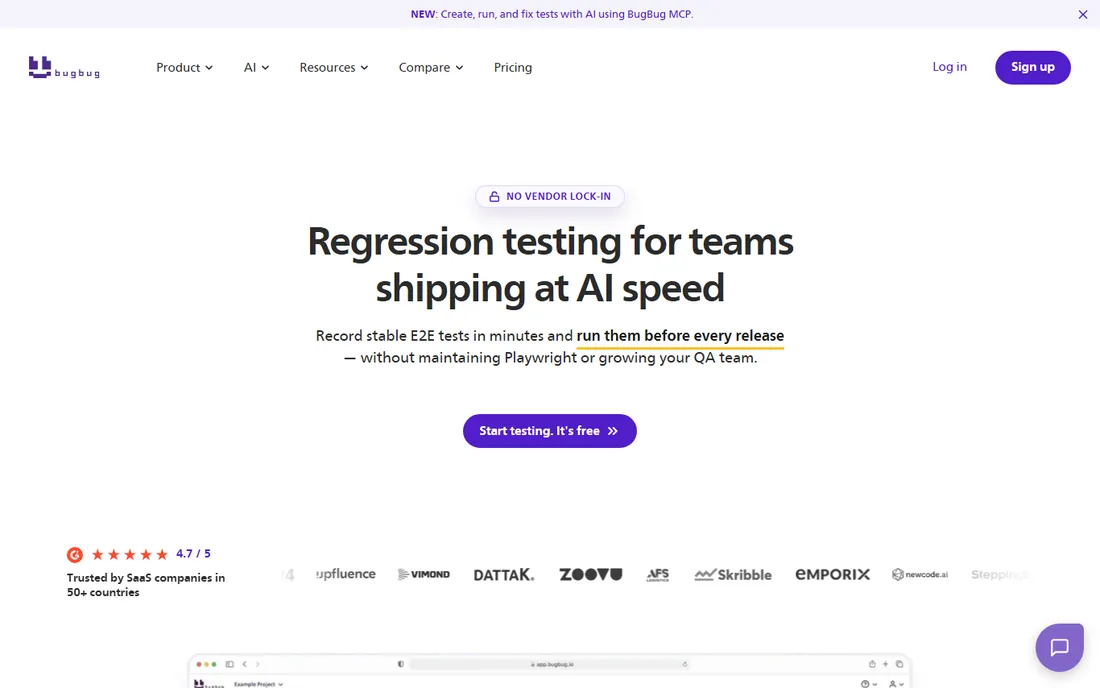
BugBug offers straightforward web test automation with a recorder-based approach and a genuinely free tier. Small teams and startups get automated regression testing without budget approval, and paid plans stay affordable.
Enterprise features like advanced reporting and SSO are thinner than the leaders. For a startup or small agency that needs basic web test automation today, BugBug's free tier is the lowest-friction start.
What we like- Free tier available
- Simple recorder
- Affordable paid plans
Watch out for- Smaller vendor
- Fewer enterprise features
Self-healing: what it actually does
Self-healing means the tool updates element locators automatically when the UI changes: a button gets a new ID, and the test finds it anyway using multiple attributes and ML matching. It reduces but does not eliminate maintenance. Major redesigns still break tests, and someone must review what the AI changed. Treat self-healing as maintenance reduction, not maintenance elimination.
Codeless vs low-code vs code
Pure codeless tools (Rainforest QA, BugBug) maximize accessibility and minimize flexibility. Low-code platforms (mabl, Testim, Katalon) let non-engineers build while engineers extend. Code-first frameworks (Playwright, Cypress) offer total control at the cost of engineering time. Most successful teams land in the middle: codeless for happy paths, code for complex scenarios. Choose based on who will maintain the tests, not who demos them.
Maintaining tests as the app grows
Test creation gets the demos; test maintenance decides the ROI. Every team discovers this around month six, when the application has evolved and a third of the test suite fails for reasons unrelated to real bugs. The maintenance burden is the number one killer of test automation initiatives, and managing it is a discipline, not a feature. Start with test design: the most maintainable tests are the smallest ones. A test that verifies one user flow with minimal steps breaks less often and is easier to fix than a 50-step end-to-end epic. Prefer many small tests over few large ones, even though large tests feel more impressive in the demo.
Page object thinking applies even in codeless tools. When the login flow changes, you want to update it in one place, not in forty tests. Most no-code platforms offer shared steps, reusable components or test fragments; use them religiously from day one. New team members should be taught the shared library before they are allowed to create tests. Without this discipline, every tester builds their own version of common flows, and a single UI change triggers dozens of individual fixes. Review the test suite monthly for duplication and consolidate. This housekeeping is unglamorous and saves more maintenance hours than any AI feature.
Triage failures fast and ruthlessly. A failing test suite that nobody investigates teaches the team to ignore it, and an ignored suite is worse than no suite. Establish the rule: every failure gets triaged within 24 hours, classified as real bug, test issue, or environment flake. Real bugs go to developers immediately (this is the suite earning its keep). Test issues get fixed or the test gets updated the same day. Flakes get quarantined: moved to a separate unstable suite that does not block deployments, with a deadline to fix or delete. A test that flakes for a month without action should be deleted; a suite full of known-flaky tests trains everyone to distrust the results.
Data management is the silent maintenance cost. Tests that depend on specific data states ("user with exactly 3 orders") break when the data changes. Prefer tests that create their own data via APIs before running and clean up afterward. Most platforms here support API setup steps; use them instead of relying on shared test environments. For data that cannot be created on the fly, use dedicated test accounts with documented states, and monitor them. When someone uses the test account for manual exploration and changes its state, three test suites fail mysteriously. Isolation prevents this entire category of pain.
Finally, measure the maintenance burden explicitly. Track time spent fixing tests versus time spent finding real bugs. A healthy suite finds bugs worth multiples of its maintenance cost. When the ratio inverts, something is wrong: usually too many brittle UI tests, not enough API-level coverage, or an application changing faster than the testing strategy accounts for. Rebalance toward API and component tests, which break less often. And prune regularly: every quarter, delete tests that have never caught a bug and cost maintenance time. A smaller, trusted suite beats a large, ignored one. Maintenance is not the tax on automation; managed well, it is the mechanism that keeps automation valuable.
Frequently asked questions
What is no code test automation?
Test automation built without programming: record user actions in a browser, define assertions visually, and the platform executes tests across browsers and devices. AI features maintain tests as the application changes.
How much do no code test automation tools cost?
Free tiers exist (Katalon, BugBug). Mid-market tools run $99 to $500 per month. Enterprise platforms (Testim, mabl, Functionize) run $500+ per month to $20,000+ per year. Match the tool to your team size before paying enterprise prices.
Can no code tools replace coded test frameworks?
For standard web regression testing, largely yes. For complex scenarios (custom protocols, performance testing, intricate setup), coded frameworks still win. Many teams use both: no-code for breadth, code for depth.
Do these tools work with CI/CD pipelines?
Yes. All the tools here integrate with Jenkins, GitHub Actions, GitLab and similar pipelines to run tests on commits and deployments. Confirm your specific pipeline during the trial.
What is flaky test and how do these tools help?
Flaky tests pass and fail randomly, usually from timing issues or unstable locators. No-code tools fight flakiness with smart waits, self-healing locators and retry logic. They reduce flakiness substantially but cannot fix fundamentally timing-dependent applications.
How long does implementation take?
Simple web apps get first automated tests running in days with recorder tools. Full regression suites with CI integration take weeks. Enterprise rollouts across many applications take months. Start with the highest-value user flows.
How we chose
We compared the no-code and low-code test automation tools teams actually adopt, from free tiers to enterprise platforms. Pricing comes from vendor pages and published comparisons; quote-based tools are marked as such. We weighted ease of test creation, maintenance burden (self-healing quality), execution scalability and fit for different team sizes. No hands-on testing was performed; assessments rest on documentation and public reviews.
Sources we checked (11)
- https://www.testim.io/
- https://www.mabl.com/
- https://leapwork.com/
- https://katalon.com/
- https://testsigma.com/
- https://www.functionize.com/
- https://www.autify.com/
- https://www.rainforestqa.com/
- https://bugbug.io/
- https://bugbug.io/blog/software-testing/low-code-automation/
- https://www.accio.com/biz-cheap/affordable-test-automation-solutions-for-small-businesses-us
Is your product missing or out of date?
We review this list regularly. Vendors can request a listing, send updated pricing or ask about featured placement.

Shihab Mia · Founder, Rankite
Shihab has spent more than a decade helping SaaS and e-commerce brands grow through search. He writes Rankite's software buying guides from pricing pages, documentation and public user reviews. More about Shihab.