How we make this list: we compare pricing pages, product documentation and public user reviews. Ratings come from G2, Capterra or Trustpilot, with the date we checked them.
Key takeaways
- Sharetribe is the fastest way to launch a marketplace, with vendor management and payments built in.
- CS-Cart Multi-Vendor gives you a self-hosted marketplace with a one-time licence and full control.
- WooCommerce with Dokan suits WordPress users who want a marketplace on a familiar platform.
- Magento and Mirakl serve enterprises that need scale, complexity and deep customisation.
- Commission, payment splitting and vendor onboarding decide success more than design templates, so test those flows first.
Quick comparison
Is your product missing or out of date?
We review this list regularly. Vendors can request a listing, send updated pricing or ask about featured placement.
Starting priceSee website
Free planFree trial
Sharetribe is purpose-built for multi-vendor marketplaces, which shows in every feature. Vendor profiles, listings, bookings or product sales, messaging, reviews, commissions and Stripe payment splitting are all built in, so you can launch a marketplace for rentals, services, products or experiences without assembling plugins.
The no-code builder lets you customise branding, pages and workflows, and a free trial lets you test the concept before paying. Sharetribe's templates cover common marketplace types, from peer-to-peer rentals to service booking, which shortens the path from idea to live site.
Monthly pricing and transaction fees on some plans add up as you scale, and deep customisation needs the higher-tier developer platform. But for a founder who wants to validate a marketplace idea quickly, Sharetribe is the fastest and safest start.
What we like- Built for marketplaces from day one
- Vendor onboarding and payments included
- No coding needed
Watch out for- Monthly subscription
- Customisation limits on lower plans
- Transaction fees on some plans
Starting priceSee website
Free planNo
CS-Cart Multi-Vendor is a self-hosted marketplace platform with a one-time licence option, which appeals to owners who dislike monthly subscriptions. You host it yourself, control the code and data, and manage vendors, products, orders, commissions and payouts from a mature admin panel.
Vendor features are strong: separate storefronts, product management, shipping settings, order handling and payout reports, plus a vendor subscription system for charging sellers. The add-on marketplace extends the platform with payment gateways, shipping tools and marketing features.
Self-hosting means you handle updates, security and performance, and the interface feels dated next to Sharetribe or Shopify. But for a marketplace owner who wants ownership and control, CS-Cart's licence model and depth are compelling.
What we like- One-time licence option
- Full code and data control
- Strong vendor and commission features
Watch out for- Needs hosting and maintenance
- Interface feels dated
- Add-ons cost extra

#3
WooCommerce with Dokan
Best for: WordPress marketplaces
Visit dokan.co
Starting priceFree
Free planYes
Dokan turns WooCommerce into a multi-vendor marketplace. Vendors get their own dashboards, storefronts and product management, while the admin controls commissions, withdrawals, shipping and order status. The core plugin is free, with premium versions adding features like vendor subscriptions, auction support, bookings and advanced reports.
The WordPress ecosystem is the advantage: thousands of themes, payment gateways, SEO tools and marketing plugins work with Dokan, and most WordPress users can set it up without learning a new platform. WooCommerce itself is free and open source, so the base cost is hosting plus any premium extensions.
A full marketplace needs several plugins working together, which can complicate maintenance and performance, and support is split across vendors. But for a WordPress site that wants to add vendors, Dokan is the most natural and affordable path.
What we like- Free core plugin
- Huge WordPress ecosystem
- Familiar for WordPress users
Watch out for- Needs several plugins for full features
- Performance depends on hosting
- Premium features cost extra
Starting priceSee website
Free planFree trial

Shopify is not a marketplace platform by itself, but apps like Webkul Multi Vendor Marketplace and similar tools turn a Shopify store into one, with vendor dashboards, commissions and payouts. That approach suits a store owner who already runs on Shopify and wants to add third-party sellers without migrating.
Shopify's strengths carry over: reliable hosting, easy product management, Shopify Payments, a huge theme and app store, and an interface that non-technical owners find friendly. A free trial lets you test the setup before committing.
Marketplace features live in apps, so vendor flexibility is less than Sharetribe or CS-Cart, and app subscriptions add to the monthly bill. Commission and payout logic also depends on the app chosen. But for a Shopify store adding vendors, the app route is the lowest-friction option.
What we like- Easiest e-commerce platform to run
- Huge app store
- Reliable hosting and payments
Watch out for- Marketplace features come from apps, not core
- App costs add up
- Less vendor flexibility
Starting priceSee website
Free planNo
Magento, now Adobe Commerce, is the enterprise open-source e-commerce platform, and marketplace extensions turn it into a powerful multi-vendor system. It handles huge catalogues, complex pricing, multiple storefronts and languages, and deep customisation, which is why large marketplaces and B2B platforms choose it.
Vendor extensions add storefronts, product approval, commissions, shipping and payouts, while Magento's core covers promotions, search, checkout and reporting at scale. The extension ecosystem is vast, and the platform integrates with ERP, CRM and warehouse systems.
Cost is the barrier: development, hosting and maintenance are enterprise-level, and a Magento marketplace is a project, not a weekend build. For a large, complex marketplace with the budget to match, Magento's flexibility is unmatched. For a startup, Sharetribe or Dokan will launch faster and cheaper.
What we like- Extremely flexible and scalable
- Huge extension ecosystem
- Handles complex catalogues
Watch out for- Expensive to build and maintain
- Needs experienced developers
Starting priceSee website
Free planNo

Mirakl is the enterprise marketplace platform used by large retailers and B2B companies to add third-party sellers to their existing e-commerce. It provides operator tools for onboarding sellers, managing catalogues, setting commissions and handling payouts, plus seller portals where vendors manage products, orders and performance.
Catalogue quality tools, including automated mapping and enrichment, help large marketplaces keep thousands of seller products consistent, which is a common pain point at scale. Mirakl integrates with major e-commerce platforms, ERPs and payment providers, and its payout system handles complex commission and tax rules.
Pricing is enterprise-level and implementation takes months, with a team on both sides. Mirakl is not for startups. For a retailer or distributor launching a marketplace as a strategic channel, it is the most complete enterprise suite available.
What we like- Built for enterprise marketplaces
- Operator and seller tools
- Strong payout and catalog features
Watch out for- Enterprise pricing
- Implementation is a major project

#7Arcadier
Best for: No-code marketplace builder4.3/5 on
G2 (6 reviews, checked Oct 2026)
Visit arcadier.com
Starting priceSee website
Free planFree trial
Arcadier is a no-code marketplace builder with templates for product, service, rental and booking marketplaces. Vendors get storefronts and dashboards, admins control commissions, categories and orders, and payment splitting works through integrated gateways. A free trial lets you build and test before paying.
The template approach speeds up launch: pick a marketplace type, customise branding and fields, invite vendors, and go live. That suits founders and small businesses that want a working marketplace without hiring developers.
Customisation is more limited than self-hosted platforms, and the ecosystem of themes and extensions is smaller than Shopify's or WooCommerce's. But for a no-code launch with vendor tools included, Arcadier is a strong, affordable option.
What we like- No-code builder with templates
- Vendor and admin tools included
- Quick to launch
Watch out for- Customisation limits
- Smaller ecosystem than Shopify or WooCommerce
Starting priceSee website
Free planNo
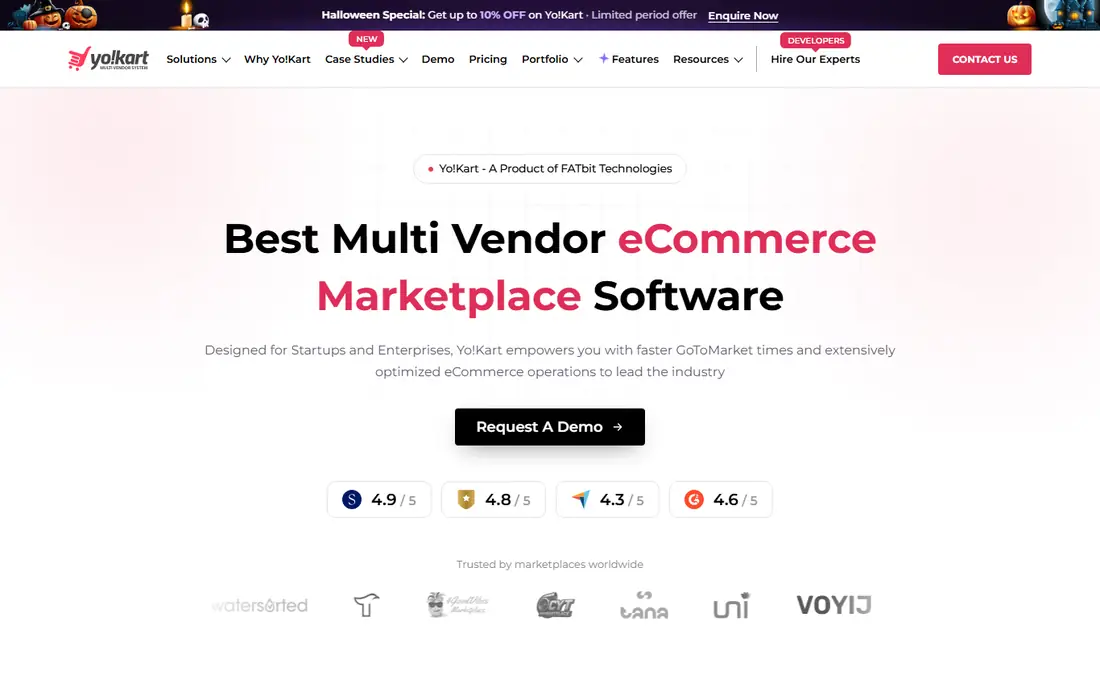
Yo!Kart is a ready-made, self-hosted marketplace package that includes a website plus vendor and admin mobile apps. It covers product and service marketplaces, with vendor storefronts, commissions, payouts, shipping, taxes and promotions built in, so buyers get a complete system rather than a set of plugins to assemble.
The one-time licence model appeals to owners who want to avoid monthly subscriptions, and the included mobile apps are a real advantage, since many marketplace platforms charge extra for apps or need separate development. Customisation is available through the vendor's services.
Licence and customisation costs can be significant, and the community is smaller than WordPress or Magento's, so finding independent developers takes more effort. But for a business that wants a complete, ready-to-launch marketplace with apps included, Yo!Kart is a practical package.
What we like- Complete marketplace package with apps
- One-time licence
- Vendor and admin mobile apps
Watch out for- Licence and customisation costs
- Smaller community than open platforms
How we chose
We compared platforms on vendor management, commission and payout handling, customisation, scalability, pricing transparency and ease of launch. Prices were checked against vendor sites, and where pricing is custom or licence-based we say so. We also read public user reviews to confirm which platforms launch smoothly and which ones create headaches around payments and vendor onboarding.
Testing the flows that matter
Before committing, test the three flows that make or break a marketplace. First, vendor onboarding: can a seller sign up, list a product and get approved without your help? Second, payment splitting: does the platform correctly split a sale between you, the vendor and any tax or shipping? Third, dispute handling: what happens when an order goes wrong? A platform that fails any of these will cost you more in support than it saves in subscription fees.
Plan for trust and quality
Marketplaces live or die on trust. Require vendor verification, use reviews and ratings, set clear return and refund policies, and monitor product quality, especially in the early months. A small number of good vendors beats a large number of poor ones, so curate carefully at launch and grow deliberately.
Frequently asked questions
What is the best multi-vendor marketplace platform for beginners?
Sharetribe is the best starting point for beginners, thanks to its built-in vendor, payment and commission features and no-code builder. Arcadier is another good no-code option, while WooCommerce with Dokan suits WordPress users on a budget.
How do marketplace platforms handle payments to vendors?
Most platforms split each sale between the marketplace operator and the vendor, using payment gateways like Stripe Connect or PayPal. Commissions, payout schedules and tax handling vary, so test the payout flow before launch.
Can I build a marketplace on Shopify?
Yes, using marketplace apps that add vendor dashboards, commissions and payouts to a Shopify store. It works well for stores adding third-party sellers, though dedicated platforms like Sharetribe offer deeper vendor features.
How much does it cost to build a marketplace?
It ranges from free, using WooCommerce with Dokan's core plugin plus hosting, to monthly subscriptions for Sharetribe or Arcadier, to one-time licences for CS-Cart or Yo!Kart, to enterprise pricing for Magento or Mirakl. Budget for payment fees and ongoing maintenance on top of the platform cost.
Do I need developers to launch a marketplace?
Not for no-code platforms like Sharetribe or Arcadier, which a non-technical founder can launch. Self-hosted platforms like CS-Cart, Magento and WooCommerce benefit from developer help, especially for customisation and scaling.
How do marketplaces make money?
Mostly through commissions on each sale, plus vendor subscription fees, listing fees, featured placement and advertising. The right mix depends on your niche: high-volume product marketplaces favour commissions, while service marketplaces often use subscriptions.
Sources we checked (8)
- https://www.sharetribe.com
- https://www.cs-cart.com/multi-vendor.html
- https://dokan.co
- https://www.shopify.com
- https://business.adobe.com/products/magento.html
- https://www.mirakl.com
- https://www.arcadier.com
- https://www.yo-kart.com
Is your product missing or out of date?
We review this list regularly. Vendors can request a listing, send updated pricing or ask about featured placement.

Shihab Mia · Founder, Rankite
Shihab has 5+ years in B2B and SaaS SEO. He writes Rankite's software buying guides from pricing pages, documentation and public user reviews. More about Shihab.
 Sharetribe
 CS-Cart Multi-Vendor
 Shopify with marketplace apps
 Magento
 Mirakl
 Yo!Kart