How we make this list: we compare pricing pages, product documentation and public user reviews. Rankite is independent; if a vendor ever pays for a featured spot, that listing is clearly labeled Partner.
Key takeaways
- Storefront-first picks: Shopify at $39 per month and BigCommerce at $39 per month (Core), both with free trials (3 days and 15 days respectively) and native marketplace integrations.
- Cheapest listing tools: LitCommerce from $29 per month with unlimited order sync and a 7-day trial, and Sellbrite at $49 per month with a 30-day trial; both keep listings, inventory and prices aligned across channels.
- The budget entry is Ecwid Starter at $5 per month for up to 10 products, though it shows no free tier on its current pricing page.
- Quote-based enterprise tools: ChannelEngine publishes no prices and sells through demos, while Linnworks prices custom by order volume and channel count.
- Nembol is the flat-rate option at $39 per month with a 14-day free trial, the only tool on this list whose bill does not rise with order volume.
Quick comparison
| Tool | Best for | Starting price | Free plan |
|---|
 Shopify Shopify | Beginners who want one store with built-in marketplace selling | $39/month (Basic) | Free trial (3 days) |
 BigCommerce BigCommerce | Growing stores that need B2B features and multiple storefronts | $39/month (Core) | Free trial (15 days) |
 Sellbrite Sellbrite | Small retailers who want listings and inventory synced from one dashboard | $49/month (Pro 100) | Free trial (30 days) |
 ChannelEngine ChannelEngine | Mid-market brands expanding across dozens of marketplaces | See website | See website |
 LitCommerce LitCommerce | Budget sellers adding TikTok Shop, Etsy and eBay to an existing store | $29/month (from, 1,000 listings on 3 channels) | Free trial (7 days) |
 Nembol Nembol | Small sellers who want flat monthly pricing for multichannel listings | $39/month | 14-day free trial (no credit card required) |
 Linnworks Linnworks | High-volume sellers needing warehouse-grade automation | See website | See website |
 Ecwid Ecwid | Adding ecommerce to an existing website | $5/month (Starter, up to 10 products) | No |
Is your product missing or out of date?
We review this list regularly. Vendors can request a listing, send updated pricing or ask about featured placement.
Every channel you add multiplies your workload. New listings to write, prices to keep in step, orders to route, and one more place where a product can sell out without the other channels noticing. A multi channel selling platform puts all of that in one dashboard, and the difference between the right one and the wrong one is measured in oversells avoided and hours saved each week.
There are two kinds of tools in this category, and they solve different problems. Shopify, BigCommerce and Ecwid are storefronts first: they give you an online store and bolt on marketplace connections. Sellbrite, ChannelEngine, LitCommerce, Nembol and Linnworks are operations hubs: they assume you already sell somewhere and keep every channel synchronized. Pick the category before you pick the tool.
#1
Shopify
Best for: Beginners who want one store with built-in marketplace selling
Visit shopify.com
Starting price$39/month (Basic)
Free planFree trial (3 days)

Shopify is the default answer for a reason. The Basic plan at $39 per month includes an online store, unlimited products, email marketing, discount codes and the marketplaces section, and the free trial lets you build before you pay. For a seller whose home base is a branded store with Amazon and eBay as extra channels, Shopify plus one marketplace app is the simplest working setup in this list.
The catch is the fee stack. The 2.9% plus 30 cent online card rate is standard, but the 2% third-party gateway fee on Basic punishes anyone not using Shopify Payments, and marketplace syncing gets metered above 50 orders. Shopify is the best storefront here, but it is not the cheapest way to synchronize five marketplaces, which is exactly what the operations hubs below exist for.
What we like- Marketplaces section imports unlimited orders, with 50 synced marketplace orders per month free
- Sell on social channels and marketplaces straight from the plan
- The checkout converts better than most rivals
Watch out for- Marketplace orders beyond the free 50 cost 1% up to $99 per month
- Using a third-party payment gateway adds a 2% fee on Basic
#2
BigCommerce
Best for: Growing stores that need B2B features and multiple storefronts
Visit bigcommerce.com
Starting price$39/month (Core)
Free planFree trial (15 days)
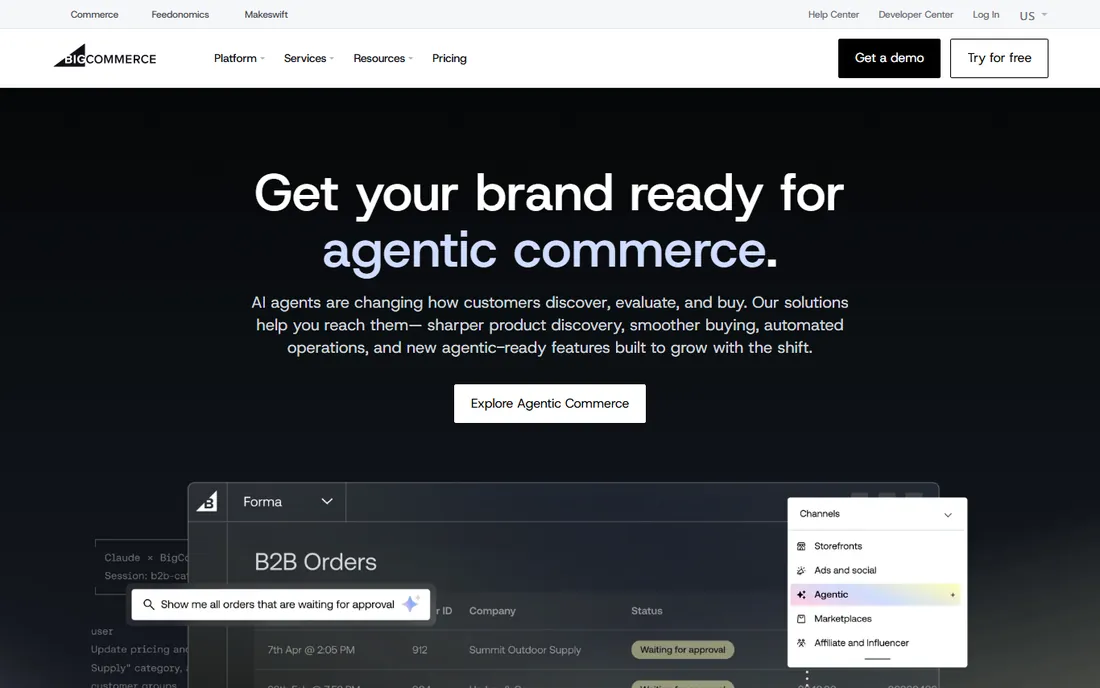
BigCommerce is the strongest storefront for sellers who outgrow Shopify's structure. Core at $39 per month includes unlimited products, unlimited bandwidth and staff accounts, plus native marketplace integrations for eBay and Amazon, and the 15-day trial is the most generous storefront trial here. The 2026 plan restructure added smooth overage pricing instead of hard tier jumps, so growth raises the bill gradually rather than in shocks.
The honest catch is the thresholds. Sell past $30,000 in trailing twelve-month GMV and you are moved to Growth at $105; past $100,000 and it is Scale at $399. That is fair pricing for volume, but a store with one viral quarter can land on a plan it did not budget for. Check your trailing sales before you commit, and confirm which payment providers avoid the Open Provider fee.
What we like- Fully functional 15-day free trial with no credit card required
- Native multi-storefront support and strong B2B tools without apps
- No transaction fees on orders through embedded payment providers
Watch out for- Plans auto-upgrade on trailing sales thresholds (Core caps around $30,000), which can surprise fast growers
- A new Open Provider fee applies to orders through gateways outside the approved list
#3
Sellbrite
Best for: Small retailers who want listings and inventory synced from one dashboard
Visit sellbrite.com
Starting price$49/month (Pro 100)
Free planFree trial (30 days)

Sellbrite is the classic marketplace sync tool, and its model is refreshingly simple: connect your channels, list once, and let inventory and orders flow through one dashboard. The Pro 100 plan at $49 per month covers up to 100 orders monthly, and the 30-day trial with full access is the longest here. For a small retailer on Amazon, eBay and Walmart who also runs a Shopify store, it removes the daily spreadsheet work of keeping stock aligned.
The catch is the order-volume ladder. Pro 500 costs $149, Pro 2K costs $249 and Pro 10K costs $399, so a growing seller's bill climbs with success. That is a fair model, but budget for the tier you will be in at year end, not the one you start in. Sellbrite also shines at listing and inventory rather than deep warehouse operations, so multi-warehouse sellers should look at Linnworks.
What we like- 30-day free trial with full access
- Plans scale by order volume so you only pay for what you sell
- Backed by GoDaddy with solid marketplace coverage
Watch out for- The vendor's own pricing page renders poorly, so plan details need confirmation with sales
- Higher order volumes push you into the $149 to $399 tiers quickly
Starting priceSee website
Free planSee website
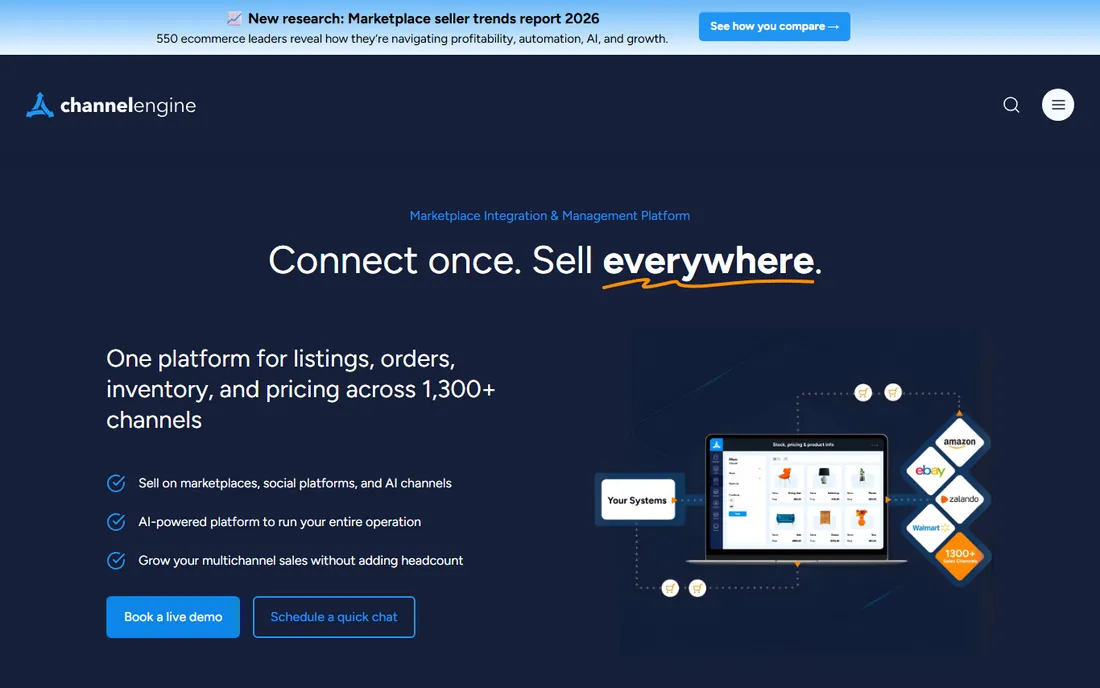
ChannelEngine is the enterprise-grade answer to multichannel selling. Where the tools above handle a handful of channels, ChannelEngine is built for brands selling across dozens of marketplaces in multiple countries, with dynamic pricing rules, margin guardrails and direct marketplace relationships that speed up approvals. It is an Amazon Platinum Partner and a bol.com Gold Integrator, credentials that matter when marketplace access is the bottleneck.
The catch is accessibility. There is no published pricing and no trial; everything runs through a demo and a quote. That is normal at this tier, but it means you cannot price-compare ChannelEngine against LitCommerce or Sellbrite without a sales process. If you are a growing brand with real channel complexity, it belongs on your shortlist; if you sell on two marketplaces, it is overkill.
What we like- More than 1,300 marketplaces and sales channels supported
- Pricing automation with margin guardrails protects profit across channels
- Official partner status with Amazon, bol.com and Zalando
Watch out for- No public pricing and no self-serve trial, so evaluation starts with a sales call
- Built for established brands, not side hustles
#5
LitCommerce
Best for: Budget sellers adding TikTok Shop, Etsy and eBay to an existing store
Visit litcommerce.com
Starting price$29/month (from, 1,000 listings on 3 channels)
Free planFree trial (7 days)
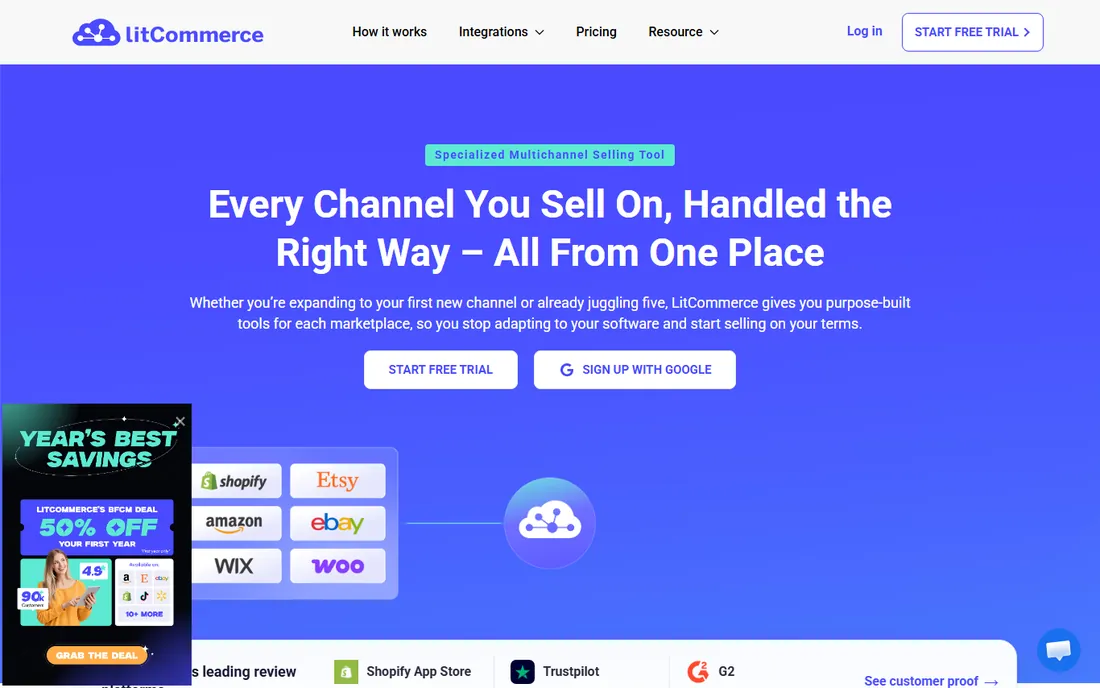
LitCommerce is the value pick for sellers whose main store already exists on Shopify, WooCommerce or Etsy and who want to add marketplaces without a big bill. From $29 per month you get 1,000 listings across 3 channels with unlimited order sync, listing templates, bulk editing and sales reports. The 7-day free trial opens up every feature, and it is an official TikTok Shop service partner, which matters as social commerce keeps growing.
The catch is counting listings honestly. One product with five variants listed on three channels can count as fifteen listings, so 1,000 listings runs out faster than it sounds for variant-heavy catalogs. The 15-minute sync is also near-time rather than real-time, so within one window two channels can each sell the last unit. Set an inventory buffer rule and LitCommerce is the cheapest credible way to sell on many channels.
What we like- Unlimited order sync on every paid plan, which rivals charge more for
- 15-minute inventory, price and order sync across channels
- AI-powered listing optimization for Etsy and eBay
Watch out for- Listing counts include every channel's listings, so product variants multiply fast and bump you a tier
- 15-minute sync windows mean you should set low-stock buffers on fast movers
#6
Nembol
Best for: Small sellers who want flat monthly pricing for multichannel listings
Visit nembol.com
Starting price$39/month
Free plan14-day free trial (no credit card required)
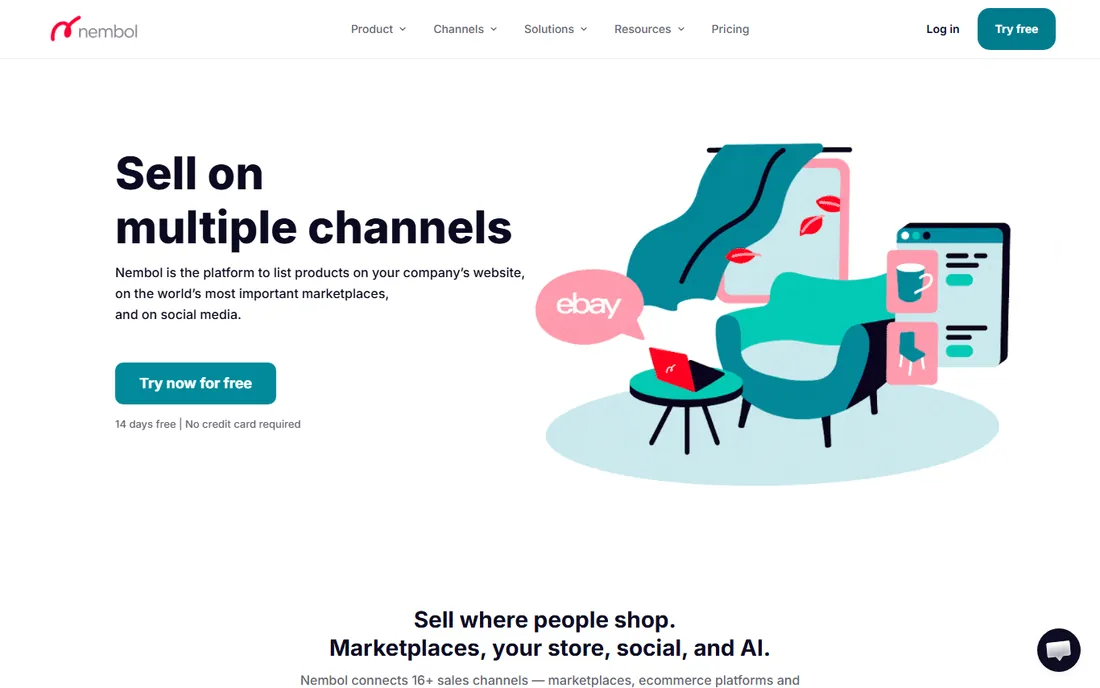
Nembol is the flat-rate listing tool on this list. Where Sellbrite climbs tiers with your order volume, Nembol charges one $39 monthly price, so a seller doing 50 orders and a seller doing 500 pay the same. The workflow centers on a single product catalog that publishes listings to your connected marketplaces and stores, keeping titles, prices and stock aligned from one place instead of editing each channel separately.
The trade is depth for simplicity. Nembol does not try to be a warehouse system or a full operations hub, so sellers with multiple warehouses or complex order routing should look at Linnworks instead. The 14-day free trial requires no credit card, which makes it the easiest evaluation on this list alongside LitCommerce: connect your channels, push a batch of listings, and see whether the catalog workflow fits your catalog size before paying anything.
What we like- Flat $39 per month that does not rise with order volume
- Publishes products to multiple marketplaces and stores from one catalog
- Free trial with no credit card opens every feature
Watch out for- Single-plan pricing offers fewer tiers to grow into than volume-priced rivals
- Smaller integration ecosystem than the enterprise operations hubs
- Confirm your channels are covered during the trial
#7
Linnworks
Best for: High-volume sellers needing warehouse-grade automation
Visit linnworks.com
Starting priceSee website
Free planSee website
Linnworks is the operations heavyweight. It connects inventory, orders, warehouses, listings and shipping carriers across 100-plus channels, with automation that routes every order to the right warehouse or 3PL and prints labels without human touches. The rules engine handles the repetitive work, and the SkuVault acquisition gives it genuine warehouse management depth that the listing tools cannot match.
The catch is that everything is enterprise-shaped. Pricing is quoted by order volume and features, there is no free trial, onboarding runs 30 to 40 days, and reviewers report annual contracts with renewal increases. For a seller doing thousands of orders a month across warehouses, the automation pays for itself many times over. For everyone else, it is the most expensive and slowest way to start.
What we like- More than 100 native channel integrations plus a partner network
- Rules engine automates order routing, carrier selection and repricing
- Owns SkuVault for real warehouse management
Watch out for- Custom quote-based pricing with no self-serve trial
- Implementation takes weeks and annual contracts are the norm
Starting price$5/month (Starter, up to 10 products)
Free planNo
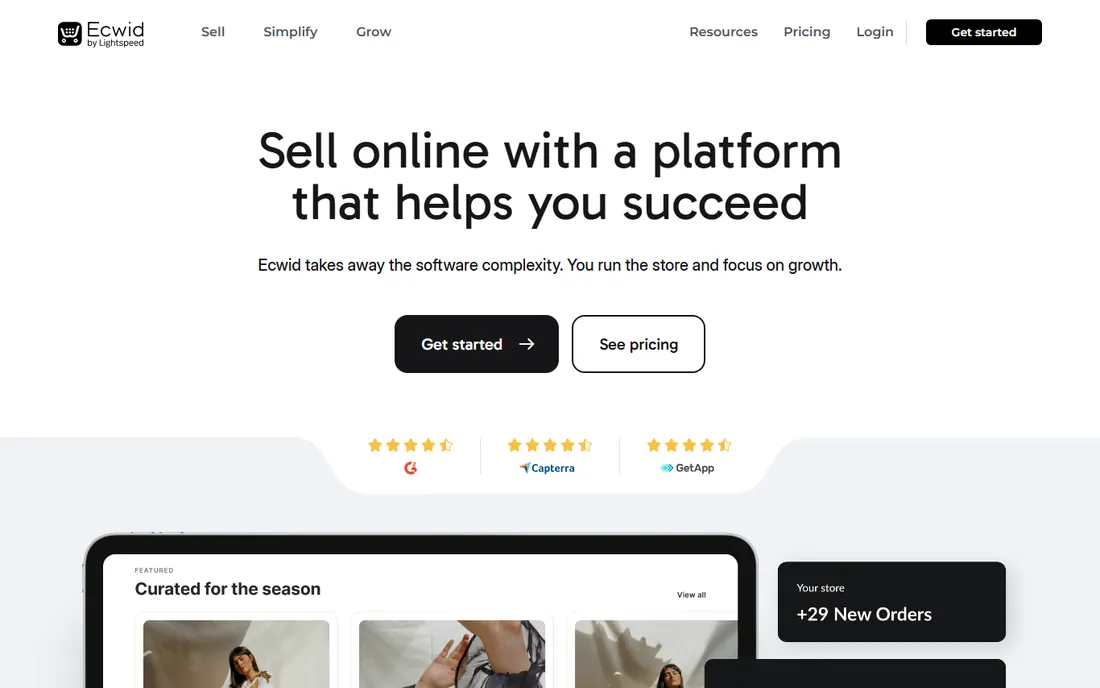
Ecwid is the odd one out, and that is its strength. Instead of making you build a new store, it drops a store into the website you already have, or gives you a simple Instant Site if you have none. Starter at $5 per month covers up to 10 products, and every plan includes unlimited bandwidth, mobile-responsive checkout and zero Ecwid transaction fees.
The catch for multichannel sellers is the plan ladder. Marketplace selling arrives on the Business plan at $65 per month, and it runs through third-party apps that can carry their own fees. Ecwid is brilliant for turning an existing site into a store cheaply; it is a mediocre pure marketplace-sync tool compared with LitCommerce or Sellbrite at similar money. Choose it for the website problem, not the channel problem.
What we like- Embeds into any website, WordPress, Wix, Squarespace or social pages, with a free Instant Site
- No transaction fees on any plan
- Marketplace selling arrives on the Business plan
Watch out for- The current pricing page shows no free tier, and Starter caps at 10 products
- Selling on Amazon and eBay needs the Business plan at $65 per month plus third-party apps
How we chose
We shortlisted candidates from the keywords buyers use: multi channel selling platform, multichannel ecommerce software and sell on multiple marketplaces. For each one we opened the vendor's own website, checked the pricing page for published plans, and weighed channel coverage, sync frequency, order and listing limits, fee structures and company-size fit against public reviews on G2, Capterra and TrustRadius and seller discussion on Reddit. Where a vendor publishes no pricing we wrote "See website" instead of repeating third-party guesses. We did not claim hands-on testing of any platform.
Sync speed and fee structures decide the winner
Two details matter more than the subscription price. The first is sync frequency. LitCommerce syncs inventory, prices and orders every 15 minutes; Linnworks updates across channels every few minutes; Shopify's marketplace syncing is metered above 50 orders. No batch-sync tool is truly real-time, so on fast-moving products set a low-stock buffer rule that marks items out of stock at quantity one or two. The cheapest plan with the wrong sync settings will cost you more in oversells and cancelled orders than the pricier plan.
The second is how fees scale with success. Sellbrite charges by order volume, so your bill rises as you sell more. Nembol is the flat-rate exception at $39 per month. BigCommerce auto-upgrades on trailing sales thresholds. Shopify meters marketplace orders above the free fifty and adds gateway fees. ChannelEngine and Linnworks quote custom, which means your renewal is a negotiation. Model the bill at your projected year-end volume, not your starting volume, and ask every vendor what triggers the next tier before you sign.
Storefronts vs operations hubs: which one are you?
If your main asset is a branded store and marketplaces are extra reach, start with a storefront: Shopify or BigCommerce, plus LitCommerce or Sellbrite to push listings out. The store is the system of record and the marketplaces feed into it. This fits most small brands.
If your main asset is the product catalog and you sell the same SKUs on Amazon, eBay, Walmart, Etsy and your own site, start with an operations hub: Sellbrite or LitCommerce at the low end, Linnworks when warehouses enter the picture. The catalog is the system of record and every channel mirrors it. This fits resellers, distributors and private-label sellers with heavy marketplace volume. Mixing the two models, two systems of record, is how oversells happen.
Frequently asked questions
What is the best multi channel selling platform for beginners?
Shopify at $39 per month is the easiest complete start: store, checkout, marketplace connections and a 3-day trial. If you already have a website, Ecwid Starter at $5 per month adds selling to it with minimal fuss. If you already sell on marketplaces and just need them synchronized, LitCommerce at $29 per month is the cheapest operations-first start.
Which platform is cheapest for selling on Amazon and eBay?
LitCommerce at $29 per month covers both with unlimited order sync and a 7-day trial, though listing limits count every channel's listings. Sellbrite at $49 per month is the next step up with a 30-day trial and order-volume pricing. Both beat building separate workflows per marketplace.
Do these tools sync inventory in real time?
None of them are truly instant. Linnworks updates across channels every few minutes, which is the fastest here, while LitCommerce runs on 15-minute cycles. The standard fix is an inventory buffer rule: mark products out of stock on channels when the count hits one or two, so a sync lag cannot produce two sales of the last unit.
Which tools charge extra as I sell more?
Sellbrite prices by monthly order volume ($49 to $399), BigCommerce auto-upgrades on trailing twelve-month sales, Shopify meters marketplace orders above 50 per month, and ChannelEngine and Linnworks quote custom pricing that scales with your operation. Always ask what triggers the next tier before you sign.
Can I keep my Shopify store and add marketplaces?
Yes, and it is the most common setup in this category. LitCommerce, Sellbrite and ChannelEngine all connect to Shopify as the main store and push listings to Amazon, eBay, Etsy, Walmart and TikTok Shop. Shopify's own marketplaces section also imports marketplace orders directly. Keep Shopify as the system of record so stock counts have one source of truth.
Which tool has the simplest pricing?
Nembol at a flat $39 per month with a 14-day free trial and no credit card. LitCommerce is the next simplest at $29 per month with a 7-day trial, though listing limits count every channel's listings. Everyone else prices by order volume, sales thresholds, or custom quotes, so model your year-end bill before signing.
Sources we checked (9)
- https://www.shopify.com/pricing
- https://www.bigcommerce.com/pricing/
- https://www.sellbrite.com/pricing
- https://www.channelengine.com/
- https://litcommerce.com/pricing/
- https://www.nembol.com
- https://linnworks.com
- https://www.ecwid.com/pricing
- https://www.g2.com/products/sellbrite/pricing
Is your product missing or out of date?
We review this list regularly. Vendors can request a listing, send updated pricing or ask about featured placement.

Shihab Mia · Founder, Rankite
Shihab has spent more than a decade helping SaaS and e-commerce brands grow through search. He writes Rankite's software buying guides from pricing pages, documentation and public user reviews. More about Shihab.