How we make this list: we compare pricing pages, product documentation and public user reviews. Rankite is independent; if a vendor ever pays for a featured spot, that listing is clearly labeled Partner.
Key takeaways
- Sellbrite is the cheapest way in: a free plan for up to 30 orders a month and paid plans from $19 a month, backed by GoDaddy.
- Listing Mirror starts at $149 a month but includes every feature on every plan, with strong Amazon-to-Walmart cross-listing and Amazon MCF order routing.
- Rithum suits brands and enterprises with its 600+ marketplace network, but pricing is quote-only and out of reach for most small sellers.
- Koongo offers a real free plan and paid tiers from 24 EUR a month, making it the lowest-risk way to test 500+ channels.
- Linnworks and Kyozou center on automation and all-in-one operations rather than pure listing, so check whether you need an order management suite or just a listing tool.
- Ecomdash is mid-transition into the Network Solutions brand, so confirm its current plans directly before committing.
Quick comparison
| Tool | Best for | Starting price | Free plan |
|---|
 Sellbrite Sellbrite | Shopify sellers starting multichannel | $19/month (Pro 100, billed annually) | Yes (free plan up to 30 orders/month; 14-day free trial) |
 Listing Mirror Listing Mirror | Amazon-first sellers expanding to Walmart and eBay | $149/month ($124/month billed annually) | Free trial |
 Rithum Rithum | Brands and enterprises scaling across marketplaces | See website (custom quote) | No |
 Linnworks Linnworks | Growing SMBs needing order automation | See website (quote-based, priced on order volume) | No |
 Kyozou Kyozou | eBay and Amazon veterans wanting an all-in-one suite | $199.99/month (based on a percentage of sales) | No |
 Koongo Koongo | Small stores testing 500+ channels cheaply | 24 EUR/month (paid plans) | Yes (no credit card required) |
 Ecomdash Ecomdash | Small retailers wanting order-volume pricing | See website | See website |
Is your product missing or out of date?
We review this list regularly. Vendors can request a listing, send updated pricing or ask about featured placement.
The best multi channel listing software
Starting price$19/month (Pro 100, billed annually)
Free planYes (free plan up to 30 orders/month; 14-day free trial)

GoDaddy-owned Sellbrite keeps the entry bar low. You can list products in bulk across Amazon, eBay, Walmart, Etsy, and your own store from one catalog, and inventory adjusts automatically when orders come in so you stop overselling. The shipping side prints discounted labels in the same interface, which matters when you are packing orders from five channels in one afternoon.
The honest catch is the order-based pricing. Pro 100 covers up to 100 orders a month, and a growing seller will outgrow it quickly; each tier jump multiplies the cost. Amazon FBA orders never import into Sellbrite, so heavy FBA sellers should look elsewhere. For a Shopify store taking its first steps onto marketplaces, though, the free plan and the $19 tier are hard to argue with.
What we like- Free plan with no credit card required
- Listing templates that save time
- Discounted shipping labels from one dashboard
Watch out for- Amazon FBA orders are never imported
- Shopify orders are excluded from the order count
- Costs rise fast as order volume grows
Starting price$149/month ($124/month billed annually)
Free planFree trial
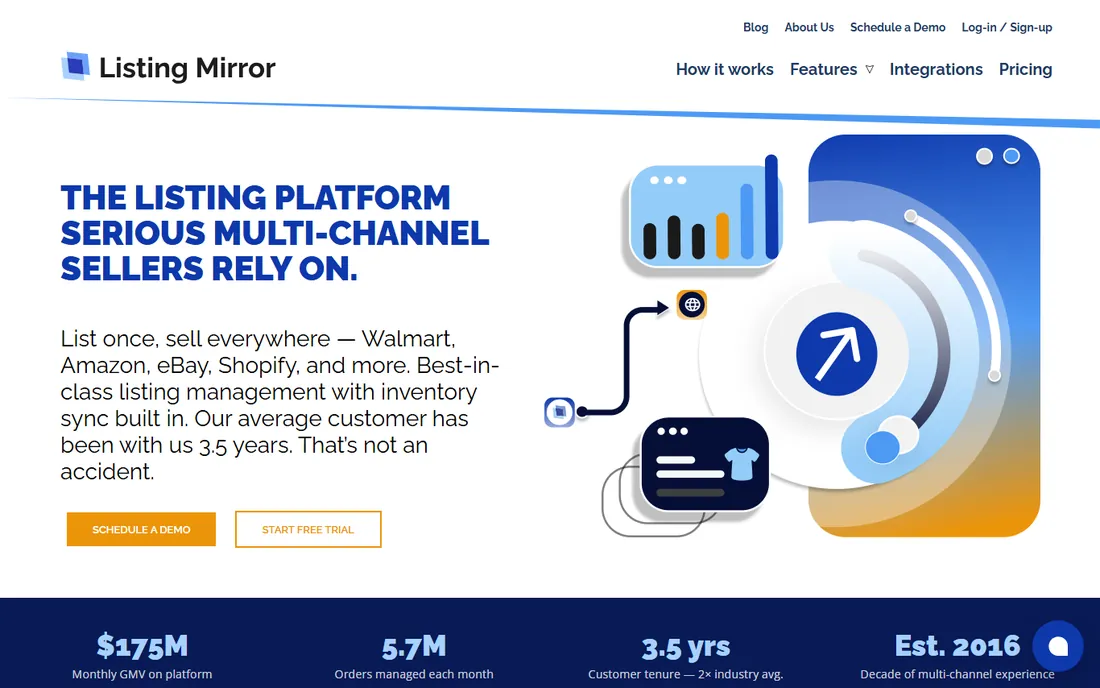
Every plan carries the same full feature set, which is rare in this category. You pick by capacity (SKUs, channels, billable orders) rather than by which features you get. Cross-listing pulls titles, descriptions, images, and pricing from your primary marketplace in a few clicks, and bulk tools handle large catalogs with filters and tags. Per-channel pricing rules let you mark up Walmart by 10 percent over Amazon automatically.
Where it pulls ahead is fulfillment. If you hold stock at Amazon FBA, Listing Mirror can send Walmart, eBay, and Shopify orders to Amazon Multi-Channel Fulfillment with tracking returned automatically. The catch is the $149 monthly starting price, which is steep if you sell a few hundred orders a month. Volume-tiered tools cost less at the low end. But for Amazon-centric sellers pushing into Walmart, the MCF routing alone can justify the bill.
What we like- Every plan includes every feature
- Per-channel pricing rules and markups
- Routes non-Amazon orders to Amazon MCF for fulfillment
Watch out for- Entry price is high compared with volume-tiered rivals
- Fewer channels than enterprise networks
- SKU and channel caps per plan
#3
Rithum
Best for: Brands and enterprises scaling across marketplaces
Visit rithum.com
Starting priceSee website (custom quote)
Free planNo

Rithum came out of the CommerceHub and ChannelAdvisor combination, and it shows in the scope. Brands manage product content, pricing, and performance from one place across 600+ marketplaces, and retailers can run their own third-party marketplaces or dropship programs on the same platform. The built-in retail media tools connect ad spend to SKU-level ROI, which most listing tools do not attempt.
This is not small-business software, and the pricing reflects that. Expect a custom quote and an enterprise sales process. If you sell a few thousand SKUs across two or three channels, the depth here becomes overhead rather than an advantage. Rithum earns its place for brands and retailers that treat marketplaces as a serious revenue channel and need the compliance, media, and fulfillment tooling to match.
What we like- 600+ marketplaces in the network
- Retail media advertising built into the platform
- AI engine for growth and margin insights
Watch out for- Quote-only enterprise pricing
- More complexity than a small catalog needs
- Self-serve onboarding is not the model
Starting priceSee website (quote-based, priced on order volume)
Free planNo
Linnworks positions itself as the operations platform rather than just a listing tool. Every sale on Amazon, eBay, Shopify, Walmart, or any of 100+ channels updates stock instantly, and automation handles carrier selection, label printing, and order routing without someone making the decision each time. The company claims customers save an average of 52 hours a month on manual work.
The trade-off is commitment. Pricing is quoted on order volume, onboarding runs 30 to 40 days, and there is no free plan to try first. That is a reasonable ask for a business doing serious multichannel volume, and a heavy one for a seller with 200 orders a month. Choose Linnworks when manual order handling is the bottleneck, not just listing creation.
What we like- 100+ channel integrations
- Rules-based order routing, carrier selection, and label printing
- Real-time inventory accuracy across every channel
Watch out for- Quote-based pricing only
- Setup typically takes 30 to 40 days
- No free plan for testing
#5
Kyozou
Best for: eBay and Amazon veterans wanting an all-in-one suite
Visit kyozou.com
Starting price$199.99/month (based on a percentage of sales)
Free planNo

Kyozou has been at this since 2003, and the product shows both the maturity and the age. It is a complete eBay, Amazon, Newegg, Walmart, and Reverb operation in one account: multichannel listing, multi-warehouse inventory with barcode scanning, order processing, and discounted shipping through UPS, FedEx, USPS, and Canada Post. The included Kyozou Webstore even lets you spin up your own storefront synced from your eBay listings.
The pricing starts at $199.99 a month and scales with a percentage of sales, so your software bill rises with your revenue even if your costs do not. The channel list is solid for North America but thinner than platforms with 500+ integrations. Kyozou fits sellers who want one system for everything and value stability over a modern interface.
What we like- Full suite covering webstore, warehouse, orders, and shipping
- Operating since 2003 with deep marketplace roots
- No contracts and no hidden fees
Watch out for- Channel set centers on North American marketplaces
- Interface feels dated next to newer tools
- Sales-percentage pricing grows with you
Starting price24 EUR/month (paid plans)
Free planYes (no credit card required)
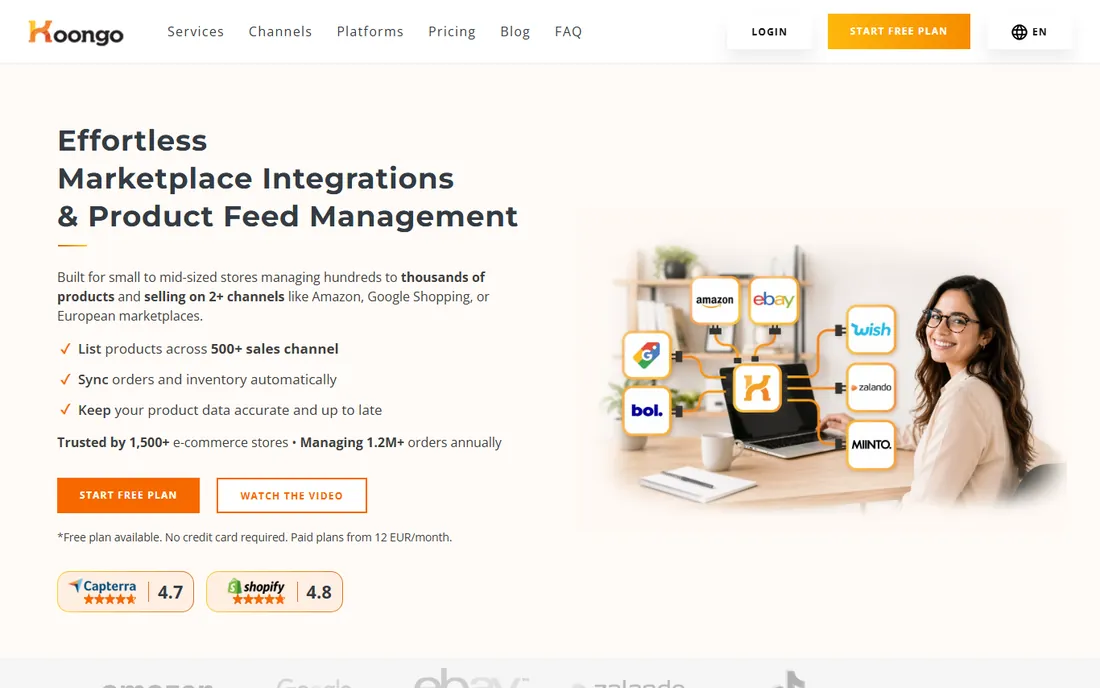
Koongo takes a feed-management approach to multichannel selling. You connect your store, pick from 500+ sales channels, map your product data once, and Koongo keeps listings, prices, and stock in sync every 5, 15, or 60 minutes depending on plan. The guided wizards walk you through marketplace setup without code, and channel-specific pricing rules let you cover marketplace fees automatically.
The standout is the pricing structure: a free plan with no credit card required, then paid plans from 24 EUR a month. That makes it the cheapest way to experiment across European marketplaces like Zalando, bol.com, and Kaufland alongside Amazon and eBay. The honest catch is that Koongo is stronger on feeds and listings than on deep order management. If you need warehouse-level operations, pair it with an order tool or pick a heavier suite.
What we like- Genuine free plan to start
- 500+ channels across 40+ countries
- Guided marketplace wizards with no coding needed
Watch out for- Feed-focused, with less order depth than full order management suites
- Pricing in euros adds conversion friction for US sellers
- Sync frequency depends on plan
Starting priceSee website
Free planSee website
Ecomdash built its name on simple, volume-based pricing for small and online retailers: you pay for your monthly order volume, not per user or per channel, with unlimited employees on the account. It covers the full back end, with multi-warehouse inventory, purchase orders, dropship management, and shipping through carriers like FedEx, UPS, and DHL Express.
The complication is the rebrand. The homepage now notes that Ecomdash is becoming Network Solutions, and plan details are difficult to confirm while the transition plays out. If the order-volume pricing model appeals to you, contact them directly and get current terms in writing before you migrate your catalog. Treat this one as a contender to verify, not a default pick.
What we like- Unlimited sales channels and unlimited users on plans
- Multi-warehouse inventory with purchase orders
- Shipping management with major carriers
Watch out for- Company is transitioning into the Network Solutions brand
- Current pricing is hard to confirm during the change
- Listing templates are lighter than specialists
How we chose
We reviewed vendor pricing pages, product documentation, and public customer reviews on G2, Capterra, and TrustRadius, plus marketplace and seller community discussions on Reddit. We favored tools that clearly support listing products across multiple sales channels, checked that each vendor's homepage was live and reachable, and weighed channel coverage, inventory sync quality, order management depth, and fit for small to mid-size US sellers. No hands-on testing was claimed or performed; all pricing reflects what vendors publish on their own sites.
What to check before you buy
Multichannel tools look similar in demos and differ sharply in practice. These are the checks that matter.
Channel coverage that matches your roadmap
Count the channels you sell on today, then add the two you plan to open next year. A tool with 15 integrations is fine if those 15 include your roadmap; a tool with 500 is marketing if 480 are European marketplaces you will never touch. Ask specifically about Walmart, TikTok Shop, and any regional channel you care about.
How inventory sync actually works
"Real-time sync" means different things. Some tools update stock every few minutes, others every hour, and the difference decides whether you oversell during a promotion. Ask for the actual sync interval on the plan you would buy, not the headline claim.
Pricing model vs. your order volume
Order-based pricing punishes growth: every tier jump multiplies your bill right when you are busiest. Quote-based platforms hide the cost until a sales call. Map your current monthly orders to the pricing grid and project one year of growth before you sign.
Who owns the product data
Some tools require the master catalog to live inside their platform; others sync from your existing store. If you ever want to leave, the first kind makes migration painful. Prefer tools that treat your Shopify, WooCommerce, or BigCommerce store as the source of truth.
Listing software vs. order management: where the line sits
Pure listing tools push your products onto marketplaces and keep prices and stock aligned. Order management suites go further: they route orders to warehouses, pick carriers, print labels, and handle returns. Many products in this list blur the line, and that is where buyers get confused.
If your pain is "I need my products on six marketplaces without retyping everything," a listing-first tool like Sellbrite, Listing Mirror, or Koongo is enough. If your pain is "we spend two hours a day deciding which warehouse ships what," you need the operations depth of Linnworks, Kyozou, or Rithum. Buying the heavier suite when you only need listings means paying for complexity you will not use. Buying the lighter tool when fulfillment is the bottleneck means adding a second system six months later. Name the actual bottleneck first, then match the tool to it.
Frequently asked questions
What is multichannel listing software?
It is software that lets you create and manage product listings across several marketplaces and sales channels from one place. Instead of logging into Amazon, eBay, Walmart, and your own store separately, you manage one catalog and the tool publishes and syncs it everywhere. Most tools also sync inventory so a sale on one channel updates stock on all the others.
How much does multichannel listing software cost?
Entry-level tools start around $19 a month or offer free plans with order limits. Mid-range platforms run $149 to $200 a month. Enterprise networks like Rithum use custom quotes that typically run far higher. The real cost driver is usually your order volume or SKU count, not the number of channels.
Do I need multichannel listing software if I only sell on two channels?
Probably not yet. Two channels are manageable with native marketplace tools and careful spreadsheet work. The software earns its keep at three or more channels, or when inventory mistakes start costing you money. If oversells happen monthly, it is time.
Which channels do these tools support?
Amazon, eBay, Walmart, Shopify, Etsy, and BigCommerce are the core set most tools cover. Beyond that it varies: Koongo reaches 500+ channels including European marketplaces, Rithum covers 600+, and Kyozou focuses on North American marketplaces. Always confirm your specific channels before buying.
Can listing software handle fulfillment too?
Some can. Listing Mirror routes orders to Amazon Multi-Channel Fulfillment, Linnworks and Kyozou include full order routing and shipping automation, and Sellbrite prints discounted labels. Feed-focused tools like Koongo handle orders more lightly. If fulfillment automation is the goal, prioritize order management depth over listing features.
What is the difference between Sellbrite and Listing Mirror?
Both target small to mid-size sellers, but their models differ. Sellbrite charges by monthly order volume with a free plan up to 30 orders, while Listing Mirror charges flat tiers starting at $149 a month with every feature included on all plans. Listing Mirror also offers Amazon MCF order routing, which Sellbrite does not.
Sources we checked (8)
- https://www.sellbrite.com/pricing-sfs-pro/
- https://www.listingmirror.com
- https://rithum.com/
- https://linnworks.com/
- https://www.kyozou.com
- https://koongo.com/
- https://www.ecomdash.com
- https://www.g2.com/products/sellbrite/pricing
Is your product missing or out of date?
We review this list regularly. Vendors can request a listing, send updated pricing or ask about featured placement.

Shihab Mia · Founder, Rankite
Shihab has spent more than a decade helping SaaS and e-commerce brands grow through search. He writes Rankite's software buying guides from pricing pages, documentation and public user reviews. More about Shihab.