How we make this list: we compare pricing pages, product documentation and public user reviews. Ratings come from G2, Capterra or Trustpilot, with the date we checked them.
Key takeaways
- Eventbrite is the simplest pick for public ticketed events, with free publishing for free events and built-in marketplace discovery.
- Whova is the strongest attendee app for conferences and associations, with community boards and AI networking.
- Cvent suits enterprise event programs with venue sourcing, but pricing starts around $15,000 per year and the learning curve is steep.
- Bizzabo suits brand-led corporate conferences, with polished design and HubSpot sync, at a premium price.
- Swapcard, Guidebook, RingCentral Events, and EventMobi each serve a niche: trade shows, budget-conscious organizations, virtual events, and heavy customization.
Quick comparison
| Tool | Best for | Starting price | Free plan |
|---|
 Eventbrite | Public ticketed events | Free for free events | Yes |
 Whova | Conferences and associations | From $2,000 per event | No |
 Cvent | Enterprise event programs | From $15,000 per year | No |
 Bizzabo | Brand-led corporate conferences | From $17,999 per year | No |
 Swapcard | B2B trade shows | From $610 per year | No |
 Guidebook | Budget-conscious organizations | $99 per month | Free trial |
 RingCentral Events | Virtual and hybrid events | From $119 per organizer per month | No |
 EventMobi | Highly customizable events | See website | No |
Is your product missing or out of date?
We review this list regularly. Vendors can request a listing, send updated pricing or ask about featured placement.
The best mobile event apps
Starting priceFree for free events
Free planYes
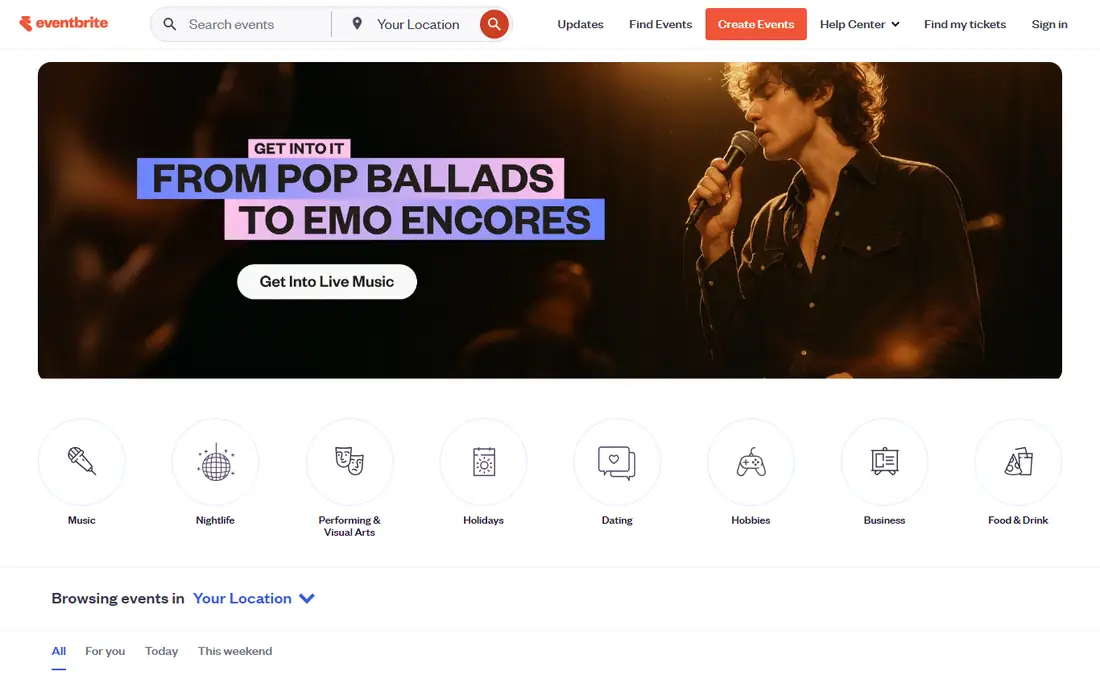
Eventbrite is the simplest mobile event app for public ticketed events. Organizers publish in minutes, sell tickets through the Eventbrite marketplace, and check attendees in with the Organizer app. Free events are free to publish, and paid events carry per-ticket fees plus payment processing, recently listed around 3.7 percent plus $1.79 per ticket plus 2.9 percent processing.
Discovery is the real advantage: millions of users browse Eventbrite for things to do, which drives ticket sales for community events, classes, and small conferences. Customization is limited, and attendee networking tools are weaker than Whova or Swapcard. For simple public events under a few hundred attendees, Eventbrite is the fastest and cheapest way to start.
What we like- Free publishing for free events
- Huge marketplace discovery
- Simple setup and check-in
Watch out for- Per-ticket fees add up on paid events
- Limited customization
- Weaker attendee networking
#2Whova
Best for: Conferences and associations4.8/5 on
G2 (1,925 reviews, checked Oct 2026)
Visit whova.com
Starting priceFrom $2,000 per event
Free planNo
Whova is the attendee-app leader for academic conferences, associations, and community-driven events. Attendees build agendas, message each other, join community boards, and get AI-powered networking suggestions, while organizers manage registration, agendas, and exhibitors from one dashboard. Engagement features such as polls, live Q and A, and photo sharing keep attendees active between sessions.
Pricing is quote-based, with recent guides listing events from around $2,000. Backend customization is more limited than EventMobi or Cvent, and attendee data exports are restricted on some plans. For engagement-focused conferences where the attendee experience matters most, Whova is the strongest app here.
What we like- Award-winning attendee app
- Community boards and AI matchmaking
- Strong engagement tools
Watch out for- Quote-based pricing
- Limited backend customization
- Restricted attendee data exports on some plans
#3Cvent
Best for: Enterprise event programs4.3/5 on
G2 (2,414 reviews, checked Oct 2026)
Visit cvent.com
Starting priceFrom $15,000 per year
Free planNo
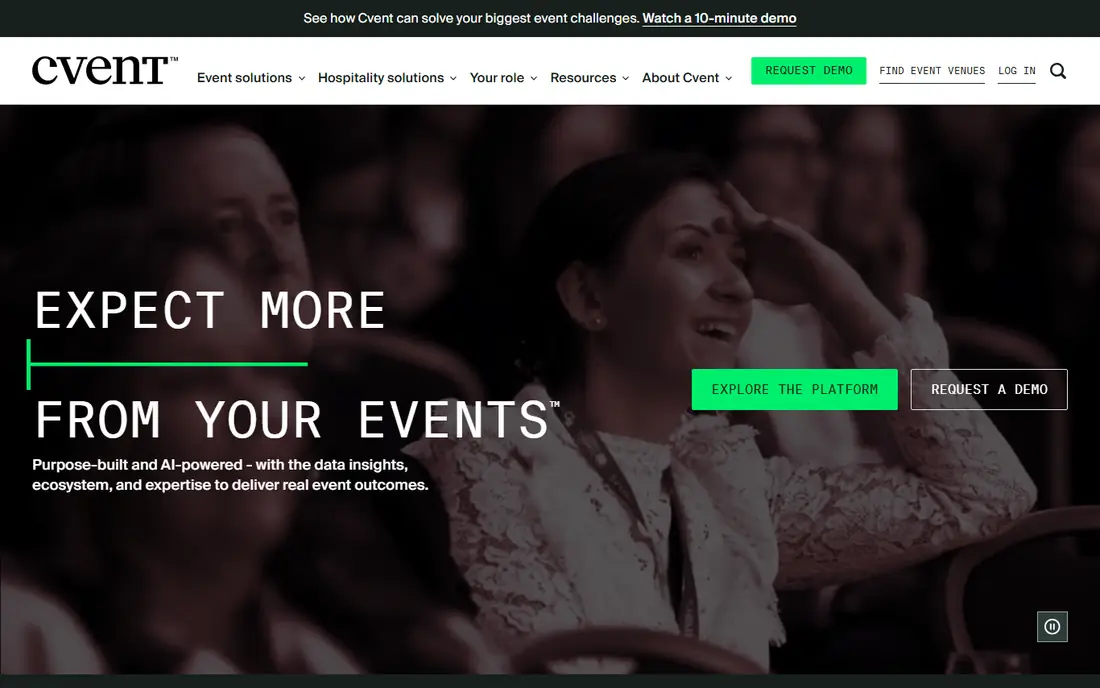
Cvent is the enterprise standard for large event programs, covering registration, venue sourcing, attendee apps, onsite check-in, and reporting in one platform. The venue marketplace helps planners source hotels and venues, and over 200 integrations connect Cvent to CRMs, marketing automation, and payment systems. Complex registration logic handles multi-track conferences and large trade shows.
Pricing starts around $15,000 per year with custom annual licensing plus per-registrant fees, and the learning curve is steep for new teams. Small events gain little from Cvent's scale. For enterprises running many large events with venue sourcing needs, Cvent remains the most complete platform available.
What we like- Enterprise scale
- Venue sourcing marketplace
- Over 200 integrations
- Deep registration logic
Watch out for- High cost
- Steep learning curve
- Custom annual licensing plus per-registrant fees
#4Bizzabo
Best for: Brand-led corporate conferences4.3/5 on
G2 (448 reviews, checked Oct 2026)
Visit bizzabo.com
Starting priceFrom $17,999 per year
Free planNo
Bizzabo targets corporate marketing teams running brand-led conferences. It offers polished branded event websites and apps, SmartBadge technology for onsite networking and lead capture, HubSpot synchronization, and analytics that tie attendance to pipeline. Studio-quality virtual production covers hybrid events.
Pricing starts around $17,999 per year, or $499 per user per month billed annually, which puts Bizzabo out of reach for small organizations. Advanced data controls are fewer than Cvent. For marketing-driven conferences where brand experience and lead capture justify premium pricing, Bizzabo is a strong choice.
What we like- Polished branded experiences
- SmartBadge onsite tech
- HubSpot sync
- Strong analytics
Watch out for- Premium pricing
- Fewer advanced data controls
- Best value only for marketing-led teams
Starting priceFrom $610 per year
Free planNo
Swapcard is built for B2B trade shows and exhibitor-led events, with AI matchmaking that connects attendees to relevant exhibitors, lead capture tools, and meeting scheduling. Self-service plans start from $610 per year, making it accessible for smaller trade shows, while enterprise tiers add branding and analytics.
The trade show focus means general conference features are less deep than Whova, and higher tiers are quote-based. App customization is moderate. For exhibitor-led events where networking and lead capture drive ROI, Swapcard offers the best matchmaking value here.
What we like- AI matchmaking and lead capture
- Exhibitor-friendly
- Self-service plans from $610 per year
Watch out for- Trade show focus limits general use
- Higher tiers are quote-based
- App customization is moderate
Starting price$99 per month
Free planFree trial
Guidebook suits universities, associations, and high-volume organizations that need a reliable attendee app without enterprise pricing. Its native offline app works where venue Wi-Fi fails, and plans support unlimited events, which suits organizations running many small events per year. Entry pricing is listed around $99 per month.
Higher tiers are quote-based, networking features are fewer than Whova, and design tools are simpler than Bizzabo. For budget-conscious organizations that value offline reliability and unlimited events over advanced networking, Guidebook is the practical pick.
What we like- Native offline app
- Unlimited events on some plans
- Low entry price for universities and associations
Watch out for- Quote-based higher tiers
- Fewer networking features than Whova
- Simpler design tools
#7RingCentral Events
Best for: Virtual and hybrid events4.5/5 on
G2 (933 reviews, checked Oct 2026)
Visit ringcentral.com
Starting priceFrom $119 per organizer per month
Free planNo
RingCentral Events, formerly Hopin, is built for virtual-first and hybrid conferences, with multi-stage virtual venues, breakout rooms, networking areas, and streaming that scales to 100,000 attendees. Paid tiers start from $119 per organizer per month on annual billing, with a free trial available.
Virtual-first design means purely in-person events gain less from the platform, and expo booths feel basic compared with Swapcard or vFairs. Costs rise with scale and ticket fees. For virtual and hybrid conferences where remote attendance is central, RingCentral Events is the strongest platform here.
What we like- Immersive virtual venues
- Breakout rooms
- Scales to 100,000 attendees
- Strong streaming
Watch out for- Virtual-first design suits in-person events less
- Expo booths feel basic
- Costs rise with scale
Starting priceSee website
Free planNo
EventMobi targets technical teams and organizations that want deep customization, with over 500 templates for agendas, maps, exhibitor listings, and branded apps. Offline support is strong, which matters for large venues with weak connectivity. Pricing is per-event or per-attendee, with recent guides listing from $1 per product per attendee, so we mark the starting price as "See website" for exact quotes.
Customization takes setup time, and marketplace reach is smaller than Eventbrite. For events with complex workflows, custom branding, or unusual agenda structures, EventMobi offers the most flexible app builder here.
What we like- Over 500 customization templates
- Strong offline support
- Per-attendee pricing options
Watch out for- Quote-based pricing
- Customization takes setup time
- Smaller marketplace reach than Eventbrite
How we chose
We compared recent 2026 event software guides that test apps on event day rather than in demos, plus vendor pricing pages. A tool made this list only if it offers a real attendee-facing mobile app with agendas, check-in, and notifications, not just registration software. Prices are starting figures from recent guides and vendor pages; enterprise tools are quote-based, so confirm through sales. Offline reliability, networking, and check-in speed weighed heavily, since those decide whether an app helps or hinders on event day.
What to check before you switch
Start with event type, not feature lists. A public ticketed concert needs Eventbrite, a trade show needs Swapcard, and a virtual conference needs RingCentral Events. Buying a general platform for a specialized event wastes money and frustrates attendees, because the workflows that matter, ticket discovery for concerts, lead capture for trade shows, streaming quality for virtual events, differ completely. Write down the three jobs your event app must do well, then score each candidate on those jobs alone before comparing extra features. Next, test the attendee app on real phones with real venue Wi-Fi conditions. Offline capability matters more than demo polish when hundreds of attendees open the app at once. Load the agenda, maps, and exhibitor lists on a test phone with Wi-Fi off, and check that check-in still works, since doors back up fast when scanning fails.
Also check total cost, not headline price. Per-ticket fees, per-registrant fees, and per-attendee charges scale with event size, while annual licences suit organizations running many events. A platform that looks cheap at 100 attendees can become the most expensive option at 5,000 attendees, so model costs at your real attendance numbers, including staff, volunteers, speakers, and exhibitors who may also need app access. Finally, confirm data exports and CRM integrations before committing, since attendee data locked inside an event app loses value after the event ends. Ask vendors how attendee lists, session attendance, and lead scans export, and whether exports carry the fields your CRM needs. Test the export with a trial event before signing an annual contract, because a clean export on the last day matters as much as a polished app on the first day, and fixing exports after the event is usually too late for follow-up campaigns, sponsor reporting, next-year planning, budget justification, renewal decisions, team debriefs, sponsor renewal talks, board reporting, attendee surveys, venue feedback, and press coverage.
Frequently asked questions
What is the best mobile event app for small events?
Eventbrite is best for small public ticketed events, with free publishing for free events and simple check-in. Guidebook suits small organizations running many events, with offline support and low entry pricing.
How much does Whova cost?
Whova is quote-based, with recent guides listing events from around $2,000. Final pricing depends on attendee count, features, and event length, so request a quote with your actual numbers.
Can event apps work offline?
Some can. Guidebook and EventMobi offer strong native offline support, while Whova and Cvent are partly web-based. Check offline capability before choosing an app for venues with weak Wi-Fi.
Which app is best for trade shows?
Swapcard is best for B2B trade shows, with AI matchmaking, exhibitor lead capture, and meeting scheduling. EventMobi suits trade shows needing heavy customization.
Does Eventbrite charge for free events?
No. Publishing and ticketing for free events is free on Eventbrite. Paid events carry per-ticket fees plus payment processing, so budget those fees into ticket prices.
What is the best virtual event platform?
RingCentral Events is best for virtual-first conferences, with multi-stage venues, breakout rooms, and scale to 100,000 attendees. Bizzabo and Whova also support hybrid events with virtual components.
Sources we checked (8)
- https://www.eventbrite.com
- https://whova.com
- https://www.cvent.com
- https://www.bizzabo.com
- https://www.swapcard.com
- https://guidebook.com
- https://www.ringcentral.com/us/en/events
- https://www.eventmobi.com
Is your product missing or out of date?
We review this list regularly. Vendors can request a listing, send updated pricing or ask about featured placement.

Shihab Mia · Founder, Rankite
Shihab has 5+ years in B2B and SaaS SEO. He writes Rankite's software buying guides from pricing pages, documentation and public user reviews. More about Shihab.