How we make this list: we compare pricing pages, product documentation and public user reviews. Rankite is independent; if a vendor ever pays for a featured spot, that listing is clearly labeled Partner.
Key takeaways
- Most teams choose between F5 NGINX Plus and HAProxy One: NGINX for the familiar config-file workflow, HAProxy for raw performance per dollar.
- VMware shops should look at Avi Load Balancer first, since it integrates natively with vCenter and NSX.
- NetScaler ADC, A10 Thunder and Barracuda Load Balancer ADC are the traditional ADC appliances, now all available virtualized and in cloud marketplaces.
- Kemp LoadMaster is the pragmatic pick for mid-size IT teams that want an ADC without enterprise sales overhead.
Quick comparison
| Tool | Best for | Starting price | Free plan |
|---|
 F5 NGINX Plus F5 NGINX Plus | Teams that know NGINX and want supported, enterprise-grade load balancing | See website (custom quote) | No (open-source NGINX is free; Plus is commercial) |
 HAProxy One HAProxy One | Performance-sensitive teams that want the fastest software load balancer | See website (custom quote) | No (open-source HAProxy is free) |
 Kemp LoadMaster Kemp LoadMaster | Mid-size IT teams that need a real ADC without enterprise procurement pain | See website | No |
 NetScaler ADC NetScaler ADC | Enterprises with Citrix infrastructure and compliance-driven ADC requirements | See website (custom quote) | No |
 VMware Avi Load Balancer VMware Avi Load Balancer | VMware vSphere and NSX shops wanting cloud-native load balancing | See website (custom quote) | No |
 A10 Thunder ADC A10 Thunder ADC | Service providers, carriers and large enterprises needing high-throughput ADC | See website (custom quote) | No |
 Barracuda Load Balancer ADC Barracuda Load Balancer ADC | IT teams that want load balancing bundled with web application security | See website | No |
Is your product missing or out of date?
We review this list regularly. Vendors can request a listing, send updated pricing or ask about featured placement.
The best load balancer software
Here is the blunt version: for most new deployments in 2026, the choice is software, not hardware, and it is usually NGINX Plus or HAProxy. The traditional ADC vendors (NetScaler, A10, F5's BIG-IP line, Kemp, Barracuda) still matter for enterprises with compliance checklists and existing contracts, but the center of gravity has moved to software load balancers that run anywhere. The seven below cover both worlds honestly.
#1
F5 NGINX Plus
Best for: Teams that know NGINX and want supported, enterprise-grade load balancing
Visit nginx.com
Starting priceSee website (custom quote)
Free planNo (open-source NGINX is free; Plus is commercial)
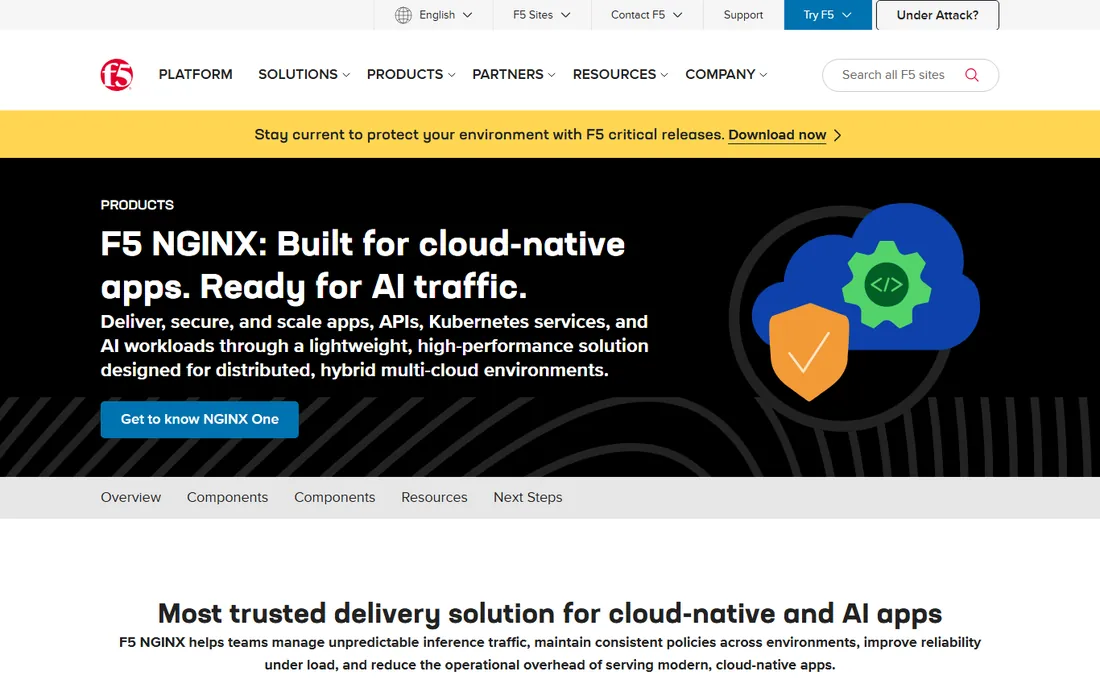
NGINX Plus is the commercial version of the world's most deployed web server, sold and supported by F5. The concrete strength is continuity: if your team already writes nginx.conf, Plus adds what production needs (active health checks, session persistence, JWT authentication, high-availability setup, live activity monitoring) without a new paradigm. It runs on bare metal, VMs, containers and all major clouds, which makes it the default software answer in heterogeneous environments.
The honest weakness is the pricing conversation. Open-source NGINX does L7 load balancing, reverse proxying and caching for free, so the Plus purchase needs a concrete justification: the support SLA, the management plane, or a specific Plus-only feature. F5 publishes no prices, so expect a sales cycle. Note the naming: F5 also sells BIG-IP, its traditional ADC; NGINX Plus is the software-native line. Do not let a rep blur the two.
What we like- The familiar NGINX configuration model with commercial support, plus active health checks, session persistence and a real-time dashboard
- Huge community knowledge base
Watch out for- Quote-based pricing with no public numbers
- The open-source version covers many use cases, so justify the Plus cost explicitly
#2
HAProxy One
Best for: Performance-sensitive teams that want the fastest software load balancer
Visit haproxy.com
Starting priceSee website (custom quote)
Free planNo (open-source HAProxy is free)
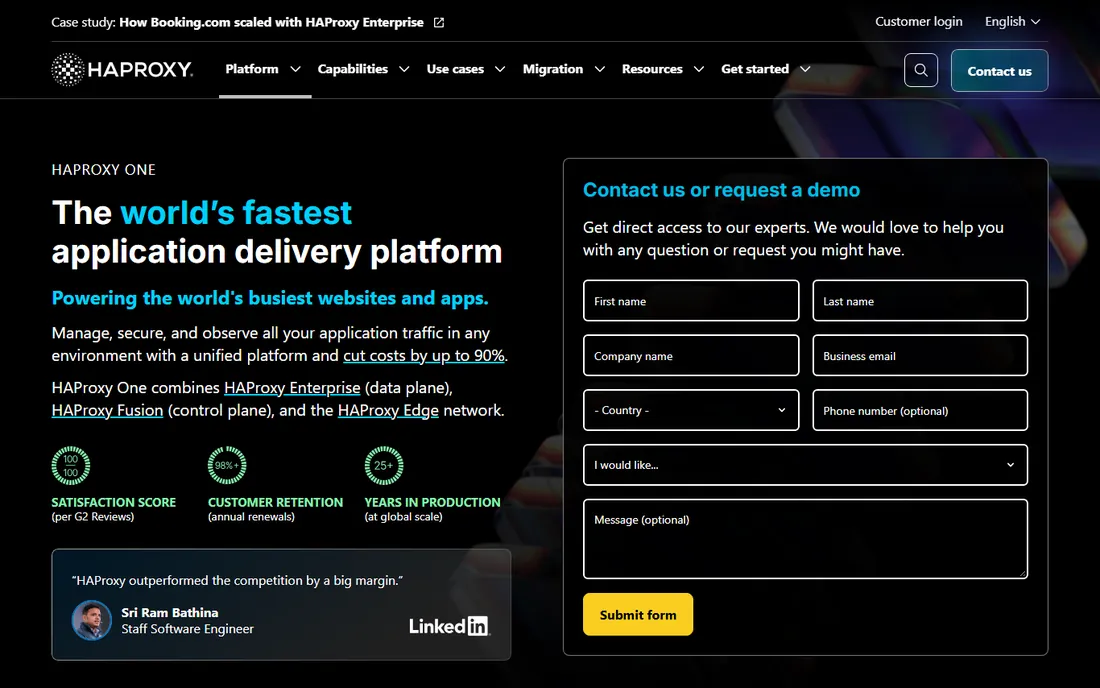
HAProxy One is the commercial platform built on open-source HAProxy, which has a long-standing reputation as the fastest software load balancer available. The concrete strength is performance per dollar: HAProxy does more requests per core than most alternatives, and the One platform wraps it with enterprise necessities (WAF, bot and API protection, global rate limiting, the Fusion control plane for fleet management). Teams migrating off F5 hardware cite lower total cost and the ability to run anywhere.
The trade-off is expertise. HAProxy configuration is famously expressive and famously unforgiving; it rewards teams that invest in learning it and punishes casual setups. The enterprise platform's pricing is quote-based. Like NGINX, the open-source core is free and excellent, so the commercial decision rests on support, security modules and centralized management. For pure L4/L7 performance, this is the benchmark.
What we like- Consistently top-tier performance and efficiency
- The enterprise platform adds WAF, bot management, DDoS protection and centralized control via Fusion
Watch out for- Configuration is powerful but expert-oriented
- Enterprise pricing is quote-based
#3
Kemp LoadMaster
Best for: Mid-size IT teams that need a real ADC without enterprise procurement pain
Visit progress.com
Starting priceSee website
Free planNo
Kemp LoadMaster, now under Progress, has long been the pragmatic ADC for organizations too small for F5 enterprise sales and too busy to build on open source. The concrete strength is packaging: a genuine application delivery controller (load balancing, SSL offload, caching, compression, WAF, global server load balancing) sold in a way mid-size IT can actually buy and deploy, across hardware, virtual appliances, cloud marketplaces and containers.
The honest caveats are scale of ecosystem and corporate parent. The community, documentation and third-party integrations are thinner than the NGINX or HAProxy worlds, and Progress's ownership invites the usual acquisition questions about long-term roadmap. Pricing starts at published entry points historically, but confirm current numbers with the vendor. For the 200-to-2000-employee company that needs an ADC this quarter, Kemp remains a sensible shortlist entry.
What we like- Straightforward ADC with L4/L7 balancing, WAF and GSLB at mid-market packaging
- Available as hardware, virtual, cloud and bare-metal
Watch out for- Smaller ecosystem and community than NGINX or HAProxy
- Progress acquisition means roadmap questions worth asking
#4
NetScaler ADC
Best for: Enterprises with Citrix infrastructure and compliance-driven ADC requirements
Visit netscaler.com
Starting priceSee website (custom quote)
Free planNo
NetScaler ADC is the current name for the former Citrix ADC, now a standalone brand under Cloud Software Group. The concrete strength is enterprise completeness: this is a full application delivery controller with decades of hardening, strong in Citrix Virtual Apps and Desktops environments, with hardware (MPX), virtual (VPX) and container (CPX) form factors plus centralized management. Regulated industries with ADC requirements on a checklist will find every box ticked.
The weakness is commercial friction. NetScaler licensing has a reputation for complexity, pricing is quote-based and enterprise-scale, and the ownership changes (Citrix to Cloud Software Group, the standalone NetScaler brand) mean buyers should ask direct questions about roadmap and support continuity. If you are standardized on Citrix, it is the natural pick; if not, the software-native options above deserve a harder look.
What we like- Deep feature set refined over decades: L4-L7 balancing, WAF, GSLB, strong Citrix Virtual Apps integration
- Available as MPX hardware, VPX virtual and CPX container
Watch out for- Historically complex licensing
- The Citrix-to-Cloud Software Group transition created uncertainty worth probing
#5
VMware Avi Load Balancer
Best for: VMware vSphere and NSX shops wanting cloud-native load balancing
Visit vmware.com
Starting priceSee website (custom quote)
Free planNo
Avi Load Balancer (formerly NSX Advanced Load Balancer) takes a different architecture: a central controller manages distributed service engines that scale elastically with traffic, with 100% REST APIs and analytics built in. The concrete strength is the VMware fit. In vSphere and NSX environments, Avi discovers infrastructure automatically, spins load balancer capacity up and down with demand, and gives application owners self-service without ticket queues.
The honest concern is the Broadcom era. VMware licensing changes have made every VMware-adjacent purchase a strategic question, and Avi's best value is inside the VMware ecosystem; outside it, the pitch is thinner. Pricing is quote-based and enterprise. For the committed VMware shop modernizing application delivery, Avi is the obvious evaluation; for everyone else, weigh the ecosystem lock-in.
What we like- Software-defined architecture with central controller and distributed data plane
- Native vCenter and NSX integration with elastic scaling
Watch out for- Broadcom-era VMware licensing uncertainty
- Best value is locked to the VMware ecosystem
#6
A10 Thunder ADC
Best for: Service providers, carriers and large enterprises needing high-throughput ADC
Visit a10networks.com
Starting priceSee website (custom quote)
Free planNo
A10 Thunder ADC comes from a vendor built for the most demanding networks: carriers, service providers and large enterprises running high-throughput application delivery with integrated DDoS protection and security. The concrete strength is performance under pressure, with hardware and virtual form factors and a security story (including the newer AI-gateway positioning) that resonates where traffic is hostile.
The trade-off is market position. A10's mindshare in enterprise IT is smaller than F5's or the open-source ecosystems, which means fewer peer references, fewer prebuilt integrations and a heavier reliance on the vendor's own professional services. Pricing is entirely quote-based. Evaluate it seriously for carrier-grade or high-throughput needs; for typical enterprise web traffic, the shortlist above is simpler.
What we like- High-performance ADC with strong DDoS and security pedigree
- Serves demanding carrier and cloud-provider environments
Watch out for- Enterprise sales motion with quote-only pricing
- Mindshare is smaller than F5 or NGINX in enterprise IT
#7
Barracuda Load Balancer ADC
Best for: IT teams that want load balancing bundled with web application security
Visit barracuda.com
Starting priceSee website
Free planNo
Barracuda Load Balancer ADC bundles application delivery with the security features Barracuda is known for: WAF covering OWASP Top 10, application DDoS protection, data loss prevention and authentication, alongside L4/L7 balancing, SSL offload, caching and GSLB. The concrete strength is the bundle for the security-conscious generalist IT team: one vendor, one support contract, available as hardware, virtual or cloud instances.
The honest limit is depth. Traffic-management specialists will find NGINX Plus, HAProxy or NetScaler more expressive for complex routing, and Barracuda's ADC mindshare trails its email and firewall businesses. Pricing is quote-based. Pick it when the requirement genuinely pairs load balancing with web application security and the team prefers one throat to choke.
What we like- ADC plus WAF, GSLB and DDoS protection in one product at accessible packaging
- Hardware, virtual and cloud instances
Watch out for- Less granular traffic-control depth than the specialist ADCs
- Barracuda's strength is breadth across security, not ADC leadership
How we chose
We mapped the products that appear in real load balancer evaluations: the software-native leaders, the traditional ADC vendors and the mid-market options. We used current names throughout: NetScaler ADC (not Citrix ADC), Avi Load Balancer under Broadcom's VMware, HAProxy One (the current enterprise platform name). Vendor documentation, pricing pages where public, G2 and Capterra reviews, and practitioner discussions on Reddit and Hacker News informed the fit notes. We excluded cloud-provider-native load balancers (AWS ALB, Azure, GCP) since those are chosen with the cloud, not evaluated standalone, and we excluded dead or acquired-into-oblivion products. No vendor paid for placement, and we did not lab-test anything.
Software vs. appliance: the real decision
The deepest divide in this market is not between vendors but between form factors. Software load balancers (NGINX Plus, HAProxy One, Avi, virtual editions of the rest) run on your infrastructure or cloud, scale by adding instances, and fit automation workflows. Hardware appliances (still sold by NetScaler, A10, Kemp, Barracuda) offer fixed capacity with predictable per-box performance and a physical device to point at during audits.
For new deployments, software usually wins: it matches CI/CD pipelines, scales elastically, and avoids the forklift upgrade when capacity runs out. Appliances still make sense where procurement requires them, where traffic is extremely high and fixed, or where the team wants a sealed box. Note that every vendor here now sells virtual or cloud editions, so "appliance vendor" increasingly means "vendor that also sells boxes," not "vendor that only sells boxes."
What to verify in evaluation
Run your actual traffic profile, not the vendor's benchmark. Key checks: SSL/TLS throughput with your cipher suite, WAF false-positive rate on your application, failover behavior under failure (not just in the demo), API completeness for your automation, and the true cost at your scale including support tiers. For open-source-core products, decide explicitly what the commercial subscription buys you beyond the free version.
Frequently asked questions
Should we just use the cloud provider's load balancer?
Often yes. If you are all-in on AWS, Azure or GCP, the native load balancer is simpler, cheaper and integrated. Evaluate standalone products when you are multi-cloud, on-premises, or need WAF and traffic features beyond what the cloud native option offers.
What is the difference between NGINX Plus and open-source NGINX?
Plus adds commercial support plus enterprise features: active health checks, session persistence, JWT/OpenID authentication, live monitoring dashboard and high-availability tooling. Open-source NGINX handles basic L7 load balancing and reverse proxying free.
Is HAProxy really faster than NGINX?
In many benchmarks HAProxy leads on raw requests per second and efficiency, which is why performance-sensitive teams choose it. Real-world differences depend on workload, TLS usage and tuning. Both are far faster than most applications need; choose on ecosystem and operability, not just benchmarks.
What happened to Citrix ADC?
It was rebranded as NetScaler ADC, now a standalone brand under Cloud Software Group. Same product lineage, new name. If documentation or colleagues still say Citrix ADC or NetScaler, they mean this product.
Do we need hardware appliances anymore?
Rarely for new deployments. Virtual and cloud editions from every vendor here cover most needs with better scaling and automation. Appliances persist for fixed high-throughput sites, regulated environments and teams that prefer them.
How is Avi different from a traditional ADC?
Avi separates the control plane (central controller) from the data plane (distributed service engines), scaling load balancer capacity elastically and exposing everything via API. Traditional ADCs are more monolithic, even in virtual form.
Sources we checked (7)
- https://www.nginx.com/
- https://www.haproxy.com/products/haproxy-one
- https://www.progress.com/kemp
- https://www.netscaler.com/
- https://www.vmware.com/
- https://www.a10networks.com/
- https://barracuda.com/adc
Is your product missing or out of date?
We review this list regularly. Vendors can request a listing, send updated pricing or ask about featured placement.

Shihab Mia · Founder, Rankite
Shihab has spent more than a decade helping SaaS and e-commerce brands grow through search. He writes Rankite's software buying guides from pricing pages, documentation and public user reviews. More about Shihab.