How we make this list: we compare pricing pages, product documentation and public user reviews. Rankite is independent; if a vendor ever pays for a featured spot, that listing is clearly labeled Partner.
Key takeaways
- Literature review software splits into three jobs: reference managers (Zotero, Mendeley, EndNote) for storing and citing, screening platforms (Rayyan, Covidence) for systematic reviews, and discovery tools (Scite, Connected Papers, Litmaps) for finding papers.
- Zotero is free and open source, which makes it the default for students; its paid tiers only charge for extra cloud storage.
- Systematic review teams choose between Rayyan's generous free tier and Covidence's institutional-standard workflows at $339 per review per year.
- Qualitative researchers coding interviews and transcripts pick NVivo (now Lumivero) or MAXQDA, with student pricing from roughly $114 to $130 a year.
- Scite's Smart Citations and Litmaps' monitoring alerts fill gaps keyword searches miss, but they supplement rather than replace systematic searching.
Quick comparison
| Tool | Best for | Starting price | Free plan |
|---|
 Zotero Zotero | Students and researchers who want free reference management | Free (300MB storage; extra storage from $20 per year) | Yes |
 Mendeley Mendeley | Researchers who want reference management plus a social academic network | Free (2GB storage) | Yes |
 EndNote EndNote | Researchers at institutions that standardize on it | $275 (one-time license; student pricing from about $124.95) | Free trial |
 Rayyan Rayyan | Budget-conscious teams running systematic review screening | $4.99 per seat per month (billed annually) | Yes |
 Covidence Covidence | Cochrane-aligned teams needing standardized review workflows | $339 per review per year | Free trial |
 NVivo NVivo | Qualitative researchers coding interviews, surveys, and documents | $130 per year (student; standard plans from $99 per user per month) | Free trial |
 MAXQDA MAXQDA | Researchers who want stable mixed-methods qualitative analysis | $114 per year (student; standard subscriptions from $299) | Free trial |
 Scite Scite | Verifying whether citations support, contrast, or just mention a claim | $20 per user per month ($12 per user per month billed annually) | Yes |
 Connected Papers Connected Papers | Exploring a field visually from one seed paper | $6 per month (Academic, billed annually) | Yes |
 Litmaps Litmaps | Keeping a literature review current with monitoring alerts | $10 per month (Pro Education, billed annually) | Yes |
Is your product missing or out of date?
We review this list regularly. Vendors can request a listing, send updated pricing or ask about featured placement.
Nobody buys one piece of software and calls the literature review done. The work breaks into stages, and each stage has its own tool: discovery tools find papers you would miss, reference managers store and cite them, screening platforms run systematic reviews by the book, and qualitative software codes interviews when the review includes them. Match the ten tools below to the stage you are stuck on rather than looking for one app to do everything.
#1
Zotero
Best for: Students and researchers who want free reference management
Visit zotero.org
Starting priceFree (300MB storage; extra storage from $20 per year)
Free planYes
Zotero is the reference manager most researchers recommend to students, and the price explains why: the full product is free, including unlimited references, Word and Google Docs integration, and the browser connector that saves papers with one click. It is open source, so a community of plugins extends it into everything from duplicate detection to journal-abbreviation handling.
The catch is storage. The free 300MB fills up fast with PDFs, and extra storage starts at $20 a year. Many users dodge this by linking Zotero to WebDAV or storing PDFs elsewhere. The interface will never win design awards, and its built-in PDF reader is functional rather than delightful. But for organizing sources and generating bibliographies in thousands of citation styles, Zotero matches tools that cost hundreds of dollars.
What we like- Completely free core features with no word or item limits
- Open source with a huge plugin ecosystem
- Excellent browser connector for saving papers
Watch out for- Free storage capped at 300MB
- Interface looks dated
- PDF annotation weaker than commercial rivals
#2
Mendeley
Best for: Researchers who want reference management plus a social academic network
Visit mendeley.com
Starting priceFree (2GB storage)
Free planYes
Mendeley pairs a reference manager with an academic social network, which gives it a discovery angle Zotero lacks. The free tier includes 2GB of cloud storage, noticeably more generous than Zotero's 300MB, and the PDF reader with annotation is genuinely good. Your library stats show readership and citation counts, and the network surface surfaces papers your field is reading. Word integration handles citation insertion and bibliography generation in the standard styles.
Under Elsevier, development has felt slow, and the shift from Mendeley Desktop to the web-first Reference Manager alienated users who liked the old workflow. If you want a free manager with more storage and a decent reader, and you do not mind the Elsevier connection, Mendeley remains a solid pick, especially for researchers already in Elsevier's ecosystem.
What we like- Free 2GB storage beats Zotero's free tier
- Clean PDF reader and annotation
- Large academic network for discovering papers
Watch out for- Development has slowed under Elsevier
- 2GB still fills up with heavy PDF use
- Migration from desktop to web frustrated long-time users
#3
EndNote
Best for: Researchers at institutions that standardize on it
Visit endnote.com
Starting price$275 (one-time license; student pricing from about $124.95)
Free planFree trial
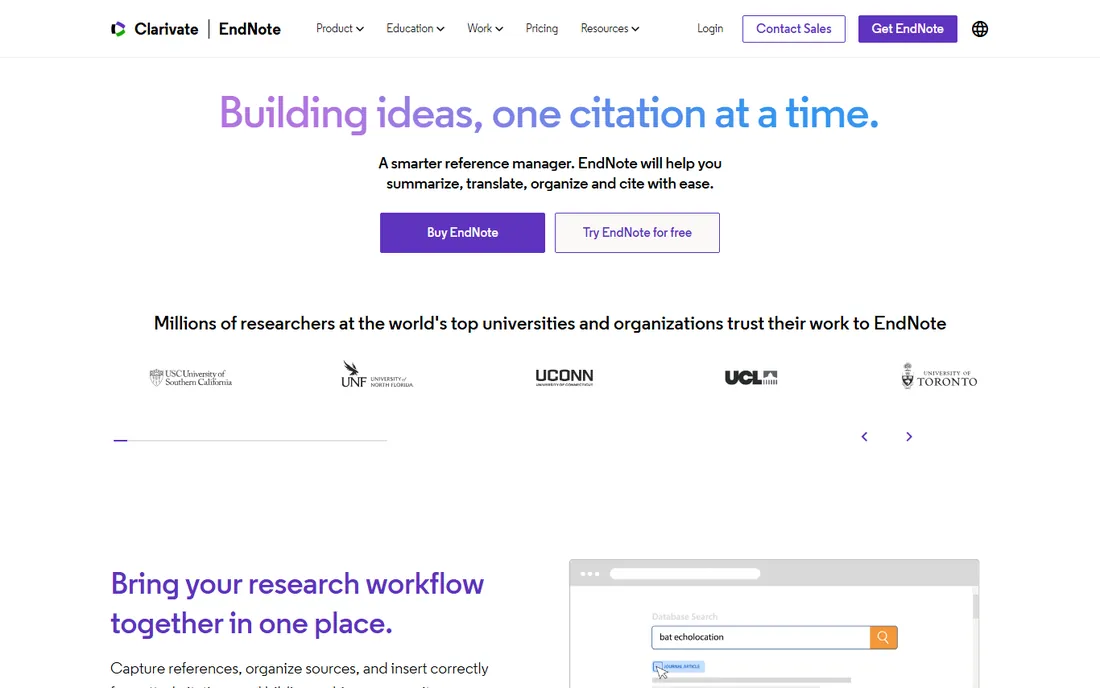
A full license costs $275 as a one-time purchase, with student pricing around $124.95, and it includes the desktop app, EndNote Web, and cloud storage. What you pay for is maturity: the Cite While You Write integration with Word is the deepest in the category, the style library covers over 7,000 citation formats, and retraction alerts flag withdrawn papers in your library, which matters when your dissertation cites hundreds of sources.
The individual price is hard to justify when Zotero is free, and most EndNote users get it through their university, which is exactly the point. The interface shows its age and the learning curve is real. If your university provides a license, take it. If you are buying out of pocket, try Zotero first and only switch if you hit a specific wall.
What we like- Deepest Word integration of any manager
- 7,000-plus citation styles
- Retraction alerts protect your bibliography
Watch out for- Expensive for individuals
- Interface feels dated
- 30-day trial is short for evaluating a long-term tool
#4
Rayyan
Best for: Budget-conscious teams running systematic review screening
Visit rayyan.ai
Starting price$4.99 per seat per month (billed annually)
Free planYes
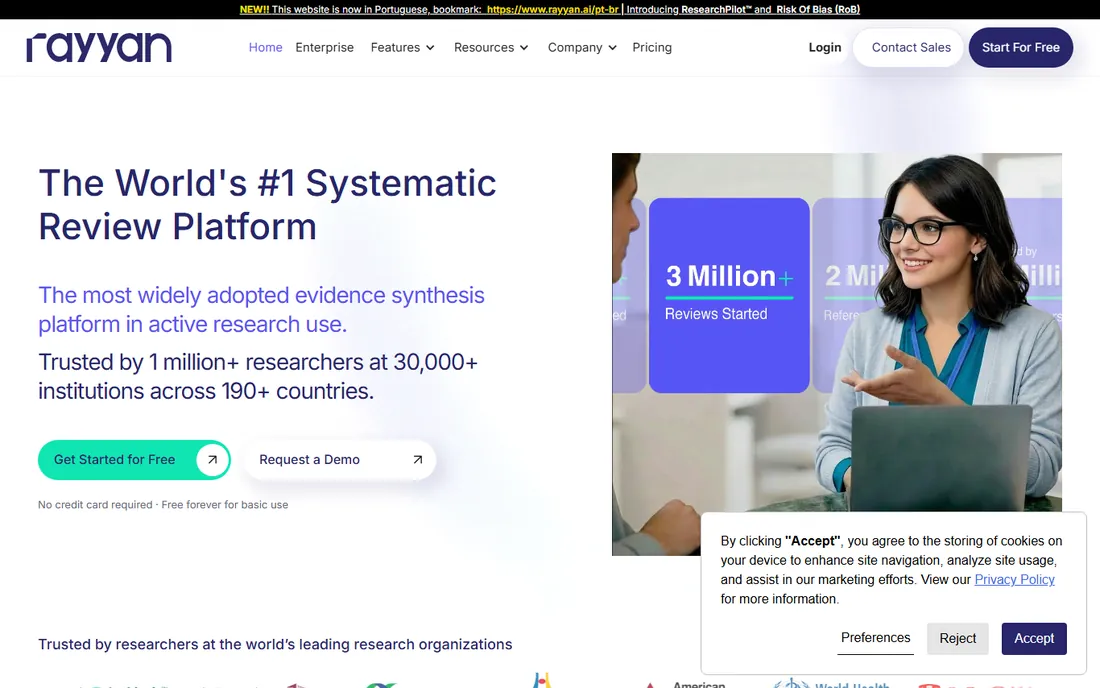
The free tier is genuinely usable: 3 active reviews, 2 reviewers, duplicate detection, and AI predictions at no cost. Paid plans start at $4.99 per seat per month on annual billing for Essential, adding PRISMA diagrams and bulk actions, with Advanced at $8.33 adding AI PICO extraction.
It is deliberately narrow. There are no data extraction forms, no meta-analysis, and no full-text management, so teams pair it with other tools for later review stages. The mobile app lets reviewers screen on the go, though the free plan limits mobile decisions. For small teams and student-led reviews, Rayyan's combination of a real free tier and low paid prices makes it the default starting point for screening.
What we like- Generous free tier with AI relevance predictions
- Fast interface built for high-volume screening
- Blind screening mode for independent dual review
Watch out for- Screening only, no extraction or synthesis tools
- AI PICO extraction needs the Advanced plan
- Free plan caps at 3 active reviews
#5
Covidence
Best for: Cochrane-aligned teams needing standardized review workflows
Visit covidence.org
Starting price$339 per review per year
Free planFree trial
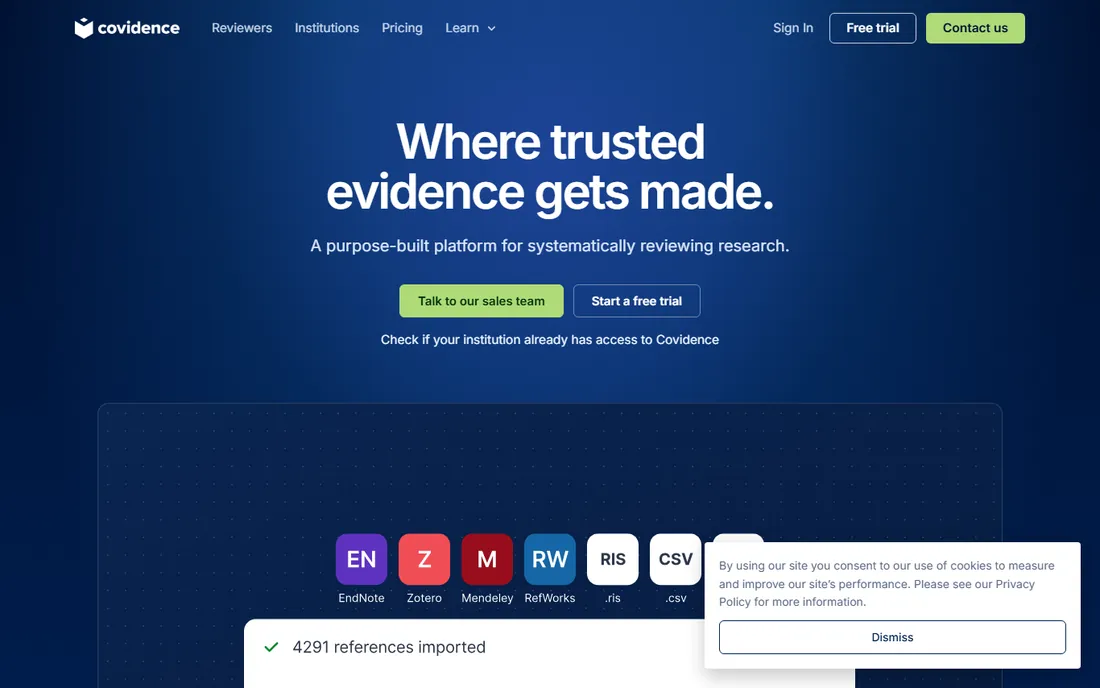
Individuals pay per review: $339 for a single review valid 12 months with unlimited collaborators, or $907 for a package of three. That is expensive next to Rayyan's free tier, and the price only makes sense when you need the full pipeline and the methodological credibility. For narrative or scoping reviews that do not need Cochrane-grade process, it is overkill. Check whether your institution already licenses it before spending anything; a large share of users never pay directly.
What we like- Institutional standard recognized by Cochrane and universities
- Covers screening, extraction, and risk-of-bias in one workflow
- Unlimited collaborators per review
Watch out for- $339 per review adds up across multiple projects
- Overkill for simple literature reviews
- Individual pricing stings without institutional backing
#6
NVivo
Best for: Qualitative researchers coding interviews, surveys, and documents
Visit lumivero.com
Starting price$130 per year (student; standard plans from $99 per user per month)
Free planFree trial
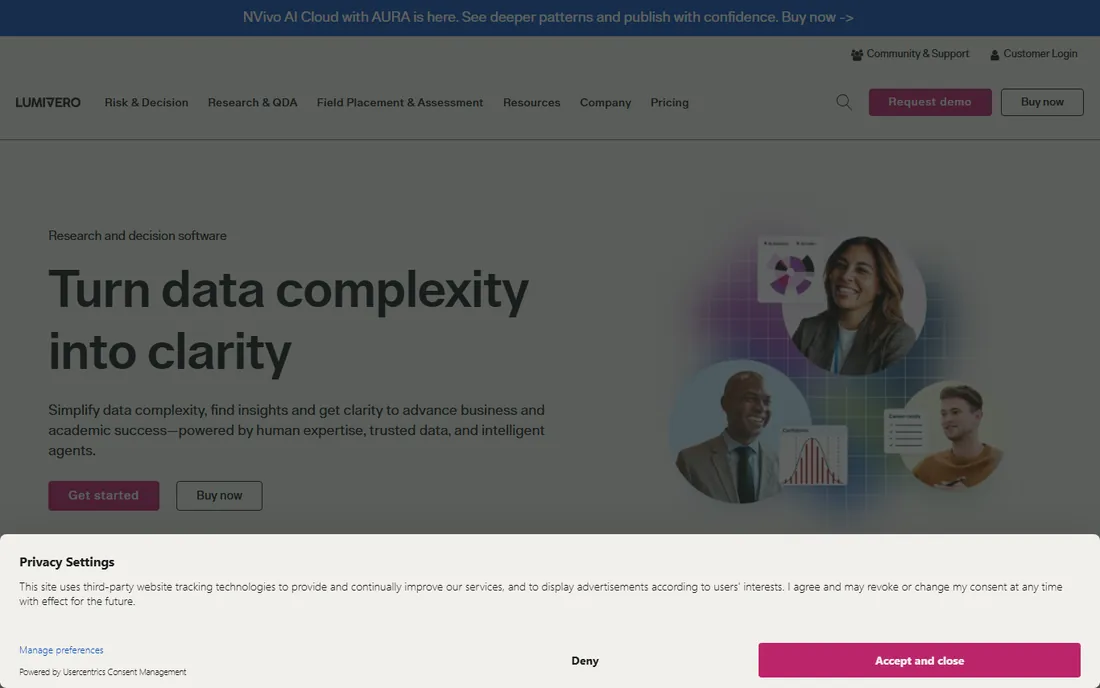
Researchers code interview transcripts, open-ended survey responses, and documents into themes, then query the coded data with matrix coding, text search, and visualization tools. It handles text, audio, video, and images in one project, and the transcription module covers 28 languages. In 2026 Lumivero launched NVivo AI Cloud with an AI agent called AURA, built for auditable qualitative analysis where every AI suggestion traces back to evidence.
What we like- Most powerful qualitative coding and querying tools
- Handles text, audio, video, and images
- New AI Cloud adds auditable AI-assisted analysis
Watch out for- Steep learning curve
- Prices rose after the Lumivero acquisition
- Works best on Windows
#7
MAXQDA
Best for: Researchers who want stable mixed-methods qualitative analysis
Visit maxqda.com
Starting price$114 per year (student; standard subscriptions from $299)
Free planFree trial
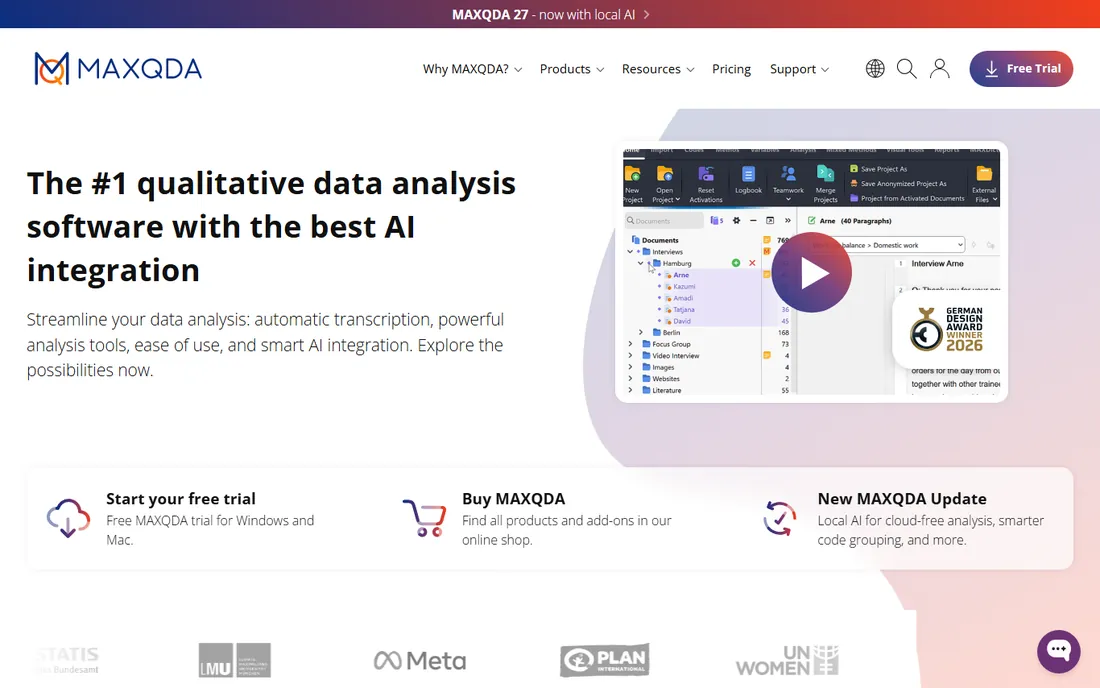
It covers the same qualitative coding ground as NVivo, interviews, focus groups, media, with equally strong tools for mixed-methods work where survey statistics meet coded text. AI-assisted coding helps with the first pass through large datasets, and team features with secure cloud sharing support collaborative projects. VERBI Software, the German company behind it, has stayed independent while competitors consolidated.
The main complaints are the 14-day trial, which is barely enough to evaluate software this deep, and a learning curve that eats real project time. If your institution mandates NVivo, use NVivo. If you are choosing freely and want the calmer, more predictable option, MAXQDA deserves the first look.
What we like- More stable than NVivo in long projects
- Strong mixed-methods and stats integration
- Transparent licensing
Watch out for- 14-day trial is short for such a complex tool
- Learning curve costs days of productivity
- Export workflows feel clunky
#8
Scite
Best for: Verifying whether citations support, contrast, or just mention a claim
Visit scite.ai
Starting price$20 per user per month ($12 per user per month billed annually)
Free planYes
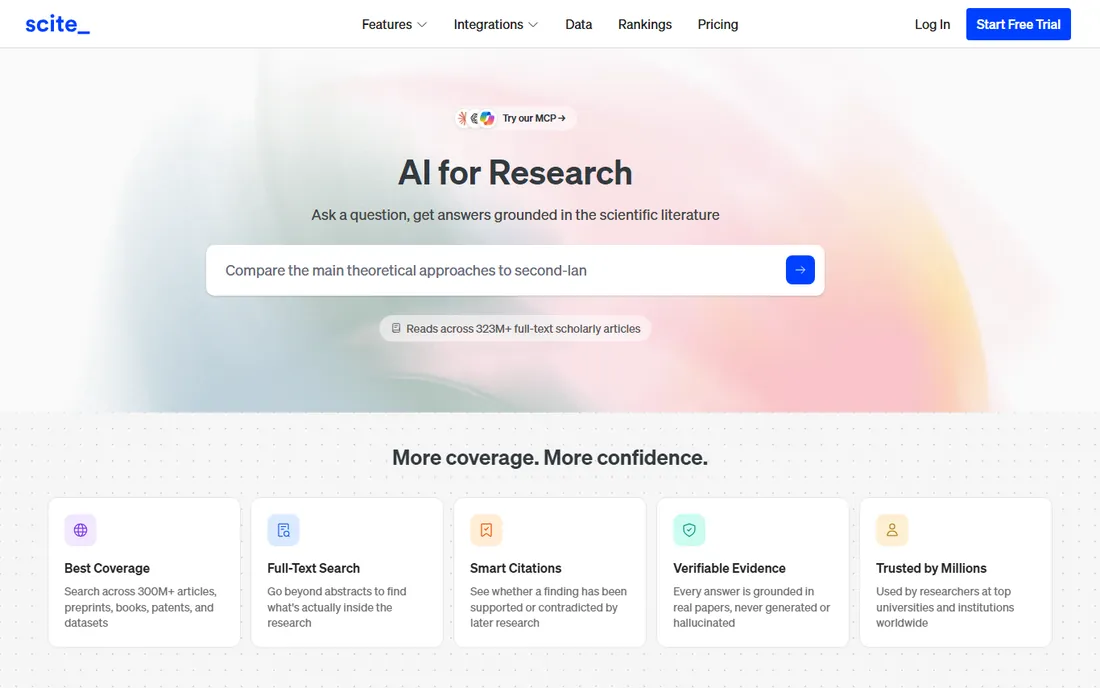
Scite answers a question citation counts cannot: how was this paper actually used by the papers citing it? Its Smart Citations classify each citing sentence as supporting, contrasting, or merely mentioning the claim, drawn from over a billion analyzed citation statements including paywalled full text. The Reference Check feature scans your manuscript PDF before submission and flags retracted references and papers with heavy contrasting citations.
Pricing starts at $20 a month, or $12 a month on annual billing, with a limited free Connect tier offering monthly credits but no assistant access. Pro at $50 adds API access and patent, clinical trial, and grant datasets. The price is the main barrier for students, and Scite is explicit that it supplements rather than replaces reproducible searches in discipline databases. Use it as the quality-control layer on top of your search strategy, not as the strategy itself.
What we like- Smart Citations show the context around every citation
- Flags retractions and editorial notices
- Reference check scans your manuscript before submission
Watch out for- $20 a month is steep for individual researchers
- AI assistant needs a paid plan
- Supplements but does not replace database searching
Starting price$6 per month (Academic, billed annually)
Free planYes
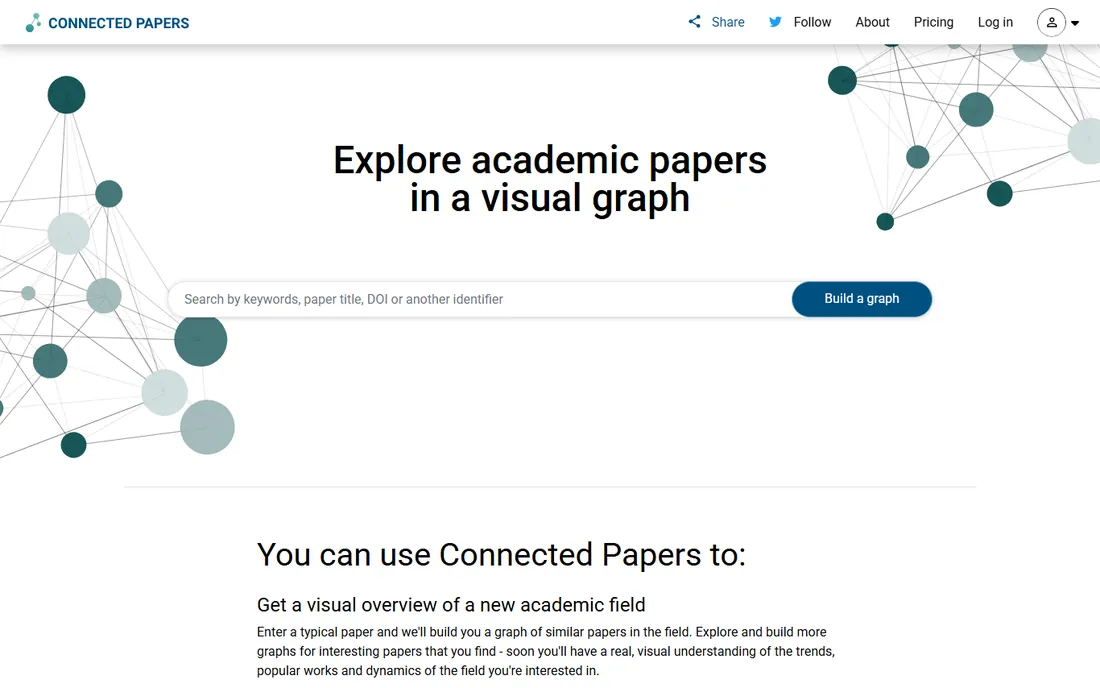
Enter a seed paper by DOI, title, or URL, and it builds a visual graph of related work using co-citation and bibliographic coupling, clustering papers that share references or get cited together. Two papers can sit close together even if neither cites the other, which is how it surfaces relevant work keyword searches never find. Prior works and derivative works split into two views, making it easy to trace how ideas evolved.
The free plan gives you 5 graphs a month with every feature included, enough for occasional exploration. Academic pricing starts at $6 a month billed annually for unlimited graphs, with a $20-a-month Business tier for commercial use. Coverage comes from the Semantic Scholar corpus, which is vast but has gaps in monographs and some non-English literature. It is a discovery tool, not a screening platform, so treat it as the start of your search, not the whole search.
What we like- Beautiful similarity graphs reveal related work keyword searches miss
- Free tier includes all features
- One-click export to Zotero and Mendeley
Watch out for- Free plan capped at 5 graphs per month
- Depends on Semantic Scholar coverage, which has gaps
- Desktop browsers only
#10
Litmaps
Best for: Keeping a literature review current with monitoring alerts
Visit litmaps.com
Starting price$10 per month (Pro Education, billed annually)
Free planYes
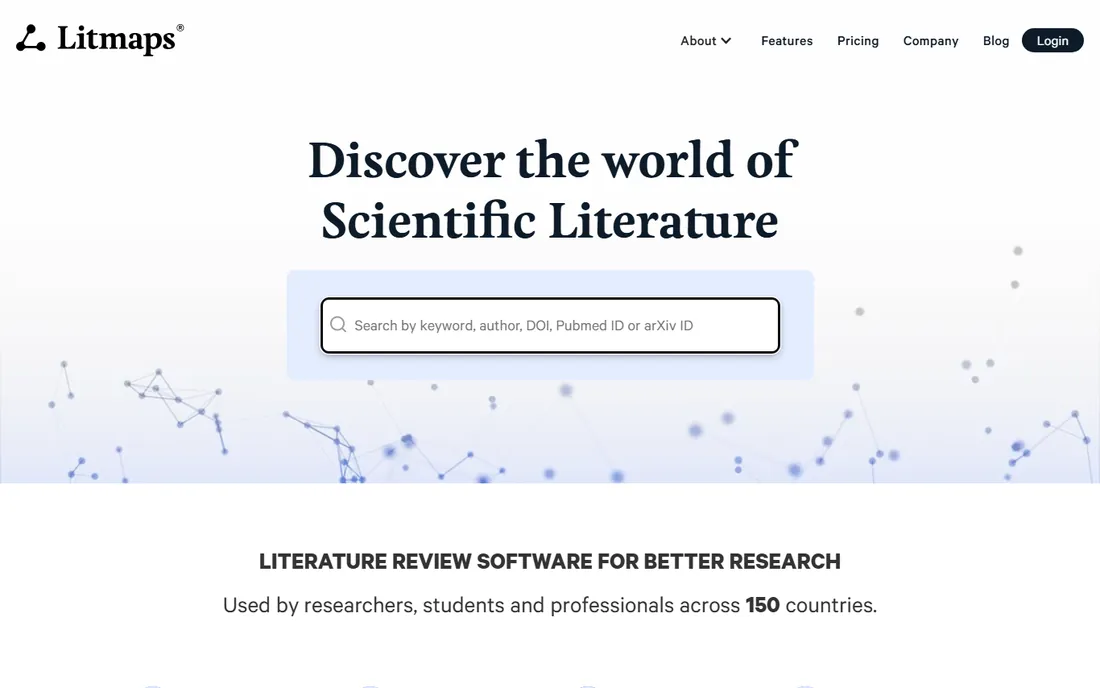
Build a Seed Map from your starting papers, then enable monitoring and get alerts when new papers match your topic, on daily or weekly schedules. That turns the "update the search before submission" chore into an automatic feed. The maps visualize citation links so you can spot foundational work and recent gaps, and Pro adds Zotero two-way sync.
The free tier allows 2 Litmaps with up to 100 articles each and basic search across 20 inputs, enough to test the workflow. Pro Education costs $10 a month billed annually, with up to 75 percent educational discounts and country-based pricing for qualifying users. Commercial pricing varies. Litmaps does not replace full-text appraisal or reference management, but as the monitoring layer on top of a Zotero library, it closes a real gap in the review workflow.
What we like- Literature alerts monitor your topic automatically
- Zotero sync on Pro
- Clean visual maps with shareable links
Watch out for- Free tier limited to 2 maps and 100 articles per map
- Search can lag on large topics
- Educational discount requires academic email
Start with your stage, not with features. Writing a thesis chapter and drowning in PDFs? Pick a reference manager first: Zotero if free matters, Mendeley if you want more free storage, EndNote if your university provides it. Running a systematic review with a team? Rayyan for the free tier and low prices, Covidence when the protocol demands Cochrane-grade standardization. Working with interviews or open-ended responses? NVivo for maximum analytical power, MAXQDA for stability.
Discovery tools layer onto any of these. Use Connected Papers when you are new to a field and need the lay of the land, Scite when you need to check whether the papers you cite actually support your claims, and Litmaps when the review will take months and the literature will move while you write. Most researchers end up with two or three tools, not one, and that is the right answer.
Where AI fits in a defensible review
AI features are now everywhere in this category: Rayyan ranks records by predicted relevance, NVivo's AURA suggests codes with auditable evidence trails, Scite's assistant answers questions from the literature, and MAXQDA offers AI-assisted first-pass coding. They save real time, and the credible ones keep a human in the loop with evidence you can inspect.
The line to hold is reproducibility. A systematic review must document its search strategy so someone else could repeat it, and AI-ranked screening is hard to reproduce exactly. Report AI-assisted steps as supplementary methods, keep your database searches as the primary strategy, and never let an AI summary stand in for reading a paper your argument depends on.
How we chose
We organized the category by workflow stage, discovery, reference management, screening, and qualitative analysis, then picked the established tool in each. Pricing comes from vendor pricing pages and recent reviews, including 2026 student-pricing tracking for NVivo and MAXQDA. We verified NVivo's move to the Lumivero brand and homepage. We excluded generic AI search tools without review-specific features and reference managers with negligible user bases. No hands-on testing is claimed; assessments rest on documented features, pricing, and reported researcher experience.
Frequently asked questions
What is the difference between a reference manager and a literature review tool?
A reference manager like Zotero or EndNote stores your sources, inserts citations, and builds bibliographies. Literature review software is broader: screening platforms like Rayyan and Covidence manage the systematic review process, discovery tools like Connected Papers find papers, and qualitative tools like NVivo analyze interview data. Most researchers need a reference manager plus one or two specialized tools.
Is Zotero really free?
Yes. The core product is free and open source with no limits on references or citations. You get 300MB of cloud storage free, with extra storage from $20 a year.
Which tool is best for a systematic review?
For the full Cochrane-style workflow, Covidence is the institutional standard at $339 per review per year, and many universities provide it free. For screening on a budget, Rayyan's free tier covers 3 active reviews with AI predictions, and paid plans start at $4.99 a seat per month. Most teams pair one of these with a reference manager for citations.
Can these tools replace searching databases like PubMed?
No. Discovery tools like Scite, Connected Papers, and Litmaps are excellent supplements, but systematic reviews require documented, reproducible searches in discipline databases. Report AI-assisted discovery as a supplementary method, not the primary strategy.
NVivo vs MAXQDA: which should I choose?
Choose NVivo if you need the deepest qualitative analysis features and your institution licenses it, or if the new AI Cloud's auditable AI fits your workflow. Choose MAXQDA if you are buying yourself and value stability, transparent licensing, and lower student pricing. Both handle interviews, surveys, and mixed-methods work well.
Do I need to pay for literature review software as a student?
Usually not much. Zotero and Mendeley are free, Rayyan's free tier covers small reviews, Connected Papers gives 5 free graphs a month, and Litmaps and Scite have usable free tiers. The tools worth paying for are NVivo or MAXQDA for qualitative dissertations, and many universities license the expensive tools institutionally, so ask your library first.
Sources we checked (20)
- https://www.zotero.org/
- https://www.mendeley.com/
- https://endnote.com/
- https://paperpile.com/r/endnote-vs-bookends/
- https://paperpile.com/r/endnote-vs-citavi/
- https://www.rayyan.ai/pricing
- https://paperguide.ai/blog/systematic-review-software/
- https://www.covidence.org/pricing/
- https://www.lumivero.com/
- https://pulse2.com/lumivero-launches-nvivo-ai-cloud-with-aura/
- https://www.quirkos.com/blog/post/comparing-costs-of-qualitative-analysis-software-in-2026/
- https://www.softwaresuggest.com/maxqda
- https://www.maxqda.com/
- https://scite.ai/
- https://www.educatorstechnology.com/2026/09/scite-review.html
- https://costbench.com/software/ai-research-tools/scite/
- https://www.connectedpapers.com/
- https://www.educatorstechnology.com/2026/09/connected-papers-review.html
- https://litmaps.com/
- https://www.educatorstechnology.com/2026/09/litmaps-review.html
Is your product missing or out of date?
We review this list regularly. Vendors can request a listing, send updated pricing or ask about featured placement.

Shihab Mia · Founder, Rankite
Shihab has spent more than a decade helping SaaS and e-commerce brands grow through search. He writes Rankite's software buying guides from pricing pages, documentation and public user reviews. More about Shihab.