How we make this list: we compare pricing pages, product documentation and public user reviews. Rankite is independent; if a vendor ever pays for a featured spot, that listing is clearly labeled Partner.
Key takeaways
- LabWare, STARLIMS, and LabVantage remain the enterprise leaders, with decades of history and deep compliance coverage for pharma and QC labs.
- Scispot and CloudLIMS lead the AI-native wave, with workflow automation and natural-language interfaces aimed at growing biotech labs.
- QBench is the modern cloud option for analytical and testing labs that want fast implementation without legacy baggage.
- Lockbox LIMS, built on Salesforce, suits labs already running on that platform.
- Sapio Sciences unites LIMS, ELN, and data cloud in one configurable platform, with a free ELN tier for evaluation.
Quick comparison
| Tool | Best for | Starting price | Free plan |
|---|
 LabWare LIMS LabWare LIMS | Enterprise pharma and QC | See website | No |
 STARLIMS STARLIMS | Long-established lab informatics | See website | No |
 LabVantage LabVantage | Integrated lab platform | See website | No |
 Scispot Scispot | AI-native biotech labs | See website | No |
 CloudLIMS CloudLIMS | SaaS LIMS with built-in QMS | See website | No |
 QBench QBench | Modern cloud LIMS | See website | No |
 Lockbox LIMS Lockbox LIMS | Salesforce-based labs | See website | No |
 Sapio Sciences Sapio Sciences | Unified LIMS plus ELN | See website | No |
Is your product missing or out of date?
We review this list regularly. Vendors can request a listing, send updated pricing or ask about featured placement.
Starting priceSee website
Free planNo
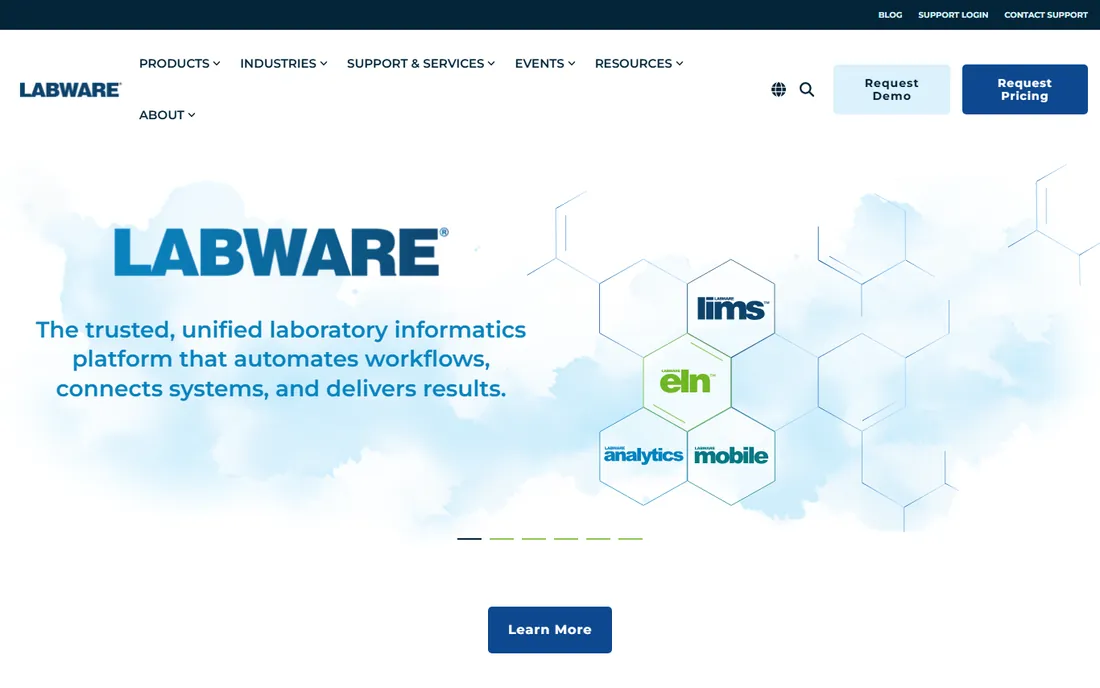
LabWare is the name that comes up in nearly every enterprise LIMS conversation. The platform unifies LIMS, ELN, mobile, and AI capabilities, with integration-first architecture designed for complex instrument ecosystems. Its customers span pharma, food and beverage, chemicals, and environmental testing, and the company reports that 98 percent of labs recommend it.
The honest catch is scale. LabWare implementations are measured in months and priced accordingly, which is normal for enterprise informatics but prohibitive for a startup lab. If you run a regulated QC operation with hundreds of users, it belongs on your shortlist. If you have one lab and twenty people, start with the smaller cloud options below.
What we like- Market leader with deep compliance coverage
- Unified platform includes LIMS, ELN, mobile, and AI modules
- Global support network
Watch out for- Enterprise pricing and long implementations
- Overkill for small or single-purpose labs
Starting priceSee website
Free planNo
STARLIMS has been selling laboratory informatics since 1986, longer than most of its competitors have existed. The platform covers quality manufacturing, clinical, and public health informatics, integrating LIMS with SDMS, LES, ELN, and analytics. With more than 700 customers across 85 countries, it has seen nearly every lab scenario.
The acquisition of Labstep gave it a modern cloud ELN for R&D teams alongside the core LIMS. The honest catch is the same as any legacy vendor: parts of the platform show their age, and you will negotiate pricing through sales rather than finding a number online. Labs that value vendor longevity above all else will appreciate the track record.
What we like- Nearly four decades of history with 2,000+ laboratories
- Covers R&D, QC, clinical, and public health
- Owns the Labstep cloud ELN
Watch out for- Legacy platform with modernization still in progress
- Pricing requires a sales conversation
Starting priceSee website
Free planNo
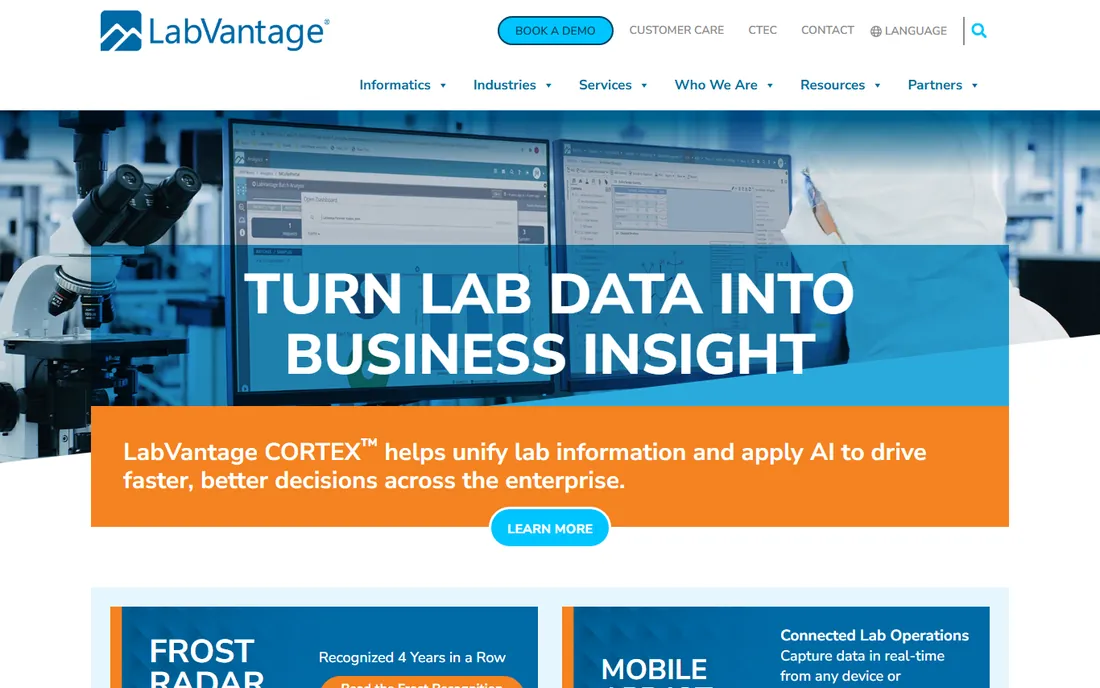
LabVantage positions its platform as the answer to fragmented lab software: LIMS, ELN, LES, SDMS, and analytics in one architecture with one license. The 100 percent browser-based platform supports mobile and IoT instrument connectivity, and pre-configured industry editions promise faster go-lives than fully custom builds. Recent releases add AI search across public and proprietary data assets.
The honest catch is positioning. This is an enterprise platform that happens to offer SaaS, not a lightweight SaaS tool. Expect a formal implementation with professional services. For mid-size and large labs standardizing on one informatics vendor, the integration story is compelling.
What we like- Single platform for LIMS, ELN, LES, and SDMS
- Pre-configured industry editions speed deployment
- Browser-based with mobile and IoT support
Watch out for- Enterprise focus means higher cost and complexity
- Customization can still require services
Starting priceSee website
Free planNo
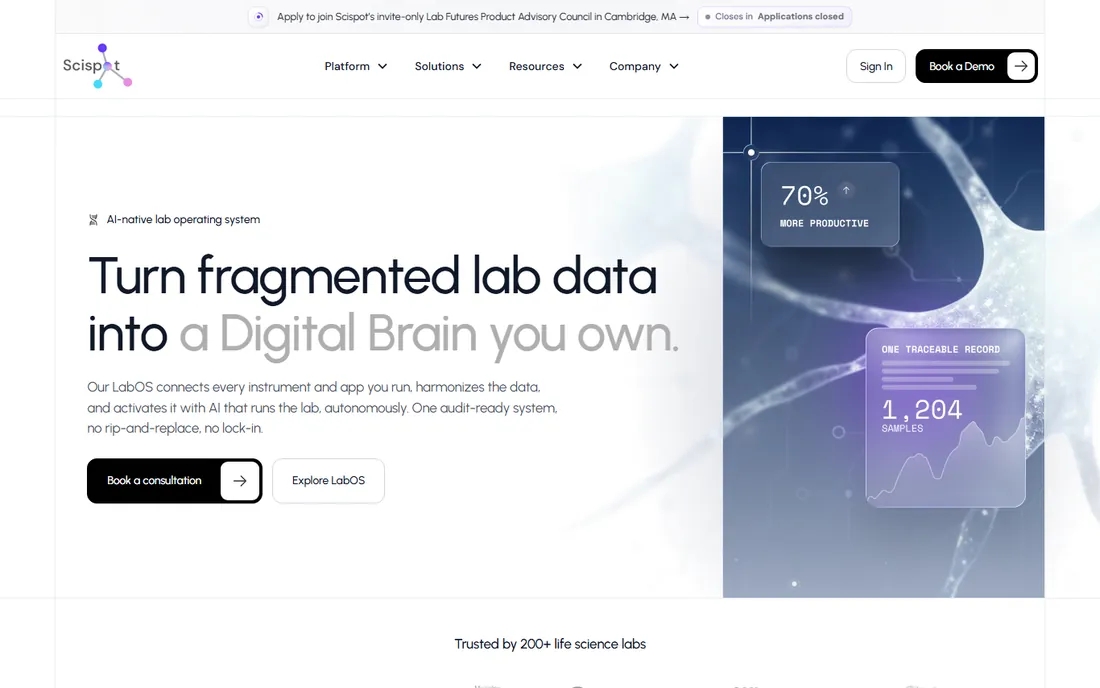
Scispot calls its product LabOS, an AI-native lab operating system that harmonizes data from instruments, ELNs, and spreadsheets into one governed "Digital Brain." Its Scibot AI agents handle lookups, flag QC deviations, and summarize sequencing runs, while the no-code builder lets scientists design apps on top of harmonized data. The platform connects through open APIs and MCP, including to AI models like ChatGPT and Claude.
Trusted by more than 200 life science labs, it targets high-growth biotech and diagnostics operations. The honest catch is youth. It does not have the forty-year compliance history of LabWare or STARLIMS, so heavily regulated GMP environments should validate audit readiness carefully. For modern genomics and biotech labs, it is one of the most interesting options in the market.
What we like- API-first with no-code workflow builder
- AI agents automate intake, QC, and reporting
- Connects to existing instruments without rip-and-replace
Watch out for- Newer vendor with a smaller customer base
- Pricing is quote-based
Starting priceSee website
Free planNo
CloudLIMS sells the pure SaaS model: one subscription, zero upfront cost, with configuration, instrument integration, report templates, data migration, training, and support bundled in. The built-in QMS, patient and client portals, and instrument calibration management make it a complete package for biobanks, clinical, cannabis, environmental, and food testing labs.
This year it added AI-native features: automatic QC anomaly detection, sample volume forecasting, and a natural-language interface for asking questions about lab data. The honest catch is the SaaS trade. You get simplicity and fast deployment, but less control over infrastructure than on-premises options. For testing labs that want to go live quickly without an IT project, it is a strong fit.
What we like- True SaaS with zero upfront cost
- Built-in QMS and patient/client portals
- AI anomaly detection and demand forecasting
Watch out for- Single-vendor SaaS means less deployment flexibility
- Depth varies by industry edition
Starting priceSee website
Free planNo
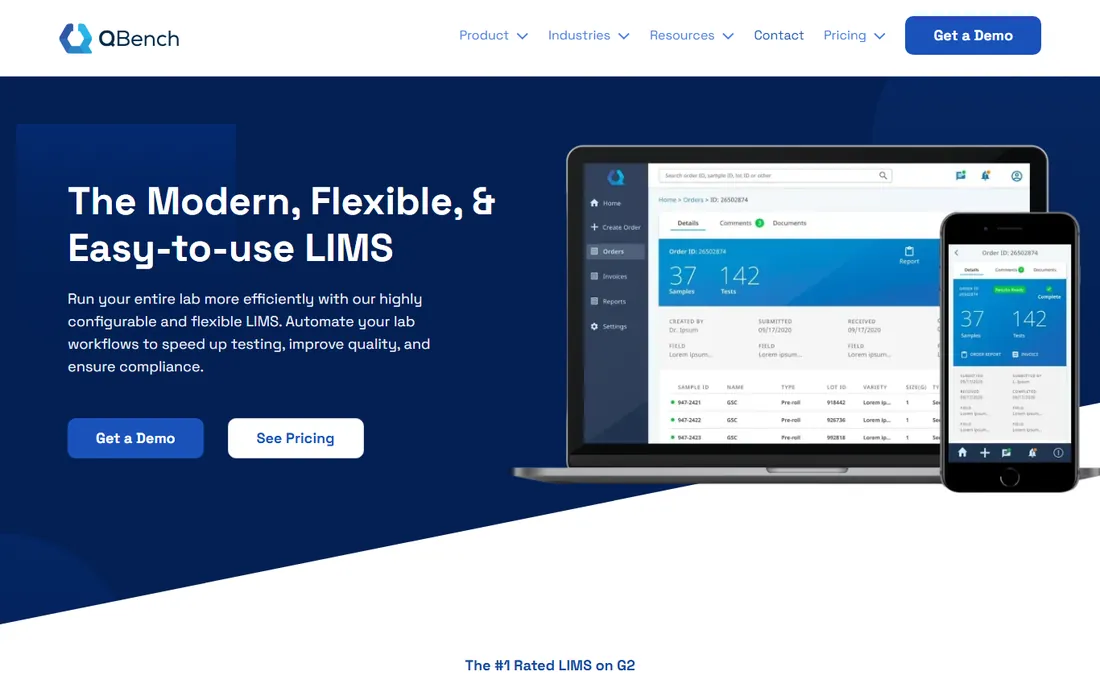
QBench is the cloud-native challenger built for analytical and testing labs. The platform emphasizes no-code configuration: admins rename workflows and fields, define roles, and add custom fields without developers, which avoids the nine-month custom implementations legacy LIMS are known for. Sample tracking, automated reporting with a no-code COA editor, and a modern REST API round out the package.
It holds strong G2 ratings for usability, user adoption, and customer relationships, and customer stories praise the responsive support team. The honest catch is transparency: pricing is not published, so you will need a demo and quote. Labs moving off spreadsheets or an aging legacy LIMS will find the implementation speed refreshing.
What we like- No-code configurability with fast implementation
- Modern REST API and integrations
- Strong G2 ratings for usability and adoption
Watch out for- Pricing not published
- Younger vendor still building enterprise depth
Starting priceSee website
Free planNo
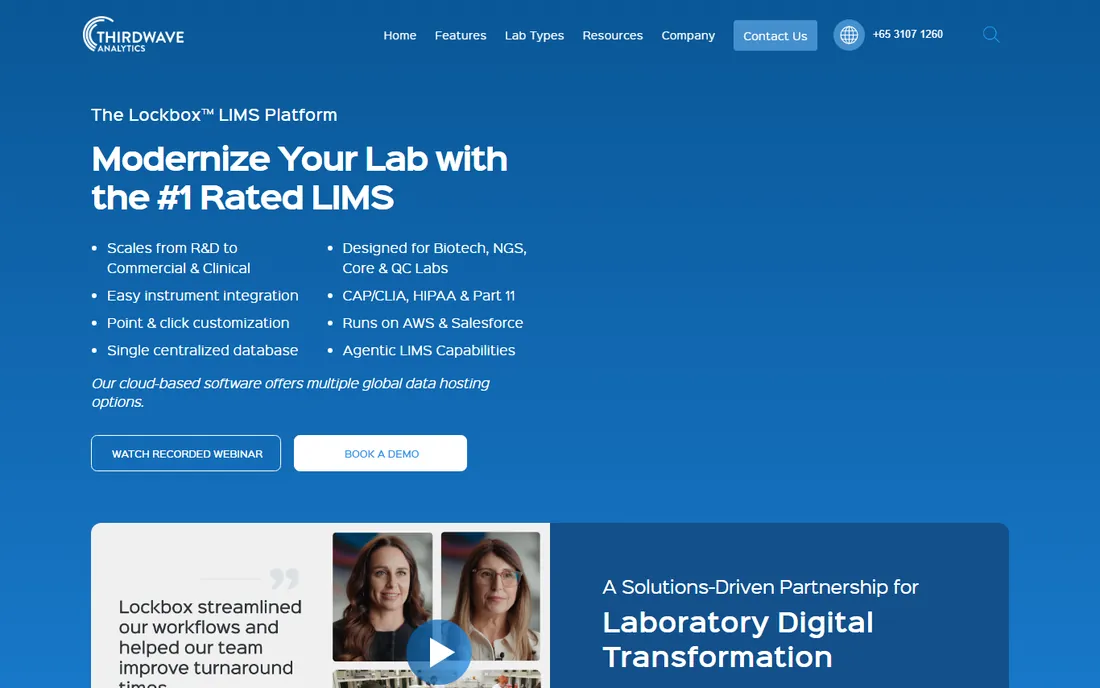
Lockbox LIMS, from Third Wave Analytics, is built natively on Salesforce, which is its defining trait. Labs already running Salesforce get the platform's integration, automation, and security model for free, with point-and-click configuration for sample tracking, multi-layered storage management, protocol execution, and inventory. Regulatory support covers 21 CFR Part 11, CAP/CLIA, HIPAA, GMP, and ISO 17025.
The honest catch is the platform bet. If your organization is standardized on Salesforce, Lockbox is an elegant fit. If not, you are buying into an ecosystem for one application, which rarely makes sense. Pricing is not published, so plan for an enterprise sales process.
What we like- Built natively on the Salesforce platform
- Point-and-click configuration without code
- Strong sample and storage management
Watch out for- Requires the Salesforce ecosystem
- Pricing not published
Starting priceSee website
Free planNo
Sapio Sciences offers an AI-native lab informatics platform that unites LIMS, ELN, and a scientific data cloud, with Elain, an AI co-scientist, assisting across workflows. No-code configuration covers workflow designers, rule engines, and UI design, with AI chat that can generate configuration code. Solutions span research, GMP manufacturing, clinical diagnostics, and NGS genomics.
The company offers a free ELN tier, which gives labs a low-risk way to evaluate the platform's approach before committing to the full LIMS. The honest catch is scope: a unified platform is powerful but heavier than a focused LIMS if you only need sample tracking. For biopharma and CRO labs that want one vendor for the whole informatics stack, Sapio is a serious contender.
What we like- One platform for LIMS, ELN, and scientific data cloud
- No-code configuration with AI-assisted setup
- Free ELN tier available for evaluation
Watch out for- Breadth can mean complexity for single-purpose labs
- Pricing not published
How we chose
We compared established and emerging LIMS vendors, checking each vendor's own site and documentation in October 2026, along with the FeaturedCustomers Summer 2026 LIMS report, G2 ratings, and public user reviews. We favored vendors with verifiable live products, real compliance coverage, and distinct positioning, from enterprise suites to AI-native challengers. We never claim hands-on testing. No vendor was included without a live, verifiable homepage.
What to look for before you buy
Match the LIMS to your lab type
A clinical diagnostics lab needs physician portals and billing; a cannabis lab needs state traceability integrations; a biopharma QC lab needs 21 CFR Part 11 and instrument validation. Most failed LIMS projects start with a generic platform forced onto a specialized workflow. Shortlist vendors with reference customers in your exact lab type, and ask to speak with them.
Budget for implementation, not just licenses
LIMS pricing is quote-based across this entire category, and the license is often the smaller half of the bill. Configuration, data migration, instrument integration, validation, and training can exceed the software cost. Ask every vendor for a total first-year cost including services, and get the data migration scope in writing.
Validate the audit trail before you commit
Regulatory compliance lives or dies on the audit trail: who did what, when, with electronic signatures and version history. During the demo, ask the vendor to show a complete audit trail for a sample from accessioning through result approval, including a correction. If they cannot show it live, move on.
The AI-native rebrand
Every vendor on this list now talks about AI, but the substance varies. Scispot and CloudLIMS have genuinely restructured around AI workflows, with agents and anomaly detection in the product. Others have added AI assistants and search on top of existing platforms. Both can be useful, but only the former changes how the lab operates day to day.
For buyers, the practical question is data readiness. AI features are only as good as the harmonized, governed data underneath them. Vendors with open APIs, structured data models, and real audit trails will deliver more AI value than those bolting a chatbot onto scattered records. Ask how the AI gets its data, not just what it can do.
Frequently asked questions
What is a laboratory information management system?
A LIMS tracks laboratory samples from receipt through testing, results, and reporting. It manages sample identity and location, connects instruments, enforces workflows and approvals, maintains audit trails, and produces certificates of analysis. It is the system of record for lab operations.
How much does LIMS software cost?
Pricing is quote-based across the industry and varies enormously. Cloud SaaS options like CloudLIMS and QBench typically cost less to start, while enterprise platforms like LabWare, STARLIMS, and LabVantage involve six-figure implementations. Always ask for total first-year cost including services and validation.
What is the difference between a LIMS and an ELN?
A LIMS manages samples, tests, results, and compliance workflows. An ELN, electronic lab notebook, records the experimental process and observations of individual scientists. Many vendors now bundle both, as with Sapio, LabVantage, and LabWare, but they solve different problems.
Which LIMS is best for a small testing lab?
Cloud-native options like CloudLIMS and QBench are designed for faster, lower-cost implementations than enterprise suites. Lockbox LIMS suits Salesforce shops. Get quotes from at least two, and make sure each has reference customers in your testing discipline.
Do I need 21 CFR Part 11 compliance?
If your lab supports pharmaceutical manufacturing or clinical work regulated by the FDA, yes. Part 11 requires electronic signatures, audit trails, and system validation. LabWare, STARLIMS, LabVantage, Lockbox, and Sapio all claim support; verify the specifics in your validation plan rather than taking marketing copy at face value.
Can a LIMS replace my spreadsheets?
For sample tracking, yes, and it should. Spreadsheets lack audit trails, version control, and access controls, which is why regulators dislike them. The migration is usually the hardest part of a LIMS project, so ask vendors about their data migration services and get the scope in writing.
Sources we checked (8)
- https://labware.com/
- https://www.starlims.com/
- https://labvantage.com/
- https://scispot.com/
- https://cloudlims.com/
- https://qbench.com/
- https://thirdwaveanalytics.com/
- https://sapiosciences.com/
Is your product missing or out of date?
We review this list regularly. Vendors can request a listing, send updated pricing or ask about featured placement.

Shihab Mia · Founder, Rankite
Shihab has spent more than a decade helping SaaS and e-commerce brands grow through search. He writes Rankite's software buying guides from pricing pages, documentation and public user reviews. More about Shihab.