How we make this list: we compare pricing pages, product documentation and public user reviews. Rankite is independent; if a vendor ever pays for a featured spot, that listing is clearly labeled Partner.
Key takeaways
- Epic and Oracle Health dominate large health systems; MEDITECH, MEDHOST, and TruBridge serve community and rural hospitals.
- Hospital software pricing is almost always quote-based; expect multi-million-dollar implementations for full EHR platforms.
- Cloud-native systems like athenahealth and eClinicalWorks lower the IT burden for smaller hospitals and hospital-owned practices.
- Veradigm's strength is the data network and analytics around its clinical products, not just the EHR itself.
Quick comparison
| Tool | Best for | Starting price | Free plan |
|---|
 Epic Epic | large health systems standardizing on one record | See website | No |
 Oracle Health Oracle Health | enterprise systems wanting clinical plus ERP integration | See website | No |
 MEDITECH MEDITECH | community hospitals wanting a proven EHR | See website | No |
 athenahealth athenahealth | hospitals with heavy ambulatory operations | See website | No |
 eClinicalWorks eClinicalWorks | hospital-owned practices and clinics | See website | No |
 Veradigm Veradigm | hospitals wanting EHR plus data and analytics network | See website | No |
 MEDHOST MEDHOST | community hospitals wanting hosted EHR and RCM services | See website | No |
 TruBridge TruBridge | rural hospitals needing EHR plus revenue cycle services | See website | No |
Is your product missing or out of date?
We review this list regularly. Vendors can request a listing, send updated pricing or ask about featured placement.
The best hospital software
#1
Epic
Best for: large health systems standardizing on one record
Visit epic.com
Starting priceSee website
Free planNo
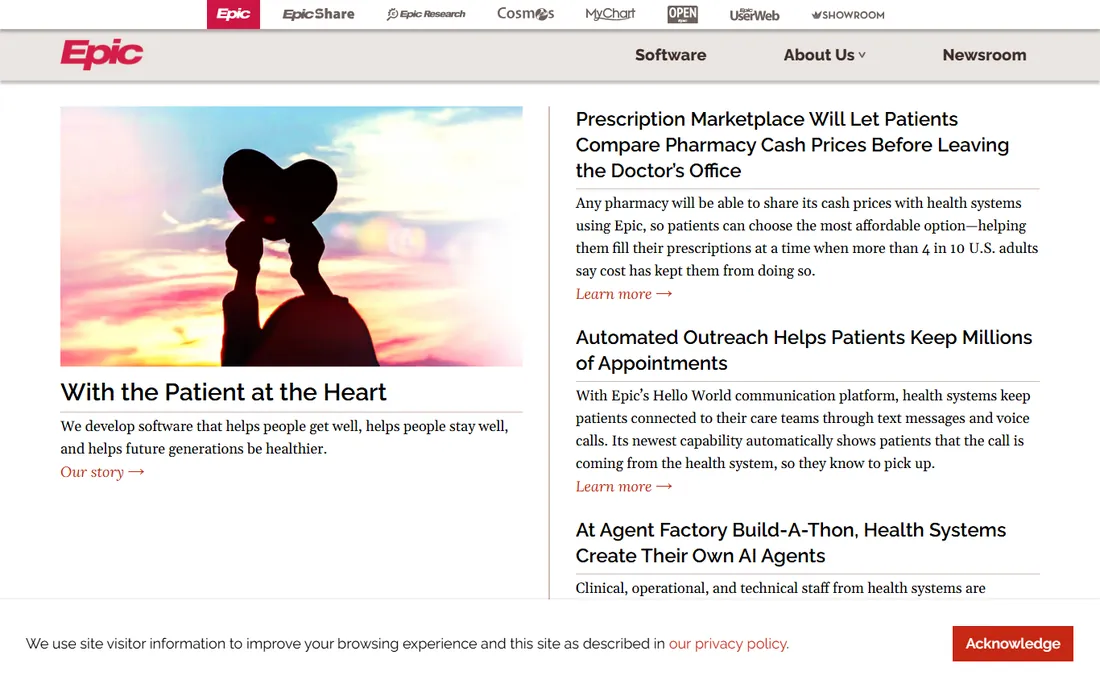
Epic is the default answer when a large health system asks what everyone else runs. The integrated clinical, revenue, and analytics suite runs on one database, which is the core reason big systems pick it: one record for every patient, everywhere in the organization. Its open API program makes connecting third-party apps more practical than the stereotype of a closed system suggests.
The honest catch is scale. Epic projects take years, cost tens of millions of dollars, and demand serious internal IT leadership. A 60-bed community hospital buys more complexity than it will ever use. For systems with the budget and the patience, though, it is the platform everything else in US hospital IT is measured against.
What we like- Deepest clinical functionality
- Huge installed base makes hiring trained staff easy
- Strong interoperability through open APIs
Watch out for- Implementations are long and expensive
- Overkill for small hospitals
#2
Oracle Health
Best for: enterprise systems wanting clinical plus ERP integration
Visit oracle.com
Starting priceSee website
Free planNo
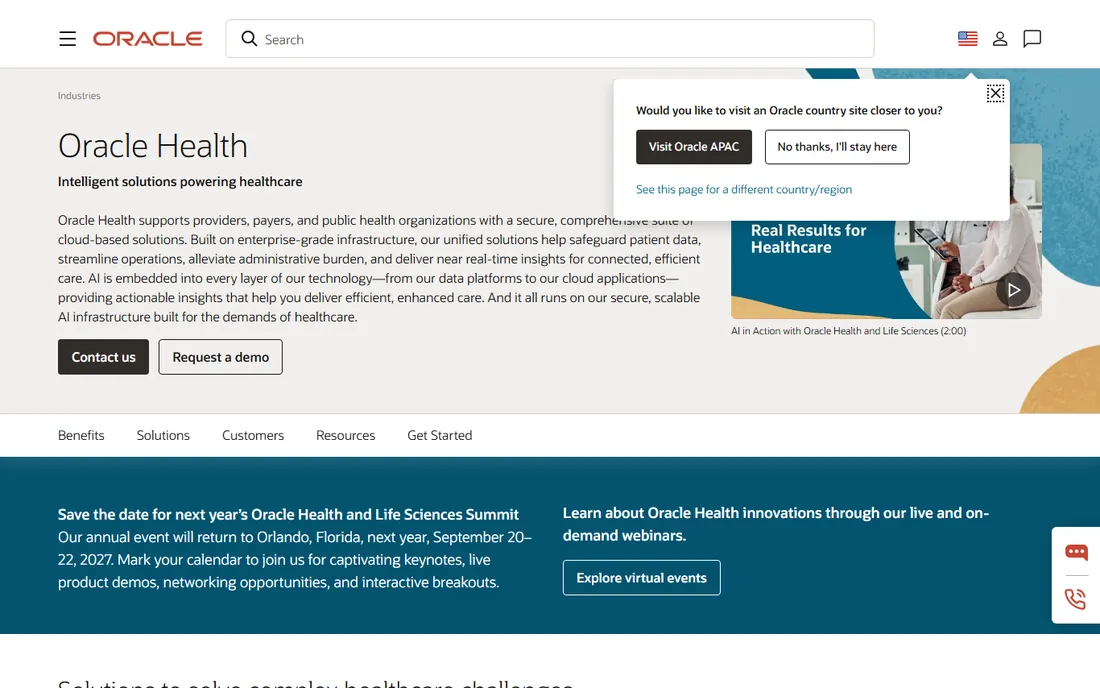
Oracle Health is the former Cerner, rebuilt around an AI-native EHR launched in 2025. The pitch that distinguishes it from Epic is integration with the back office: supply chain, workforce, and finance run on the same Oracle engine as clinical care. Hospitals that already live in the Oracle world get a level of enterprise integration no pure EHR vendor can match.
The trade-off is transition. Oracle is running a coexistence model where departments can stay on legacy Millennium while ambulatory clinics move to the new platform. That is pragmatic, but it means years of running two systems side by side. Buyers should evaluate the new EHR on its current maturity, not on Millennium's reputation.
What we like- AI-native next-generation EHR
- Deep integration with Oracle enterprise systems
- Strong in supply chain and financial operations
Watch out for- The new EHR is still being rolled out
- Migration path from legacy Millennium takes planning
Starting priceSee website
Free planNo
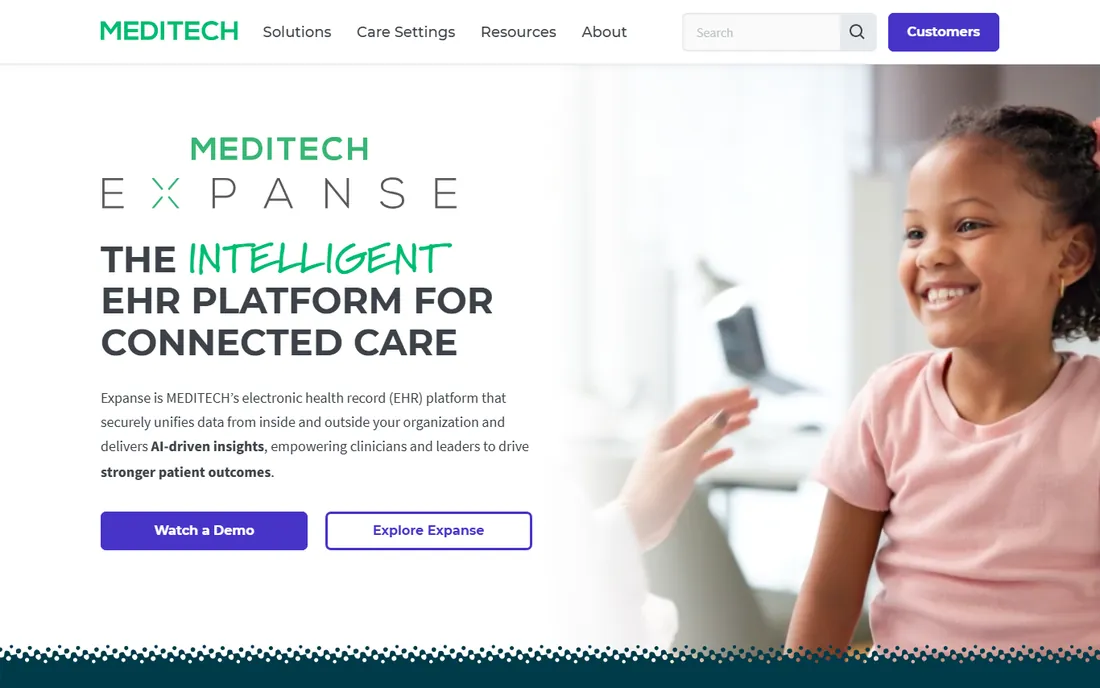
MEDITECH has been selling hospital software since 1969, and its current Expanse platform is a genuinely modern web-based EHR. The customer base skews toward community and rural hospitals, including giants like HCA Healthcare, which has been migrating to Expanse. For an independent hospital that needs a full inpatient EHR without Epic's price tag, MEDITECH is usually the first name on the shortlist.
The company has also pushed into interoperability with its Traverse Exchange network and national framework participation. The honest catch: MEDITECH's oldest customers still run legacy generations, and getting everyone onto Expanse has been a multi-year project. New buyers should confirm they are buying Expanse and nothing older.
What we like- Strong fit for small and mid-size hospitals
- Expanse is modern and mobile-friendly
- Long track record with community hospitals
Watch out for- Still climbing to full parity with Epic in advanced analytics
- Upgrades from legacy platforms take effort
Starting priceSee website
Free planNo
athenahealth's athenaOne combines EHR, practice management, billing, and patient engagement in one cloud service. The company pairs software with back-office services, so practices get its payer knowledge base and claims workflows rather than just a system to configure themselves. It has been rated best in class by KLAS for its independent physician practice suite.
For hospital buyers, athenahealth fits best where the hospital owns a large network of clinics and outpatient facilities. Full inpatient EHR is not its center of gravity. The cloud model is a real advantage for organizations that want to avoid running data centers, and implementations move faster than the enterprise players.
What we like- True cloud-native platform
- Includes revenue cycle expertise as a service
- Specialty-specific workflows
Watch out for- Primarily ambulatory focused
- Inpatient coverage is thinner than pure hospital vendors
Starting priceSee website
Free planNo
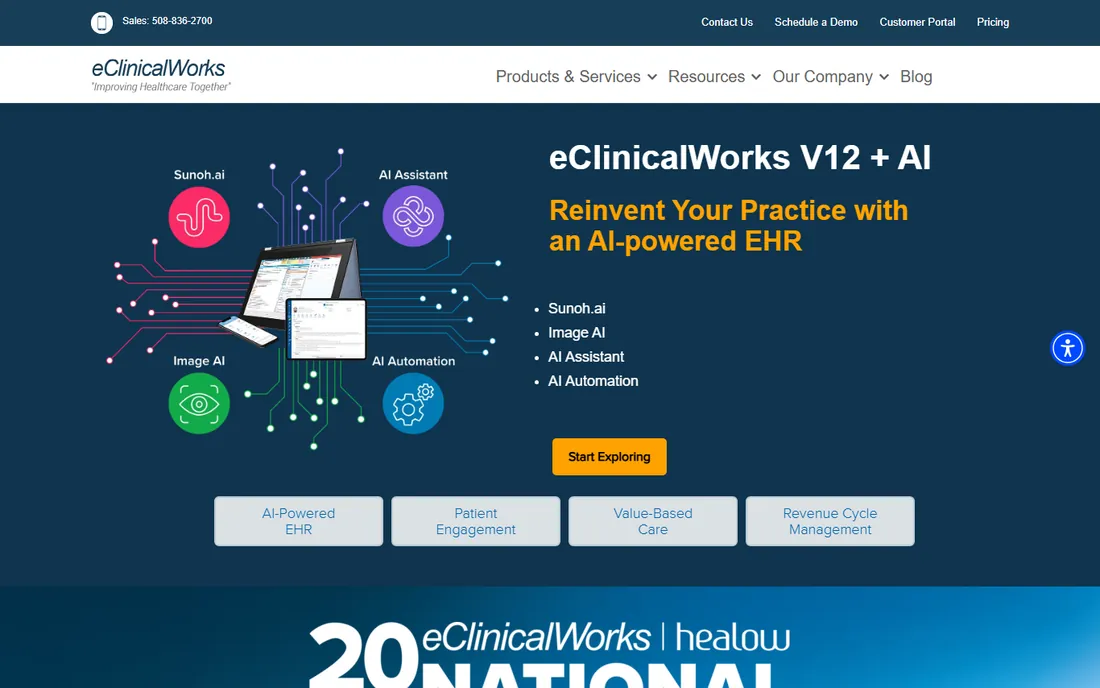
eClinicalWorks is one of the largest cloud EHR vendors in the US, with more than 180,000 physicians and nurse practitioners on the platform. Its strength is the ambulatory side: documentation, practice management, telehealth, and patient engagement bundled together. Recent additions like the healow Genie AI contact center and the Sunoh AI scribe show the company investing in reducing documentation burden.
For hospital systems, eClinicalWorks is a fit for the owned-practice portfolio rather than the inpatient core. Pricing is generally friendlier than the enterprise tier, and the cloud model keeps IT overhead low. Buyers wanting a single vendor for both the hospital and every clinic should look elsewhere.
What we like- Large cloud EHR install base
- Built-in telehealth and patient engagement through healow
- Fast implementations for practices
Watch out for- Hospital inpatient functionality is limited
- Design feels dated in places
#6
Veradigm
Best for: hospitals wanting EHR plus data and analytics network
Visit veradigm.com
Starting priceSee website
Free planNo
Veradigm is the former Allscripts, renamed in 2023, and it sells more than an EHR: the business spans provider software, payer analytics, and life sciences data. The Veradigm Network connects these pieces, which makes the company interesting for hospitals that want population health analytics and research participation alongside clinical software. Products like the Paragon acute care EHR and the AI Ambient Scribe round out the clinical side.
The honest catch is clarity. The rename, the delisting of the stock, and the breadth of the portfolio make it harder to answer the simple question of which product a hospital buys. Ask for the specific product line item, not the corporate story, during evaluation.
What we like- Broad portfolio spanning providers, payers, and life sciences
- Large data network for insights
- AI scribing built in
Watch out for- Corporate identity shifted after the Allscripts rename
- Product line breadth can be confusing
#7
MEDHOST
Best for: community hospitals wanting hosted EHR and RCM services
Visit medhost.com
Starting priceSee website
Free planNo
MEDHOST has spent over four decades selling to community hospitals, and that focus shows in the product and the delivery model. The hosted and managed approach means predictable IT expenses and less downtime worry for hospitals without deep technical teams. Revenue cycle services, denial management, and the EDIS emergency department system are all part of the package.
The trade-off is vendor scale. MEDHOST cannot match the R&D budgets of Epic or Oracle, so buyers should check that the product roadmap covers their specialty needs. For the hospitals it targets, though, the partnership model and community-hospital DNA are genuine advantages.
What we like- 40 years focused on community hospitals
- Hosted and managed delivery model
- Revenue cycle services included
Watch out for- Smaller vendor than the big three
- Innovation pace trails Epic and Oracle
#8
TruBridge
Best for: rural hospitals needing EHR plus revenue cycle services
Visit trubridge.com
Starting priceSee website
Free planNo
TruBridge is the former CPSI, rebranded in 2024, and it pairs EHR technology with revenue cycle management services for community hospitals. More than 1,500 healthcare organizations use its solutions, and its RCM offerings carry HFMA peer review. The no-upfront-cost nTrust program, where TruBridge takes a percentage of collections, is genuinely different from the usual capital expenditure model.
The honest catch is scope. TruBridge is built for rural and community hospitals, and large systems will find the clinical depth limited compared with Epic or Oracle. For a critical access hospital where cash flow matters more than feature count, the EHR-plus-services bundle is hard to beat.
What we like- EHR plus revenue cycle services from one vendor
- Built for rural and critical access hospitals
- Peer-reviewed RCM products
Watch out for- Mainly a rural play
- Limited appeal for larger health systems
How we chose
We built this list from the vendors' own pricing pages, product documentation, and public materials, plus public reviews on G2 and Capterra, hospital IT coverage, and Reddit threads from working health IT staff. We weighted acute care and inpatient capability, since "hospital software" implies the full inpatient core, and we required every vendor to have a verifiable, current homepage and an active product line.
What to check before signing a hospital contract
Hospital software buys are five- to ten-year commitments, so the diligence matters more than the demo. Start with the hard requirements. Confirm ONC Health IT certification status for the specific version you are buying. Ask for reference sites at your bed count and your specialty mix. Get the implementation timeline and the internal staffing requirement in writing.
Then probe the commercial terms. Ask what the contract costs over seven years, not year one, including modules you will likely add later. Clarify who pays for interfaces, upgrades, and the AI features vendors are racing to add. Finally, get the exit plan: data extraction formats, timelines, and costs if you leave.
Hospital software vs practice management software
One common confusion deserves its own note. Tools like athenahealth and eClinicalWorks are strong in ambulatory care and hospital-owned clinics, but full inpatient hospital operations involve the ED, the OR, bed management, pharmacy, lab, and inpatient billing. If your hospital admits patients overnight, make sure the product you are evaluating is a genuine hospital information system, not a practice EHR with a hospital sticker.
Frequently asked questions
What is the most widely used hospital software?
Epic holds the largest share of the US acute care hospital market, followed by Oracle Health and MEDITECH. That market leadership matters because it affects hiring, third-party integrations, and peer references.
How much does hospital software cost?
Full EHR implementations typically cost millions of dollars for a community hospital and tens of millions for a large system, covering software, implementation services, and hardware. Almost all enterprise pricing is quote-based, so budget early and plan for a seven- to ten-year total cost of ownership.
What is the difference between Epic and MEDITECH?
Epic targets large health systems with the deepest clinical functionality, while MEDITECH focuses on community and rural hospitals with a strong value proposition. MEDITECH's Expanse platform competes well for smaller hospitals, though Epic's ecosystem is larger.
Can small hospitals use cloud-based hospital software?
Yes. Cloud-native vendors reduce the need for on-site data centers and large IT teams, which makes them attractive for small and rural hospitals. MEDHOST, athenahealth, and eClinicalWorks all offer hosted or cloud models suited to this segment.
What happened to Allscripts?
Allscripts Healthcare Solutions renamed itself Veradigm in January 2023 and now operates under the Veradigm brand at veradigm.com. Its clinical products continue under the Veradigm name.
What happened to CPSI?
CPSI rebranded as TruBridge in 2024 and now operates at trubridge.com. The company focuses on rural and community hospital EHR and revenue cycle solutions.
Sources we checked (8)
- https://www.epic.com/
- https://www.oracle.com/health/
- https://meditech.com/
- https://athenahealth.com/
- https://eclinicalworks.com/
- https://veradigm.com/
- https://medhost.com/
- https://trubridge.com/
Is your product missing or out of date?
We review this list regularly. Vendors can request a listing, send updated pricing or ask about featured placement.

Shihab Mia · Founder, Rankite
Shihab has spent more than a decade helping SaaS and e-commerce brands grow through search. He writes Rankite's software buying guides from pricing pages, documentation and public user reviews. More about Shihab.