How we make this list: we compare pricing pages, product documentation and public user reviews. Rankite is independent; if a vendor ever pays for a featured spot, that listing is clearly labeled Partner.
Key takeaways
- Benchling dominates biotech R&D but commercial pricing is quote-only and reported in the thousands per user per year. Its academic plan is free.
- LabArchives offers the clearest published pricing in the group, with a free tier and a Professional plan at $575 per user per year for corporate labs.
- SciNote and RSpace both offer free plans with real compliance features, making them strong picks for small labs and startups.
- If you need ELN plus LIMS plus inventory in one system, LabGuru, LabCollector, and SciSure bundle all three.
Quick comparison
| Tool | Best for | Starting price | Free plan |
|---|
 Benchling Benchling | Biotech R&D teams | Free for academics; commercial plans by quote | Yes (academic) |
 LabArchives LabArchives | Labs wanting clear published pricing | $575 per user per year (corporate Professional) | Yes |
 SciNote SciNote | Regulated labs on a budget | Free; paid plans by quote | Yes |
 RSpace RSpace | Universities and open-science labs | $120 per user per year | Yes (Community) |
 LabGuru LabGuru | Labs wanting ELN plus LIMS in one platform | By quote | Free trial |
 SciSure SciSure | Labs needing a compliant European-built platform | By quote | Free trial |
 LabCollector LabCollector | Modular labs that buy only what they need | $900 per user per year (ELN pack) | Yes (free startup pack) |
Is your product missing or out of date?
We review this list regularly. Vendors can request a listing, send updated pricing or ask about featured placement.
The best lab notebook software
Starting priceFree for academics; commercial plans by quote
Free planYes (academic)
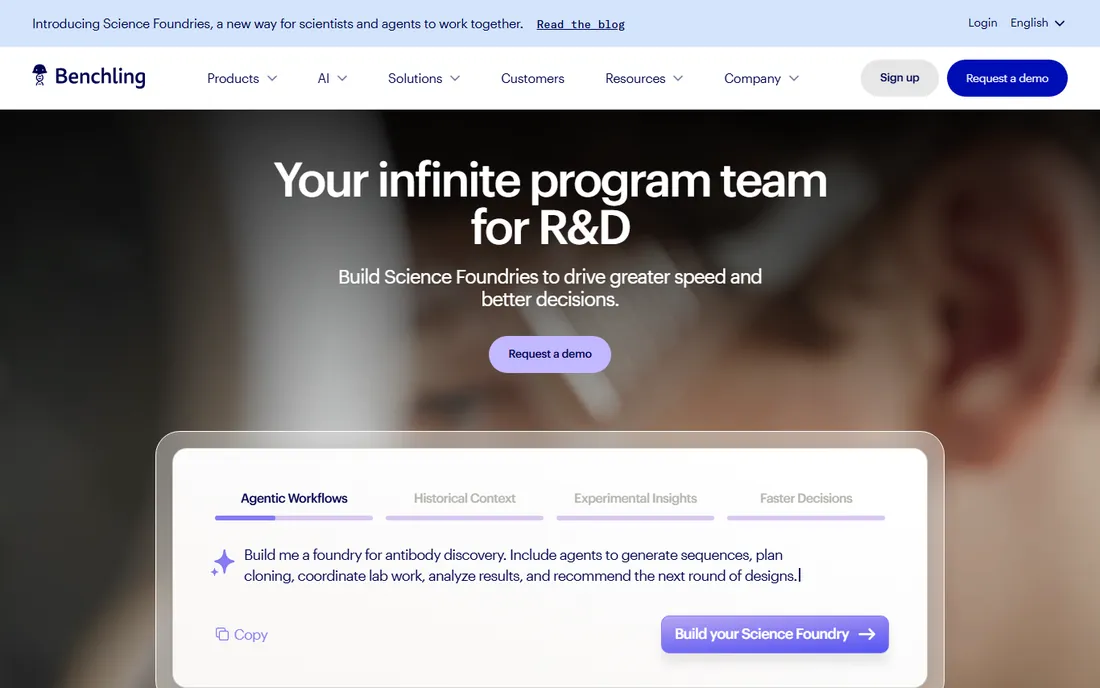
Benchling started at MIT in 2012 and grew into the default notebook for biotech R&D. The reason is specialization: CRISPR guide design, plasmid editing, primer design, and sequence alignment live inside the same notebook where you record experiments. For a molecular biology lab, that removes the constant hopping between a notebook and a separate analysis tool.
The platform now covers the full R&D lifecycle, from bioresearch through bioprocess, with AI-assisted search and workflow automation layered on top. Collaboration is real-time, and the data model is designed for computational science, which matters once a lab starts doing serious data work.
The honest catch is the price wall between academia and industry. The academic plan is free and generous, but commercial plans are quote-only and third-party reports put them at $5,000 to $7,000 per user per year. Smaller labs and startups often find the cost hard to justify, and several reviewers note that adapting Benchling to non-standard workflows takes real admin effort. Confirm export options and the full two-year cost before committing.
What we like- Purpose-built molecular biology tools including CRISPR design and sequence analysis
- Used by more than 200,000 scientists
- Strong workflow automation
Watch out for- Commercial pricing is quote-only and reported at $5,000 to $7,000 per user per year
- Can require heavy onboarding for smaller labs
- Some users report data export limitations
Starting price$575 per user per year (corporate Professional)
Free planYes
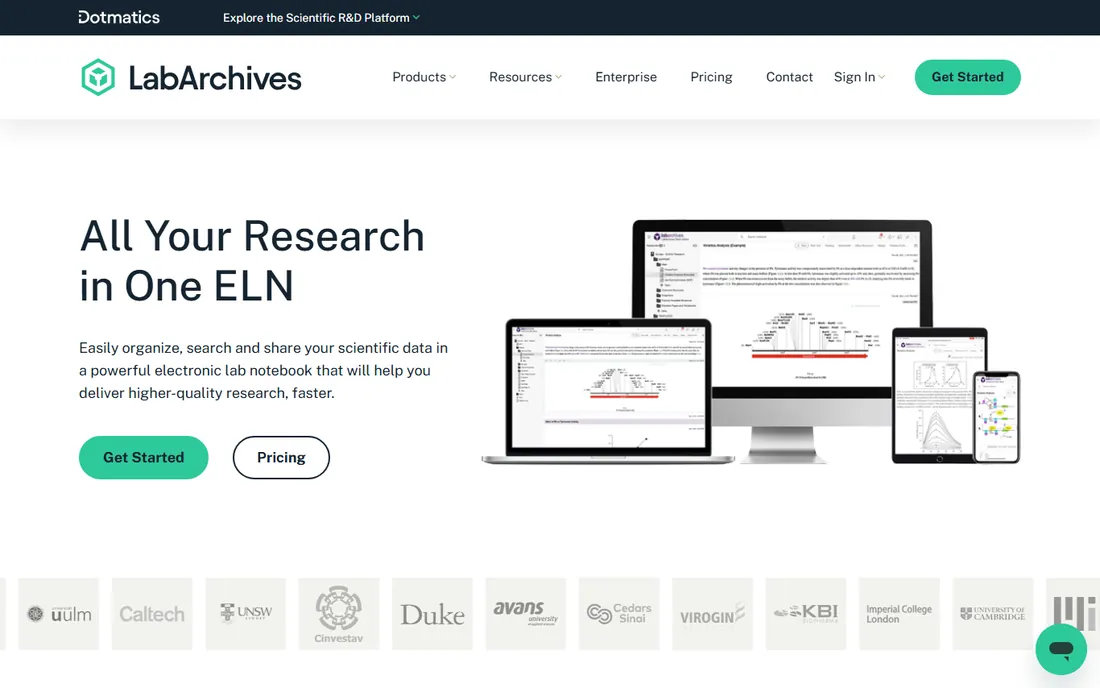
LabArchives, now part of Dotmatics, is the veteran of this list. It has been cloud-based since 2009, holds an NIH agency license covering thousands of users, and publishes its pricing openly, which is rare in this market. The free plan gives individuals two notebooks, and the Professional plan at $575 per user per year corporate ($330 academic) adds unlimited notebooks, 100GB per user, and larger file limits.
Compliance is a genuine strength. Electronic signatures, audit trails, and 21 CFR Part 11 support come standard, and the platform integrates with SnapGene and GraphPad Prism, tools most life-science labs already use. For teaching labs, there is even a $25 per student per term classroom edition.
The catch is that the base ELN is just the notebook. Inventory management costs extra through the ELN plus Inventory bundle at $675 per user per year corporate. The interface also shows its age compared with Benchling or SciNote. If you want one vendor, one invoice, and pricing you can see before the sales call, LabArchives is the straightforward choice.
What we like- Transparent pricing with a free tier
- 21 CFR Part 11 compliance features
- Trusted by NIH and more than 500 institutions
Watch out for- Inventory is a separate paid bundle
- Interface feels dated next to newer rivals
- Enterprise features need the custom tier
Starting priceFree; paid plans by quote
Free planYes
SciNote is a top-rated ELN trusted by the FDA and USDA, and it manages the unusual trick of being both compliance-ready and genuinely affordable. The free plan covers the core notebook, and paid tiers (Essential, Validated, Platinum) add the compliance and QA depth regulated labs need. Electronic signatures, audit trails, timestamps, and access controls are built for 21 CFR Part 11 and GLP/GMP work.
The projects, experiments, and tasks structure mirrors how research actually happens, and the built-in inventory management links reagents directly to experiments. Protocol templates and protocols.io integration speed up repetitive work, and there are mobile apps for bench-side use.
The catch is pricing opacity. SciNote publishes no prices for paid plans, so budgeting requires a sales conversation. Some reviewers also find the deeply nested layout requires too many clicks to reach results. For a small regulated lab that needs compliance without enterprise cost, it remains one of the best values in the category.
What we like- Free plan with real functionality
- 21 CFR Part 11 compliance built in
- Inventory and team management included
Watch out for- Paid pricing is quote-only with no published tiers
- Some users find the nested structure click-heavy
- Advanced analytics need higher plans
Starting price$120 per user per year
Free planYes (Community)
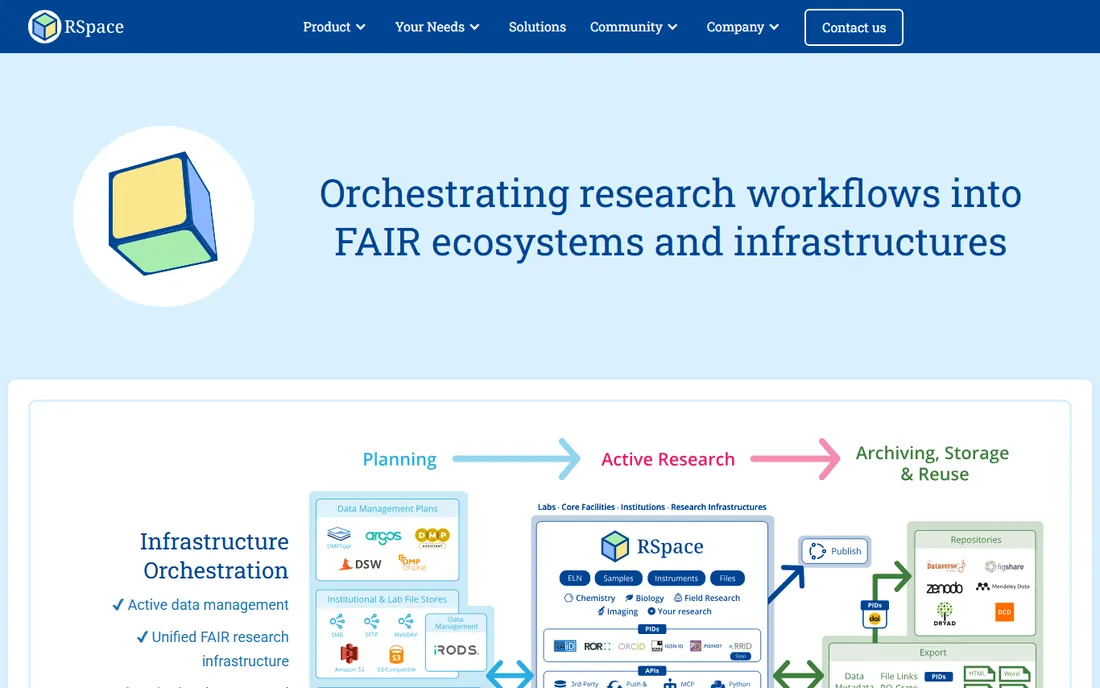
RSpace takes a different path from the venture-backed giants. The Community tier is free with unlimited storage, the core platform is open source and can be self-hosted, and paid plans start around $120 per user per year. For universities and public research institutions, site licenses cover unlimited users, which makes budgeting simple.
The platform has grown beyond a notebook into research data infrastructure: sample management, persistent identifiers (ORCID, DataCite, IGSN), and FAIR data workflows are native. Integrations with Box, Dropbox, OneDrive, GitHub, and Mendeley connect it to the tools researchers already use.
The catch is depth in specialized science. The molecular biology and chemistry tooling does not match Benchling, and the integration catalog is smaller than the big commercial platforms. But for labs that care about open science, data ownership, and predictable cost, RSpace is the principled pick.
What we like- Free Community tier with unlimited storage
- Open-source option for self-hosting
- Strong FAIR data and persistent identifier support
Watch out for- Smaller vendor with fewer native integrations
- Chemistry and biology tools are less deep than Benchling
- Enterprise features need institutional licenses
Starting priceBy quote
Free planFree trial
LabGuru, from BioData, is built for labs that are tired of stitching a notebook to a separate inventory system. The ELN, LIMS, and inventory management live in one platform: plan experiments on the calendar, track samples and reagents with barcode support, schedule shared equipment, and automate routine workflows with triggers and rules.
Compliance is covered with FDA 21 CFR Part 11 electronic signatures and audit trails, and the support team is staffed by PhD application scientists rather than generalists. The platform serves more than 750 organizations across academia, pharma, and biotech.
The catch is that pricing is entirely quote-based, so you cannot budget without talking to sales. Third-party listings suggest mid-market pricing, but confirm it directly. Implementation for a lab with complex inventory also deserves a proper pilot. If the goal is one system for experiments, samples, and equipment, LabGuru delivers it.
What we like- ELN, LIMS, and inventory in one system
- 21 CFR Part 11 compliant e-signatures
- Strong workflow automation with a scripting option
Watch out for- No published pricing
- Implementation can take planning for larger labs
- Interface prioritizes function over polish
Starting priceBy quote
Free planFree trial
SciSure is the new name for eLabJournal, the long-running ELN from the Dutch company formerly known as Bio-ITech (now eLabNext, majority-owned by Eppendorf). The rebrand unifies the ELN, LIMS, and sample management tools into one Digital Lab Platform. If you search for eLabJournal today, you land on SciSure, which is the same product line under its new brand.
The platform is built for regulated work: 21 CFR Part 11 compliance, electronic signatures, audit trails, and ISO 27001-certified hosting. Deployment is flexible across cloud, private cloud, or on-premises, which matters for labs with strict data residency rules. The marketplace adds integrations and workflow extensions.
The catch is the transition. The eLabJournal to SciSure rebrand is recent, so older reviews and documentation use the old name. Pricing is quote-only with no published tiers. For labs that value European data handling and a single compliant platform, it is worth a demo, but ask for the current brand documentation and a written quote early.
What we like- ELN plus LIMS plus inventory in one Digital Lab Platform
- 21 CFR Part 11 and GxP compliance
- Cloud, private cloud, or on-premises deployment
Watch out for- Recent rebrand from eLabJournal can confuse buyers
- No published pricing
- Smaller US support footprint than domestic rivals
Starting price$900 per user per year (ELN pack)
Free planYes (free startup pack)
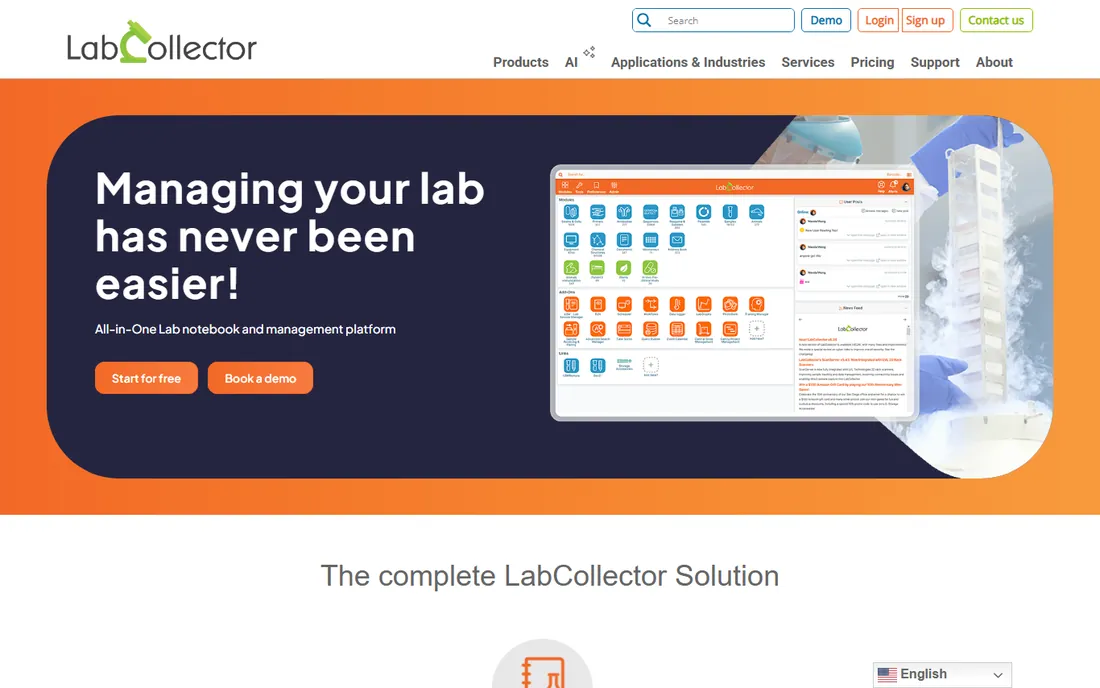
LabCollector from AgileBio takes the modular approach: instead of one big platform price, you buy packs. The ELN pack runs $900 per user per year, the inventory pack $500, and the LIMS/LIS pack $1,250, with a free startup pack covering three users. A small lab can start with exactly the module it needs and add more later.
Customization is the selling point. Every module accepts custom fields, and a large add-on catalog covers equipment scheduling, workflows, data loggers, and service management for core facilities. The system handles chemicals with structure search, which chemistry-heavy labs appreciate.
The catch is complexity in buying and setup. Pack-based pricing takes work to map to your actual needs, and the interface prioritizes function over beauty. Add-ons can also push the total well past the entry price. For labs that know exactly which modules they need and want to pay for nothing else, the model works well.
What we like- Modular packs let you buy ELN, LIMS, or inventory separately
- Free startup pack for 3 users
- Highly customizable with custom fields and add-ons
Watch out for- Pricing is pack-based and can confuse
- Interface feels utilitarian
- Advanced modules add cost quickly
How we chose
We reviewed vendor pricing pages, product documentation, and public reviews on G2, Capterra, SourceForge, and Slashdot, along with ELN comparison research from the scientific community. We prioritized 21 CFR Part 11 and GLP compliance features, inventory integration, data export options, and transparent pricing. We favored tools with free plans or published prices so small and mid-size US labs can budget realistically. We did not claim hands-on testing of any product.
What to verify before you commit
An ELN holds your lab's intellectual property, so the buying decision deserves more scrutiny than most software.
Confirm compliance features match your regulators
If you work under FDA, GLP, or GMP rules, verify electronic signatures, audit trails, and 21 CFR Part 11 support in writing. Ask whether compliance features are included in the tier you are buying or gated behind a validated plan.
Test data export before you need it
Ask for a full export of a test project during the trial: experiments, attachments, metadata, and audit history. Check the formats. A notebook you cannot leave is a liability, not an asset.
Price the whole lab, not one user
Multiply the per-user price by every scientist, student, and collaborator who needs access. Some vendors charge for read-only or external users. Get the annual total for your actual headcount in the quote.
Run a real pilot with your own protocols
Import two or three of your actual experiment templates and run them for two weeks. This surfaces workflow mismatches that demos hide, especially around inventory linking and approval chains.
Check where your data lives
Ask about hosting region, backup frequency, and what happens to your data if you cancel. Labs with grant or institutional requirements may need specific data residency guarantees.
When a free plan is enough
Not every lab needs a paid ELN. Academic groups, small startups, and teaching labs can run for years on the free tiers from Benchling (academic), LabArchives, SciNote, or RSpace Community. The free plans cover experiment documentation, collaboration, and basic compliance features.
The upgrade triggers are consistent: you need validated 21 CFR Part 11 workflows, you outgrow storage or user limits, or you need inventory and LIMS depth that free tiers exclude. Until one of those hits, keep the money for reagents.
Frequently asked questions
What is the best electronic lab notebook for a small biotech startup?
SciNote and RSpace offer the strongest free plans with compliance features, while LabArchives Professional at $575 per user per year corporate gives published pricing without a sales negotiation. Benchling is the most powerful but commercial pricing starts in the thousands per user per year.
Is Benchling really free?
Benchling is free for academic researchers, including the notebook and molecular biology tools. Commercial and industry use requires a paid plan, which is quote-only and reported at roughly $5,000 to $7,000 per user per year.
Which lab notebook software is 21 CFR Part 11 compliant?
LabArchives, SciNote, LabGuru, SciSure, and Benchling (on paid plans) all offer 21 CFR Part 11 features including electronic signatures and audit trails. RSpace supports them as well. Always confirm the compliance scope in writing for the specific tier you buy.
Can I migrate from paper notebooks to an ELN?
Yes. Most vendors offer import tools and onboarding help for paper-to-digital migration. SciNote, LabArchives, and SciSure all document migration support. Plan the migration as a project: scanning, structuring, and validating old records takes longer than the software setup.
What happened to eLabJournal?
eLabJournal was rebranded to SciSure as its parent company Bio-ITech became eLabNext. The product line continues under the SciSure name at elabjournal.com, now positioned as a Digital Lab Platform combining ELN, LIMS, and inventory.
Do electronic lab notebooks work for chemistry labs?
Yes, though fit varies. LabCollector offers chemical structure search, Benchling covers small molecules, and RSpace supports chemistry workflows. Chemistry-heavy labs should verify structure drawing, reaction handling, and inventory integration during the trial.
Sources we checked (12)
- https://benchling.com/
- https://www.benchling.com/academic
- https://labarchives.com/
- https://www.labarchives.com/pricing
- https://www.scinote.net
- https://researchspace.com/
- https://www.researchspace.com/features
- https://labguru.com/
- https://www.elabjournal.com
- https://www.labcollector.com
- https://www.g2.com/products/labcollector-lims-eln/pricing
- https://www.scispot.com/blog/labarchives-vs-benchling-vs-scispot
Is your product missing or out of date?
We review this list regularly. Vendors can request a listing, send updated pricing or ask about featured placement.

Shihab Mia · Founder, Rankite
Shihab has spent more than a decade helping SaaS and e-commerce brands grow through search. He writes Rankite's software buying guides from pricing pages, documentation and public user reviews. More about Shihab.