How we make this list: we compare pricing pages, product documentation and public user reviews. Rankite is independent; if a vendor ever pays for a featured spot, that listing is clearly labeled Partner.
Key takeaways
- Juniper Square is the default for private markets GPs that want investor reporting, fund admin, and a portal from one vendor.
- Backstop and Dynamo suit firms that want reporting wrapped into a broader investment management and CRM platform.
- Allvue and eFront fit large institutions that need deep fund accounting behind the reporting layer.
- Real estate sponsors get better value from purpose-built tools: Cash Flow Portal, InvestNext, and Covercy publish clearer pricing and onboard faster.
Quick comparison
| Tool | Best for | Starting price | Free plan |
|---|
 Juniper Square Juniper Square | Private markets GPs that want reporting, admin, and portal in one | See website | No |
 Backstop Solutions Backstop Solutions | Investment firms that want reporting inside a full front-to-back platform | See website | No |
 Dynamo Software Dynamo Software | Alternatives managers with complex, configurable workflows | See website | No |
 Allvue Allvue | Large PE, VC, and private debt firms on Allvue accounting | See website | No |
 eFront eFront | Institutions that want private markets tech backed by BlackRock | See website | No |
 Carta Carta | VC and PE funds administered on Carta | See website | No |
 Cash Flow Portal Cash Flow Portal | Real estate syndicators that want fast setup | See website | No |
 InvestNext InvestNext | Real estate funds that need serious distribution and compliance tooling | See website | No |
 Covercy Covercy | Commercial real estate firms wanting banking built in | See website | No |
 AppFolio Investment Management AppFolio Investment Management | Property managers that already run on AppFolio | See website | No |
Is your product missing or out of date?
We review this list regularly. Vendors can request a listing, send updated pricing or ask about featured placement.
The best investor reporting software
#1
Juniper Square
Best for: Private markets GPs that want reporting, admin, and portal in one
Visit junipersquare.com
Starting priceSee website
Free planNo
Quarter-end is where investor reporting software earns its keep, and Juniper Square built its name on that exact week. More than 2,300 GPs run funds on the platform, which combines fund accounting, an investor portal, investor CRM, and data rooms in one system. Capital calls, distributions, K-1s, and quarterly statements flow from the same data that runs the accounting, so the numbers LPs see match the books. Over 750,000 LPs and $1T in investor equity sit on the platform, which tells you the LP experience is battle-tested.
The practical appeal is consolidation. Instead of stitching a portal onto a fund admin's PDFs, the GP gets one source of truth from fundraising through final distribution, with onboarding, subscriptions, and reporting in the same workflows. Newer AI features generate tear sheets and investor updates from live fund data. The honest trade-off: pricing is quote-based and the platform makes most sense when you buy the stack, including fund administration. A small GP that only needs a portal may find the commitment heavy for the reporting job alone.
What we like- Unified fund accounting, portal, and CRM
- 2,300-plus GPs on the platform
- Data rooms included
Watch out for- Quote-based enterprise pricing
- Best value when you also use their fund admin
Starting priceSee website
Free planNo
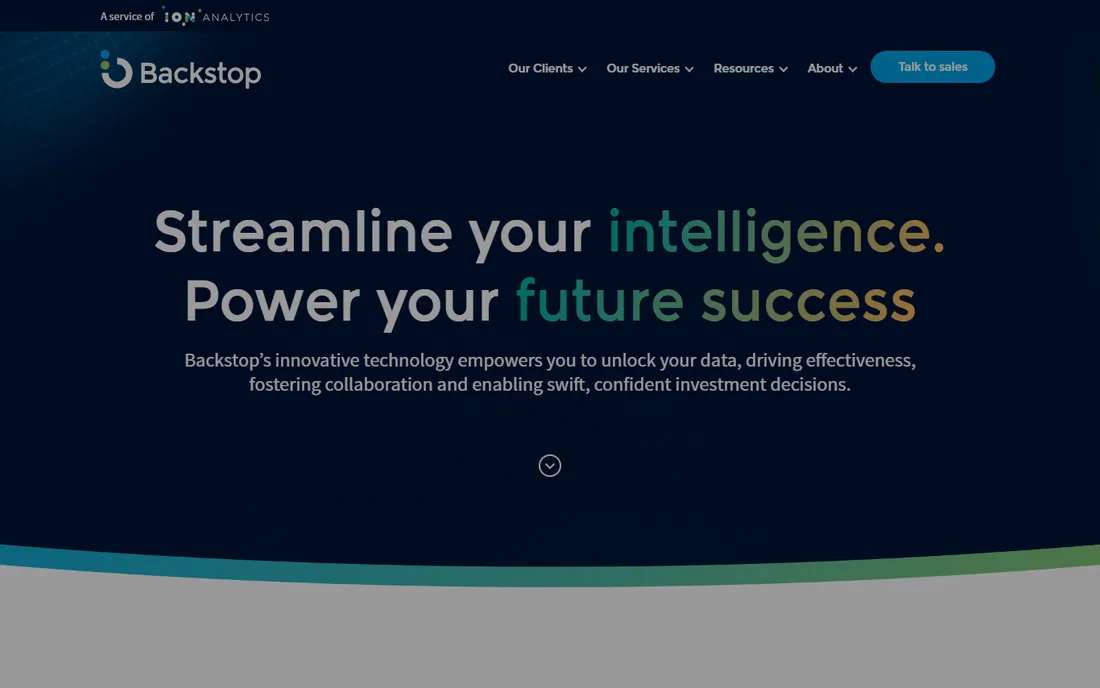
Backstop approaches investor reporting as one module in a full investment management suite. The platform covers research management, portfolio management, CRM, capital raising, investor relations, and a branded client portal, with data services that pull in custodial, fund admin, and benchmark feeds automatically. For allocators, funds of funds, and managers that live in the system all day, reporting becomes a byproduct of work already happening in the platform.
The strength is the single source of truth across the investment lifecycle: the same contact record that tracks a prospect meeting feeds the distribution list for the quarterly letter, and fund admin data loads directly into performance reporting. Client testimonials emphasize daily-use reliability and support quality. The weakness for a pure reporting buyer is scope. If you only need LP statements and a portal, you will pay for and implement a much bigger system. Backstop fits firms that want the CRM and research modules too.
What we like- CRM, research, portfolio, and portal in one system
- Strong data services
- Long institutional track record
Watch out for- Broad platform can feel heavy for reporting-only needs
- Quote-based pricing
Starting priceSee website
Free planNo
Dynamo has spent two decades building configurable software for alternative asset managers, and flexibility is the pitch. The platform covers private equity and venture capital, hedge funds, real estate, and limited partners, with modules for investor relations, deal pipeline, portfolio monitoring, fund accounting integration, and a secure investor portal. Reporting is a standout: users praise how easily data can be pulled, sliced, and displayed without IT help.
That configurability cuts both ways. Firms with unusual fund structures or multi-strategy operations can model them faithfully, but the implementation needs someone who understands both the business and the system. Dynamo suits mid-size and large managers that have outgrown rigid tools and want the portal, CRM, and reporting shaped to their processes. Smaller GPs should weigh the implementation effort against simpler options like Juniper Square or the real estate tools below.
What we like- Highly configurable across asset classes
- Integrated investor portal
- Strong reporting flexibility
Watch out for- Configuration takes time and expertise
- Quote-based enterprise pricing
#4
Allvue
Best for: Large PE, VC, and private debt firms on Allvue accounting
Visit allvue.com
Starting priceSee website
Free planNo
Allvue is one of the heavyweights in private capital technology, combining fund accounting, portfolio monitoring, fundraising, and an investor portal on one platform. For firms already running Allvue's accounting, the portal and reporting modules pull directly from the general ledger, which removes the reconciliation work that plagues bolt-on portals. Private debt managers in particular value the loan-level accounting behind the investor views.
The fundraising side includes pipeline CRM and configurable data rooms, and a Passthrough integration handles subscription documents. The honest framing: Allvue sells to institutions, with enterprise pricing and implementation to match. A first-time fund manager will find the process and the price daunting. It belongs on the list for established managers that want reporting backed by serious accounting depth rather than a standalone portal.
What we like- Deep fund accounting backbone
- Unified platform with fundraising and portal
- Strong in private debt
Watch out for- Enterprise sales process
- Best fit when already on Allvue's accounting core
#5
eFront
Best for: Institutions that want private markets tech backed by BlackRock
Visit efront.com
Starting priceSee website
Free planNo
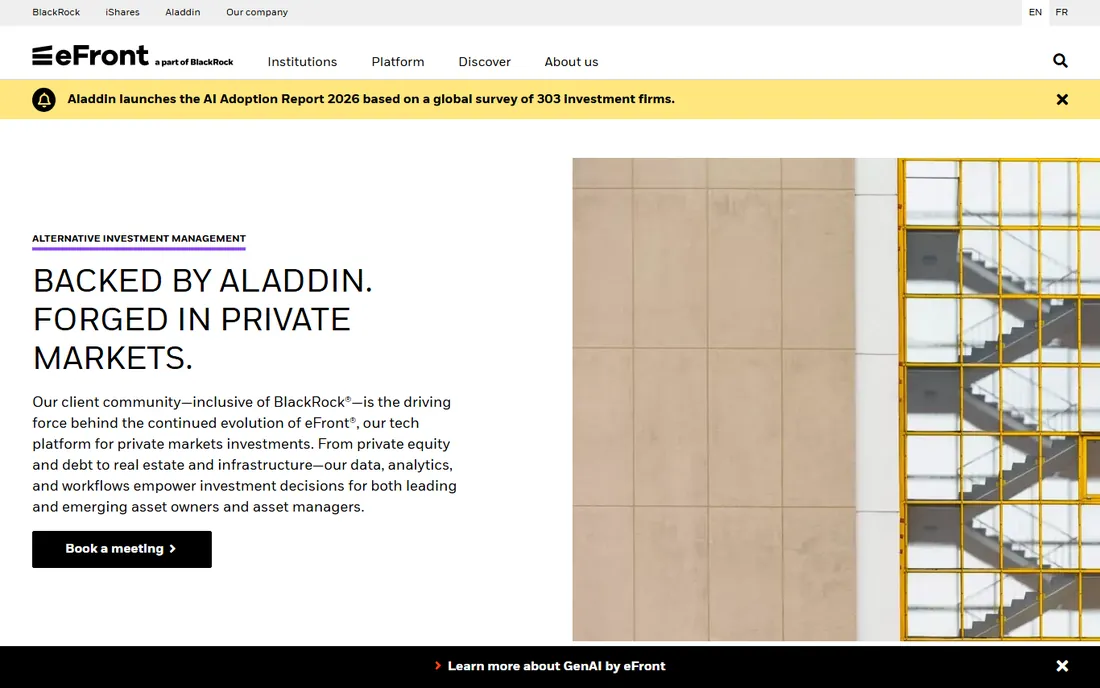
eFront is BlackRock's technology platform for private markets, covering private equity, private debt, real estate, and infrastructure. The pitch is whole-portfolio insight: alternative investment data managed alongside public markets data through Aladdin, with analytics, fundraising, fund administration, and reporting workflows built for practitioners. Asset owners like pensions and endowments use it to monitor allocations, while managers use it for fund operations and investor reporting.
The differentiator is analytical depth. eFront Insight provides private markets performance data and benchmarking that smaller platforms cannot match, and newer AI features assist with analysis. The trade-off is accessibility. This is institutional software with institutional pricing and sales cycles, aimed at firms with dedicated operations teams. Emerging managers should look elsewhere. For large allocators and managers that already live in the BlackRock ecosystem, it is a natural fit.
What we like- Deep private markets data and analytics
- Aladdin integration
- Strong asset-owner tools
Watch out for- Institutional focus and pricing
- Overkill for small GPs
Starting priceSee website
Free planNo

Carta started with cap tables and grew into fund administration, which makes its investor portal a natural extension for the 50,000-plus companies and many funds on the platform. For VC and PE funds administered by Carta, LPs get statements, capital calls, and tax documents from the same system that holds the fund's books. The platform now adds AI features that let teams query fund data and automate workflows.
The fit is strongest for venture capital, where Carta's equity management roots run deepest, and for emerging managers that want one vendor from formation through reporting. Complex private equity structures with layered entities may find the reporting less deep than purpose-built fund accounting platforms like Allvue or eFront. Pricing is quote-based and scales with the number of entities and assets. If your fund already runs on Carta, the portal is the path of least resistance.
What we like- Equity, fund admin, and portal from one vendor
- Strong for VC workflows
- Large existing user base
Watch out for- Reporting depth varies by fund complexity
- Pricing scales with assets and entities
Starting priceSee website
Free planNo
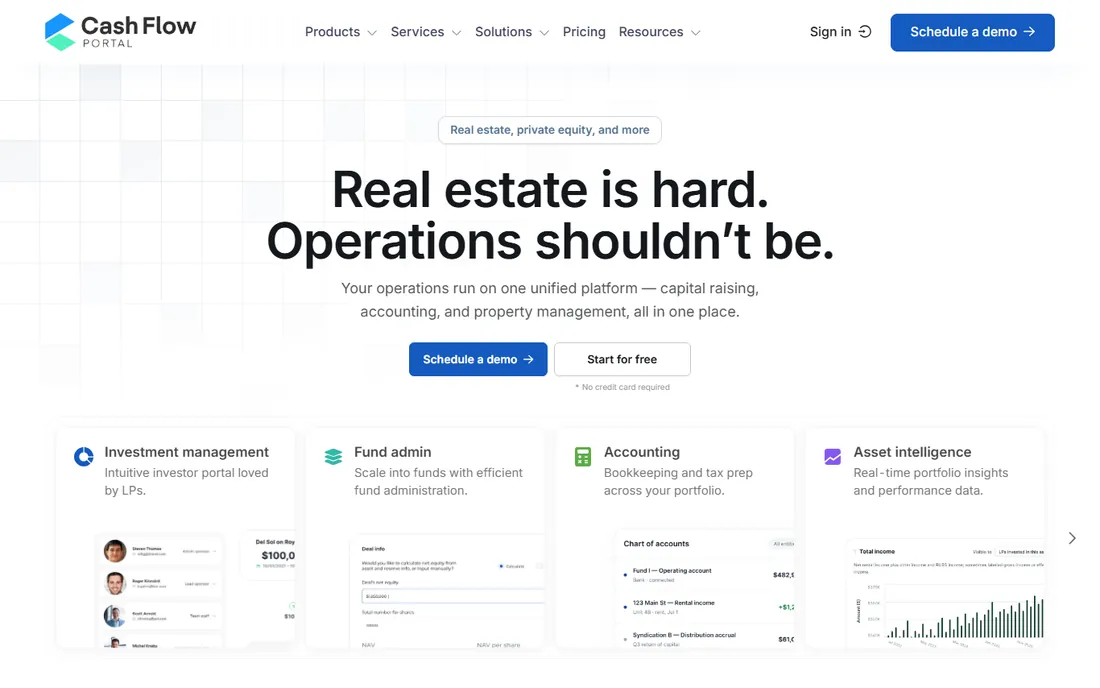
Cash Flow Portal is built for real estate sponsors who need to raise capital and report to investors without hiring an operations team. The platform combines an investor portal, CRM, fund administration, accounting, distribution management, and AI-assisted underwriting in one system. Onboarding is famously fast, with the company promising GPs can start raising in under 12 hours, and support runs through responsive channels that reviewers consistently praise.
The value proposition is completeness at the small end of the market. Distribution waterfalls, K-1 generation, capital calls, and investor communications all live in one place, backed by Y Combinator and strong G2 ratings in real estate investment management. The honest limit is focus: this is a real estate tool, and private equity or venture firms should look at the institutional options above. Pricing is not published on the site, so get a quote early and compare it against InvestNext and Covercy.
What we like- Quick onboarding
- Built-in fund admin and accounting
- Strong support reputation
Watch out for- Real estate focused, less suited to PE or VC
- Pricing not published
#8
InvestNext
Best for: Real estate funds that need serious distribution and compliance tooling
Visit investnext.com
Starting priceSee website
Free planNo

InvestNext targets real estate GPs running funds and syndications at growing scale. The standout feature is the distribution waterfall builder: complex splits calculate automatically and pay out through integrated ACH, which removes the spreadsheet risk from the most error-prone part of fund operations. Around that sit a white-label investor portal, CRM, integrated accreditation, KYC/AML verification, cap table management, and document handling.
Security and compliance get real attention, with external audits behind the encryption and authentication claims. The platform suits sponsors moving from syndications to funds who need institutional-grade controls without enterprise software timelines. The trade-offs mirror Cash Flow Portal: real estate only, and pricing requires a sales conversation. Get quotes from both plus Covercy, compare the distribution and tax features line by line, and pick based on your fund structure.
What we like- Point-and-click distribution waterfalls
- Integrated accreditation and KYC/AML
- White-label portal
Watch out for- Pricing not published
- Real estate only
#9
Covercy
Best for: Commercial real estate firms wanting banking built in
Visit covercy.com
Starting priceSee website
Free planNo
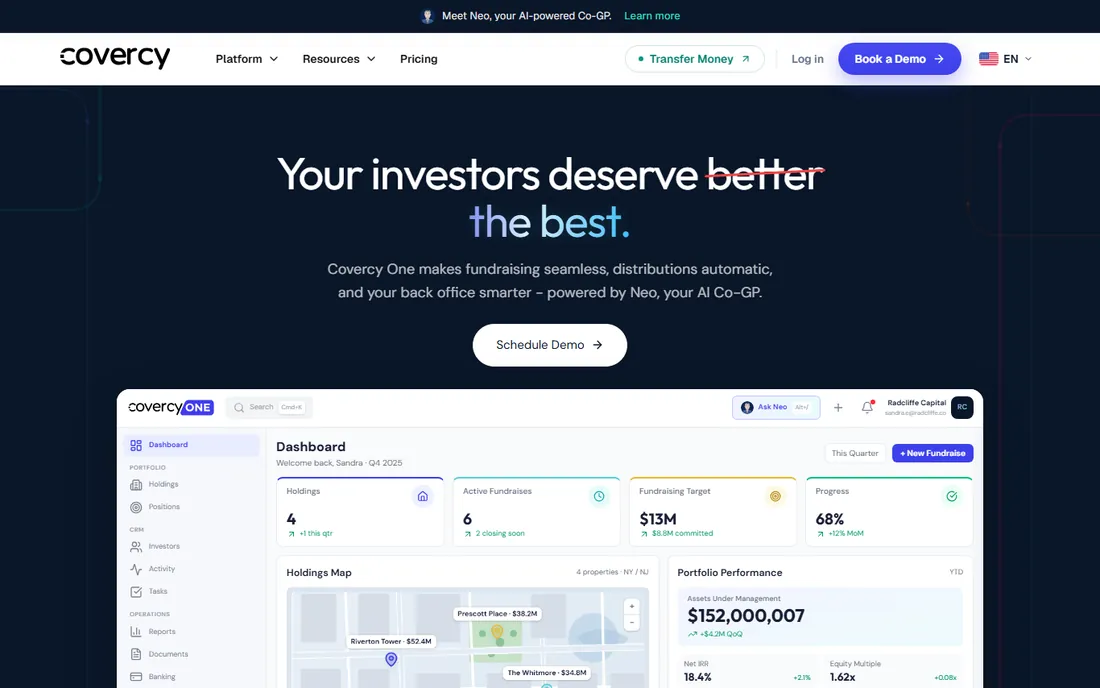
Covercy's pitch is that investor reporting should not require a separate banking relationship. The platform, now called Covercy One, combines fundraising, a CRM, an investor portal, fund administration, K-1 generation, and banking with FDIC-insured accounts, so distributions move without leaving the system. An AI assistant drafts reports and answers questions about portfolio data, and integrations cover QuickBooks, Plaid, Yardi, and NetSuite.
For commercial real estate firms, the banking integration is genuinely differentiating: pending distributions, scheduled payouts, and transaction history sit next to the investor records they belong to. The tax center tracks K-1 status across investors, which simplifies the most dreaded part of the year. The honest caveats: the unified platform positioning is newer, so diligence on reference customers matters, and pricing is quote-based. If moving money inside the reporting platform appeals to you, Covercy deserves a demo alongside Cash Flow Portal and InvestNext.
What we like- Banking and payments inside the platform
- Fund admin and tax center
- AI assistant for reporting
Watch out for- Newer all-in-one positioning
- Pricing not published
#10
AppFolio Investment Management
Best for: Property managers that already run on AppFolio
Visit appfolio.com
Starting priceSee website
Free planNo
AppFolio Investment Management extends the company's property management platform into the capital side of real estate. Firms already running AppFolio for operations get investor management, a portal, performance reporting, and fundraising tools on the same data: rent rolls, occupancy, and financials flow into investor views without rekeying. The unified experience is the entire argument, and with thousands of property management customers, the distribution is built in.
The fit is narrow but real. If your firm manages properties on AppFolio and raises capital from investors, the investment management module removes the gap between operations and reporting that standalone portals cannot close. If you do not run AppFolio for property management, the standalone value is thinner than the purpose-built tools above. Pricing is quote-based. Property managers evaluating a first investor portal should compare this against Cash Flow Portal on features and total cost before deciding.
What we like- Unified with AppFolio property management
- Investor portal and reporting
- Large existing customer base
Watch out for- Property management centric
- Standalone value lower outside the AppFolio ecosystem
Portal vs fund accounting: know what you are buying
Investor reporting software comes in two shapes, and confusing them is the most expensive mistake in this category. A portal takes data from somewhere else and presents it to LPs: statements, capital calls, documents, messages. Fund accounting software produces the data: the general ledger, allocations, waterfalls, and tax lots. Juniper Square, Allvue, and Carta bundle both. Backstop, Dynamo, and eFront wrap reporting around broader platforms. Cash Flow Portal, InvestNext, Covercy, and AppFolio bundle reporting with real-estate-specific operations.
Why it matters: if you already have a fund administrator, you may only need a portal, and paying for bundled accounting wastes money. If you self-administer, a portal without accounting leaves you reconciling spreadsheets every quarter. Ask each vendor exactly where their numbers come from, how data flows from the accounting system to the LP view, and what happens when the two disagree. The vendors that answer crisply are the ones whose architecture you can trust.
What to check before you sign
Start with implementation. Enterprise platforms like Allvue and eFront take months and need your operations team engaged. Juniper Square, Backstop, and Dynamo typically take weeks to a few months depending on scope. The real estate tools promise days. Get the timeline in writing with named milestones, and ask what the vendor needs from you each week.
Next, check the LP experience. Ask for a demo login to a sample portal and judge it like an investor would: can they find their capital account statement, see upcoming capital calls, and download tax documents without calling you? Every inbound question the portal does not answer becomes your team's work in March.
Then interrogate pricing. Almost everything here is quote-based, so get the full schedule: platform fee, per-fund or per-investor charges, onboarding fees, and what triggers price increases as you grow. Ask about contract length and what happens to your data and LP access if you leave. Data export in standard formats should be contractual, not a favor.
Finally, check references in your asset class. A portal beloved by real estate syndicators may frustrate a private credit manager. Ask for two reference customers with a similar fund structure and call them.
How we chose
We started with the platforms GPs and fund administrators actually evaluate, then verified each product on its own website in October 2026. Pricing is quote-based across most of this category, so where vendors do not publish prices we say so rather than inventing numbers. We weighed product documentation, public reviews, and analyst coverage, and matched each tool to a buyer type: private markets GPs, institutional managers, venture funds, and real estate sponsors. We did not implement any platform or run a fund on these systems.
Frequently asked questions
What is investor reporting software?
It is software that produces and delivers the information investors receive: capital account statements, capital calls, distribution notices, quarterly reports, tax documents like K-1s, and an online portal where LPs access everything. Some products bundle fund accounting underneath; others are portals that sit on top of a separate accounting system or fund administrator.
How much does investor reporting software cost?
Nearly all of it is quote-based. Institutional platforms like Juniper Square, Allvue, eFront, Backstop, and Dynamo price by fund complexity, investor count, and modules, typically reaching five or six figures annually. Real estate tools like Cash Flow Portal, InvestNext, and Covercy cost less and sometimes publish starting prices. Get a written quote with the full fee schedule before comparing.
Do I need fund administration bundled?
If you self-administer your funds, bundled accounting saves reconciliation work every quarter. If you outsource to a fund administrator, you may only need the portal and reporting layer, and some administrators offer their own. Ask each vendor where their numbers come from and how they sync with your administrator before deciding.
How long does implementation take?
It ranges from days to months. Real estate platforms like Cash Flow Portal promise onboarding in under two weeks. Mid-market platforms like Juniper Square and Dynamo typically take several weeks to a few months. Enterprise systems like Allvue and eFront can take the better part of a year with complex fund structures. Get milestones in writing.
Can this replace our Excel reporting?
That is the goal, but only if the data underneath is sound. A portal that pulls from reconciled fund accounting replaces spreadsheets. A portal fed by manual uploads just moves the spreadsheet work earlier in the process. Ask vendors how data flows from source to LP view and what breaks when it does not.
Sources we checked (12)
- https://www.junipersquare.com/
- https://www.backstopsolutions.com/
- https://www.dynamosoftware.com/
- https://allvue.com/
- https://www.efront.com/
- https://www.carta.com/
- https://www.cashflowportal.com/
- https://investnext.com/
- https://www.covercy.com/
- https://www.appfolio.com/
- https://www.caplinked.com/blog/best-investor-portal-software/
- https://www.peony.ink/blog/data-room-for-investors
Is your product missing or out of date?
We review this list regularly. Vendors can request a listing, send updated pricing or ask about featured placement.

Shihab Mia · Founder, Rankite
Shihab has spent more than a decade helping SaaS and e-commerce brands grow through search. He writes Rankite's software buying guides from pricing pages, documentation and public user reviews. More about Shihab.