How we make this list: we compare pricing pages, product documentation and public user reviews. Rankite is independent; if a vendor ever pays for a featured spot, that listing is clearly labeled Partner.
Key takeaways
- Tiny sellers should start with Zoho Inventory (free, 50 orders/month) or Sortly (free, 100 items): both cover real needs at $0.
- Growing multichannel brands should compare Cin7 ($349/month) against Finale Inventory ($99/month) for marketplace sync.
- Small manufacturers should look at Katana (free to 30 SKUs; Core $299/month) for production planning.
- QuickBooks-centric wholesalers should shortlist Fishbowl (from $229/month) for its mature QuickBooks sync.
Quick comparison
| Tool | Best for | Starting price | Free plan |
|---|
 Cin7 Cin7 | Growing brands selling across Shopify, Amazon and wholesale | $349/month (Core Standard); Pro $599/month | No (14-day free trial) |
 Zoho Inventory Zoho Inventory | Small sellers already in the Zoho ecosystem | Free plan (50 orders/month); Standard $39/month ($29/month annual) | Yes (50 orders/month) |
 inFlow inFlow | Product businesses needing real inventory control without enterprise software | $89/month (Entrepreneur); Small Business $249/month | No (14-day free trial) |
 Sortly Sortly | Teams that need to track stuff, not run full ERP | Free plan (100 items, 1 user); Advanced $49/month ($24/month first-year annual) | Yes (100 items, 1 user) |
 Katana Katana | Small manufacturers and makers selling direct | Free plan (30 SKUs); Core from $299/month | Yes (limited SKUs) |
 Fishbowl Fishbowl | QuickBooks-centric manufacturers and wholesalers | From $229/month (Inventory, 2 users); Advanced from $595/month | No (14-day free trial) |
 Unleashed Unleashed | Product businesses wanting straightforward inventory without ERP complexity | $70/month (Small, up to 500 orders); Medium $200/month | No (14-day free trial) |
 Finale Inventory Finale Inventory | Multichannel Amazon and Shopify sellers | $99/month (Starter, 1 user, up to 500 orders/month); Bronze $240/month | No (14-day free trial) |
Is your product missing or out of date?
We review this list regularly. Vendors can request a listing, send updated pricing or ask about featured placement.
The best inventory software
Inventory lies to you in exactly one way: the spreadsheet says you have it, the shelf says you do not. Every stockout, oversell and emergency reorder traces back to that gap. Inventory software closes it by making one system the truth across sales channels, warehouses and purchase orders. These eight tools cover the real market, from free trackers to multichannel platforms, with the pricing that decides between them.
#1
Cin7
Best for: Growing brands selling across Shopify, Amazon and wholesale
Visit cin7.com
Starting price$349/month (Core Standard); Pro $599/month
Free planNo (14-day free trial)
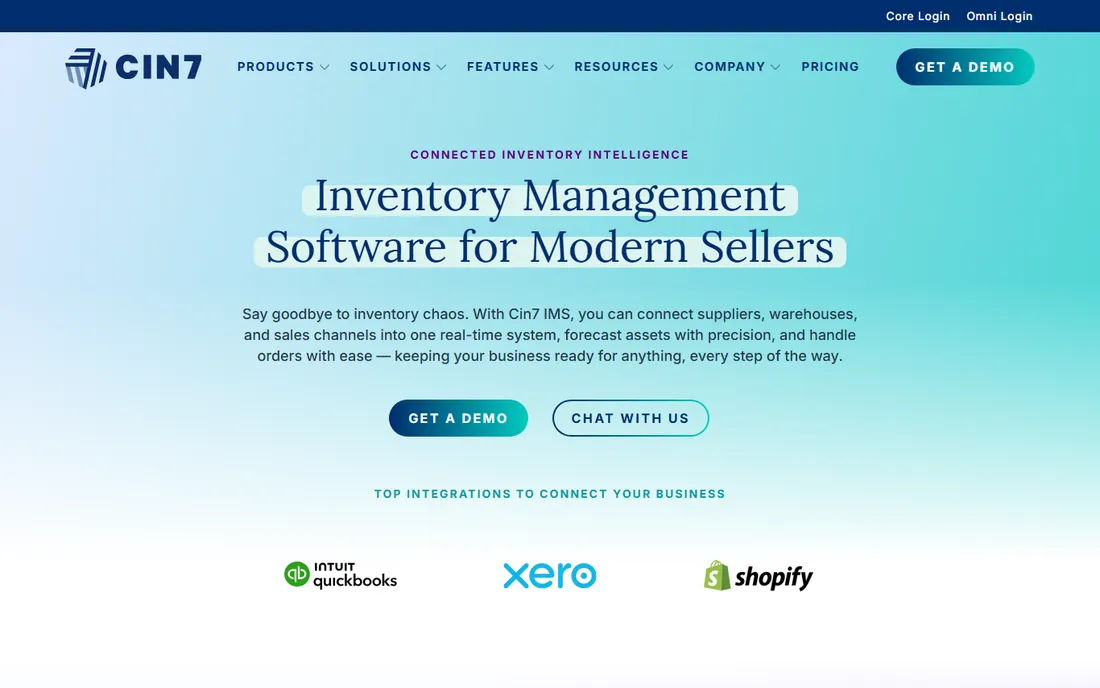
Cin7 is inventory truth for brands selling everywhere at once. Stock levels stay accurate across Shopify, Amazon and wholesale, native EDI handles retail compliance, and 3PL workflows cover outsourced fulfillment. The QuickBooks and Xero integrations keep accounting in sync.
This is not a $29 tool, and it does not pretend to be. The $349 entry price and guided implementation suit growing brands, not side hustles. For a multichannel business where oversells cost real money, Cin7's depth justifies the price. For a single-channel seller, the tools below do the job cheaper.
What we like- Strong multichannel and 3PL workflows
- Native EDI for retail and wholesale
- Deep integrations with QuickBooks and Xero
Watch out for- Entry price is high for small sellers
- Implementation takes real effort
#2
Zoho Inventory
Best for: Small sellers already in the Zoho ecosystem
Visit zoho.com
Starting priceFree plan (50 orders/month); Standard $39/month ($29/month annual)
Free planYes (50 orders/month)
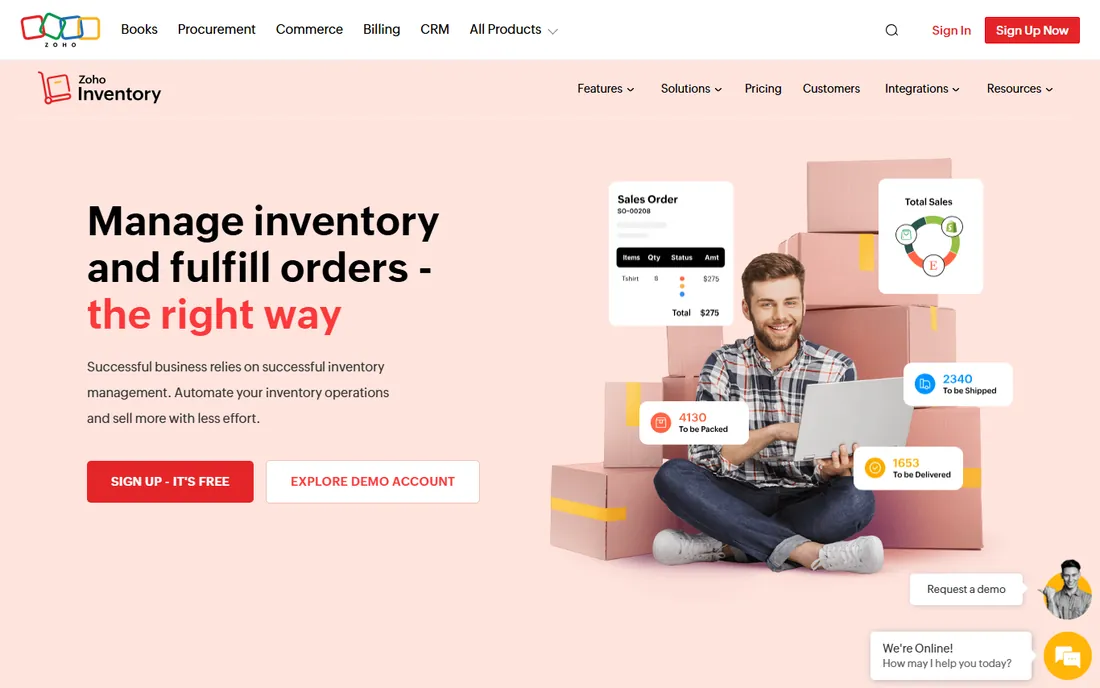
Zoho Inventory is the value pick for small sellers: a real free tier at 50 orders a month, then $29 to $39 for Standard. The Zoho Books and CRM integrations make it the natural choice inside the Zoho stack, and Shopify and Amazon connections cover the sales side.
The ceiling arrives with complexity. Multi-warehouse and manufacturing workflows push you upmarket, and US support coverage is thinner than the bigger rivals. Setup is self-serve. For a small seller starting out, this is the cheapest real inventory system; graduate when the warehouse outgrows it.
What we like- Generous free tier for tiny sellers
- Tight integration with Zoho Books and CRM
- Affordable paid tiers
Watch out for- Advanced warehousing needs higher tiers
- US support coverage is thinner than competitors
Starting price$89/month (Entrepreneur); Small Business $249/month
Free planNo (14-day free trial)
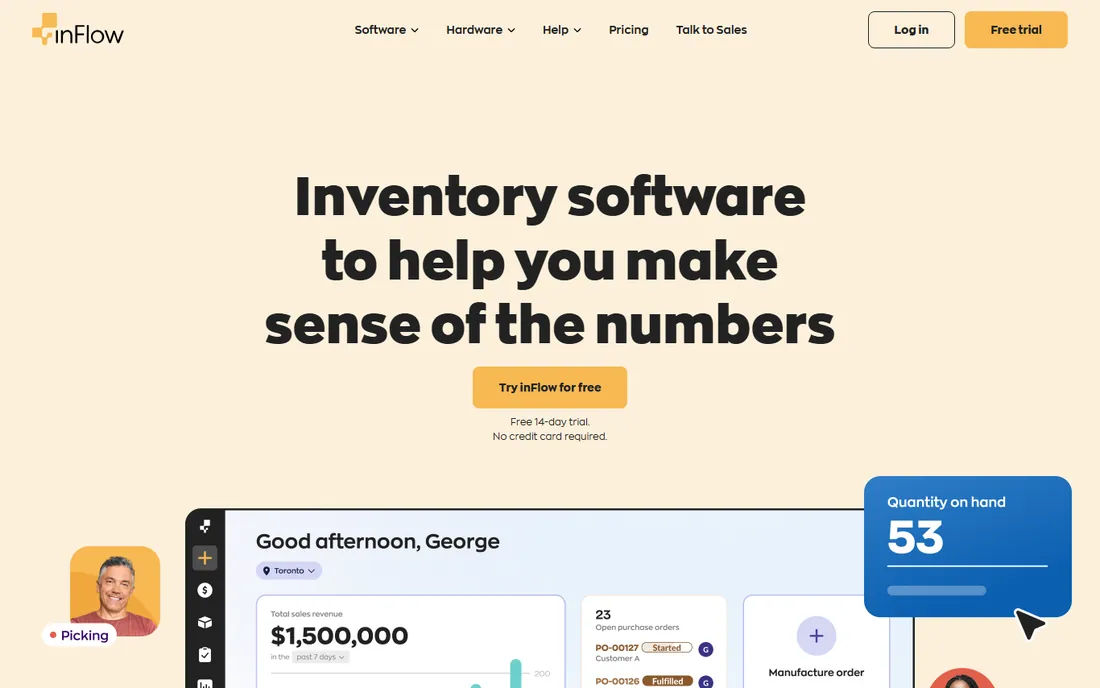
inFlow balances ease of use with genuine warehouse features: order management, stock control, and manufacturing and assembly for businesses that build what they sell. The per-tier feature sets are clear, so you know what each step up buys.
The tier jumps are the thing to plan for. Outgrowing Entrepreneur means a big step to $249, with no free tier to linger on. Setup is guided, with QuickBooks, Shopify and shipper integrations. For a product business that has outgrown spreadsheets but not its budget, inFlow is the mid-market workhorse.
What we like- Strong order and inventory management for SMBs
- Good manufacturing and assembly features
- Clear per-tier feature sets
Watch out for- No free tier to test long-term
- Pricing jumps steeply between tiers
#4
Sortly
Best for: Teams that need to track stuff, not run full ERP
Visit sortly.com
Starting priceFree plan (100 items, 1 user); Advanced $49/month ($24/month first-year annual)
Free planYes (100 items, 1 user)
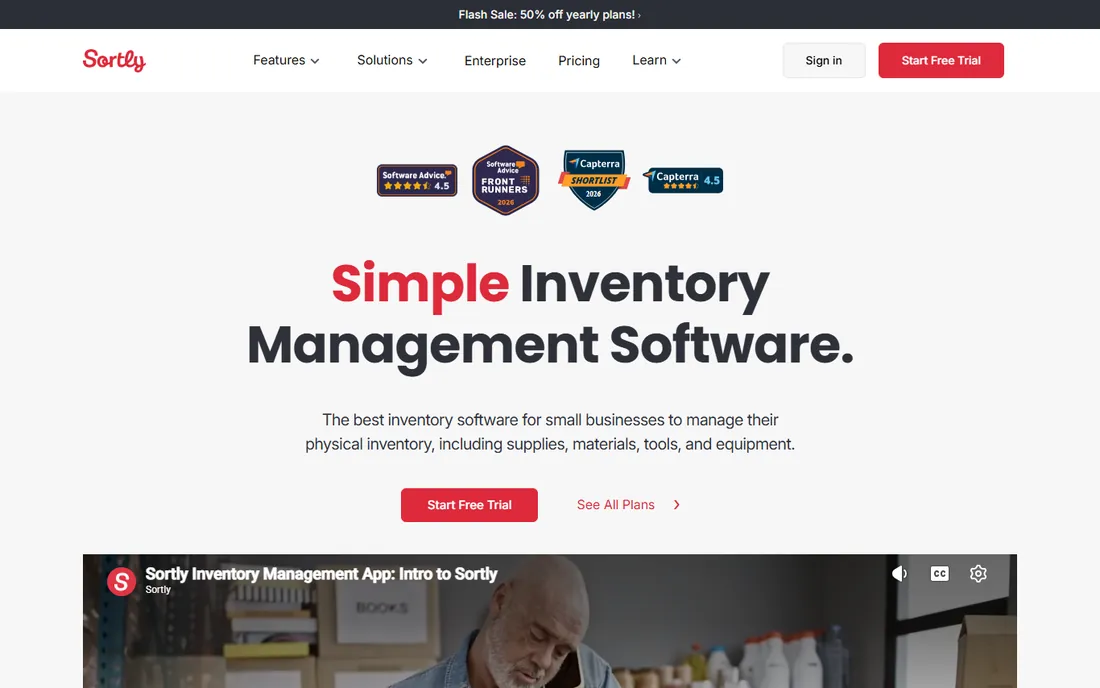
Sortly answers a simpler question than the rest of this list: where is everything? Visual inventory with phone-based barcode and QR scanning, a great mobile app for the floor team, and setup measured in hours. For a contractor, event company or small warehouse tracking assets and stock, this is enough.
It is not an ERP. Accounting, order management and purchasing live elsewhere, so pair it with your existing tools. Per-user costs add up for large teams. But for visual stock tracking at $0 to $49, nothing is easier to adopt.
What we like- Easiest visual inventory tracking with barcode and QR
- Great mobile app for teams on the floor
- Fast setup
Watch out for- Not a full accounting or order management system
- Per-user costs add up for large teams
Starting priceFree plan (30 SKUs); Core from $299/month
Free planYes (limited SKUs)
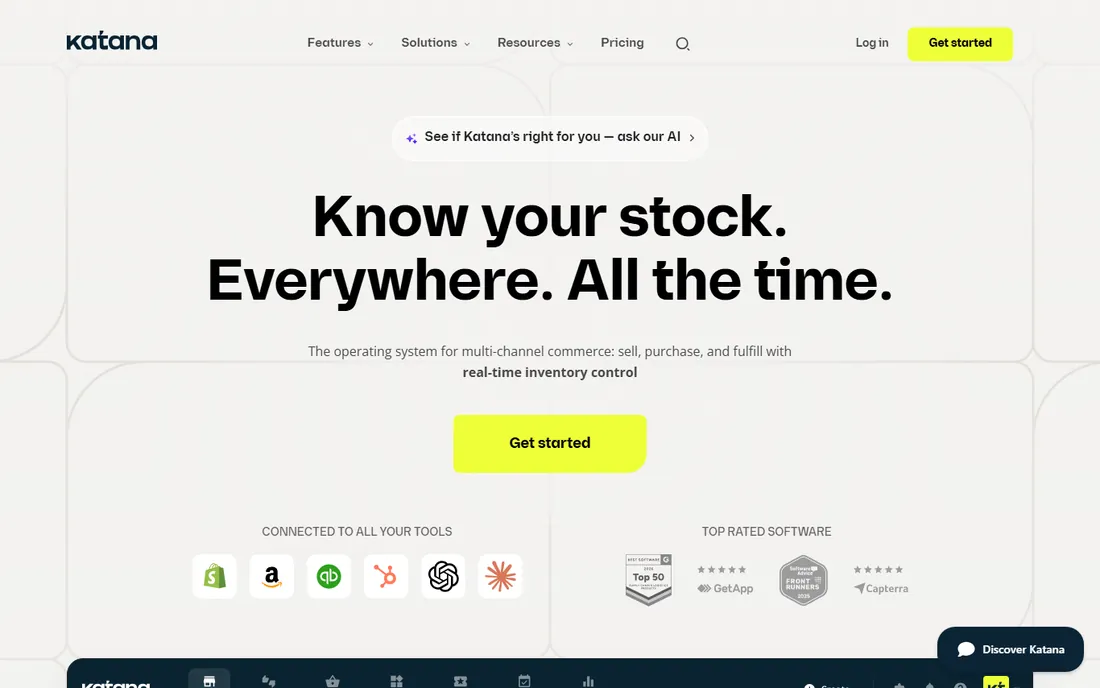
Katana is the only tool here built for making things. Production planning, materials, and shop-floor workflows are native, not bolted on, which generic inventory tools cannot match. The Shopify and QuickBooks integrations suit makers selling direct.
Volume-based pricing means success raises the bill, so model the scaling cost before committing. Advanced features need higher tiers. Setup is guided. For a small manufacturer, Katana is the purpose-built pick; for a reseller, the general tools are cheaper.
What we like- Built for manufacturers with real production planning
- Visual shop-floor workflows
- Good Shopify and QuickBooks integrations
Watch out for- Pricing scales with order volume, which can surprise growing makers
- Advanced features need higher tiers
Starting priceFrom $229/month (Inventory, 2 users); Advanced from $595/month
Free planNo (14-day free trial)
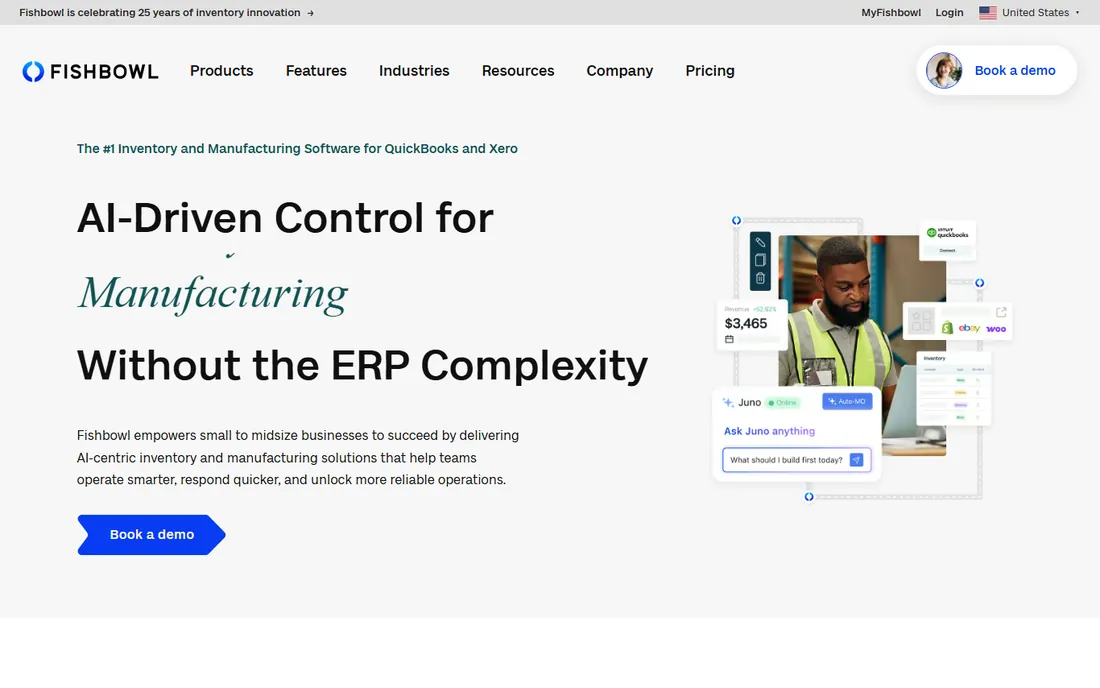
Fishbowl's moat is the QuickBooks sync: years of maturity in keeping inventory and accounting aligned, plus real manufacturing and warehouse depth. For a wholesaler or manufacturer whose books live in QuickBooks, this integration is the reason to buy.
Modernity is the trade. The interface feels dated next to Cin7 or Katana, and implementation can be heavy. Annual contracts are typical. If QuickBooks is your accounting home and you make or move physical goods, Fishbowl is the proven pick; if you are starting fresh, compare the cloud-native options first.
What we like- Deep QuickBooks integration, a long-standing strength
- Strong manufacturing and warehouse features
- Asset and order tracking
Watch out for- Dated interface compared with cloud-native rivals
- Implementation can be heavy
Starting price$70/month (Small, up to 500 orders); Medium $200/month
Free planNo (14-day free trial)

Unleashed keeps it simple: inventory, purchase orders and sales orders with transparent pricing tied to order volume, starting at $70 for 500 orders. The Xero integration is strong, and the QuickBooks and Shopify connections cover the rest.
Two things to know. There is no free tier, only the trial. And Unleashed is now part of The Access Group, so enterprise buyers should confirm roadmap direction before committing. For a product business that wants straightforward inventory without ERP weight, this is the clear-priced pick.
What we like- Clear order-volume-based pricing
- Strong purchase and sales order management
- Good Xero integration
Watch out for- No free tier
- Now part of The Access Group, so roadmap watchers should note the ownership
Starting price$99/month (Starter, 1 user, up to 500 orders/month); Bronze $240/month
Free planNo (14-day free trial)
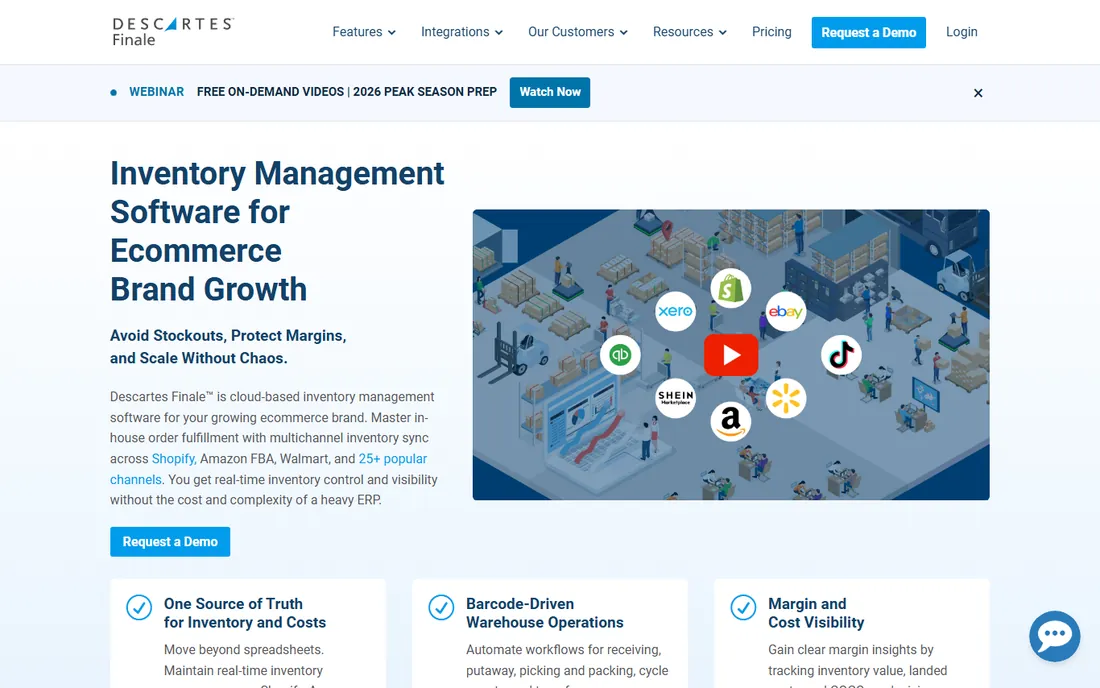
Finale is the multichannel seller's tool: stock stays accurate across Amazon, Shopify and other marketplaces, with barcode-based warehouse workflows that keep the pick-pack-ship operation honest. At $99 for the Starter tier, it undercuts Cin7 significantly for sellers who do not need EDI.
The interface is utilitarian rather than beautiful, and advanced features need higher tiers. Setup is guided with monthly billing. For an Amazon-plus-Shopify seller who needs real inventory sync without enterprise pricing, Finale is the value alternative to Cin7.
What we like- Strong multichannel inventory sync for Amazon and Shopify sellers
- Barcode-based warehouse workflows
- Good value at entry tier
Watch out for- Interface is utilitarian
- Advanced features require higher tiers
Frequently asked questions
How much does inventory software cost?
From $0 to $1,199 per month. Sortly and Zoho Inventory have real free tiers, Finale starts at $99, inFlow at $89, Unleashed at $70, Fishbowl from $229, Katana Core from $299, and Cin7 from $349 to $1,199. Price against your order volume and channel count, not just the entry tier.
Do I need inventory software or just a spreadsheet?
Spreadsheets work until they do not: usually around 100 SKUs, two sales channels, or the first oversell that costs a customer. The triggers are multichannel selling, purchase orders, warehouse staff, or manufacturing. If any of those apply, a spreadsheet is already costing you money.
What is the difference between inventory software and ERP?
Inventory software manages stock, orders and purchasing. ERP adds accounting, HR, CRM and manufacturing planning in one system. Most small businesses need inventory software plus their accounting tool; ERP enters the picture past roughly $5-10M in revenue or complex manufacturing.
Which inventory software integrates with QuickBooks?
Fishbowl has the deepest QuickBooks sync. Cin7, Katana, inFlow, Finale and Unleashed all integrate with QuickBooks, and Zoho Inventory pairs with Zoho Books. Confirm whether the integration is two-way and real-time before committing; "integrates with QuickBooks" ranges from deep sync to CSV export.
Can inventory software handle Amazon FBA?
Partially. These tools track your inventory position including FBA stock, but FBA's own warehousing and fulfillment stay in Seller Central. Cin7 and Finale handle multichannel FBA sellers best. If FBA is your only channel, Seller Central plus a bookkeeping tool may be enough.
The mistake is buying for today's size instead of the operation's shape. Single-channel seller: Zoho Inventory or inFlow. Multichannel Amazon plus Shopify: Finale or Cin7. Manufacturer: Katana or Fishbowl. Visual tracking only: Sortly. Xero shop: Unleashed. The cheapest tool that fits the operation beats the most powerful tool that does not; inventory software fails on adoption, not features.
Implementation deserves its own budget line. The free and self-serve tools (Zoho, Sortly, inFlow) get you live in days with your own effort. The guided platforms (Cin7, Fishbowl, Katana) need weeks of setup with vendor help, and that time costs staff hours whether or not there is an implementation fee. Plan the data migration too: SKU lists, supplier records, open purchase orders and starting stock counts all have to move cleanly. A rushed cutover at quarter end is how inventory systems earn their bad reputation.
How we chose
We started with the categories buyers search: inventory software, best inventory software, and software for inventory management. For each candidate we checked the vendor's own pricing pages, cross-checked capabilities and costs against public reviews on G2 and Capterra and practitioner discussion on Reddit, and compared channel coverage, warehouse depth and company-size fit. Where a price could not be verified on the vendor's page we wrote "See website" rather than guessing. The shortlist mixes free trackers with multichannel platforms, because a side hustle and a growing brand are not buying the same thing.
Sources we checked (10)
- https://www.cin7.com/pricing/
- https://www.zoho.com/inventory/pricing/
- https://inflowinventory.com/pricing/
- https://sortly.com/pricing/
- https://katanamrp.com/pricing/
- https://fishbowlinventory.com/pricing/
- https://unleashedsoftware.com/pricing/
- https://finaleinventory.com/pricing/
- https://www.g2.com/categories/inventory-management
- https://www.capterra.com/inventory-management-software/
Is your product missing or out of date?
We review this list regularly. Vendors can request a listing, send updated pricing or ask about featured placement.

Shihab Mia · Founder, Rankite
Shihab has spent more than a decade helping SaaS and e-commerce brands grow through search. He writes Rankite's software buying guides from pricing pages, documentation and public user reviews. More about Shihab.