How we make this list: we compare pricing pages, product documentation and public user reviews. Rankite is independent; if a vendor ever pays for a featured spot, that listing is clearly labeled Partner.
Key takeaways
- Oracle SCM, SAP and Blue Yonder are the enterprise planning leaders; all are quote-based with implementations measured in months.
- Kinaxis (concurrent planning) and o9 Solutions (AI-driven digital twins) lead the advanced planning and scenario-modeling end.
- Manhattan Associates is the warehouse and distribution specialist; Infor Nexus connects the multi-tier supplier network.
- E2open ($549/year freemium entry) is the only one here with a published starting price; Coupa brings AI-native supply chain design from its LLamasoft acquisition.
Quick comparison
| Tool | Best for | Starting price | Free plan |
|---|
 Oracle SCM Oracle SCM | Multi-regional end-to-end operations | See website (custom quote) | No |
 SAP SAP | SAP-centric global planning | See website (custom quote) | No |
 Blue Yonder Blue Yonder | Retail and manufacturing planning | See website (custom quote) | No |
 Manhattan Associates Manhattan Associates | Warehouse and distribution execution | See website (custom quote) | No |
 Kinaxis Kinaxis | Concurrent scenario planning | See website (custom quote) | No |
 Infor Infor | Networked supply chain with supplier finance | See website (custom quote) | No |
 E2open E2open | Multi-enterprise visibility and logistics | $549/year | Yes |
 Coupa Coupa | AI-native supply chain design and planning | See website (custom quote) | No |
 o9 Solutions o9 Solutions | AI forecasting with digital twin modeling | See website (custom quote) | No |
Is your product missing or out of date?
We review this list regularly. Vendors can request a listing, send updated pricing or ask about featured placement.
The best supply chain software
A COO gets the call on a Tuesday: a key supplier's factory is shut down for two weeks, a container is stuck at a port, and three big customers expect shipments Friday. Her team scrambles across spreadsheets, emails and a planning tool nobody fully trusts. By the time they model one alternative, the facts have changed. The company will miss deliveries it could have saved with a faster answer.
That faster answer is what the best supply chain software provides. These platforms unify demand planning, inventory optimization, logistics, warehouse execution and supplier collaboration, then let planners model disruptions and respond in hours instead of weeks. The nine below are the strongest in 2026, all enterprise-grade, all sold on custom quotes because every deployment is different.
Starting priceSee website (custom quote)
Free planNo
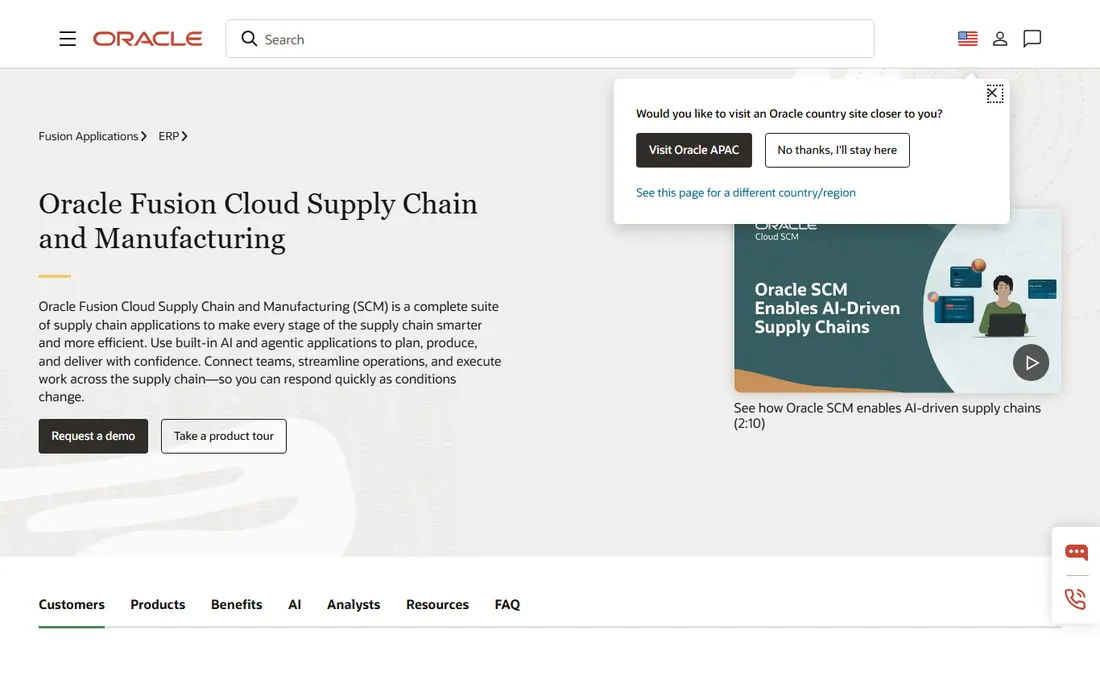
Oracle Fusion Cloud SCM is the everything platform: demand planning, supply planning, manufacturing, inventory, order management, logistics, procurement and product lifecycle in one cloud suite, with machine learning embedded across modules. Multi-regional companies running Oracle ERP get a unified system where finance and operations share one data model.
The honest catch is scope and cost. Pricing is modular and quoted, third-party estimates put enterprise deals well into six figures annually, and implementation is a program, not a project. Oracle SCM fits large organizations standardizing on Oracle. Companies outside the Oracle ecosystem should weigh the integration tax honestly.
What we like- Broadest module coverage (planning, manufacturing, logistics, procurement)
- Cloud-native with embedded machine learning
- Strong inside Oracle ERP shops
Watch out for- Custom pricing with complex module math
- Implementations are major projects
- Best value requires the Oracle stack
Starting priceSee website (custom quote)
Free planNo
SAP's supply chain suite, led by Integrated Business Planning (IBP), is the choice of the world's most complex manufacturers. Demand sensing, inventory optimization, response planning and S&OP run on one model with the depth that decades of manufacturing customers built. Inside an S/4HANA landscape, nothing integrates more naturally.
The tradeoff is the SAP experience: custom quotes, long implementations, heavy consulting needs and a pace of change slower than the cloud natives. SAP is for global enterprises whose supply chains are genuinely among the world's most complicated. Mid-market companies will find faster, cheaper answers elsewhere.
What we like- IBP is the deepest sales-and-operations planning tool here
- Unmatched for complex global manufacturing
- Tight S/4HANA integration
Watch out for- Quote-based pricing
- Famously demanding implementations
- Innovation pace lags cloud-native rivals
Starting priceSee website (custom quote)
Free planNo
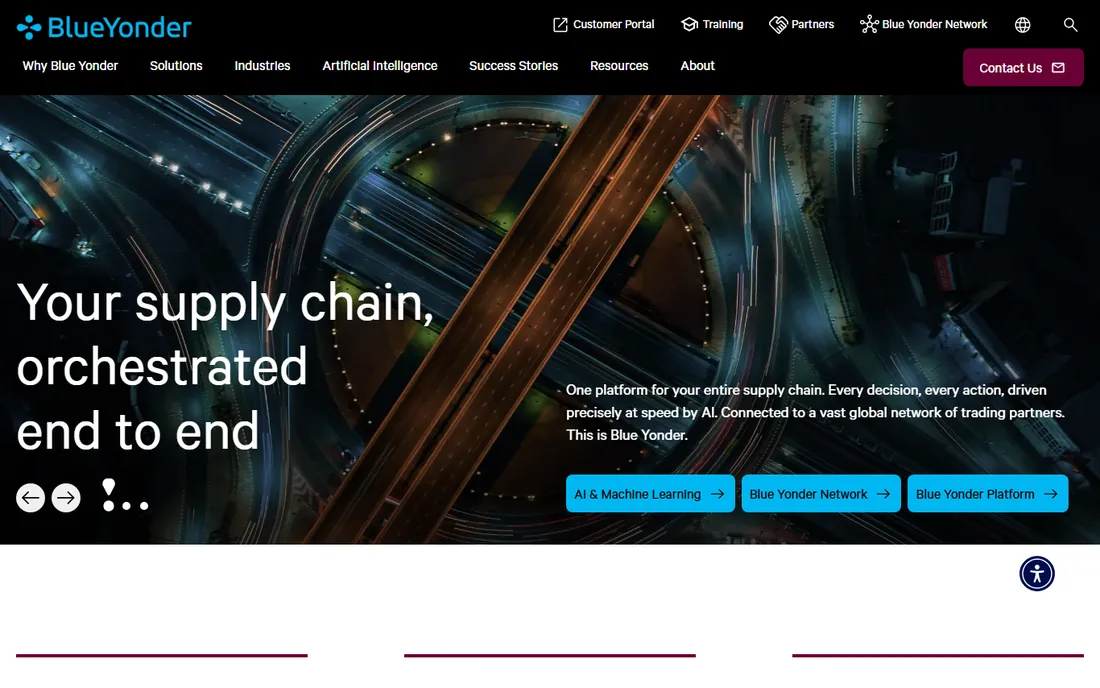
Blue Yonder (formerly JDA) dominates retail supply chain planning. Its demand forecasting, inventory optimization, replenishment and labor management are tuned for the realities of retail: seasons, promotions, perishables and thousands of SKUs across hundreds of locations. Manufacturers with complex distribution use it heavily too.
The honest catch is the price tier. Enterprise deals are quoted and industry analyses place them among the highest in the category, with implementations to match. Blue Yonder is for retailers and large manufacturers where planning precision directly moves margin. Smaller operations cannot justify it.
What we like- Best-in-class retail and grocery planning
- Strong AI/ML demand forecasting
- Deep omni-channel fulfillment tooling
Watch out for- Custom pricing at the top of the market
- Complex implementations
- The JDA-to-Blue-Yonder evolution still confuses buyers
#4
Manhattan Associates
Best for: Warehouse and distribution execution
Visit manh.com
Starting priceSee website (custom quote)
Free planNo

Manhattan Associates owns warehouse execution. Manhattan Active Warehouse Management runs some of the world's largest distribution centers with labor optimization, robotics orchestration and wave planning that the planning-first vendors cannot match. Transportation and order management round out the execution suite.
The tradeoff is focus. Manhattan is execution-first: brilliant at running the warehouse and the network, thinner on demand planning and S&OP than Kinaxis or o9. Companies whose problem is distribution complexity (3PLs, retailers, high-volume eCommerce) should start here. Companies whose problem is planning should start with the planners.
What we like- The warehouse management standard for complex distribution
- Cloud-native Manhattan Active platform
- Strong labor and robotics optimization
Watch out for- Quote-based pricing
- Execution-focused, so planning depth lags the planning specialists
- Enterprise orientation
Starting priceSee website (custom quote)
Free planNo
Kinaxis Maestro (formerly RapidResponse) changed planning with concurrency: instead of sequential planning cycles, every planner works on one model and sees the impact of changes instantly. What-if scenarios that took weeks now take minutes, which is why pharmaceutical, automotive and high-tech companies with brutal complexity swear by it.
The honest catch is that concurrency demands discipline. The platform is only as good as the planning process around it, pricing is quoted, and execution (warehousing, transportation) is not its strength. For planning-led organizations facing constant disruption, Kinaxis is the fastest answer in this list. For execution problems, look at Manhattan.
What we like- Concurrent planning lets every planner see impacts instantly
- Superb what-if scenario modeling
- Strong in high-complexity industries (pharma, auto, high-tech)
Watch out for- Custom pricing
- Planning-focused, so execution modules are thinner
- Needs planning maturity to exploit
#6
Infor
Best for: Networked supply chain with supplier finance
Visit infor.com
Starting priceSee website (custom quote)
Free planNo

Infor's supply chain story centers on the network. Infor Nexus (from the GT Nexus acquisition) connects tens of thousands of suppliers, carriers and banks on a multi-enterprise network, combining visibility with trade finance and payments. The planning and execution suite adds demand planning, warehouse management and transportation.
The tradeoff is sprawl. Infor's portfolio is vast, product boundaries blur, and buyers need guidance to map needs to products. Pricing is quoted. But the network effect is real: companies whose supply chains span many tiers of suppliers get visibility and financial coordination that point solutions cannot replicate.
What we like- Infor Nexus connects suppliers, 3PLs and banks on one network
- Strong process manufacturing and distribution depth
- Coleman AI across the suite
Watch out for- Quote-based pricing
- The product portfolio is sprawling and confusing
- Implementations need specialized expertise
Starting price$549/year
Free planYes
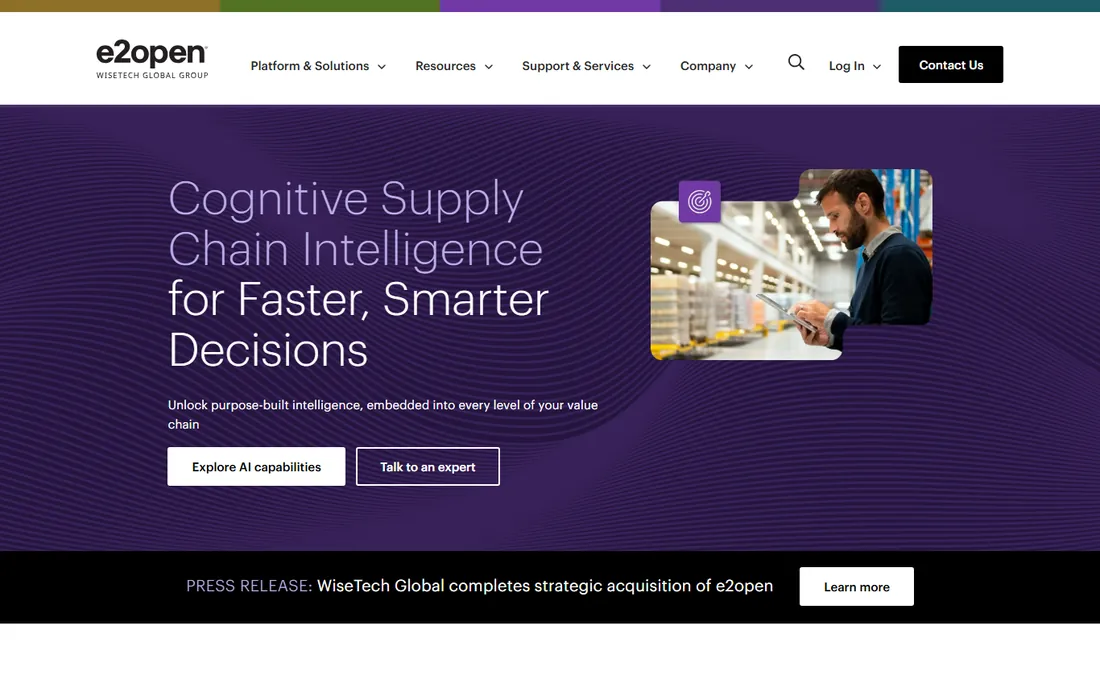
E2open is the only platform here with a published starting price: $549 a year with a freemium tier covering logistics visibility, purchase order collaboration and demand sensing. That makes it the only one a mid-size company can pilot without a sales process. The full platform spans planning, global trade, transportation and channel management across a multi-enterprise network.
The honest catch is the two-tier reality. The entry price covers the collaboration basics; the serious planning and execution capabilities are quote-based enterprise deals with real implementation effort. But the freemium path is genuinely differentiating in this category. If you want to test multi-enterprise visibility before committing, E2open is the place to start.
What we like- Published $549/year entry with a freemium tier, unique here
- Deep multi-tier visibility and global trade
- Strong demand sensing
Watch out for- Full platform is quote-based and enterprise-priced
- Complex interface with a steep learning curve
- Integration work is significant
#8
Coupa
Best for: AI-native supply chain design and planning
Visit coupa.com
Starting priceSee website (custom quote)
Free planNo
Coupa's supply chain products (built on the LLamasoft acquisition) focus on design and planning: digital twins of the supply chain, network optimization, demand modeling and AI-generated prescriptions for cost and resilience. Combined with Coupa's procurement and spend management heritage, it connects sourcing decisions to supply chain outcomes.
The tradeoff is scope. Coupa is strongest at designing and planning the network, thinner at running it day-to-day than Manhattan or Blue Yonder, and pricing is quoted. For companies rethinking their supply chain footprint (nearshoring, network redesign, resilience planning), the digital-twin approach is the most advanced here.
What we like- Supply chain design with digital-twin modeling (from LLamasoft)
- AI prescriptions for network optimization
- Strong spend and procurement heritage
Watch out for- Custom pricing
- Design-and-planning focus means execution is thinner
- Best value inside the Coupa platform
Starting priceSee website (custom quote)
Free planNo

o9 Solutions pitches the AI-native planning platform: machine-learning forecasting, a digital twin of the enterprise (its "Enterprise Knowledge Graph"), and integrated planning from strategic to operational horizons. Large global enterprises in retail, manufacturing and consumer goods use it to replace spreadsheet-and-legacy planning with a single intelligent model.
The honest catch is the bar to entry. o9 sells to large enterprises with custom quotes, implementations are transformations, and the AI needs clean, rich data to work. This is not software you buy; it is a planning capability you build with o9's help. For enterprises ready for that commitment, the platform is among the most advanced here.
What we like- AI-powered forecasting and digital twin ("EKG") platform
- Strong in large global enterprises
- Integrated planning across horizons
Watch out for- Custom pricing for large enterprises only
- Implementations are major transformations
- Needs data maturity to deliver
Scoping supply chain software without drowning
Start with the problem, not the platform. "End-to-end supply chain software" is a trap: nobody buys all of it at once. Define the one or two processes that hurt most (forecast accuracy, warehouse throughput, supplier visibility, transportation cost) and shortlist the vendors that lead there. Manhattan for warehouses, Kinaxis and o9 for planning, Infor Nexus and E2open for networks, Blue Yonder for retail.
Then check your ERP reality. Oracle and SAP deliver their best value inside their own ERP landscapes; outside them, integration becomes a permanent tax. Cloud-native best-of-breed (Kinaxis, o9, Manhattan Active) integrates more openly but leaves you assembling the suite. Neither path is wrong, but switching ERPs to match the SCM tool is a decision that dwarfs the software choice.
Finally, pilot before you commit. E2open's freemium tier lets you test multi-enterprise collaboration cheaply. For the rest, demand a proof of concept on your data with your planners, not a vendor demo on vendor data. The demo always works. Your data, with its gaps and quirks, is the real test.
How this guide was researched
This guide was researched from vendor sites, published pricing analyses and practitioner reviews, with facts verified in October 2026. None of the enterprise vendors here publish pricing on their own sites; E2open is the exception with its published entry tier. Every tool here is an active product sold today.
No hands-on testing was involved and no vendor paid for placement. The selection weights planning depth, execution capability, network and visibility features, AI and scenario-modeling maturity, and fit for different supply chain archetypes (retail, manufacturing, distribution, global networks). All nine are enterprise-grade because that is where this category's buying happens.
Implementation is the real price tag
In supply chain software, the subscription is the smaller number. Industry analyses consistently show implementation, integration, data migration and change management costing as much as the software itself, sometimes more, with enterprise rollouts running 12 to 18 months. The quote you sign is the beginning of the spending, not the end of it.
Budget three things separately: the software subscription, the implementation (systems integrator or vendor services), and the internal team (backfilled planners, IT, change management). Get the implementation estimate in writing before signing the software contract, because the two are negotiated by different people and the second one surprises everyone. And staff the data work early: every one of these platforms is only as good as the data feeding it, and data cleanup is the phase nobody budgets and everybody needs.
Frequently asked questions
How much does supply chain software cost?
Enterprise platforms are quote-based, with industry analyses placing annual deals from tens of thousands into the millions depending on modules, users and scope. E2open is the exception with a published $549/year entry tier. Always budget implementation separately; it often matches or exceeds the subscription.
What is the difference between supply chain planning and execution?
Planning decides what should happen (forecasts, inventory targets, production schedules, network design); execution makes it happen (warehouse operations, transportation, order fulfillment). Kinaxis, o9 and Blue Yonder lead planning; Manhattan leads execution; Oracle, SAP and Infor try to cover both.
How long does supply chain software implementation take?
Enterprise deployments typically run 12 to 18 months for full rollouts, with phased go-lives along the way. Mid-market pilots (E2open's entry tier, focused Manhattan deployments) can go live in weeks to months. Data migration and integration with ERP are the long poles; start them first.
Do I need supply chain software if I already have an ERP?
ERPs handle transactions well but plan poorly. If your planners live in spreadsheets beside the ERP, you have the gap these tools fill: forecasting, scenario modeling, optimization and network visibility. Oracle and SAP customers get the smoothest path inside their ERP; others add best-of-breed planners alongside it.
What is a digital twin in supply chain?
A digital twin is a live virtual model of your supply chain (suppliers, plants, inventory, lanes, demand) that you can run scenarios against: what if this supplier fails, what if demand spikes 30%, what if we nearshore. o9, Coupa and Kinaxis all offer versions of it. The value is answering disruption questions in minutes instead of weeks.
Which supply chain software is best for small businesses?
None of the enterprise nine, honestly. Small businesses should look at mid-market tools like NetSuite, Cin7 or Katana, or start with E2open's $549/year entry tier for visibility. The enterprise platforms need the scale, data and budget of large operations to pay off.
Sources we checked (8)
- https://www.decipherzone.com/blog-detail/best-supply-chain-management-tools-guide
- https://www.itqlick.com/oracle-scm-cloud/pricing
- https://www.selecthub.com/c/supply-chain-management-software/
- https://www.selecthub.com/supply-chain-management-software/e2open-vs-infor-supply-chain-management/
- https://www.selecthub.com/supply-chain-management-software/e2open-vs-manhattan-supply-chain/
- https://locus.sh/blogs/best-supply-chain-visibility-software/
- https://research.com/software/online-supply-chain-management-software-companies
- https://technologycounter.com/products/coupa-supply-chain
Is your product missing or out of date?
We review this list regularly. Vendors can request a listing, send updated pricing or ask about featured placement.

Shihab Mia · Founder, Rankite
Shihab has spent more than a decade helping SaaS and e-commerce brands grow through search. He writes Rankite's software buying guides from pricing pages, documentation and public user reviews. More about Shihab.