How we make this list: we compare pricing pages, product documentation and public user reviews. Rankite is independent; if a vendor ever pays for a featured spot, that listing is clearly labeled Partner.
Key takeaways
- Cin7 Core at $349 a month is the strongest all-rounder for multichannel sellers who need inventory, warehouse and EDI in one system.
- Fishbowl at $229 a month billed annually fits manufacturers and QuickBooks shops that need work orders and bills of materials.
- ShipHero at $1,850 a month is built for high-volume ecommerce brands where pick accuracy directly drives profit.
- Zoho Inventory and inFlow cover small warehouses credibly from $29 and $99 a month respectively.
- Deposco, Logiwa, 3PL Warehouse Manager and NetSuite are quote-based enterprise options; budget for implementation, not just licenses.
Quick comparison
| Tool | Best for | Starting price | Free plan |
|---|
 Cin7 Cin7 | Multichannel sellers needing EDI | $349/month (Core) | Free trial (14 days) |
 Fishbowl Fishbowl | Manufacturers on QuickBooks | $229/month (billed annually) | No |
 Finale Inventory Finale Inventory | Simple affordable warehouse tracking | $99/month | Free trial |
 inFlow inFlow | B2B and wholesale warehouses | $99/month (billed annually) | Free trial (14 days) |
 Zoho Inventory Zoho Inventory | Startups and small warehouses | Free; paid from $29/month | Yes |
 ShipHero ShipHero | High-volume ecommerce fulfillment | $1,850/month | No |
 Logiwa Logiwa | High-volume multi-warehouse operations | See website | No |
 Deposco Deposco | Enterprise fulfillment at scale | See website | No |
 3PL Warehouse Manager 3PL Warehouse Manager | Third-party logistics providers | See website | No |
 NetSuite WMS NetSuite WMS | Companies already on NetSuite ERP | See website | No |
Is your product missing or out of date?
We review this list regularly. Vendors can request a listing, send updated pricing or ask about featured placement.
The best warehouse software
The myth that keeps small warehouses on spreadsheets is that warehouse management software is for Amazon-scale distribution centers. The software vendors priced for enterprises encouraged this belief for years. But the math runs the other way. A mis-pick rate of three percent on a thousand orders a month is thirty angry customers, thirty reshipments and thirty refunds. A large operation absorbs that. A small brand does not.
The second misconception is that a WMS is just inventory tracking with a barcode scanner. Real warehouse software manages the movement: receiving, putaway rules, pick paths, packing verification, cycle counts and returns. Inventory software tells you what you have. A WMS tells your team exactly where to walk, what to grab and in what order, which is where the labor savings actually come from.
The honest split in this category is operational complexity, not company size. If you ship from one location with a few hundred SKUs, Zoho Inventory or Finale covers you. If you run kitting, multiple warehouses, 3PL clients or EDI with retail partners, you need the heavier platforms and their heavier prices. Count your locations, channels and daily orders before you count features.
Starting price$349/month (Core)
Free planFree trial (14 days)
Cin7 is the top warehouse management software pick for product businesses selling across Shopify, Amazon, wholesale and retail simultaneously. The Core plan at $349 a month centralizes inventory, warehouse operations, point of sale and 3PL in one cloud system, and the Omni tier adds the EDI compliance that big-box retail partners demand. Few platforms cover the journey from purchase order to retail chargeback in one login.
The catch is complexity. This is genuinely powerful software that takes real onboarding time, and the total cost rises as you add integrations beyond the included ones. Single-channel sellers will find it heavier than they need. But for the multichannel brand drowning in oversells and spreadsheet reconciliation, Cin7 is the consolidation play that ends the chaos.
What we like- 700+ integrations with built-in EDI on Omni
- True multichannel inventory sync across marketplaces
- AI-driven demand forecasting included
Watch out for- Learning curve is real, expect weeks of onboarding
- Costs climb with add-ons and integrations
- Overkill for single-channel sellers
Starting price$229/month (billed annually)
Free planNo
Fishbowl owns the QuickBooks warehouse. If your accounting lives in QuickBooks and your operation involves manufacturing, assembly or kitting, nothing else connects the two worlds this tightly. Inventory transactions sync to QuickBooks automatically, and the manufacturing module handles work orders, BOMs and lot tracking that pure ecommerce tools cannot touch. Plans start at $229 a month billed annually for the Essentials tier with two users.
The honest weaknesses are polish and reporting. The interface shows its age, out-of-the-box reports are thin, and custom reporting costs extra. There is no trial, so evaluate from the demo with your actual BOMs and workflows. For manufacturers already committed to QuickBooks, though, the integration depth outweighs the rough edges.
What we like- Deepest QuickBooks integration in the category
- Work orders, bills of materials and lot tracking built in
- Modular setup lets you enable only what you use
Watch out for- Interface feels dated next to cloud-native rivals
- Reporting is basic without paid customization
- No free trial, demo only
Starting price$99/month
Free planFree trial
Finale is the answer for the warehouse that needs real barcode-driven receiving, picking and cycle counts without a four-figure monthly bill. At $99 a month it undercuts nearly everything else in this list while covering the core workflows: purchase orders, stock transfers, bin locations and multichannel sync. Users consistently praise the short learning curve.
It is not a manufacturing system and does not pretend to be. Businesses with work orders and BOMs should look at Fishbowl; Amazon FBA sellers will hit integration gaps. But for the straightforward stock-and-ship warehouse, Finale delivers the highest-value basics per dollar in this comparison.
What we like- $99 a month starting price is the lowest serious WMS entry here
- Short learning curve with a simple interface
- Connects with 40+ platforms including Shopify and Amazon
Watch out for- Lacks advanced manufacturing depth
- No FBA integration without workarounds
- Customization options are limited
Starting price$99/month (billed annually)
Free planFree trial (14 days)
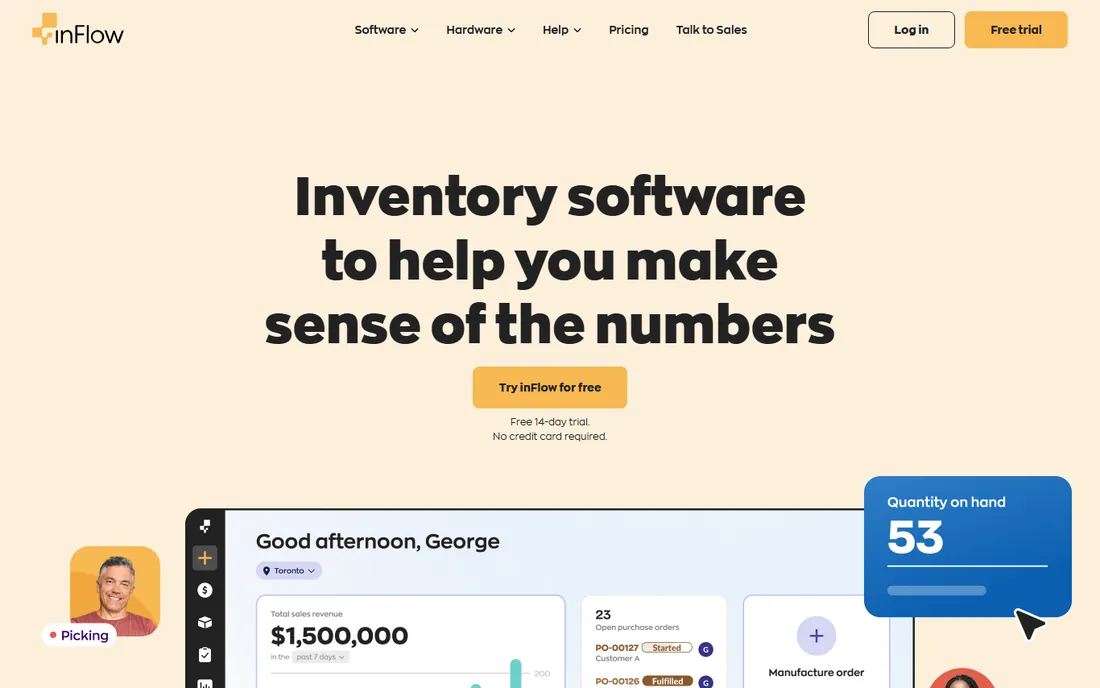
inFlow serves the wholesale distributor that lives on purchase orders and invoices rather than Shopify checkouts. B2B showrooms let customers browse and order at their contract pricing, invoicing automation keeps the paperwork moving, and the warehouse basics (receiving, picking, barcoding) are solid. At $99 a month billed annually with a 14-day trial, it is priced for small distributors.
Ecommerce-first brands will find the multichannel tooling thinner than Cin7's or ShipHero's. And operations with complex pick-path optimization or multi-warehouse orchestration will outgrow it. But for the B2B warehouse where the sales rep relationship matters more than the shopping cart, inFlow fits like it was built for the job, because it was.
What we like- B2B showrooms and invoicing automation built in
- $99 a month billed annually is affordable
- Handles wholesale pricing tiers naturally
Watch out for- Ecommerce depth trails Cin7 and ShipHero
- Advanced warehouse automation is lighter
- Best for simpler operations
#5
Zoho Inventory
Best for: Startups and small warehouses
Visit zoho.com
Starting priceFree; paid from $29/month
Free planYes
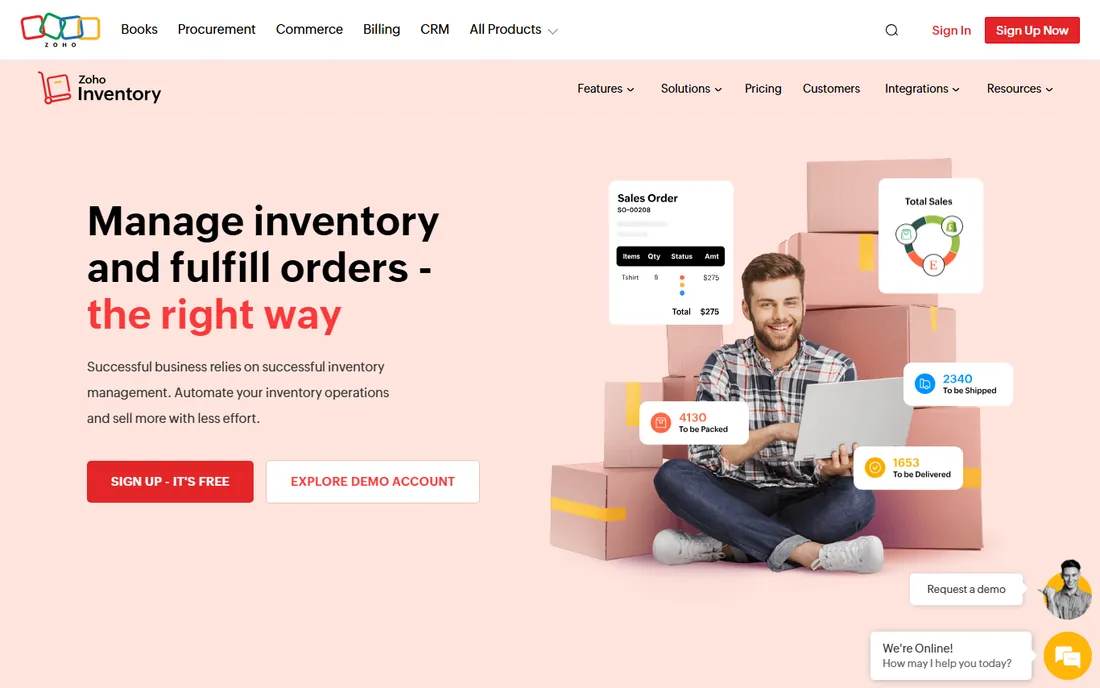
Zoho Inventory is the on-ramp to real warehouse software. The free plan covers a startup's first SKUs, and $29 a month buys order management, marketplace sync, barcode support and shipping automation. For the small business graduating from spreadsheets, it delivers the core disciplines, bin tracking, reorder points, purchase orders, at a price that needs no budget meeting.
The ceiling arrives with complexity. Multi-warehouse orchestration, advanced pick optimization and manufacturing workflows are beyond its scope, and deep ERP integration means the broader Zoho suite. Treat it as the right tool for the first warehouse. When daily order volume or location count doubles twice, plan the migration deliberately rather than fighting the platform.
What we like- Genuine free plan for very small operations
- Paid plans from $29 a month
- Bundling, kitting and marketplace sync included
Watch out for- Lacks deep enterprise and manufacturing features
- Warehouse automation is basic
- Support responsiveness varies
Starting price$1,850/month
Free planNo
ShipHero is not trying to be affordable. At $1,850 a month for the brand WMS and $1,995 for the 3PL edition, it targets ecommerce brands where warehouse efficiency is a profit lever: mis-pick reduction, 3x picking efficiency gains and 30% faster shipping are the claims that justify the price. The platform handles the full fulfillment workflow with the sophistication high-volume operations need.
Small brands should not be here. The pricing, the implementation effort and the feature depth all assume serious daily volume. But for the scaling DTC brand or the 3PL serving them, ShipHero is one of the few platforms designed around ecommerce fulfillment rather than adapted to it, and that focus shows in the workflow design.
What we like- Purpose-built for ecommerce pick, pack and ship at scale
- Serves over 10% of Shopify Plus stores
- 3PL edition for fulfillment providers
Watch out for- $1,850 a month starting price excludes small brands
- No trial
- Implementation is a serious project
Starting priceSee website
Free planNo
Logiwa IO targets warehouses where volume and complexity intersect: multiple locations, multiple sales channels, multiple clients. The workflow coverage is comprehensive, from receiving and targeted putaway through replenishment, cycle counts and returns, all driven through mobile scanning. Automated rules and exception management keep high-volume floors running without constant supervision.
This is enterprise software with enterprise buying. Pricing is quoted, implementations are projects, and the platform assumes an operations team. Smaller warehouses will get more value per dollar from Cin7 or Fishbowl. But for the growing 3PL or the brand running several warehouses, Logiwa's multi-client architecture is exactly the right shape.
What we like- Cloud WMS designed for high-volume multi-channel fulfillment
- Real-time task management engine with automated rules
- Strong 3PL and multi-client support
Watch out for- Quote-based pricing with no public starting point
- Implementation complexity suits larger operations
- Smaller brands will find it heavy
Starting priceSee website
Free planNo
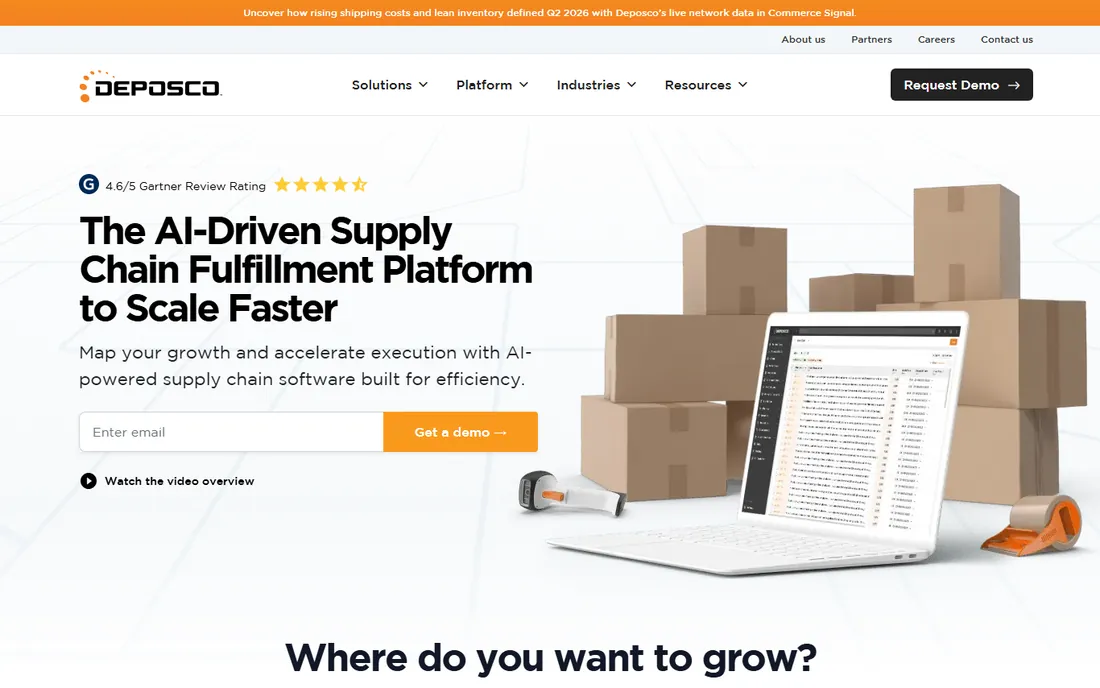
Deposco plays in the enterprise fulfillment space against Manhattan and HighJump, with a cloud-native architecture that implementations praise for speed relative to legacy competitors. The platform covers warehouse management, distributed order management and supply chain planning, which suits retailers and brands orchestrating inventory across warehouses, stores and 3PLs.
Everything about the buying process is enterprise: quoted pricing, discovery calls, implementation services. There is no self-serve path and no published starting price. Companies evaluating Deposco usually have a formal RFP and a seven-figure logistics budget. If that is you, it belongs on the shortlist. If not, the mid-market options above will serve you better.
What we like- Cloud-native platform spanning WMS, order management and planning
- Strong in retail and ecommerce fulfillment at scale
- Rapid implementation reputation for its class
Watch out for- Enterprise pricing and sales process
- Overkill below serious volume
- Customization needs professional services
Starting priceSee website
Free planNo
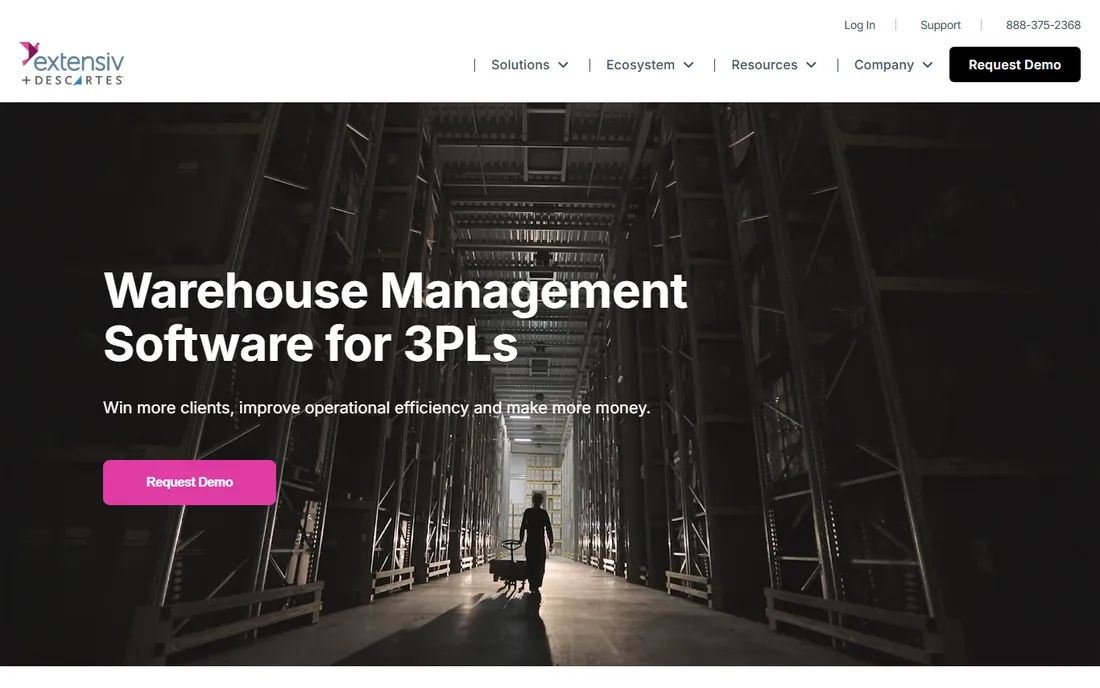
3PL Warehouse Manager, part of Extensiv, is the specialist for third-party logistics providers. Client billing, per-client inventory visibility, EDI connections and client portals are native concepts, not add-ons. A 3PL running on generic WMS software ends up building client management in spreadsheets; this platform starts from the 3PL business model.
Brands running their own warehouse should skip it. The entire product assumes you serve multiple clients with distinct billing, SLAs and inventory. Pricing is quoted per operation. For the 3PL evaluating systems, the relevant comparison is against other 3PL-native platforms, and the Extensiv ecosystem (including marketplace connections and automation) is a meaningful advantage.
What we like- Built specifically for 3PL client billing and management
- Client portals and EDI included
- Part of the Extensiv fulfillment ecosystem
Watch out for- Designed for 3PLs, not for brands running their own warehouse
- Quote-based pricing
- Client onboarding complexity is real
Starting priceSee website
Free planNo
NetSuite's warehouse management only makes sense in one context: you already run NetSuite ERP. In that context it is excellent, because warehouse transactions post to the same database as orders, purchasing and financials with no integration middleware. Advanced wave management, cycle counting and compliance features cover serious distribution operations.
Nobody should buy NetSuite for the WMS alone. The ERP implementation is a six-figure, multi-month undertaking, and the warehouse module is one piece of it. But for the mid-size distributor already on NetSuite, turning on the WMS module beats bolting a third-party system onto the ERP every time. Evaluate it as an ERP decision with warehouse benefits, not the reverse.
What we like- Native warehouse module inside the NetSuite ERP
- Single database from order to accounting
- Advanced automation and compliance for mid-size to large companies
Watch out for- Quote-based enterprise pricing
- Implementation measured in months
- Warehouse-only buyers should not adopt an ERP for the WMS
The receiving test
Every WMS demo looks good on picking because vendors rehearse picking. Ask for the receiving workflow instead. Receiving is where warehouse reality lives: partial shipments, damaged goods, wrong SKUs, lot and serial capture, putaway decisions. A platform that handles messy receiving gracefully will handle the rest of your operation.
Run your actual chaos through it. Bring a real purchase order with a short shipment and a damaged carton. Ask how the system handles a lot-tracked item arriving without lot documentation. Ask what happens when a barcode will not scan. The quality of the answers tells you more than any feature matrix, because receiving is the workflow your team cannot skip or postpone.
Then check the hardware story. Barcode scanners, mobile computers and label printers are a separate budget line, typically $500 to $1,800 per device for warehouse-grade hardware. Confirm which devices the software supports and whether the mobile app works offline on the warehouse floor, where Wi-Fi dead zones are a fact of life.
How we assembled this top 10
We started from vendor pricing pages and documentation, then cross-checked against public reviews on G2, Capterra, TrustRadius and SelectHub. Every published price above reflects plan pricing verified in October 2026, including Cin7's $349 Core plan and Fishbowl's $229 annual-billed Essentials tier. Where vendors publish no pricing, which is standard for enterprise WMS, we say so instead of repeating estimates.
We did not claim hands-on testing of any platform. We weighted warehouse-specific capabilities over generic inventory features: receiving and putaway, pick-path optimization, barcode and mobile workflows, multi-location support, carrier and marketplace integrations, and 3PL billing. Pure shipping tools and spreadsheet-grade trackers did not make the cut.
Implementation costs nobody puts on the pricing page
The subscription is often the smallest line in year one. Implementation and data migration typically run $1,500 to $10,000 or more depending on warehouse count, SKU complexity and how messy the legacy data is. Training runs $300 to $1,500 per session. Premium support often costs 15 to 20 percent of the annual license on top.
Budget the full picture before signing. A $349-a-month platform can easily cost $15,000 in year one once implementation, hardware, training and add-ons land. That is still cheap if it cuts mis-picks and labor hours, but it should be a deliberate decision, not a surprise. Ask every vendor for a written year-one total including services, and compare those numbers, not the monthly rates.
Frequently asked questions
What is the difference between inventory software and a WMS?
Inventory software tracks what you have and where it sits. A warehouse management system directs the work: receiving workflows, putaway rules, optimized pick paths, packing verification and labor management. Small operations need the first; growing warehouses need the second.
How much should a small warehouse budget for WMS software?
From $29 a month for Zoho Inventory to around $350 for Cin7 Core, plus hardware and onboarding. Most small warehouses land between $100 and $400 a month in software. Budget an equal amount for first-year implementation and devices.
Do we need barcode scanners, or can staff use phones?
Phones work for low-volume operations and several platforms have solid mobile apps. Past a few hundred picks a day, dedicated scanners pay for themselves in speed and durability. Warehouse-grade devices run $500 to $1,800 each.
Can a WMS integrate with QuickBooks?
Yes. Fishbowl has the deepest QuickBooks integration, and most platforms connect to QuickBooks, Xero or NetSuite. Confirm whether the integration is real-time sync or batch, and whether it covers purchase orders and COGS or just sales.
How long does WMS implementation take?
Small warehouses on Zoho or Finale can go live in weeks. Mid-market platforms like Cin7 and Fishbowl typically take one to three months with data migration and training. Enterprise systems run three to nine months. Plan the cutover for a slow season.
Should a 3PL use the same software as a brand warehouse?
Usually not. 3PLs need client billing, per-client portals and multi-client inventory separation, which brand-focused WMS platforms handle poorly. 3PL Warehouse Manager and Logiwa are built for the 3PL model; brand warehouses should use brand-focused tools.
Sources we checked (12)
- https://www.cin7.com/pricing
- https://www.fishbowl.com/pricing
- https://www.finaleinventory.com/pricing
- https://www.inflowinventory.com/pricing
- https://www.zoho.com/inventory/pricing
- https://www.shiphero.com/pricing
- https://www.logiwa.com/pricing
- https://www.deposco.com/pricing
- https://www.extensiv.com/pricing
- https://www.netsuite.com/pricing
- https://www.cin7.com/blog/best-inventory-management-software-solutions/
- https://softwarefinder.com/manufacturing-software/fishbowl
Is your product missing or out of date?
We review this list regularly. Vendors can request a listing, send updated pricing or ask about featured placement.

Shihab Mia · Founder, Rankite
Shihab has spent more than a decade helping SaaS and e-commerce brands grow through search. He writes Rankite's software buying guides from pricing pages, documentation and public user reviews. More about Shihab.