How we make this list: we compare pricing pages, product documentation and public user reviews. Ratings come from G2, Capterra or Trustpilot, with the date we checked them.
Direct answer
RELEX Solutions is the top pick for grocery chains that need forecasting and replenishment in one system. It suits multi-store grocers with fresh and center store ranges. Netstock is the simpler alternative for food distributors already running an ERP, with Essentials at $900 per month and no store ordering suite to manage.
Key takeaways
- Multi-store grocers should start with RELEX Solutions, which covers fresh store ordering for loose, bulk and variable-weight items in 1 platform.
- Food distributors on an ERP should look at Netstock first, since Essentials starts at $900 per month and implementation typically takes 6 to 10 weeks.
- Fresh department teams should compare Afresh, which aggregates 35 days of store-level demand for DC buying decisions.
- Grocery chains that want automated daily store orders can check LEAFIO AI, which states more than 30,000 stores connected to its platform.
- European grocers with produce waste problems can test Freshflow, which states 120 plus signals in its per-store forecast model.
Quick comparison
| Tool | Best for | Starting price | Free plan |
|---|
 RELEX Solutions | Grocery chains needing unified forecasting and replenishment | See website | None found on vendor page |
 Blue Yonder | Large grocers needing forecasting plus warehouse tools | See website | None found on vendor page |
 SymphonyAI Retail CPG | Grocers fixing shelf gaps and phantom inventory | See website | None found on vendor page |
 Netstock | Food distributors on an ERP needing reorder planning | Essentials: $900/month | None found on vendor page |
 Afresh | US grocers ordering fresh and center store | See website | None found on vendor page |
 Upshop | Grocers unifying ordering across all departments | See website | None found on vendor page |
 LEAFIO AI | Grocery chains automating daily store orders | See website | None found on vendor page |
 Slimstock Slim4 | Food and grocery suppliers planning end to end | See website | None found on vendor page |
 Logile | Grocers with heavy in-store fresh production | See website | None found on vendor page |
 Freshflow | European grocers fixing fresh produce ordering | See website | None found on vendor page |
Is your product missing or out of date?
We review this list regularly. Vendors can request a listing, send updated pricing or ask about featured placement.
The best inventory planning software for grocery
Grocery inventory planning is harder than general retail planning because fresh items expire, weights vary, and demand shifts with weather, holidays and promotions. A forecast that works for packaged goods can still fail on produce, meat and bakery lines. This list ranks tools by grocery fit first, then by how clearly each vendor states pricing, trials and deployment needs on its own pages. Tools with a stated grocery, fresh or perishables use case rank above general inventory tools. Where a vendor hides pricing, the entry says See website instead of guessing a figure.
Starting priceSee website
Free planNone found on vendor page
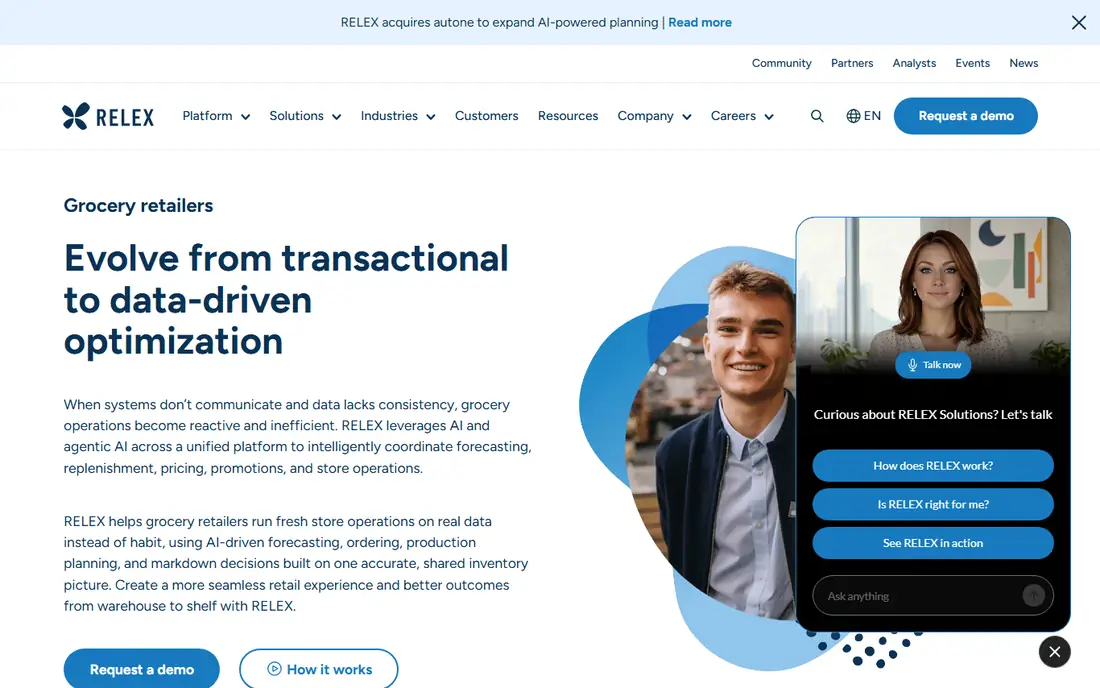
RELEX Solutions is built for grocery chains that want forecasting, replenishment, pricing, promotions and store operations in one system. That breadth matters when a promotion in one department changes demand in another, or when fresh and center store orders must land in the same store plan. The grocery page states fresh store ordering for loose, bulk and variable-weight items, which is the detail many general tools miss. RELEX Mobile also gives store teams order proposals and exception alerts, so planners can review store-level issues instead of only central forecasts. It suits chains with several stores and a central planning team.
The catch is cost and scope. RELEX does not publish a starting price on the grocery page checked, so you must talk to sales before you can budget. The platform also covers far more than replenishment, which can slow a buyer who only needs fresh ordering. Pick RELEX if you want one planning system across departments and stores. Look elsewhere if you need a published price or a narrow fresh-only tool.
What we like- Unified forecasting, replenishment, pricing, promotions and store operations on one platform
- Fresh store ordering covers loose, bulk and variable-weight items
- RELEX Mobile gives store teams order proposals and exception alerts
Watch out for- No published price on the page checked, so buying is contact-led
- Broad unified platform is more than a store-only ordering need
Starting priceSee website
Free planNone found on vendor page
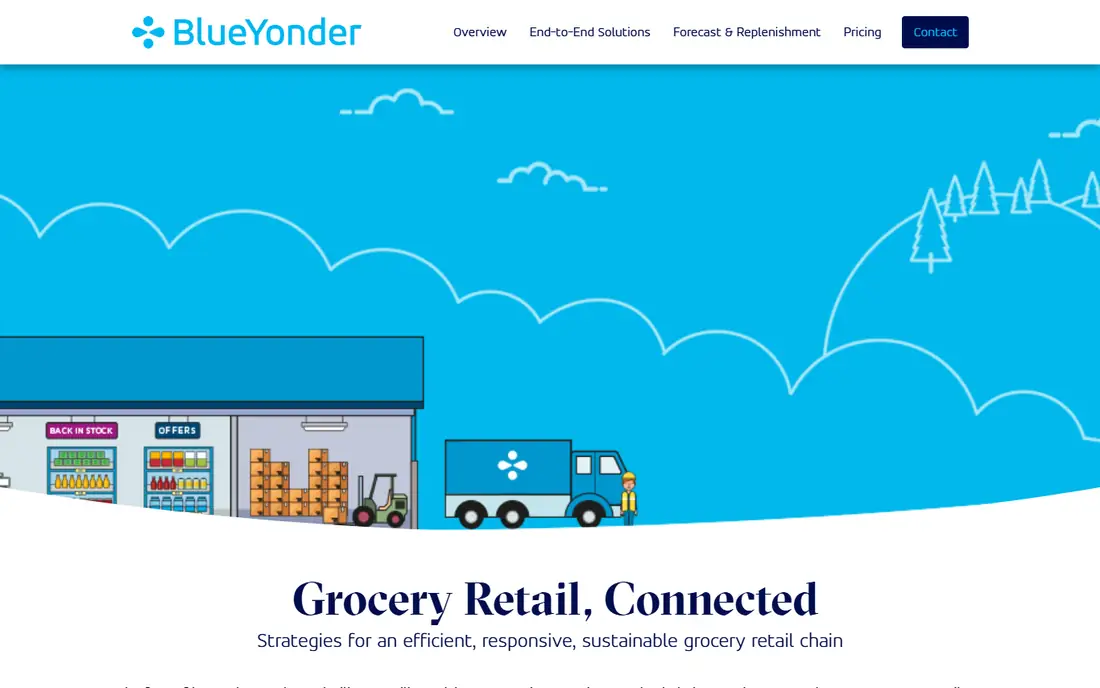
Blue Yonder targets large grocers that need forecasting and replenishment tied to wider supply chain work. Its grocery page states forecasting and store replenishment with AI and ML, plus markdown pricing for expiring products. That markdown piece matters in grocery, where a forecast miss becomes waste unless price action clears stock in time. The same vendor also covers category, workforce and warehouse management for grocers, so the planning conversation can extend beyond store orders. It suits chains that already run complex distribution networks and want one vendor across planning and warehouse decisions. Smaller chains may find the scope heavy.
The catch is that the grocery page checked lists no price and pushes contact-led buying. Blue Yonder also spans many modules, so a team that only wants fresh ordering may pay for a wider suite than it needs. Pick Blue Yonder if warehouse, category and workforce planning sit in the same program as replenishment. Look elsewhere if you want a focused grocery ordering tool with a public price.
What we like- Grocery forecasting and store replenishment with AI and ML
- Markdown pricing for expiring products
- Also covers category, workforce and warehouse management for grocers
Watch out for- No published price on the page checked, so buying is contact-led
- Scope spans many modules, so a narrow fresh-ordering buyer gets a wider suite
#3
SymphonyAI Retail CPG
Best for: Grocers fixing shelf gaps and phantom inventory
Visit symphonyai.com
Starting priceSee website
Free planNone found on vendor page
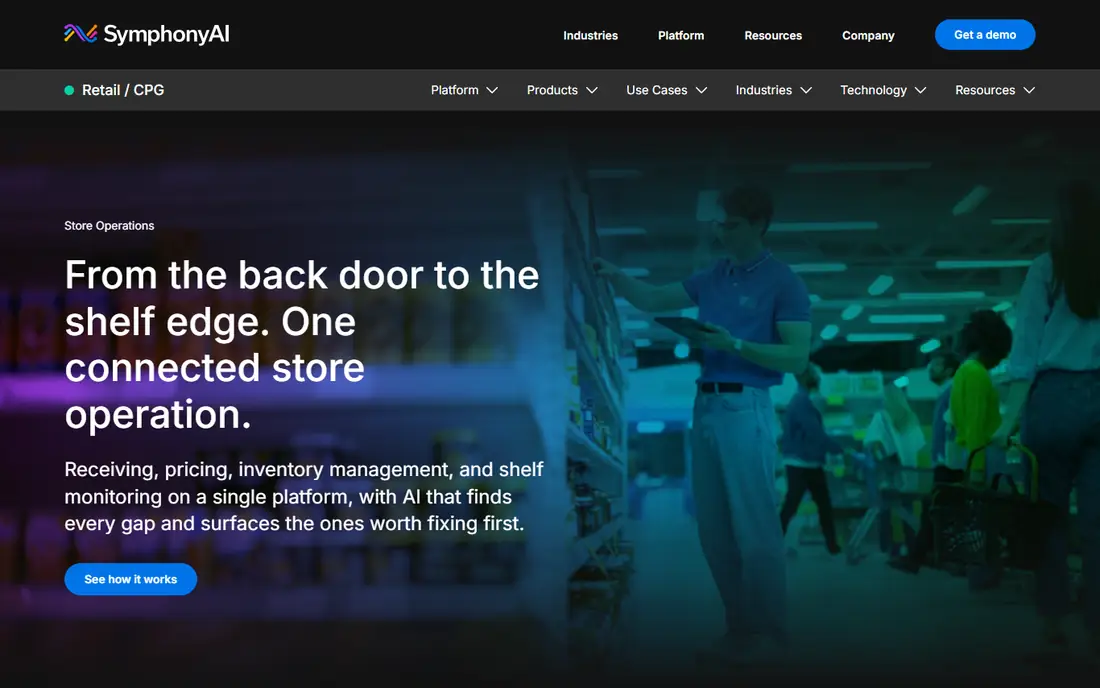
SymphonyAI Retail CPG focuses on store operations, which makes it a fit for grocers whose main problem is shelf accuracy rather than central forecasting. The vendor states perpetual inventory across store, back room and shelf, plus fresh production planning for short-shelf-life items by day. Computer vision detects out-of-stocks and phantom inventory, which helps when the system says stock exists but the shelf is empty. That shelf-level view is valuable in grocery, where a wrong count quickly becomes a missed sale or a bad order. It suits chains that want store execution data feeding replenishment decisions.
The catch is that shelf monitoring depends on image capture, and the vendor lists options such as mobile, camera systems or robotics. You must choose and run that capture method before the data improves. Pricing is also not published on the page checked. Pick SymphonyAI if phantom inventory and shelf gaps are your main loss. Look elsewhere if your core need is central demand forecasting with no store image program.
What we like- Perpetual inventory across store, back room and shelf
- Fresh production planning for short-shelf-life items by day
- Computer vision detects out-of-stocks and phantom inventory
Watch out for- No published price on the page checked
- Shelf monitoring relies on image capture options such as mobile, camera systems or robotics
#4
Netstock
Best for: Food distributors on an ERP needing reorder planning
Visit netstock.com
Starting priceEssentials: $900/month
Free planNone found on vendor page
Netstock is the clearest priced option in this list and the best fit for food distributors that already run an ERP. Its food and beverage page states support for perishable goods, shelf life and automated replenishment. Essentials gives a daily stock position and tells planners what to order and when, which suits teams moving off spreadsheets. The vendor states integration with over 60 ERP systems, so the tool sits on top of existing inventory data rather than replacing it. Pricing starts at Essentials: $900/month, with Advanced at $1,500/month and Commercial at $2,000/month on the packages page.
The catch is that Netstock needs a supported ERP and sells annual subscriptions. It is not a standalone store ordering system for shelf-level grocery work. Implementation typically takes 6 to 10 weeks, so data quality in the ERP matters before go-live. Pick Netstock if you are a distributor or wholesaler with ERP data and want reorder planning with a public price. Look elsewhere if you need store-level fresh ordering or have no ERP in place.
What we like- Food and beverage page states perishable goods, shelf life and automated replenishment support
- Essentials gives daily stock position and order timing
- Integrates with over 60 ERP systems
Watch out for- Annual subscriptions, so there is no monthly-only entry on the page
- Needs a supported ERP underneath, it is not a standalone store system
Starting priceSee website
Free planNone found on vendor page
Afresh is built for US grocers that order fresh and center store items with shelf life in mind. Its demand forecasting page states a probabilistic forecast that gives a demand range per item, store and day, rather than one fixed number. Ordering weighs shelf life and on-hand inventory, which fits fresh departments where ordering to the average still creates waste. DC buying aggregates store demand with price and promotion lifecycle, and the vendor states a 35-day view of store-level demand. It suits grocers that want fresh ordering logic tied to distribution center decisions.
The catch is that Afresh does not publish pricing on the page checked, and its model is grocery-specific by design. That focus is a strength for grocers and a limit for mixed retail groups. You also need store-level sales and inventory data clean enough for daily forecasts. Pick Afresh if fresh ordering and DC buying are one connected problem. Look elsewhere if you run non-grocery categories or need a public price before a sales call.
What we like- Probabilistic forecast gives a demand range per item, store and day
- Ordering weighs shelf life and on-hand inventory
- DC buying aggregates store demand with price and promotion lifecycle
Watch out for- No published price on the page checked
- Forecast model is grocery-specific, so non-grocery assortment fit is not the stated use
#6
Upshop
Best for: Grocers unifying ordering across all departments
Visit upshop.com
Starting priceSee website
Free planNone found on vendor page
Upshop aims at grocers that order department by department and want one workflow instead. Its Total Store Ordering page states that every item, department and supplier can sit in one ordering flow. One demand signal uses holidays, weather, dayparts and promotions, which matches how grocery demand actually moves during a week. The vendor names four suites: Fresh, Inventory, Waste and eCommerce. That mix suits chains where fresh waste, center store availability and online orders compete for the same stock. Upshop also states that Invafresh fresh tools now sit under Upshop after the merger, so list Upshop only.
The catch is scope. Upshop covers eCommerce and waste suites beyond pure replenishment, and the page checked lists no price. A grocer that only needs DC replenishment may buy more platform than the problem requires. Pick Upshop if department-by-department ordering is the pain and you want one demand signal. Look elsewhere if you need a narrow forecasting tool or a published starting price.
What we like- Total Store Ordering unifies every item, department and supplier in one workflow
- One demand signal uses holidays, weather, dayparts and promotions
- Suites cover Fresh, Inventory, Waste and eCommerce
Watch out for- No published price on the page checked, so buying is contact-led
- Platform scope includes eCommerce and waste suites beyond pure replenishment
#7
LEAFIO AI
Best for: Grocery chains automating daily store orders
Visit leafio.ai
Starting priceSee website
Free planNone found on vendor page
LEAFIO AI is aimed at grocery and convenience chains that want daily store orders generated from demand data. The vendor states demand-driven order generation for replenishment across supply chain levels, and names grocery and convenience as best suited segments. It connects ERP and POS data for forecasting and replenishment, so store sales and inventory balances feed the order logic. The homepage states more than 30,000 stores connected to the platform. It suits chains that still build store orders manually and want a system to propose orders across many locations. The fit is strongest where ERP and POS data already exist.
The catch is time and data. LEAFIO states implementation is typically about 6 months, and the system needs ERP or accounting data such as sales history and inventory balances. Chains with weak item data will spend that time on cleanup before orders improve. Pricing is not published on the homepage checked. Pick LEAFIO if daily store order automation is the goal and your data is ready. Look elsewhere if you need a fast start or have no ERP or POS feed.
What we like- Demand-driven order generation for replenishment across supply chain levels
- Grocery and convenience named as best suited segments
- Connects ERP and POS data for forecasting and replenishment
Watch out for- Implementation is typically about 6 months per vendor FAQ
- Needs ERP or accounting data sources such as sales history and inventory balances
Starting priceSee website
Free planNone found on vendor page
Slimstock Slim4 suits food and grocery suppliers that plan from forecast through purchase orders. Its food page covers forecasting, promotion management and order generation, and the order generator uses lead times, waste optimisation and supplier constraints. That supplier constraint detail matters in food supply, where minimum order rules and lead times decide what a planner can actually buy. Slim4 integrates with existing ERP solutions and works alongside the ERP rather than replacing it. The vendor frames an S&OP kick start as 90 days on the page checked. It suits suppliers and wholesalers more than store-level fresh teams.
The catch is that Slim4 depends on your ERP and does not publish a price on the food page checked. Buying is demo-led, so budget talks start later than with Netstock. It also plans supply more than shelf execution, so store teams may still need another tool for daily fresh work. Pick Slim4 if supplier constraints and promotions drive your planning. Look elsewhere if you need store ordering or a public price.
What we like- Food and grocery page covers forecasting, promotion management and order generation
- Order generator uses lead times, waste optimisation and supplier constraints
- Integrates with existing ERP solutions
Watch out for- No published price on the page checked, so buying is demo-led
- Slim4 works alongside an ERP rather than replacing it
#9
Logile
Best for: Grocers with heavy in-store fresh production
Visit logile.com
Starting priceSee website
Free planNone found on vendor page
Logile fits grocers where fresh departments produce food in store, such as bakery, deli and prepared meals. Its fresh item management page states a recipe-to-replenishment flow that ties forecasting, production, labeling and inventory together. AI forecasting uses sales, shrink, promotions, seasonality and weather, and guided mobile production plans show staff what to make and when. That production link is the difference from pure replenishment tools, because the order decision and the make decision happen in the same department. The vendor states fresh departments drive more than 30 percent of grocery traffic.
The catch is focus and payback timing. Logile is store-level fresh software, so DC replenishment is not the stated core on the page checked. The vendor states typical payback within 14 to 18 months, which is slower than a simple reorder tool. Pricing is not published on the page checked. Pick Logile if in-store production waste is your main loss. Look elsewhere if your problem is warehouse replenishment across packaged goods.
What we like- Recipe-to-replenishment flow ties forecasting, production, labeling and inventory
- AI forecasting uses sales, shrink, promotions, seasonality and weather
- Guided mobile production plans show what to make and when
Watch out for- Store-level fresh focus, so DC replenishment is not the stated core on this page
- Vendor states typical payback within 14 to 18 months, not immediate
Starting priceSee website
Free planNone found on vendor page
Freshflow is a focused fresh ordering tool for European grocers. Its homepage states that it simulates saleable inventory using spoilage, shelf life, scan errors and write-offs, which matches how fresh stock actually disappears from the shelf. It builds one forecast model per store using weather, holidays and promotions, and states 120 plus signals in that model. The vendor also states it sits on top of existing systems with no migration project, which lowers the switching cost for chains with a working ERP. It suits produce-led grocers that want better fresh orders without replacing core systems.
The catch is geography and scope. Freshflow positions itself around live stores across Europe, and its scope is fresh departments rather than full-store planning. Center store planning still needs another system. Pricing is not published on the homepage checked. Pick Freshflow if you are a European grocer and fresh produce ordering is the problem. Look elsewhere if you need one tool for every department or operate outside its stated market.
What we like- Simulates saleable inventory using spoilage, shelf life, scan errors and write-offs
- One forecast model per store using weather, holidays and promotions
- Sits on top of existing systems with no migration project stated
Watch out for- Europe-focused positioning on the page, with live stores across Europe
- Fresh-department scope, so center-store planning needs another system
How much does grocery inventory planning software cost?
Most grocery inventory planning software does not publish a price. In this list, only Netstock states a starting price on its own packages page: Essentials at $900/month, Advanced at $1,500/month and Commercial at $2,000/month, on annual subscriptions. The other nine tools say See website because their vendor pages checked list no price. Budget beyond license fees. Netstock states implementation typically takes 6 to 10 weeks. LEAFIO AI states implementation is typically about 6 months. Logile states typical payback within 14 to 18 months. Ask each vendor for the license price, implementation fee, and the data feeds required before you compare quotes. Ask whether the quote includes store rollout, item data cleanup, and training for fresh department staff. A low license price can still cost more in year one if every store needs new counting routines. Compare total cost over 3 years, not the first invoice alone. Include the cost of ERP or POS integration work in the same comparison.
Afresh, Logile and Freshflow fit fresh departments best in this list. Afresh weighs shelf life and on-hand inventory in ordering and gives a demand range per item, store and day. Logile ties forecasting to in-store production, labeling and inventory, which suits bakery and deli teams that make food daily. Freshflow simulates saleable inventory with spoilage, shelf life, scan errors and write-offs for produce-led ordering.
Do you need an ERP before buying grocery replenishment software?
Yes, most tools in this list need ERP or POS data before they can plan well. Netstock integrates with over 60 ERP systems and plans from ERP inventory data. Slim4 works alongside an ERP rather than replacing it. LEAFIO AI connects ERP and POS data and needs sales history and inventory balances. Freshflow states it sits on top of existing systems.
What is the difference between demand forecasting and replenishment?
Demand forecasting estimates what customers will buy, by item, store and day. Replenishment turns that estimate into orders, using on-hand stock, shelf life, lead times and supplier rules. Afresh states a probabilistic forecast with a demand range, then weighs shelf life in ordering. Slim4 states forecasting plus an order generator that uses lead times and supplier constraints. A good forecast with weak replenishment rules still overorders fresh lines.
Frequently asked questions
What is the best inventory planning software for a small grocery chain?
RELEX Solutions is the top pick for chains that need forecasting and replenishment together, but its price is See website. A small chain with ERP data and a tight budget should price Netstock first, since Essentials starts at $900/month for reorder planning.
How much does Netstock cost for food distributors?
Netstock states Essentials at $900/month, Advanced at $1,500/month and Commercial at $2,000/month on its packages page. The vendor states pricing is based on annual subscriptions. Essentials gives daily stock position and order timing. Advanced adds a planning horizon of up to 24 months. Implementation typically takes 6 to 10 weeks.
Which tools help most with perishable grocery ordering?
Afresh, Freshflow and Logile state the clearest perishable logic. Afresh weighs shelf life and on-hand inventory when ordering. Freshflow simulates saleable inventory using spoilage, shelf life, scan errors and write-offs. Logile ties fresh forecasting to production plans, labeling and inventory. RELEX also states fresh store ordering for loose, bulk and variable-weight items.
Do any of these grocery tools offer a free trial?
No free plan or trial was found on the vendor pages checked for these 10 tools. Each entry lists free plan as None found on vendor page. That does not prove a trial can never be arranged in a sales call. It means the public vendor pages checked on 2026-11-27 did not state trial terms.
Should a grocery buyer choose a fresh-only tool or a full platform?
Choose a fresh-only tool when produce, meat or bakery waste is the main loss and center store ordering already works. Choose a full platform such as RELEX or Upshop when promotions, pricing and ordering across departments must share one plan. Fresh-only tools in this list include Afresh, Logile and Freshflow.
What to look for before you buy
First, check whether the tool states a grocery, fresh or perishables use case on its own site. Second, confirm the data feeds it needs, such as ERP stock balances, POS sales history and shelf life fields. Third, ask for the full price in writing, since nine of these 10 tools list See website. Fourth, test how the tool handles variable-weight items, promotions and short shelf life lines. Fifth, agree the rollout timeline before signing.
How we chose
We built a candidate list of grocery, fresh and food supply planning tools, then kept 10 with a stated grocery, food retail, fresh or perishables fit on the vendor site. Prices and trial terms were checked on vendor pages on 2026-11-27. Only Netstock published a starting price. No hands-on testing was done. Strengths and weaknesses point to vendor page facts.
Sources we checked (11)
- https://www.relexsolutions.com/industries/retail/grocery/
- https://now.blueyonder.com/groceryretailconnected
- https://www.symphonyai.com/retail-cpg/store-operations
- https://www.netstock.com/industries/food-beverage/
- https://www.netstock.com/packages/
- https://www.afresh.com/platform/demand-forecasting
- https://upshop.com/upshop-launches-total-store-ordering-to-optimize-customer-service-and-revenues
- https://www.leafio.ai/
- https://www.slimstock.com/industries/food/
- https://www.logile.com/solutions/fresh-item-management
- https://www.freshflow.ai/
Is your product missing or out of date?
We review this list regularly. Vendors can request a listing, send updated pricing or ask about featured placement.

Shihab Mia · Founder, Rankite
Shihab has 5+ years in B2B and SaaS SEO. He writes Rankite's software buying guides from pricing pages, documentation and public user reviews. More about Shihab.