How we make this list: we compare pricing pages, product documentation and public user reviews. Rankite is independent; if a vendor ever pays for a featured spot, that listing is clearly labeled Partner.
Key takeaways
- Jewel360 ($199/month, unlimited users) is the cleanest cloud pick for independent retailers that want serialized tracking, repairs and vendor integrations in one subscription.
- On a tight budget, WJewel starts at $99/month (paid annually) and Deelo at $19 per seat per month, with both covering repairs and custom orders.
- The Edge remains the proven on-premise choice for stores that want their data on local servers and deep jewelry-specific reporting.
- CaratIQ bundles POS with marketing tools and a free jewelry website, but per-user pricing ($300 to $800 per month) adds up fast as the team grows.
- Manufacturers and multi-channel sellers should look at PIRO Fusion ($299 to $999 per month) and Adaptive Jewelry ERP instead of a retail-only POS.
Quick comparison
| Tool | Best for | Starting price | Free plan |
|---|
 Jewel360 Jewel360 | Independent jewelry retailers that want a cloud all-in-one system | $199/month (unlimited users and products) | No (no free plan advertised) |
 The Edge The Edge | Established jewelers that want a proven on-premise system | See website (custom quote) | No (no free plan advertised) |
 WJewel WJewel | Full-service stores that want POS, inventory and accounting in one system | $99/month (paid annually, single user) | Free trial (30 days, risk-free) |
 PIRO Fusion PIRO Fusion | Jewelry manufacturers and multi-channel sellers needing ERP depth | $299/month (Starter package) | No (no free trial advertised) |
 CaratIQ CaratIQ | Growth-focused stores that want POS, CRM and marketing bundled | $300/month (Basic, 3 users) | Free trial (per G2) |
 Lightspeed Retail Lightspeed Retail | Jewelers prioritizing omnichannel selling across marketplaces and social | See website (tiered per-outlet pricing) | No (no free plan advertised) |
 Deelo Deelo | Independent jewelers that want to collapse five tools into one platform | $19/seat/month | Free trial (no credit card required) |
 Logic Mate (JewelMate) Logic Mate (JewelMate) | Jewelry wholesalers and manufacturers with B2B workflows | See website (custom quote) | No (no free plan advertised) |
 AcctVantage AcctVantage | Jewelry businesses that want accounting and operations in one ERP | See website (custom quote) | No (no free plan advertised) |
 Adaptive Jewelry ERP Adaptive Jewelry ERP | Mid-size to large jewelry companies with complex operations | See website (custom quote) | No (no free plan advertised) |
Is your product missing or out of date?
We review this list regularly. Vendors can request a listing, send updated pricing or ask about featured placement.
The best jewelry inventory software
A jeweler with 400 pieces in the cases and another 200 in the safe cannot run the business on a spreadsheet and a generic cash register. Two diamond solitaires with the same SKU can have different carat weights, different GIA certificate numbers, different costs and different retail prices. Add repairs, appraisals, memo goods, trade-ins and layaway, and the inventory system becomes the store's memory. The ten systems below handle that reality, from cloud POS built for independents to ERP platforms built for manufacturers.
#1
Jewel360
Best for: Independent jewelry retailers that want a cloud all-in-one system
Visit jewel360.com
Starting price$199/month (unlimited users and products)
Free planNo (no free plan advertised)
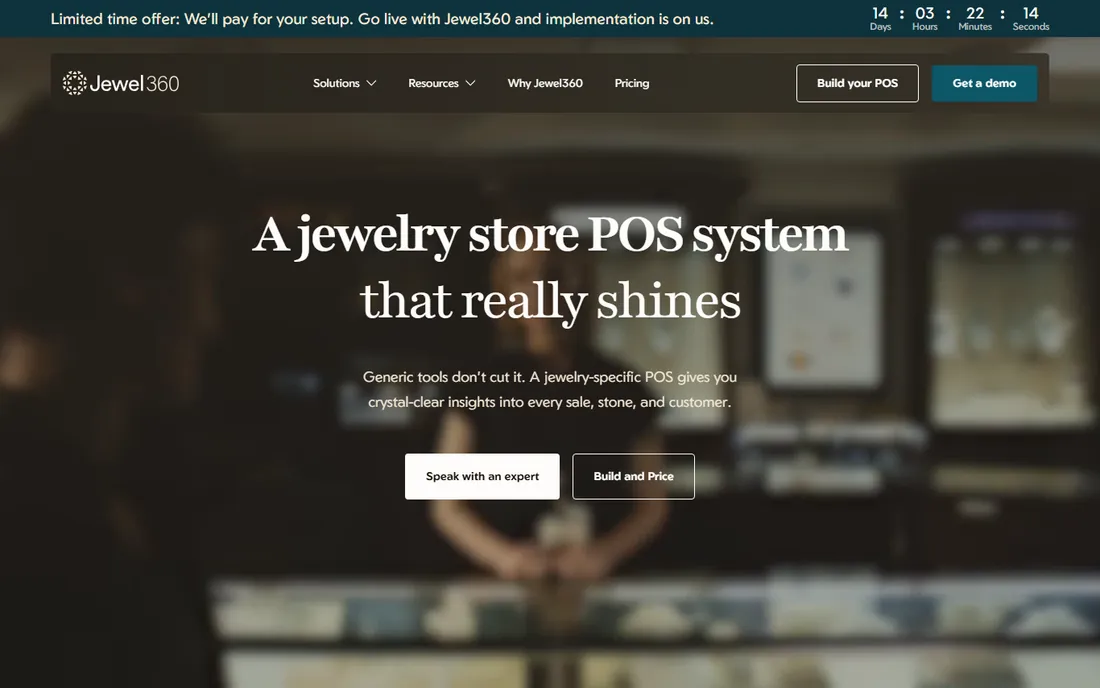
Jewel360 is the system newer independent stores are switching to, and the reason is simple: it was built for jewelry from day one, not adapted from general retail. Every piece gets its own record with stone attributes, certificates and bin location. Repairs run on job templates with automated text and email updates at each stage, plus photo documentation. Appraisals, trade-ins with current metal pricing, consignment and layaway are native, not add-ons. Two-way integrations cover Stuller, Geller's Blue Book, Jewelers Mutual, Clientbook, QuickBooks and Affirm.
The honest catch is the entry price. At $199 a month with a one-time setup fee that varies by store, Jewel360 costs more than the budget options below, and stores that need Shopify sync pay for Plus. Migration is the other cost: moving serialized inventory with certificates and vendor data takes real work, though Jewel360 assigns a dedicated Customer Success Manager to handle data migration, training and workflow setup.
What we like- Unlimited users and products on every plan with no per-user fees
- Serialized inventory with GIA certificate integration and bin tracking on core plans
- Month-to-month billing with no long-term contracts
Watch out for- The $199 floor is steep for very small shops
- Native Shopify sync sits on the Plus plan, not the base plan
Starting priceSee website (custom quote)
Free planNo (no free plan advertised)
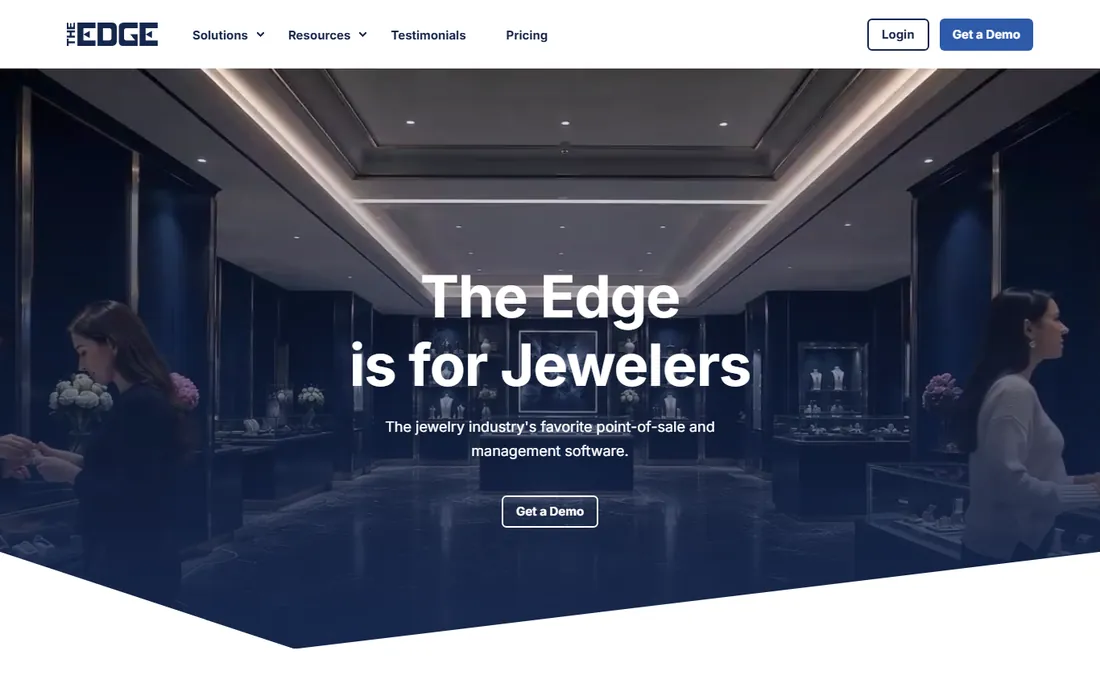
If your store has run on the same system for fifteen years and sees no reason to change that, The Edge is likely what you are already running. Built by Abbott Jewelry Systems in Shelton, Connecticut, it is the legacy standard for independent jewelry retail: point of sale, inventory management, CRM, reporting and store operations in one package that lives on your own servers. Thousands of independents trust it precisely because it does not change underneath them.
The trade-off is the one every legacy system faces. There is no cloud-native version, so checking inventory or repair status from home is not what The Edge was designed for. Pricing is custom-quoted, which makes side-by-side comparison harder. Note the ownership change: Serent Capital invested in 2026 and founder Dick Abbott retired with Josh Brenner stepping in as CEO, so the product roadmap is in new hands.
What we like- Two decades of jewelry-specific workflows, from repairs to vendor management
- Deep inventory and sales reporting built for the trade
- Strong training and support reputation among independents
Watch out for- On-premise architecture means no true cloud access to the store from anywhere
- Pricing is quote-based, so you talk to sales before you see a number
#3
WJewel
Best for: Full-service stores that want POS, inventory and accounting in one system
Visit wjewel.com
Starting price$99/month (paid annually, single user)
Free planFree trial (30 days, risk-free)
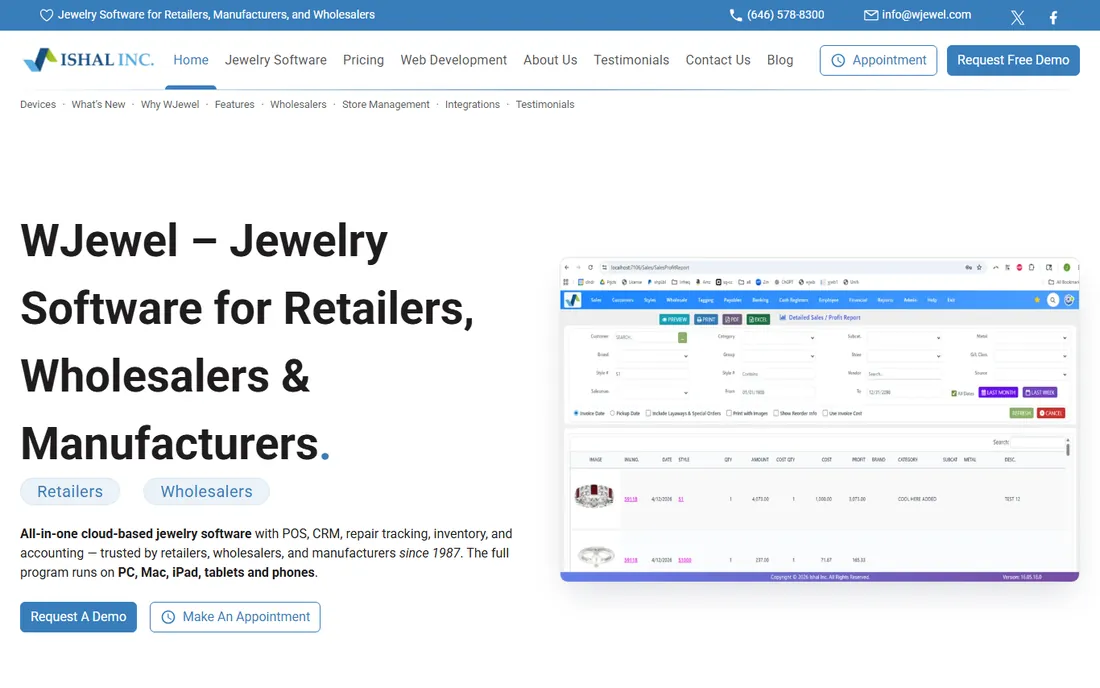
WJewel wins the value argument in a way few jewelry systems can: the entry subscription starts at $99 a month and includes accounting that most vendors sell separately or leave to QuickBooks. Invoicing, repair orders, serialized inventory, scrap gold buying, layaway, multi-store support and full business reporting run in one system. Integrations cover QuickBooks, Shopify, GIA and FedEx. The vendor, Ishal Inc., has served jewelers for nearly four decades, and setup plus data migration from your old system is included.
The honest catch is the per-user math. That $99 covers one user; every additional seat and location is quoted, so a five-person store pays more than the headline price. Reviewers consistently praise the support and the depth of jewelry-specific workflows (karat and metal tracking, style-level costing, repair workflows), while noting the interface looks dated next to cloud-native rivals.
What we like- Full accounting (AP and general ledger) built in, plus scrap gold buying and memo tracking
- Setup and data migration included with unlimited training and 365-day phone and email support
- Predictable pricing with no long-term contract
Watch out for- The $99 entry price covers a single user, with more users and locations quoted per store
- The interface is functional rather than modern, with a learning curve for new staff
#4
PIRO Fusion
Best for: Jewelry manufacturers and multi-channel sellers needing ERP depth
Visit gopiro.com
Starting price$299/month (Starter package)
Free planNo (no free trial advertised)
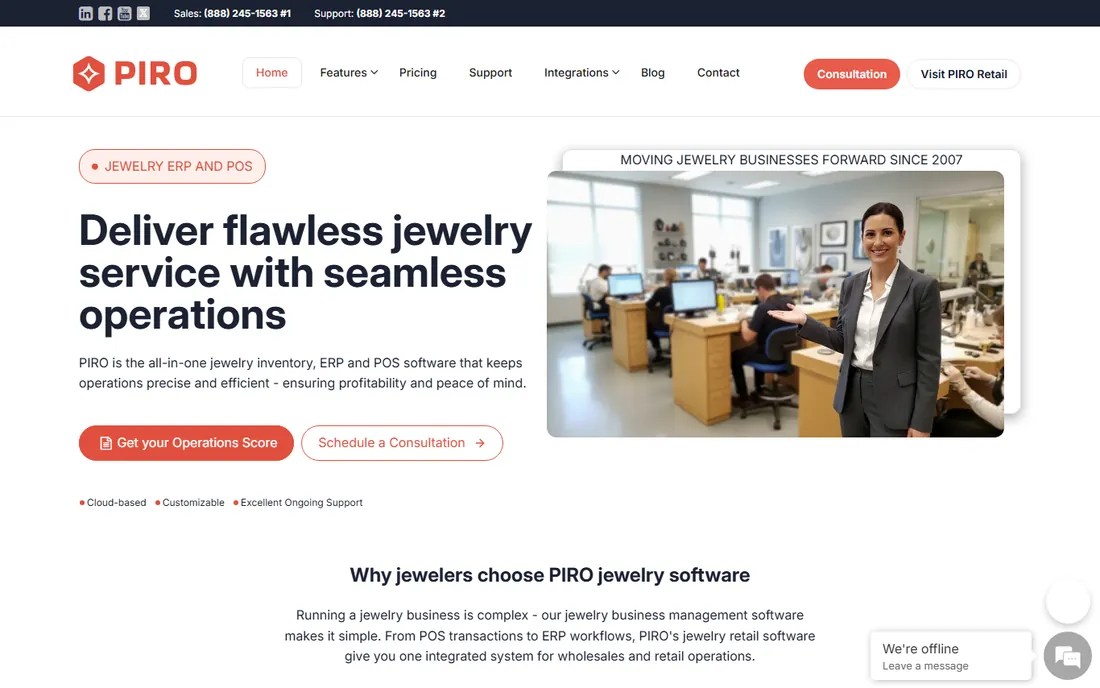
PIRO Fusion is not really a POS with extras; it is a jewelry ERP that happens to include a POS. Built by MindSpark, it connects inventory, production workflow, custom jobs, repairs, purchasing and sales in one system, with manufacturing-specific features like jewelry balances and scale integration, Rappaport price feed removal and RFID inventory management. For a business that makes, wholesales and retails jewelry, that single database replaces three disconnected tools.
The honest catch is price and weight. The $299 Starter package is the floor; Pro at $599 and Enterprise at $999 reflect the ERP scope, and additional users cost more. A single-location retailer that only needs POS and repairs will find PIRO more system than the store needs. Multi-channel sellers and manufacturers are the real audience.
What we like- True jewelry ERP scope: inventory, production, repairs, purchasing and sales in one database
- RFID inventory control with Kitco live gold prices on the dashboard
- Broad channel integrations (Shopify, Etsy, Magento, Amazon) plus QuickBooks and Xero
Watch out for- The useful tiers jump to $599 (Pro) and $999 (Enterprise) per month, with extra users billed on top
- This is an implementation project, not a sign-up-and-sell POS
#5
CaratIQ
Best for: Growth-focused stores that want POS, CRM and marketing bundled
Visit caratiq.com
Starting price$300/month (Basic, 3 users)
Free planFree trial (per G2)
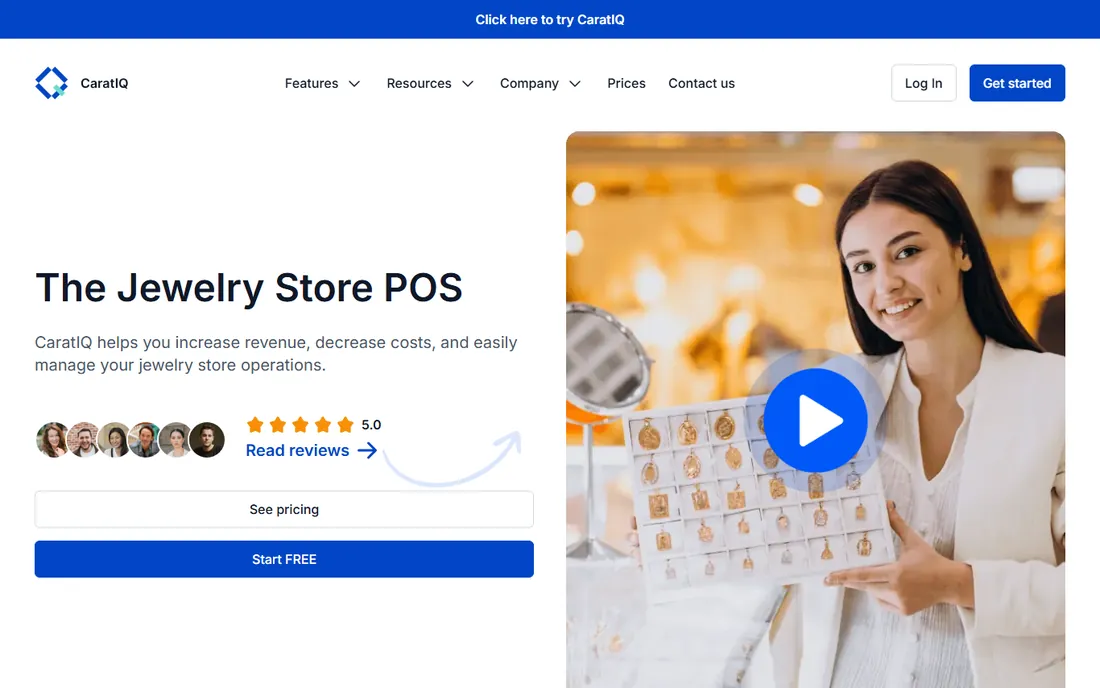
CaratIQ sells the bundle: point of sale, customer management, marketing tools, e-commerce website, appointment scheduling and repair tracking in one subscription aimed at growing stores. The marketing depth stands out, with segmented SMS and email campaigns, call time and loyalty features built in rather than bolted on. Every plan includes a jewelry-specific website with live inventory sync, and integrations cover Stuller, Geller's, GIA, Mailchimp, Klaviyo, Podium, Affirm and Klarna.
The honest catch is the pricing structure. Basic starts at $300 a month for three users and 20,000 items; a six-person store lands on the $550 Professional tier, and a seventh hire pushes costs up again at $100 per extra user per month. CaratIQ is also the newest vendor on this list, so its track record is shorter than the legacy systems.
What we like- POS, CRM, marketing automation (SMS, email, calling), appointment booking and repair tracking in one subscription
- A jewelry website with e-commerce is included
- Integrations with Stuller, Geller's Blue Book, GIA and BriteCo
Watch out for- Per-user pricing ($300 for 3 users, $550 for 5, $800 for 7, plus $100 per extra user) punishes larger teams
- Inventory caps (20,000 to 100,000 items by tier) limit high-volume stores
#6
Lightspeed Retail
Best for: Jewelers prioritizing omnichannel selling across marketplaces and social
Visit lightspeedhq.com
Starting priceSee website (tiered per-outlet pricing)
Free planNo (no free plan advertised)
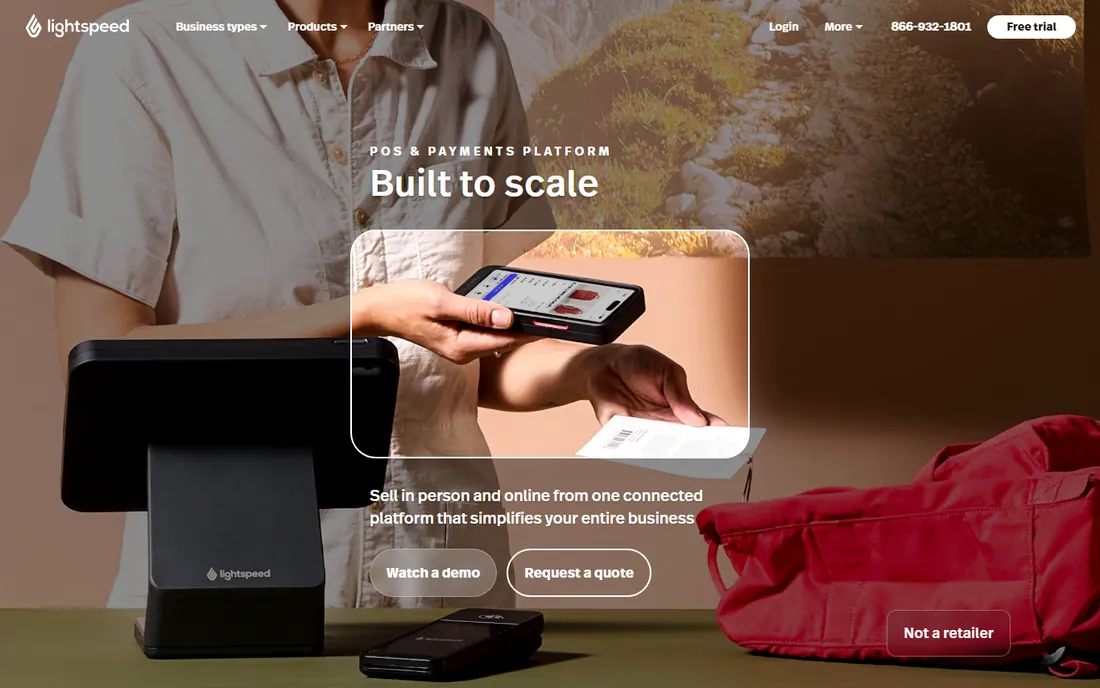
Lightspeed is the only general retail platform on this list, and it earns its place through omnichannel depth no jewelry specialist matches. If the growth plan involves selling across your own site, Amazon, eBay and social channels alongside the store, Lightspeed's e-commerce, loyalty and multi-location inventory tooling is stronger than anything built only for jewelers. Serial tracking covers piece-level basics, and supplier catalogs include jewelry vendors through NuORDER.
The honest catch is the missing jewelry layer. There are no native repair work orders with chain-of-custody, no appraisal document generation, no memo or consignment workflows, and no two-way Stuller or Geller's integrations. A jeweler on Lightspeed is adapting a retail platform, which works for inventory and sales but leaves the service side of the business in spreadsheets or add-ons.
What we like- Deep omnichannel tools (built-in e-commerce, marketplace and social selling) no jewelry specialist matches
- Serial tracking and multi-location inventory
- Supplier catalog access including jewelry vendors via NuORDER
Watch out for- Not jewelry-specific: no native repair ticketing, appraisal documents or memo workflows
- Per-outlet pricing (Plus plan $289/month per outlet in the US) multiplies cost for multi-store jewelers
#7
Deelo
Best for: Independent jewelers that want to collapse five tools into one platform
Visit deelo.ai
Starting price$19/seat/month
Free planFree trial (no credit card required)
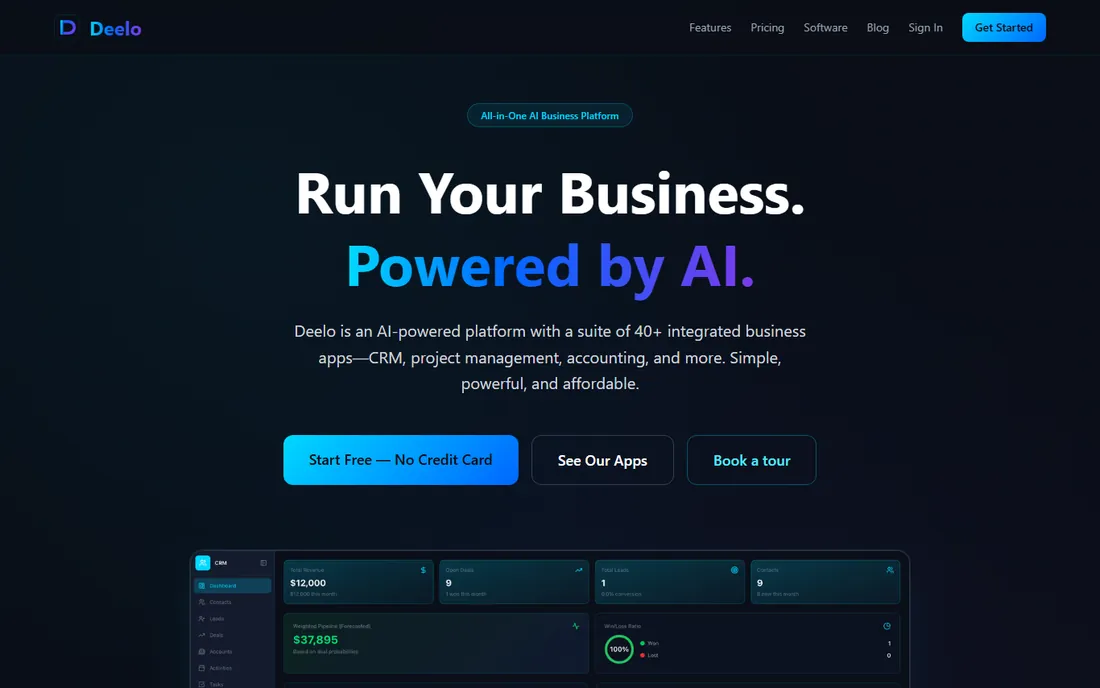
Deelo takes the opposite approach from the legacy systems: one modern platform where inventory, repairs, appraisals, e-signatures and client communication live together instead of across five subscriptions. Inventory uses custom fields to track serial numbers, GIA certificate numbers, carat weight, color, clarity, metal type and cost on each piece. Repairs and custom orders run as "matters" with deposits, milestones and status automation, and a client portal lets customers check repair status or layaway balances without calling the store.
The honest catch is depth versus breadth. Deelo covers more functions than any single legacy tool, but its jewelry-specific reporting is thinner than The Edge's, and stores that live in industry-standard reports may miss them. The $19 per seat price is the lowest entry here, but it scales with headcount.
What we like- Inventory, repair tickets, custom orders, appraisals, e-signatures, automation and a client portal in one system
- Piece-level custom fields (serial, certificate, carat, metal type and weight) make serialized tracking practical
- The lowest entry price on this list
Watch out for- Less jewelry-specific reporting depth than The Edge or Jewel360
- Per-seat pricing means a 10-person store pays $190 a month before any add-ons
#8
Logic Mate (JewelMate)
Best for: Jewelry wholesalers and manufacturers with B2B workflows
Visit logicmate.com
Starting priceSee website (custom quote)
Free planNo (no free plan advertised)
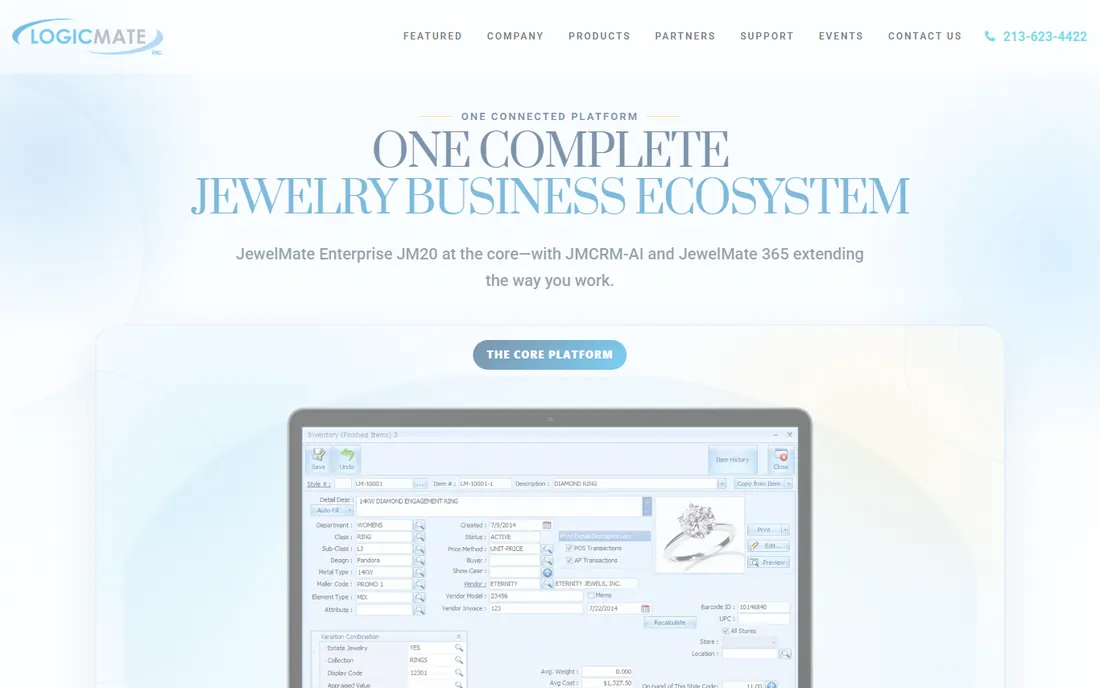
Logic Mate has sold jewelry software since 1989, and its JewelMate system shows it: this is built for wholesalers and manufacturers first, retailers second. The Glendale, California company covers the B2B side of the trade (distribution, multi-channel integrations, custom e-commerce) alongside retail POS, inventory management and CRM. For a business that sells to other jewelers as well as consumers, that wholesale depth matters more than a pretty checkout screen.
The honest catch is modernity. JewelMate is a mature Windows-era product line, and stores expecting a cloud dashboard they can open on a phone will find it dated. Pricing is custom-quoted, so budget planning starts with a sales conversation. The right buyer is a wholesaler or manufacturer that values three decades of trade-specific stability over a modern interface.
What we like- In the jewelry software business since 1989, with deep wholesale, manufacturing and distribution workflows
- JewelMate covers inventory, CRM, accounts receivable and payable, and e-commerce
- Long-tenured support team that knows the trade
Watch out for- Quote-based pricing with no published plans
- The product shows its age next to cloud-native interfaces
#9
AcctVantage
Best for: Jewelry businesses that want accounting and operations in one ERP
Visit acctvantage.com
Starting priceSee website (custom quote)
Free planNo (no free plan advertised)
AcctVantage answers a different question from everyone else on this list: what if the accounting system and the inventory system were the same product. The ERP bundles accounting management, inventory, order management, purchasing, CRM, built-in POS, shipping, a B2B portal and payment processing, which removes the reconciliation work between QuickBooks and a separate inventory tool. Third-party listings put pricing around $300 per user per month, but the vendor quotes each deployment.
The honest catch is scope. This is an ERP implementation with training and configuration, not a weekend POS rollout. Single-location retailers will find it heavy; multi-location jewelers and jewelry distributors that are outgrowing a POS-plus-QuickBooks stack are the fit.
What we like- Built-in accounting, POS, shipping, B2B portal and payment processing in one vertically integrated product
- No stitching QuickBooks to a separate inventory system
- Configurable rather than custom-built, with no annual contracts
Watch out for- ERP weight and implementation effort far beyond a POS signup
- Quote-based pricing aimed at larger operations
Starting priceSee website (custom quote)
Free planNo (no free plan advertised)
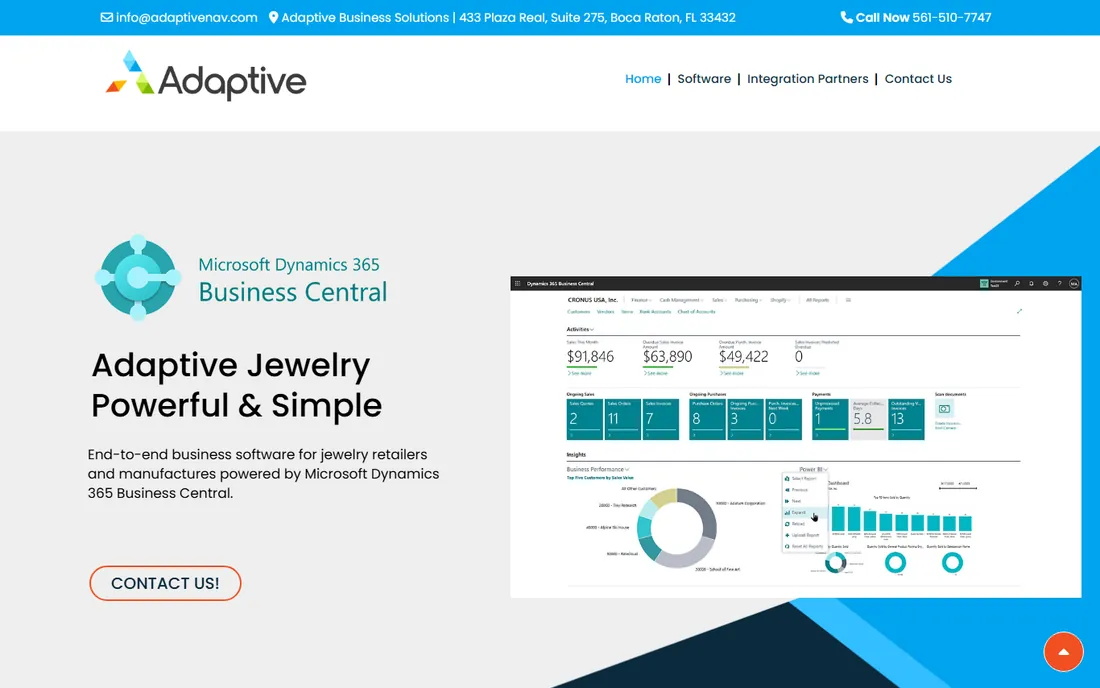
Adaptive Jewelry ERP sits at the top of this list in complexity and at the top in capability for multi-entity jewelry companies. Built by Adaptive Business Solutions on the Microsoft Dynamics NAV platform, it covers POS, inventory, accounting, replenishment planning, subcontracting, manufacturing and special orders. The replenishment features go beyond simple reorder points into retail science: sales anticipation, nice shelf stocks and store order leveling across locations.
The honest catch is everything that comes with ERP. Pricing is quoted per deployment (third-party listings cite one-time licensing around $5,000 for the first users), implementation is a project, and the feature set assumes a company with dedicated operations staff. A three-store independent should not be here; a 50-location chain or a manufacturer-distributor-retailer hybrid should.
What we like- Built on Microsoft Dynamics NAV for proven ERP depth
- Retail replenishment planning (counting by exception, store order leveling, zero-turnover checks) beyond basic reordering
- Supports 10 to 300 users across retail, wholesale, manufacturing and distribution
Watch out for- Enterprise implementation with one-time licensing costs
- Complete overkill for single stores or small chains
What to check before you buy jewelry inventory software
Start with serialized piece tracking, because it is the feature that separates jewelry software from generic retail POS. Every piece needs its own record with serial number, certificate number, gemological details, metal type, metal weight, cost and retail price. If a vendor talks about SKU-level quantities and cannot show you a per-piece record with a GIA certificate attached, keep looking.
Next, map your service workflows: repairs, custom orders, appraisals, memo goods, trade-ins and layaway. These are where jewelry stores lose money in generic systems. Ask for a live walkthrough of a repair ticket from intake photo to customer pickup notification, and of an appraisal document generated from the piece record. Count how many of your workflows need a separate tool or a spreadsheet; each one is a monthly subscription and a reconciliation headache.
Then check the vendor connections that run a jewelry store: Stuller catalog and ordering, Geller's Blue Book repair pricing, GIA certificate lookup, Jewelers Mutual, and your accounting system. Two-way integrations beat catalog imports. On pricing, compare the real totals: per-user fees (CaratIQ, Deelo) versus flat subscriptions (Jewel360, WJewel), inventory caps, setup fees and the cost of add-on modules. Finally, ask about data migration from your current system and who does it; moving serialized inventory with certificates is the hardest part of any switch.
Cloud vs. on-premise: pick your deployment
The jewelry software market is split between cloud systems (Jewel360, CaratIQ, Deelo, WJewel) and on-premise or hybrid systems (The Edge, Logic Mate). Cloud means access from any device, automatic updates and no server to maintain; it also means a monthly subscription forever and your data on someone else's infrastructure. For most independents opening a second location or selling online, cloud is the practical choice.
On-premise means the system and the data live on your own servers. Stores choose it for control, for decades of stable workflows, and sometimes for PCI and insurance preferences. The cost is hardware, backups and upgrades on your schedule, plus no checking the store from your phone. If you go on-premise, ask the vendor directly about their cloud roadmap and how long the current version will be supported; the industry is moving, and you do not want to buy into a dead end.
How we chose
We started with the searches buyers actually run: jewelry inventory software, jewelry POS software and jewelry store management software. For each candidate we checked the vendor's own site and pricing pages, looked at public reviews on G2, Capterra and SourceForge, and compared serialized tracking, repair and appraisal workflows, vendor integrations and company-size fit. Prices shown come from vendor-published pages; where the vendor does not publish pricing we wrote "See website" rather than guessing.
Frequently asked questions
How much does jewelry inventory software cost?
Entry prices on this list run from $19 per seat per month (Deelo) and $99 per month (WJewel, annual) to $199 per month flat (Jewel360) and $299 per month and up for ERP systems like PIRO Fusion. Legacy and ERP vendors (The Edge, Logic Mate, AcctVantage, Adaptive) quote custom prices. Budget for setup fees and data migration on top of the subscription.
Do I need jewelry-specific software, or will a general POS work?
A general POS like Lightspeed handles sales and basic serial tracking, but it has no native repair ticketing, appraisal documents, memo workflows or jewelry vendor integrations. If repairs, appraisals or custom orders are part of your revenue, jewelry-specific software pays for itself in reclaimed staff time.
What is serialized inventory tracking?
It means every individual piece gets its own record, instead of tracking quantities per SKU. A serialized record carries the serial number, certificate number, carat weight, color, clarity, metal type, metal weight, cost, retail price, bin location and vendor, so staff can find and price any piece without opening every case.
Can jewelry software sync with my website?
Yes, on the cloud systems. Jewel360 syncs with Shopify on its Plus plan, CaratIQ includes a jewelry website with e-commerce, Deelo and WJewel connect to Shopify, and PIRO Fusion covers Shopify, Etsy, Magento and Amazon. Confirm two-way sync (online orders updating store inventory) rather than one-way catalog export.
How long does it take to switch jewelry software?
Plan on four to twelve weeks. The software setup is the fast part; migrating serialized inventory with certificates, customer histories and vendor data is the slow part. Vendors that include dedicated migration (Jewel360 assigns a Customer Success Manager; WJewel includes data migration) shorten this considerably. Avoid switching during the holiday season.
Sources we checked (12)
- https://jewel360.com/blog/lightspeed
- https://jewel360.com/blog/wjewel
- https://jewel360.com/blog/caratiq
- https://jewel360.com/blog/the-edge
- https://www.wjewel.com/pos-pricing.php
- https://www.caratiq.com/prices
- https://www.gopiro.com/
- https://deelo.ai/blog/best-jewelry-store-software-2026
- https://www.theedgeforjewelers.com/
- https://www.logicmate.com/
- https://www.acctvantage.com/
- https://justjewelrysoftware.com/
Is your product missing or out of date?
We review this list regularly. Vendors can request a listing, send updated pricing or ask about featured placement.

Shihab Mia · Founder, Rankite
Shihab has spent more than a decade helping SaaS and e-commerce brands grow through search. He writes Rankite's software buying guides from pricing pages, documentation and public user reviews. More about Shihab.