How we make this list: we compare pricing pages, product documentation and public user reviews. Rankite is independent; if a vendor ever pays for a featured spot, that listing is clearly labeled Partner.
Key takeaways
- If you need true fund accounting on a small budget, Aplos ($79/month) is the most purpose-built option, with fund-based balance sheets and donation tracking included from the Lite plan.
- QuickBooks Online ($38/month Simple Start) is the most widely used, but it is not a real fund accounting system: nonprofits track funds with workarounds like classes and sub-accounts, and budgeting needs the $140/month Plus plan.
- Mid-sized and large nonprofits with multiple grants, programs or entities should shortlist Sage Intacct and Blackbaud Financial Edge NXT (both custom-quoted), which handle restricted funds, grant billing and multi-entity consolidation natively.
- Eligible nonprofits can get Oracle NetSuite at no license cost through the NetSuite Social Impact donation program, which makes enterprise ERP realistic for organizations that could never afford it.
- The genuinely free option is Wave (free Starter plan), which covers invoicing, bills and double-entry bookkeeping, but it has no fund accounting at all.
Quick comparison
| Tool | Best for | Starting price | Free plan |
|---|
 Aplos Aplos | Small nonprofits and churches that need true fund accounting without enterprise complexity | $79/month (Lite plan) | Free trial (15 days, no credit card) |
 Sage Intacct Sage Intacct | Mid-sized and large nonprofits with multiple grants, funds, programs, locations or entities | See website (custom quote only) | No |
 QuickBooks Online QuickBooks Online | Small nonprofits that want the most widely used and accountant-supported ledger | $38/month (Simple Start) | Free trial (30 days) |
 Blackbaud Financial Edge NXT Blackbaud Financial Edge NXT | Nonprofits already fundraising on Blackbaud products like Raiser's Edge NXT | See website (custom quote only) | No |
 Xero Xero | Small nonprofits that want clean double-entry books with unlimited users | $25/month (Early plan) | Free trial (30 days) |
 Fund EZ Fund EZ | Growing nonprofits that have outgrown QuickBooks and want purpose-built fund accounting | See website (custom quote) | No (free demo offered) |
 FreshBooks FreshBooks | Very small nonprofits with simple income, expenses and invoicing | $23/month (Lite plan) | Free trial (30 days) |
 Oracle NetSuite Social Impact Oracle NetSuite Social Impact | Nonprofits that qualify for donated enterprise ERP through the Social Impact program | See website (custom quote; base donation available at no cost for eligible organizations) | Software donation program (free base donation for eligible nonprofits) |
 Wave Wave | Tiny nonprofits and all-volunteer organizations that need real books for zero dollars | $0 (Starter plan); Pro at $19/month | Yes (Starter plan is free) |
Is your product missing or out of date?
We review this list regularly. Vendors can request a listing, send updated pricing or ask about featured placement.
The best accounting software for non profits
Here is a blunt opinion to start: most "accounting software for nonprofits" lists are padded with general small-business tools that were never designed for fund accounting. A nonprofit does not just track income and expenses. It tracks restricted versus unrestricted funds, grant spending against budgets, donor pledges and functional expenses, all in reports a board and an auditor will accept. These nine tools are ranked by how honestly they handle that job, from purpose-built fund accounting systems to general ledgers that nonprofits commonly adapt.
#1
Aplos
Best for: Small nonprofits and churches that need true fund accounting without enterprise complexity
Visit aplos.com
Starting price$79/month (Lite plan)
Free planFree trial (15 days, no credit card)
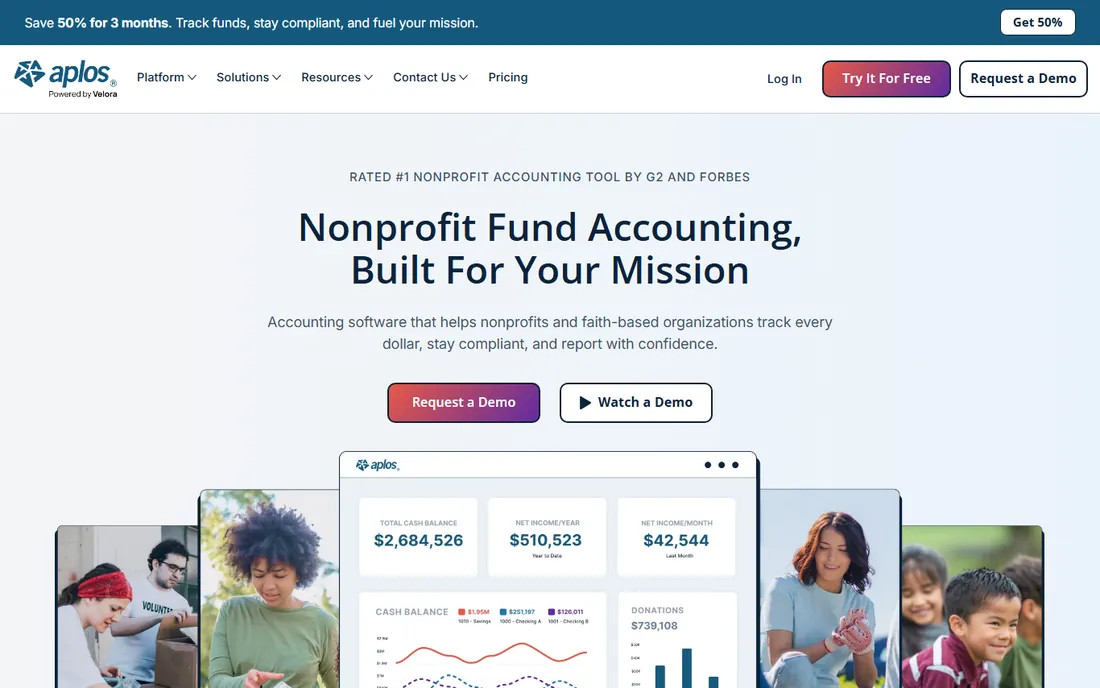
Aplos was built for nonprofits first, and that shows in the details general tools miss. Every plan includes fund accounting, so restricted and unrestricted dollars stay separated from day one, with financial statements you can filter by fund. The Lite plan at $79 per month covers 2 users, bank reconciliation, custom reports, a board portal and 1099 management. Churches get text-to-give, contribution statements and donor records in the same system, which is why so many small congregations run on it.
The honest catch is the tier structure. If you need budgeting, accounts payable or third-party integrations, you need Core at $129 per month. Budgeting by fund or grant, dimensional reporting and fixed assets only appear on Advanced at $229 per month, which is a big step for a small organization. Reviewers also note that add-on modules and per-user costs can push the real bill above the sticker price. Still, for a nonprofit under a few million in annual revenue, this is the most fund-accounting-for-your-money on the list.
What we like- Fund-based balance sheets and income statements from the entry plan
- Donation tracking, contribution statements and online giving forms built in
- 15-day free trial with no credit card required
Watch out for- Partner integrations need the $129/month Core plan or higher
- Advanced plan at $229/month is a steep jump for budgeting by fund
- CRM and pledge features feel basic next to dedicated donor systems
#2
Sage Intacct
Best for: Mid-sized and large nonprofits with multiple grants, funds, programs, locations or entities
Visit sage.com
Starting priceSee website (custom quote only)
Free planNo
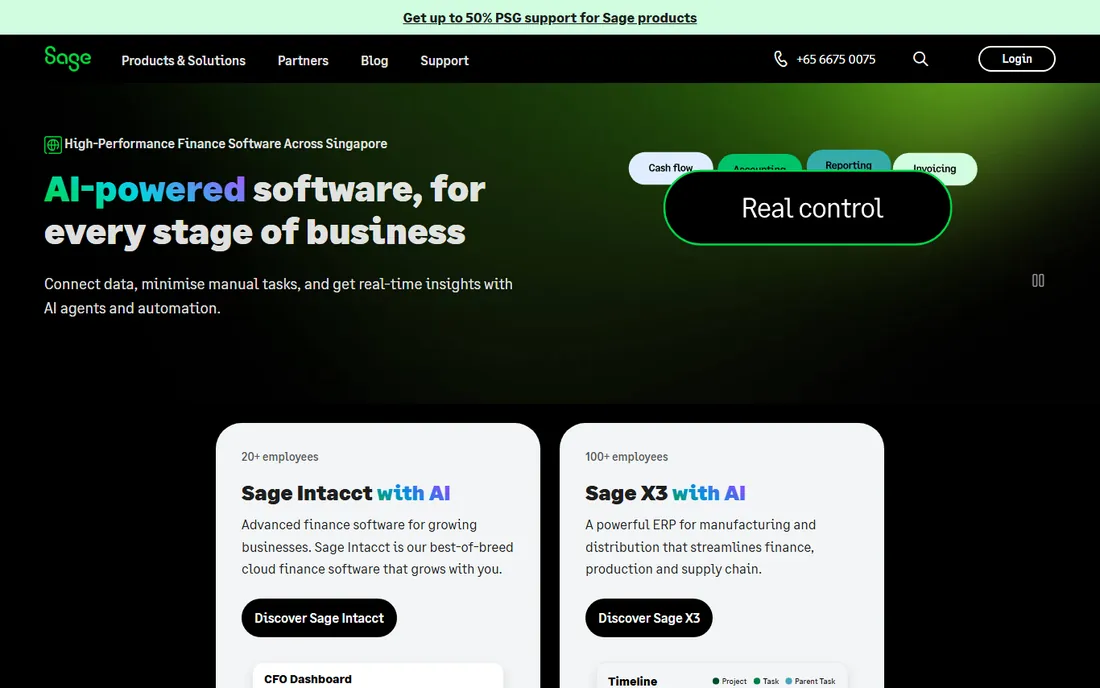
Sage Intacct is the system nonprofits graduate to when QuickBooks starts breaking under the weight of grants and entities. Its signature feature is dimensional accounting: you tag transactions with dimensions like fund, program, location and grant instead of creating thousands of chart-of-accounts entries, then slice reports any way the board asks. Grant tracking and billing, revenue recognition, multi-entity consolidation and audit trails are native, and the nonprofit edition ships with FASB-friendly reporting templates.
The commercial reality is enterprise-grade. Pricing is custom-quoted based on modules, users and implementation scope, and the first-year total including implementation is a serious budget line. Deployment takes weeks to months, not an afternoon. But for organizations managing restricted funding across programs or consolidating multiple entities, the time saved on reporting and audit prep is the whole point. This is the pick when spreadsheets and workarounds have become a full-time job.
What we like- Dimensional general ledger reports across funds, grants, programs and entities without bloating the chart of accounts
- Native grant tracking and billing, revenue recognition and multi-entity consolidation
- Real-time dashboards built for nonprofit finance teams
Watch out for- No published pricing, so budgeting requires a sales conversation
- Implementation is a real project with modules, integrations and training to scope
- Overkill and overpriced for small organizations
#3
QuickBooks Online
Best for: Small nonprofits that want the most widely used and accountant-supported ledger
Visit quickbooks.intuit.com
Starting price$38/month (Simple Start)
Free planFree trial (30 days)
QuickBooks Online earns its spot through ubiquity, not purity. More accountants know it than any other option here, and integrations with donation platforms like DonorPerfect and Fundly keep gift data flowing in. Set the company type to nonprofit and you get the right chart of accounts, statement of financial position and statement of activities reports. For simple organizations with one or two funding sources, that is genuinely enough.
Know what you are buying, though. QuickBooks tracks funds through workarounds, and auditors will ask harder questions as grant complexity grows. The 2026 pricing reset matters too: Simple Start holds at $38 per month, but Essentials is now $85, Plus is $140 and Advanced is $340 per month, and nonprofits realistically need Plus for budgeting and donor management. If you outgrow it, Aplos, Fund EZ and Sage Intacct all market themselves as the next step for a reason.
What we like- The largest ecosystem of nonprofit-savvy accountants and app integrations
- Nonprofit chart of accounts, donor tracking and grant-friendly reports available on Plus and Advanced
- Bank feeds, invoicing and payroll all in one familiar product
Watch out for- Not true fund accounting, so restricted funds are tracked with classes, locations and sub-accounts
- Budgeting is gated to Plus ($140/month) and Advanced ($340/month)
- Essentials is $85/month after Intuit's 2026 price increase
#4
Blackbaud Financial Edge NXT
Best for: Nonprofits already fundraising on Blackbaud products like Raiser's Edge NXT
Visit blackbaud.com
Starting priceSee website (custom quote only)
Free planNo
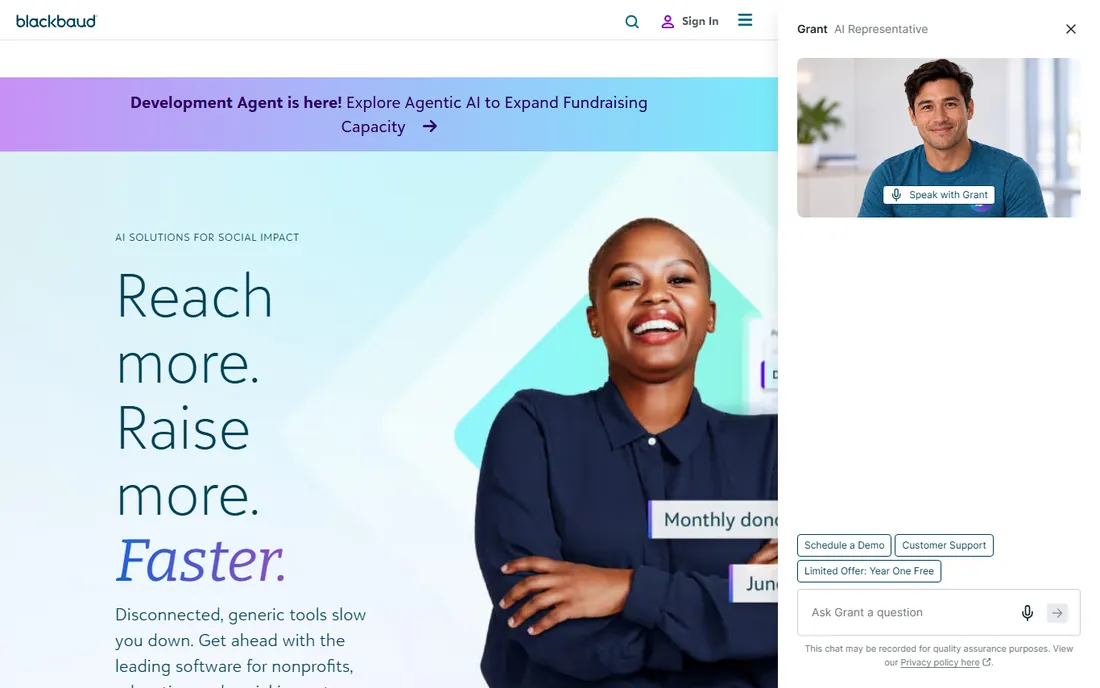
Blackbaud Financial Edge NXT is the finance half of the Blackbaud universe. Where it shines is the connection between fundraising and accounting: donations recorded in Raiser's Edge NXT flow into fund accounting without re-entry, grants are tracked against budgets, and the Chart Organizer lets you reshape the chart of accounts for different audiences without rebuilding it. For universities, large charities and foundations already committed to Blackbaud, this is the coherent choice.
The price of coherence is lock-in. Everything is custom-quoted, and reviewers consistently describe it as an enterprise purchase with enterprise implementation timelines. The interface and workflow assume a finance team, not a part-time bookkeeper. If your fundraising lives outside Blackbaud, Sage Intacct usually wins the head-to-head. If it lives inside Blackbaud, Financial Edge NXT is the path of least resistance.
What we like- True fund accounting with encumbrance tracking, grant management and FASB-ready statements
- Tight integration with Raiser's Edge NXT, so gifts flow from fundraising to the ledger
- Purpose-built for nonprofit and education finance teams
Watch out for- Custom pricing with enterprise-level total cost
- Implementation and training are significant undertakings
- Weakest value if you do not use other Blackbaud products
#5
Xero
Best for: Small nonprofits that want clean double-entry books with unlimited users
Visit xero.com
Starting price$25/month (Early plan)
Free planFree trial (30 days)
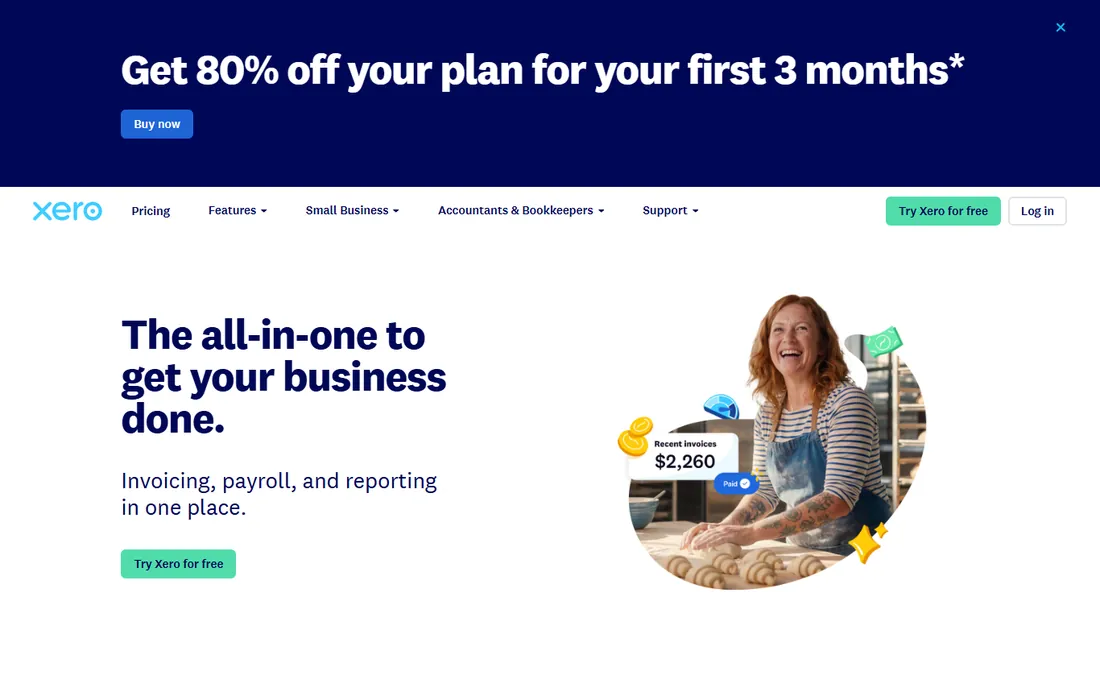
Xero is the general ledger that behaves itself. The reconciliation workflow is fast, the interface stays out of the way, and unlimited users on every plan means the treasurer, the bookkeeper and the executive director can all have access without seat fees. For a small nonprofit with straightforward finances and one primary funding stream, Xero plus a donation app gets the job done at $25 per month on Early or $55 on Growing.
The limits are structural. There is no fund dimension, no grant tracking and no nonprofit-specific reporting: you use tracking categories for programs and export to spreadsheets for the rest. Payroll in the US goes through Gusto at $49 per month plus $6 per person, and the Early plan's invoice and bill caps push most organizations to Growing. Choose Xero for simplicity and user-friendliness, not for nonprofit depth.
What we like- Unlimited users on every plan, so board treasurers and bookkeepers cost nothing extra
- Bank reconciliation is widely considered the best in small-business accounting
- 1,000-plus app integrations including donation and fundraising tools
Watch out for- No fund accounting features at all, so restricted funds need tracking categories and manual discipline
- US payroll runs through a Gusto partnership at extra cost
- Early plan caps you at 20 invoices and 5 bills per month
#6
Fund EZ
Best for: Growing nonprofits that have outgrown QuickBooks and want purpose-built fund accounting
Visit fundez.com
Starting priceSee website (custom quote)
Free planNo (free demo offered)
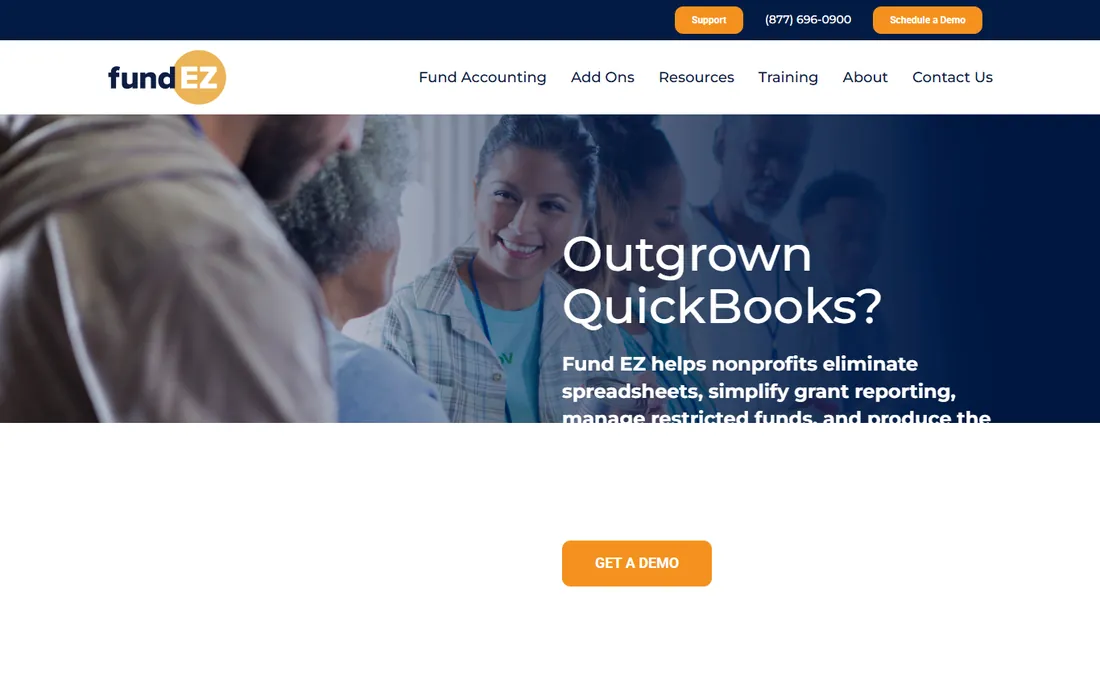
Fund EZ is the veteran specialist that many nonprofits discover after QuickBooks stops being enough. It handles restricted versus unrestricted funds, direct and indirect cost allocations, grant tracking and board-ready financial statements as core functions, not add-ons. Specialty modules cover fundraising, fixed assets, HIPAA-compliant Medicaid billing and foster care billing, which makes it a fit for human-service nonprofits with unusual accounting needs. Support is unlimited and toll-free, and reviewers consistently praise the help they get setting up their chart of accounts.
The trade-off is modernity. The product looks and feels like its era, the website publishes no prices, and the integration ecosystem is small. Third-party directories list pricing starting around $140 per month for the cloud version, but treat that as a rumor until you get a quote. If your organization is growing past basic bookkeeping and wants fund accounting without enterprise cost, Fund EZ deserves a demo alongside Aplos.
What we like- Purpose-built for nonprofits for over three decades, with fund, grant and allocation reporting native to the system
- Modules for fundraising, fixed assets, Medicaid billing and foster care
- Unlimited toll-free support included
Watch out for- No published pricing, so every purchase starts with a sales call
- The interface looks dated next to cloud-native competitors
- Integrations are thinner than the big platforms
#7
FreshBooks
Best for: Very small nonprofits with simple income, expenses and invoicing
Visit freshbooks.com
Starting price$23/month (Lite plan)
Free planFree trial (30 days)
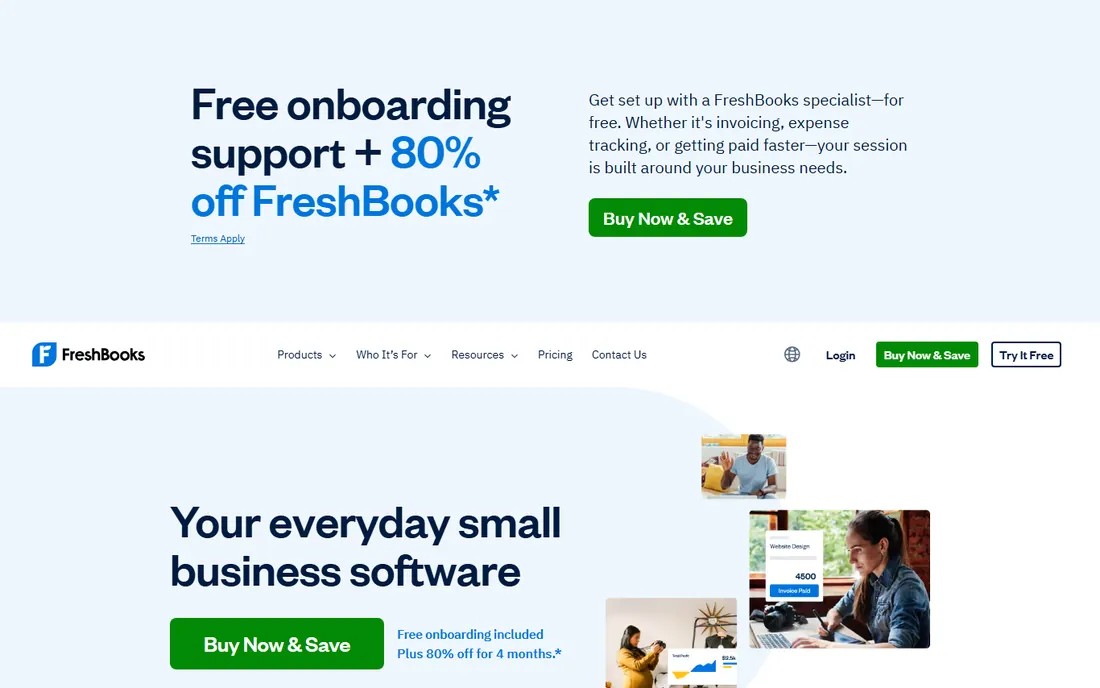
FreshBooks fits the smallest nonprofits: the ones whose accounting is really invoicing, expense tracking and a year-end report for the accountant. The interface is genuinely friendly, automated bank import keeps the books current, and the Lite plan at $23 per month covers 5 billable clients. Time tracking on every plan helps organizations that need to log hours against grants or programs.
Do not mistake it for fund accounting software. There is no restricted-fund tracking, no grant reporting and no nonprofit chart of accounts. The client-based pricing model also fits badly once you add staff, since each team member is $11 per month. FreshBooks is a good answer for a tiny nonprofit with simple finances and a part-time bookkeeper; anything with grants or restricted funds should look at Aplos or Wave instead.
What we like- The easiest invoicing and expense tracking of the general tools here
- Double-entry accounting reports, bank reconciliation and accountant access on Plus ($43/month)
- Time tracking built in for grant-funded staff hours
Watch out for- No fund accounting or grant management features
- Lite caps you at 5 billable clients
- Adding team members costs $11 per person per month on every plan
#8
Oracle NetSuite Social Impact
Best for: Nonprofits that qualify for donated enterprise ERP through the Social Impact program
Visit netsuite.com
Starting priceSee website (custom quote; base donation available at no cost for eligible organizations)
Free planSoftware donation program (free base donation for eligible nonprofits)
NetSuite through the Social Impact program is the best-kept secret in nonprofit accounting. Eligible nonprofits and social enterprises receive a standard donation of NetSuite at no license cost or at a steep discount scaled to prior-year revenue, plus access to Suite Pro Bono implementation assistance. What you get is a genuine enterprise ERP: fund accounting with FASB-compliant reporting, grant lifecycle management, multi-entity consolidation, donor and volunteer records and inventory, all in one system.
The catch is that free software is not free implementation. Even with donated licenses and volunteer help, getting NetSuite live takes months of staff time, and the system assumes professional finance operations. Additional users and modules are discounted but not free. For a growing nonprofit with a finance team and multi-entity or multi-program complexity, though, this can put a $50,000-plus system within reach at a fraction of the cost. Apply through the Social Impact page and confirm eligibility before budgeting anything.
What we like- Full cloud ERP with fund accounting, grant management, multi-entity consolidation and 250-plus FASB-compliant reports
- Eligible nonprofits receive the base software donation at 100 percent discount
- Suite Pro Bono pairs you with NetSuite staff for implementation help
Watch out for- Standard NetSuite pricing is enterprise-level if you do not qualify for the donation
- Implementation is a major project even with pro bono help
- The system is more complex than any small nonprofit needs
#9
Wave
Best for: Tiny nonprofits and all-volunteer organizations that need real books for zero dollars
Visit waveapps.com
Starting price$0 (Starter plan); Pro at $19/month
Free planYes (Starter plan is free)
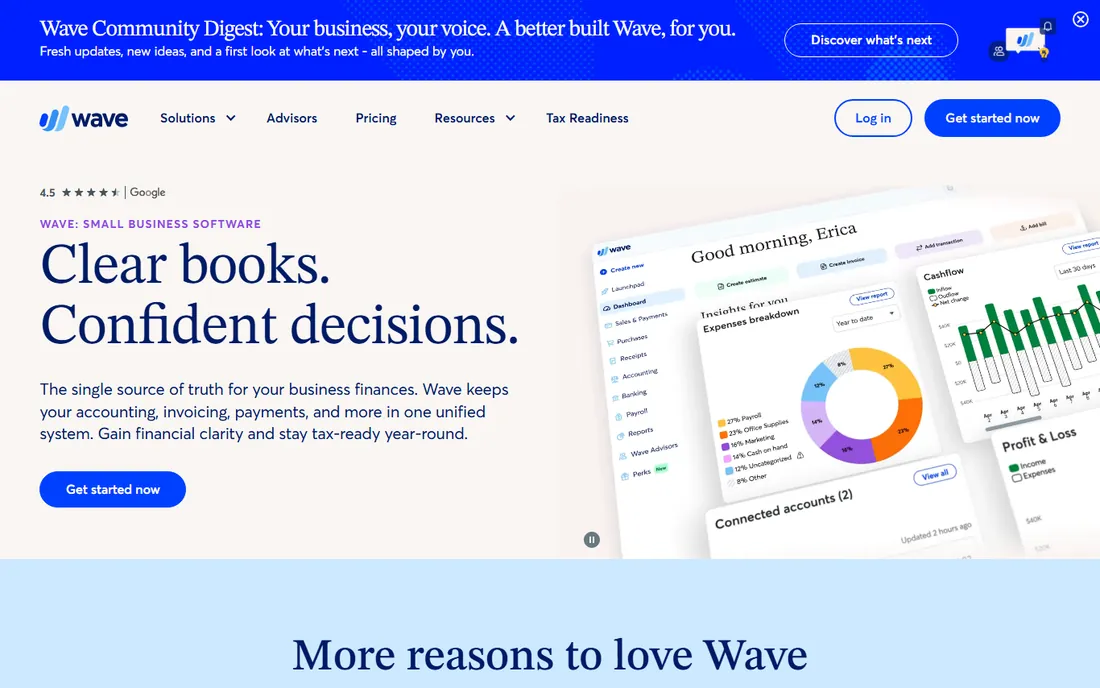
Wave is the answer to "we have no budget and a volunteer treasurer." The Starter plan is genuinely free: unlimited invoices, estimates, bills, bookkeeping records and standard reports, with no user limits. Pro at $19 per month (confirmed on Wave's own pricing page) adds automatic bank transaction imports, receipt capture and multi-user access, which is where the product starts saving real time.
Set expectations correctly. Wave knows nothing about funds, grants or donor restrictions; it is a small-business ledger that nonprofits use because it is free. If you accept donations online, card processing costs 2.9 percent plus $0.60 per transaction. But for a brand-new nonprofit or a small community group that needs clean books and is years away from complex grants, Wave is the rational starting point. Migrate to Aplos or Fund EZ when restricted funding arrives.
What we like- Free double-entry accounting, invoicing, bills and financial reports on the Starter plan
- Pro at $19 per month adds automatic bank imports, receipt capture and unlimited users
- Simplest setup of any tool on this list
Watch out for- No fund accounting, grant tracking or nonprofit-specific features whatsoever
- Payment processing fees apply when you accept online donations
- Payroll is a separate paid add-on
How we chose
We started with the searches nonprofit buyers actually run: nonprofit accounting software, fund accounting software and accounting software for churches. For each candidate we checked the vendor's own pricing page, read nonprofit-sector reviews and practitioner discussion on G2, Capterra and Reddit, and compared fund accounting depth, grant handling, reporting and organization-size fit. Where a vendor publishes no prices, we wrote "See website" instead of repeating third-party guesses. We excluded general tools with no nonprofit footprint and products that no longer exist.
What to check before you buy
Fund accounting is the line that divides this list. Ask every vendor one question: can you produce a statement of financial position by fund, with restricted and unrestricted dollars separated, without exporting to a spreadsheet? Aplos, Sage Intacct, Blackbaud Financial Edge NXT, Fund EZ and NetSuite answer yes natively. QuickBooks, Xero, FreshBooks and Wave answer with workarounds.
Then check the grant workflow. If you manage grants, you need budget-versus-actual reporting by grant, deadline tracking and indirect cost allocations. That is native in the fund accounting systems and manual everywhere else. Also confirm the Form 990 story: Aplos e-files the 990-N and 990-EZ, and the bigger systems produce the statements your preparer needs, but none of these tools replaces a CPA at filing time.
Finally, count the real users and the real price. Per-user fees, payroll add-ons and implementation costs routinely double the sticker price. Get the full first-year total in writing, including onboarding, before you compare quotes.
Fund accounting vs. regular accounting: why the distinction matters
Regular accounting answers "did we make or lose money." Fund accounting answers "whose money is it, what can we spend it on, and did we spend it that way." Donors, grantors and auditors care about the second question, and US generally accepted accounting principles require nonprofits to report net assets with and without donor restrictions.
That is why a generic ledger with good intentions can still fail an audit. Classes and tracking categories approximate funds, but they do not enforce restrictions or produce FASB-style statements on their own. If your revenue is mostly unrestricted donations and program fees, a general tool with discipline is fine. The moment restricted grants arrive, the cost of workarounds exceeds the cost of a fund accounting system. Buy for the funding you will have in two years, not the funding you have today.
Frequently asked questions
What is the best accounting software for a small nonprofit?
Aplos at $79 per month is the strongest fit for most small nonprofits because fund accounting, donation tracking and nonprofit reports are built in from the entry plan. If your finances are simple and you want the cheapest start, Wave is free. If you want maximum accountant support, QuickBooks Online at $38 per month is the safe mainstream pick.
Is QuickBooks good for nonprofit accounting?
It is adequate for small nonprofits with simple finances. QuickBooks Online offers a nonprofit chart of accounts, donor tracking and grant-friendly reporting on Plus and Advanced, and almost every accountant knows it. It is not true fund accounting, so organizations with multiple restricted grants usually outgrow it and move to Aplos, Fund EZ or Sage Intacct.
What is fund accounting?
Fund accounting is an accounting method that tracks money by its purpose and restrictions rather than just by income and expense. It separates net assets with donor restrictions from those without, tracks each grant and program separately, and produces the statements auditors and grantors require. Aplos, Sage Intacct, Blackbaud Financial Edge NXT, Fund EZ and NetSuite do it natively.
How much does nonprofit accounting software cost?
Entry pricing runs from $0 (Wave Starter) to $79 per month (Aplos Lite), with general tools like Xero at $25 and FreshBooks at $23 per month. Mid-market fund accounting starts around $129 per month (Aplos Core) and rises into custom quotes for Sage Intacct, Blackbaud and NetSuite. Eligible nonprofits can get NetSuite donated at no license cost.
Can nonprofits get accounting software for free?
Yes, in three ways. Wave's Starter plan is free with real double-entry accounting. Oracle NetSuite donates base licenses to eligible nonprofits through its Social Impact program. TechSoup and similar programs also offer donated or discounted software to qualifying organizations. Free options lack fund accounting depth, so growing nonprofits usually pay for it eventually.
Do I need an accountant if I use nonprofit accounting software?
Yes, for year-end close, the Form 990 and audit prep. The software keeps your books organized and produces the reports, but nonprofit tax compliance and audit requirements still need a CPA who knows the sector. Budget for professional help separately from the software subscription.
Sources we checked (13)
- https://aplos.com/pricing
- https://aplos.com/
- https://www.sage.com/en-us/solutions/nonprofit/
- https://www.blackbaud.com/products/blackbaud-financial-edge-nxt
- https://quickbooks.intuit.com/pricing
- https://quickbooks.intuit.com/industry/non-profits/
- https://www.xero.com/us/pricing-plans/
- https://fundez.com/
- https://www.freshbooks.com/pricing
- https://www.netsuite.com/socialimpact
- https://www.waveapps.com/pricing
- https://www.g2.com/categories/nonprofit-accounting
- https://www.capterra.com/nonprofit-accounting-software/
Is your product missing or out of date?
We review this list regularly. Vendors can request a listing, send updated pricing or ask about featured placement.

Shihab Mia · Founder, Rankite
Shihab has spent more than a decade helping SaaS and e-commerce brands grow through search. He writes Rankite's software buying guides from pricing pages, documentation and public user reviews. More about Shihab.