How we make this list: we compare pricing pages, product documentation and public user reviews. Rankite is independent; if a vendor ever pays for a featured spot, that listing is clearly labeled Partner.
Key takeaways
- Most HR software now bundles payroll, benefits, and hiring: Gusto and BambooHR lead for small teams, while Rippling and Deel go deeper on automation and global teams.
- Published prices are rare in this category; BambooHR, Namely, and Paychex all price by employee count and quote, so budget a discovery call before you budget the line item.
- If your team is outside the US, Deel is the standout for global payroll and compliance in 150-plus countries.
- Per-technician style simplicity does not exist here; instead, watch per-employee pricing, because a quote that looks cheap for 10 people can sting at 60.
Quick comparison
| Tool | Best for | Starting price | Free plan |
|---|
 BambooHR BambooHR | Growing teams that need strong people data and clean reporting | See website | No |
 Gusto Gusto | Small businesses that want payroll, benefits, and HR basics handled | See website | Free to sign up |
 Rippling Rippling | Companies that want HR, IT, and finance unified in one platform | See website | No |
 Namely Namely | Mid-size companies that want an HCM platform with human help attached | See website | No |
 Deel Deel | Teams hiring employees and contractors across borders | See website | No |
 HiBob HiBob | Modern, distributed companies focused on culture and engagement | See website | No |
 Paychex Paychex | Businesses that want an established payroll and HR partner with deep compliance expertise | See website | No |
Is your product missing or out of date?
We review this list regularly. Vendors can request a listing, send updated pricing or ask about featured placement.
The HR software purchase that starts with a spreadsheet and ends with a demo
Your HR manager walks into the meeting with a spreadsheet of 40 vendors, 60 feature columns, and no idea where to start. Two months later you are on demo number nine, each vendor swears they do everything, and the spreadsheet has gained 20 more columns. This list cuts through that. These seven platforms are the ones small and mid-size US businesses actually buy in 2026, each with a clear lane: payroll-first, people-first, automation-first, or global-first. Find your lane first, and the shortlist writes itself.
#1
BambooHR
Best for: Growing teams that need strong people data and clean reporting
Visit bamboohr.com
Starting priceSee website
Free planNo
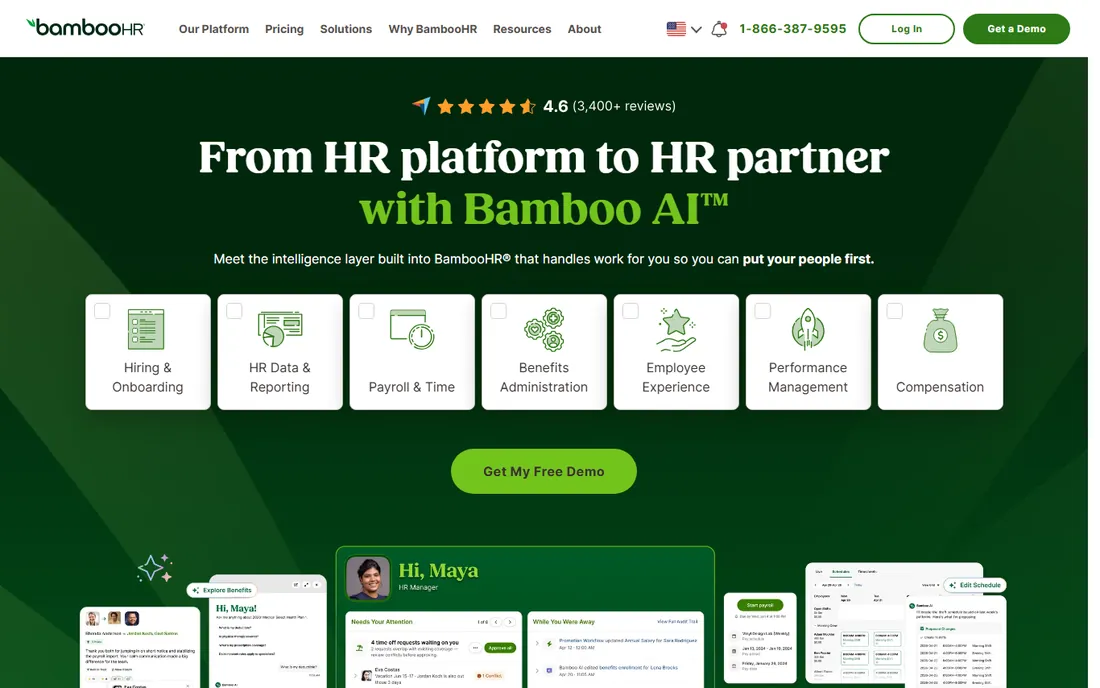
For companies between roughly 25 and 500 employees, BambooHR is the people-first default. Employee records, hiring, onboarding, time off, and performance reviews live in one system with a consistent interface that employees do not hate using. The reporting library is the real selling point: HR teams can answer headcount, turnover, and compensation questions without exporting to a spreadsheet.
Pricing is the friction. BambooHR quotes based on headcount and selected features, so two companies can pay very different amounts for the same logo. Payroll and benefits are add-ons rather than native inclusions, which pushes the total higher than the headline quote. If your priority is people management and clean data with payroll attached, it is worth the call. If payroll is the core need, start with Gusto or Rippling instead.
What we like- Well-designed core HR, applicant tracking, and performance tools in one place
- Reporting that non-technical managers can actually use
- Payroll, time tracking, and benefits add-ons without leaving the platform
Watch out for- Pricing varies by employee count and is quote-based
- Advanced payroll features require add-ons that raise the total
#2
Gusto
Best for: Small businesses that want payroll, benefits, and HR basics handled
Visit gusto.com
Starting priceSee website
Free planFree to sign up
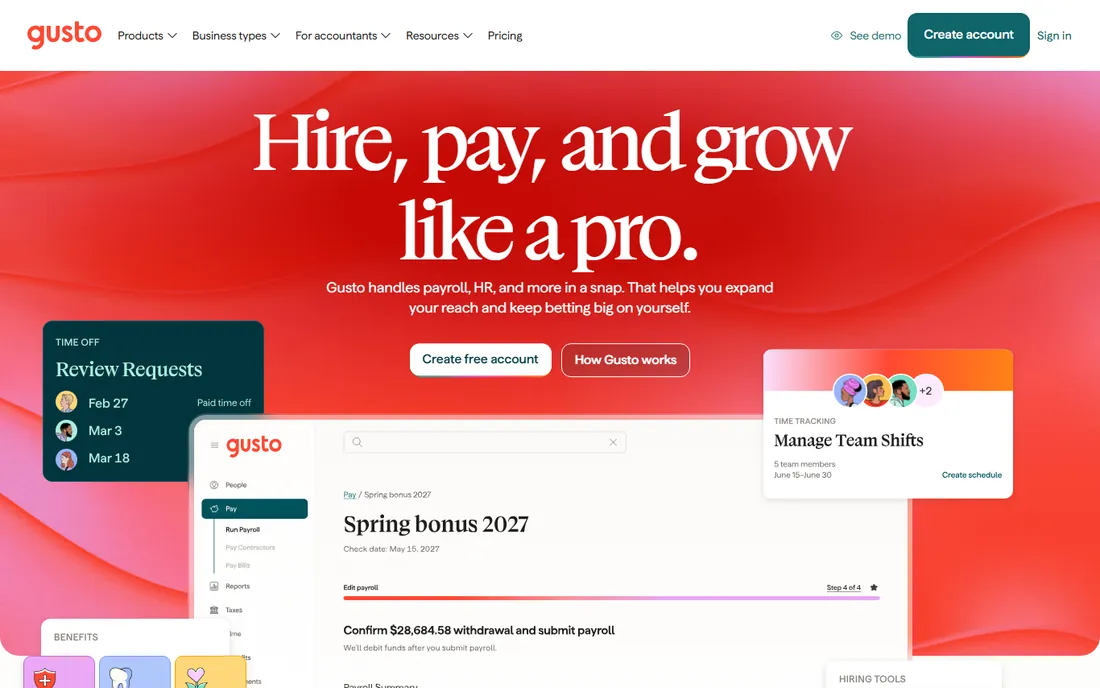
Gusto remains the easiest way for a small US business to stop doing payroll by hand. You create a free account, add your team, and run your first payroll in minutes; taxes file automatically and benefits like health and 401k plug into the same flow. The interface is built for owners, not HR professionals, which is why it has become the default for businesses under 100 people.
The limits show up at scale. Per-employee pricing means costs rise steadily as you hire, and companies with international workers will outgrow Gusto's global coverage. Onboarding, compliance help, and time tracking are solid, but they are designed for straightforward US teams. For a typical small business with W-2 employees and no global ambitions, nothing here is easier.
What we like- Fast payroll runs with automatic tax filing
- Benefits, onboarding, and time tracking in one flow
- Free account signup with no charge until payroll runs
Watch out for- Pricing scales per employee and can add up
- International capabilities are limited compared with Deel or Rippling
#3
Rippling
Best for: Companies that want HR, IT, and finance unified in one platform
Visit rippling.com
Starting priceSee website
Free planNo
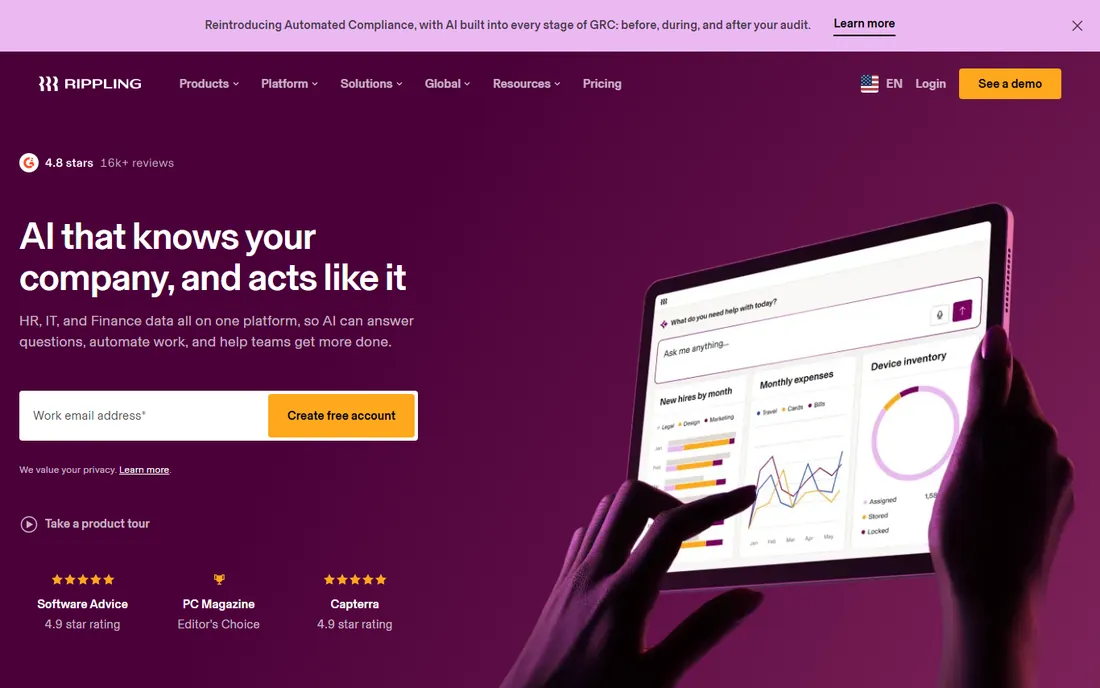
Rippling's pitch is that employee data should flow everywhere automatically. Onboard someone once and Rippling creates their payroll record, provisions their laptop and apps, issues a corporate card, and enrolls them in benefits, all from one workflow. For IT-lean companies, collapsing HR, IT, and finance tooling into one platform removes real administrative overhead.
That unification is also the risk. You pay per module, so the price climbs as you activate more of the platform, and smaller teams may pay for IT and finance functionality they barely use. Implementation takes longer than a payroll-first tool. Rippling fits best when you are growing fast enough that manual HR and IT processes are visibly breaking, typically past 50 employees with momentum toward several hundred.
What we like- One system for HR, payroll, IT device management, and spend
- Deep automation across onboarding and offboarding
- Strong reporting with workforce and business data joined
Watch out for- Quote-only pricing with modules that add up
- Breadth can be more than a small team needs
#4
Namely
Best for: Mid-size companies that want an HCM platform with human help attached
Visit namely.com
Starting priceSee website
Free planNo
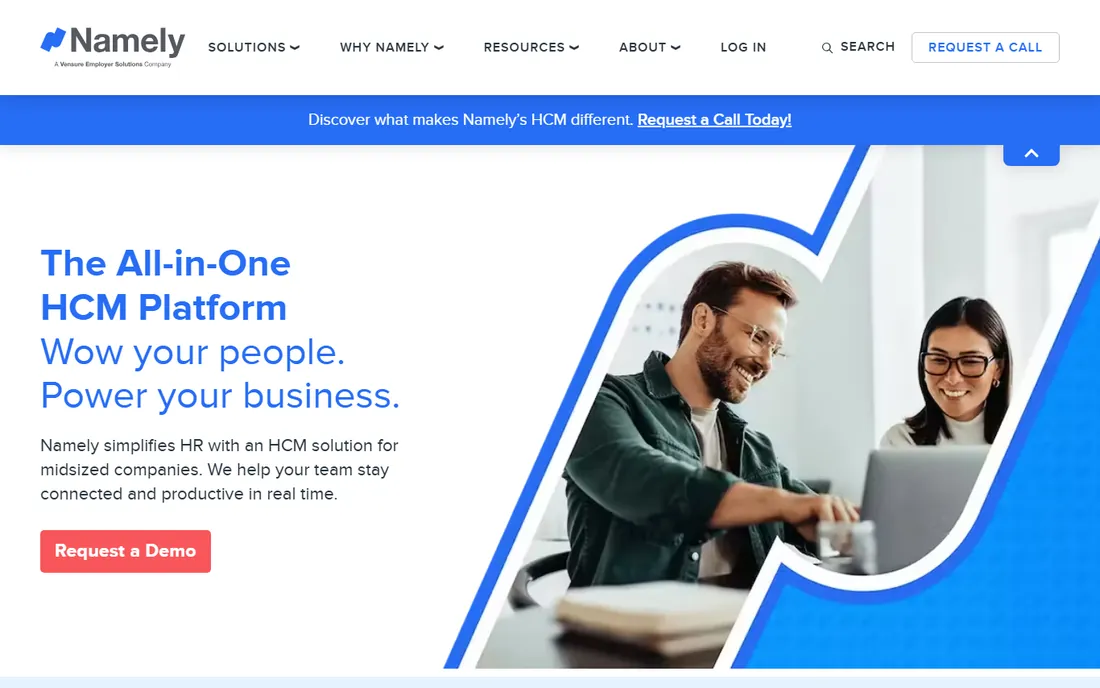
Namely occupies the middle of the market with a full human capital management platform plus something most competitors lack: managed services. You can buy the software alone or layer on managed payroll, managed benefits, and a dedicated HR business partner, which appeals to companies that have outgrown DIY HR but are not ready for an in-house HR department.
The platform covers the standard suite well: payroll, time tracking, benefits enrollment, onboarding, performance, and reporting. Compliance tools for multi-state operations are a particular strength, which matters for companies hiring across the US. It is not the cheapest path and not the flashiest interface, but for a mid-size company that wants one accountable partner for HR operations, Namely is built for exactly that.
What we like- Full HCM suite covering payroll, benefits, time, and talent
- Managed payroll and managed HR services available
- Scalable for companies from dozens to hundreds of employees
Watch out for- Quote-based pricing only
- Smaller businesses may find it heavier than needed
#5
Deel
Best for: Teams hiring employees and contractors across borders
Visit deel.com
Starting priceSee website
Free planNo
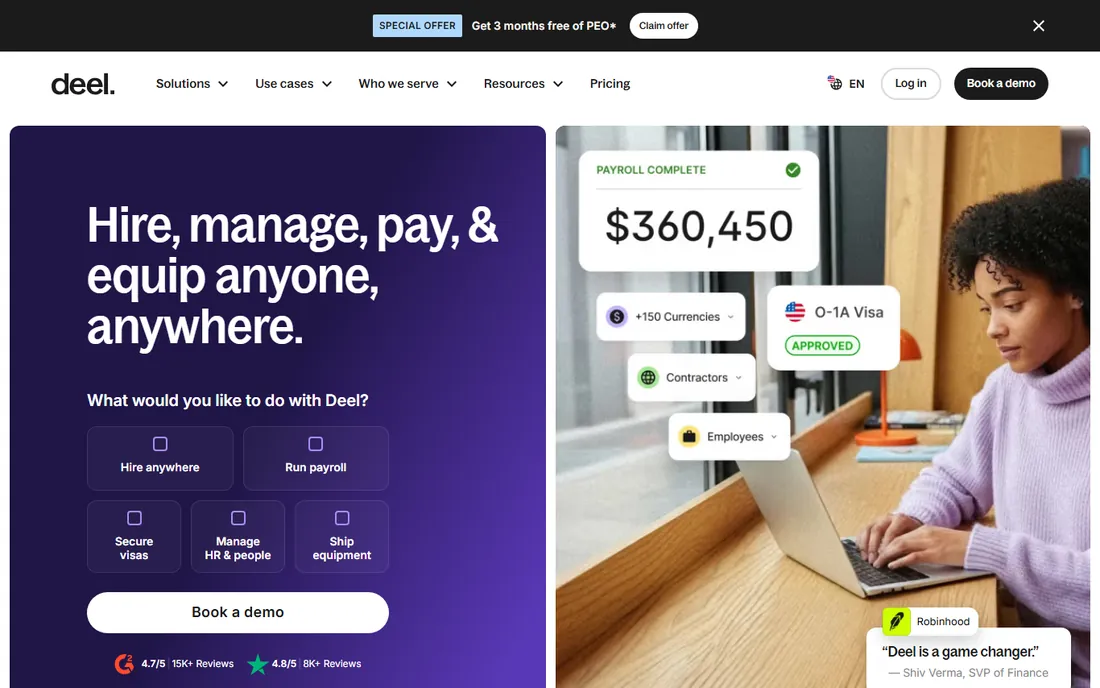
Deel solves the hardest HR problem most software avoids: employing people legally in countries where you have no entity. Its employer-of-record service handles contracts, payroll, taxes, and compliance across 150-plus countries, and the platform also manages international contractors, equipment, and equity. For remote-first companies, it replaces a patchwork of local providers.
If everyone you employ is in the US, Deel is overkill and you will pay global rates for local needs. But the moment you hire your first engineer in another country, the alternatives get complicated fast. Deel's pricing depends on whether workers are employees or contractors and in which countries, so expect a custom quote. For distributed teams, it is the category leader for a reason.
What we like- Global payroll and compliance across 150-plus countries
- Employer-of-record services remove the need for foreign entities
- One dashboard for contractors and full-time staff worldwide
Watch out for- Pricing varies by worker type and country
- Domestic-only US teams pay for global infrastructure they do not need
#6
HiBob
Best for: Modern, distributed companies focused on culture and engagement
Visit hibob.com
Starting priceSee website
Free planNo
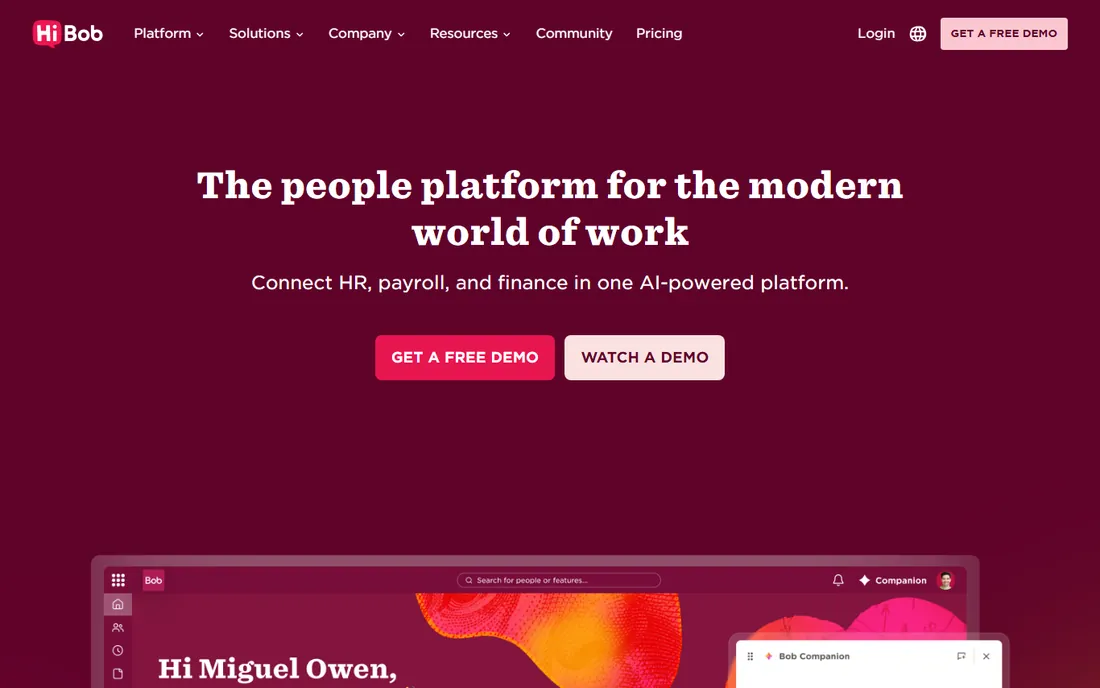
HiBob, sold as Bob, is the HR platform for companies that treat culture as a feature. Onboarding flows, performance reviews, surveys, and recognition tools are designed to be engaging rather than bureaucratic, and the interface reflects that. Underneath, it handles core HR, time and attendance, and people analytics competently across multiple countries.
The gap to know about is payroll. In the US, HiBob connects to payroll providers rather than running it natively, so companies that want one vendor for everything may prefer Gusto or Rippling. What you get instead is one of the best people-experience platforms in the mid-market. If your HR strategy centers on engagement, retention, and a distributed workforce, HiBob deserves the shortlist.
What we like- Strong engagement, performance, and culture tools that employees actually open
- Solid core HR and time tracking
- Built for multi-country teams with localized workflows
Watch out for- Quote-only pricing
- Payroll runs through integrations rather than natively in the US
#7
Paychex
Best for: Businesses that want an established payroll and HR partner with deep compliance expertise
Visit paychex.com
Starting priceSee website
Free planNo
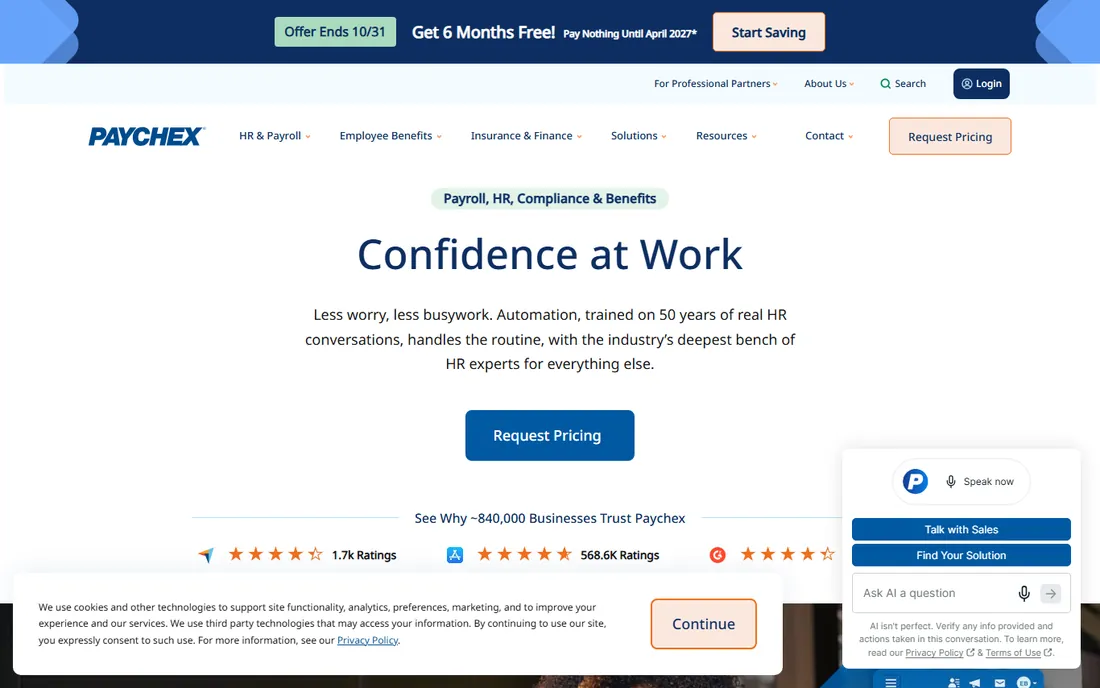
Paychex is the incumbent that newer tools are measured against. With roughly 840,000 business clients and over 50 years in payroll, it offers the full stack: payroll processing, tax administration, benefits, HR consulting, and its Paychex Flex cloud platform. For businesses in heavily regulated industries or complex multi-state setups, that depth of compliance experience matters.
The trade is modernity and price transparency. Paychex quotes custom pricing based on headcount and services, and the experience feels more like a traditional service relationship than a self-serve SaaS product. Younger teams may find the interface dated next to Gusto or Rippling. But when the priority is never missing a tax filing and having an expert to call, Paychex has earned its staying power.
What we like- Decades of payroll experience serving around 840,000 businesses
- HR advisory services plus technology in one relationship
- Strong tax and compliance handling across all 50 states
Watch out for- Custom quotes only with pricing that varies widely
- The platform can feel less modern than newer competitors
What to check before you buy
Do not start with feature lists. Start with headcount and trajectory, because nearly every HR platform prices per employee and the economics change dramatically between 15 and 150 people. A platform that is affordable for your team today can become your largest software line item in two years. Ask every vendor for pricing at your current headcount and at double that number.
Separate payroll from everything else
Payroll is the one function that cannot fail. If a platform's payroll is an add-on or a partner integration rather than a native core, dig into who actually files your taxes and what happens when something goes wrong. The cleanest setups run payroll natively in the same system as HR data.
Test the employee experience, not just the admin view
Admins buy HR software but employees use it. Ask for a demo of the employee self-service side: requesting time off, viewing pay stubs, updating benefits, completing onboarding tasks. If employees avoid the system, your HR team ends up doing the data entry the software was supposed to eliminate.
Clarify who handles compliance
Multi-state tax registration, benefits compliance, and labor law updates are where HR software earns its fee or fails you. Ask exactly which compliance obligations the vendor takes on versus which stay yours. Some vendors file everything; others give you the tools and leave the responsibility with you.
Get implementation in writing
Ask how long onboarding takes, what data migration includes, and whether you get a dedicated implementation manager or a help center link. HR transitions have hard deadlines tied to payroll cycles, and a vague onboarding plan is how companies end up running two systems for six months.
HR software pricing, explained
Almost nobody in this category publishes prices, and there is a reason: every quote depends on headcount, modules, and services. Expect per-employee-per-month pricing as the base, with payroll, benefits administration, and time tracking as either included tiers or paid add-ons. BambooHR, Namely, and Paychex will all ask about your employee count before naming a number. Gusto publishes plan tiers on its site but still prices per person. When comparing quotes, normalize to total annual cost at your headcount, including implementation fees and add-ons, because headline per-employee numbers hide the real total.
How we chose
We focused on platforms that small and mid-size US businesses actually shortlist in 2026: full HR suites with payroll, benefits, and hiring coverage rather than point tools. We reviewed each vendor's product pages, pricing disclosures, and documentation, then cross-checked against public reviews on G2, Capterra, and Reddit to see how the software performs after the sales demo ends. We favored platforms with transparent feature sets, real US payroll capability, and a clear fit for a specific company size or structure, and we left out enterprise-only suites and single-feature tools.
Frequently asked questions
What is the best HR software for a small business?
Gusto is the most common pick for small US businesses because it combines easy payroll, tax filing, benefits, and HR basics in one affordable flow. Teams that expect to pass 50 employees soon should also look at BambooHR for stronger people management or Rippling for deeper automation.
How much does HR software cost?
Most platforms charge per employee per month plus fees for add-ons like payroll or benefits administration. Small teams typically land between $40 and $100 per employee per year for core HR, with full payroll and benefits pushing costs higher. Nearly all vendors quote custom pricing, so get written quotes at your current and projected headcount.
Does HR software include payroll?
Some does and some does not. Gusto, Rippling, Namely, Paychex, and Deel include payroll as a core capability. BambooHR and HiBob handle payroll through add-ons or integrations with payroll providers. Always confirm whether tax filing is included, because payroll without filing is just a calculator.
What is the difference between HR software and a PEO?
HR software gives you the tools to run HR yourself. A PEO becomes a co-employer that takes on payroll taxes, benefits, and compliance liability directly. Some vendors here, like Deel with its employer-of-record service, blur the line for international workers.
Can HR software handle employees in multiple states?
Yes, and this is a key differentiator. Platforms like Gusto, Paychex, Rippling, and Namely handle multi-state tax registration and compliance as part of their payroll service. If you hire across state lines, confirm this explicitly rather than assuming it is included.
Sources we checked (7)
- https://www.bamboohr.com
- https://gusto.com
- https://www.rippling.com
- https://namely.com/
- https://www.deel.com
- https://hibob.com/
- https://paychex.com/
Is your product missing or out of date?
We review this list regularly. Vendors can request a listing, send updated pricing or ask about featured placement.

Shihab Mia · Founder, Rankite
Shihab has spent more than a decade helping SaaS and e-commerce brands grow through search. He writes Rankite's software buying guides from pricing pages, documentation and public user reviews. More about Shihab.