How we make this list: we compare pricing pages, product documentation and public user reviews. Rankite is independent; if a vendor ever pays for a featured spot, that listing is clearly labeled Partner.
Key takeaways
- Home health, hospice and non-medical personal care are different software categories: buy the platform built for your payer mix, not the one with the longest feature list.
- If you bill Medicaid, start with HHAeXchange: in payer-partner states the provider portal and EVV tools are free, and no other platform connects you to MCOs the same way.
- For Medicare-certified home health and hospice, the shortlist is Axxess, Homecare Homebase and KanTime: all three handle OASIS, PDGM billing and compliance, and all three are quote-priced.
- Non-medical agencies should look at WellSky Personal Care (formerly ClearCare) and AxisCare, which are built around private-duty scheduling, caregiver retention and family communication.
- Expect demos and custom quotes, not free trials: none of these platforms publish pricing, so budget the sales process into your timeline.
Quick comparison
| Tool | Best for | Starting price | Free plan |
|---|
 Axxess Axxess | Agencies running home health, hospice and personal care under one roof | See website (custom quote) | No (demo by appointment) |
 Homecare Homebase Homecare Homebase | Mid-size and large home health and hospice agencies | See website (custom quote) | No (demo by appointment) |
 HHAeXchange HHAeXchange | Medicaid home care providers who live and die by EVV compliance | See website (free provider portal in payer-partner states; paid plans otherwise) | Free provider portal in payer-partner states (no permanent free plan elsewhere) |
 WellSky Personal Care WellSky Personal Care | Private-duty and franchise non-medical home care agencies | See website (custom quote) | No (demo by appointment) |
 AlayaCare AlayaCare | Multi-service-line agencies that want AI doing the admin work | See website (custom quote) | No (demo by appointment) |
 AxisCare AxisCare | Non-medical and Medicaid agencies that want scheduling done right | See website (custom quote, per-client pricing) | No (demo by appointment) |
 KanTime KanTime | Enterprise home health and hospice agencies needing a certified EMR | See website (custom quote) | No (demo by appointment) |
Is your product missing or out of date?
We review this list regularly. Vendors can request a listing, send updated pricing or ask about featured placement.
The best home healthcare software
Here is the blunt version: home healthcare software is sold, not bought. Every vendor on this list prices by quote, demos by appointment and onboards by project plan. That makes comparison harder, but it also means the decision comes down to fit rather than feature checklists. A Medicaid personal-care agency and a Medicare-certified home health agency live in different regulatory worlds, and the platform that serves one will frustrate the other. These seven cover the real market, organized by who each one actually serves.
#1
Axxess
Best for: Agencies running home health, hospice and personal care under one roof
Visit axxess.com
Starting priceSee website (custom quote)
Free planNo (demo by appointment)
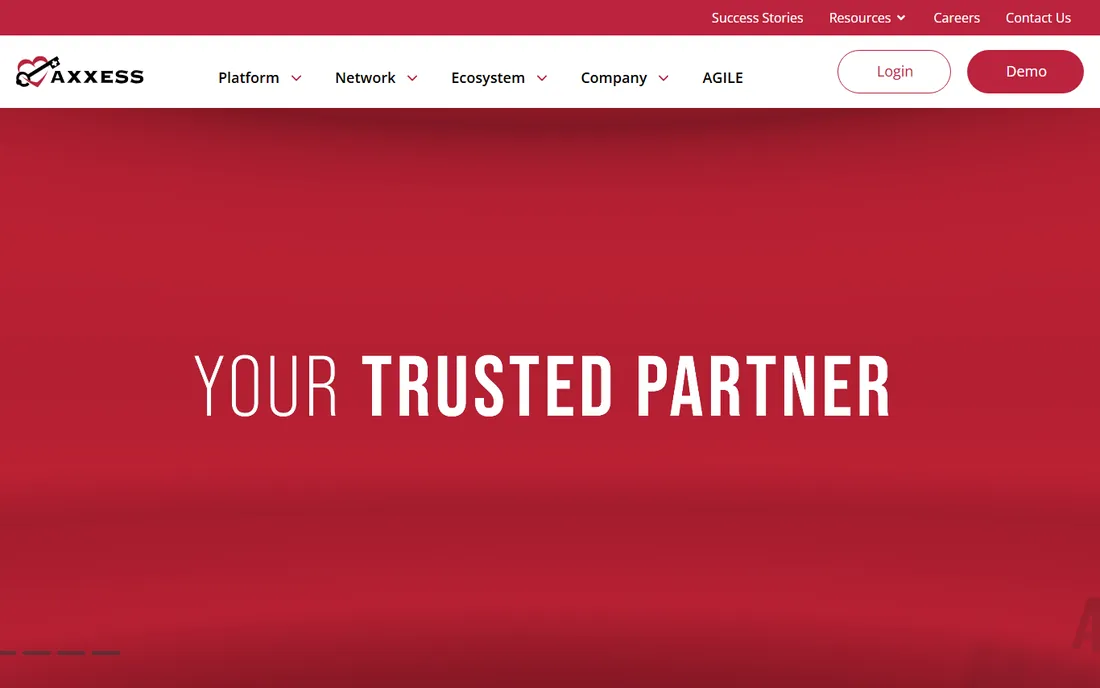
Axxess is the closest thing this market has to a full-suite vendor. The Dallas-based company serves more than 10,000 organizations across home health, home care, hospice and palliative care, and the pitch is a single ecosystem: documentation, scheduling, billing, payroll, EVV and compliance in one place instead of stitched-together point tools. The mobile app lets nurses update charts and check medication guides at the point of care, and the EVV uses GPS to verify visits for payer compliance.
The honest catch is that breadth has a cost in complexity. Smaller agencies consistently report a learning curve, and with no published pricing you cannot shortcut the quote process. Axxess also runs an education and staffing arm, which tells you who the ideal customer is: a growing agency that wants a technology partner, not just software. If you run multiple service lines, the unified platform is the reason to choose it.
What we like- One ecosystem covering home health, home care, hospice and palliative care with shared scheduling and billing
- GPS-based electronic visit verification built into the caregiver mobile app
- Revenue cycle tools with real-time automated claims processing
Watch out for- Quote-based pricing with no public numbers, so budgeting requires the sales process
- The breadth of the platform means a longer implementation for smaller agencies
#2
Homecare Homebase
Best for: Mid-size and large home health and hospice agencies
Visit hchb.com
Starting priceSee website (custom quote)
Free planNo (demo by appointment)
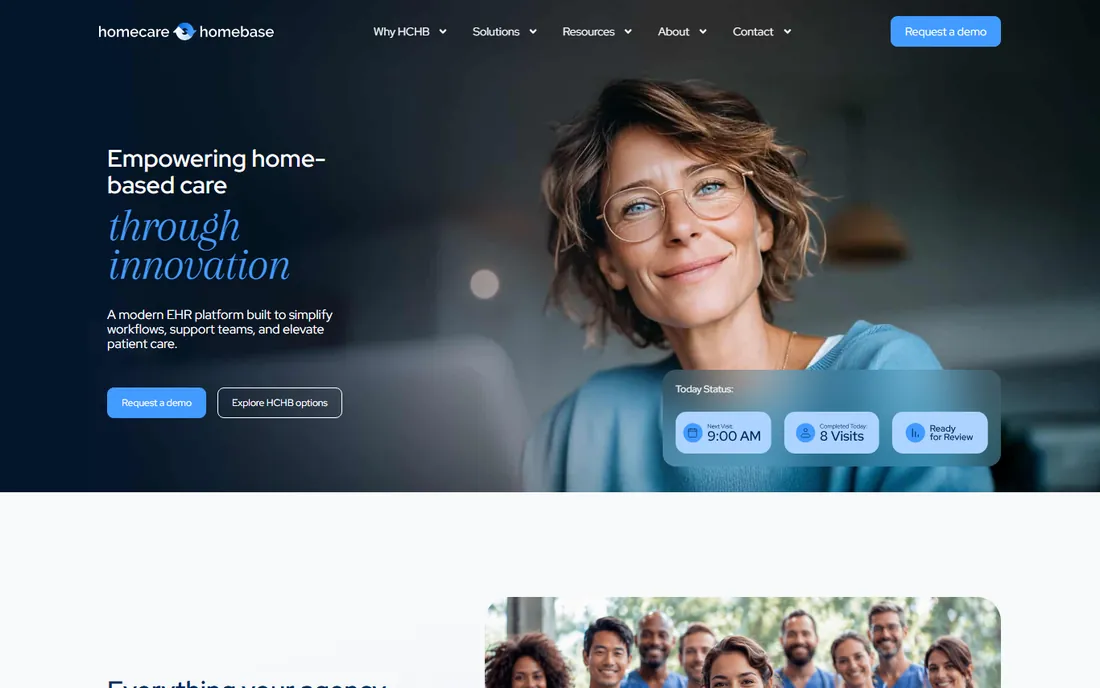
Homecare Homebase has been at this since 1999, and it shows in the depth of the clinical and billing workflows. This is software designed around how Medicare home health actually works: 30-day payment periods, clinical groupings, comorbidity adjustments and the documentation burden that comes with them. The analytics layer is one of the stronger ones in the category, and the Hearst Health backing means it is not going anywhere.
The tradeoff is fit. HCHB is frank about serving mid-size and larger agencies, and the pricing, implementation timeline and day-to-day complexity reflect that. A ten-caregiver startup will drown in it; a 200-clinician agency will find the structure it needs. If you are Medicare-certified and growing past the point where spreadsheets work, this belongs on the demo list.
What we like- Purpose-built for Medicare home health and hospice workflows, including OASIS and PDGM billing
- Part of Hearst Health, which gives it enterprise-grade resources and stability
- Strong analytics and revenue cycle management
Watch out for- Pricing and implementation are geared toward larger agencies, and small shops often find it heavy
- The interface shows its age next to newer cloud platforms
#3
HHAeXchange
Best for: Medicaid home care providers who live and die by EVV compliance
Visit hhaexchange.com
Starting priceSee website (free provider portal in payer-partner states; paid plans otherwise)
Free planFree provider portal in payer-partner states (no permanent free plan elsewhere)
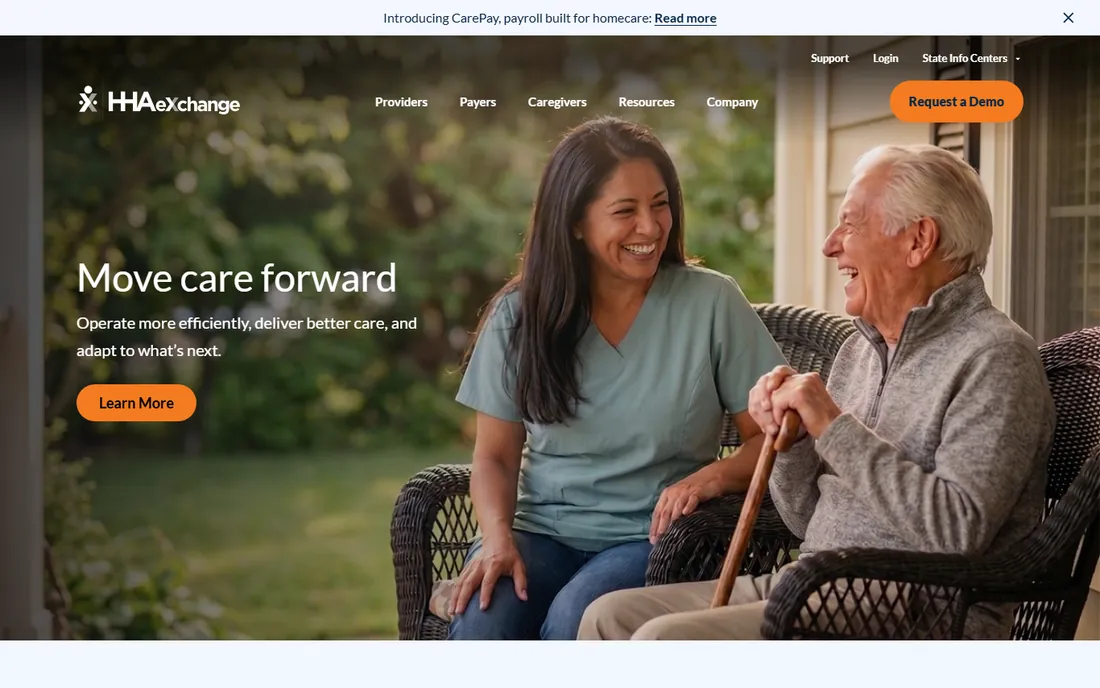
HHAeXchange occupies a unique position: it is infrastructure, not just software. Founded in 2008 for Medicaid home and community-based services, it now connects more than 32,000 US providers with 180-plus managed care organizations and 30 state Medicaid programs. In partner states, the MCOs provide the provider portal, EVV tools and billing free to agencies, which makes the pricing conversation very short.
If you bill Medicaid, this is close to mandatory in many states, and the question is not whether to use it but how far to go with its paid tiers. The platform handles 600,000 EVV confirmations a day, which is the scale argument for its compliance engine. The limitation is scope: this is a Medicaid world. Medicare-certified home health agencies need one of the clinical platforms above alongside it, not instead of it.
What we like- The only platform that directly connects agencies, state Medicaid programs and managed care organizations
- EVV, authorizations and claims billing in one portal
- In many states the MCO partnership makes the core tools free to providers
Watch out for- Built for Medicaid HCBS, so Medicare home health agencies will find it thin
- Agencies outside partner states pay for what others get free
#4
WellSky Personal Care
Best for: Private-duty and franchise non-medical home care agencies
Visit wellsky.com
Starting priceSee website (custom quote)
Free planNo (demo by appointment)
WellSky Personal Care is the new name for ClearCare, which WellSky acquired and rebranded, and the rename matters because it signals where the product sits: inside WellSky's much larger post-acute portfolio. For private-duty agencies the pitch is scale-proven operations: scheduling, caregiver management, billing, payroll and a Family Room portal that keeps relatives informed and lets them split bills. The AI layer, SkySense, adds summarization and ambient documentation.
The buyer profile here is specific: franchises and multi-location personal care enterprises that need consistency across offices. Independent agencies with twenty caregivers can use it, but they will pay enterprise prices for enterprise software. If caregiver recruiting and retention are your biggest problems, the engagement tooling is the reason to look here first.
What we like- The largest installed base in private-duty care, including 8 of the 10 biggest personal care enterprises
- HITRUST CSF certified with strong caregiver engagement and family communication tools
- Deep bench of integrations for hiring, background checks and payments
Watch out for- Enterprise pricing and sales process with no public numbers
- The platform's breadth can overwhelm small independent agencies
#5
AlayaCare
Best for: Multi-service-line agencies that want AI doing the admin work
Visit alayacare.com
Starting priceSee website (custom quote)
Free planNo (demo by appointment)
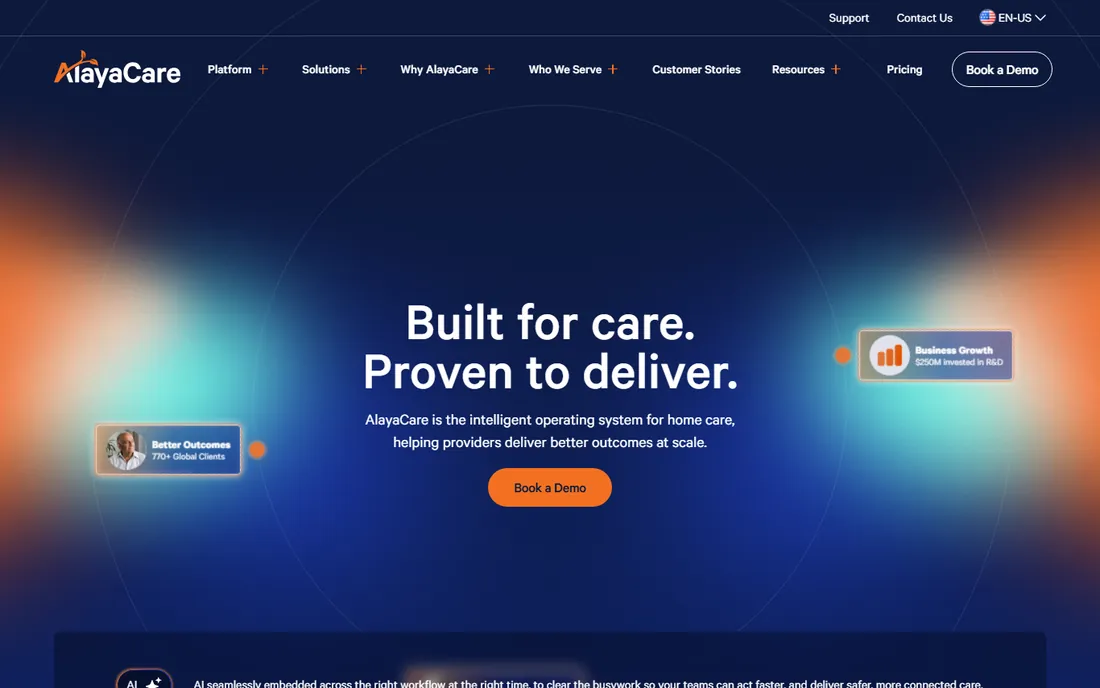
AlayaCare is the modern challenger in this list. The Canadian company, founded in 2014, built a single cloud platform for the whole client lifecycle and is now layering AI agents across it: intake, scheduling, clinical documentation and billing each get automation aimed at the admin work that burns out office staff. The visit optimizer handles routing across 10 million-plus visits a month, and the platform serves home care, private-duty nursing, pediatrics and infusion from one system.
The honest read is that you are buying into a roadmap. The core platform is proven across hundreds of agencies, but the agentic AI suite is where the differentiation, and the risk, sits. For agencies running several service lines that want one operating system instead of four logins, AlayaCare is the most modern option. Price it against Axxess and expect a serious enterprise conversation either way.
What we like- End-to-end platform covering intake, scheduling, clinical documentation, billing and payroll with AI agents for each
- Strong in home care, private-duty nursing, pediatrics and infusion
- Modern interface with real-time analytics
Watch out for- Premium positioning with quote-only pricing
- The AI features are newest, so expect a maturing roadmap rather than a finished product
#6
AxisCare
Best for: Non-medical and Medicaid agencies that want scheduling done right
Visit axiscare.com
Starting priceSee website (custom quote, per-client pricing)
Free planNo (demo by appointment)
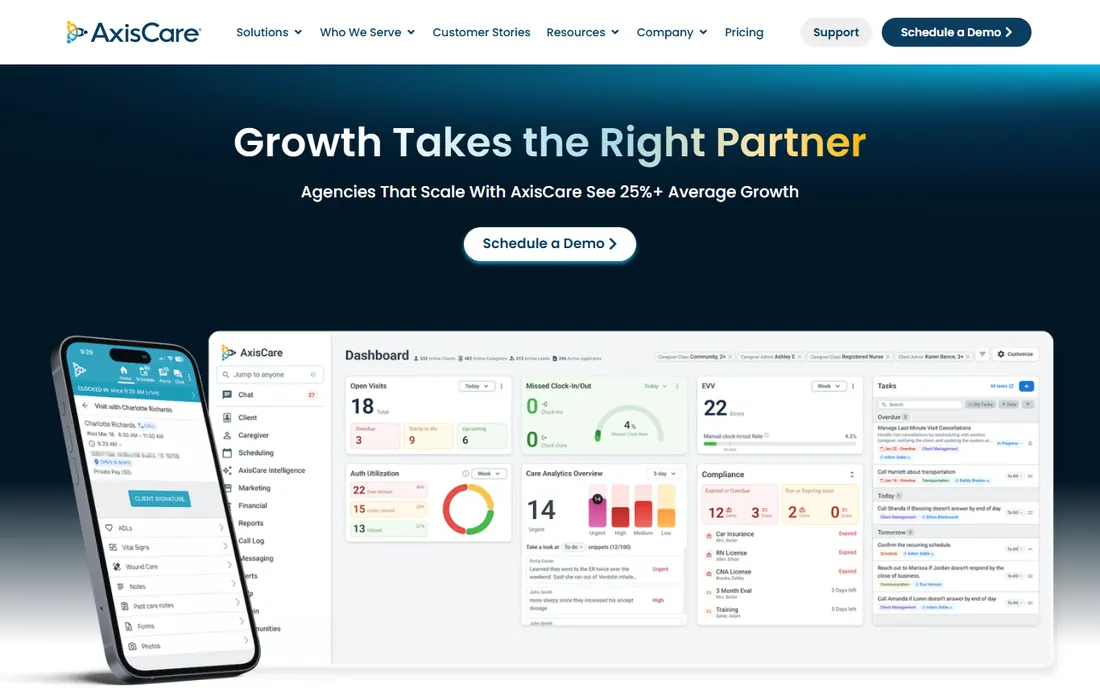
AxisCare keeps its focus narrow on purpose: non-medical personal care and Medicaid agencies. The platform does scheduling, EVV, billing, payroll and caregiver management with an emphasis on ease of use, and reviewers consistently rate it among the simplest to learn in the category. The per-client pricing model is worth noting: instead of per-seat licenses that punish you for hiring, costs track your client census.
For a private-duty agency choosing between AxisCare and WellSky Personal Care, the decision is usually scale and ambition. AxisCare suits independent agencies and regional players that want capable software without enterprise overhead. WellSky suits franchises and enterprises that need the bigger ecosystem. Both require the quote conversation; neither publishes a number.
What we like- Scheduling-first design with a GPS caregiver mobile app, custom forms and flexible reporting
- Handles Medicaid and VA billing alongside private pay
- Per-client pricing options that scale with census rather than seats
Watch out for- Focused on non-medical care, so clinical home health agencies need more
- No public pricing and a sales-led buying process
#7
KanTime
Best for: Enterprise home health and hospice agencies needing a certified EMR
Visit kantime.com
Starting priceSee website (custom quote)
Free planNo (demo by appointment)
KanTime pitches itself as the enterprise post-acute EMR, and the ONC Health IT certification gives that claim regulatory weight. The platform handles the full post-acute spectrum, home health, hospice, pediatric, private duty and consumer-directed services, with business intelligence dashboards that let management drill into clinical, financial and operational KPIs. Offline-capable point-of-care apps matter for clinicians working in homes with poor connectivity.
The buyer here is the larger agency or multi-state operator that needs one system across service lines and the compliance credentials to satisfy auditors. Smaller agencies will find the enterprise sales process and implementation scope disproportionate. If you are choosing between KanTime, Axxess and Homecare Homebase, the demos will feel similar; the differentiator is usually which one your peer agencies already run and recommend.
What we like- ONC Health IT certified EMR purpose-built for post-acute care
- Covers home health, hospice, pediatric, private duty and consumer-directed services in one system
- Works on iOS, Android and Windows devices online and offline
Watch out for- Enterprise positioning with a sales-led process and no public pricing
- The breadth of service lines means configuration effort during implementation
Match the software to your agency type
The single biggest mistake buyers make is comparing these seven as if they compete directly. They mostly do not. Start from your payer mix. If most revenue is Medicaid, HHAeXchange is the foundation and your real decision is which scheduling or billing companion to pair with it in your state. If most revenue is Medicare home health or hospice, your shortlist is Axxess, Homecare Homebase and KanTime, and the choice comes down to agency size and service-line breadth.
Non-medical private-duty agencies have a cleaner choice: WellSky Personal Care for franchises and enterprises, AxisCare for independents and regional players, AlayaCare if you run several service lines and want the most modern platform. Do not buy a Medicare home health EMR for a private-duty agency; you will pay for clinical depth you never use and fight workflows built for a different business.
Then check three things in every demo. First, EVV: confirm it meets your state's exact requirements, because state rules differ and this is where agencies get fined. Second, billing: watch a claim go from visit to payment, including denials and re-billing, since revenue cycle is where cheap software gets expensive. Third, the caregiver app: your aides will use it dozens of times a day, and adoption lives or dies on whether it works offline and takes seconds per visit.
EVV is the part buyers underestimate
Electronic visit verification is federally mandated for Medicaid-funded personal care and home health services under the 21st Century Cures Act, and every state implements it differently. The software question is not whether a vendor "has EVV" but whether its EVV matches your state's data requirements, integrates with your payers' systems and survives a caregiver's real workday.
The practical differences: GPS-based verification versus telephony, offline clock-in for homes without signal, and how exceptions get resolved when a visit does not verify cleanly. HHAeXchange has the structural advantage here because it sits between agencies and payers, so verification and billing stay in one flow. For the EMR platforms, ask for a live walkthrough of a failed verification: how the office sees it, how it gets fixed and how long the fix takes. The vendors with good answers show you; the ones with weak answers change the subject.
Also confirm who pays. In HHAeXchange partner states the core EVV and billing tools are free to providers through the MCO relationship. Everywhere else, EVV is a line item in your quote. Get it itemized before you sign, because it is one of the few costs in this category that varies wildly by state.
How we chose
We started with the platforms agencies actually evaluate: Medicare home health EMRs, Medicaid EVV platforms, private-duty management software and multi-service-line suites. For each candidate we opened the vendor's own site, checked product documentation against public reviews on G2, Capterra and agency communities, and compared feature depth, payer fit and agency-size fit. Every vendor here prices by custom quote, so we wrote "See website" wherever no public price exists rather than repeating third-party estimates. We excluded generic EHRs and point tools that do not handle home-based care workflows.
Frequently asked questions
How much does home healthcare software cost?
Vendors do not publish prices; every platform on this list is quote-based. Expect pricing to scale with your caregiver or client census, the service lines you run and the modules you need. Budget for implementation and training on top of the subscription: enterprise rollouts routinely cost as much in services as in first-year licenses. Get at least three quotes and itemize EVV, onboarding and support separately.
What is EVV and do I need it?
Electronic visit verification electronically records who provided care, to whom, when and where. It is federally required for Medicaid-funded personal care and home health services. If you bill Medicaid, you need it; if you are private-pay only, it is still useful for accountability but not legally required. State requirements differ, so confirm your state's rules before choosing.
Should a small agency buy the same software as a large one?
Usually not. Enterprise platforms like Homecare Homebase and KanTime assume dedicated admin staff and longer implementations. Small agencies do better with focused tools: AxisCare for private duty, HHAeXchange's free portal for Medicaid, or AlayaCare if you want modern software that scales with you. Buy for the agency you are now, with a path to the agency you plan to become.
Can one platform handle home health, hospice and private duty together?
Axxess, AlayaCare and KanTime are built for exactly this: multiple service lines in one system with shared scheduling, billing and compliance. The tradeoff is implementation complexity. If you only run one service line today, a focused platform is cheaper and faster to adopt; consolidate when the second service line is real, not hypothetical.
How long does implementation take?
For small private-duty agencies, weeks. For Medicare-certified home health agencies moving to an enterprise EMR, expect two to four months including data migration, OASIS workflow configuration, billing setup and staff training. Ask every vendor for a written implementation plan with milestones before signing, and talk to two reference customers of your size.
What happens to my data if I switch vendors?
Your clinical and billing records remain yours, but extraction formats and history migration vary by vendor. Before signing, get the data export terms in writing: what formats are available, how far back history goes and what migration assistance costs. The cheapest time to negotiate this is before you sign, not when you want to leave.
Sources we checked (10)
- https://www.axxess.com/
- https://hchb.com/
- https://www.hhaexchange.com/
- https://wellsky.com/personal-care-software/
- https://alayacare.com/
- https://axiscare.com/
- https://www.kantime.com/
- https://www.hhaexchange.com/info-hub/north-carolina-home-health
- https://wellsky.com/clearcare-is-now-wellsky-personal-care/
- https://www.prweb.com/releases/kantime-and-playmaker-health-announce-strategic-integration-to-deliver-proven-growth-solutions-to-home-health-and-hospice-providers-822351220.html
Is your product missing or out of date?
We review this list regularly. Vendors can request a listing, send updated pricing or ask about featured placement.

Shihab Mia · Founder, Rankite
Shihab has spent more than a decade helping SaaS and e-commerce brands grow through search. He writes Rankite's software buying guides from pricing pages, documentation and public user reviews. More about Shihab.