How we make this list: we compare pricing pages, product documentation and public user reviews. Rankite is independent; if a vendor ever pays for a featured spot, that listing is clearly labeled Partner.
Key takeaways
- Startup-friendly pricing starts around $100-130 per month (Jirav from $100/mo, Float Essentials at $130/mo or $105/mo annual), while enterprise-grade platforms like Cube start at $1,500/mo.
- If your team lives in QuickBooks or Xero, Clockwork ($599/mo annual) and Float build your forecast from live books in minutes; Datarails and Cube keep you in Excel and Google Sheets instead.
- Float, Clockwork, Fathom and Dryrun all offer free trials with no credit card, so you can test with real data before committing.
- Most AI-native platforms (Drivetrain, Abacum, Datarails) are quote-based, which means budgeting requires a sales conversation.
Quick comparison
| Tool | Best for | Starting price | Free plan |
|---|
 Datarails Datarails | Finance teams that refuse to leave Excel | See website | No |
 Cube Cube | Teams that plan in spreadsheets but need one governed source of truth | From $1,500/mo (Go plan, per Cube's own pricing) | No |
 Float Float | Startups that need to trust their cash forecast | From $130/mo ($105/mo billed annually, Essentials plan) | Free trial (14 days) |
 Jirav Jirav | SMBs wanting budgeting, forecasting and dashboards in one tool | From $100/mo (vendor lists a $100-750/mo range) | No |
 Clockwork Clockwork | QuickBooks and Xero users who want forecasts built for them | From $599/mo (Predict plan, annual billing) | Free trial (14 days) |
 Fathom Fathom | Startups that need beautiful reporting and consolidation | See website | Free trial |
 Dryrun Dryrun | Founders who think in scenarios and want visual forecasts | See website | Free trial |
 Drivetrain Drivetrain | Startups outgrowing spreadsheets that want AI-built models | See website | No |
 Abacum Abacum | Scaling startups that need collaborative, continuous planning | See website | No |
Is your product missing or out of date?
We review this list regularly. Vendors can request a listing, send updated pricing or ask about featured placement.
The best fp&a software for startups
Your seed round just closed. You have eighteen months of runway, a finance hire who starts Monday, and a board that wants a hiring plan, a burn forecast and three scenarios by Friday. The spreadsheet you built at 2 a.m. technically works, but nobody else can touch it without breaking it. That is the exact moment startup FP&A software earns its keep. The nine tools below cover the full range, from cash-flow apps you can set up today to AI-native platforms that grow with you to Series C.
Starting priceSee website
Free planNo
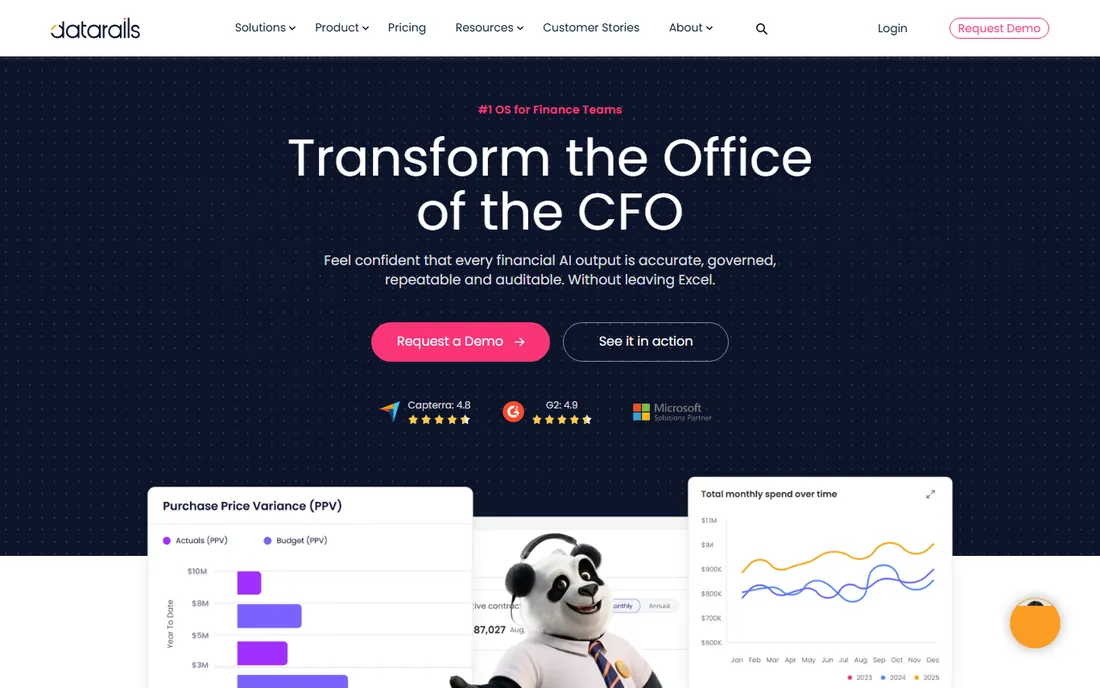
Datarails is the answer for teams whose entire financial brain lives in Excel and is staying there. Instead of replacing your models, its FinanceOS connects them to live data from your ERP, CRM and HRIS, then adds the things spreadsheets lack: version control, permissions, audit trails and a single source of truth. The company claims more than 2,000 finance teams run on the platform, and its homepage carries strong Capterra and G2 ratings.
The catch for startups is positioning and price. Datarails sells to the office of the CFO, and the buying motion is enterprise: demo, scoping, quote. A seed-stage company with one finance hire may find the platform powerful but heavier than necessary, and the cost will reflect the target market. If your plan is to keep Excel at the center while adding governance and automation around it, Datarails is the most credible way to do that.
What we like- Excel-native workflows with version control and audit trails
- Connects to 600+ data sources with live consolidation
- FP&A Genius AI layer for governed, explainable outputs
Watch out for- Quote-based pricing with a sales-led buying process
- Aimed at established finance teams, which can be more than a pre-seed startup needs
Starting priceFrom $1,500/mo (Go plan, per Cube's own pricing)
Free planNo
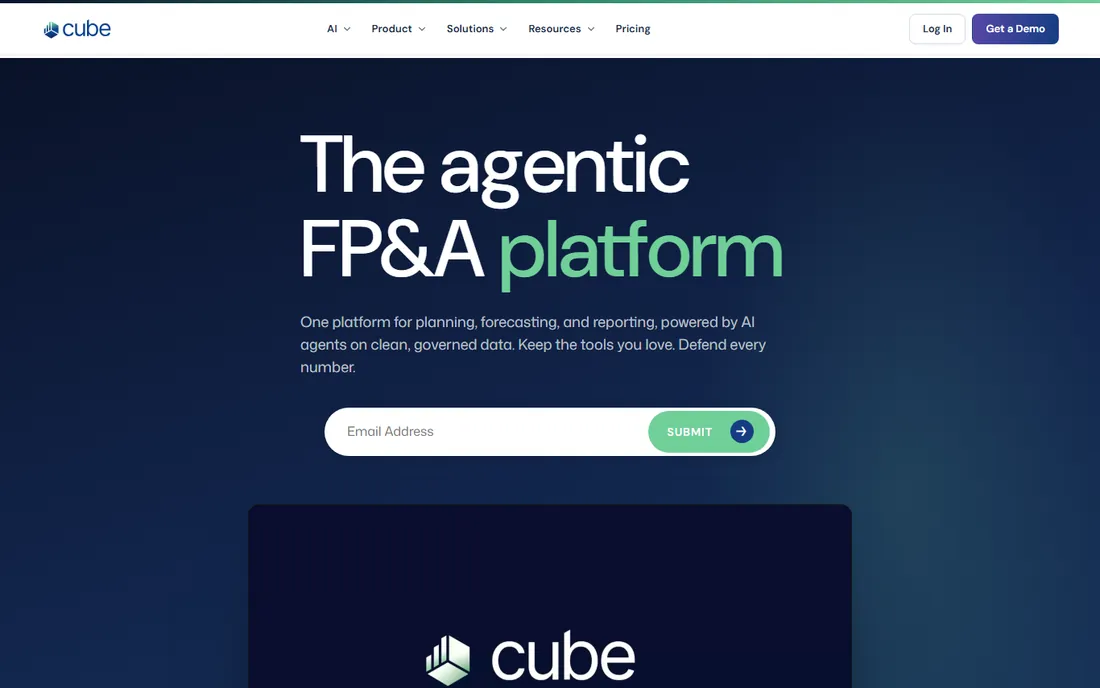
Cube takes the "meet users where they work" idea further than anyone. Your team keeps building models in Excel or Google Sheets, but the numbers underneath come from one governed layer that Cube syncs everywhere, including Slack and Teams. Its published pricing is refreshingly transparent for the category: $1,500 per month for Go, $2,800 for Pro. The platform's agentic AI features point every answer back to a traceable source transaction, which matters when the board asks where a number came from.
The honest math: $1,500 a month is real money for a startup that just hired its first finance person. Cube is priced for companies with genuine planning complexity, multiple departments, headcount planning, driver-based models, not for a ten-person team that needs a burn forecast. If that complexity is already here, Cube's spreadsheet-native approach means faster adoption than a rip-and-replace platform.
What we like- Works inside Excel, Google Sheets, Slack, Teams and PowerPoint
- Published pricing: Go at $1,500/mo, Pro at $2,800/mo
- Agentic AI layer traces every answer to source transactions
Watch out for- Entry price is steep for very early startups
- Implementation still needs a proper onboarding
Starting priceFrom $130/mo ($105/mo billed annually, Essentials plan)
Free planFree trial (14 days)
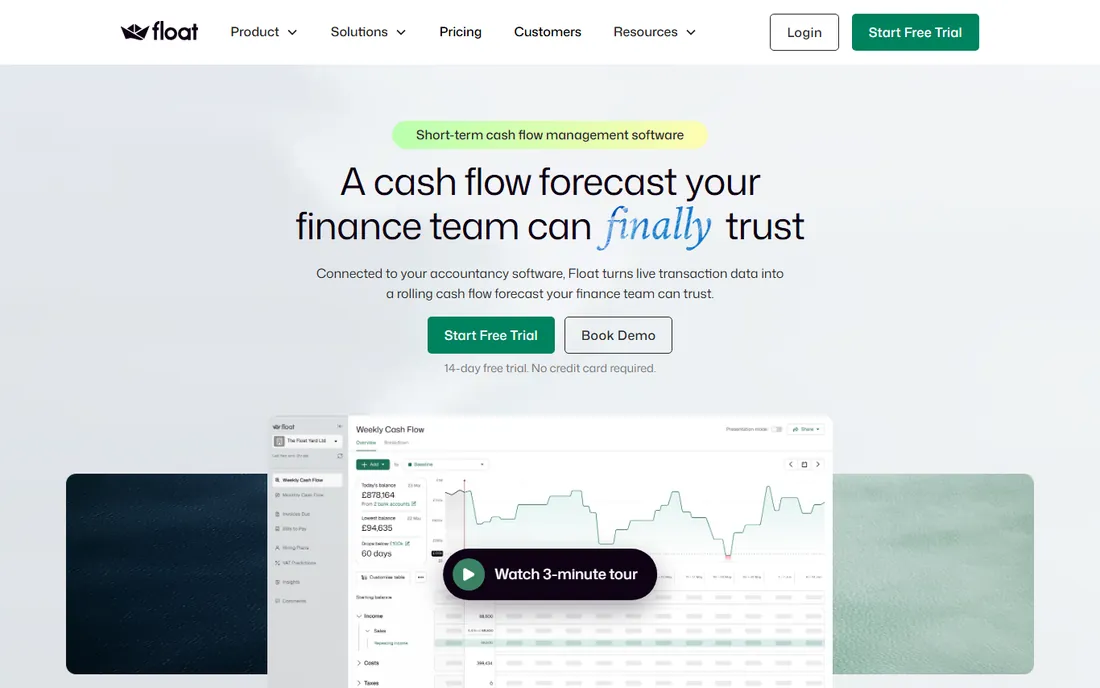
Float does one thing well: it turns your accounting data into a cash forecast your whole leadership team can read. Connect Xero or QuickBooks, and you get a 13-week rolling view for day-to-day decisions plus monthly forecasts up to three years for board conversations. Pricing is public and simple: Essentials at $130/month ($105 annual), Growth at $265 ($215), Scale at $389 ($315), all with unlimited users. A 14-day trial needs no credit card.
The limitations are clear and worth knowing. Float only integrates with Xero and QuickBooks Online right now, so NetSuite shops are out of luck. The Essentials tier caps at companies under 2m in revenue and 12-month forecasts, and multi-entity consolidation lives on the Scale plan (up to 5 entities, then $63/month per extra entity annually). If cash visibility is your burning problem and you run Xero or QBO, Float is the fastest path to a forecast you trust.
What we like- Published pricing with unlimited users on every plan
- 14-day free trial with no credit card required
- 13-week rolling plus 36-month forecasts with 8 scenarios
Watch out for- Integrates only with Xero and QuickBooks Online today
- Essentials plan is limited to companies under 2m in revenue
#4
Jirav
Best for: SMBs wanting budgeting, forecasting and dashboards in one tool
Visit jirav.com
Starting priceFrom $100/mo (vendor lists a $100-750/mo range)
Free planNo
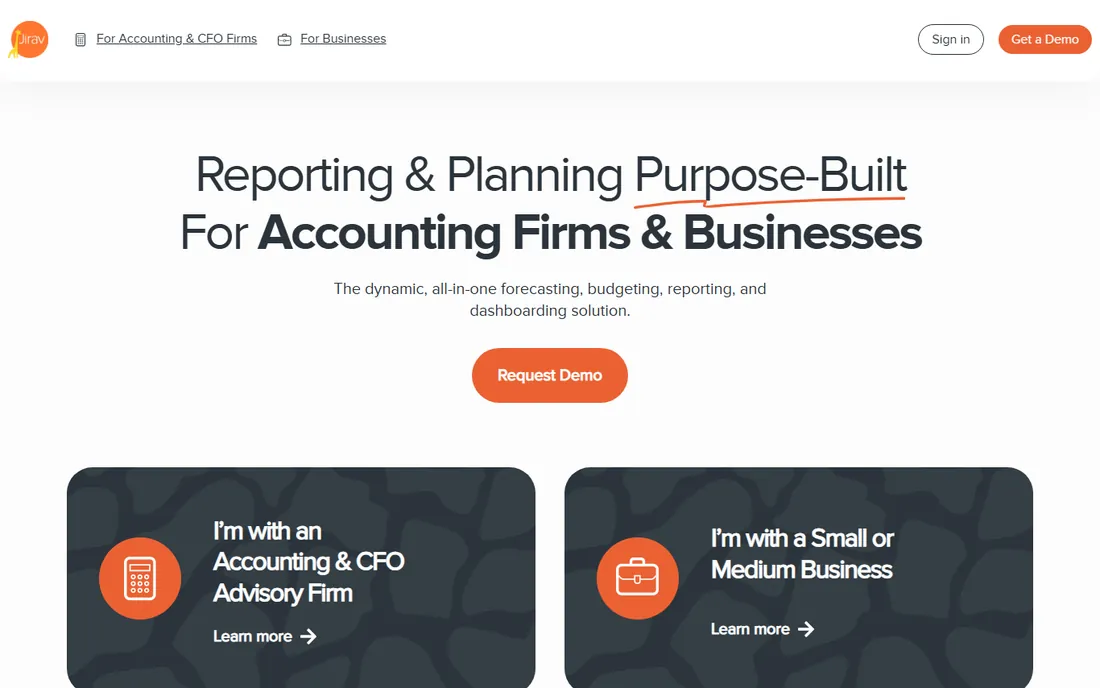
Jirav is the all-rounder of startup FP&A. It covers the full loop: annual budgets, rolling forecasts, headcount and revenue planning, plus dashboards and board-ready reporting packages. Its own site lists a price range of $100 to $750 per month, which puts the entry point within reach of funded startups, and industry-specific templates mean you are not staring at a blank model on day one. The company reports more than 4,000 customers, including accounting firms that use it for client advisory.
What you give up is the try-before-you-buy ease of trial-led competitors. Jirav sells through demos, and driver-based planning, while powerful, asks more of a first-time finance hire than a tool that auto-builds your forecast from QuickBooks. If you want one system that handles budgeting through board reporting and you have someone who can own it, Jirav's breadth is hard to match at this price.
What we like- All-in-one budgeting, forecasting, reporting and dashboarding
- Industry templates speed up setup for common business models
- Serves 4,000+ companies including VC-backed startups
Watch out for- No free trial or free tier advertised
- Driver-based modeling has a learning curve for spreadsheet-only teams
#5
Clockwork
Best for: QuickBooks and Xero users who want forecasts built for them
Visit clockwork.ai
Starting priceFrom $599/mo (Predict plan, annual billing)
Free planFree trial (14 days)
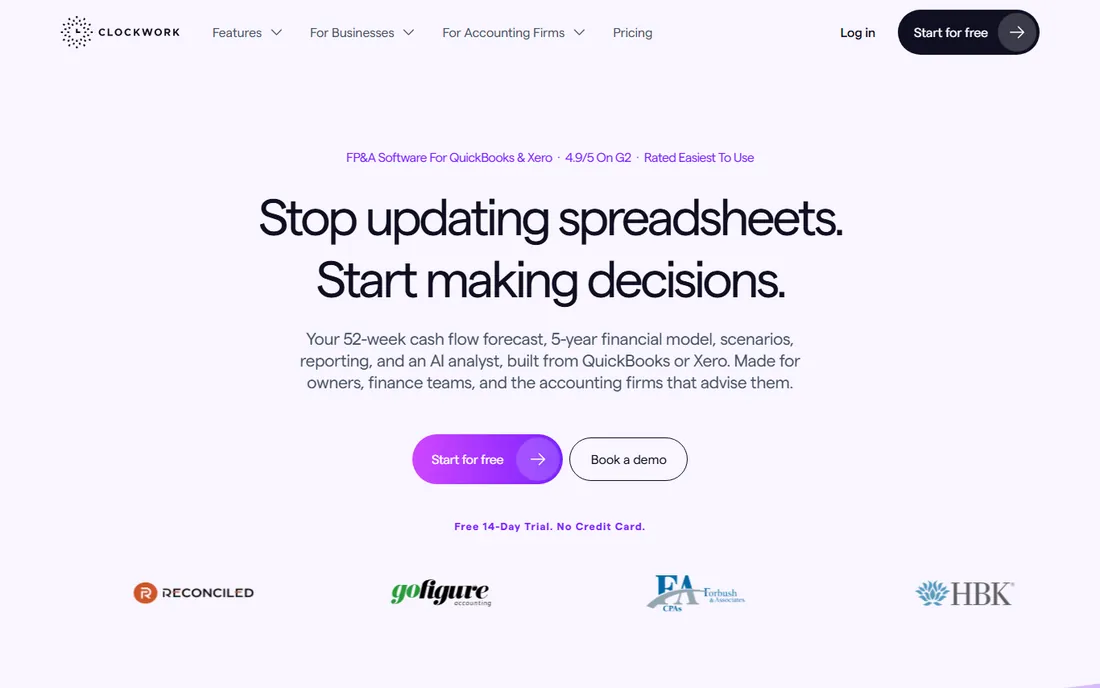
Clockwork is built for the founder or finance lead who wants answers, not another modeling project. Connect QuickBooks or Xero and it automatically builds a 52-week cash flow forecast, a five-year financial model and live dashboards, then keeps them updated as your books change. Its AI analyst, Mira, runs forecasts, builds scenarios and explains variances in plain language. Pricing is published: $599/month for Predict, $799 for Advance, $1,199 for Ultimate on annual billing, with a 14-day trial that needs no card.
The price is the filter. At $599 a month, Clockwork costs more than Float or Jirav's entry tiers, and it makes sense only if you will actually use the automation and the AI analyst weekly. It is also tightly coupled to QuickBooks and Xero; messy books produce messy forecasts, and the tool will not fix your chart of accounts. For funded startups running on QBO or Xero with real planning questions every week, it is one of the most genuinely useful tools on this list.
What we like- Auto-builds a 52-week cash flow forecast and 5-year model from your books
- Mira AI analyst answers questions and builds scenarios
- 14-day free trial with no credit card
Watch out for- Pricing starts at $599/mo, which is steep for pre-revenue startups
- Only as good as your QuickBooks or Xero data hygiene
#6
Fathom
Best for: Startups that need beautiful reporting and consolidation
Visit fathomhq.com
Starting priceSee website
Free planFree trial
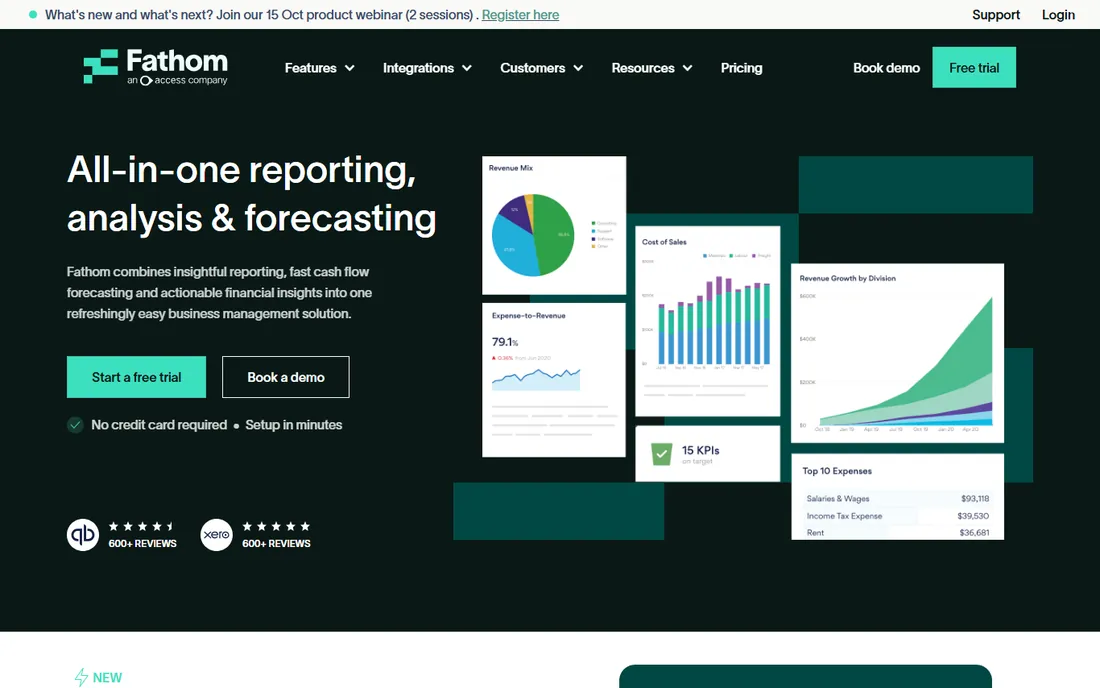
Fathom started as a reporting tool and grew into a solid analysis and forecasting platform. Its pitch is clarity: insightful reporting, fast cash flow forecasting and KPI tracking in one refreshingly simple package. The site claims more than 110,000 businesses use it, per-company pricing includes unlimited users, and multi-entity consolidation plus group benchmarking make it genuinely useful for startups with subsidiaries or portfolio companies.
The trade-off is depth. Fathom will not replace a driver-based planning platform for complex headcount and revenue modeling; it is stronger at explaining what happened and projecting cash than at building intricate operating models. Pricing is not published, so you will need to talk to sales to budget precisely. For founders who need investor-grade reporting fast, with forecasting as a bonus rather than the core, Fathom is a strong, approachable pick.
What we like- Per-company pricing with unlimited users on every plan
- Consolidation and group benchmarking built in
- Trial available with no credit card and setup in minutes
Watch out for- Vendor does not publish pricing, so budgeting needs a conversation
- Forecasting depth is lighter than dedicated FP&A platforms
#7
Dryrun
Best for: Founders who think in scenarios and want visual forecasts
Visit dryrun.com
Starting priceSee website
Free planFree trial
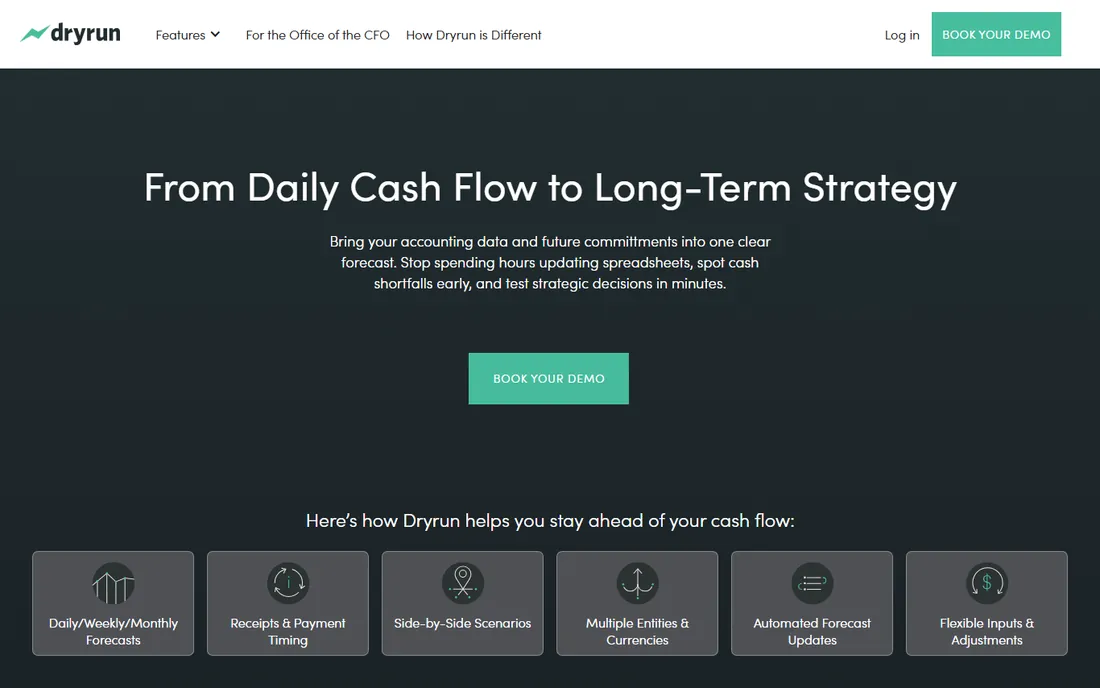
Dryrun feels like it was designed by someone who got tired of arguing about spreadsheets in board meetings. The interface is visual and dynamic: build unlimited forecasts and scenarios, compare them side by side, and show exactly how a hiring plan or a delayed enterprise deal changes your cash position. It connects to Xero, QuickBooks Online and Pipedrive, handles multi-entity consolidation with live currency conversion, and lets you blend connected data with manual inputs and spreadsheet imports.
The honest limitation is scope. Dryrun is a cash flow forecasting and scenario tool first, not a full FP&A suite with headcount planning workflows and board reporting packages. Pricing is not published, so expect a sales conversation. For startups whose core question is "what happens to cash if we do X," Dryrun's visual approach makes the answer obvious to everyone in the room, including non-finance founders.
What we like- Highly visual scenario modeling with unlimited forecasts
- Imports from Xero, QuickBooks and Pipedrive plus spreadsheet uploads
- Multi-entity consolidation with live currency conversion
Watch out for- Pricing is not published on the vendor site
- Positioning skews toward cash flow rather than full FP&A
#8
Drivetrain
Best for: Startups outgrowing spreadsheets that want AI-built models
Visit drivetrain.ai
Starting priceSee website
Free planNo
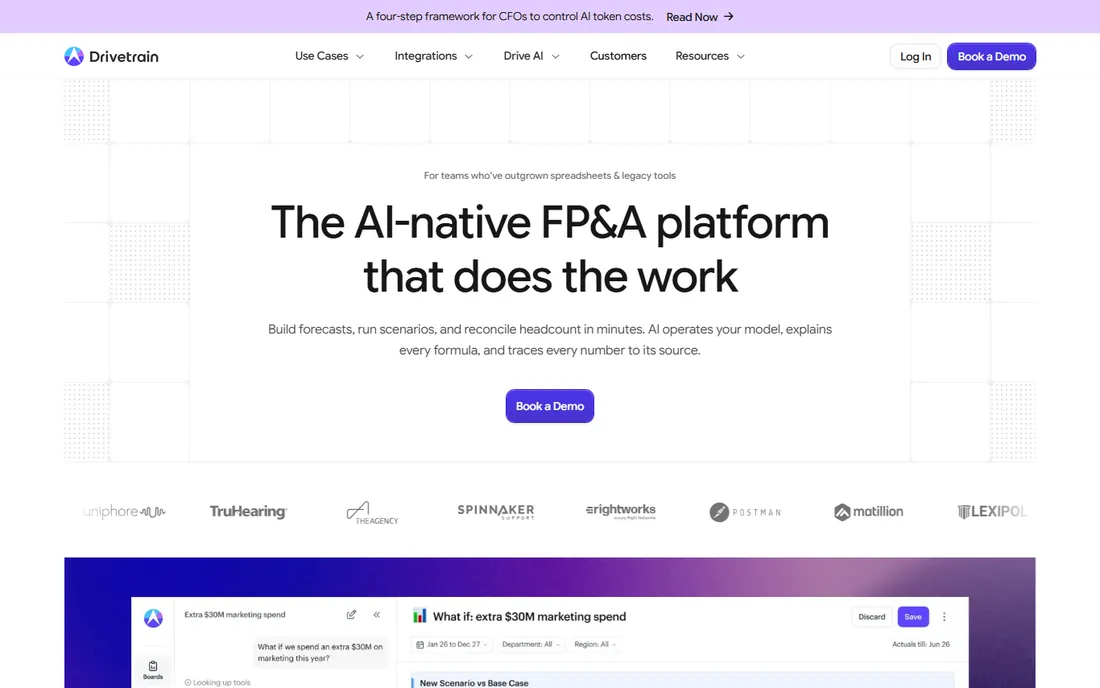
Drivetrain is one of the AI-native FP&A platforms built for teams that have outgrown spreadsheets but do not want a legacy enterprise tool. Its agents build models, run scenarios, reconcile headcount and explain every formula in plain language, with each number traceable to its source system. With more than 800 connectors, it pulls actuals from your ERP, CRM and HRIS automatically, and the Excel-style formula language means finance hires feel at home immediately.
For startups, the consideration is fit and cost. Drivetrain is quote-based and clearly aimed at scaling companies with real planning complexity, and every customer gets a dedicated finance advisor, which tells you the price band. A pre-seed team will not use half of it. But if you are scaling past 50 people with multiple departments and a finance hire who needs real analytical backup, Drivetrain's AI does genuine work rather than demo-ware.
What we like- AI agents build scenarios, explain formulas and trace numbers to sources
- 800+ pre-built connectors with scheduled syncs
- Excel-style formulas lower the learning curve
Watch out for- Quote-based pricing aimed at funded, scaling companies
- Rich feature set can be more than an early team needs
#9
Abacum
Best for: Scaling startups that need collaborative, continuous planning
Visit abacum.ai
Starting priceSee website
Free planNo

Abacum pitches itself as the AI-native FP&A platform you can actually run without a systems project. Its standout feature is the AI Modeler: describe what you want in plain language and it builds a structured, editable financial model. Around that sit collaborative planning workflows, driver-based budgeting, headcount and revenue planning, investor reporting and real-time multi-entity consolidation. It is designed for continuous planning, where the forecast updates as the business moves rather than once a quarter.
The startup caveat is maturity and price transparency. Abacum is quote-based, and as a newer platform its template library and community are smaller than incumbents'. What you get in return is a modern architecture without legacy baggage and AI features that are core to the product rather than bolted on. For Series A and B companies building a real planning cadence, it is worth a demo alongside Drivetrain.
What we like- AI Modeler builds financial models from plain-language descriptions
- Collaborative workflows for budgeting, headcount and revenue planning
- Investor reporting and multi-entity roll-ups built in
Watch out for- Quote-based pricing with no public entry point
- Newer platform with a smaller template and community ecosystem
Picking FP&A software when finance is one person (or nobody)
Match the tool to the owner, not the org chart. If the founder is doing finance between investor calls, you need automation: Clockwork or Float, which build the forecast from your books with minimal input. If you just hired your first finance lead and they live in Excel, Datarails or Cube lets them keep their models while adding governance. If nobody owns finance yet, do not buy an enterprise platform; buy the simplest forecasting tool and revisit after the hire.
Then check the integration list before anything else. FP&A software is only as good as its data feed, and every tool on this list has a different answer: Float and Clockwork are QuickBooks/Xero-only, Drivetrain and Abacum connect hundreds of systems, Cube and Datarails meet you in the spreadsheet. Confirm your accounting platform, your HR system and your CRM are all supported, ask how often data syncs, and find out who fixes the sync when it breaks. A beautiful model on stale data is worse than no model.
The spreadsheet question to answer before you buy
Every startup eventually faces the same fork: stay in spreadsheets with a governance layer, or move to a purpose-built platform. Staying in Excel (Datarails, Cube) keeps adoption near zero and preserves every custom model you have built, but it also preserves spreadsheet habits: hidden tabs, broken links, one person who understands the file. Moving to a platform (Jirav, Drivetrain, Abacum, Clockwork) forces cleaner processes but demands real onboarding and usually costs more.
The deciding factor is team size and model complexity. Under 20 people with one model owner, a spreadsheet-centric tool or even a cash-flow app is fine. Past 50 people, with department heads submitting budgets and a board expecting scenario analysis, the governance and workflow features of a real platform start paying for themselves. Buy for the company you will be in twelve months, not the one you are today, but do not buy three years ahead either: shelf-ware is the most expensive software there is.
How we chose
We focused on tools a startup can realistically buy and run: published or attainable pricing, self-serve trials where offered, and genuine fit for lean finance teams rather than enterprise checklists. We read each vendor's own site for current plans, pricing, trial terms, integrations and AI claims, marking pricing "See website" wherever the vendor keeps it behind sales. We cross-checked against public reviews on G2 and Capterra and founder discussions on Reddit, and mixed established platforms with newer AI-native vendors. No vendor paid for placement, and we made no hands-on testing claims.
Frequently asked questions
What is the best FP&A software for an early-stage startup?
For most early startups, Float or Clockwork. Float's Essentials plan ($130/mo, $105 annual) gives you a trustworthy cash forecast from Xero or QuickBooks in minutes, and Clockwork auto-builds a 52-week forecast plus a five-year model. Both offer 14-day trials with no credit card. Add Jirav when you need real budgeting workflows.
How much does FP&A software cost for startups?
Entry points range from about $100-130 per month (Jirav from $100/mo, Float Essentials at $130/mo) to $599/mo for Clockwork's Predict plan and $1,500/mo for Cube's Go plan. AI-native platforms like Datarails, Drivetrain and Abacum are quote-based and typically cost more. Always confirm current pricing with the vendor.
Can FP&A software replace my spreadsheet models?
It depends on the tool. Datarails and Cube are designed to keep your Excel and Google Sheets models while adding live data, version control and governance. Platform tools like Jirav, Drivetrain and Abacum replace the spreadsheet with structured workflows. If your models are simple, a platform is cleaner; if they are intricate and custom, the spreadsheet-native route preserves your work.
Do I need FP&A software if I only need cash flow forecasting?
No. If cash is the only question, a focused tool like Float or Dryrun is cheaper and faster to set up than a full FP&A suite. Buy the full platform when you also need headcount planning, departmental budgets, scenario modeling and board reporting. Many startups start with cash forecasting and graduate to FP&A at Series A.
What integrations matter most in startup FP&A software?
Your accounting platform first (QuickBooks, Xero or NetSuite), then HR (for headcount planning) and CRM (for revenue planning). Check that the vendor supports your exact stack and ask about sync frequency. Float and Clockwork only support Xero and QuickBooks Online, while Drivetrain lists 800+ connectors and Datarails lists 600+ sources.
Is AI in FP&A software actually useful or just marketing?
The useful parts are concrete: auto-building forecasts from your books (Clockwork), explaining variances and tracing numbers to sources (Drivetrain, Cube), and generating models from plain language (Abacum). Treat vague "AI-powered insights" claims skeptically and ask for a live demo on your own data before believing any of it.
Sources we checked (0)
Is your product missing or out of date?
We review this list regularly. Vendors can request a listing, send updated pricing or ask about featured placement.

Shihab Mia · Founder, Rankite
Shihab has spent more than a decade helping SaaS and e-commerce brands grow through search. He writes Rankite's software buying guides from pricing pages, documentation and public user reviews. More about Shihab.