How we make this list: we compare pricing pages, product documentation and public user reviews. Rankite is independent; if a vendor ever pays for a featured spot, that listing is clearly labeled Partner.
Key takeaways
- Fathom and Jirav lead for companies that want investor-grade reports and forecasts, but both price for firms and finance teams, not solo owners.
- LivePlan is the cheapest credible starting point at $20 a month, built for founders who need forecasts and lender-ready statements without hiring a CFO.
- Float and Dryrun solve one painful problem well: knowing your cash position weeks ahead, which matters more than pretty dashboards for most small businesses.
- Spotlight Reporting, Reach Reporting and Calxa are sold mainly through accountants, so expect a demo call rather than self-serve signup.
- No tool replaces clean books; every product on this list syncs with QuickBooks Online or Xero, and garbage in still means garbage out.
Quick comparison
| Tool | Best for | Starting price | Free plan |
|---|
 Fathom Fathom | Accounting firms and advisors | $450 per month (Pro plan) | Free trial (14 days) |
 Jirav Jirav | FP&A and virtual CFO work | $50 per month (Controller Essentials) | Free trial |
 LivePlan LivePlan | Startups and small business planning | $20 per month (Standard, billed monthly) | No (35-day money-back guarantee) |
 PlanGuru PlanGuru | Detailed budgeting and forecasting | See website | Free trial |
 Float Float | Cash flow forecasting | See website | Free trial (14 days) |
 Dryrun Dryrun | Cash scenario modeling | See website | Free trial |
 Spotlight Reporting Spotlight Reporting | Accountant-delivered client reports | $329 per month (Basic advisor plan) | No |
 Reach Reporting Reach Reporting | Visual management reports | See website | Free trial (no credit card required) |
 Calxa Calxa | Not-for-profits and small business | See website | Free trial (30 days) |
Is your product missing or out of date?
We review this list regularly. Vendors can request a listing, send updated pricing or ask about featured placement.
Maya runs a 45-person marketing agency in Austin. Every month she exports her profit and loss from QuickBooks, pastes it into a spreadsheet, and spends a full day building the board pack her investors expect. She asked me which software could cut that day down to an hour. The honest answer depends on who is doing the reporting. Some tools on this list are built for owners like Maya. Others are built for the accountants who serve owners like Maya. Knowing which camp you sit in saves you from buying the wrong one.
Starting price$450 per month (Pro plan)
Free planFree trial (14 days)
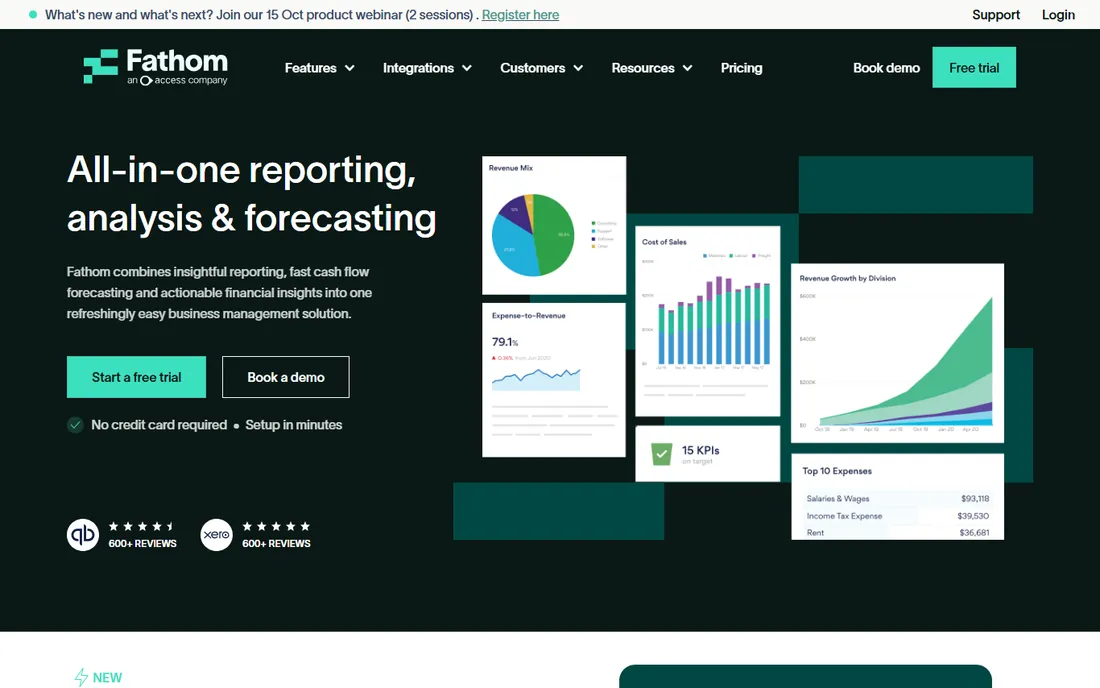
Fathom built its name on one thing: management reports that do not look like accounting software output. Branded P&Ls, KPI scorecards, variance commentary with AI assistance, and cash flow forecasts all come out in a format you can hand to a bank or a board. It syncs with QuickBooks, Xero and Sage, and the consolidation engine handles multi-entity groups with eliminations.
The catch is the pricing model. Fathom now sells primarily to accounting firms: Pro starts at $450 a month, and the $67 Portfolio tier is a monitoring product, not the full reporting suite. A single small business buying direct will feel overcharged. If your accountant already runs Fathom, ask them to add you as a client company instead of buying it yourself.
What we like- Beautiful management reports clients actually read
- Strong KPI tracking and three-way forecasting
- Consolidates up to 300 entities
Watch out for- Priced for firms, not single businesses
- The cheaper Portfolio tier lacks full reporting depth
Starting price$50 per month (Controller Essentials)
Free planFree trial
Jirav is the closest thing to hiring a financial planning team without the payroll. You connect your accounting data, build budgets from drivers like headcount and revenue per rep, and run scenarios across up to seven years. The Controller Essentials tier starts at $50 a month, which is genuinely affordable for what was once enterprise-only capability.
Where it earns its keep is the forward look. Most reporting tools describe the past beautifully. Jirav models the future: what happens to cash if you hire three people in Q2, or lose your biggest client. The trade-off is complexity. Setting up drivers takes real thought, and companies that only want a monthly report pack will use a tenth of what they pay for.
What we like- Real driver-based budgeting and long-range forecasting
- Strong workforce planning
- Accountants praise the onboarding support
Watch out for- Overkill if you only need monthly P&L packs
- The full planning power sits in higher tiers
Starting price$20 per month (Standard, billed monthly)
Free planNo (35-day money-back guarantee)

LivePlan is the top financial reporting software for founders who are still doing their own finance. At $20 a month for Standard ($15 on annual billing), it builds your P&L, balance sheet and cash flow forecasts, compares budget to actuals from QuickBooks or Xero, and generates the board-style reports lenders ask for. Premium at $40 a month adds scenarios, benchmarks and deeper analysis.
The honest limitation is the ceiling. LivePlan will not do multi-entity consolidation or driver-based workforce models. It is a planning and tracking tool for one company, and it is excellent at that job. Businesses that outgrow it usually land on Jirav or hire a fractional CFO.
What we like- Cheapest credible option on this list
- Lender-ready forecasts and 550+ sample plans
- AI forecast builder for beginners
Watch out for- Reporting depth is thinner than Fathom or Jirav
- Geared toward planning, not month-end close
Starting priceSee website
Free planFree trial

PlanGuru has been doing budgeting and forecasting since before most of this list existed, and the depth shows. You get an integrated income statement, balance sheet and cash flow model, payroll utilities, business valuation tools, and consolidations, with imports from QuickBooks, Xero and Excel. Nonprofits get a tailored edition, which is rare.
The friction is the buying experience. Pricing is not published on the site, so you will talk to sales before you know the cost. The desktop heritage also shows in the interface. If you want the most forecasting methods per dollar and do not mind a learning curve, it delivers. If you want to sign up in five minutes, look elsewhere.
What we like- Forecasts all three statements up to 10 years out
- 20+ built-in forecasting methods
- Strong nonprofit and advisor editions
Watch out for- Interface feels dated next to cloud-native rivals
- Pricing is not published, expect a sales conversation
Starting priceSee website
Free planFree trial (14 days)
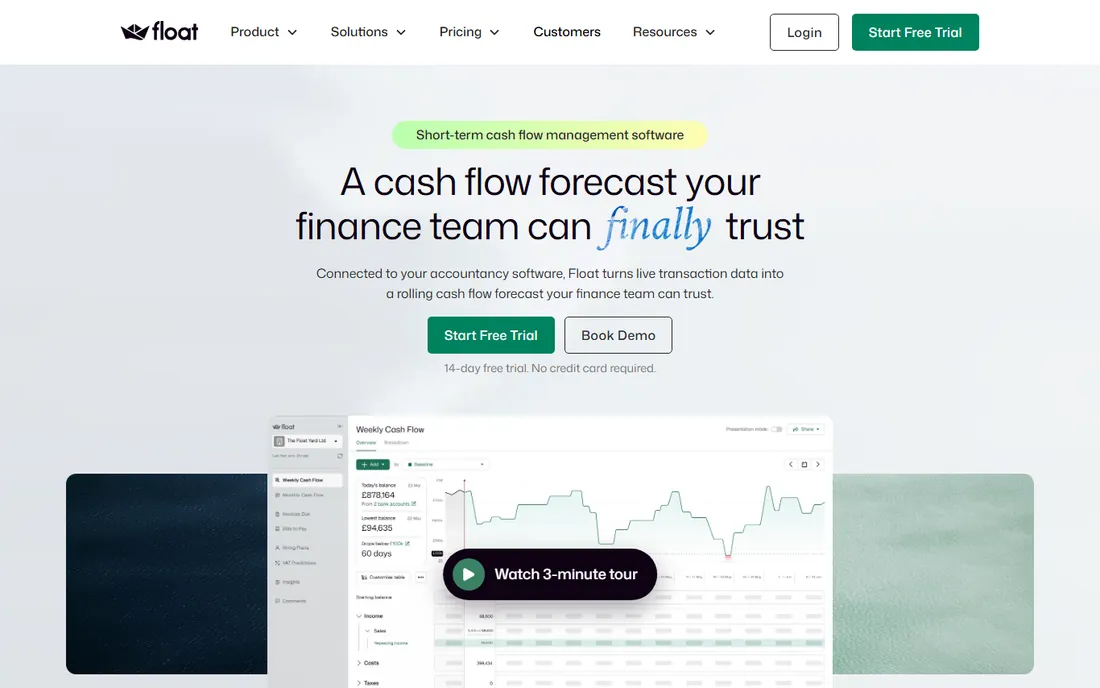
Float answers one question better than anyone: will we have enough cash, and when. It pulls reconciled transactions from Xero or QuickBooks every day, builds a rolling forecast, and lets you toggle scenarios like a new hire or a delayed client payment to see the cash impact instantly. Over 8,000 finance teams use it, and the 14-day trial needs no credit card.
The limitation is scope. Float does not produce management P&Ls, KPI dashboards or board packs. Pair it with your accounting software's native reports or a tool like Fathom, and it covers the forward-looking cash piece beautifully. Buy it expecting a full reporting suite and you will be disappointed.
What we like- Cash forecast rebuilds itself from live accounting data
- 13-week and monthly views
- Scenario toggles for hiring and spending decisions
Watch out for- Narrow focus, it does cash, not full financial reporting
- Integrates only with Xero and QuickBooks Online
Starting priceSee website
Free planFree trial
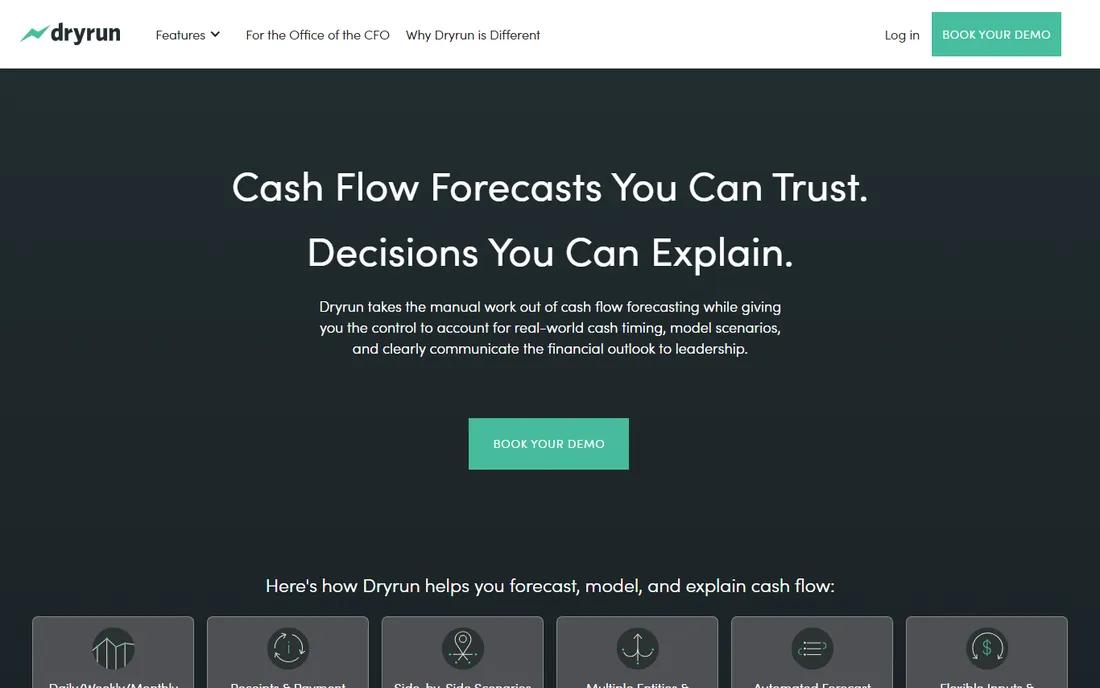
Dryrun sits between a spreadsheet and a full FP&A platform. It automates the baseline cash forecast from your accounting data, then lets you layer in the messy reality spreadsheets handle badly: upcoming projects, expected sales, planned hires, debt payments. Compare scenarios side by side and show leadership exactly when each plan needs cash.
The advantage over Float is flexibility with non-accounting inputs. The disadvantage is maturity: fewer public reviews, a smaller support footprint. For project-based businesses where the accounting system only holds half the picture, that trade is often worth it.
What we like- Models projects and commitments before invoices exist
- Side-by-side scenario comparison
- Pulls from ERP plus manual inputs
Watch out for- Smaller vendor with less review history than rivals
- Pricing requires a conversation
Starting price$329 per month (Basic advisor plan)
Free planNo
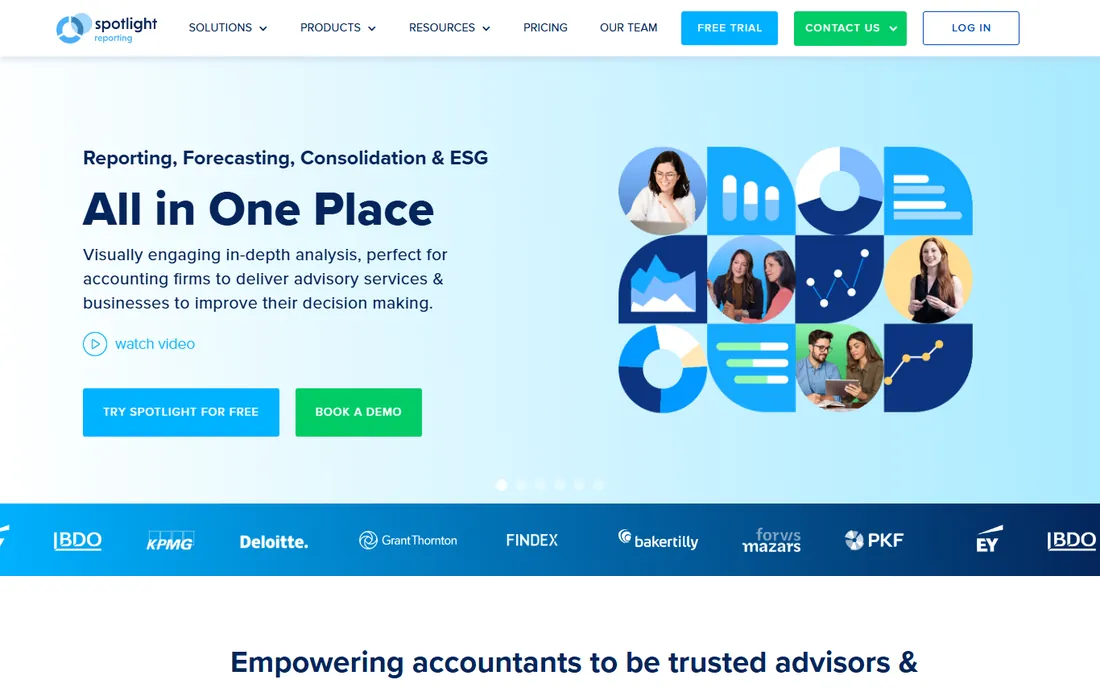
Spotlight Reporting is the tool your accountant uses to make you look informed. Firms buy the Basic plan (recently raised from $295 to $329 a month) and produce branded performance reports, forecasts and dashboards for their whole client base. Training and round-the-clock support are bundled, which explains part of the price.
As a business owner, you almost certainly will not buy this directly. You will encounter it as the report your accountant sends each month. If you are shopping for an advisory accountant, asking whether they run Spotlight, Fathom or Reach tells you a lot about the quality of reporting you will receive.
What we like- Purpose-built for accountants serving many clients
- Includes training and 24/7 support
- Strong benchmarking across client portfolios
Watch out for- Sold to advisors, not directly to businesses
- The price only makes sense at firm scale
Starting priceSee website
Free planFree trial (no credit card required)
Reach Reporting does for financial reports what a good designer does for a pitch deck. The templates are genuinely attractive, every element takes your branding, and the output covers monthly analysis, KPI dashboards, variance reports and multi-year projections. It connects to QuickBooks, Xero, Google Sheets and Excel.
The open question is price transparency. You will need to talk to their team for a quote, which makes comparison shopping harder. The product itself earns its 4.9-star user rating. If visual quality matters for your board or investor updates, it deserves a trial slot next to Fathom.
What we like- Polished, fully brandable report templates
- Three-way budgeting and forecasting
- Consolidation across entities and currencies
Watch out for- Pricing is quote-based
- Newer and smaller than Fathom with fewer third-party reviews
Starting priceSee website
Free planFree trial (30 days)
Calxa deserves its place for one underserved audience: not-for-profits. Grant acquittals, program budgets, board packs with fund-level detail, these are painful in generic tools and first-class here. Businesses use it too, for automated management reports with scheduled delivery straight to stakeholders.
The 30-day trial is generous, and the budget wizards genuinely shorten setup. The trade-off is scale of ecosystem: fewer integrations and a smaller user community than the big names. If you run a nonprofit or a small business that wants reports to just arrive each month, that will not matter.
What we like- Standout nonprofit budgeting and grant reporting
- Budget wizards cut setup time
- Links to Xero, QuickBooks and MYOB
Watch out for- Smaller ecosystem and fewer integrations than US-focused rivals
- Pricing not published
How we chose
We started from the tools accountants and finance teams actually recommend: G2 and Capterra category leaders, Reddit threads from controllers and fractional CFOs, and vendor documentation. Every price above comes from the vendor's own pricing page as of October 2026, or is marked See website where the vendor does not publish pricing. We excluded pure BI platforms that need an analyst to configure, and accounting suites whose reporting is an afterthought. The test was simple: can a small or mid-size company get decision-ready financial reports without hiring a data team.
What to check before you buy
Start with your accounting system. Every tool here syncs with QuickBooks Online or Xero, but the quality of that sync decides your experience. Run a trial with your real data, not the demo dataset, and check whether your chart of accounts maps cleanly. A tool that needs three days of mapping work is not the time-saver it claims to be.
Next, decide who owns the reporting. If your accountant will build and send the reports, the advisor-priced tools (Fathom, Spotlight, Reach) make sense bought through the firm. If you are doing it yourself, favor self-serve products with published pricing and real trials: LivePlan, Jirav, Float. Ask about contract length too. Fathom bills monthly with no lock-in, which is rare at its tier, while quote-based vendors may expect annual commitments.
Finally, match the tool to the decision you actually need to make. Cash questions point to Float or Dryrun. Investor and lender reporting points to Fathom, Jirav or LivePlan. Nonprofit grant compliance points to Calxa. Buying the biggest platform for the smallest question is the most common waste in this category.
The spreadsheet question
Every finance lead asks it: why not just stay in Excel. For a one-person finance function with stable operations, honestly, a well-built spreadsheet still works. The tools above earn their fees in three situations. First, when month-end reporting eats days of manual work that automation could compress to minutes. Second, when the business needs forecasts and scenarios, not just history, which spreadsheets handle badly at scale. Third, when someone other than the builder needs to read the output: a board, a bank, an investor. If none of those apply yet, keep the spreadsheet and revisit in a year.
Frequently asked questions
What is financial reporting software?
It is software that pulls data from your accounting system and turns it into readable reports: profit and loss statements, balance sheets, cash flow statements, KPI dashboards and forecasts. The best tools automate the monthly pack and add forward-looking analysis your accounting software does not provide.
How much does financial reporting software cost?
For small businesses, expect $20 to $100 a month for self-serve tools like LivePlan or Jirav's entry tier. Advisor-grade platforms like Fathom and Spotlight Reporting run $329 to $450 a month and are usually bought by accounting firms. Quote-based vendors can go higher for multi-entity setups.
Do I need financial reporting software if I have QuickBooks?
QuickBooks produces accurate standard reports, but they look like accounting output and lack forecasting, KPI tracking and commentary. Reporting software adds the presentation layer and the forward look. Many businesses start feeling the gap when a bank, investor or board asks for a monthly pack.
What is the difference between reporting and FP&A software?
Reporting software focuses on presenting financial results clearly: statements, dashboards, variance analysis. FP&A software adds planning: driver-based budgets, long-range forecasts and scenario models. Tools like Jirav and PlanGuru do both, while Fathom leans reporting and Float leans forecasting.
Can financial reporting software replace my accountant?
No. It replaces the manual report-building your accountant does, which should lower your bill or free them for advisory work. The judgment calls, tax planning and compliance still need a human. The best setups pair software automation with an accountant who interprets the numbers.
Which tool is best for cash flow forecasting?
Float and Dryrun specialize in cash. Float rebuilds the forecast automatically from live accounting data, while Dryrun handles manual inputs like upcoming projects better. Jirav and Fathom also do three-way cash forecasting as part of broader suites.
Sources we checked (9)
- https://fathomhq.com/pricing
- https://jirav.com/pricing
- https://www.liveplan.com/pricing
- https://planguru.com/
- https://www.spotlightreporting.com/pricing
- https://floatapp.com/
- https://reachreporting.com/
- https://calxa.com/
- https://dryrun.com/
Is your product missing or out of date?
We review this list regularly. Vendors can request a listing, send updated pricing or ask about featured placement.

Shihab Mia · Founder, Rankite
Shihab has spent more than a decade helping SaaS and e-commerce brands grow through search. He writes Rankite's software buying guides from pricing pages, documentation and public user reviews. More about Shihab.