How we make this list: we compare pricing pages, product documentation and public user reviews. Rankite is independent; if a vendor ever pays for a featured spot, that listing is clearly labeled Partner.

Key takeaways
- Causal is the most approachable modern modeling tool, with spreadsheet-like logic in a real application.
- Cube and Drivetrain keep finance teams in spreadsheets while adding control and consolidation.
- Bob Finance (formerly Mosaic), Jirav, and Clockwork serve startups and scale-ups with investor-ready planning.
- Planful and Spotlight Reporting cover enterprise FP&A and accountant-friendly reporting respectively.
Quick comparison
| Tool | Best for | Starting price | Free plan |
|---|
 Causal Causal | visual financial modeling | See website | Free trial |
 Cube Cube | spreadsheet-native FP&A | See website | No |
 Bob Finance Bob Finance | startup metrics and planning | See website | Free trial |
 Jirav Jirav | all-in-one financial planning | See website | Free trial |
 Clockwork Clockwork | automated FP&A for startups | See website | Free trial |
 Drivetrain Drivetrain | spreadsheet-powered planning | See website | Free trial |
 Planful Planful | enterprise FP&A | See website | No |
 Spotlight Reporting Spotlight Reporting | accountant-friendly reporting | See website | Free trial |
Is your product missing or out of date?
We review this list regularly. Vendors can request a listing, send updated pricing or ask about featured placement.
The best financial modelling software
Starting priceSee website
Free planFree trial
Causal reimagines financial modeling as visual, connected logic rather than spreadsheet cells. Build models with formulas that read like plain language, see dependencies as diagrams, and share interactive dashboards that stakeholders actually understand.
The approachability is the breakthrough. Finance teams build sophisticated models without the formula archaeology of legacy spreadsheets, and the visual structure makes models auditable in ways cell-based files never are. Scenario comparisons and sensitivity analysis are built in.
Very large enterprises with complex consolidation needs may outgrow it. But for startups, scale-ups, and finance teams tired of spreadsheet chaos, Causal's model-first design is refreshingly sane.
What we like- Intuitive visual models
- Spreadsheet-like formulas
- Great dashboards
Watch out for- Less suited to huge enterprises
- Newer platform
Starting priceSee website
Free planNo

Cube's insight is that finance teams will not leave spreadsheets, so it meets them there. Connect Excel or Google Sheets to Cube, and the spreadsheet becomes a window into governed, centralized financial data rather than a fragile standalone file.
The centralized logic solves spreadsheet sprawl: definitions live in one place, versions are controlled, and everyone works from the same numbers. Implementation is fast because the team keeps their familiar interface.
It remains spreadsheet-dependent; teams wanting to escape spreadsheets entirely should look at Causal or Planful. But as the pragmatic path from spreadsheet chaos to governed planning, Cube's adoption story is compelling.
What we like- Keep working in Excel and Sheets
- Centralized logic
- Fast implementation
Watch out for- Spreadsheet dependence
- Less visual than Causal
Starting priceSee website
Free planFree trial

Bob Finance, formerly known as Mosaic, provides startups with real-time financial metrics and planning. Connect accounting, HR, CRM, and billing systems, and get investor-ready dashboards, forecasts, and variance analysis without finance team heroics.
The startup focus shows in the metrics: burn multiple, runway, net revenue retention, and the SaaS KPIs that boards expect. Founders get financial clarity without hiring a finance team prematurely.
The rebrand from Mosaic means some references still use the old name. Enterprise depth trails Planful. But for startups and scale-ups needing credible financial planning and board reporting, Bob Finance fits the stage precisely.
What we like- Real-time metrics
- Startup-focused
- Good integrations
Watch out for- Rebrand from Mosaic causes confusion
- Less enterprise depth
Starting priceSee website
Free planFree trial
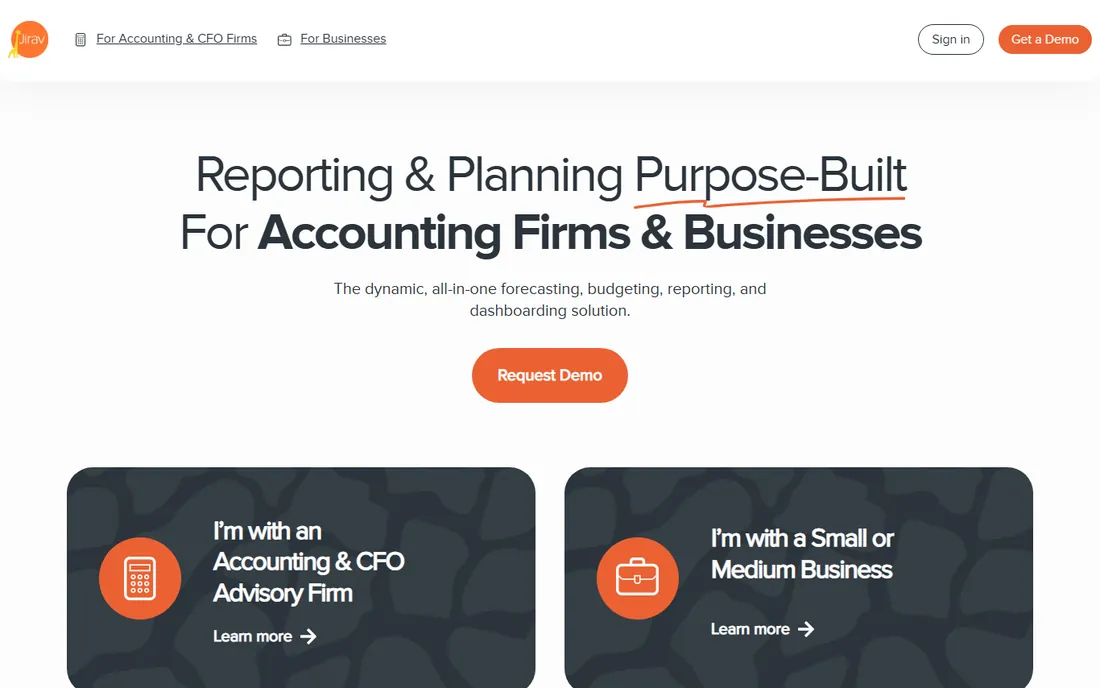
Jirav gives small finance teams the full planning toolkit: budgeting, forecasting, scenario modeling, and dashboards in one affordable platform. Companies without large FP&A departments get professional planning capability.
The all-in-one scope reduces tool sprawl. Plans connect to actuals automatically, dashboards update themselves, and the team spends time analyzing rather than assembling. The learning curve respects small teams.
Enterprise customization needs may exceed it. But for mid-market companies building their first real planning process, Jirav delivers the essentials without enterprise complexity or cost.
What we like- Budgeting, forecasting, dashboards in one
- Good for small finance teams
- Solid integrations
Watch out for- Less customizable than enterprise tools
- Mid-market focus
Starting priceSee website
Free planFree trial

Clockwork applies AI to startup FP&A: connect your systems, and the platform builds forecasts, generates board-ready reports, and flags variances automatically. The pitch is finance-team output without the finance team.
The automation handles the repetitive planning work: data consolidation, report generation, and forecast updates that consume analysts' weeks. Founders get professional financial management earlier in the company's life.
As a newer platform, the track record at scale is shorter. Complex enterprises need more. But for startups wanting credible FP&A without the headcount, Clockwork's automation-first approach is well timed.
What we like- AI-assisted forecasting
- Automated reporting
- Startup-friendly
Watch out for- Newer platform
- Less proven at scale
Starting priceSee website
Free planFree trial
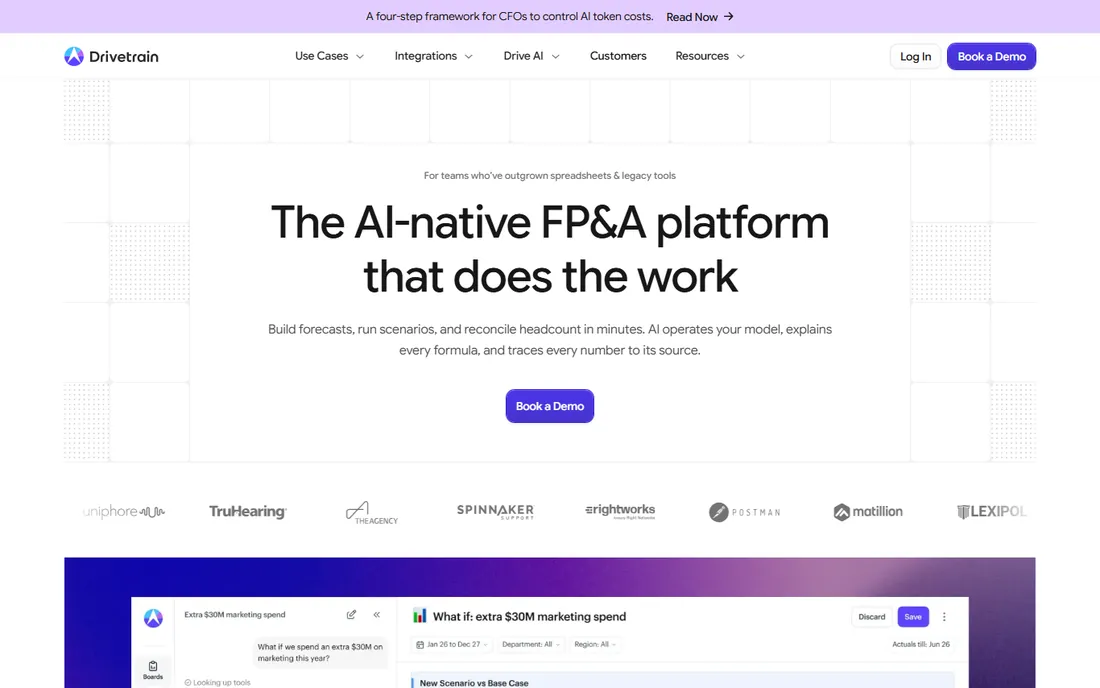
Drivetrain keeps finance teams in the spreadsheet interface they know while adding the power they lack: multi-dimensional modeling, consolidation across entities, and scenario planning that standalone files cannot handle.
The familiarity drives adoption. Teams build on existing spreadsheet skills while gaining version control, collaboration, and the analytical depth of a real planning platform. Consolidation across subsidiaries works properly, not through linked-file fragile chains.
Vendor maturity is the caveat; it is newer than the established players. But for finance teams that think in spreadsheets and need planning power, Drivetrain's approach respects how they work.
What we like- Familiar spreadsheet interface
- Powerful consolidation
- Good scenario planning
Watch out for- Newer vendor
- Pricing not transparent
Starting priceSee website
Free planNo

Planful is the enterprise FP&A platform for companies where planning is a serious discipline: multi-entity consolidation, complex budgeting workflows, workforce planning, and the reporting that large organizations require.
The depth shows in financial close integration, sophisticated modeling, and the governance that public companies need. Implementation follows established methodologies, and the platform scales with organizational complexity.
Startups should not consider it; the pricing and implementation assume enterprise scale. But for mid-market and enterprise finance teams running formal planning processes, Planful's completeness justifies the investment.
What we like- Deep enterprise planning
- Strong consolidation
- Proven at scale
Watch out for- Enterprise pricing and implementation
- Overkill for startups
Starting priceSee website
Free planFree trial
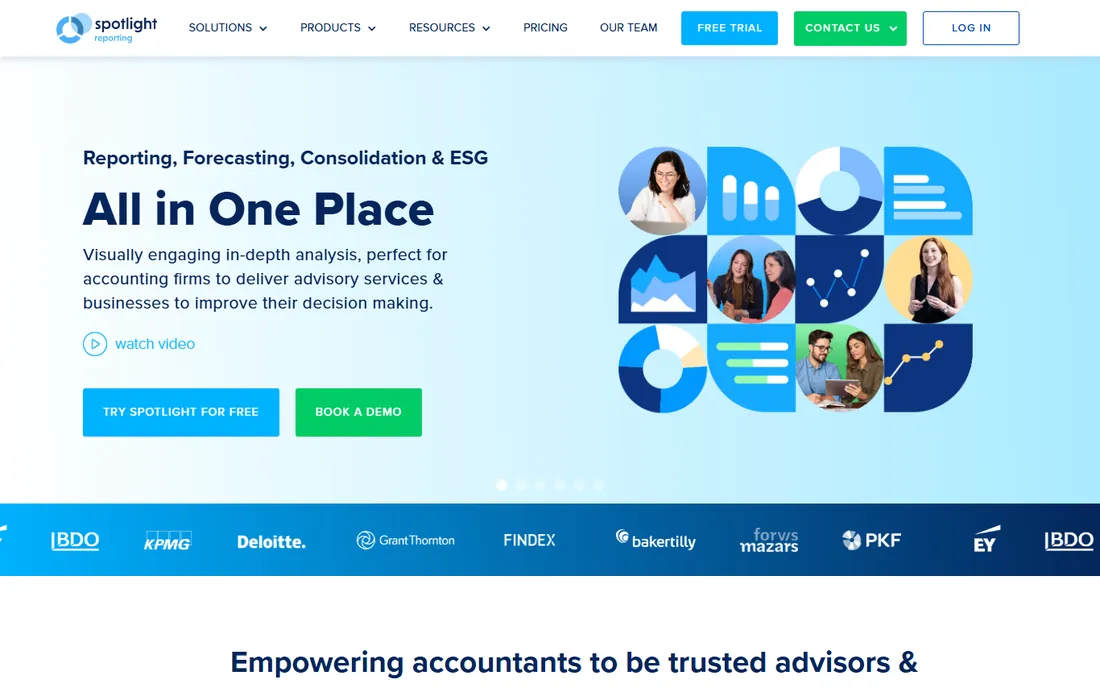
Spotlight Reporting serves accountants and advisors who produce client reports: beautiful, insightful management reports generated from Xero, QuickBooks, or MYOB data. The visualizations make financials understandable to business owners.
The forecasting add-ons extend into planning, and the multi-entity consolidation suits growing businesses. For advisory practices, the white-labeled reports differentiate the service.
Modeling depth trails the dedicated FP&A tools; this is reporting and light planning rather than deep financial modeling. But for accountants elevating their reporting and advisory, Spotlight's presentation quality is unmatched.
What we like- Beautiful client reports
- Accountant-focused
- Good forecasting add-ons
Watch out for- Reporting-first, less modeling depth
- Best with advisor involvement
Escaping spreadsheet hell
Every finance team knows the symptoms: linked files that break, version confusion, the one person who understands the model, month-end heroics. Dedicated modeling tools solve these structurally, not cosmetically.
The migration path matters. Tools like Cube and Drivetrain let teams keep spreadsheet interfaces while gaining governance, easing the transition. Rip-and-replace to unfamiliar interfaces fails more often.
Start with the most painful model, usually the operating forecast or board pack. Prove the new approach there, then expand. The credibility from one successful migration funds the rest.
What good modeling looks like
Good models separate inputs, calculations, and outputs clearly. Drivers are explicit and adjustable. Scenarios compare cleanly. Someone new can understand the logic without the author explaining.
Version control and audit trails are non-negotiable for important models. Know who changed what, when, and why. The tools here provide this; spreadsheet files shared by email do not.
Document assumptions. Every model embeds judgments about growth, margins, and costs. surfacing those assumptions lets decision-makers challenge them, which is the entire point of modeling.
Scenario planning that boards trust
Boards do not want a single forecast; they want to understand the range of outcomes. Build three scenarios as standard: base case (most likely), upside (things go well), and downside (things go badly). The discipline of defining all three forces honest thinking about risks and opportunities.
Make the drivers explicit and adjustable. Revenue growth, margins, headcount, and burn should be visible inputs, not buried formulas. When a board member asks "what if growth is half that," the model should answer in seconds, not after a weekend of rework.
Document the story behind the numbers. Every forecast embeds a narrative about the business; write it down. The model is the quantification of the strategy, and the strategy discussion matters more than the spreadsheet precision.
The monthly cadence that works
Forecasting is a rhythm, not an event. Monthly, compare actuals to forecast, understand variances, and update the outlook. The tools here automate the data gathering; the value is in the conversation the variances provoke.
Keep the forecast honest. Sandbagging and hockey sticks both destroy credibility over time. The goal is the best current estimate, not the number that makes everyone comfortable. Teams that forecast honestly make better decisions faster.
Close the loop on decisions. When the forecast drives a hiring pause or a spending increase, note it. Over time, the organization learns which forecast signals merit action, and the planning process earns its keep.
How we chose
We compared financial planning and modeling tools used by startups, finance teams, and accountants, based on vendor documentation, practitioner discussion, and reviews on software directories. We covered visual modeling, spreadsheet-native FP&A, startup metrics platforms, enterprise planning, and accountant reporting. We noted that Mosaic is now Bob Finance and that Finmark was acquired by Bill.com and is no longer available standalone. Pricing is typically quote-based, so we link to vendors for current numbers.
Frequently asked questions
When do we outgrow spreadsheets for financial modeling?
When models break regularly, versions confuse the team, or month-end takes heroics. The usual trigger is organizational: multiple contributors, board-level scrutiny, or the departure of the one person who understands the file.
How do we choose between spreadsheet-native and new-interface tools?
If the team is deeply skilled in spreadsheets and resistant to change, Cube or Drivetrain ease the transition. If the team is frustrated with spreadsheets and wants a fresh start, Causal or Jirav offer cleaner breaks. Adoption success matters more than feature lists.
What metrics should startups track?
Burn, runway, revenue growth, gross margin, and unit economics (CAC payback, LTV/CAC). Bob Finance, Clockwork, and Jirav all surface these. The discipline of reviewing them monthly matters more than the tool.
Can these tools replace our accountant?
No. They improve internal planning and reporting; accountants provide tax compliance, audit support, and strategic advice. Spotlight Reporting specifically enhances the accountant relationship rather than replacing it.
How long does implementation take?
Spreadsheet-native tools deploy in weeks; new-interface platforms take one to three months for full adoption. Enterprise tools like Planful run longer. The constraint is usually data readiness and team bandwidth, not the software.
How do we get executives to trust the forecast?
Transparency and track record. Show the drivers, document assumptions, and build credibility through accurate past forecasts. Trust comes from being right repeatedly, not from impressive models.
Should finance own the model or share it?
Finance should own the official model, with inputs from department heads. Shared ownership of inputs plus clear ownership of the model balances accuracy with accountability.
What is driver-based planning?
Building forecasts from operational drivers, like headcount, conversion rates, or units sold, rather than flat growth percentages. Driver-based models explain why numbers move and make scenarios meaningful.
Sources we checked (8)
- https://www.causal.app/
- https://cube.software/
- https://www.hibob.com/
- https://www.jirav.com/
- https://www.clockwork.ai/
- https://www.drivetrain.ai/
- https://planful.com/
- https://www.spotlightreporting.com/
Is your product missing or out of date?
We review this list regularly. Vendors can request a listing, send updated pricing or ask about featured placement.

Shihab Mia · Founder, Rankite
Shihab has spent more than a decade helping SaaS and e-commerce brands grow through search. He writes Rankite's software buying guides from pricing pages, documentation and public user reviews. More about Shihab.