How we make this list: we compare pricing pages, product documentation and public user reviews. Rankite is independent; if a vendor ever pays for a featured spot, that listing is clearly labeled Partner.
Key takeaways
- Financial consolidation is an enterprise category: all pricing is quote-based except Cube, which publishes plans from $1,250 per month.
- The core job is the same everywhere: consolidate entities and currencies, automate intercompany eliminations, and produce audit-ready group financials.
- Excel-native tools (Vena, Datarails, Cube) keep finance teams in spreadsheets with governance on top; platform tools (OneStream, Prophix, Planful, Jedox) replace the spreadsheet layer.
- None of these are self-serve purchases. Every vendor evaluates through demos and proofs of concept, so budget for an implementation project, not just a license.
Quick comparison
| Tool | Best for | Starting price | Free plan |
|---|
 OneStream OneStream | Large enterprises unifying consolidation and planning | See website | No |
 Vena Vena | Excel-native consolidation for mid-market | See website | No |
 Prophix Prophix | Mid-market corporate performance management | See website | No |
 Datarails Datarails | Excel-based FP&A automation for finance teams | See website | No |
 Cube Cube | Spreadsheet-native planning with published pricing | $1,250 per month (lean teams) | Free trial |
 Planful Planful | Continuous planning with consolidation | See website | No |
 Jedox Jedox | Flexible planning and consolidation platform | See website | Free trial |
 insightsoftware insightsoftware | Consolidation across the Office of the CFO | See website | No |
Is your product missing or out of date?
We review this list regularly. Vendors can request a listing, send updated pricing or ask about featured placement.
The best financial consolidation software
#1
OneStream
Best for: Large enterprises unifying consolidation and planning
Visit onestream.com
Starting priceSee website
Free planNo
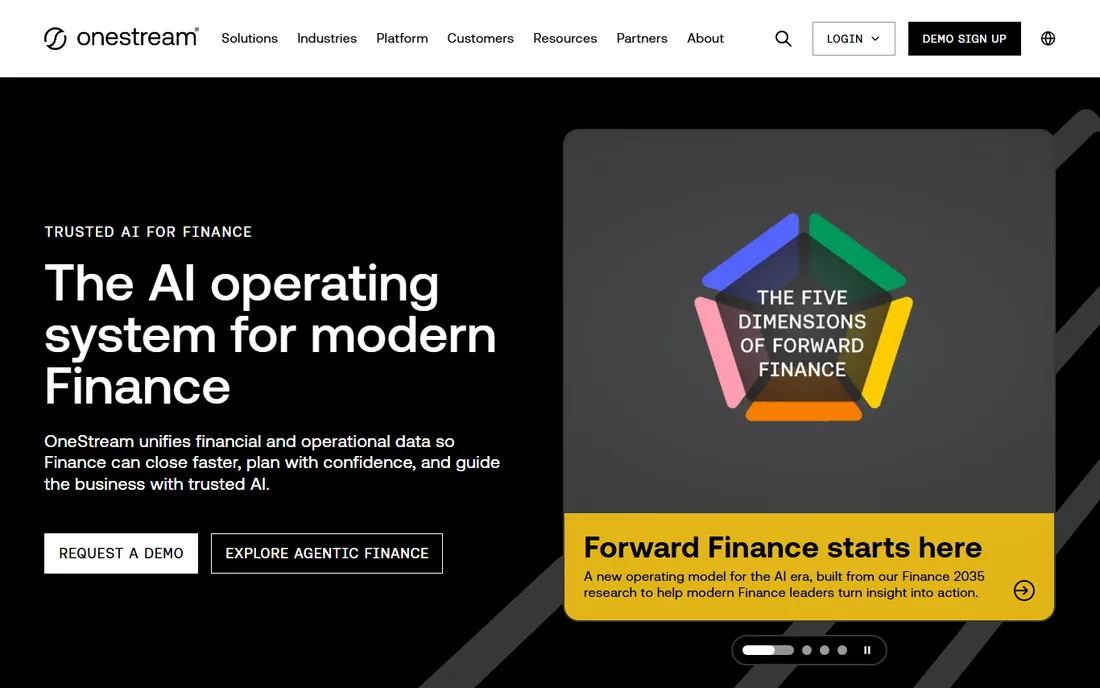
OneStream is the enterprise standard for unifying financial consolidation, planning, close and reporting in a single platform. Pricing is fully custom and quote-based, with evaluations running through demos and proofs of concept. It is designed for large, complex organizations: multi-entity, multi-currency groups with intercompany transactions, minority interests and regulatory reporting requirements.
The platform's core idea is unification. Instead of separate tools for consolidation, budgeting, forecasting and account reconciliation, OneStream runs them on one extensible platform with a marketplace of prebuilt solutions. That reduces the integration sprawl that plagues finance tech stacks at large companies.
The honest reality is scale. OneStream is a six-figure annual commitment with a significant implementation, aimed at organizations with dedicated finance transformation teams. Mid-market companies and groups with simple structures will find it heavy and slow to deploy. If you run a complex global group and want one platform for the whole close-to-report cycle, it is the benchmark.
What we like- One platform for consolidation, planning and close
- Strong for complex multi-entity groups
- Extensible marketplace
Watch out for- Enterprise pricing with long sales cycles
- Implementation is a major project
- Overkill below mid-market
Starting priceSee website
Free planNo
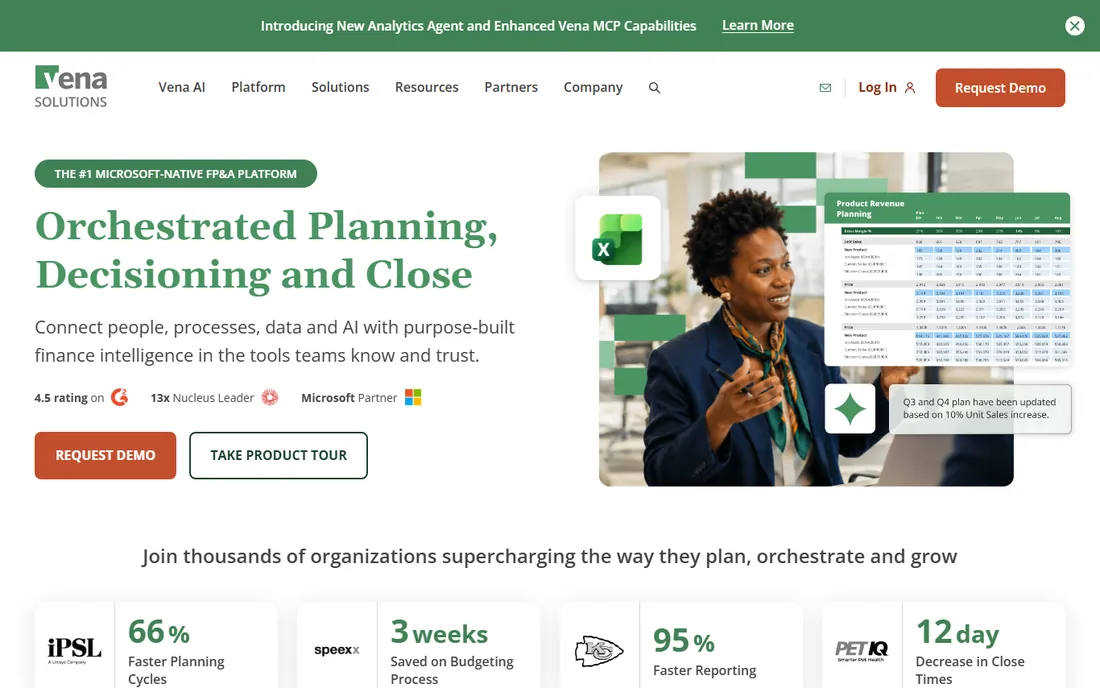
Vena is an Excel-native planning and consolidation platform: finance teams work in the Excel interface they know, while Vena adds a centralized database, workflows, version control and audit trails underneath. Pricing is quote-based, with the Professional tier reported around $1,200 per month as a starting point; evaluations run through demos and guided trials.
The appeal is adoption. Finance teams resist leaving Excel, and Vena does not ask them to. Consolidation, budgeting, scenario modeling and reporting happen in familiar workbooks, with governance, collaboration and data integration handled by the platform. Report builders pull from the general ledger into governed templates.
The honest caveats: pricing is opaque until you talk to sales, and very large or complex groups may outgrow the Excel-centric model. Implementation is still a project, not a signup. Vena suits mid-market companies that want governed consolidation without retraining finance on a new interface.
What we like- Finance teams stay in Excel
- Strong workflow and audit trail
- Good mid-market fit
Watch out for- Quote-based pricing
- Excel dependency can limit scale
- Implementation needed
Starting priceSee website
Free planNo
Prophix is a corporate performance management platform serving mid-market organizations with budgeting, forecasting, consolidation and reporting. Pricing is quote-based, with starting figures commonly reported around $50,000 per year; there is no free tier and evaluation runs through demos.
The product is built for structured finance processes: automated data collection from ERPs and GLs, intercompany eliminations, currency translation, and audit-ready consolidated statements. Workflow automation routes tasks and approvals through the close cycle, which shortens close times for teams still consolidating in spreadsheets.
The honest trade-offs are cost and rigidity. It is a real enterprise purchase with implementation services, and highly unusual structures or edge-case accounting may need workarounds. For mid-market CFOs who want a governed, auditable consolidation process without enterprise-platform complexity, Prophix is a proven fit.
What we like- Purpose-built for mid-market finance
- Structured budgeting and consolidation
- Strong automation
Watch out for- Quote-based pricing, typically five figures annually
- Implementation project required
- Less flexible for edge cases
Starting priceSee website
Free planNo
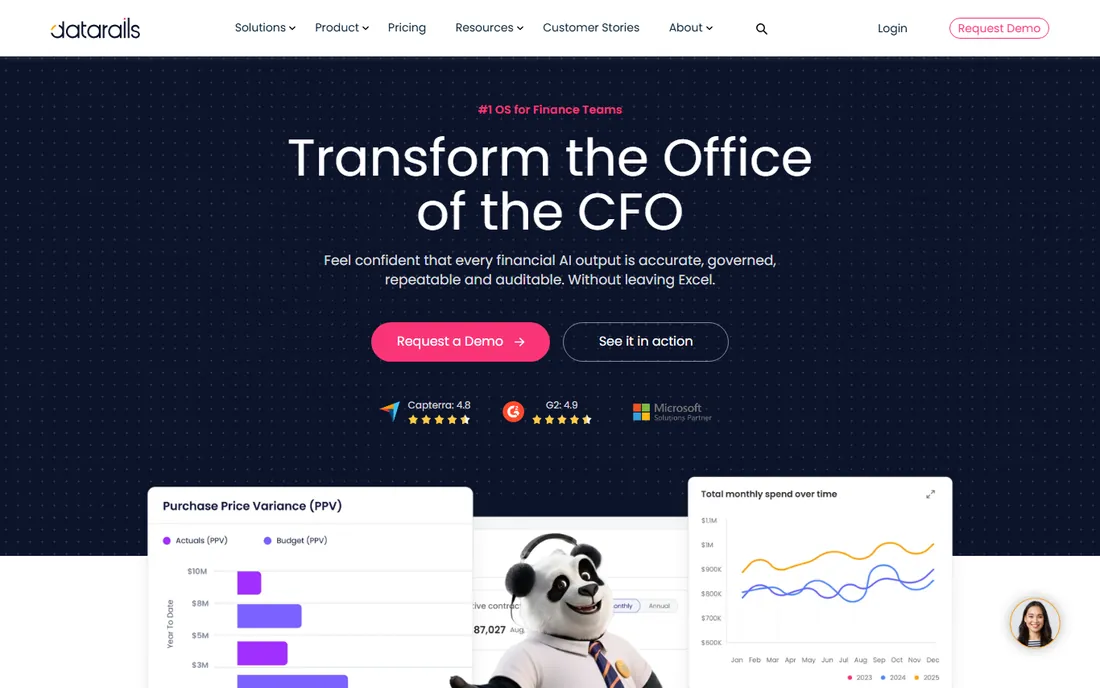
Datarails is an Excel-based FP&A platform that automates data consolidation, reporting, budgeting and forecasting for finance teams. Pricing is quote-based, with starting figures commonly reported around $20,000 per year; evaluations run through demos and custom proofs of concept rather than free trials.
The product's pitch is simple: keep Excel, lose the manual work. Datarails connects spreadsheets to source systems, automates data refreshes, consolidates actuals across entities, and builds board-ready reports and dashboards with drill-down to transactions. Scenario and variance analysis run on live data instead of static exports.
The honest limits: it is FP&A software, not a full close management suite, so statutory consolidation depth is lighter than OneStream or Prophix. Pricing opacity means budgeting by quote. For finance teams drowning in manual Excel consolidation who want automation without changing tools, it delivers fast.
What we like- Keeps Excel as the interface
- Automates data consolidation and reporting
- Fast time to value
Watch out for- Quote-based pricing
- No self-serve trial
- Focused on FP&A rather than full close
Starting price$1,250 per month (lean teams)
Free planFree trial
Cube is the first spreadsheet-native FP&A platform, and notably the only tool here with published pricing: plans start at $1,250 per month for lean finance teams and $2,450 per month for companies looking to scale, with customizable enterprise plans above that. A trial is available.
The product connects Excel and Google Sheets bidirectionally to source systems (NetSuite, QuickBooks, Sage Intacct, HRIS), giving finance teams a single source of truth they access from their own spreadsheets. Features include formula-based calculations, forecasting models, cash management, intercompany accounting and custom report templates, with audit trails and permissions for governance.
The honest caveats: $15,000 a year is still serious money, and Cube is built for finance professionals, not FP&A beginners. Statutory consolidation for complex groups is lighter than OneStream's. But for high-growth mid-market companies that want governed consolidation without abandoning spreadsheets, Cube's transparency and two-week implementations are genuine advantages.
What we like- Published transparent pricing
- Spreadsheet-native with Excel and Google Sheets
- Fast two-week implementations
Watch out for- Starts at $15,000 a year, not cheap
- Built for finance pros, not beginners
- Lighter statutory consolidation
Starting priceSee website
Free planNo
Planful is a continuous planning and FP&A platform with consolidation capabilities, strong in mid-market budgeting, forecasting and structured planning processes. Pricing is quote-based, with starting figures commonly reported around $25,000 per year; evaluation runs through sales demos.
The platform's differentiator is continuous planning: rolling forecasts, driver-based models and scenario planning that keep plans current instead of annual and stale. Consolidation, close management and financial reporting sit alongside planning, so the close-to-plan cycle runs in one system with marketing and workforce planning modules available.
The honest reality is enterprise buying: no trial, no published prices, and an implementation that needs finance team buy-in. Companies with simple structures may find it more process than they need. For mid-market CFOs building a planning-led finance function with consolidation included, Planful is a solid contender.
What we like- Continuous planning methodology
- Strong mid-market presence
- Consolidation plus budgeting in one flow
Watch out for- Quote-based pricing
- No free trial
- Implementation and change management needed
#7
Jedox
Best for: Flexible planning and consolidation platform
Visit jedox.com
Starting priceSee website
Free planFree trial
Jedox is a flexible enterprise planning and consolidation platform popular in Europe, built on multidimensional modeling that handles complex business logic. Pricing is quote-based and customized by use case; a free trial is available for evaluation.
The platform's strength is flexibility. The in-memory OLAP engine supports sophisticated models for consolidation, budgeting, forecasting and operational planning, with Excel, web and mobile interfaces. It adapts to unusual structures and industry-specific requirements that more rigid platforms struggle with.
The honest caveats: flexibility cuts both ways, and getting the most from Jedox requires modeling expertise on the finance or IT side. The US presence and partner ecosystem are smaller than domestic rivals. For European groups and companies with complex modeling needs, it deserves a place on the shortlist.
What we like- Flexible multidimensional modeling
- Strong in Europe
- Trial available
Watch out for- Pricing is quote-based
- Flexibility demands modeling expertise
- Smaller US presence
Starting priceSee website
Free planNo
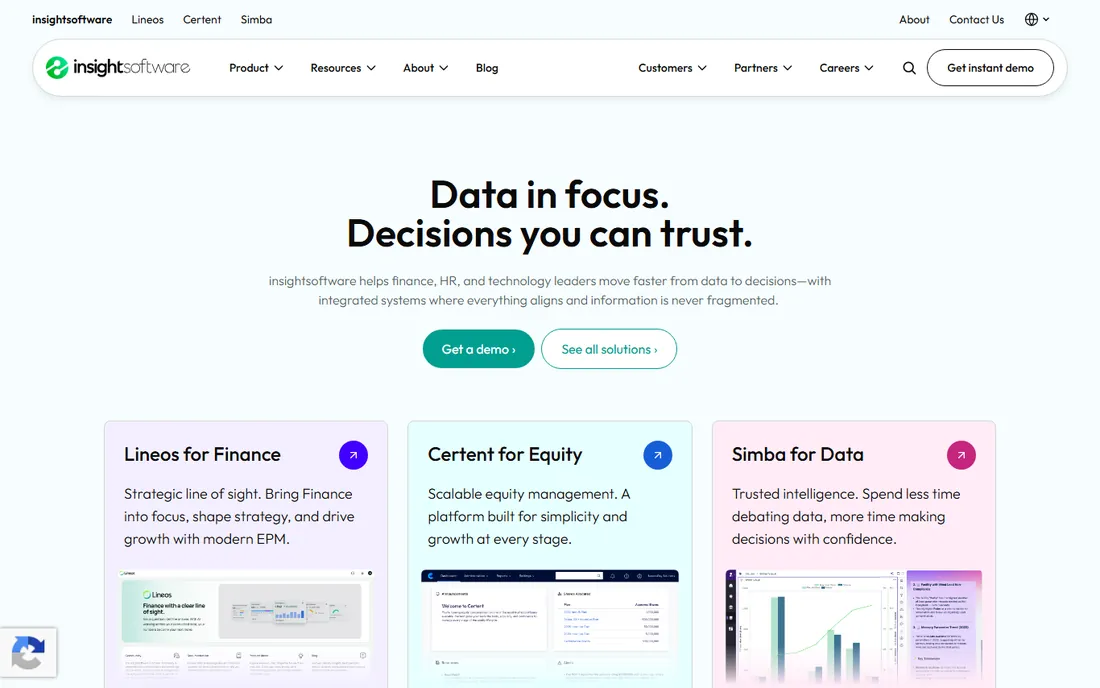
insightsoftware offers a broad suite for the Office of the CFO, including financial consolidation alongside reporting, planning, close management, tax and equity management. Pricing is quote-based, with evaluation through demos.
The suite strategy is the pitch: consolidation connects to reporting, disclosure management, lease accounting and other CFO functions from one vendor, with deep connectivity to major ERPs. For finance teams standardizing on a single vendor across the close-to-disclose cycle, that breadth reduces vendor management.
The honest caveats: the suite was built partly through acquisitions, so integration depth varies by product, and the breadth can be more than a pure consolidation buyer needs. Pricing is fully custom. It suits larger finance organizations buying a platform strategy rather than a point tool.
What we like- Broad CFO suite beyond consolidation
- Strong ERP connectivity
- Acquisitive product depth
Watch out for- Suite breadth can mean integration complexity
- Quote-based pricing
- Best for larger finance teams
What to compare before you buy
Start with structural complexity. A group with five entities in one currency can consolidate in Cube, Vena or Datarails. A group with fifty entities, intercompany trading, minority interests and multi-GAAP reporting needs OneStream, Prophix or insightsoftware. Buying enterprise depth for a simple structure wastes money; buying a lightweight tool for a complex group fails at audit time.
Consolidation vs planning vs close
These overlap but differ. Consolidation aggregates entity financials into group statements with eliminations and currency translation. Planning covers budgeting and forecasting. Close management handles reconciliations and task workflows. OneStream and insightsoftware span all three; Cube, Vena and Datarails lean toward planning with consolidation features. Define which jobs you are buying before comparing.
Implementation and total cost
License quotes are only part of the cost. Enterprise consolidation projects need implementation services, data integration work and finance team training, often matching or exceeding the first year of licensing. Ask every vendor for reference customers with your entity count and ERP, and budget the services line, not just the subscription.
How we chose
We built this list from each vendor's product documentation and published pricing, cross-checked against 2026 market research. Every tool had to offer real financial consolidation (multi-entity aggregation, eliminations, currency handling) and be live today. Prices are stated exactly as documented; where pricing is unpublished or quote-only, which is the norm in this category, we wrote "See website". We did not run hands-on trials; this guide reflects documented capabilities as each vendor presents them.
Frequently asked questions
How much does financial consolidation software cost?
Almost all pricing is quote-based. Cube publishes plans from $1,250 per month. Reported starting figures for others run roughly $14,400 a year for Vena, $20,000 for Datarails, $25,000 for Planful and $50,000 for Prophix, with OneStream, Jedox and insightsoftware fully custom. Implementation services typically add substantially to first-year cost.
What does financial consolidation software actually do?
It aggregates financial data from multiple entities into group financial statements: collecting trial balances, translating currencies, eliminating intercompany transactions and balances, handling minority interests, and producing audit-ready consolidated reports. Modern platforms add planning, close workflows and disclosure management on top.
Can I do consolidation in Excel?
Small groups do, but it breaks with scale: version chaos, no audit trail, manual eliminations and error-prone currency translation. Excel-native tools like Vena, Datarails and Cube keep the spreadsheet interface while adding a governed database underneath, which is the practical middle ground before full platform consolidation.
How long does implementation take?
Cube advertises implementations as short as two weeks. Mid-market platforms like Vena, Prophix and Planful typically take several weeks to a few months. Enterprise OneStream and insightsoftware deployments can run six months or more depending on entity count, ERP integrations and reporting requirements.
Do I need consolidation software or just FP&A software?
If you operate one entity, FP&A software covers planning and reporting. If you operate multiple legal entities and need group financial statements with eliminations and currency translation, you need consolidation capability. Many platforms now do both, so multi-entity groups should buy a tool that handles the full close-to-report cycle.
Which consolidation tool works with my ERP?
All eight connect to major ERPs. Cube integrates natively with NetSuite, QuickBooks and Sage Intacct. Vena, Datarails and Planful cover the mid-market ERP range. OneStream, Prophix, Jedox and insightsoftware handle SAP, Oracle and multi-ERP setups. Confirm your specific ERP and version with the vendor during evaluation.
Sources we checked (9)
- https://www.onestream.com/
- https://www.venasolutions.com/
- https://www.prophix.com/
- https://www.datarails.com/
- https://www.cubesoftware.com/pricing/
- https://planful.com/
- https://www.jedox.com/en/
- https://www.insightsoftware.com/
- https://www.cubesoftware.com/blog/onestream-alternatives
Is your product missing or out of date?
We review this list regularly. Vendors can request a listing, send updated pricing or ask about featured placement.

Shihab Mia · Founder, Rankite
Shihab has spent more than a decade helping SaaS and e-commerce brands grow through search. He writes Rankite's software buying guides from pricing pages, documentation and public user reviews. More about Shihab.