How we make this list: we compare pricing pages, product documentation and public user reviews. Rankite is independent; if a vendor ever pays for a featured spot, that listing is clearly labeled Partner.
Key takeaways
- CLO 3D and Browzwear lead 3D garment design, with Browzwear stronger on the full development workflow and CLO 3D on designer adoption.
- Marvelous Designer, from the same company behind CLO, is the cloth simulation choice for games, film and digital fashion.
- Tukatech, Optitex and Style3D cover the production side: pattern making, grading, nesting and factory handoff.
- Adobe Illustrator and CorelDRAW still handle the 2D work: technical flats, prints and textile graphics.
Quick comparison
| Tool | Best for | Starting price | Free plan |
|---|
 CLO 3D CLO 3D | designers moving to 3D sampling | See website | Free trial |
 Browzwear Browzwear | brands digitizing the whole development process | See website | No |
 Marvelous Designer Marvelous Designer | realistic digital clothing for games, film and fashion | See website | Yes |
 Style3D Style3D | AI-accelerated fashion design and marketing | See website | No |
 Tukatech Tukatech | affordable professional pattern making | $19/month | No |
 Optitex Optitex | manufacturers needing 2D/3D CAD/CAM | See website | No |
 Adobe Illustrator Adobe Illustrator | technical flats, prints and textile design | See website | Free trial (7 days) |
 CorelDRAW CorelDRAW | vector graphics with a perpetual license option | $549 one-time | Yes |
Is your product missing or out of date?
We review this list regularly. Vendors can request a listing, send updated pricing or ask about featured placement.
Fashion design software splits into three jobs. 3D tools (CLO 3D, Browzwear, Marvelous Designer, Style3D) create virtual garments and cut physical sampling. CAD/CAM tools (Tukatech, Optitex) make production patterns, grade sizes and plan cutting. 2D vector tools (Illustrator, CorelDRAW) draw the flats, prints and graphics that start every collection. Most brands end up with one from each group.
Starting priceSee website
Free planFree trial
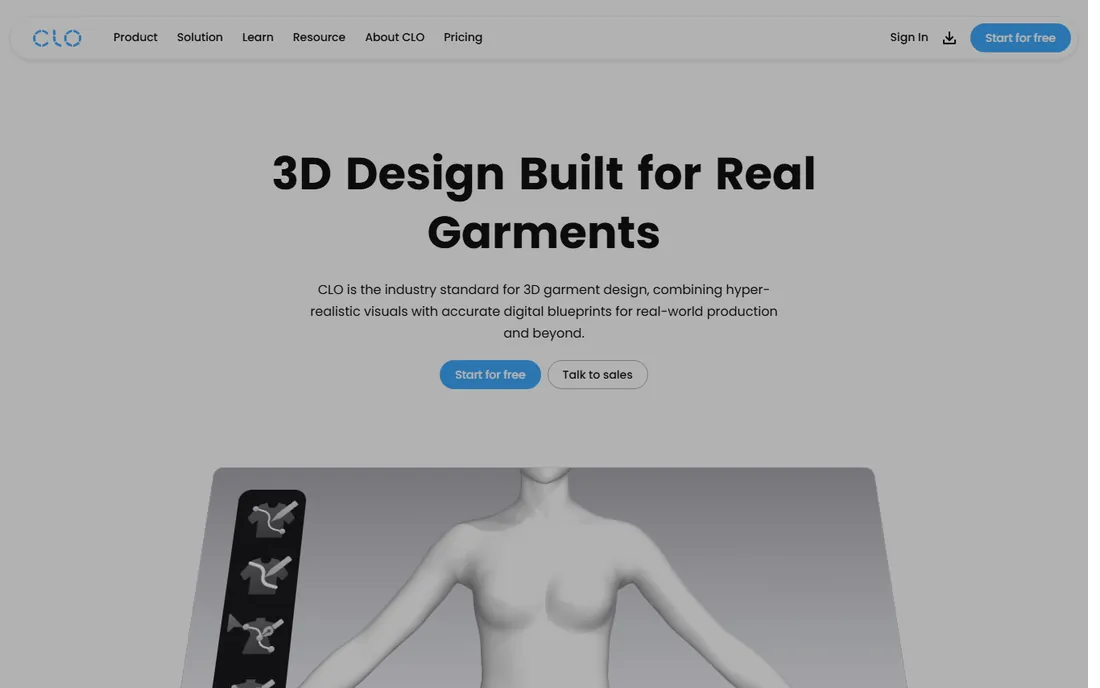
CLO 3D is the name most fashion designers know in 3D. It simulates how fabric drapes, stretches and fits on avatars with enough accuracy to replace physical samples for many garments, and its renders are good enough for e-commerce and marketing.
The platform now stretches from AI-assisted ideation through line planning to factory handoff, with CLO-SET handling the collaboration layer. The honest catch is the learning curve: making a pretty render is easy, making a pattern-accurate digital twin takes training. Pricing is quote-based, which frustrates smaller studios. If your goal is fewer samples and faster approvals, CLO 3D is the default choice.
What we like- Industry standard with 8 million plus designers
- Hyper-realistic drape and fit simulation
- Huge asset library with 2,000 plus official assets
Watch out for- Pricing is not published on the site
- Steep learning curve for pattern-accurate work
- Needs a strong GPU for complex garments
Starting priceSee website
Free planNo
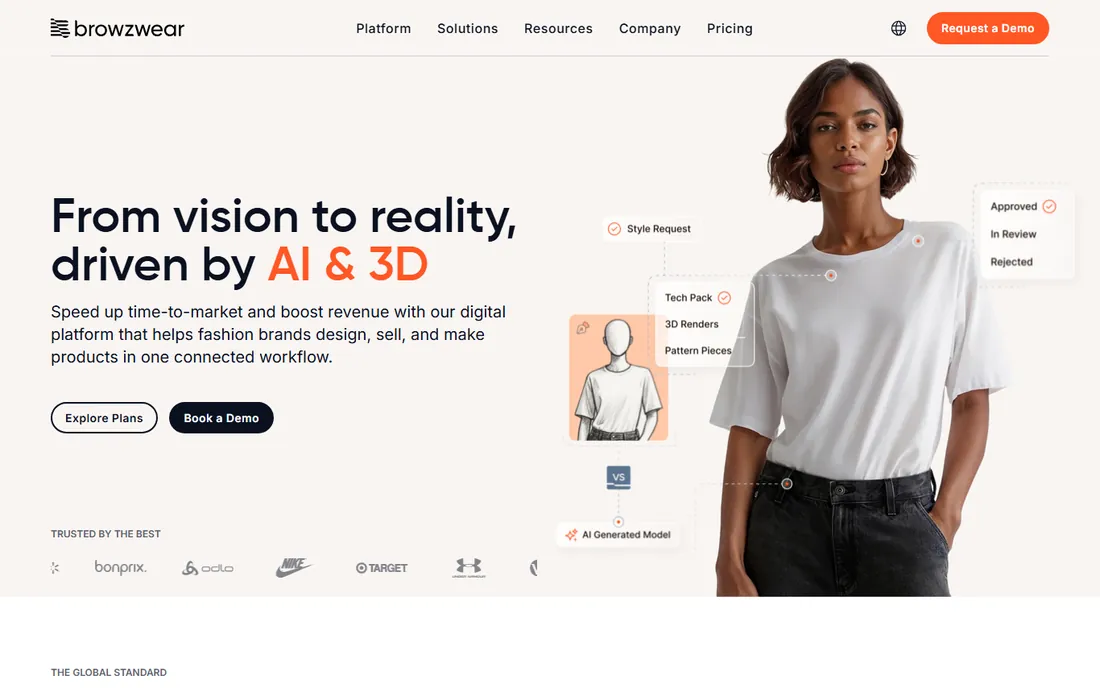
Browzwear's pitch is that most 3D tools stop at design, while it connects every stage from first sketch to factory floor. VStitcher creates the digital twin, AI models validate fit across the size run, Stylezone aligns buyers and vendors around the same 3D asset, and integrations push data to PLM, ERP and factories.
The customer list is the proof: Nike, Target, Puma, Walmart and over 1,000 apparel companies. Reported results include 50 to 80 percent fewer physical samples. This is enterprise software with enterprise pricing and implementation, so independent designers should look at CLO 3D or Style3D instead. For brands and manufacturers digitizing product development, Browzwear is the platform play.
What we like- Connects design through factory in one workflow
- Physics-based simulation with real fabric data
- Trusted by Nike, Target, Puma and Walmart
Watch out for- Enterprise pricing and sales process
- Heavier implementation than CLO 3D
- Overkill for independent designers
Starting priceSee website
Free planYes
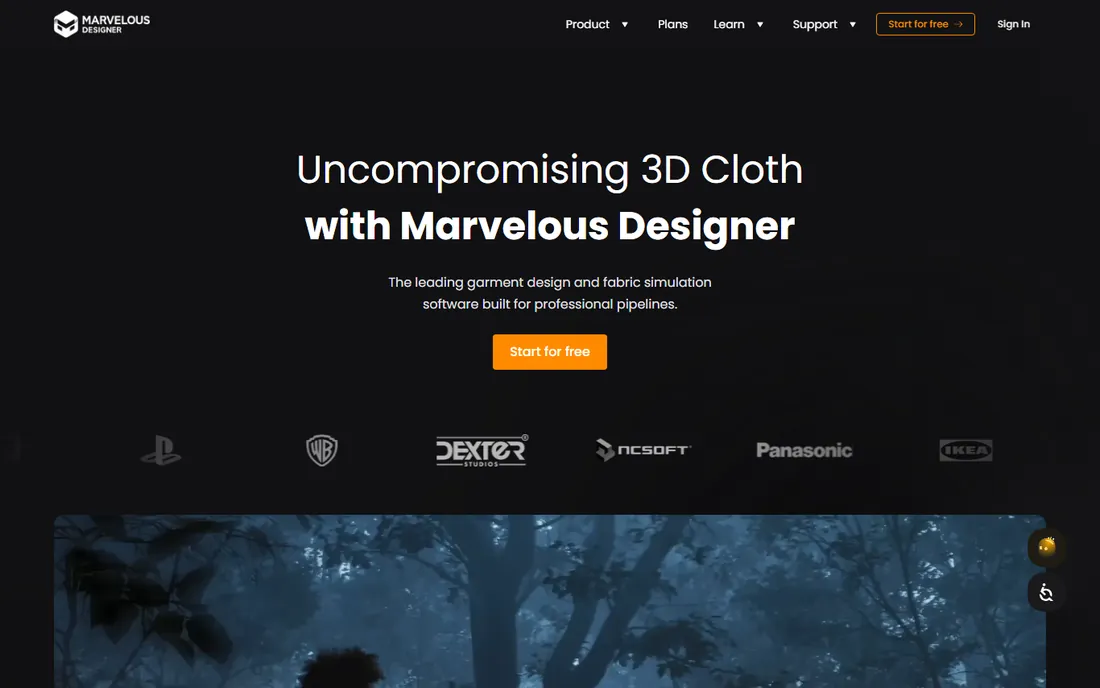
Marvelous Designer comes from the same company as CLO 3D and shares its simulation engine, but it is tuned for creative industries. Game studios, film VFX teams and digital fashion creators use it to make clothing that moves and drapes realistically on characters.
The workflow is pattern-based, so anyone who understands garment construction picks it up fast, and the results have made it an industry standard for digital cloth. For fashion brands doing production work, CLO 3D is the better sibling. For anyone creating clothing for screens, virtual worlds or digital fashion drops, Marvelous Designer is the tool.
What we like- The best cloth simulation available
- Industry standard in games and film
- Intuitive pattern-based workflow
Watch out for- Fashion production features are lighter than CLO 3D
- Pricing not published
- Aimed at artists more than pattern makers
Starting priceSee website
Free planNo
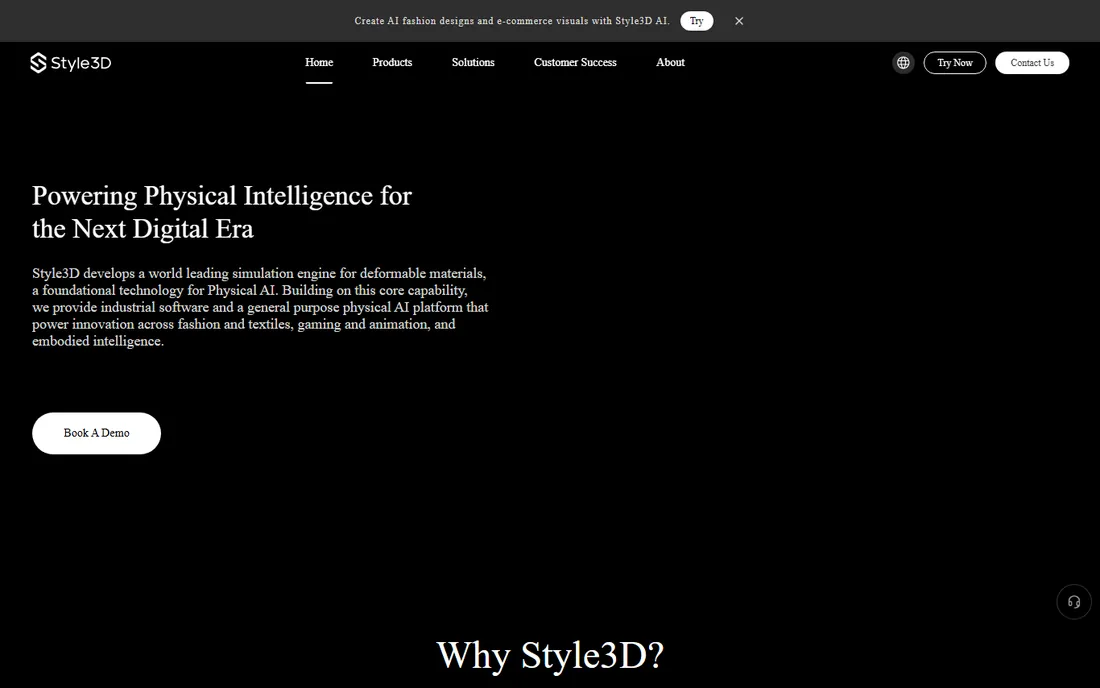
Style3D pairs a serious simulation engine for deformable materials with generative AI, aiming at the whole fashion workflow: AI-powered design inspiration, 3D development, cloud collaboration and marketing renders. It also absorbed Assyst CAD, giving it pattern-making credibility.
The marketing angle is the differentiator: generating high-definition product visuals and runway animations in minutes is a real cost saver for e-commerce teams. The sales motion is enterprise, with demos and quotes rather than self-serve pricing. Brands evaluating Browzwear should put Style3D on the shortlist, especially if AI-assisted design is a priority.
What we like- Combines generative AI with 3D simulation
- Fast e-commerce renders and runway animations
- End-to-end workflow from design to marketing
Watch out for- Demo and quote-based sales
- Newer brand outside China
- Less entrenched in Western supply chains
Starting price$19/month
Free planNo
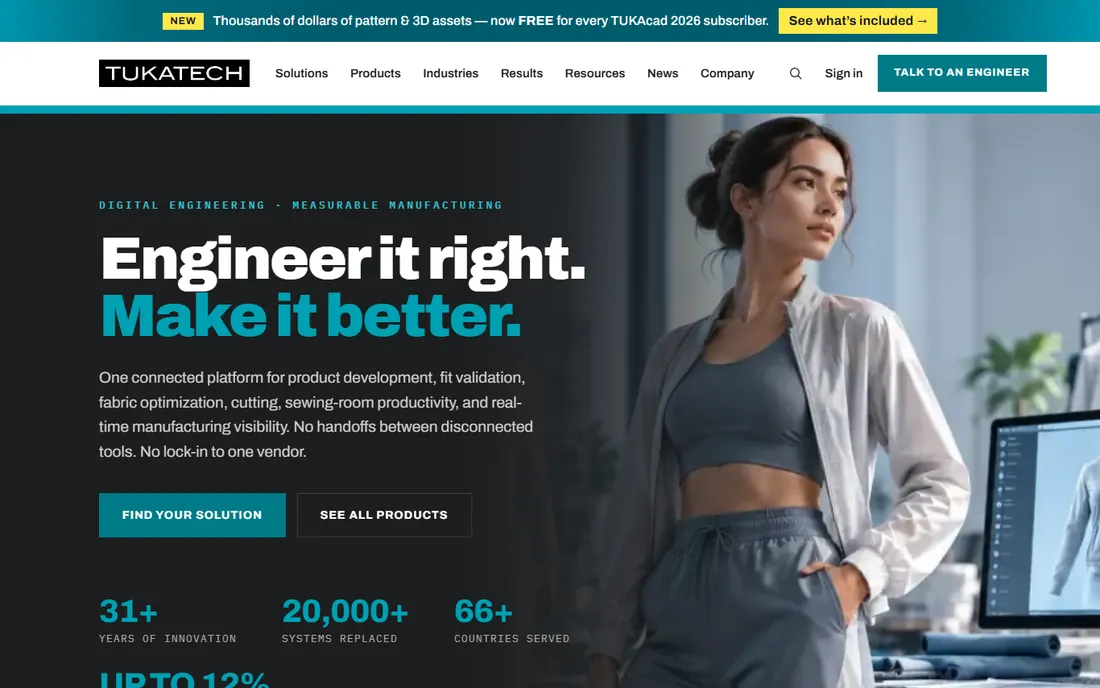
Tukatech has spent 30 plus years building CAD for apparel, and its pitch is refreshingly practical: engineer patterns right, make manufacturing measurable. TUKAcad handles pattern making, grading and markers, TUKA3D adds virtual sampling, and the system extends to cutting-room productivity and real-time factory visibility.
The standout is pricing transparency: TUKAcad subscriptions start at $19 a month, which makes professional pattern CAD accessible to small brands and freelancers. Over 20,000 systems have been replaced with Tukatech's, per the vendor. If your bottleneck is pattern accuracy and production efficiency rather than 3D renders, Tukatech delivers more value per dollar than the 3D-first tools.
What we like- TUKAcad subscriptions start at $19 a month
- Complete ecosystem from pattern to cutting room
- Strong training and support reputation
Watch out for- Interface shows its age in places
- 3D features trail CLO 3D and Browzwear
- Hardware integration adds cost
Starting priceSee website
Free planNo
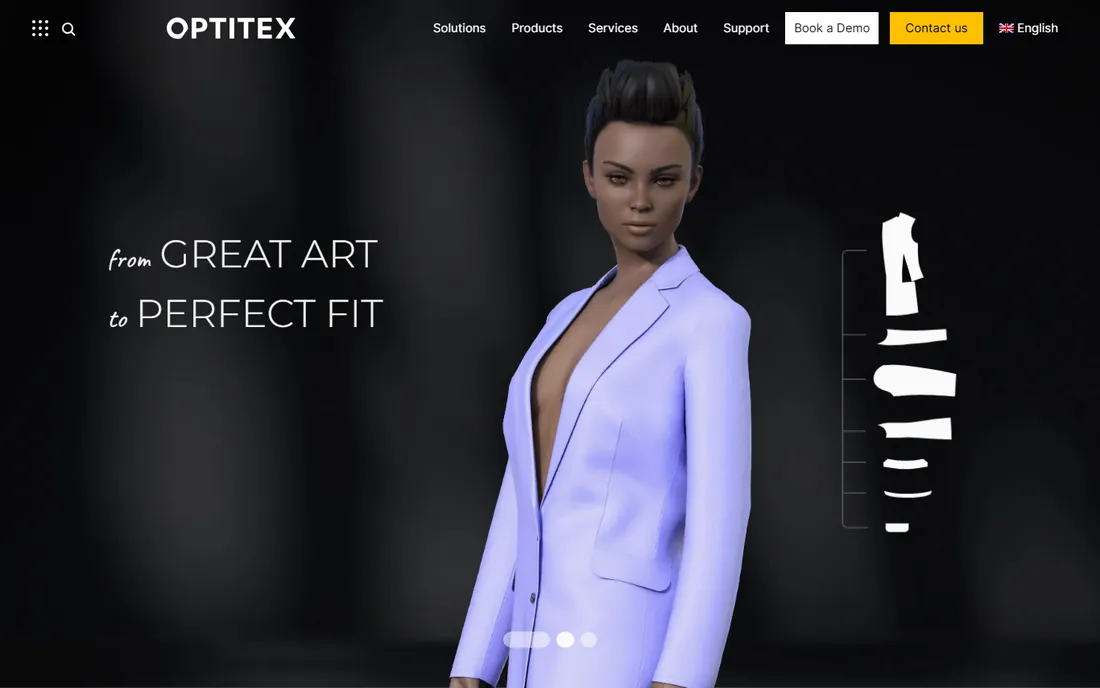
Optitex is a 2D/3D CAD/CAM platform built for manufacturers, with pattern making, grading, nesting and 3D visualization in one interoperable package. Automatic nesting helps with early costing, and open format support means it plays well with other software and cutting hardware.
Customers include Nike, Adidas, Marks and Spencer and Next, which tells you the scale it serves. Like most manufacturing CAD, it is sold through quotes and demos, and implementation is a project, not a download. For cut-and-sew manufacturers and large brands, it belongs on every shortlist alongside Tukatech and Lectra.
What we like- Interoperable 2D/3D platform
- Automatic nesting for early costing
- Strong customer base including Nike, Adidas, M&S and Next
Watch out for- Quote-based enterprise pricing
- Interface less modern than newer rivals
- Implementation needs planning
#7
Adobe Illustrator
Best for: technical flats, prints and textile design
Visit adobe.com
Starting priceSee website
Free planFree trial (7 days)
Almost every fashion designer already uses Illustrator for technical flats, specification drawings, print repeats and textile graphics. It is the 2D foundation that the 3D and CAD tools build on, and its precision tools suit the exactness that tech packs demand.
Illustrator will not drape a garment or grade a pattern, and Adobe does not pretend otherwise. But no 3D tool has replaced it for flats and graphics, and the Creative Cloud integration with Photoshop keeps it central to the design workflow. Every fashion designer needs vector software; for most, this is the one.
What we like- The industry standard for fashion flats and sketches
- Huge library of fashion brushes and templates
- Integrates with Photoshop and the Creative Cloud
Watch out for- Not a 3D or pattern tool
- Subscription cost adds up
- Overkill if you only need basic sketching
Starting price$549 one-time
Free planYes
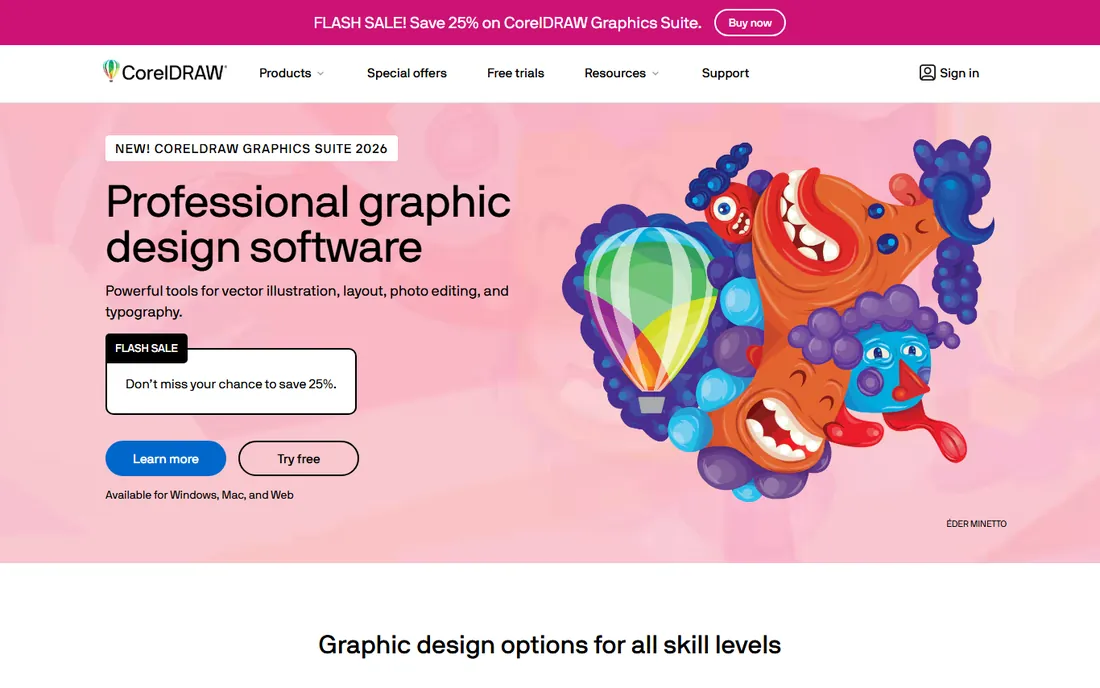
CorelDRAW Graphics Suite 2026 covers vector illustration, layout, photo editing and typography, and it is popular with designers who prefer owning software to renting it: the $549 one-time purchase stands out in a subscription world. It is widely used in print, signage and textile-adjacent work.
In fashion specifically, Illustrator has the deeper ecosystem of fashion templates, brushes and training. But CorelDRAW is a capable alternative for flats, prints and graphics, and the perpetual license appeals to freelancers watching monthly costs. The free trial makes comparison easy.
What we like- One-time purchase available at $549
- Strong for print, signage and textile graphics
- Free trial with no credit card
Watch out for- Less fashion-specific content than Illustrator
- Smaller user community in fashion
- 3D and CAD features are absent
How we chose
We reviewed vendor product pages, pricing information and industry coverage, comparing 3D simulation quality, pattern-making depth, production features, pricing transparency and fit for different business sizes. We covered the three jobs fashion software does (3D design, CAD/CAM production, 2D graphics) rather than listing eight similar 3D tools. We did not claim hands-on testing.
Independent designers and small brands should start with the affordable end: Tukatech for patterns at $19 a month, CLO 3D or Marvelous Designer for 3D, and Illustrator or CorelDRAW for flats. Total monthly cost stays manageable and each tool earns its place.
Mid-size brands digitizing development should evaluate Browzwear and Style3D against CLO 3D, focusing on workflow integration rather than render quality alone. The deciding factor is usually how the tool connects to your PLM and your factories, not how pretty the drape looks.
Manufacturers and large enterprises live in CAD/CAM: Tukatech, Optitex and Lectra are the shortlist, judged on nesting efficiency, hardware compatibility and support. Get references from similar operations before committing, because implementation quality varies more than feature lists suggest.
One more practical note: check file compatibility before you buy. Pattern files move between systems more often than vendors admit, and a CAD tool that cannot cleanly import your existing block library will cost you weeks of redrafting. Ask for a trial import of your own files during evaluation, not just a canned demo.
Frequently asked questions
What is the best 3D fashion design software?
CLO 3D is the most widely adopted, with over 8 million designers. Browzwear is stronger for end-to-end product development at enterprise scale. Marvelous Designer leads for games, film and digital fashion.
How much does CLO 3D cost?
CLO does not publish pricing on its website; it is sold through quotes and subscriptions. Contact CLO or request a demo for current pricing.
Can 3D fashion software replace physical samples?
Partially. Browzwear reports 50 to 80 percent fewer physical samples among customers, and some simple product groups go to production with zero samples. Complex fits and new fabrics still need physical validation.
What software do fashion designers use for technical flats?
Adobe Illustrator is the industry standard for technical flats, spec drawings and print design. CorelDRAW is a capable alternative, especially for designers who prefer a one-time purchase.
What is the difference between CLO 3D and Marvelous Designer?
Both come from the same company and share simulation technology. CLO 3D is built for fashion production workflows, while Marvelous Designer targets games, film, animation and digital fashion.
Which fashion design software is best for beginners?
Tukatech's $19-a-month TUKAcad subscription is the most affordable professional option. For 3D, both CLO 3D and Marvelous Designer offer free trials to learn with. Students should also check each vendor's education pricing, which is often heavily discounted or free.
Sources we checked (8)
- https://clo3d.com/
- https://browzwear.com/
- https://marvelousdesigner.com/
- https://style3d.com/
- https://www.tukatech.com
- https://optitex.com/
- https://www.adobe.com
- https://www.coreldraw.com/
Is your product missing or out of date?
We review this list regularly. Vendors can request a listing, send updated pricing or ask about featured placement.

Shihab Mia · Founder, Rankite
Shihab has spent more than a decade helping SaaS and e-commerce brands grow through search. He writes Rankite's software buying guides from pricing pages, documentation and public user reviews. More about Shihab.