How we make this list: we compare pricing pages, product documentation and public user reviews. Rankite is independent; if a vendor ever pays for a featured spot, that listing is clearly labeled Partner.
Key takeaways
- Ramp and Brex both offer genuinely free entry plans funded by card interchange, which makes them the lowest-risk starting point for startups that want corporate cards with expense controls built in.
- If business travel drives most of your spend, Navan is the only platform here that treats travel booking and expense reporting as one workflow instead of two disconnected tools.
- Expensify and Zoho Expense suit teams that want to keep their existing corporate cards and just fix receipt capture and reimbursements, without adopting a new card program.
- Mesh Payments is the strongest pick for multi-entity global companies, while Pleo remains the most mature card-first option for teams with European operations.
Quick comparison
| Tool | Best for | Starting price | Free plan |
|---|
 Ramp Ramp | startups and SMBs wanting free all-in-one spend management | See website | Yes |
 Brex Brex | startups to mid-market companies wanting cards, banking, and expenses together | $0 (Essentials); Premium $12 per user/month | Yes |
 Navan Navan | companies where business travel drives most of the expense volume | See website | Yes |
 Expensify Expensify | small teams that want the simplest path from receipt photo to reimbursement | See website | Yes |
 Pleo Pleo | European SMBs and mid-market firms that want smart company cards | See website | Yes |
 Mesh Payments Mesh Payments | global enterprises running travel and expense across multiple entities | See website | Yes |
 Zoho Expense Zoho Expense | budget-conscious teams already running on Zoho applications | See website | Yes |
Is your product missing or out of date?
We review this list regularly. Vendors can request a listing, send updated pricing or ask about featured placement.
#1
Ramp
Best for: startups and SMBs wanting free all-in-one spend management
Visit ramp.com
Starting priceSee website
Free planYes
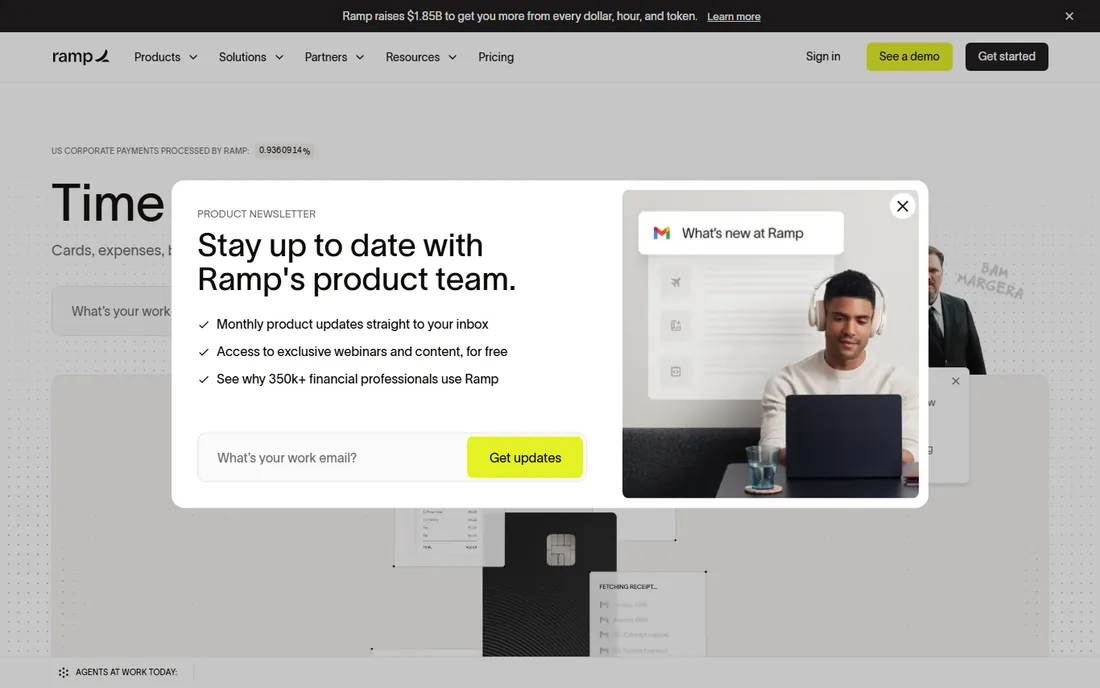
Ramp has become the default recommendation for early-stage companies because the core product costs nothing. You get physical and virtual corporate cards, automated receipt matching, expense approvals, bill pay, and accounting integrations without a subscription. The company makes money from card interchange fees, which is why the free tier can be this generous. For a startup processing a few hundred transactions a month, that removes the usual budget objection entirely.
The trade is that Ramp wants you inside its card ecosystem. Advanced policy controls, AI-assisted expense reviews, and multi-entity administration sit on the paid Plus and Enterprise tiers, and Plus also carries a platform fee on top of the per-user price, so larger teams should get a written quote before committing. International card issuance and locally funded reimbursements are concentrated in Enterprise. If your team is US-centered and you are comfortable running spend on Ramp cards, it is hard to beat on value.
What we like- Genuinely free core plan with unlimited cards and users
- 1.5% cashback on card spend
- Combines cards, bill pay, procurement, and travel in one platform
Watch out for- Advanced approval workflows and multi-entity controls require paid tiers
- International features are strongest on Enterprise
#2
Brex
Best for: startups to mid-market companies wanting cards, banking, and expenses together
Visit brex.com
Starting price$0 (Essentials); Premium $12 per user/month
Free planYes
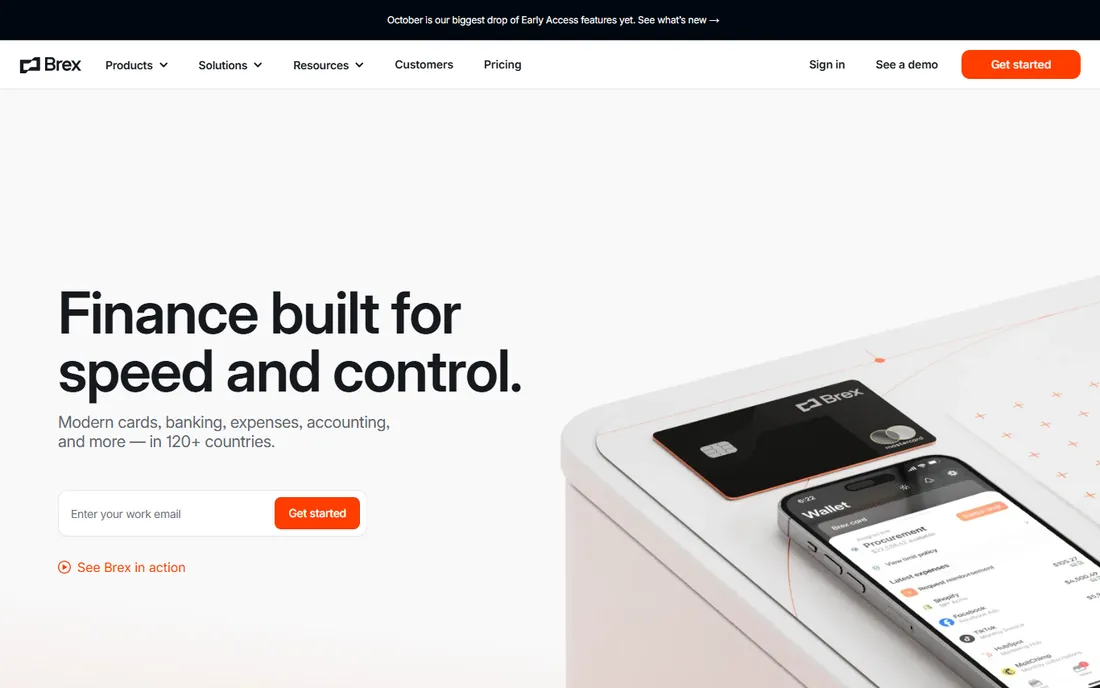
Brex pitches itself as a complete financial stack rather than just an expense tool, and the pricing page backs that up: Essentials is $0 per user per month and includes corporate cards, AI-driven expense rules, travel booking, bill pay, reimbursements, and real-time reporting. Premium at $12 per user per month adds customizable expense policies, dynamic approval chains, multi-entity support, live budgets, and deeper ERP and HRIS integrations. Every plan includes 24/7 support by phone, chat, email, WhatsApp, or text, which is unusual at the free level.
The honest catch is qualification. Not every business will be approved for a Brex card, and companies that cannot use the card lose much of the platform's advantage. Brex also bundles banking and treasury features that a ten-person company may never touch. For funded startups and growing mid-market firms that do qualify, though, the combination of free entry pricing and genuinely useful automation (the company reports 71% of expenses are handled entirely by automation) makes it a strong Ramp alternative, especially if you want business banking in the same login.
What we like- Free Essentials plan includes cards, bill pay, travel, and reimbursements
- 24/7 human support on every plan
- Strong multi-entity and global features on paid tiers
Watch out for- You must qualify for the Brex card to get full value
- The broad feature set can feel like overkill for very small teams
#3
Navan
Best for: companies where business travel drives most of the expense volume
Visit navan.com
Starting priceSee website
Free planYes

Navan, formerly TripActions, is the only tool on this list built travel-first. For companies with up to 300 employees, travel booking costs nothing because Navan earns supplier commissions from airlines and hotels. Expense management is free for your first five monthly expensing users, then charged per active user after that. An active user means someone who actually submitted an expense that month, not everyone with an account, which keeps the bill tied to real usage.
That model fits teams whose expense reports are mostly flights and hotels. Receipts are captured at booking, policies are enforced before money is spent, and employees can keep their existing Visa, Mastercard, or Amex corporate cards through Navan Connect instead of switching card programs. The downside is arithmetic: once you pass five expense users, every additional submitter adds to the monthly bill, and there is no published Enterprise price. If your expenses are mostly software subscriptions and vendor payments rather than travel, a card-first platform like Ramp or Brex will usually cost less.
What we like- Travel booking is free for companies up to 300 employees
- Expense capture is automatic at the point of booking
- Works with your existing corporate cards via Navan Connect
Watch out for- Expense management fees start after the first five users, so costs scale with headcount
- Enterprise pricing is custom and opaque
#4
Expensify
Best for: small teams that want the simplest path from receipt photo to reimbursement
Visit expensify.com
Starting priceSee website
Free planYes
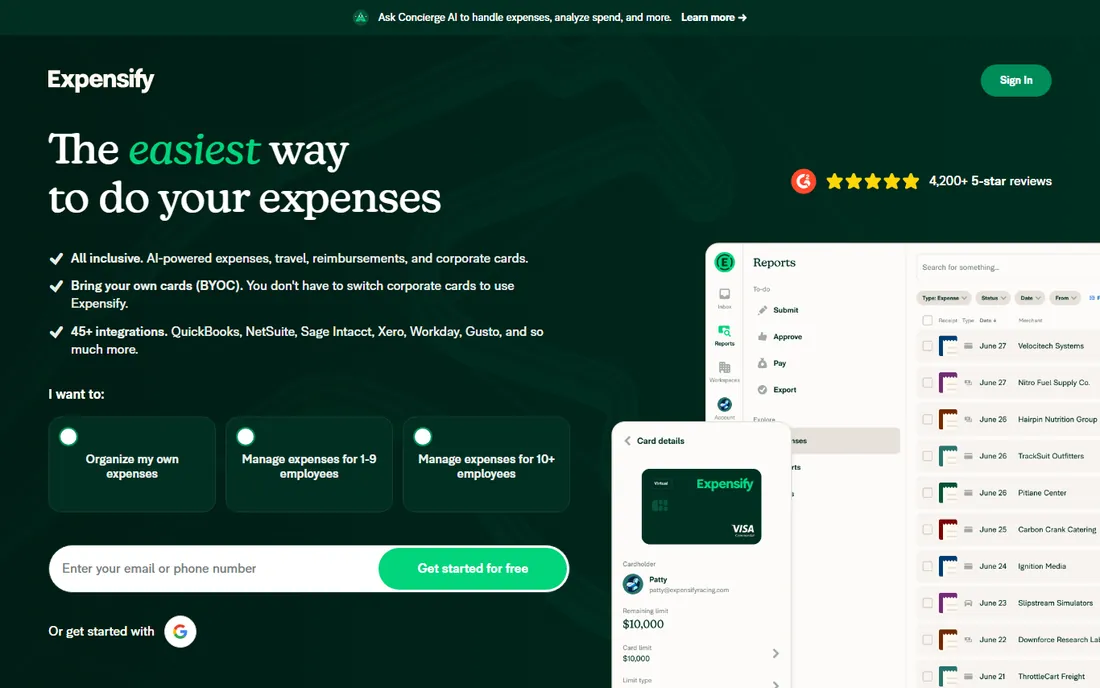
Expensify has been doing this longer than most competitors, and it shows in the small details. Snap a receipt with the mobile app and SmartScan transcribes the merchant, amount, and date; the report practically builds itself. Unlike the card-first platforms, Expensify works with the corporate cards you already have, importing transactions from thousands of banks, and it also offers its own Expensify Card with cashback for teams that want one. Pricing is per active user, so seasonal staff and occasional submitters do not inflate the bill.
The pricing structure is the thing to read carefully. The entry Collect plan is a flat monthly rate per member, while the Control tier has several variations depending on whether you commit annually and route spend through the Expensify Card. Bring your own cards and pay month to month, and the per-user cost can be double the headline rate. There is a free tier for individuals with limited SmartScan credits. Expensify fits best when you want to fix expense reporting without changing how your company pays for things.
What we like- SmartScan receipt capture is fast and accurate
- Bring-your-own-card support from thousands of banks
- Per-active-user pricing means you only pay for people who submit
Watch out for- Pricing varies with card choice and commitment, which complicates budgeting
- Advanced controls require the higher Control tier
#5
Pleo
Best for: European SMBs and mid-market firms that want smart company cards
Visit pleo.io
Starting priceSee website
Free planYes

Pleo created the smart-company-card category in Europe and still leads it there, with more than 40,000 businesses on the platform. Employees get physical or virtual cards with individual limits, snap receipts in the mobile app, and finance sees every transaction in real time with data flowing straight into Xero, QuickBooks, NetSuite, or local systems like DATEV. The pitch is trust within guardrails: give people autonomy to spend, enforce policy automatically, and stop policing expense reports after the fact.
For US-based teams, the honest assessment is that Pleo's center of gravity remains Europe. Feature depth, local card programs, and support coverage are strongest there, and American buyers should confirm exactly what works domestically before rolling out. Pricing is modular rather than a single per-user number, and there is a free Starter plan for very small teams. If your company has European entities or plans to open them, Pleo deserves a serious look; if you operate only in the US, the domestic leaders will feel more at home.
What we like- Mature card-first platform trusted by tens of thousands of European businesses
- Real-time receipt capture with automatic accounting sync
- Strong local integrations like DATEV and Visma
Watch out for- US coverage and support lag the European experience
- Pricing is modular, so the total depends on your configuration
#6
Mesh Payments
Best for: global enterprises running travel and expense across multiple entities
Visit meshpayments.com
Starting priceSee website
Free planYes
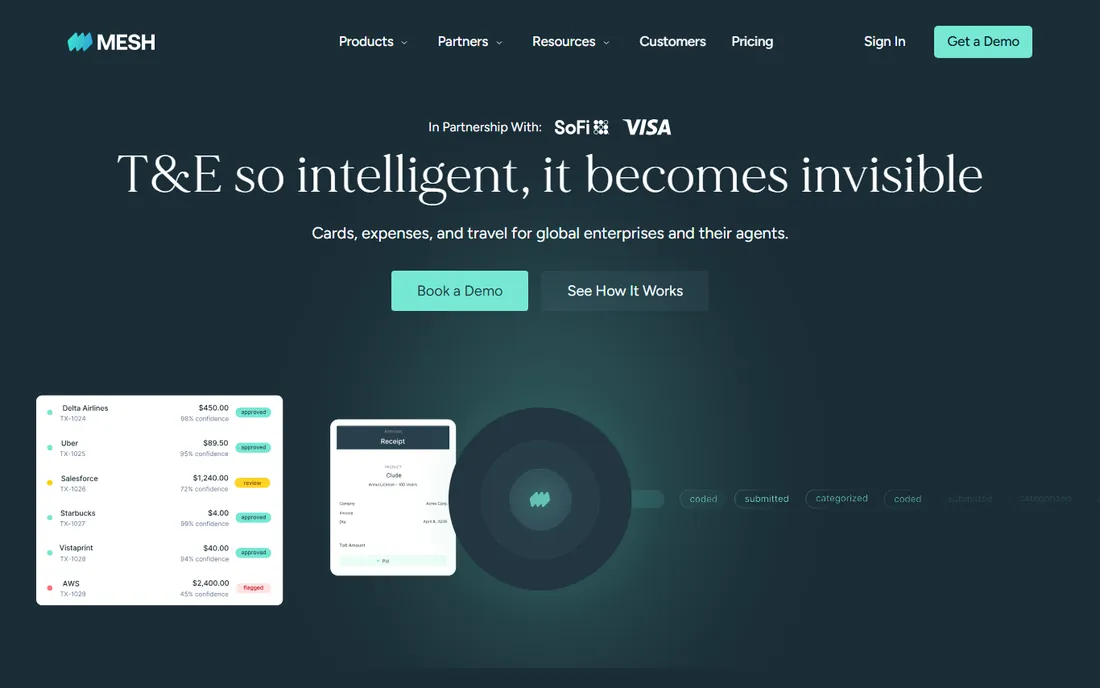
Mesh Payments targets the messy reality of global expense programs: dozens of entities, multiple currencies, and employees booking travel however they like. Its orchestration layer sits over your existing stack, pulling in transactions from corporate cards, travel bookings, and reimbursements, then coding, categorizing, and reconciling them automatically. Local-currency Visa cards are available in more than 40 countries, and the platform handles VAT documentation and multi-entity approval chains that simpler tools cannot.
The overlay approach is a genuine differentiator for large companies that cannot rip out their current card programs. There is a free Pro plan for up to three users, which is enough to evaluate the workflow. The catch is that Mesh is unapologetically enterprise: pricing is unpublished, implementation is consultative, and a 20-person startup will find the platform more than it needs. For finance leaders managing T&E across borders, though, it solves problems the SMB-focused tools on this list do not attempt.
What we like- Purpose-built for multi-entity global T&E with local-currency cards in 40+ countries
- AI receipt processing with automatic GL coding
- No-migration overlay model works with existing cards
Watch out for- Enterprise positioning means less hand-holding for small teams
- Pricing is not published, so expect a sales conversation
#7
Zoho Expense
Best for: budget-conscious teams already running on Zoho applications
Visit zoho.com
Starting priceSee website
Free planYes
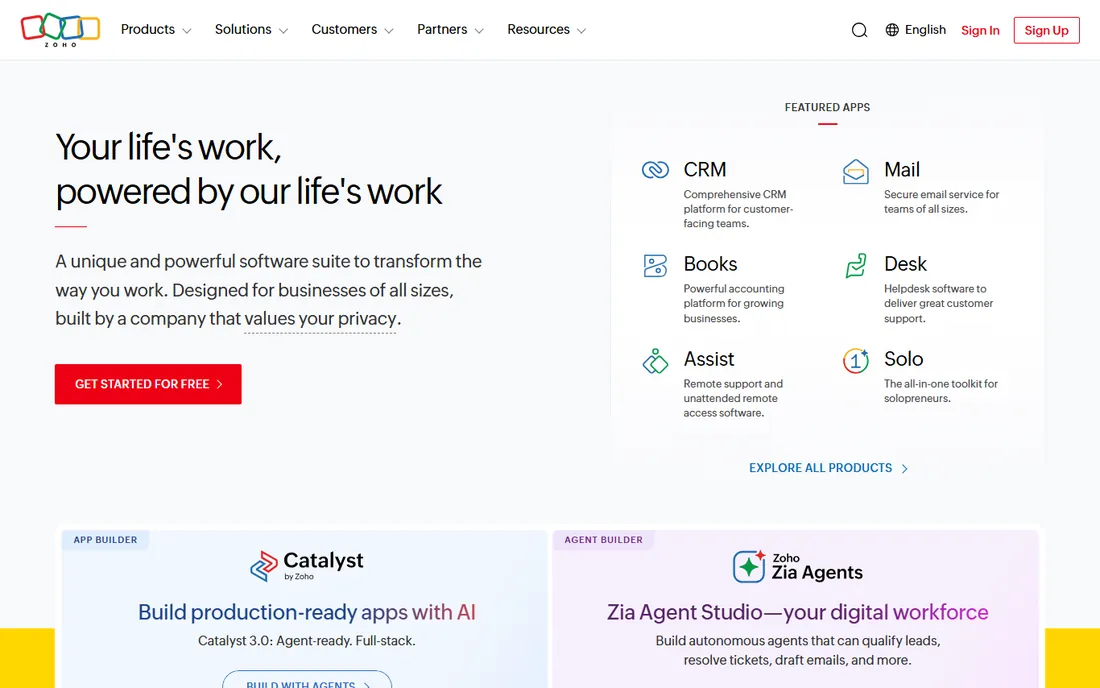
Zoho Expense is the value pick, and the free plan is genuinely usable: up to three users get receipt capture, mileage tracking, and basic approvals at no cost. Paid tiers stay inexpensive by the standards of this category, and the native integration with Zoho Books means approved expenses flow into accounting without CSV exports or third-party connectors. Multi-level approval workflows, policy enforcement, and per diem automation cover the needs of most small businesses.
The limitation is scope. Zoho Expense is one app inside a 50+ product suite, and it shows: the deepest integrations, the smoothest workflows, and the best support experience all assume you run Zoho Books or Zoho One. As a standalone expense tool competing on features alone, it trails Ramp, Brex, and Navan on automation depth and global coverage. But for a small business already paying for Zoho, or a nonprofit watching every dollar, it delivers the core expense workflow at a fraction of the typical cost.
What we like- Free plan covers up to three users with receipt scanning and mileage tracking
- Native sync with Zoho Books
- Multi-level approvals and per diem automation on paid tiers
Watch out for- Best experience requires the Zoho ecosystem
- Global expense features trail the dedicated leaders
How we chose
We started from the fintech expense platforms with real traction in 2026: corporate-card issuers, spend management suites, and travel-plus-expense tools that US finance teams actually evaluate. For each one we checked the vendor's own homepage and pricing page, read plan details and free-tier limits, and compared feature lists, integration catalogs, and support terms. We also weighed public review sentiment from G2 and Capterra and community discussion on Reddit to see where each product frustrates real users. No vendor paid for placement, and we did not accept trial accounts or hands-on demos as the basis for rankings; this guide reflects published product and pricing information as of October 2026.
What to check before you sign up
Start with the card question, because it determines everything else. Ramp, Brex, Pleo, and Mesh are built around their own corporate card programs: the best pricing, the deepest automation, and features like virtual cards and merchant controls assume you run spend on their cards. Expensify and Navan are more flexible, working with cards you already have. If switching card programs is a non-starter for your finance team, that single constraint narrows the field fast.
Next, count who actually submits expenses. Per-active-user pricing (Expensify, Navan) only charges for people who file in a given month, which favors teams with seasonal or occasional submitters. Per-user pricing on every seat (typical of Brex Premium and Ramp Plus) is simpler to forecast but punishes you for dormant accounts. Ask each vendor exactly how they define a billable user before you sign; the definitions differ and the difference shows up on the invoice.
Finally, test the accounting integration with your real chart of accounts, not a demo. Every vendor on this list claims NetSuite, QuickBooks, Xero, or Sage Intacct integrations, but the depth varies: automatic GL coding, multi-entity mapping, and real-time sync are not the same as a nightly CSV export. Run a month of real transactions through a trial before committing, and confirm who handles the mapping work during onboarding.
Where the real costs hide
The headline per-user price is rarely the whole story. Ramp's paid tier adds a platform fee scaled to team size on top of the per-user subscription. Brex is transparent about its per-seat model, but Enterprise features like local card issuance in 50+ countries are custom-quoted. Navan's travel product is free, which can mask how quickly the per-active-user expense fees add up once the whole company is submitting.
Watch for three specific extras. First, implementation and onboarding fees: enterprise-oriented tools like Mesh and Navan Enterprise often include guided setup in the quote, while self-serve tools leave configuration to you. Second, international costs: foreign transaction fees, currency conversion spreads, and per-entity charges can dwarf the subscription for global teams. Third, card program economics: cashback and rewards (Ramp's 1.5%, Brex's travel rewards) offset costs, but only if your spend volume is high enough to matter. Get every fee in writing, including the ones labeled "custom."
Frequently asked questions
Do I need a corporate card to use these tools?
Not always. Expensify and Navan work with cards you already have, importing transactions from thousands of banks. Ramp, Brex, Pleo, and Mesh deliver their best experience on their own card programs, though, with deeper controls and better pricing tied to card usage.
Are the free plans actually usable?
For small teams, yes. Ramp's free plan includes unlimited cards and users with expense management and bill pay. Brex Essentials is free with cards, travel, and reimbursements. Navan offers free travel booking for companies up to 300 employees. Each free tier reserves advanced approvals and multi-entity features for paid plans.
How do these tools handle reimbursements for out-of-pocket spending?
All seven support employee reimbursements via ACH or bank transfer for spending on personal cards. Approval workflows route the request to the right manager, and most platforms let you set reimbursement timelines and track status from a dashboard.
Which tool is best for international expenses?
Mesh Payments leads for multi-entity global programs with local-currency cards in 40+ countries. Brex supports 120+ countries with local card programs on Enterprise. Navan handles multi-currency travel and expense well. Confirm VAT and tax compliance features for each country you operate in.
Can I migrate from spreadsheets or another expense tool?
Yes, and most vendors offer guided onboarding for it. The practical work is mapping your chart of accounts, rebuilding approval chains, and reissuing cards if you switch programs. Plan for a parallel run of one full expense cycle before turning off the old system.
Sources we checked (7)
- https://www.brex.com/pricing
- https://www.brex.com/
- https://ramp.com/
- https://navan.com/
- https://www.pleo.io/
- https://meshpayments.com/
- https://www.zoho.com/
Is your product missing or out of date?
We review this list regularly. Vendors can request a listing, send updated pricing or ask about featured placement.

Shihab Mia · Founder, Rankite
Shihab has spent more than a decade helping SaaS and e-commerce brands grow through search. He writes Rankite's software buying guides from pricing pages, documentation and public user reviews. More about Shihab.