How we make this list: we compare pricing pages, product documentation and public user reviews. Rankite is independent; if a vendor ever pays for a featured spot, that listing is clearly labeled Partner.
Key takeaways
- Ramp and Brex run full expense platforms for free, funded by card interchange; Ramp Plus at $15 a user a month and Brex Premium at $12 add advanced controls.
- Expensify remains the classic expense reporting tool at $5 a member a month for Collect, with an AI concierge that now acts on expenses by chat.
- Fyle became Sage Expense Management in 2026, with plans from $14.99 a user a month and direct card integrations that work without switching cards.
- Zoho Expense is the budget pick at $3 a user a month with a free plan for up to 3 users.
- Navan combines travel booking with expense capture, and its first 5 monthly expensing users are free for companies under 300 employees.
Quick comparison
| Tool | Best for | Starting price | Free plan |
|---|
 Ramp Ramp | free spend management with corporate cards | Free; Plus $15/user/month (plus platform fee) | Yes |
 Brex Brex | startups wanting cards plus spend controls | Free (Essentials); Premium $12/user/month | Yes |
 Expensify Expensify | classic expense reporting and reimbursements | $5/member/month (Collect) | Yes (basic free plan) |
 Zoho Expense Zoho Expense | budget expense automation | $3/user/month (Standard, billed annually) | Yes (up to 3 users) |
 Navan Navan | travel plus expense in one platform | Free (first 5 expensing users); then $15/user/month | Yes (5 users free, companies up to 300 employees) |
 BILL Spend & Expense BILL Spend & Expense | budget control with BILL corporate cards | Free (with BILL corporate card) | Yes |
 Float Float | Canadian teams wanting cards and bill pay | Free (Essential, CAD); Professional $10/user/month CAD | Yes |
 Pleo Pleo | European teams with strong VAT handling | From $39/month (Essential, 3 users included) | No (free trial) |
 Sage Expense Management Sage Expense Management | real-time expense control on existing cards | $14.99/user/month (Growth, minimum 5 users) | No (free trial) |
 Airbase Airbase | procurement-led mid-market spend management | See website (custom quote) | No (free trial) |
Is your product missing or out of date?
We review this list regularly. Vendors can request a listing, send updated pricing or ask about featured placement.
The best expense management software for small business
Three changes reshaped this category in 2026. First, Fyle was acquired and became Sage Expense Management, with new plans starting at $14.99 a user a month. Second, Pleo removed the free Starter tier it once offered for up to three users; entry now starts at paid plans. Third, the free tier became a business model: Ramp, Brex, Float, Navan, and BILL all run genuinely free core plans funded by card interchange rather than subscriptions.
The market keeps growing fast. Research puts expense management software at $7.47 billion in 2025, growing to $8.45 billion in 2026, with AI-driven expense analytics and real-time spend visibility as the main growth drivers. The practical effect is that even free tools now include automated receipt matching, policy enforcement, and AI review features that used to cost per-user fees.
The split that matters for small businesses is card-first versus report-first. Ramp, Brex, BILL, Float, Pleo, and Airbase issue corporate cards and control spend before it happens. Expensify, Zoho Expense, Sage Expense Management, and Navan focus on capturing, approving, and reimbursing expenses after the fact. Pick card-first if you want to prevent overspend; pick report-first if your team spends on personal cards and needs clean reimbursements.
#1
Ramp
Best for: free spend management with corporate cards
Visit ramp.com
Starting priceFree; Plus $15/user/month (plus platform fee)
Free planYes
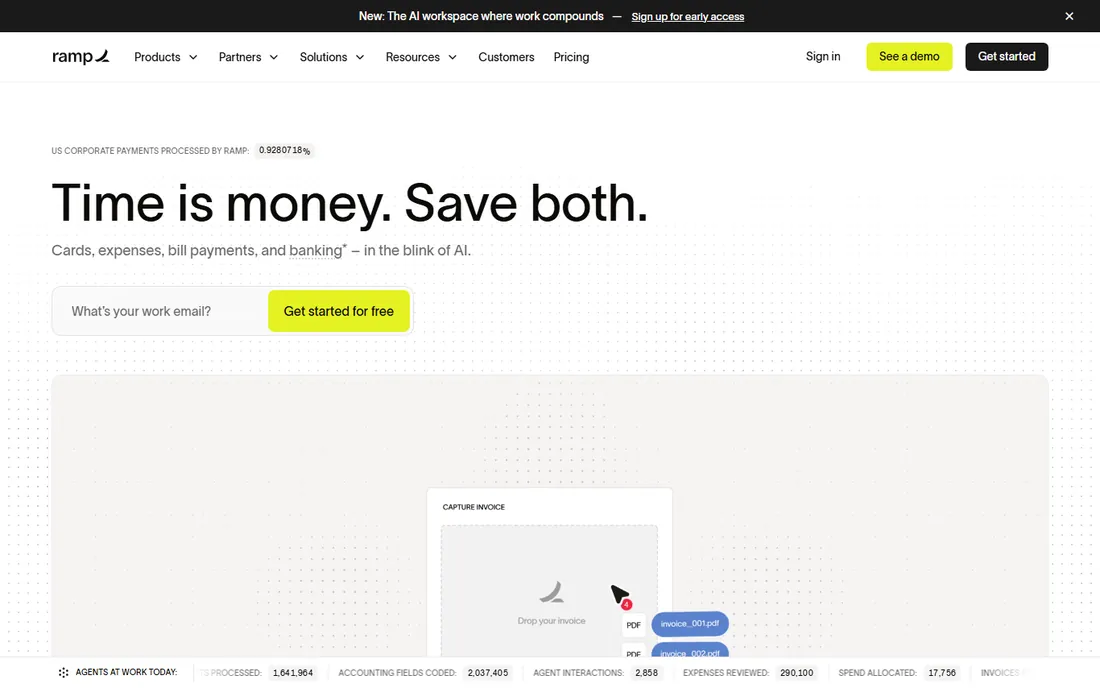
Ramp is the strongest free option in this category. The free plan includes unlimited physical and virtual cards, expense management with automatic receipt matching, ACH bill pay, reimbursements, travel booking, and accounting sync with QuickBooks and Xero. There is no trial timer and no per-user fee. Ramp earns from card interchange, which is why it has no incentive to meter the free tier the way subscription tools do.
Plus at $15 a user a month plus a team-size-based platform fee adds AI-powered expense reviews, advanced approval workflows, procurement and vendor management, and deeper multi-entity and international capability. The honest catch is the ecosystem lock-in: Ramp works best when your card spend moves with it, and expedited payment rails like same-day ACH cost about $10 a payment. For a small business that can run its spending on Ramp cards, the free plan covers nearly everything.
What we like- Core platform genuinely free with unlimited cards
- Bill pay and travel booking included at no cost
- 1.5% cash back on card spend
Watch out for- Advanced controls require Plus
- Expedited payments like same-day ACH carry fees
#2
Brex
Best for: startups wanting cards plus spend controls
Visit brex.com
Starting priceFree (Essentials); Premium $12/user/month
Free planYes
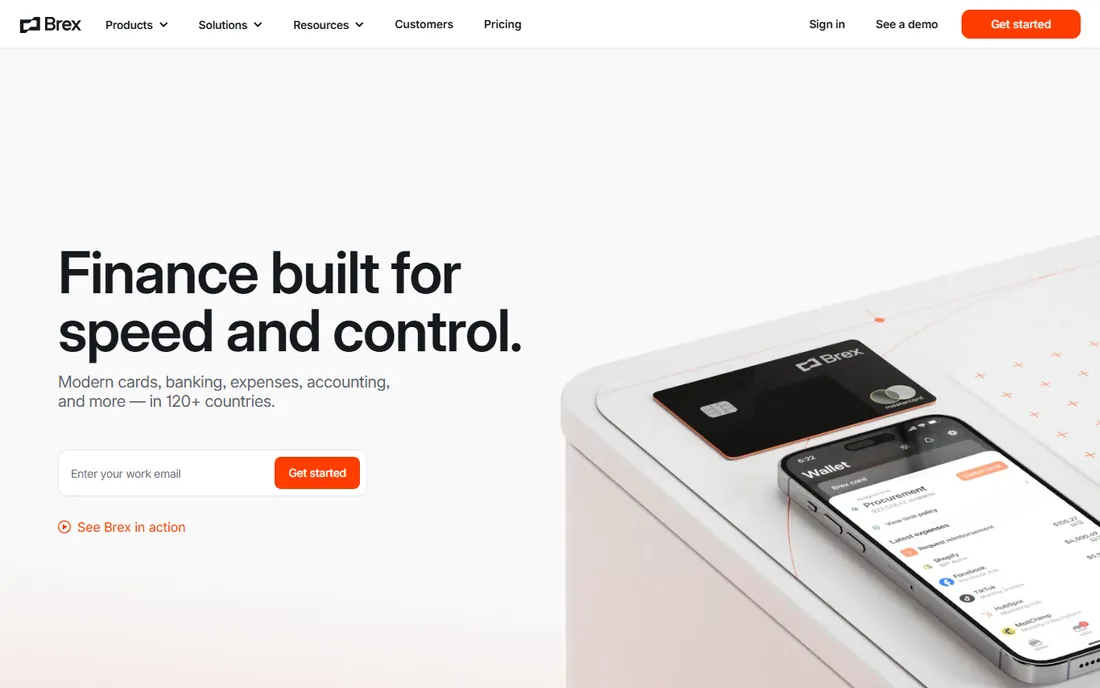
Brex built its name with startups and keeps the strongest free tier next to Ramp. Essentials at $0 a user a month includes reimbursements, bill pay, travel booking, accounting integrations, real-time reporting, support for up to two entities, and access to the corporate card program. Premium at $12 a user a month adds multiple customizable expense policies, dynamic review chains, AI-powered compliance detection, advanced approval structures, additional entities, and ERP and HRIS integrations.
The trade-off mirrors Ramp's: the free plan is excellent, and the platform is built around cards and spend management rather than standalone expense reporting. Employees do not have to use Brex cards to submit expenses, but the full value shows when they do. Startups choosing between Ramp and Brex should compare the Plus and Premium feature lists against their actual workflows; both free tiers are strong enough that the paid decision can wait.
What we like- Free Essentials plan with cards, bill pay, and travel
- Live budgets and AI-assisted expense reviews
- Global card programs
Watch out for- Premium expense controls cost $12 a user
- Deeper international features need higher tiers
Starting price$5/member/month (Collect)
Free planYes (basic free plan)
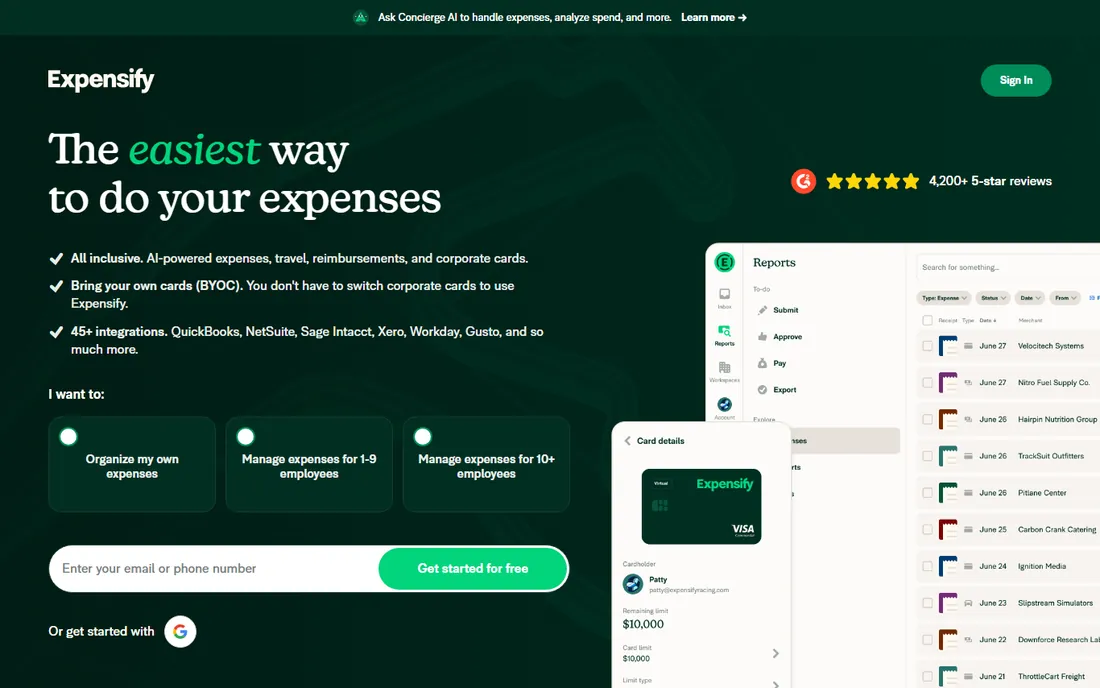
Expensify is the veteran of this list, and its 2026 standout is Concierge AI, which acts rather than only advises: it can approve a report, create a rule, or re-tag a batch of expenses from a chat conversation. Collect at a flat $5 a member a month with no annual commitment includes unlimited SmartScans, expense approvals, bill pay, invoicing, third-party card feeds, global reimbursements, QuickBooks and Xero sync, travel booking, and chat. New customers get a 30-day free trial.
Control is where buyers should read carefully. The advertised $9 a member is a conditional discount that scales with the share of spend running on the Expensify Card, capped at 50 percent off; without the card it is $18 a member on annual billing or $36 pay-per-use. Budget from the undiscounted numbers unless your spend is already heavily on the Expensify Card. For teams that need mature expense reporting without adopting a card program, Collect at $5 remains the simplest honest price in this list.
What we like- Unlimited SmartScan receipt capture on every plan
- No annual commitment on Collect
- AI concierge that approves and re-tags expenses by chat
Watch out for- Control pricing is confusing with conditional card discounts
- Advanced workflows cost $18 to $36 a member without the Expensify Card
Starting price$3/user/month (Standard, billed annually)
Free planYes (up to 3 users)

Zoho Expense wins on price. The free plan covers up to 3 users with receipt capture, mileage, multicurrency, and accounting integrations. Standard at $3 a user a month billed annually adds unlimited users, corporate card reconciliation, multilevel approvals, and 20 autoscans per user. Premium at $5 a user a month adds travel requests, per diem automation, and advanced customization. Charging only for active users keeps the bill honest for teams with seasonal spenders.
The limits are real but fair at this price. The free plan's 20 total autoscans run out fast, and corporate card management, travel booking, and live mileage tracking sit on paid tiers. For a small business already in the Zoho ecosystem, approved expenses post automatically into Zoho Books, which removes double entry. As a standalone, it is the cheapest credible expense automation available.
What we like- Cheapest paid plan in this list
- Free plan for teams of 3
- Integrates with Zoho Books, QuickBooks, and Xero
Watch out for- Free plan limited to 20 total receipt autoscans
- Travel booking and advanced approvals need Premium
Starting priceFree (first 5 expensing users); then $15/user/month
Free planYes (5 users free, companies up to 300 employees)
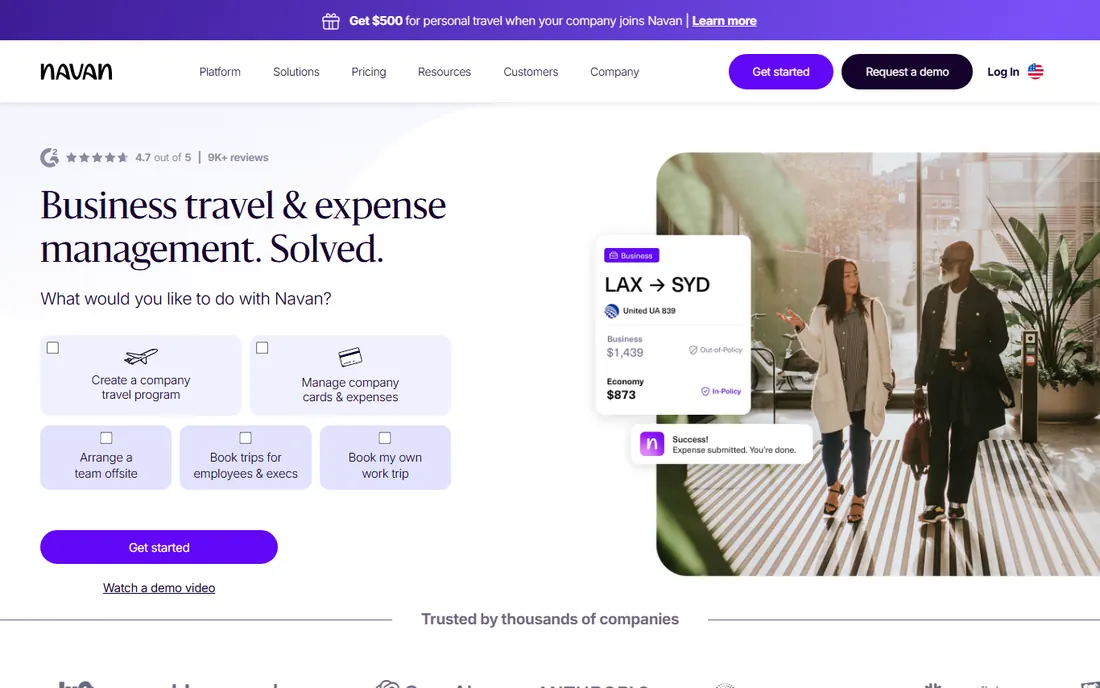
Navan, formerly TripActions, solves the travel-expense problem at the source: expenses are captured automatically when trips are booked, so the expense report largely writes itself. The free tier covers the first 5 monthly expensing users for companies up to 300 employees, with travel booking free through commissions. Beyond that, expensing users cost $15 a user a month.
Policy enforcement happens at booking, which catches out-of-policy spend before it is spent rather than flagging it weeks later. That design is the reason to choose Navan over a pure expense tool. The honest catch is fit: a team that rarely travels pays for a travel platform it barely uses. Sales teams, consultants, and anyone with real travel volume should evaluate Navan first; desk-bound teams should not.
What we like- Travel booking and expense capture in one workflow
- Expenses created automatically at booking
- Generous free tier for small teams
Watch out for- $15 a user beyond the free five adds up
- Travel-centric design is overkill for non-traveling teams
#6
BILL Spend & Expense
Best for: budget control with BILL corporate cards
Visit bill.com
Starting priceFree (with BILL corporate card)
Free planYes
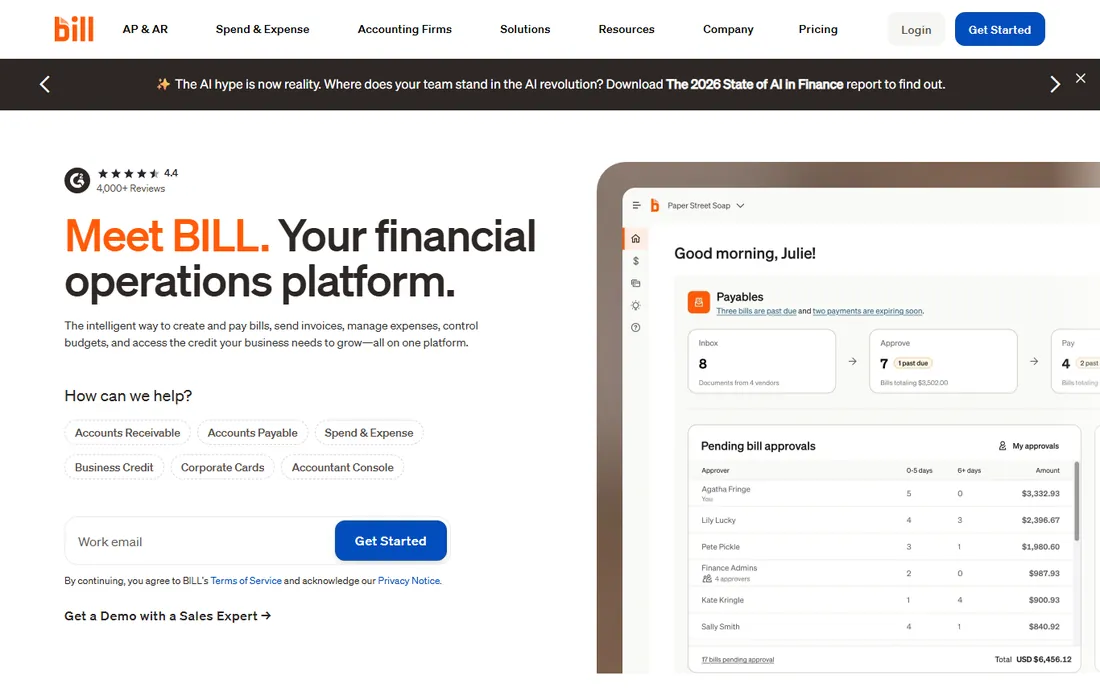
BILL Spend & Expense, the former Divvy, is the free card-first option inside the BILL ecosystem. The expense platform is free with the BILL corporate card, covering spending controls, budgets, virtual cards, and expense management. It integrates naturally with BILL's accounts payable and receivable products, which makes it attractive for businesses already running BILL for bill pay.
The trade-off is the ecosystem. The free expense tier assumes the BILL card, and businesses wanting BILL's full AP automation move into paid tiers. For a small business that wants free spend controls and is happy inside BILL's world, it is a clean fit. Compare it directly against Ramp and Brex, which offer comparable free card programs without requiring other BILL products.
What we like- Free with the BILL card
- Spending controls and budgets built in
- Integrates with BILL's AP and AR products
Watch out for- Free tier tied to the BILL card program
- Paid AP/AR tiers cost extra
Starting priceFree (Essential, CAD); Professional $10/user/month CAD
Free planYes
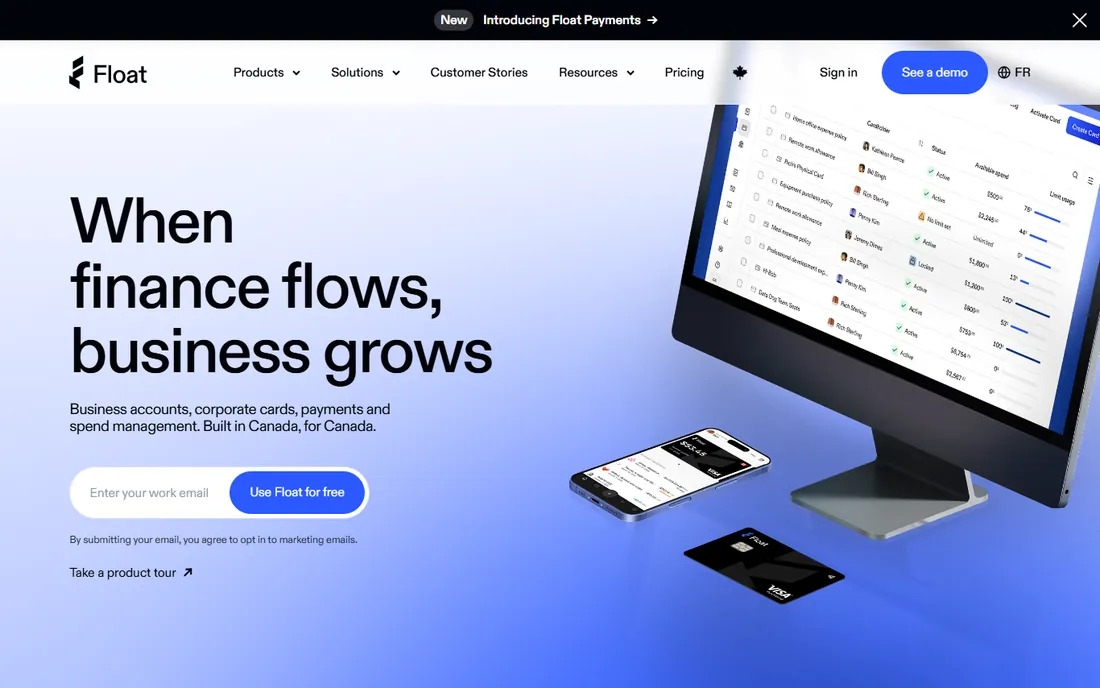
Float is the Canadian answer to Ramp. The free Essential tier includes up to 20 physical and unlimited virtual cards, bill pay, employee reimbursements with mileage, automated receipt collection, Canadian tax tracking, and accounting sync with QuickBooks and Xero, all at $0 a user a month in CAD. Professional at $10 a user a month CAD with a $100 monthly minimum covering 10 active users adds advanced approvals, NetSuite integration, and an AI transaction coding agent.
Pricing is in Canadian dollars and the product is built for Canadian businesses, with CDIC-insured accounts and Interac support. US-only teams should treat Float as a reference point rather than a pick and choose between Ramp, Brex, or BILL. Canadian small businesses get a genuinely free, locally built spend platform.
What we like- Free Essential tier with cards, bill pay, and reimbursements
- CAD and USD cards with Canadian tax tracking
- 1% cashback on spend
Watch out for- Canada-first with limited US fit
- NetSuite integration needs Professional
#8
Pleo
Best for: European teams with strong VAT handling
Visit pleo.io
Starting priceFrom $39/month (Essential, 3 users included)
Free planNo (free trial)
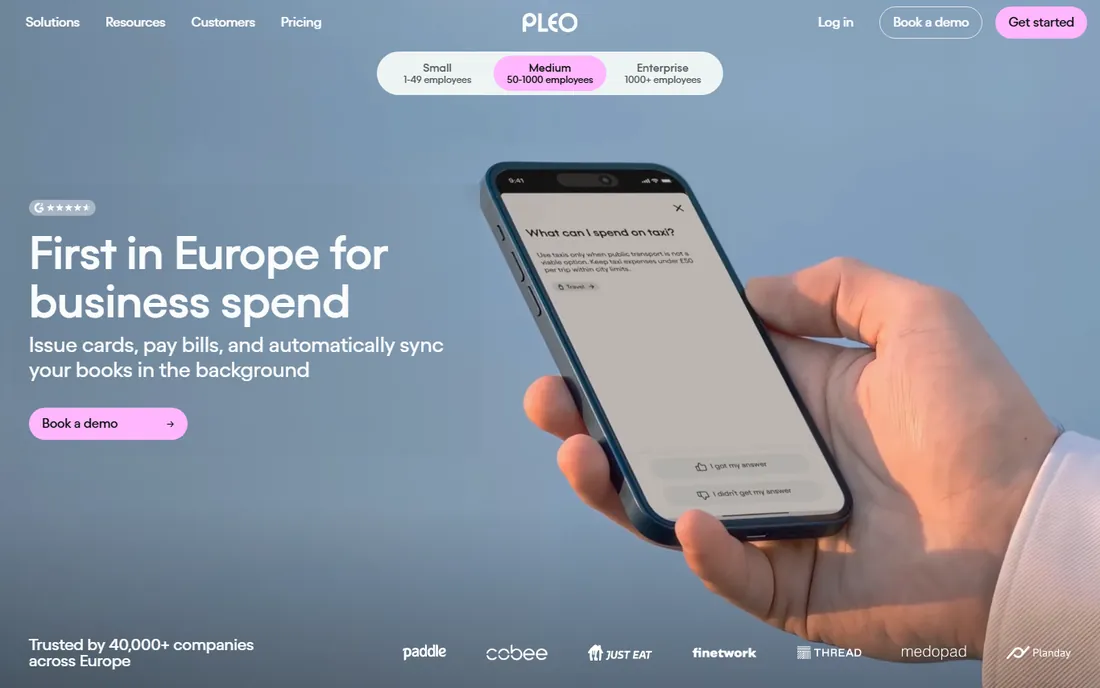
Pleo is the European small-team pick, with smart company cards, real-time expense tracking, and deep integrations with European accounting systems and VAT workflows. Essential from $39 a month includes 3 users, cards, automated expense reports, accounting integrations, and recurring vendor management. Advanced and Beyond add multi-entity management, cashback up to 0.75 percent, AI expense review, and spending insights.
The 2026 change matters: the free Starter plan for up to three users is gone, so the smallest teams now pay from day one. The per-extra-user fees of $11 to $18 a month also compound quickly as headcount grows. Pleo suits UK and EU teams that value VAT-aware expense handling and a simple interface. US teams get less of the localization advantage and should compare Ramp or Brex first.
What we like- Clean receipt-capture UX for non-finance staff
- Strong European accounting and VAT support
- Spending insights and AI review on higher tiers
Watch out for- Free Starter tier was removed in 2026
- Per-extra-user fees of $11 to $18 compound as teams grow
#9
Sage Expense Management
Best for: real-time expense control on existing cards
Visit sage.com
Starting price$14.99/user/month (Growth, minimum 5 users)
Free planNo (free trial)
The biggest acquisition story in this category: Fyle became Sage Expense Management in 2026. The pitch is real-time expense control without changing corporate cards. Direct integrations with existing Visa, Mastercard, and American Express deliver transactions instantly on swipe, so finance sees spend as it happens. Employees submit receipts through Gmail, Outlook, text, Slack, or the mobile app. Growth at $14.99 a user a month with a 5-user minimum adds corporate card management and fraud detection; Business at $17.99 a user a month with a 10-user minimum adds multi-org approvals and ACH reimbursements.
The honest read is that you pay more than Expensify Collect for the real-time card integration and ERP depth. Teams already running NetSuite, Sage Intacct, or Xero that refuse to switch card programs get the most value. Everyone else should weigh whether instant swipe visibility justifies roughly triple the per-user cost of Zoho Expense.
What we like- Works with existing Visa, Mastercard, and Amex without switching cards
- Real-time transaction visibility on swipe
- Strong ERP integrations
Watch out for- No free tier
- Minimum user counts on paid plans
- Rebrand from Fyle may confuse existing users
Starting priceSee website (custom quote)
Free planNo (free trial)
Airbase sits at the top end of this list. It combines procurement requests, accounts payable, and expense management in one system with structured approval chains, which suits mid-market companies where purchasing needs finance oversight before money moves. The guided procurement workflows and vendor management go well beyond expense reporting.
The catch is fit and pricing. Airbase is quote-based with no published plans, and it is more platform than a 20-person company needs. It earns its place here for small businesses that are scaling fast toward mid-market complexity and want one system for procurement and expenses. Everyone else should start with the free tiers from Ramp, Brex, or BILL.
What we like- Unifies procurement, AP, and expense in one workflow
- Strong approval chains for controlled spending
- Guided procurement for larger teams
Watch out for- Custom pricing with no self-serve path
- More platform than most small businesses need
We verified every published price on the vendor's own pricing page or help documentation and marked quote-only platforms rather than inventing numbers. We read 2026 coverage from The Business Research Company, Ramp's own comparison guides, and third-party pricing analyses to track this year's shifts: the Fyle to Sage rebrand, Pleo's removed free tier, and the spread of interchange-funded free plans. We checked reviewer feedback on G2 and Capterra for receipt accuracy, support quality, and ease of use. We weighted each tool to the team size and spending style it serves rather than ranking by feature count.
What to check before you choose
Start with your spending style, not the feature list. If your team spends on company cards, a card-first platform like Ramp, Brex, BILL, Float, or Pleo controls spend before it happens and the free tiers are genuinely usable. If your team spends on personal cards and submits for reimbursement, a report-first tool like Expensify, Zoho Expense, or Sage Expense Management fits better. If travel is the main spend, Navan's booking-to-expense automation beats every alternative.
The real cost of "free"
Free plans from Ramp, Brex, BILL, and Float are funded by card interchange, which means the vendor earns when you spend on their cards. That is not a trick, but it shapes the product: the best features assume your spend runs through their card program. Businesses that keep spending on other cards or bank transfers get less value and may hit paid upsells sooner. Model your actual card mix before committing to a card-first platform.
Per-user versus active-user pricing
Zoho Expense and Fyle's Sage successor charge only for active users who submit expenses, which favors teams with seasonal or occasional spenders. Ramp Plus, Brex Premium, and Expensify charge per user or member more broadly. Count who actually expenses monthly, not your total headcount, when comparing these.
Receipt capture and AI review quality
Receipt OCR accuracy varies more than vendors admit. During trials, test with your real receipts: crumpled thermal paper, foreign currencies, multi-line items. Check whether the AI review flags duplicates and policy violations or just categorizes. Expensify's Concierge AI and Ramp's AI review are the most capable in this list, but verify against your own expense patterns.
Accounting integration depth
Every tool here claims QuickBooks and Xero integrations, but the depth differs. Ask whether approved expenses post automatically as categorized transactions, whether the sync is two-way, and how multi-entity or multi-currency businesses are handled. NetSuite and Sage Intacct support matters for scaling teams; only some platforms include it on lower tiers.
The direction of travel is clear from 2026's launches. AI is moving from receipt scanning to acting on expenses: Expensify's Concierge approves reports and re-tags expenses by chat, Ramp's Plus tier runs AI expense reviews, and Float ships a transaction coding agent. Card programs keep absorbing adjacent workflows: bill pay, travel booking, and procurement now sit inside the same platforms. And the free tier has become a permanent pricing strategy rather than a trial, with interchange revenue funding it. Expect the next wave to be agentic: expense tools that do not just flag policy violations but resolve them, chase missing receipts, and negotiate the renewal the duplicate subscription charge revealed.
Frequently asked questions
What is expense management software?
Expense management software captures, approves, and reimburses business expenses. Card-first platforms like Ramp and Brex issue corporate cards and control spending before it happens. Report-first tools like Expensify and Zoho Expense process receipts and reimbursements after the fact. Most also handle bill pay, travel, and accounting sync.
How much does expense management software for small business cost?
Many strong options are free: Ramp, Brex, BILL Spend & Expense, Float, and Navan's first 5 users cost nothing. Paid plans start at $3 a user a month with Zoho Expense and $5 a member with Expensify. Mid-tier card platforms run $12 to $15 a user a month. Enterprise tools like Airbase are custom quotes.
Which expense management software is free?
Ramp's core plan is free with unlimited cards, as is Brex Essentials. BILL Spend & Expense is free with the BILL card. Float's Essential tier is free in CAD. Navan gives the first 5 expensing users free. Zoho Expense is free for up to 3 users. These free tiers are funded by card interchange, not trials.
Should I choose a corporate card platform or an expense reporting tool?
Choose a corporate card platform like Ramp or Brex if you want to control spending before it happens with limits and approvals. Choose an expense reporting tool like Expensify or Zoho Expense if your team spends on personal cards and needs fast reimbursements. Many businesses use both: cards for planned spend, reimbursements for the rest.
What happened to Fyle?
Fyle was acquired and rebranded as Sage Expense Management in 2026. It now integrates with Sage's product line, with plans from $14.99 a user a month and direct integrations with existing Visa, Mastercard, and Amex cards. Existing Fyle users were migrated to the Sage platform.
Is Expensify or Ramp better for a small business?
Ramp is better if you want free spend management built around corporate cards with proactive controls. Expensify is better if you need mature expense reporting and reimbursements without changing how your team pays. At $5 a member, Expensify Collect is the cheapest paid reporting tool; Ramp's free plan is the cheapest card platform.
Sources we checked (12)
- https://www.ramp.com/pricing
- https://www.brex.com/pricing
- https://www.expensify.com/pricing
- https://www.zoho.com/expense/pricing
- https://www.navan.com/pricing
- https://www.bill.com/pricing
- https://floatfinancial.com/pricing
- https://www.pleo.io/en/pricing
- https://www.sage.com
- https://www.airbase.com/pricing
- https://www.thebusinessresearchcompany.com/report/expense-management-software-global-market-report
- https://use.expensify.com/resource-center/guides/best-business-expense-tracking-app
Is your product missing or out of date?
We review this list regularly. Vendors can request a listing, send updated pricing or ask about featured placement.

Shihab Mia · Founder, Rankite
Shihab has spent more than a decade helping SaaS and e-commerce brands grow through search. He writes Rankite's software buying guides from pricing pages, documentation and public user reviews. More about Shihab.