How we make this list: we compare pricing pages, product documentation and public user reviews. Rankite is independent; if a vendor ever pays for a featured spot, that listing is clearly labeled Partner.
Key takeaways
- Almost every enterprise budgeting vendor quotes custom prices: Anaplan, Workday Adaptive Planning, Planful and Prophix publish no pricing, so budget for a sales process, not a checkout page.
- If your finance team lives in Excel, shortlist Vena, Datarails and Cube. They keep the spreadsheet interface and add a governed database underneath.
- Already running Workday HCM or Financials? Workday Adaptive Planning connects budgets and forecasts to the same data model.
- Mid-market teams that want to move fast should look at Datarails, Cube and Prophix, which are built for shorter implementations than the enterprise platforms.
Quick comparison
| Tool | Best for | Starting price | Free plan |
|---|
 Anaplan Anaplan | Large enterprises running connected planning across finance, supply chain, sales and HR | See website (custom quote) | No |
 Workday Adaptive Planning Workday Adaptive Planning | Companies already running Workday HCM or Financials that want planning on the same data | See website (custom quote) | No |
 Vena Vena | Finance teams that live in Microsoft Excel and Microsoft 365 | See website (custom quote) | No |
 Datarails Datarails | Excel-centric finance teams that want automated consolidation without a long implementation | See website (custom quote) | No |
 Cube Cube | Finance teams that want to keep working in Excel and Google Sheets with a governed data layer | See website (custom quote) | No |
 Pigment Pigment | Enterprises that want AI-driven planning across finance, sales, HR and supply chain | See website (custom quote) | No |
 Planful Planful | Companies that want budgeting, financial close and consolidation in one platform | See website (custom quote) | No |
 Prophix Prophix | Mid-market companies that want plan-to-close coverage with automation built in | See website (custom quote) | No |
Is your product missing or out of date?
We review this list regularly. Vendors can request a listing, send updated pricing or ask about featured placement.
The best enterprise budgeting software
Budget season still breaks the same way it did a decade ago: one master spreadsheet, forty emailed copies, and a finance team spending weeks stitching versions together instead of analyzing numbers. Enterprise budgeting software exists to end that cycle. It puts the budget, the forecast and the actuals in one governed system, with workflows, approvals and scenario modeling built in.
The eight platforms below cover the real market, from the spreadsheet-friendly tools mid-market teams adopt in weeks to the connected-planning platforms large enterprises run across every department. None of them publish prices, which is normal at this tier. What differs is the interface your team works in, the depth of modeling, and how much help you need to get live.
#1
Anaplan
Best for: Large enterprises running connected planning across finance, supply chain, sales and HR
Visit anaplan.com
Starting priceSee website (custom quote)
Free planNo
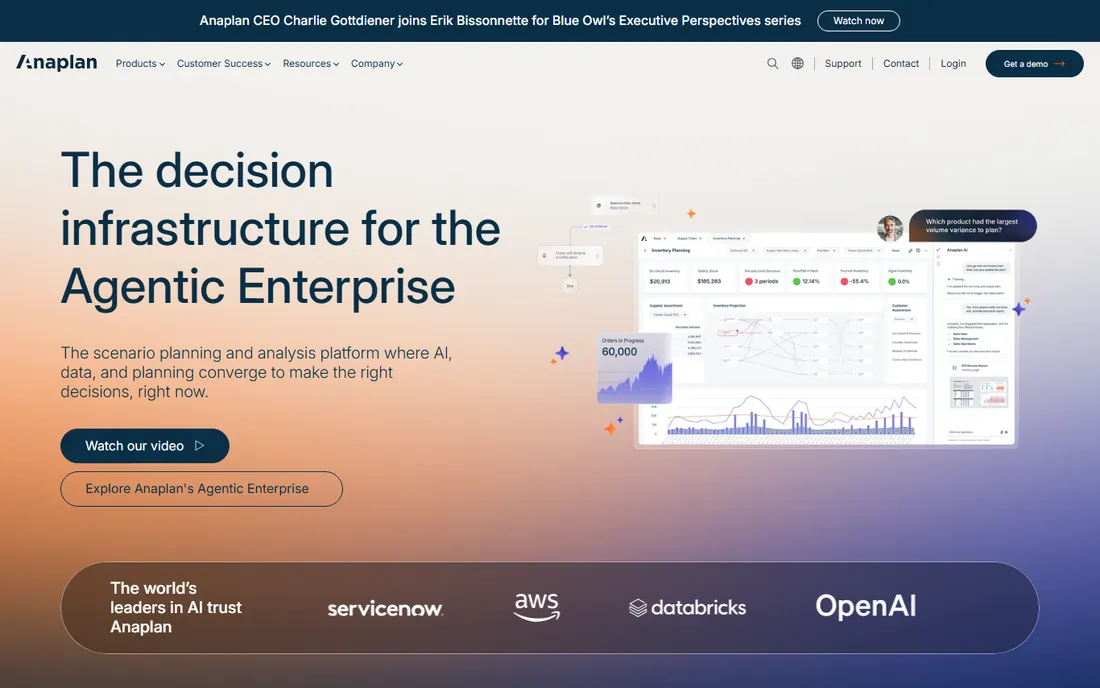
Anaplan is the heavyweight of this list. It is built for companies where the budget is not a finance document but a company-wide operating plan: headcount in HR, inventory in supply chain, quotas in sales, all feeding one set of numbers. The platform's calculation engine handles large models with many dimensions, and its scenario tools let planners test assumptions without rebuilding anything. Anaplan has pushed hard into AI-assisted planning, with agents that work inside the planning environment.
The honest catch is the buying and implementation curve. Everything is custom-quoted, and a full deployment is a project, not a signup. Companies that succeed with Anaplan typically have a dedicated planning team and a partner to configure it. If your finance team is five people with one ERP, this is more platform than you need. If you run planning across business units and countries, it is the reference standard.
What we like- True connected planning: one model can link financial budgets to supply chain, sales and workforce plans
- Strong scenario modeling with a dedicated calculation engine
- Deep partner and consultant ecosystem for large rollouts
Watch out for- No published pricing and a sales-led buying process
- Implementations are consulting-heavy and best suited to companies with real IT and finance transformation budgets
#2
Workday Adaptive Planning
Best for: Companies already running Workday HCM or Financials that want planning on the same data
Visit adaptiveplanning.com
Starting priceSee website (custom quote)
Free planNo
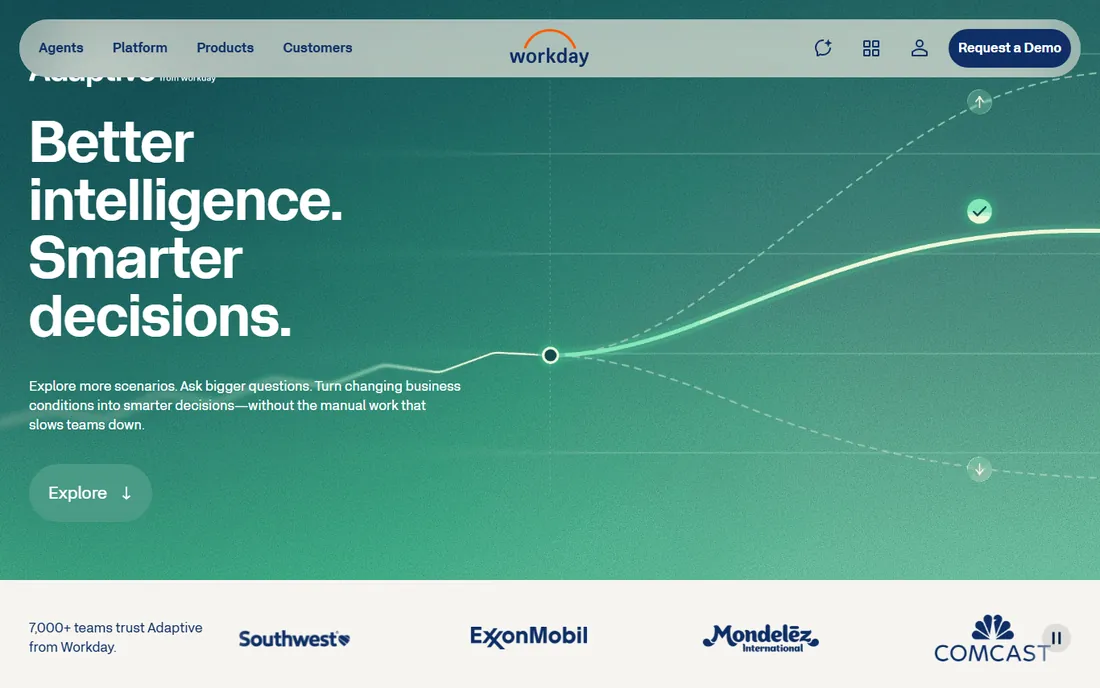
Workday bought Adaptive Insights years ago and folded it into the Workday suite, and that history is the whole pitch: your budget plans sit on the same platform as your HR and financial data. Headcount planning is the standout use case, because open roles, hires and compensation data are already in the system instead of arriving as spreadsheet exports. The platform covers budgeting, forecasting, scenario modeling and reporting, with AI features aimed at variance explanations and driver analysis.
The catch is the ecosystem lock-in. Adaptive Planning works as a standalone product, but its strongest argument is the Workday connection, and pricing is entirely custom. Companies on NetSuite or SAP get less of the integration benefit. If your company already runs Workday, this is the path of least resistance. If not, compare it against the spreadsheet-native options below before committing.
What we like- Planning connects directly to Workday HCM and financial data, so headcount and actuals flow in automatically
- Strong workforce planning since HR and finance share one model
- Recognizable interface that Workday users learn fast
Watch out for- Pricing is quote-only and the value case is weakest for companies not already on Workday
- Deep customization still benefits from implementation help
Starting priceSee website (custom quote)
Free planNo
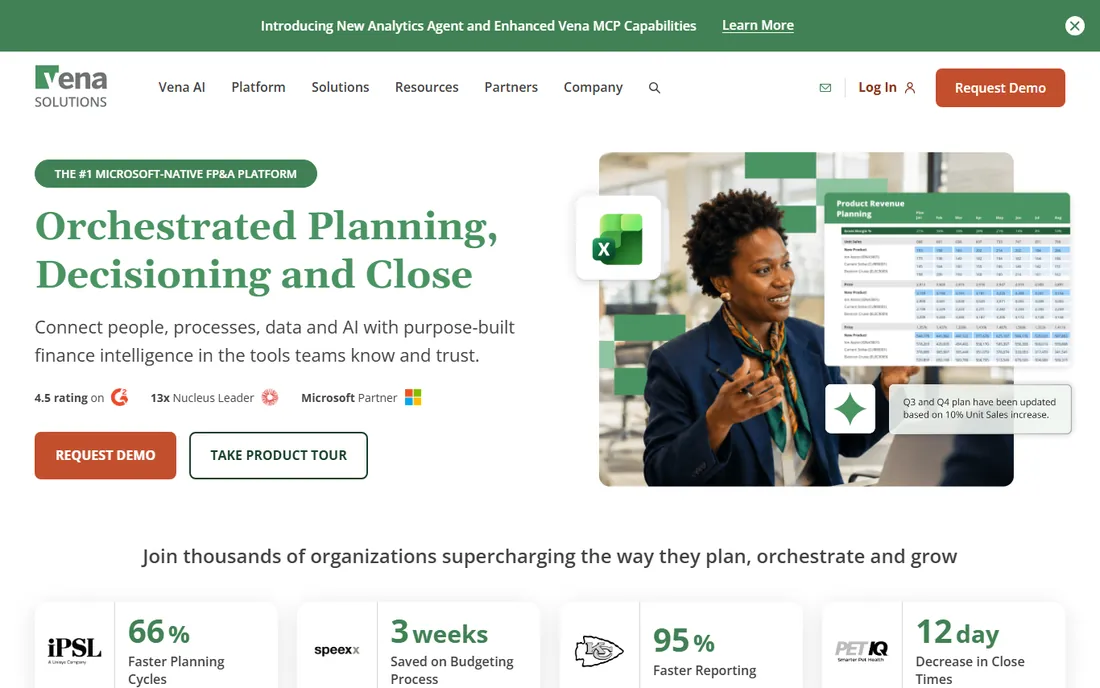
Vena's bet is simple: finance teams will never leave Excel, so put the database behind it instead of replacing it. Users build budgets in real Excel workbooks while Vena's central database stores the numbers, manages versions and runs approval workflows. The Microsoft alignment runs deep, with Power BI dashboards, Teams integration and AI agents that work across the data. Vena also covers adjacent processes like financial close and reporting, so it can grow beyond budgeting.
The tradeoff is the Microsoft dependency. Vena is explicit that it does not support Google Sheets, so mixed or Google-based shops should look elsewhere. Pricing runs through sales with two named tiers, Professional and Complete, but no published numbers. For a finance team that plans in Excel and reports in PowerPoint, the learning curve is close to zero, which is exactly the point.
What we like- Native Excel interface, so finance users keep the tool they know while a central database handles governance
- Deep Microsoft ecosystem ties (Teams, Power BI, Copilot)
- Workflow, approvals and pre-built templates for budgeting and close
Watch out for- Excel-centric by design, so teams standardizing on Google Sheets get less value
- Pricing is quote-only with Professional and Complete plan tiers
#4
Datarails
Best for: Excel-centric finance teams that want automated consolidation without a long implementation
Visit datarails.com
Starting priceSee website (custom quote)
Free planNo
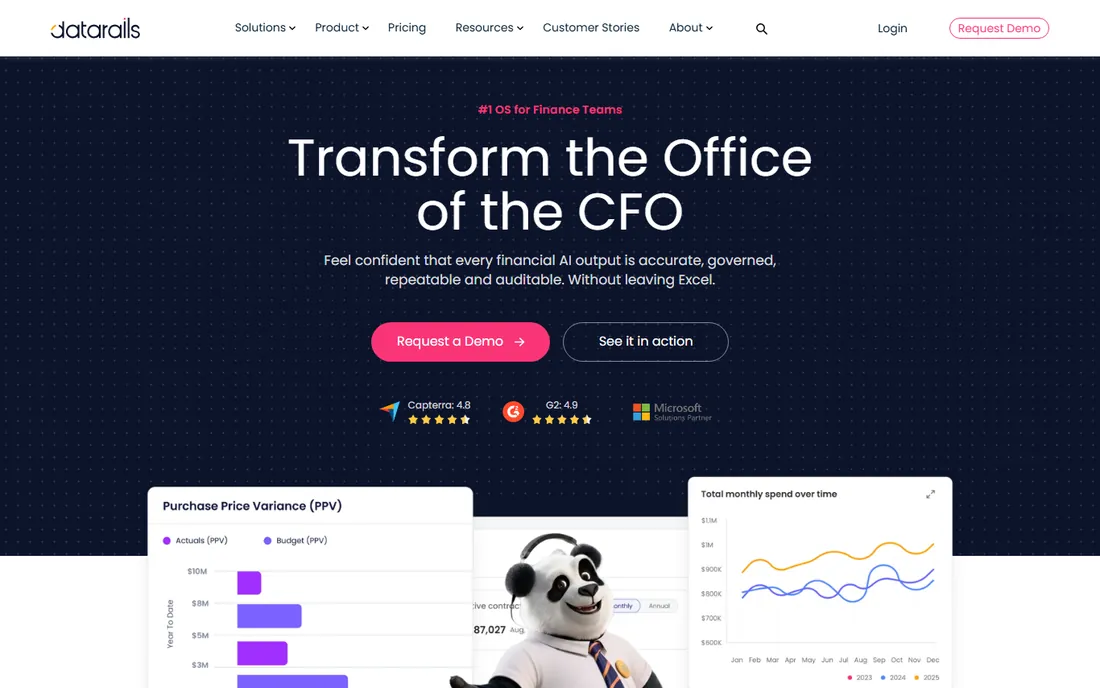
Datarails takes the same keep-Excel philosophy as Vena but aims it at faster time to value. The pitch is that finance teams keep their existing spreadsheets and models while Datarails automates the consolidation, reporting and forecasting around them, with version control and audit trails that spreadsheets lack. The company connects to hundreds of data sources and has leaned into AI, including an AI connector that feeds governed financial data to tools like Claude and ChatGPT. Datarails says implementation takes weeks, not months.
The honest catch is positioning. Datarails historically served the mid-market and is moving up, so very large enterprises with complex multi-dimensional models should validate fit carefully. Pricing is quote-only. If your team is drowning in manual consolidation and wants relief fast without retraining everyone, this is one of the shortest paths on the list.
What we like- Keeps your existing Excel models and connects them to a governed cloud database
- Connects to hundreds of ERPs, CRMs and HRIS systems for automated data pulls
- AI features for variance analysis and reporting assistance
Watch out for- The Excel-first design means teams that want a fully new modeling interface will find it familiar rather than fresh
- Pricing is custom and requires a sales conversation
#5
Cube
Best for: Finance teams that want to keep working in Excel and Google Sheets with a governed data layer
Visit cubesoftware.com
Starting priceSee website (custom quote)
Free planNo
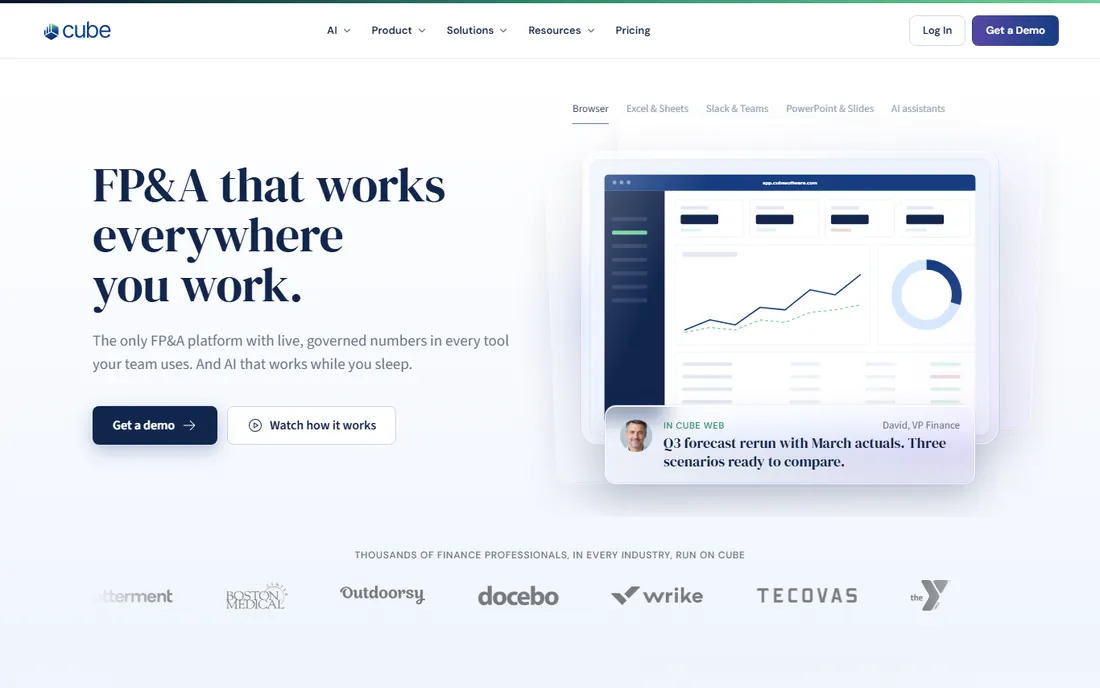
Cube is the spreadsheet purist's FP&A platform. Instead of asking finance to learn a new modeling language, it syncs a governed data layer into Excel and Google Sheets, where the team already works. Budgeting, forecasting, scenario planning and reporting all run through the spreadsheet interface, with the database handling consolidation, permissions and audit history. Supporting both Excel and Google Sheets matters: mixed shops that Vena cannot serve get a real option here.
The catch is maturity. Cube is younger and smaller than the enterprise incumbents, so buyers who need industry-specific pre-built models or a large consultant bench have fewer options. Pricing is custom-quoted. For mid-market finance teams that refuse to give up their spreadsheets, Cube's pitch is the most literal on this list: nothing about your workflow changes except the data gets trustworthy.
What we like- Works inside both Excel and Google Sheets through add-ins, a rare combination in this category
- Governed single source of truth with audit trails and permissions
- Fast go-live positioning aimed at mid-market teams
Watch out for- No published pricing
- As a younger vendor than Anaplan or Workday, the partner ecosystem and pre-built content library are smaller
#6
Pigment
Best for: Enterprises that want AI-driven planning across finance, sales, HR and supply chain
Visit pigment.com
Starting priceSee website (custom quote)
Free planNo
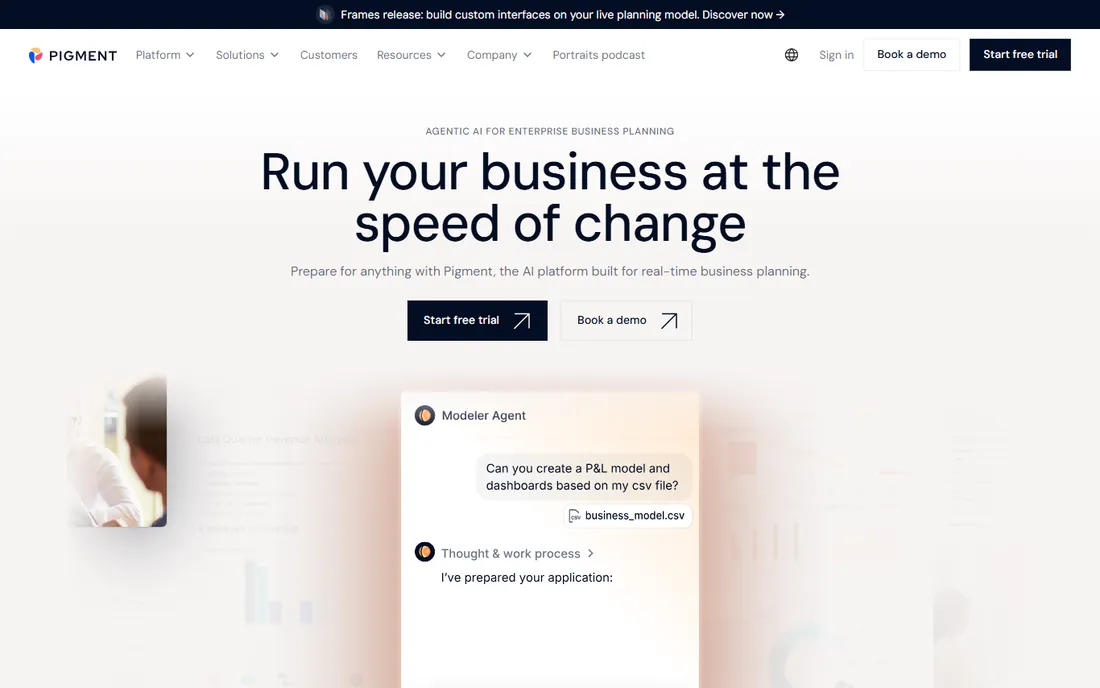
Pigment is the newest name on this list and the most aggressive on AI. It positions itself as a business planning platform rather than a finance-only tool: finance, sales, HR and supply chain build their plans in one place with shared data and logic. The interface is modern and visual, a deliberate contrast to the dense grids of legacy EPM tools. Integrations cover the systems enterprises actually run, from SAP and NetSuite to Snowflake and Salesforce, plus Excel and Google Sheets.
The catch is that newness cuts both ways. Pigment's modeling power and governance are proven at real enterprises, but buyers coming from Anaplan or Oracle will find a smaller library of industry templates and fewer specialized consultants. Pricing is entirely custom. If your planning process spans departments and your team will actually use AI-assisted modeling, Pigment deserves a demo slot.
What we like- Modern interface built for cross-functional planning, not just finance
- Agentic AI features that work inside the planning model
- Strong integrations with ERPs, data warehouses and HRIS systems
Watch out for- Premium positioning with quote-only pricing
- Younger than the legacy enterprise vendors, so long-tenured planning teams may find less pre-built industry content
#7
Planful
Best for: Companies that want budgeting, financial close and consolidation in one platform
Visit planful.com
Starting priceSee website (custom quote)
Free planNo
Planful, formerly Host Analytics, has been in this market longer than most names here. Its strength is breadth across the finance cycle: budgeting and forecasting plus financial consolidation, close management and reporting in one platform. For controllers, that matters: the same system that holds the budget also produces the actuals and the variance reports, which cuts reconciliation work. Planful emphasizes that finance teams can own the platform without heavy IT involvement.
The catch is that Planful's pace of interface innovation lags the newest entrants. Teams that want the newest AI modeling or the most modern user experience may find Pigment or Anaplan more exciting. Pricing is quote-only. For companies that want one vendor for planning through close, with a track record to point at, Planful is the steady choice.
What we like- Combines planning with close, consolidation and reporting, so the budget and the actuals live together
- Finance-owned platform designed to reduce IT dependency
- Long track record with mid-market and upper-mid-market companies
Watch out for- No published pricing and a sales-led process
- The interface and modeling depth feel more traditional next to Pigment or Anaplan's newest releases
#8
Prophix
Best for: Mid-market companies that want plan-to-close coverage with automation built in
Visit prophix.com
Starting priceSee website (custom quote)
Free planNo
Prophix targets the mid-market directly, and everything about the product reflects that: enough automation to run plan-to-close without a large team, but without the enterprise implementation project. The Prophix One platform covers budgeting and forecasting through consolidation, close and reporting, with AI agents that handle repetitive work like budget collection and account reconciliations. Like Vena and Datarails, it meets Excel users where they are instead of demanding a new interface on day one.
The catch is the ceiling. Prophix is honest about its mid-market focus, so a company planning a global multi-entity rollout with heavy dimensional modeling should test that limit early. Pricing is custom-quoted. For a growing company whose finance team is still small but whose spreadsheet process is breaking, Prophix hits the sweet spot between power and practicality.
What we like- Full plan-to-close scope (budgeting, forecasting, consolidation, close, reporting) aimed at mid-market complexity
- AI agents for budget collection and reconciliations
- Can keep Excel where it works and replace it where it does not
Watch out for- Quote-only pricing
- The mid-market focus means the largest enterprises may outgrow its modeling scale
How we chose
We started with the categories buyers actually search: enterprise budgeting software, FP&A software, budgeting and forecasting software, and corporate performance management. For each candidate we opened the vendor's own homepage and product pages, confirmed the product is live and fits enterprise budgeting (not personal budgeting or basic accounting), and checked public reviews on G2 and Capterra plus practitioner discussion on Reddit for recurring strengths and complaints. Prices and free plans come only from vendor pages: where a vendor publishes nothing, we wrote "See website" rather than repeating third-party estimates.
What drives the price of enterprise budgeting software
Nobody on this list publishes a price, and that is standard for the category. Expect a quote built from three parts: a platform fee, a per-user fee that varies by role (planners cost more than viewers), and implementation services. The platform fee is where vendors differ most: spreadsheet-native tools like Cube and Datarails tend to start lower because implementation is lighter, while Anaplan and Workday Adaptive Planning projects include significant configuration work.
Two line items surprise buyers. First, integrations: connecting your ERP, HRIS and CRM is sometimes scoped as a separate workstream with its own fee. Ask which connectors are included and which are custom. Second, the AI tier: several vendors now gate their AI agents and advanced analytics behind higher editions, so confirm whether the demo you saw matches the edition you are quoted.
The practical move is to get three quotes, not one. Pricing in this market is negotiated, and vendors discount for multi-year terms, for adding modules later, and for competitive situations. Ask every vendor for the same thing: total first-year cost including implementation, the renewal price in writing, and what happens to your data if you leave. The cheapest quote is rarely the cheapest three-year cost.
This market splits into two philosophies, and your choice between them matters more than any feature checklist. Excel-native tools (Vena, Datarails, Cube) keep the spreadsheet as the working interface and add a governed database behind it. Adoption is fast because nobody relearns anything; the risk is that complex models still carry spreadsheet habits like fragile formulas.
Model-native platforms (Anaplan, Pigment, Workday Adaptive Planning) ask users to work in the vendor's own modeling environment. The learning curve is steeper, but the models are more controlled: dimensions, calculations and permissions are first-class, not bolted on. These platforms also handle connected planning better, where a change in the sales plan automatically reshapes the workforce plan.
Planful and Prophix sit between the camps, offering their own interfaces while keeping Excel in the loop. The rule of thumb: if your planners are finance analysts who live in spreadsheets, start with the Excel-native camp. If planning spans departments and needs one connected model, start with the model-native camp. Most failed implementations we see in reviews come from buying the wrong camp, not the wrong vendor.
Frequently asked questions
How much does enterprise budgeting software cost?
Vendors do not publish prices, so every deal is quoted. Mid-market tools like Datarails, Cube and Prophix generally land in the tens of thousands per year; enterprise platforms like Anaplan and Workday Adaptive Planning run higher once implementation is included. Get the first-year total, the renewal price and the implementation fee in writing before comparing.
What is the difference between budgeting software and FP&A software?
Budgeting is one process inside FP&A. Every tool on this list does budgeting, but FP&A platforms also cover forecasting, scenario modeling, reporting, and often consolidation and close. If you only need an annual budget, a lighter tool works. If you forecast monthly and report variances to the board, buy the FP&A scope.
Can budgeting software replace Excel?
It replaces the emailed-spreadsheet process, not necessarily the spreadsheet itself. Vena, Datarails and Cube keep Excel as the interface with a database behind it. Anaplan, Pigment and Workday Adaptive Planning replace the workbook with their own modeling environment. Either way, version chaos and manual consolidation are what disappear.
How long does implementation take?
Spreadsheet-native tools like Datarails and Cube position for go-live in weeks. Enterprise platforms like Anaplan and Workday Adaptive Planning typically take months, especially with multi-entity or multi-department scope. The biggest driver is not the software but your data: clean chart of accounts and defined planning processes shorten every timeline.
Do these tools handle multi-entity consolidation?
Most do, but depth varies. Planful and Prophix bundle consolidation and close with planning, which suits companies that consolidate monthly. Anaplan and Pigment handle multi-entity modeling well but pair it with reporting rather than a full close process. If consolidation is your main pain, weight Planful and Prophix higher.
Should a mid-market company buy an enterprise platform?
Usually not as a first step. Enterprise platforms assume dedicated planning staff and transformation budgets. Mid-market teams get more value from Datarails, Cube or Prophix, which are built for smaller teams and faster rollouts. Move up to Anaplan or Workday Adaptive Planning when planning spans departments and the spreadsheet-native tools hit their modeling ceiling.
Sources we checked (8)
- https://www.anaplan.com
- https://www.adaptiveplanning.com
- https://venasolutions.com
- https://datarails.com
- https://www.cubesoftware.com
- https://pigment.com
- https://planful.com
- https://prophix.com
Is your product missing or out of date?
We review this list regularly. Vendors can request a listing, send updated pricing or ask about featured placement.

Shihab Mia · Founder, Rankite
Shihab has spent more than a decade helping SaaS and e-commerce brands grow through search. He writes Rankite's software buying guides from pricing pages, documentation and public user reviews. More about Shihab.