How we make this list: we compare pricing pages, product documentation and public user reviews. Rankite is independent; if a vendor ever pays for a featured spot, that listing is clearly labeled Partner.
Key takeaways
- The headline decision is scope: a finance-led platform (Sage Intacct) versus a full operational ERP (NetSuite, Dynamics 365, Acumatica).
- Enterprise vendors almost never publish pricing; expect custom quotes and six-figure annual deals, with Odoo the transparent exception.
- Multi-entity consolidation, intercompany transactions and dimensional reporting are the capabilities that separate this tier from QuickBooks.
- Implementation costs rival license costs, so the selection process matters more than the feature list.
Quick comparison
Is your product missing or out of date?
We review this list regularly. Vendors can request a listing, send updated pricing or ask about featured placement.
The best enterprise accounting software
Starting priceSee website
Free planNo
NetSuite is the most common answer to "enterprise accounting software" for a reason: it is a unified cloud ERP where financials, operations, inventory and CRM share one database. Multi-entity consolidation with local tax and reporting support across 190+ currencies makes it the default for international mid-market companies. You can start with accounting plus basic ERP and add modules as you grow.
The honest costs are money and effort. Pricing is custom quote, with typical annual deals running well into five or six figures, and implementation is a genuine project. The breadth that is the selling point can also overwhelm a midsize finance team. For the growing international company that needs one system for finance and operations, NetSuite remains the benchmark.
What we like- Financials, inventory, manufacturing and CRM on one database
- Strong multi-entity and multi-currency support
- 20+ years of implementation experience
Watch out for- Custom-quote pricing with significant annual cost
- The breadth can overwhelm midsize companies
- Implementation is a project, not a purchase

#2
Sage Intacct
Best for: Finance-led dimensional reporting
Visit sage.com
Starting priceSee website
Free planNo
Sage Intacct is the finance team's tool: a cloud-native financial management platform whose dimensional reporting lets CFOs slice results by entity, department, project or custom dimensions without a rigid chart of accounts. Services and SaaS companies choose it for revenue recognition, project accounting and fast multi-entity consolidation, and finance-only implementations move faster than full ERP rollouts.
It is not an operational ERP: inventory, manufacturing and warehousing are thinner than NetSuite's, and pricing is custom quote. For the finance-led organization whose hardest problem is reporting and close speed rather than warehouse operations, Intacct is the sharper instrument.
What we like- Dimensional chart of accounts for flexible reporting
- Faster implementation for finance-only deployments
- Strong for services and SaaS companies
Watch out for- Custom-quote pricing
- Weaker on operations than full ERPs
- Inventory-heavy businesses need companion systems

#3
Microsoft Dynamics 365 Finance
Best for: AI-driven finance in the Microsoft ecosystem
Visit microsoft.com
Starting priceSee website
Free planNo
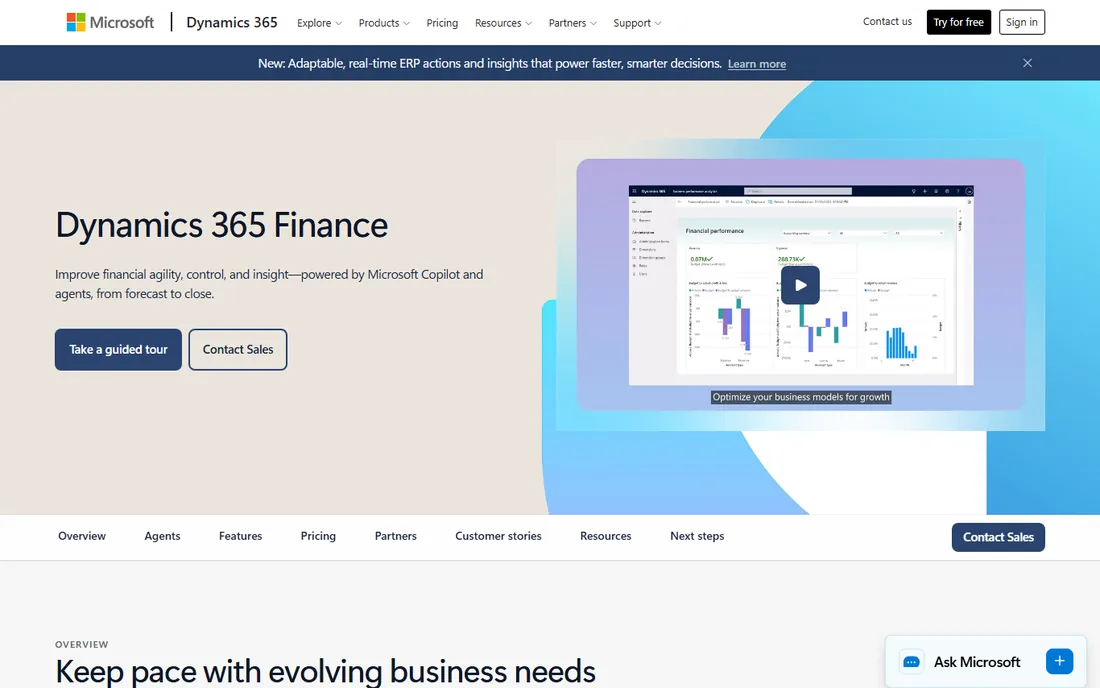
Dynamics 365 Finance brings AI-driven automation to the financial close: forecasting, anomaly detection and close management, surfaced through the Microsoft tools finance teams already use. Integration with Teams, Outlook and Power BI is native rather than integrated, and the per-user licensing model is familiar to Microsoft shops.
The evaluation caveat is pricing transparency: per-user figures circulate but the vendor's public pricing page did not yield a verifiable number, so get the quote. And the value compounds inside the Microsoft ecosystem; outside it, the integration advantage fades. For the Microsoft-centric enterprise, it is the natural finance platform.
What we like- AI-powered forecasting and financial close
- Native integration with Teams, Outlook and Power BI
- Per-user pricing model
Watch out for- Pricing not verifiable on the public pricing page
- Enterprise-grade complexity
- Best value inside the Microsoft stack
Starting priceSee website
Free planNo
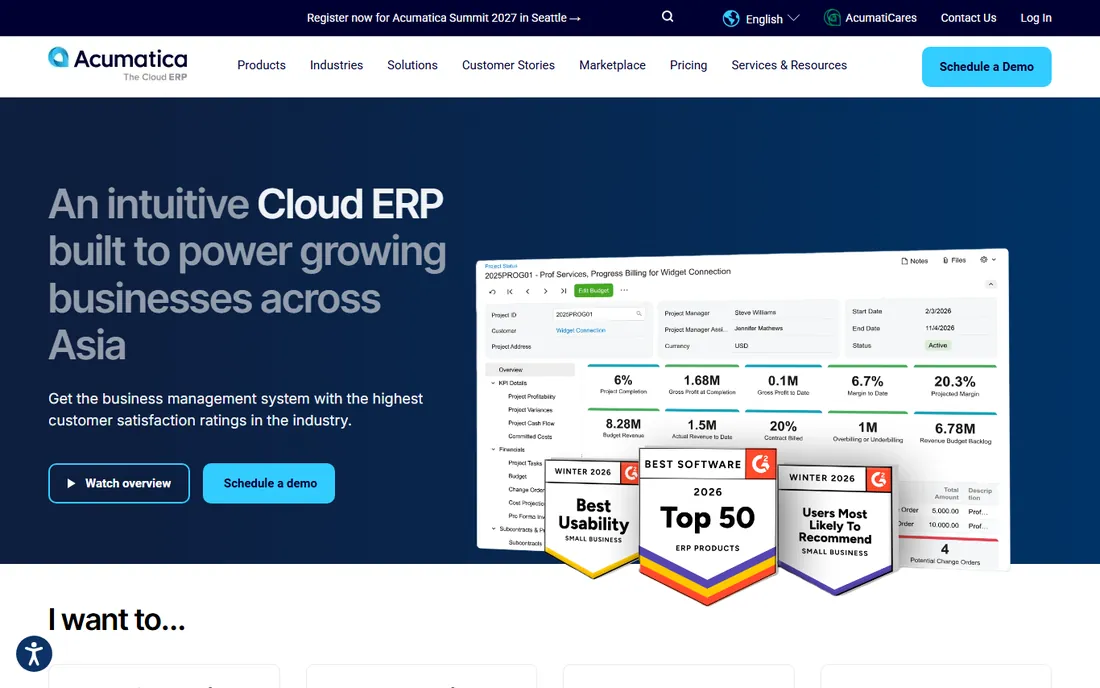
Acumatica's differentiator is structural: it prices on computing resources consumed rather than named users, so the warehouse team, the office and the accountants can all log in without per-seat math. For distribution and manufacturing companies with many light users, the model is genuinely cheaper than per-user rivals.
Pricing is quote-based, and the partner-led implementation model means your experience depends on the partner. For the mid-market manufacturer or distributor that wants real ERP without per-user licensing, Acumatica is the alternative to evaluate alongside NetSuite.
What we like- Resource-based pricing, not per-user licensing
- Strong for distribution and manufacturing
- Cloud or hybrid deployment
Watch out for- No published pricing
- Implementation partner quality varies
- Smaller ecosystem than NetSuite

#5
SAP Business One
Best for: Small-enterprise operations
Visit sap.com
Starting priceSee website
Free planNo
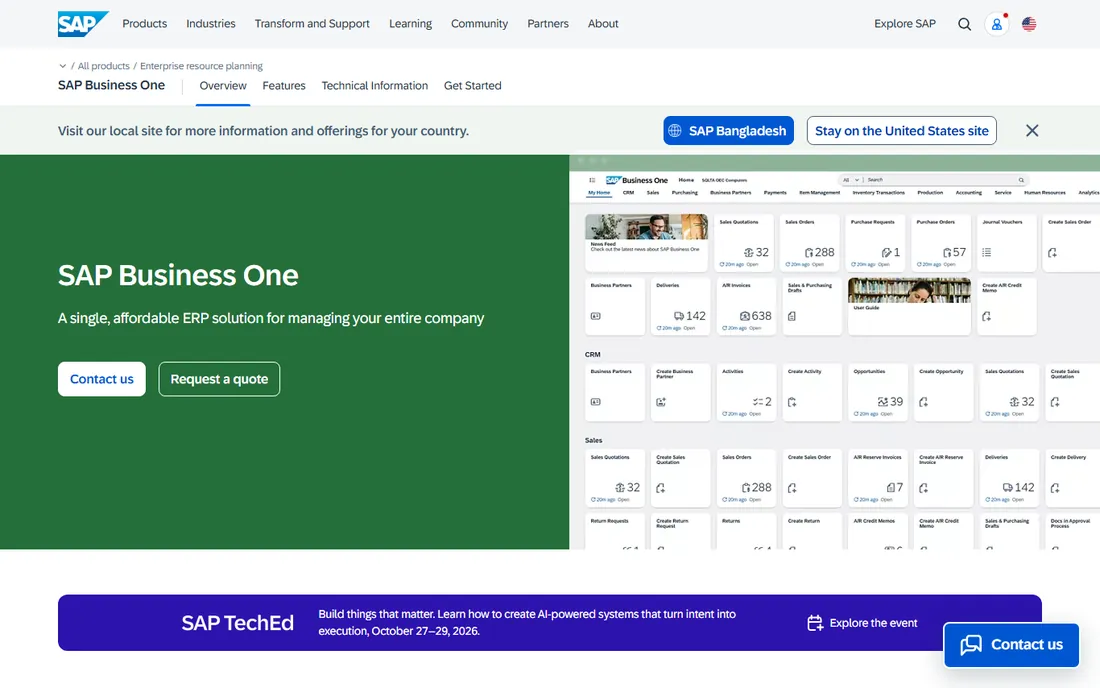
SAP Business One is SAP's answer for smaller enterprises: accounting, inventory, manufacturing and CRM in one system, deployable in the cloud or on premise. For the growing manufacturer that wants the SAP badge and native production management, it delivers real ERP depth.
Multi-entity and subsidiary support is more limited than its bigger SAP siblings, and pricing is quote-based through partners. For the small enterprise with manufacturing operations and growth ambitions, Business One is the SAP-shaped option.
What we like- Full ERP for smaller enterprises with native manufacturing
- SAP ecosystem credibility
- Cloud or on-premise deployment
Watch out for- No published pricing
- Multi-subsidiary support is limited
- The SAP name brings enterprise sales complexity

#6
SAP Business ByDesign
Best for: Mid-market subsidiaries of large groups
Visit sap.com
Starting priceSee website
Free planNo
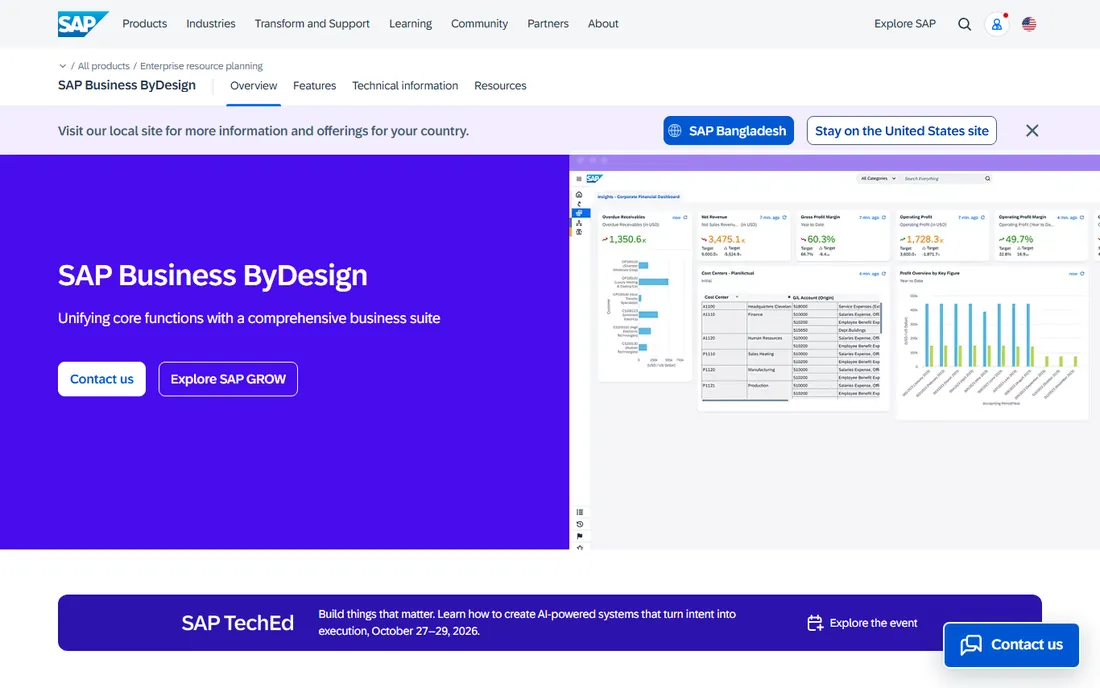
Business ByDesign is SAP's cloud suite for the mid-market, strongest in its natural habitat: subsidiaries of large groups that need to standardize on SAP with proper multi-entity consolidation. The financials are comprehensive, and the suite covers the operational side too.
For a standalone company with no SAP mandate, the suite pricing and implementation weight are worth comparing against NetSuite and Acumatica. For the subsidiary that needs to roll up to a group SAP environment, ByDesign is built for exactly that.
What we like- Full-suite cloud ERP with strong multi-entity
- Suited to subsidiaries standardizing on SAP
- Comprehensive financials
Watch out for- No published pricing
- Suite pricing can be heavy for standalone companies
- Implementation is substantial
Starting priceSee website
Free planNo
QuickBooks Enterprise is the bridge product: the QuickBooks interface your team knows, scaled up with advanced reporting, inventory management and multi-user support. For the business that has outgrown QuickBooks Pro or Online but is not ready for NetSuite's price tag, it is the natural next step and the cheapest entry to this list.
The ceiling is real: no true multi-entity consolidation, limited global capability, and desktop architecture under the hood. Pricing is not published in a verifiable figure on the vendor's site. For the growing domestic business hitting QuickBooks limits, Enterprise buys years of headroom.
What we like- Familiar QuickBooks interface with advanced reporting
- Built-in inventory and multi-user support
- The lowest-cost entry to this tier
Watch out for- Pricing not verifiable on the vendor's public page
- No true multi-entity consolidation
- Desktop roots show

#8
Odoo
Best for: Budget-conscious ERP with published pricing
Visit odoo.com
Starting price$31.10 per user/month (Standard, billed annually)
Free planYes
Odoo is the transparency outlier in a quote-only category. Standard plans run $31.10 per user per month billed annually for all apps, and the One App Free plan gives unlimited users a single app at no cost. The app suite covers accounting, inventory, CRM, manufacturing and more, all integrated.
The honest note: low license cost does not mean low total cost. Implementation, customization and data migration still take effort, and individual app depth varies. For the budget-conscious company that wants real ERP with a published price, Odoo is the only honest quote on this page.
What we like- Published pricing from $31.10 a user a month
- One App Free plan with unlimited users
- All apps including accounting, inventory and CRM
Watch out for- Implementation still needs effort or partners
- The app breadth means uneven depth
- Enterprise features trail the big suites

#9
Workday Financial Management
Best for: Large-enterprise finance plus HR
Visit workday.com
Starting priceSee website
Free planNo
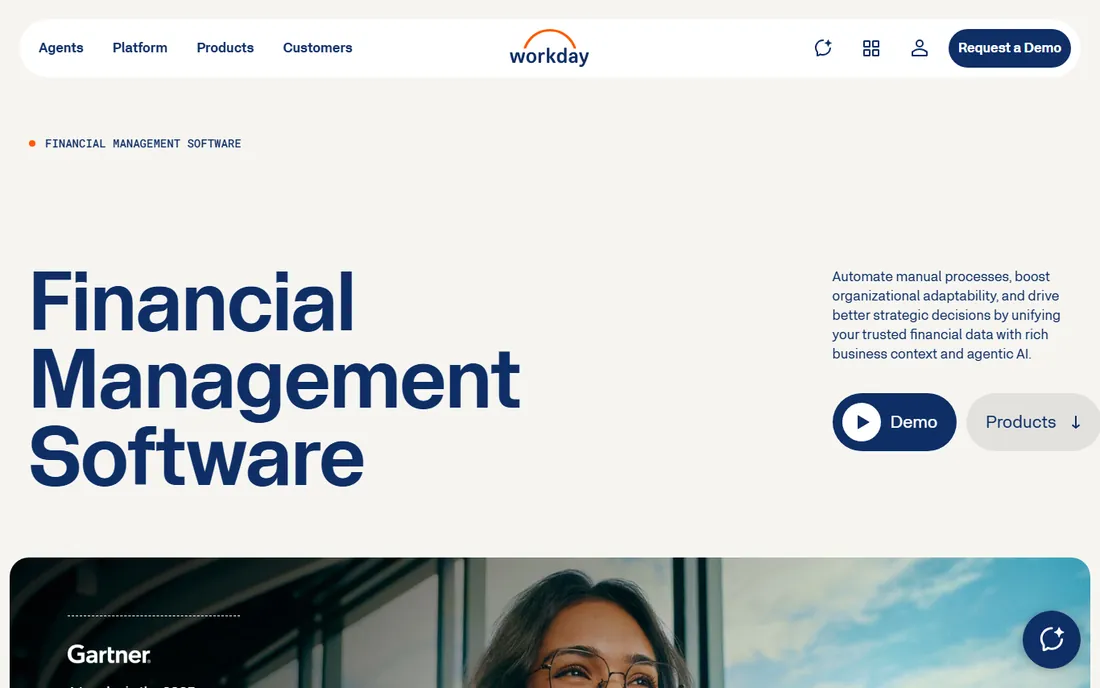
Workday Financial Management serves the large enterprise where finance, HR and workforce planning belong in one model: management consultancies, IT services firms and other headcount-driven organizations. Consolidation, planning and compliance are built for scale, and the unified data model is the point.
Everything about it is enterprise-grade, including the pricing and the implementation program. Below large-enterprise scale it is overkill; above it, the finance-plus-HCM combination is the reason to choose it. For the large services firm, Workday is the platform to evaluate.
What we like- Finance and HR in one model for headcount-driven firms
- Strong for planning, consolidation and compliance
- Built for large enterprises
Watch out for- Enterprise pricing with no published figures
- Overkill below large-enterprise scale
- Implementation is a major program
How we chose
We selected financial management platforms with genuine enterprise adoption in 2026, verified each product exists today, and used only vendor-published pricing, captured in October 2026. This category is overwhelmingly quote-based, so most listings say so; Odoo is the only vendor with a published, verifiable price. We weighted multi-entity capability, reporting depth and real deployment fit over feature counts.
Finance-led vs operations-led: the real choice
The category splits on one question: is this a finance system or an operations system with finance in it? Sage Intacct and Workday are finance-led: reporting, consolidation, close speed, planning. NetSuite, Dynamics 365, Acumatica and the SAP products are operations-led: the ledger is one module among inventory, manufacturing and supply chain.
Choose by your hardest problem. If month-end close, multi-entity reporting and revenue recognition dominate, buy finance-led. If inventory accuracy, order fulfillment and production costing dominate, buy operations-led. Buying an operational ERP for a reporting problem, or a finance platform for a warehouse problem, is the expensive version of this decision.
Why nobody publishes pricing
Enterprise software pricing is quote-based because the price is genuinely variable: user counts, modules, entities, implementation scope and negotiation all move it. A published number would be wrong for most buyers. Expect the license quote to be roughly matched by implementation costs in year one, and always get competing quotes: list prices in this tier are starting positions, not prices.
The practical move is a structured selection process: document requirements, run scripted demos against your actual scenarios (a multi-entity close, an intercompany elimination, your nastiest reporting ask), and check references in your industry. The demo that uses your data beats the demo that uses theirs.
Frequently asked questions
How much does enterprise accounting software cost?
Almost every vendor quotes custom pricing. Indicative annual ranges run from around $15,000 for mid-market platforms to $100,000+ for NetSuite-class deployments, plus comparable implementation costs. Odoo publishes pricing from $31.10 per user per month. Get multiple quotes; nobody pays list.
What is the difference between ERP and accounting software?
Accounting software handles the ledger: GL, AP, AR, reporting. ERP adds operations: inventory, manufacturing, supply chain, often CRM and HR, on the same database. Enterprise accounting software usually means ERP financials or a finance platform like Intacct that sits above operational systems.
Do we need multi-entity support?
If you operate more than one legal entity, yes, and it is non-negotiable. Multi-entity support means intercompany transactions, eliminations and consolidated reporting handled natively. QuickBooks-class tools cannot do this; every product on this list except QuickBooks Enterprise handles it to some degree.
How long does implementation take?
Finance-only deployments (Intacct-style) can go live in a few months. Full ERP implementations (NetSuite, SAP) typically take six to eighteen months depending on scope, data migration and customization. Budget the internal team's time, not just the consultant's invoice.
Can we migrate from QuickBooks?
Yes, and it is the most common migration in this tier. Plan for chart-of-accounts redesign, historical data decisions (how much history to migrate), and retraining. Most vendors and partners have QuickBooks migration playbooks; ask for the reference customers who did it.
Is cloud or on-premise better for enterprise accounting?
Cloud is the default in 2026 for everything except specific regulatory or latency requirements. The vendors on this list are cloud-first (SAP Business One retains an on-premise option). Cloud shifts upgrade and infrastructure burden to the vendor, which is usually the right trade at enterprise scale.
Sources we checked (9)
- https://www.netsuite.com/
- https://www.sage.com/en-us/sage-business-cloud/intacct/
- https://www.microsoft.com/en-us/dynamics-365/products/finance
- https://www.acumatica.com/
- https://www.sap.com/products/erp/business-one.html
- https://www.sap.com/products/erp/business-bydesign.html
- https://quickbooks.intuit.com/desktop/enterprise/
- https://www.odoo.com/pricing
- https://www.workday.com/en-us/products/financial-management.html
Is your product missing or out of date?
We review this list regularly. Vendors can request a listing, send updated pricing or ask about featured placement.

Shihab Mia · Founder, Rankite
Shihab has spent more than a decade helping SaaS and e-commerce brands grow through search. He writes Rankite's software buying guides from pricing pages, documentation and public user reviews. More about Shihab.
 Oracle NetSuite ERP
 Acumatica
 QuickBooks Enterprise